Buying Databases for Marketing in 2026: What Really Works
Thinking about buying databases for marketing? Here's what bought lists actually cost you in deliverability, compliance, and ROI — and the smarter alternative.
Buying Databases for Marketing in 2026: What Really Works
Buying a ready-made contact database feels like the shortcut every marketer wants: pay once, get 50,000 emails, start sending tomorrow. The problem is that the shortcut usually leads off a cliff. Bought lists are stale, shared across dozens of buyers, riddled with spam traps, and increasingly illegal to email under modern consent law.
This guide breaks down what you're actually buying when you buy a marketing database, what it costs you downstream, and why building a targeted list on demand beats buying a static one almost every time.
TL;DR#
- Buying databases for marketing trades short-term speed for long-term damage — bought lists are old, non-consented, and shared with every other buyer.
- The real cost isn't the purchase price — it's burned sender reputation, blacklisted domains, and GDPR/CAN-SPAM exposure.
- Most "millions of contacts" databases have 20–40% decay per year, so a list is partly dead before you load it.
- Building data on demand with a verified email finder gives you fresher, consented, targeted contacts at a lower true cost.
- If you must buy, verify every record before sending and warm up your domain — never blast a cold purchased list.
What does "buying a database for marketing" actually mean?#
When a vendor sells you a marketing database, you're buying a static CSV or a feed: rows of names, job titles, company names, emails, and sometimes phone numbers, scraped or aggregated from public sources, old web forms, and resold partner data. You pay a flat fee or a per-record price, and the file is yours.
The pitch is volume. "10 million B2B contacts." "Verified decision-makers in your niche." What the pitch hides is that the same file has often been sold to hundreds of other buyers, the data was collected months or years ago, and nobody on the list agreed to hear from you.
There are roughly three things sold under the "database" label:
- Static prospect lists — a one-time CSV dump, priced per record or per package.
- Database subscriptions — ongoing access to a searchable contact pool (Apollo, ZoomInfo, Lusha-style platforms).
- On-demand data tools — you search for the exact people you need and pull verified contacts in real time, paying only for what you use.
The first is what most people mean by "buying a database," and it's the riskiest. The third is where modern marketers are moving, and it's where a tool like the Tomba Email Finder fits.

Wait — that's the meme slot. Here it is properly:
Why is buying marketing databases so risky?#
The conclusion first: a purchased list can wreck the email infrastructure you spend years building, and the damage outlives any sale you close from it.
Here's what goes wrong, in order of how much it hurts:
- Spam traps. Old databases are full of recycled and pristine spam-trap addresses. Hit a few and mailbox providers flag your domain as a spammer. Recovering sender reputation takes weeks or months.
- High bounce rates. With 20–40% annual data decay, a year-old list bounces hard. Gmail and Outlook treat >2–3% bounce rates as a red flag and start routing you to spam.
- No consent. Under GDPR, a bought list almost never carries lawful consent. CAN-SPAM is laxer in the US but still requires accurate headers and easy opt-out — and bought lists rarely track suppression properly.
- Shared data. The same contacts get the same pitches from everyone who bought the file. Your "fresh" outreach lands in an inbox already sick of cold email.
- Brand damage. People remember who spammed them. A bought-list blast can torch trust you can't rebuild with a discount code.
Mailbox providers in 2026 weigh engagement more heavily than ever. A list that nobody opted into produces low opens, high complaints, and a fast slide into the spam folder — which then drags down deliverability for the customers who did opt in.
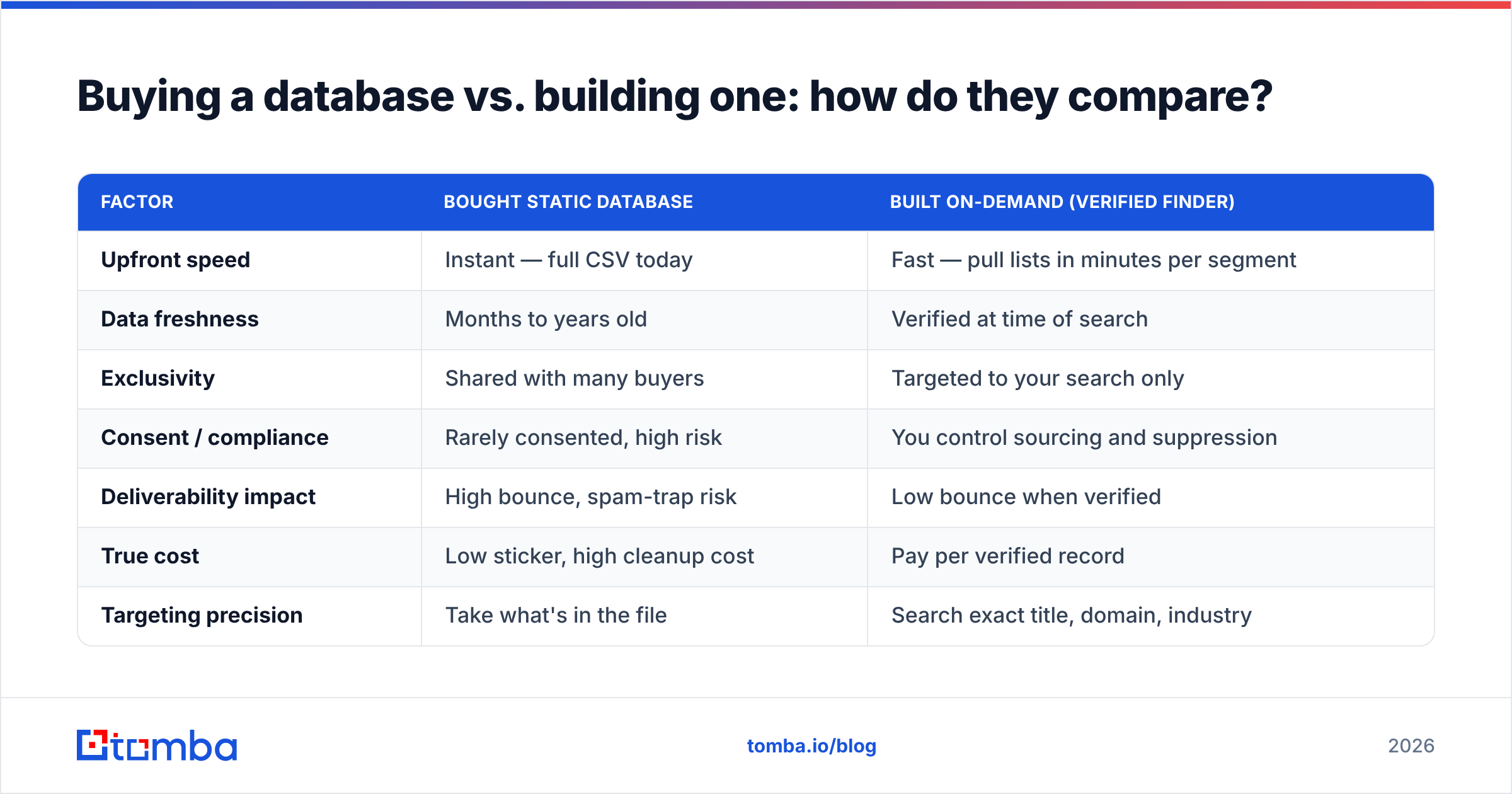
Buying a database vs. building one: how do they compare?#
The honest comparison isn't "buy = bad, build = good" across every axis. Buying wins on raw upfront speed. It loses on almost everything that determines whether your campaign actually makes money.
| Factor | Bought static database | Built on-demand (verified finder) |
|---|---|---|
| Upfront speed | Instant — full CSV today | Fast — pull lists in minutes per segment |
| Data freshness | Months to years old | Verified at time of search |
| Exclusivity | Shared with many buyers | Targeted to your search only |
| Consent / compliance | Rarely consented, high risk | You control sourcing and suppression |
| Deliverability impact | High bounce, spam-trap risk | Low bounce when verified |
| True cost | Low sticker, high cleanup cost | Pay per verified record |
| Targeting precision | Take what's in the file | Search exact title, domain, industry |
Notice the pattern: buying optimizes the one metric (speed-to-volume) that matters least for ROI, and sacrifices the metrics (freshness, consent, deliverability) that decide whether anyone reads your message.
What does a bought database really cost you?#
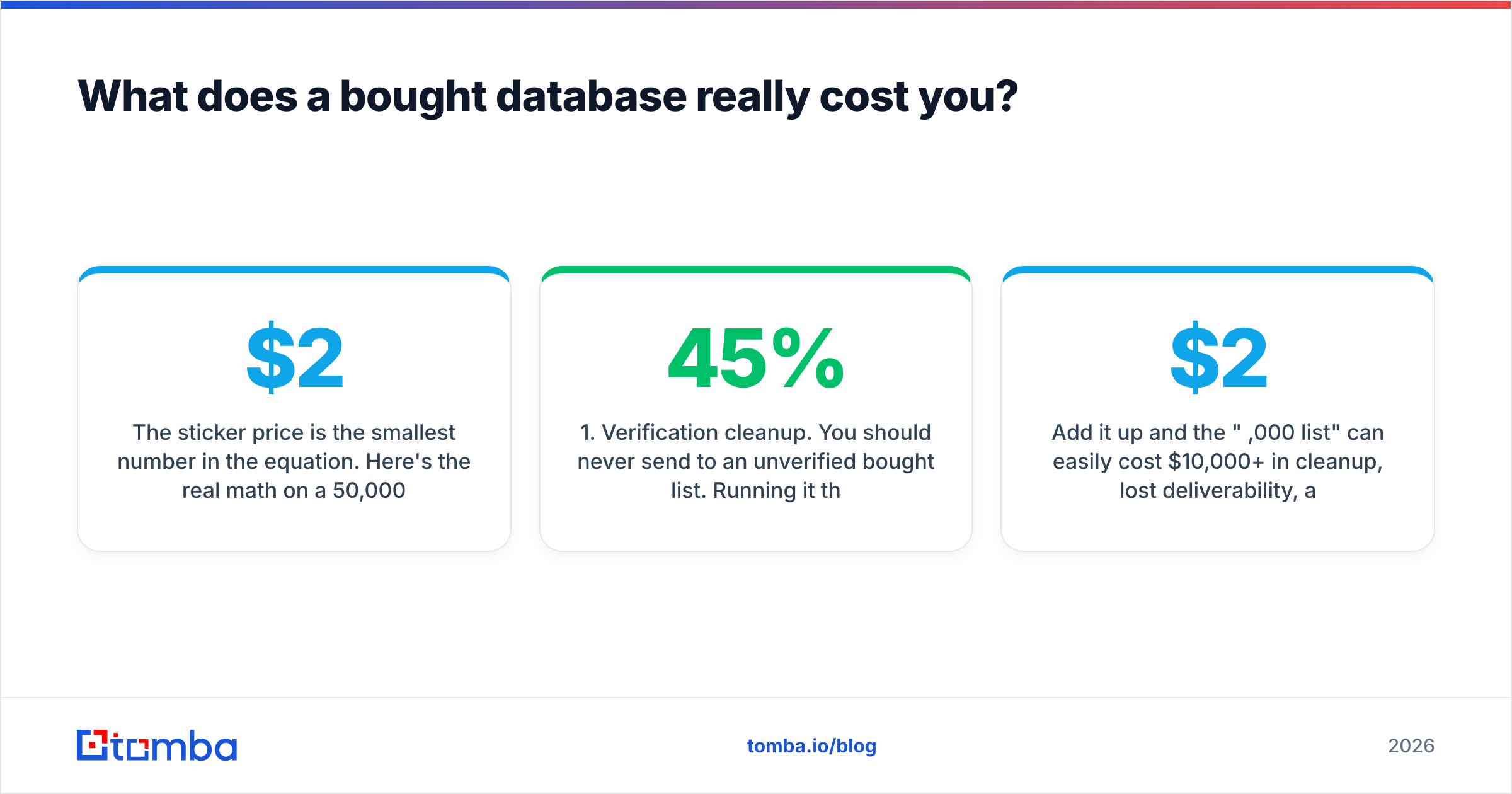
The sticker price is the smallest number in the equation. Here's the real math on a 50,000-record list bought for, say, $2,000.
- Verification cleanup. You should never send to an unverified bought list. Running it through an email verifier typically removes 25–45% as invalid, risky, or catch-all. You paid for 50,000 and can safely use maybe 28,000.
- Deliverability recovery. If even part of the list trips spam traps, you're looking at domain warm-up, possible IP changes, and lost sends to your real customers while you recover. That cost is measured in weeks of pipeline, not dollars on an invoice.
- Compliance exposure. A single GDPR complaint can trigger an investigation. Fines aside, the legal and remediation time dwarfs the list price.
- Opportunity cost. Low response rates from a tired, shared list mean your team wastes hours chasing dead contacts instead of warm ones.
Add it up and the "$2,000 list" can easily cost $10,000+ in cleanup, lost deliverability, and wasted rep time — to reach 28,000 people who never asked to hear from you.
Is it ever okay to buy a marketing database?#
Yes, with guardrails — and even then, treat it as raw material, not a campaign-ready asset.
If you buy, do all of the following before a single send:
- Verify every record. Run the entire file through verification and drop invalid, role-based, and risky addresses. A catch-all verifier helps you judge the ambiguous catch-all domains that bounce unpredictably.
- Suppress aggressively. Remove anyone already in your CRM, anyone who previously unsubscribed, and obvious spam-trap patterns.
- Warm the domain. Don't send 50,000 cold emails from a fresh domain. Ramp volume gradually and watch your reputation signals. A warmup calculator helps you plan the ramp.
- Segment and personalize. Send small, relevant batches with a clear opt-out, not one giant blast.
- Honor consent law. Confirm you have a lawful basis for each region you're emailing, and make opt-out one click.
If that sounds like more work than building a targeted list from scratch — it often is. Which is the whole point.
What's the better alternative to buying a database?#
Build your list on demand from verified, current data instead of renting someone else's stale file. Conclusion first: on-demand data is fresher, exclusive to you, easier to keep compliant, and usually cheaper once you count the cleanup you skip.
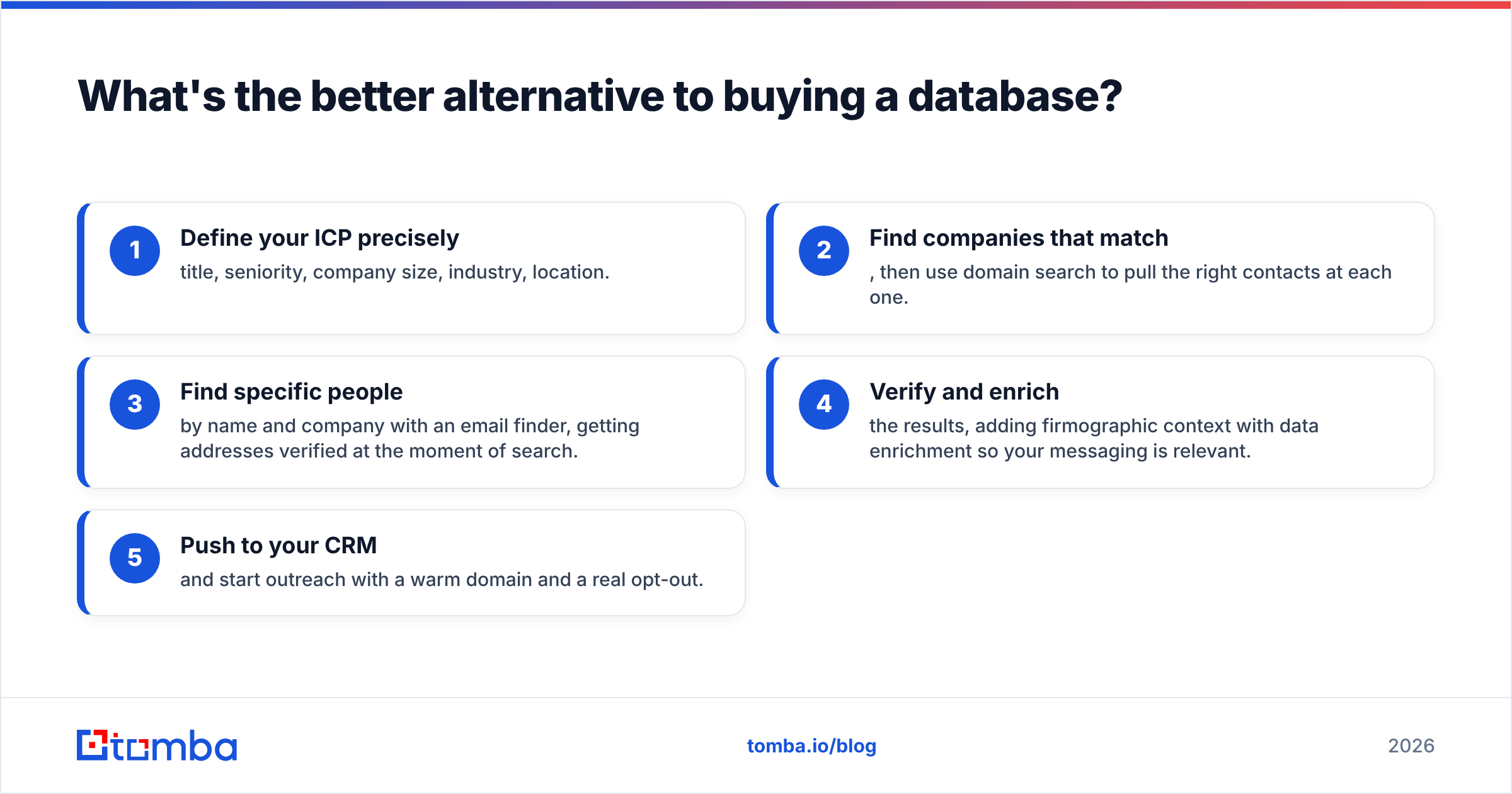
The modern workflow looks like this:
- Define your ICP precisely — title, seniority, company size, industry, location.
- Find companies that match, then use domain search to pull the right contacts at each one.
- Find specific people by name and company with an email finder, getting addresses verified at the moment of search.
- Verify and enrich the results, adding firmographic context with data enrichment so your messaging is relevant.
- Push to your CRM and start outreach with a warm domain and a real opt-out.
This is the difference between buying a fish market's day-old catch and fishing exactly where the fish are biting today. You get fewer records, but nearly all of them are real, reachable, and yours alone.
Reputable B2B data providers and review platforms like G2 and Capterra increasingly rank tools on verification accuracy and data freshness rather than raw database size — a signal that the market has caught on to the cost of stale, bought lists. Even HubSpot's own guidance (hubspot.com) is blunt: don't buy email lists.
How do you keep a marketing list healthy over time?#
Buying or building, your data starts decaying the moment you get it. People change jobs, companies fold, domains lapse. A healthy list is a maintained one.
Build these habits:
- Re-verify quarterly. Run your active list through verification on a schedule and drop newly-invalid addresses before they bounce.
- Track engagement. Sunset contacts who never open after a defined window. Low-engagement records hurt your reputation even when the address is valid.
- Enrich continuously. Job changes are sales signals. Keep firmographic and role data current so your segments stay accurate.
- Suppress relentlessly. Maintain one source of truth for unsubscribes and bounces across every tool you use.
- Watch your sender signals. Monitor email deliverability, complaint rates, and authentication so problems surface before they spread.
A 10,000-contact list you maintain will out-earn a 100,000-contact list you bought and forgot — every quarter, without exception.
Frequently asked questions#
Is buying email databases for marketing legal? It depends on jurisdiction. In the EU and UK, GDPR generally requires consent or a narrowly-applicable legitimate interest, and bought lists rarely meet that bar. In the US, CAN-SPAM permits cold B2B email but still requires accurate headers, a valid physical address, and a working opt-out. Legal in some regions does not mean effective everywhere.
Why do bought lists hurt deliverability so much? Because they contain spam traps and dead addresses. High bounces and spam-trap hits tell mailbox providers your domain behaves like a spammer, and they start filtering all your mail — including to people who opted in.
How accurate are purchased marketing databases? Expect significant decay. Industry data shows B2B contact data degrades roughly 20–40% per year, so a list assembled even a year ago will have a meaningful chunk of invalid records before you load it.
What's cheaper, buying or building? On sticker price, buying. On true cost, building usually wins once you factor in verification cleanup, deliverability recovery, and the higher response rate of fresh, targeted, exclusive data.
Can I just verify a bought list and be safe? Verification removes invalid and risky addresses and is mandatory if you insist on using a bought file — but it can't create consent, can't make the data exclusive to you, and can't undo the fact that recipients never asked to hear from you.
The bottom line#
Buying databases for marketing optimizes the wrong number. You get volume today and pay for it in deliverability, compliance, and wasted effort for months. The marketers winning in 2026 build smaller, fresher, exclusive lists from verified data — and maintain them like the asset they are.
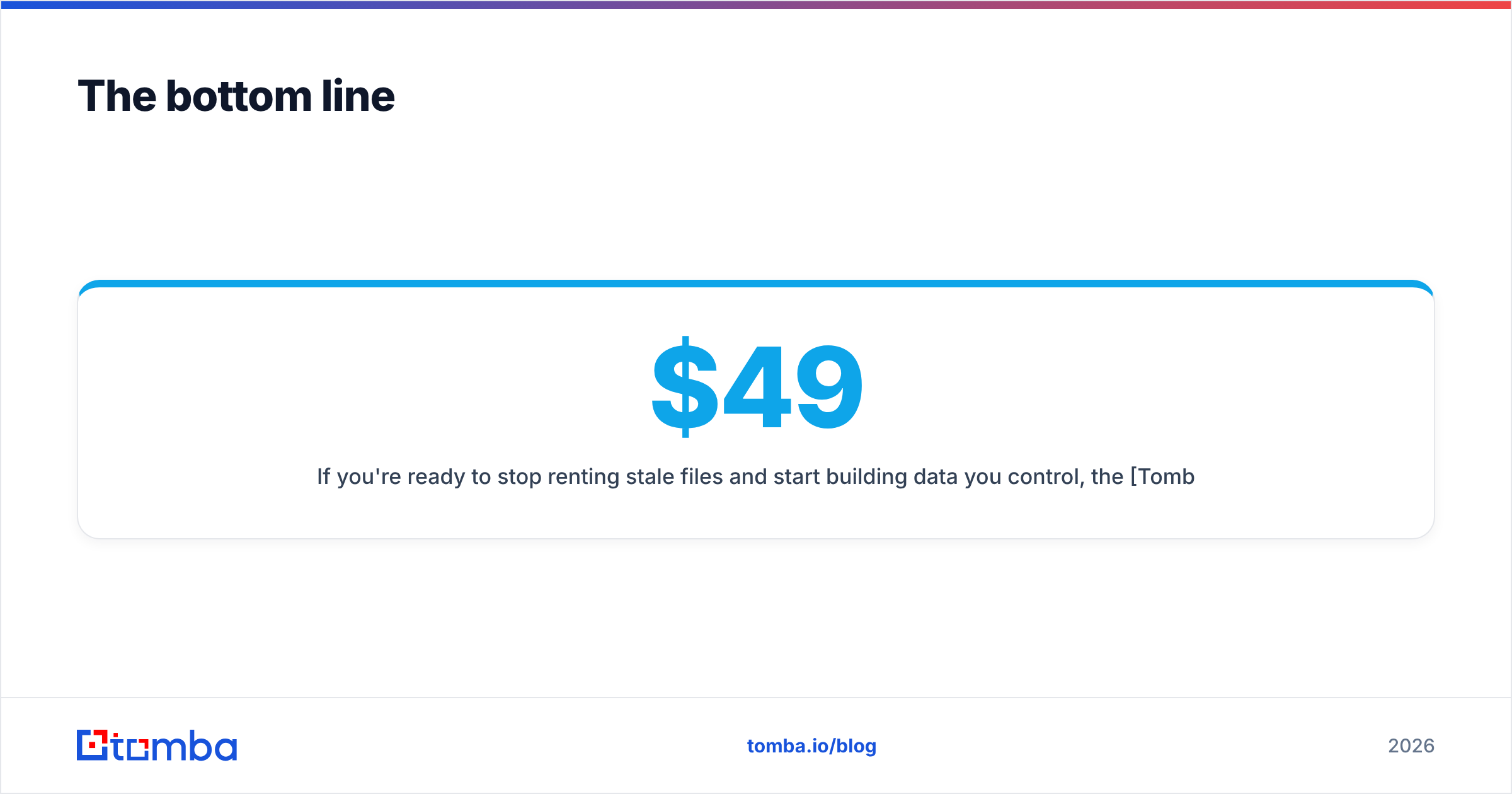
If you're ready to stop renting stale files and start building data you control, the Tomba Email Finder lets you find verified professional emails by name, company, or domain — exclusive to your search, verified at the moment you pull them. Start on the free tier (25 searches a month), and when you're ready to scale, Tomba pricing runs from $49/mo Starter to $99/mo Growth and $249/mo Pro. Build the list. Don't buy the liability.
Ready to find emails that actually work?
Join 150,000+ professionals who stopped guessing and started sending. Free credits on signup — no credit card required.
Get the Tomba newsletter
Practical outbound tactics and product updates — once every two weeks.
About the author