Byteplant vs Apollo.io (2026): Which Data Tool Wins?
Byteplant validates email lists; Apollo.io builds and works them. Here's an honest 2026 breakdown of pricing, accuracy, and which one your pipeline actually needs.
Byteplant vs Apollo.io: Which One Belongs in Your Stack in 2026?
You are comparing two tools that barely play the same sport. Byteplant is an email-validation specialist that tells you whether the addresses you already have are safe to send to. Apollo.io is a sprawling sales-intelligence platform that finds prospects, stores their contact data, and runs your outreach sequences. Picking between them is less "which is better" and more "which problem am I solving this quarter?"
This breakdown cuts through the marketing and shows you exactly where each tool earns its price — and where a leaner, cheaper option covers most of the same ground.
TL;DR#
- Byteplant = email and address verification. Buy it if you have a list and need to clean it before sending.
- Apollo.io = a B2B database plus prospecting and sequencing. Buy it if you need to find people, not just validate them.
- They are not direct competitors; many teams run a finder, then a verifier, then a sequencer — three jobs, not one tool.
- Pricing gap is large. Byteplant charges per verification credit; Apollo charges per seat with usage caps that bite fast.
- If your real need is accurate email finding plus verification without seat fees, a focused tool like Tomba covers both jobs at a lower entry price.
What Does Byteplant Actually Do?#
Byteplant is a data-quality company. Its flagship products — Email Validator, Phone Validator, and Address Validator — exist to scrub the lists you already own. Think of it like a water filter: it does not bring you water, it makes the water you have safe to drink.
The Email Validator runs syntax checks, MX-record lookups, SMTP probes, and disposable-domain detection, then returns a deliverability verdict per address. It is genuinely good at this narrow job, and it is built for high-volume, compliance-conscious senders who care about bounce rates and sender reputation.
What Byteplant does not do is generate new contacts. There is no prospecting database, no "find the marketing director at Acme Corp" search, and no sequencing engine. If your CRM is empty, Byteplant has nothing to validate.

What Does Apollo.io Actually Do?#
Apollo.io sits at the opposite end of the workflow. It is a full go-to-market platform built around a contact database of hundreds of millions of business profiles. You filter by title, industry, headcount, technology, and intent signals, then export or sequence the people you find.
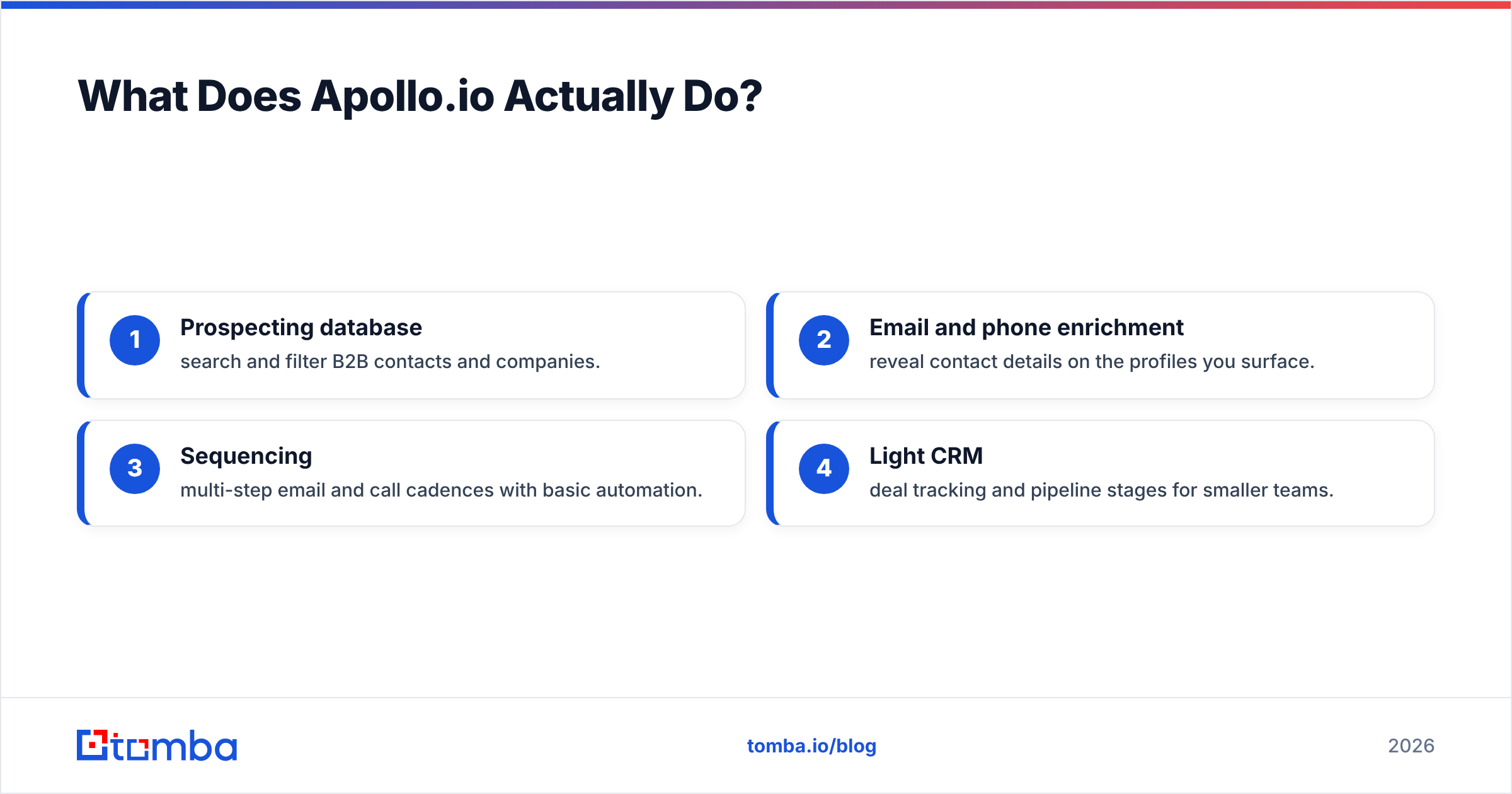
Apollo bundles four jobs into one subscription:
- Prospecting database — search and filter B2B contacts and companies.
- Email and phone enrichment — reveal contact details on the profiles you surface.
- Sequencing — multi-step email and call cadences with basic automation.
- Light CRM — deal tracking and pipeline stages for smaller teams.
That breadth is the appeal and the catch. You pay for the whole suite even if you only need the database, and Apollo's email accuracy — while decent — is variable across regions and seniority levels because the data is crowd-sourced and aged at different rates.

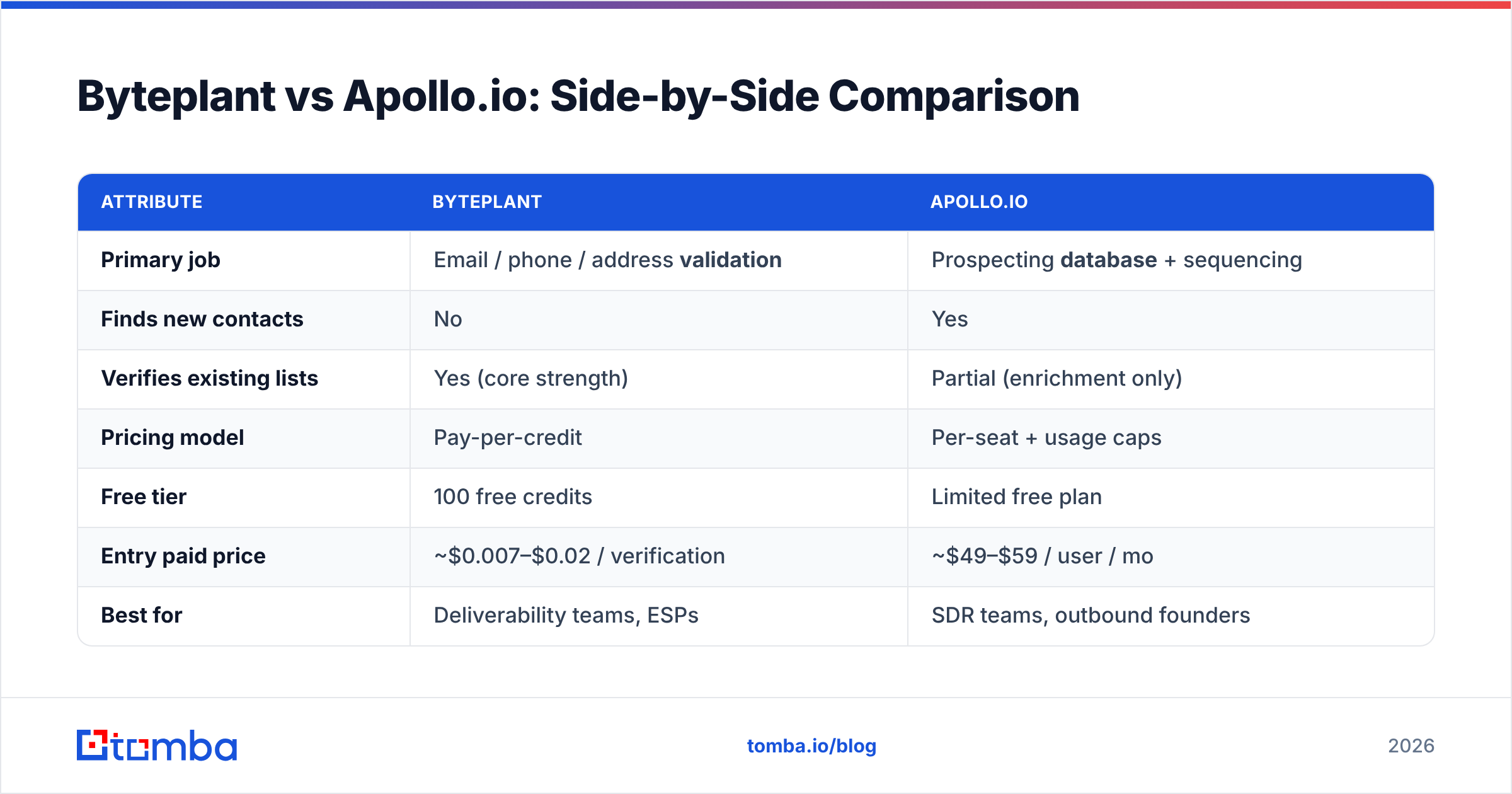
Byteplant vs Apollo.io: Side-by-Side Comparison#
Here is the honest layout. Notice that the two tools overlap in almost nothing except "email touches data."
| Attribute | Byteplant | Apollo.io |
|---|---|---|
| Primary job | Email / phone / address validation | Prospecting database + sequencing |
| Finds new contacts | No | Yes |
| Verifies existing lists | Yes (core strength) | Partial (enrichment only) |
| Pricing model | Pay-per-credit | Per-seat + usage caps |
| Free tier | 100 free credits | Limited free plan |
| Entry paid price | ~$0.007–$0.02 / verification | ~$49–$59 / user / mo |
| Best for | Deliverability teams, ESPs | SDR teams, outbound founders |
| Sequencing / outreach | No | Yes |
| API access | Yes | Yes |
| Data freshness control | You supply the data | Crowd-sourced, varies |
The takeaway: choosing "Byteplant vs Apollo.io" only makes sense if you already know which half of the funnel you are fixing. One cleans, the other collects.

Which Problem Are You Actually Solving?#
Map your pain to the tool. This is where most buyers go wrong — they buy a platform when they needed a feature, or a feature when they needed a platform.
- "My bounce rate is killing my domain." That is a validation problem. Byteplant — or any solid email verifier — fixes it. Apollo is overkill.
- "My CRM is empty and I need 2,000 net-new prospects." That is a sourcing problem. Apollo's database earns its keep here; Byteplant cannot help.
- "I need to find emails and trust them before I send." This is the most common real-world case, and it is exactly where a dedicated email finder with built-in verification beats buying two separate products.
The third scenario is where the Byteplant-or-Apollo framing breaks down. Most teams do not want a list-cleaner or a bloated GTM suite. They want accurate addresses, verified at the point of discovery, without paying per seat for features they ignore.
How Accurate Is the Email Data?#
Accuracy is the whole game, so be specific about what each tool means by it.
Byteplant's accuracy is about verdict reliability — when it says an address is valid, how often is it right? On well-formed lists, Byteplant's SMTP-level checks are strong, though catch-all domains remain the universal blind spot for every verifier on the market. If you send to catch-all domains a lot, pair any verifier with a dedicated catch-all verifier to reduce guesswork.
Apollo's accuracy is about data freshness — when it hands you an email, is the person still reachable there? Because Apollo's contact data is contributed and aged unevenly, accuracy swings by role and geography. Senior contacts and non-US records tend to decay faster. Apollo enriches, but it does not re-verify every address in real time, so a meaningful share of "found" emails still bounce.
This is the practical gap: Byteplant verifies but does not find; Apollo finds but does not deeply verify. Running both closes the loop but doubles your tooling cost.

How Does Pricing Compare?#
The pricing structures are not comparable line-for-line, which is itself a buying signal.
Byteplant is transaction-based: you buy verification credits and spend them as you clean lists. Costs scale with volume, not headcount, so a two-person team and a fifty-person team pay the same per check. That is fair for occasional cleaning and brutal for continuous high-volume sending.
Apollo is seat-based: every rep needs a license, and each tier caps how many email and mobile credits you can pull per month. Hit the cap and you either upgrade or wait. For a growing SDR team, those caps and per-seat fees compound quickly.
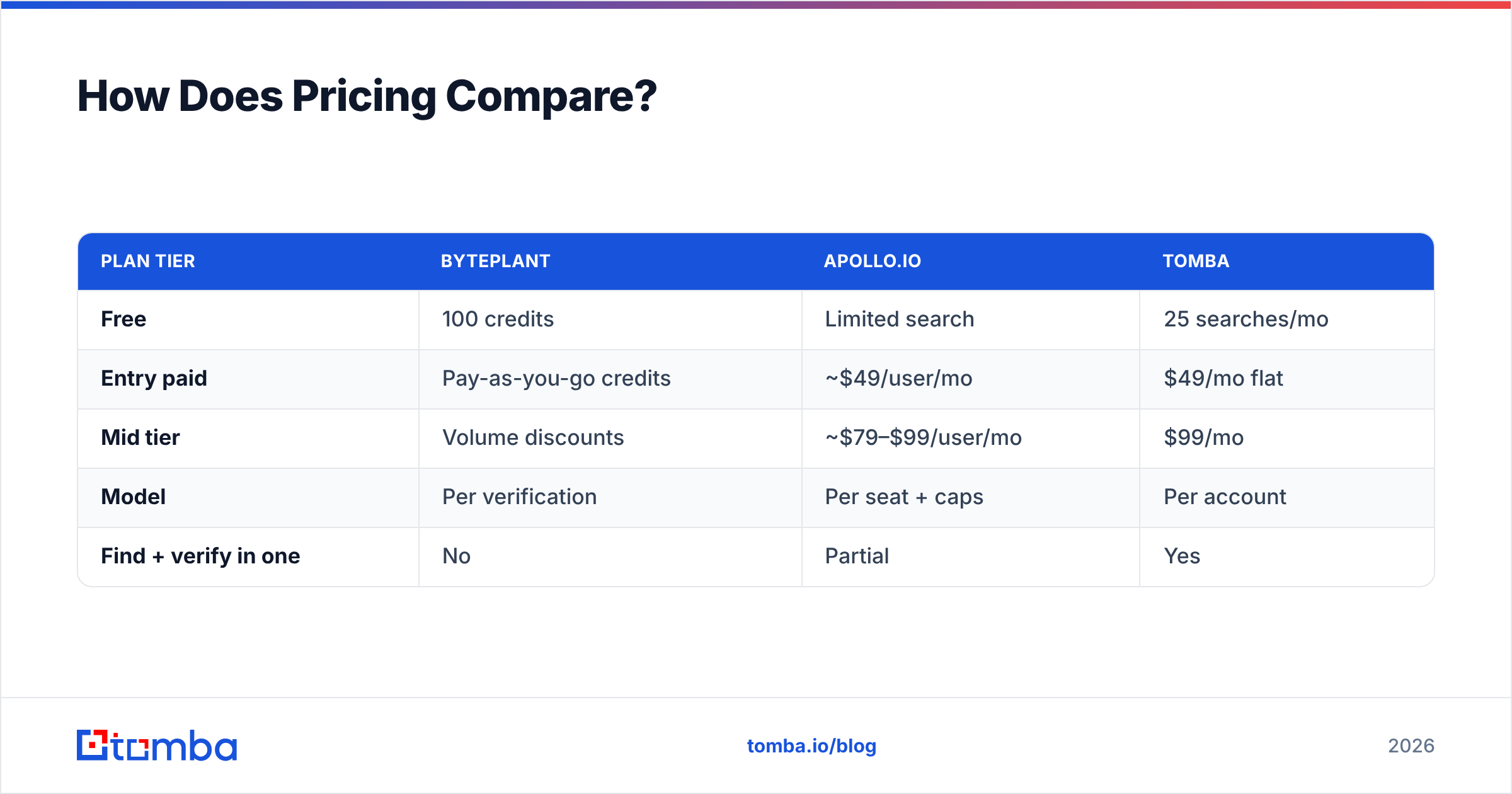
If you want a single number to anchor against, compare both to a finder-plus-verifier with flat, predictable tiers. Tomba's pricing starts free at 25 searches per month, with a Starter plan at $49/mo, Growth at $99/mo, and Pro at $249/mo — no per-seat tax, and finding and verification live under one roof. For teams that were eyeing Apollo mainly for its database, the Apollo alternative comparison is worth a look before you commit to seats.
| Plan tier | Byteplant | Apollo.io | Tomba |
|---|---|---|---|
| Free | 100 credits | Limited search | 25 searches/mo |
| Entry paid | Pay-as-you-go credits | ~$49/user/mo | $49/mo flat |
| Mid tier | Volume discounts | ~$79–$99/user/mo | $99/mo |
| Model | Per verification | Per seat + caps | Per account |
| Find + verify in one | No | Partial | Yes |
When Should You Pick Byteplant?#
Choose Byteplant when validation is the project. Specifically:
- You run an ESP or send transactional mail at scale and need a hardened, API-first validator in your pipeline.
- You bought a list (carefully, and compliantly) and need to scrub it before it ever touches your sending domain.
- You already source contacts elsewhere and only need the cleaning step.
- You care about phone and postal validation too, which Byteplant handles alongside email.
In these cases Byteplant is a sharp, specialized instrument. You are not buying prospecting; you are buying confidence in data you already hold. Just remember it is one stage of the workflow, not the whole thing.
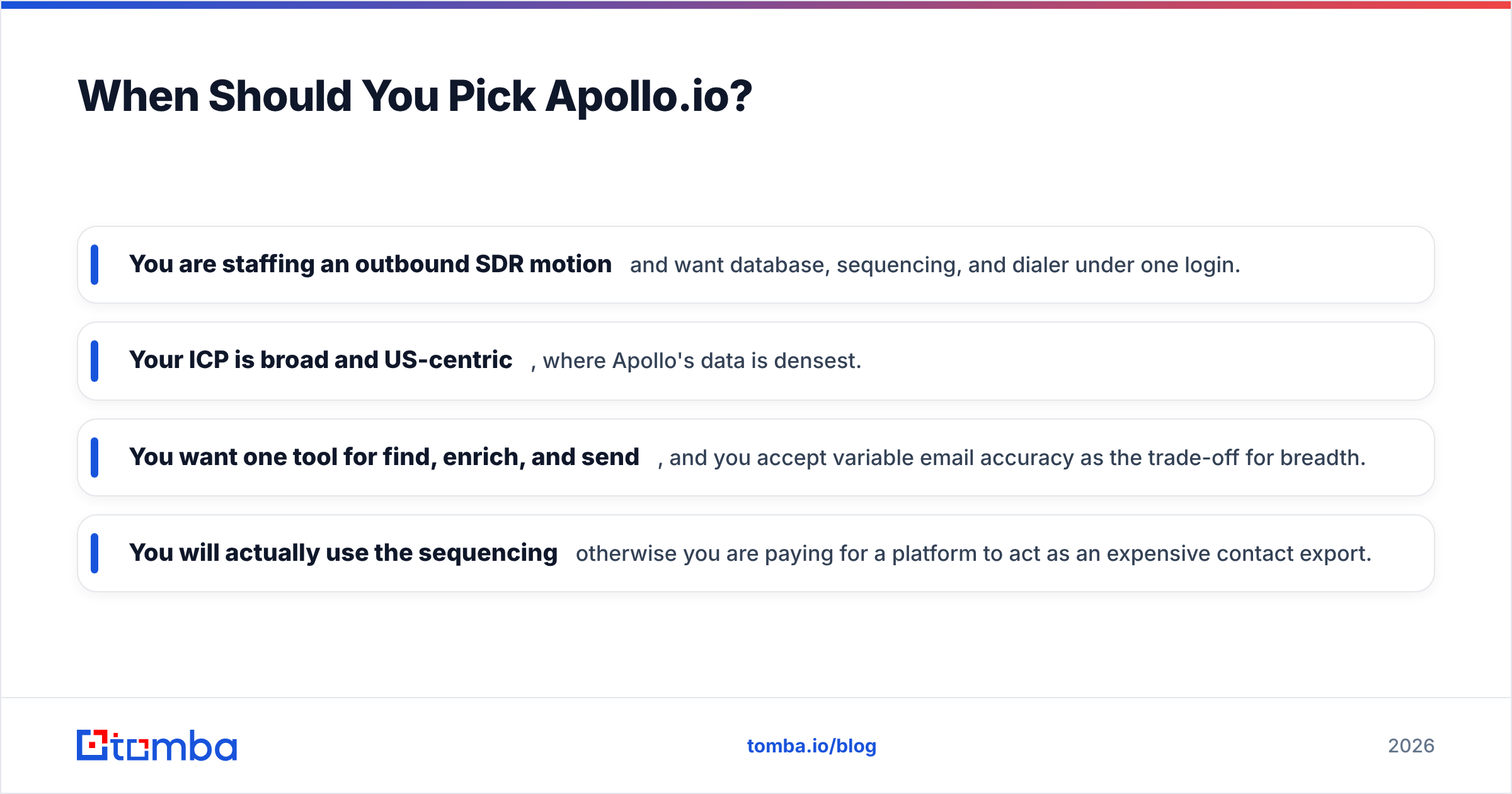
When Should You Pick Apollo.io?#
Choose Apollo when you need volume sourcing and you have the budget and team to use the rest of the suite:
- You are staffing an outbound SDR motion and want database, sequencing, and dialer under one login.
- Your ICP is broad and US-centric, where Apollo's data is densest.
- You want one tool for find, enrich, and send, and you accept variable email accuracy as the trade-off for breadth.
- You will actually use the sequencing — otherwise you are paying for a platform to act as an expensive contact export.
Apollo is a reasonable hub for a funded sales team. It becomes wasteful when a solo founder or a small RevOps team buys five seats to use ten percent of the features.
Is There a Better Middle Ground?#
For most readers comparing "Byteplant vs Apollo.io," the honest answer is that neither is the whole solution — and you do not need to bolt two subscriptions together to get there.
The recurring real-world need is simple: find a verified business email when you have a name and a company, in bulk, without seat fees. That is a finder-with-verification job. A focused tool handles it by combining domain search, pattern detection, and live verification in one pass, so the addresses you export are already cleaned. You can pull contacts company-by-company with domain search, then push a list through the bulk email finder when you scale up.
You lose Apollo's deep prospecting filters and Byteplant's specialized phone/address validation — so if either of those is your core need, buy the specialist. But if you are like most teams stuck choosing between an over-broad platform and a single-purpose cleaner, the middle path is usually the cheapest and the least painful to operate.
For independent context on either platform, check verified reviews on G2 and the vendor docs at Apollo.io and Byteplant before you sign anything.
The Bottom Line#
Byteplant and Apollo.io solve different halves of the same funnel. Byteplant makes the data you have trustworthy; Apollo gives you data you did not have. Compare them only after you have named the job: cleaning a list, or filling one.
If your actual goal is accurate emails you can send to today — found and verified in a single step, billed by usage instead of seats — start with the Tomba Email Finder. Grab the free tier, run a few searches against your target accounts, and see whether you ever needed two subscriptions in the first place. Most teams find that one focused tool quietly replaces the awkward Byteplant-plus-Apollo stack they were about to buy.
Ready to find emails that actually work?
Join 150,000+ professionals who stopped guessing and started sending. Free credits on signup — no credit card required.
Get the Tomba newsletter
Practical outbound tactics and product updates — once every two weeks.
About the author