How to Sell to the C-Suite in 2026: A Practical Guide
Reaching the C-suite is harder than ever—more gatekeepers, shorter attention, higher stakes. Here's how to research, message, and reach executives who actually reply in 2026.
Selling to the C-suite is not a bigger version of selling to a manager. It is a different sport with different rules, a different clock, and a different definition of "value." Get it wrong and your email dies in a delegate's inbox. Get it right and one 20-minute conversation can move a six-figure deal further than three months of bottom-up nurturing.
This guide breaks down who sits in the C-suite in 2026, how executives actually make buying decisions, and the concrete tactics — research, messaging, timing, and data — that get you a reply instead of silence.
TL;DR#
- The C-suite is a small, guarded, time-starved audience. Win by leading with business outcomes (revenue, risk, cost, speed), not features.
- Executives buy on trust and timing. They rarely respond to generic outreach — they respond to relevance tied to a current initiative or pain.
- You need accurate contact data. A wrong or catch-all executive email tanks both your reply rate and your sender reputation.
- Multithread on purpose. Champions build the internal case; the C-suite grants the budget. You need both.
- Brevity wins. A CEO reads the first line and the ask. Everything else is optional.
What is the C-suite, exactly?#
The "C-suite" refers to a company's most senior executives — the leaders whose titles usually start with "Chief." They own strategy, budget, and the final yes on major purchases. When people say a deal "went to the C-suite," they mean it reached the person who can approve spend without asking anyone else.
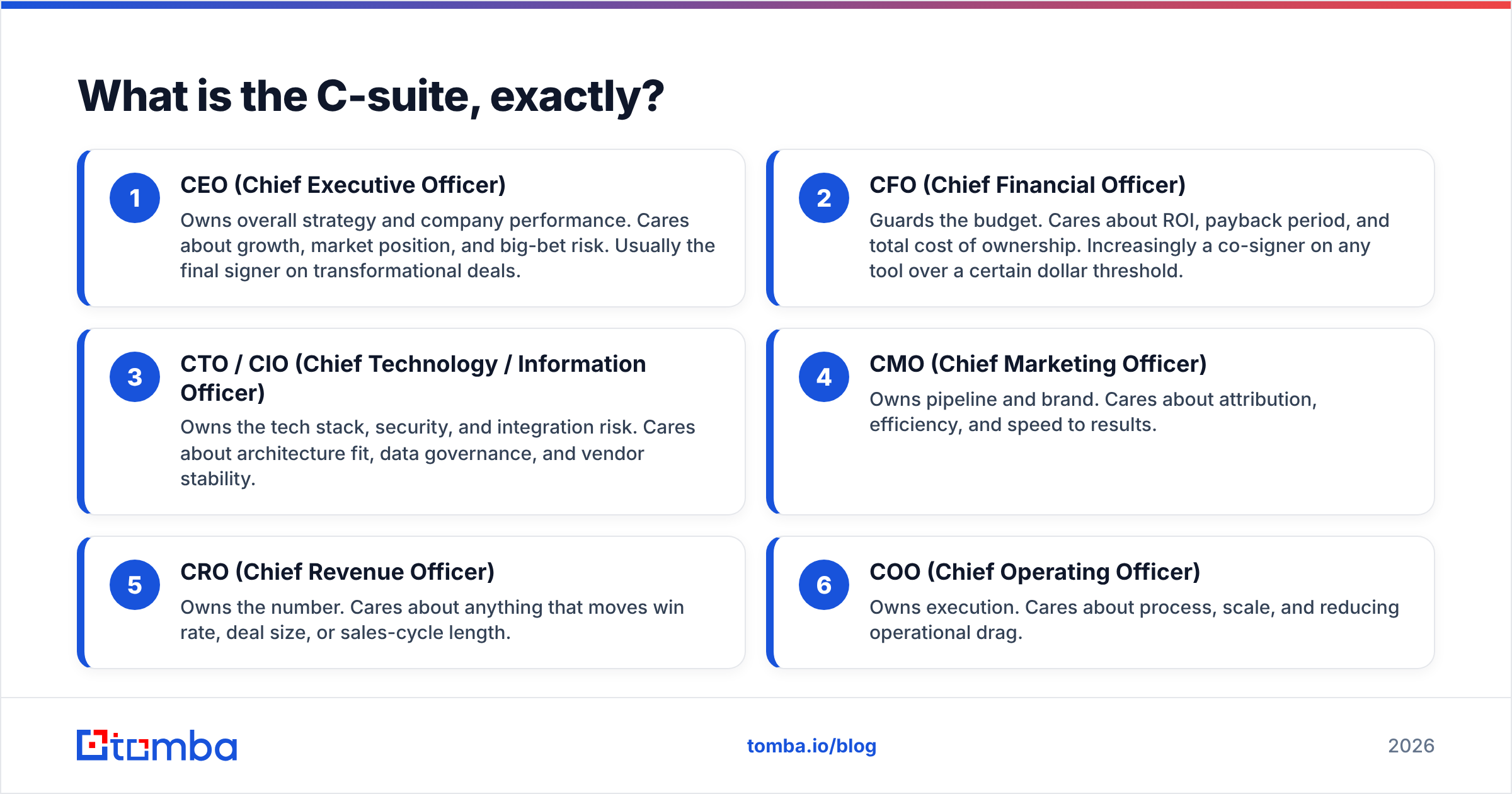
The core roles you'll encounter in B2B sales:
- CEO (Chief Executive Officer) — Owns overall strategy and company performance. Cares about growth, market position, and big-bet risk. Usually the final signer on transformational deals.
- CFO (Chief Financial Officer) — Guards the budget. Cares about ROI, payback period, and total cost of ownership. Increasingly a co-signer on any tool over a certain dollar threshold.
- CTO / CIO (Chief Technology / Information Officer) — Owns the tech stack, security, and integration risk. Cares about architecture fit, data governance, and vendor stability.
- CMO (Chief Marketing Officer) — Owns pipeline and brand. Cares about attribution, efficiency, and speed to results.
- CRO (Chief Revenue Officer) — Owns the number. Cares about anything that moves win rate, deal size, or sales-cycle length.
- COO (Chief Operating Officer) — Owns execution. Cares about process, scale, and reducing operational drag.
Newer titles keep appearing — Chief Data Officer, Chief Product Officer, Chief AI Officer — but the buying psychology is the same: outcomes over features, and time is the scarcest resource in the building.

Why is selling to the C-suite so hard?#
Because everything about an executive's day is designed to filter you out. Three structural reasons:
They're protected. Executive assistants, generic role inboxes, and "please route through procurement" policies exist specifically to keep low-relevance messages away. A Gartner analysis of B2B buying has repeatedly shown that buying groups have grown larger and more risk-averse, which means more people can say no before you ever reach the person who can say yes.
They think in outcomes, not features. A director might get excited that your tool "has a Chrome extension." A CFO does not care. They care whether that extension shortens the sales cycle by 8% and what that's worth annually. If you can't translate your product into their P&L, you sound like noise.
They have zero patience for irrelevance. An executive scans the first sentence and decides in under two seconds. If your opener is "I hope this email finds you well" followed by three sentences about your company, you're deleted.
The takeaway: you don't earn C-suite attention by trying harder at the same tactics. You earn it by being sharper, shorter, and more relevant than everyone else in that inbox.
How do executives actually make buying decisions?#
They rarely make them alone, and they rarely make them first. Here's the pattern that repeats across most enterprise deals:
- A problem surfaces (a board mandate, a missed number, a competitor move, a compliance deadline).
- A champion — often a director or VP — researches solutions and builds an internal case.
- The C-suite is pulled in to approve budget, weigh risk, and make the final call.
This is why bottom-up and top-down selling both work — and why the best reps do both at once. Your champion educates the organization from the inside. Your executive outreach creates urgency and air cover from the top. When they meet in the middle, deals close.
The mistake reps make is treating the C-suite like a lead-gen channel. Executives are not there to be "nurtured" through a 12-email drip. They're there to validate that a decision the organization is already leaning toward is the right one. Your job is to be relevant at exactly that moment — which means research and timing matter more than volume.
What does effective C-suite messaging look like?#
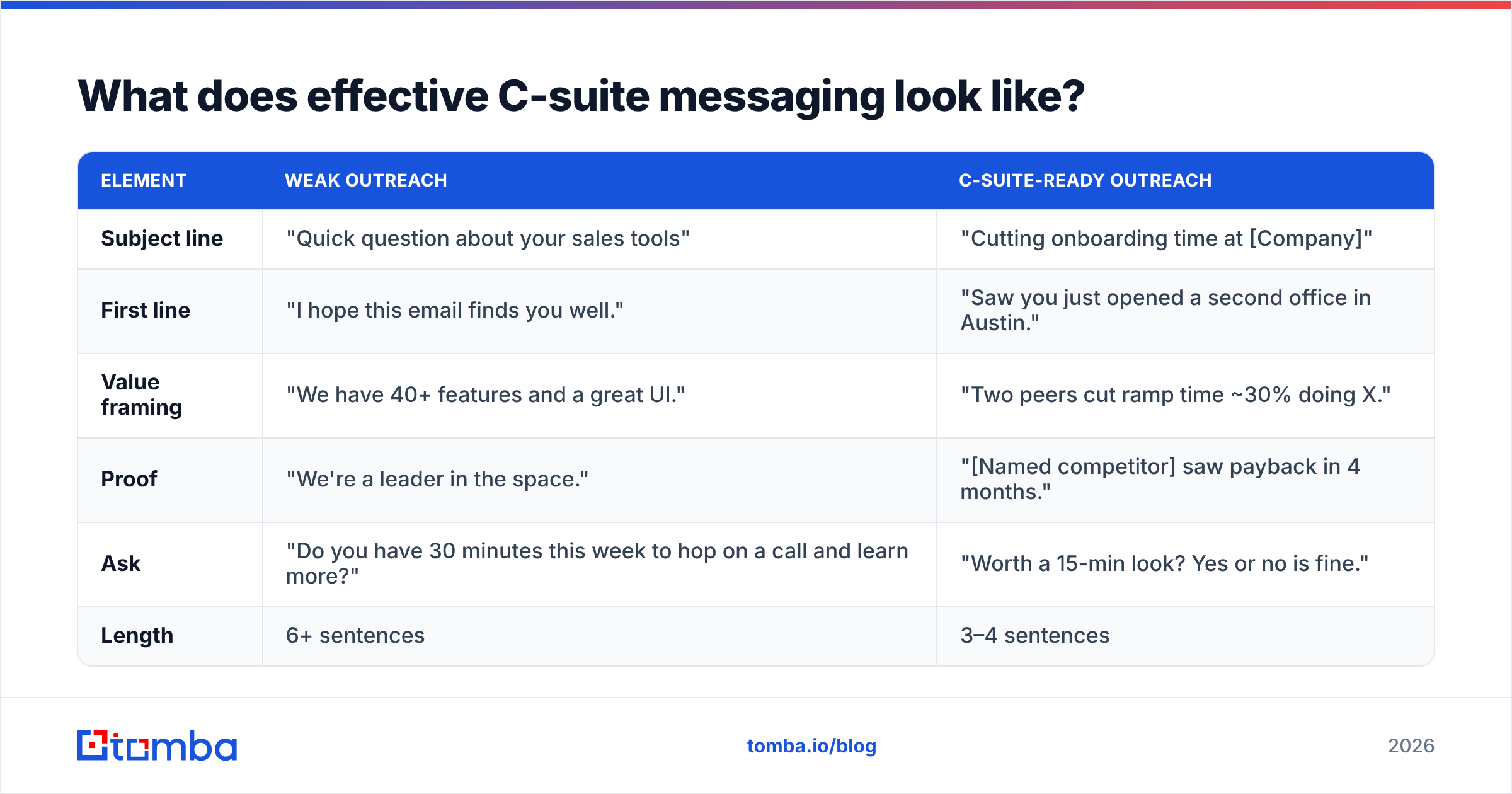
Short, specific, and about them. Compare the two openers below:
| Element | Weak outreach | C-suite-ready outreach |
|---|---|---|
| Subject line | "Quick question about your sales tools" | "Cutting onboarding time at [Company]" |
| First line | "I hope this email finds you well." | "Saw you just opened a second office in Austin." |
| Value framing | "We have 40+ features and a great UI." | "Two peers cut ramp time ~30% doing X." |
| Proof | "We're a leader in the space." | "[Named competitor] saw payback in 4 months." |
| Ask | "Do you have 30 minutes this week to hop on a call and learn more?" | "Worth a 15-min look? Yes or no is fine." |
| Length | 6+ sentences | 3–4 sentences |
Principles behind the good column:
- Lead with a trigger. A funding round, a new hire, an expansion, a product launch, a regulation. It proves you did homework and gives a reason to reply now.
- Quantify the outcome. Executives translate everything into money and time. Do that math for them.
- Name-drop credibly. Peers and competitors are the most persuasive proof for a C-suite reader — social proof at their altitude.
- Make the ask tiny. "Worth a look?" beats "Can we schedule a 30-minute demo." Lower the cost of yes.
- Respect the clock. If it takes more than 15 seconds to read, it's too long.
For deeper subject-line testing, a free subject line generator helps you draft variants worth A/B testing before you send to a high-value contact.
How do you actually reach the C-suite?#
You need three things: the right person, the right contact detail, and the right channel. Most reps nail the first and fumble the other two.
Find the right decision-maker. Titles vary wildly between companies — one org's "VP of Growth" is another's "CMO." Map the buying group before you write a word. Tools like a LinkedIn finder help you connect a profile to a verified work email so your message lands in the inbox that matters.
Get an accurate, deliverable email. This is where most executive outreach quietly fails. Executive addresses are often guessed ("first.last@") and guessing wrong does double damage: your message never arrives, and bounces erode your sender reputation, which hurts every future send. Use an email finder to source the address and an email verifier to confirm it's live before you hit send. For enterprise domains that accept everything, a catch-all verifier tells you whether that "valid" address is actually safe to email.
Multithread across channels. Email plus LinkedIn plus a well-timed call outperforms any single channel. If email is your primary motion, protect email deliverability with clean lists and proper authentication — because one great message to a real executive is worth more than 500 sprayed to bad addresses.

Which data approach wins with executives?#
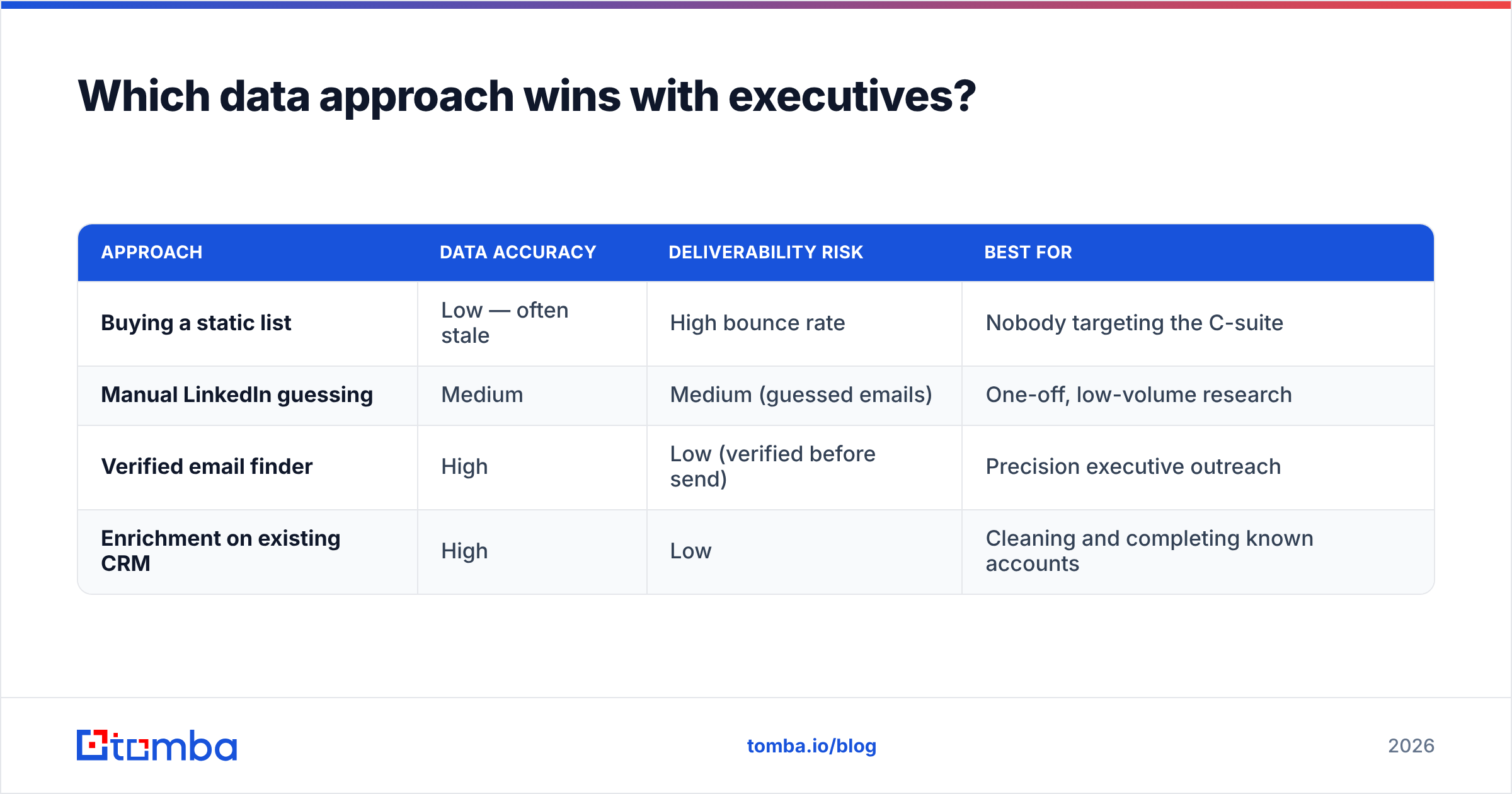
The one that trades volume for accuracy. Here's how the common approaches stack up when your target is a hard-to-reach executive:
| Approach | Data accuracy | Deliverability risk | Best for |
|---|---|---|---|
| Buying a static list | Low — often stale | High bounce rate | Nobody targeting the C-suite |
| Manual LinkedIn guessing | Medium | Medium (guessed emails) | One-off, low-volume research |
| Verified email finder | High | Low (verified before send) | Precision executive outreach |
| Enrichment on existing CRM | High | Low | Cleaning and completing known accounts |
The pattern is clear: for the C-suite, precision beats reach every time. You are not running a numbers game against 10,000 contacts — you're trying to reach maybe 50 people who could sign a deal, and every bounce or wrong-person email costs you credibility you can't get back.
That's why data enrichment matters as much as finding. Pulling in role, seniority, company size, and tech stack lets you segment executives and tailor the pitch — a CFO message and a CTO message should never read the same. If you want to see where contact data comes from and how it's validated, Tomba documents its data sources openly. Independent reviews on G2 are another useful sanity check when you're comparing vendors on real accuracy rather than marketing claims.
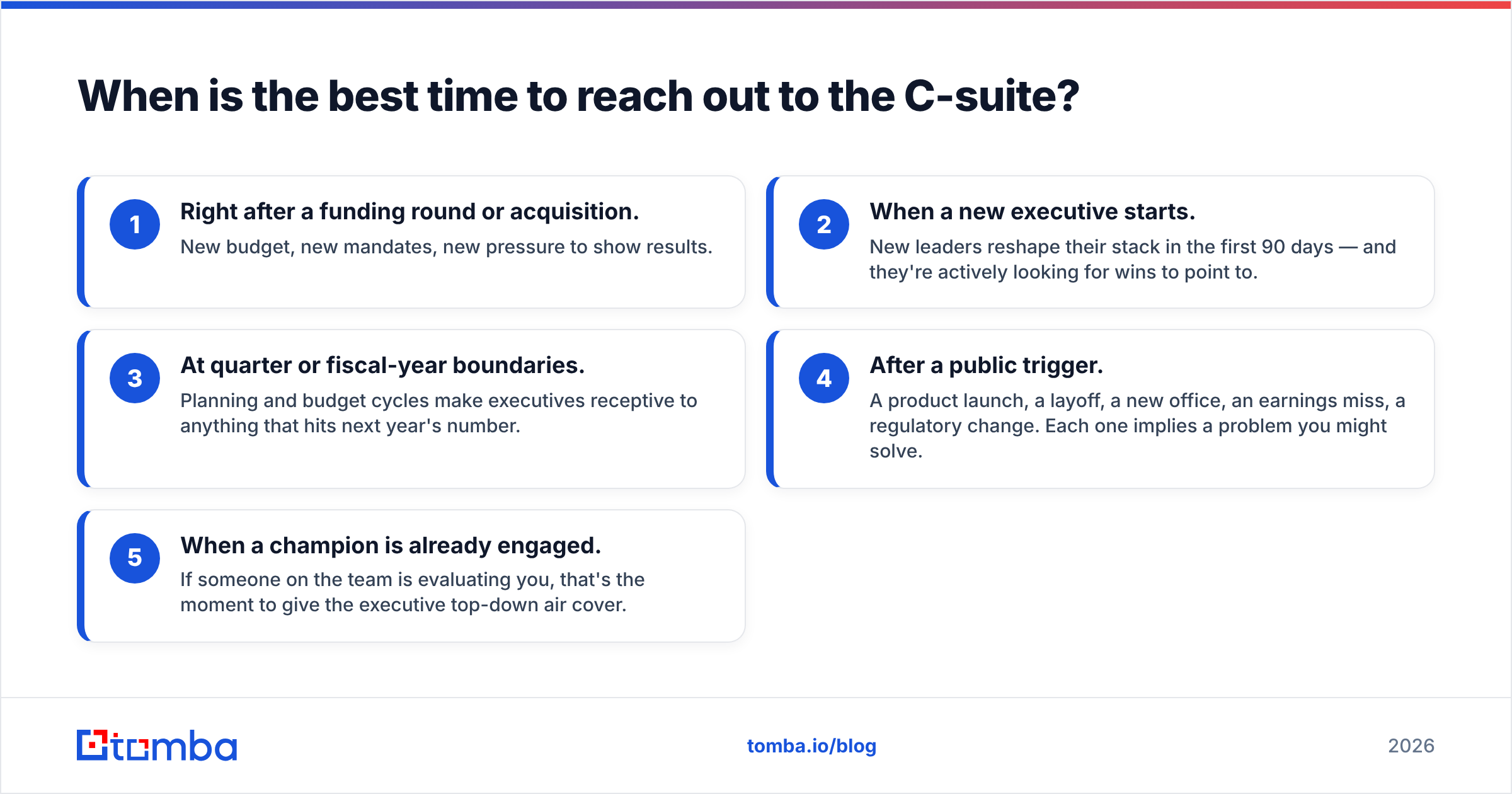
When is the best time to reach out to the C-suite?#
When something in their world just changed. Timing beats persistence because relevance beats volume. The highest-response windows:
- Right after a funding round or acquisition. New budget, new mandates, new pressure to show results.
- When a new executive starts. New leaders reshape their stack in the first 90 days — and they're actively looking for wins to point to.
- At quarter or fiscal-year boundaries. Planning and budget cycles make executives receptive to anything that hits next year's number.
- After a public trigger. A product launch, a layoff, a new office, an earnings miss, a regulatory change. Each one implies a problem you might solve.
- When a champion is already engaged. If someone on the team is evaluating you, that's the moment to give the executive top-down air cover.
You can catch some of these signals by monitoring news, hiring pages, and funding databases — then acting within days, not weeks. Speed on a trigger is one of the few advantages a smaller vendor has over an incumbent.
What mistakes kill C-suite deals?#
Even strong reps torpedo executive relationships with avoidable errors:
- Pitching features to a strategy buyer. The C-suite buys outcomes. Translate every feature into revenue, risk, cost, or speed.
- Going straight to the CEO on a small deal. If your product is a $5k operational tool, the CEO will route you down — and you've burned a first impression. Match the title to the deal size.
- Single-threading. Betting the whole deal on one executive who might leave, get reorged, or go quiet. Always build a coalition.
- Sending to unverified emails. Bounces don't just fail — they damage your domain reputation and signal sloppiness to sophisticated buyers.
- Being long. Every extra sentence lowers your reply rate with a time-starved reader. Cut, then cut again.
- No clear next step. End with one specific, low-friction ask. Ambiguity is the enemy of a busy person.
Avoiding these is mostly discipline. The reps who consistently reach executives aren't more talented — they're more relevant, more accurate, and more concise than the competition flooding the same inboxes.
How do you scale C-suite outreach without going generic?#
Carefully, and with the right tooling. The tension is real: personalization drives replies, but hand-researching every executive doesn't scale past a few dozen accounts a week. The resolution is a tiered system.
Tier 1 — your top 20 accounts. Fully manual research, custom messaging, multichannel sequences. Worth hours each.
Tier 2 — your next 100. Templated frameworks with genuine personalization variables (trigger, peer proof, role-specific outcome) populated from enriched data. Worth minutes each.
Tier 3 — broad awareness. Lighter touch, but still verified contacts and role-appropriate messaging. Never spray-and-pray.
The connective tissue across all three tiers is clean, verified data. Whether you pull contacts one at a time or run a bulk email finder across a target list, verify before you send and enrich so every message can carry a relevant hook. Straightforward, transparent Tomba pricing — a free tier at 25 searches per month, then Starter at $49/mo and Growth at $99/mo — lets you start small on Tier 1 and scale as your executive list grows.
Reach the executives who can actually say yes#
The C-suite rewards relevance and punishes noise. You win by knowing exactly who to reach, why now, and what outcome they care about — then delivering that in three tight sentences to an inbox that actually exists.
That last part is where deals quietly die. If your executive emails are guessed, stale, or unverified, even perfect messaging never arrives. Start with the Tomba Email Finder to source verified, deliverable executive contacts by name, company, or domain — then pair it with the built-in verifier so every high-stakes message lands. Precision in, replies out. That's how you sell to the C-suite in 2026.
Related guides#
Ready to find emails that actually work?
Join 150,000+ professionals who stopped guessing and started sending. Free credits on signup — no credit card required.
Get the Tomba newsletter
Practical outbound tactics and product updates — once every two weeks.
About the author