How to Sell at the C Suite Level: A 2026 Executive Playbook
Selling at the C-suite level is a different sport: shorter attention, bigger stakes, zero tolerance for fluff. Here's how to find, reach, and win executive buyers in 2026.
Selling to a manager and selling to a chief executive are not the same job. At the C suite level, the buyer has less time, more context, and a sharper filter for anything that sounds like a pitch. Get the framing right and a two-line email can open a deal. Get it wrong and you never hear back. That is not because your product is weak. It is because you spoke to a CFO the way you'd speak to an SDR.
This guide breaks down what the C suite level means for sellers in 2026. You'll see how executive buying differs from everything below it. And you'll get the concrete workflow — from finding the right contact to writing the message — that earns replies from people whose calendars are booked three weeks out.
TL;DR#
- The C-suite level is a decision altitude, not a job title. CEOs, CFOs, COOs, CTOs, CMOs and CROs buy outcomes and risk reduction, not features.
- Executives filter on relevance in under 10 seconds. Your first line has to prove you understand their business, not your product.
- Top-down beats bottom-up for high-ACV deals. A champion three levels down rarely moves a six-figure decision without air cover from above.
- Accuracy of contact data matters more here than anywhere. A bounced email to a CEO is a wasted, unrepeatable shot — verify before you send.
- A repeatable stack (find → verify → enrich → personalize → multi-thread) turns C-suite outreach from luck into a process.
What does "C suite level" actually mean in sales?#
The C suite level is the tier of an organization made up of "chief" officers. These are the executives who own company-wide outcomes and control large budgets. The common roles are CEO, CFO, COO, CTO/CIO, CMO, and CRO. More and more, that list also includes the CISO, the CDO for data, and the Chief People Officer.
What separates them from directors and VPs isn't seniority for its own sake. It's scope and accountability. A VP of Marketing owns a function. A CMO owns a number the board is watching. That difference changes everything about how they buy.
Think of it like an airport. Front-line staff care about whether the gate is staffed. The airport CEO cares about whether the whole operation runs on budget and reputation survives the quarter. Same building, completely different questions. If you walk into the CEO's office talking about gate staffing, you've lost the room.
The core roles and what each one actually cares about#
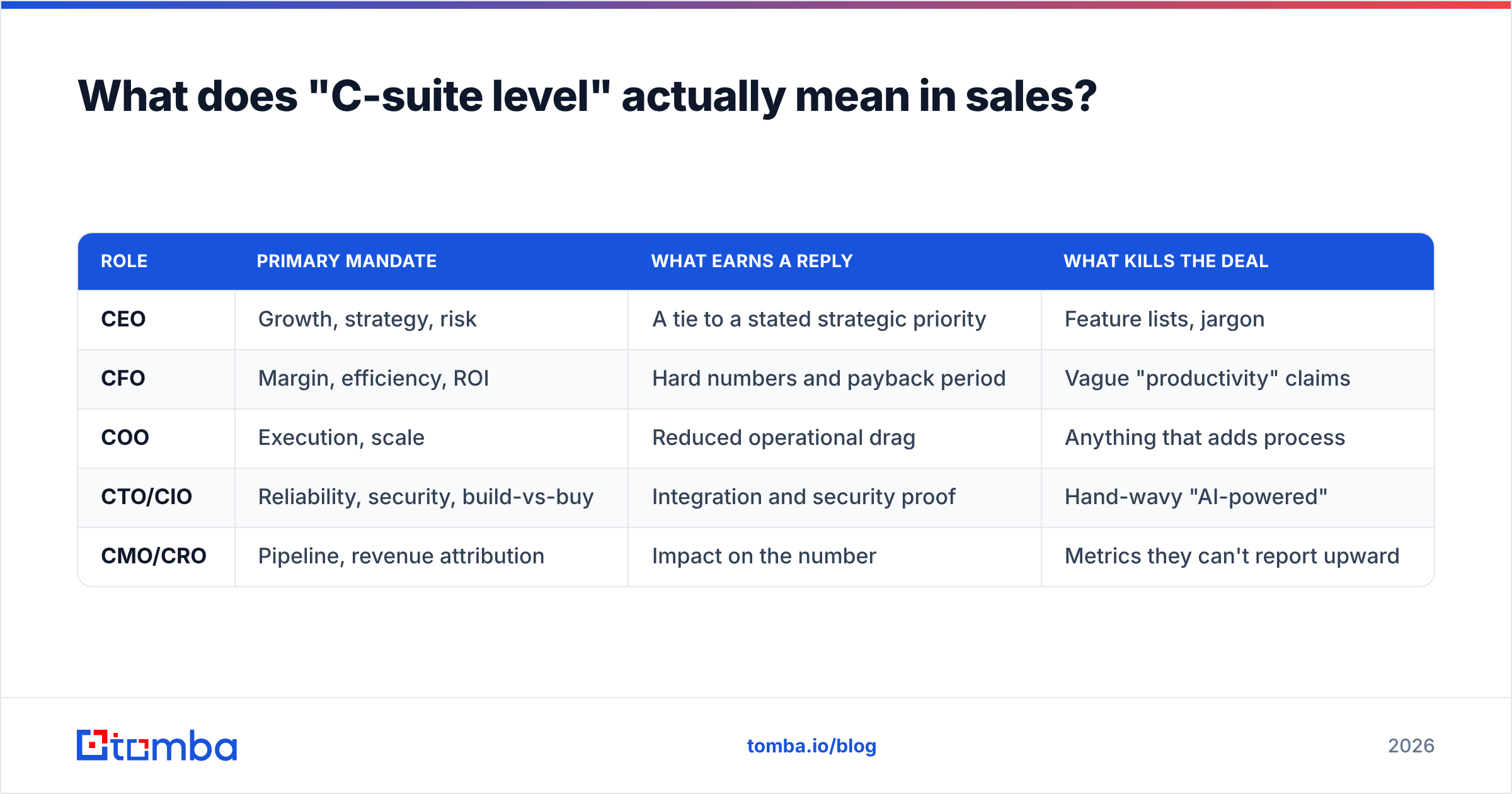
| Role | Primary mandate | What earns a reply | What kills the deal |
|---|---|---|---|
| CEO | Growth, strategy, risk | A tie to a stated strategic priority | Feature lists, jargon |
| CFO | Margin, efficiency, ROI | Hard numbers and payback period | Vague "productivity" claims |
| COO | Execution, scale | Reduced operational drag | Anything that adds process |
| CTO/CIO | Reliability, security, build-vs-buy | Integration and security proof | Hand-wavy "AI-powered" |
| CMO/CRO | Pipeline, revenue attribution | Impact on the number | Metrics they can't report upward |
Notice the pattern: none of them care about your product on the first touch. They care about a problem they already own. Your job is to connect the two in a sentence they'd forward to a colleague.
Why is selling at the C-suite level so different?#
Because the buying behavior inverts. Lower in the org, buyers evaluate features against a checklist. At the executive level, they evaluate risk, outcome, and credibility — and they do it fast.
Three structural differences drive this:
- Time scarcity is absolute. A senior executive gets more inbound in a morning than an SDR gets in a week. Your message competes with board decks, legal, and their own team. Length is a cost.
- They buy the "why now," not the "what." Executives rarely need convincing that a category exists. They need a reason to act this quarter instead of next year. Urgency has to be their urgency, tied to a trigger event — a new hire, an earnings miss, an acquisition, a market shift.
- Trust is transferred, not earned from scratch. A warm intro, a mutual connection, a relevant case study from a peer company — these do more than any amount of clever copy. Social proof at the C-suite level is peer proof.
According to research summarized by Gartner, the typical B2B buying group for a complex solution now involves six to ten decision-makers. The executive is rarely the one filling out the demo form — but they're almost always the one who can kill or greenlight the deal. That's why ignoring them is expensive.
Top-down vs. bottom-up: which motion wins?#
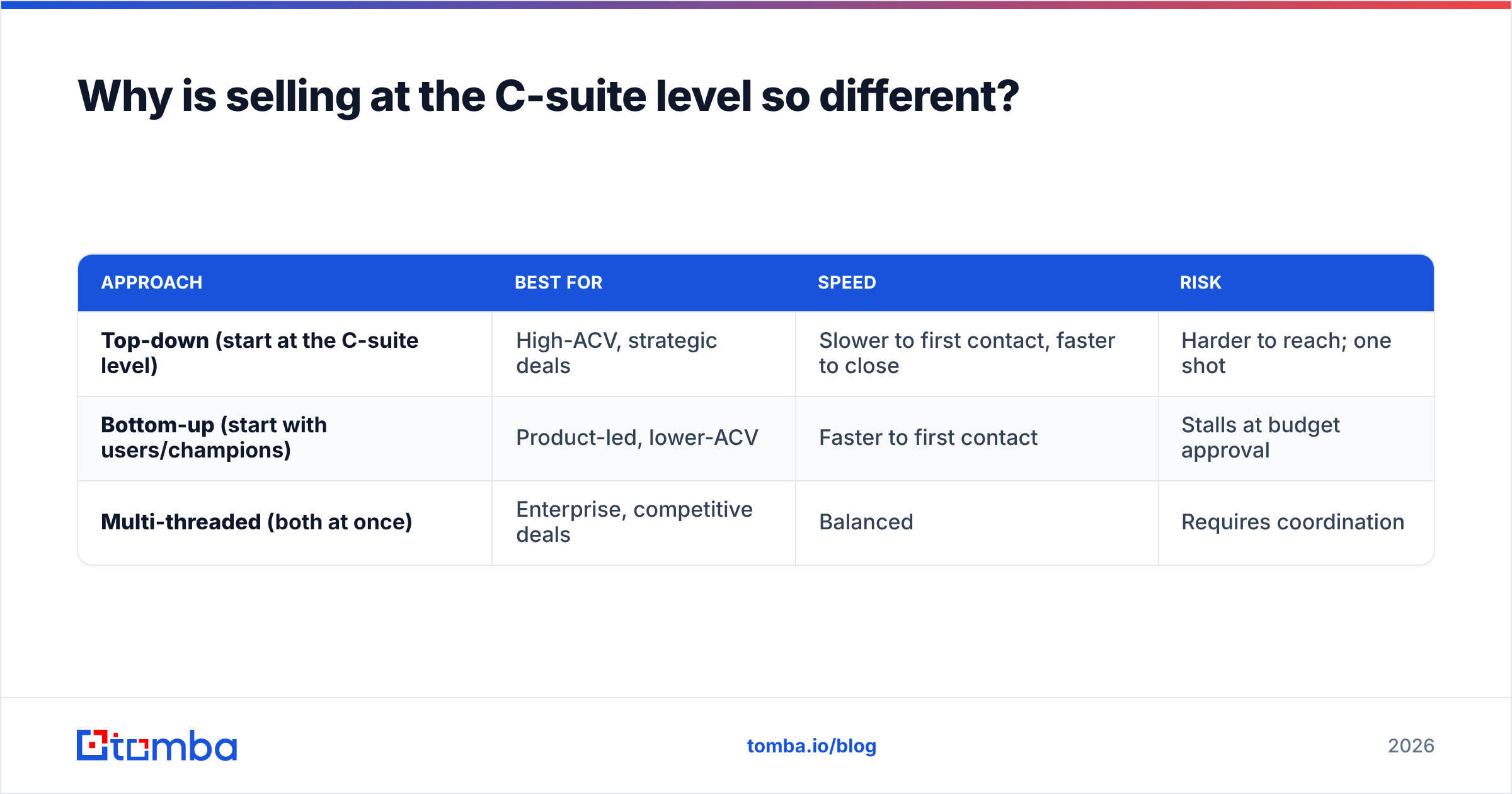
Both work, but for different deal sizes. Here's the honest trade-off.
| Approach | Best for | Speed | Risk |
|---|---|---|---|
| Top-down (start at the C-suite level) | High-ACV, strategic deals | Slower to first contact, faster to close | Harder to reach; one shot |
| Bottom-up (start with users/champions) | Product-led, lower-ACV | Faster to first contact | Stalls at budget approval |
| Multi-threaded (both at once) | Enterprise, competitive deals | Balanced | Requires coordination |
The winning motion in 2026 for anything above roughly $50K ACV is multi-threaded: build a champion in the trenches who feels the pain daily, and in parallel give an executive the strategic frame that justifies the spend. When the champion says "we need this" and the CFO already understands why, the deal doesn't die in procurement.
How do you actually reach the C-suite level?#
You reach executives with a process, not a hail-mary. The workflow has five stages, and each one has a failure mode that quietly wastes your best opportunities.
1. Find the right person — precisely#
"Reach the CFO" is not a plan until you have a name. Guessing the wrong contact or emailing info@ is how you burn a company you'll never get back. Use a company-level search to map the actual org before you write anything. Tomba's domain search returns the verified contacts and email patterns for a company from just the domain, so you can identify the real decision-maker instead of a shared inbox.
For roles that live more on LinkedIn than in a corporate directory, a LinkedIn finder resolves a profile to a business email. And when phone is the right channel — often true for a COO who ignores email — a phone finder gets you the direct line rather than the switchboard.
2. Verify before you send#
This is the step most teams skip, and it costs them the most at this altitude. A bounce to a director is a nuisance. A bounce to a CEO is a burned shot that also dings your sender reputation — which then hurts the next executive you email at that domain.
Run every executive address through an email verifier first. Executive inboxes are often protected by catch-all domains that accept everything and reveal nothing, so a dedicated catch-all verifier is worth its weight when you're targeting large enterprises where a single bad send can nuke your credibility.

3. Enrich for context#
A name and email get you delivered. Context gets you a reply. Before writing, pull the executive's recent moves, company signals, and tech stack so your first line can reference something real. Data enrichment fills in the firmographic and role detail that turns "Dear CFO" into "Congrats on the Series C — most finance teams your size hit a reconciliation wall at exactly this stage."
4. Write like their time is worth more than yours#
The executive email formula is brutally simple: relevance, then insight, then a small ask.
- Relevance (line 1): a trigger event or a peer proof point. Not "I hope this finds you well."
- Insight (line 2-3): something they didn't know that reframes a problem they own. This is the whole email.
- Ask (line 4): a low-friction yes. "Worth a 15-minute conversation, or should I send this to [their VP]?" gives them an easy exit that still moves the deal.
Keep it under 90 words. If a CFO has to scroll, you've already lost. If you're stuck on the opener, a subject-line and framing tool like Tomba's cold email AI can generate variants tuned for brevity — then cut them down further.
5. Multi-thread and follow up with new information#
One email is a coin flip. The follow-up is where deals are made — but only if each touch adds something. Never "just bumping this." Each follow-up should carry a new proof point, a relevant piece of news, or a different angle. And thread the champion at the same time: when the executive forwards your note internally, you want someone below already nodding.
What tools and data do you need for C-suite outreach?#
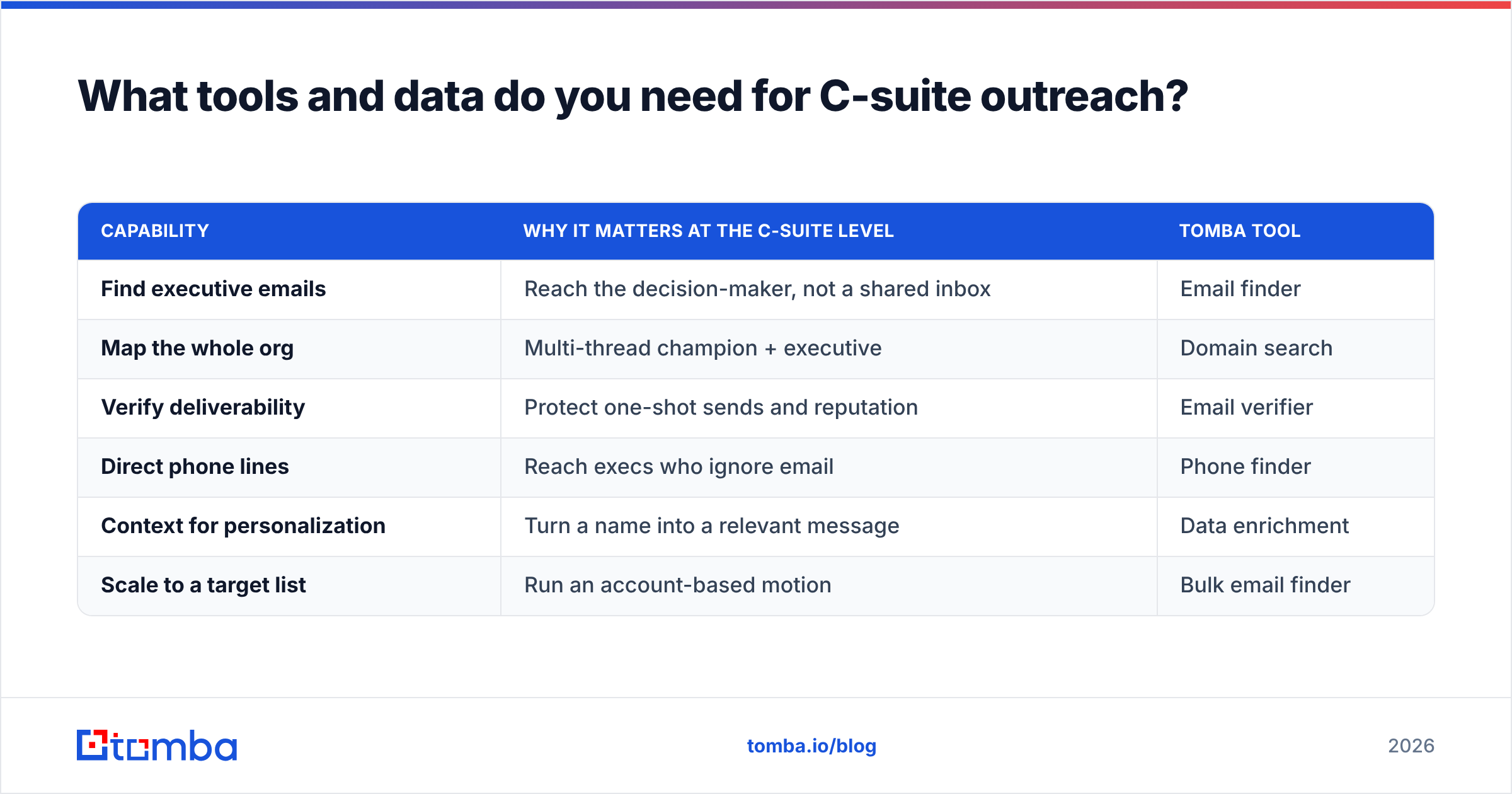
You need three things working together: accurate contact data, verification, and enrichment. Precision at the top of the funnel compounds, because every downstream step multiplies the quality — or the garbage — you started with.
| Capability | Why it matters at the C-suite level | Tomba tool |
|---|---|---|
| Find executive emails | Reach the decision-maker, not a shared inbox | Email finder |
| Map the whole org | Multi-thread champion + executive | Domain search |
| Verify deliverability | Protect one-shot sends and reputation | Email verifier |
| Direct phone lines | Reach execs who ignore email | Phone finder |
| Context for personalization | Turn a name into a relevant message | Data enrichment |
| Scale to a target list | Run an account-based motion | Bulk email finder |
For teams running account-based outbound at scale, the sequence is the same but batched: build the target account list, use a bulk email finder to resolve the executive contacts, verify the whole list, enrich, then personalize per account. The Tomba API lets you wire this directly into your CRM or sequencer so the data lands where your reps already work — check Tomba pricing to match a plan to your list volume.
Compared with all-in-one platforms, the advantage of a focused data layer is accuracy. Bloated databases carry stale executive records — people who left, titles that changed after a reorg. At the C-suite level, staleness is fatal: the CFO you're emailing left six months ago and now your "personalized" note is evidence you didn't do your homework. Independent reviews on G2 consistently rank data freshness above raw record count for this exact reason.
How do you measure success at the C-suite level?#
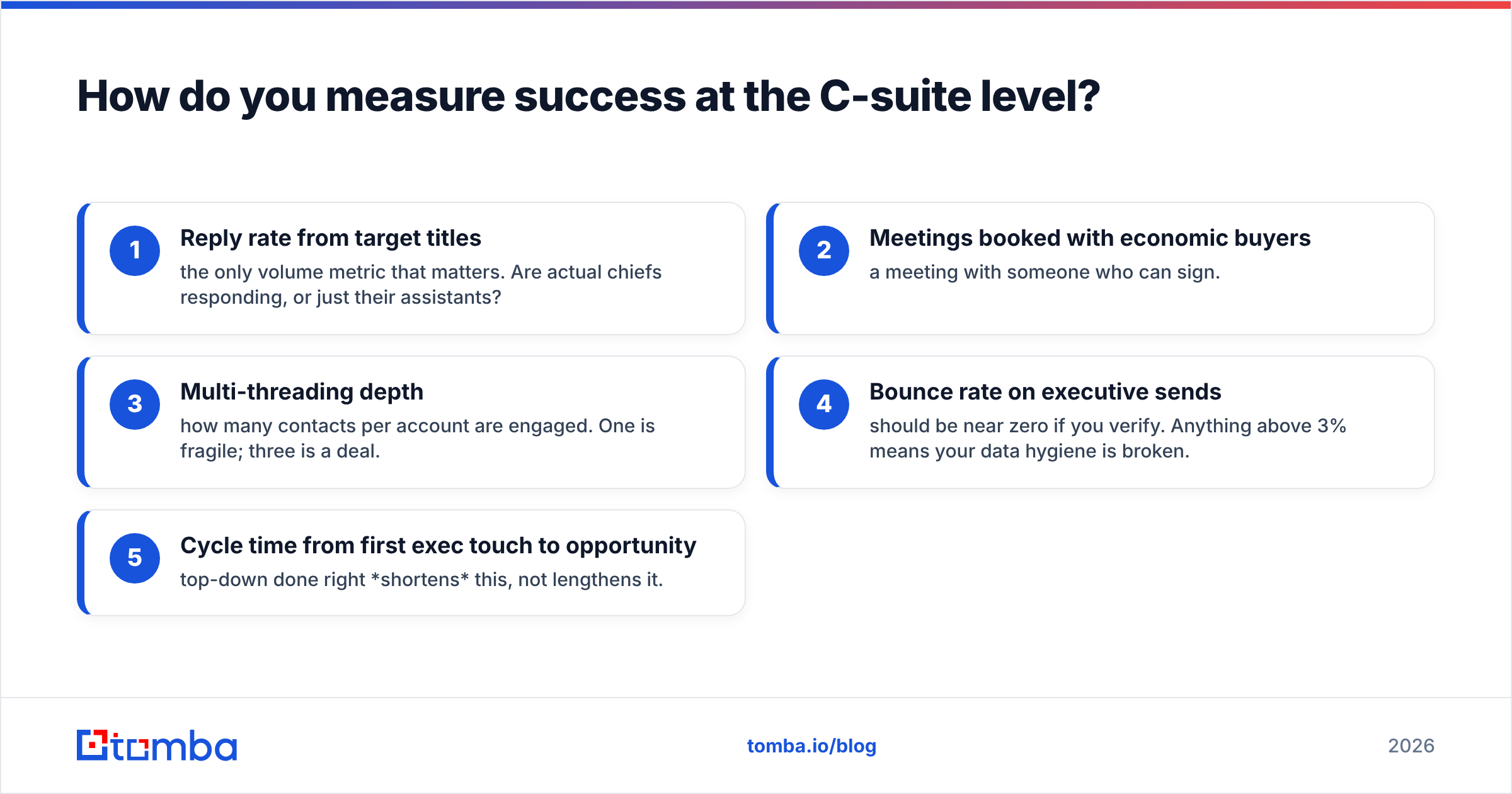
Not by open rates. Executive outreach is low-volume and high-consequence, so vanity metrics mislead you. Track these instead:
- Reply rate from target titles — the only volume metric that matters. Are actual chiefs responding, or just their assistants?
- Meetings booked with economic buyers — a meeting with someone who can sign.
- Multi-threading depth — how many contacts per account are engaged. One is fragile; three is a deal.
- Bounce rate on executive sends — should be near zero if you verify. Anything above 3% means your data hygiene is broken.
- Cycle time from first exec touch to opportunity — top-down done right shortens this, not lengthens it.
If reply rates are flat, the problem is almost never volume. It's relevance. Send fewer, better emails to more precisely chosen people, and the numbers move.
Common mistakes that get you ignored#
- Pitching features to someone who buys outcomes. A CTO doesn't want your integration list; they want to know it won't page them at 3 a.m.
- Emailing a guessed address. Permutation-guessing an executive's email and hoping it lands is how you bounce into a spam folder. Find and verify instead.
- Treating every C-role identically. A CFO and a CMO share an org chart row and nothing else. Segment your messaging by mandate.
- Single-threading. Betting a six-figure deal on one busy person is how deals go dark with no explanation.
- Following up with nothing. "Circling back" is a delete trigger. New information, every time.
The bottom line#
Selling at the C suite level rewards precision over volume at every stage. The executives you want to reach aren't unreachable — they're just protected by a filter that punishes irrelevance and low effort. Beat the filter with accurate data, real personalization, and a message that respects their time, and a category of buyer that most reps consider impossible becomes a repeatable pipeline source.
Start where it counts: with the right person and a deliverable address. Tomba's Email Finder resolves verified executive emails from a name and domain — and the free tier gives you 25 searches a month to test the workflow on your top accounts before you scale. Find the decision-maker, verify the send, and make your one shot count.
Related guides#
Ready to find emails that actually work?
Join 150,000+ professionals who stopped guessing and started sending. Free credits on signup — no credit card required.
Get the Tomba newsletter
Practical outbound tactics and product updates — once every two weeks.
About the author