Call Shadowing in Sales: The Complete 2026 Playbook
Call shadowing turns your best reps into a training engine. Here's how to run it in 2026 without wasting anyone's time, plus a framework, templates, and metrics.
Call shadowing is the fastest, cheapest way to turn tribal knowledge into a repeatable sales motion — if you run it with structure instead of vibes. Most teams "let the new rep sit in on a few calls" and call it onboarding. That is not shadowing; that is wasted seat time. This guide shows you how to do it properly in 2026.
TL;DR#
- Call shadowing is structured observation of live or recorded sales calls so reps learn the playbook by watching it executed, then get coached on what they saw.
- There are four formats — live listen-only, reverse shadowing, recorded async, and AI-assisted review — and each fits a different stage of ramp.
- A shadowing session without a scorecard and a debrief is just background noise. The debrief is where the learning happens.
- Teams that formalize shadowing cut ramp time and lift win rates because reps copy proven behavior instead of guessing.
- Pair shadowing with clean contact data so reps spend rep time talking, not hunting for numbers.
What is call shadowing in sales?#
Call shadowing is when a salesperson observes another person's sales calls — live or recorded — to learn how the conversation actually runs in the wild. Think of it like a medical residency: a new doctor does not read three textbooks and then perform surgery. They scrub in, watch an attending work, then get handed the scalpel for one step at a time, under supervision.
Sales is the same. A deck explains what to say. Shadowing shows how it lands when a prospect pushes back, goes quiet, or asks about price in the first 90 seconds. The tone, the pause before answering an objection, the way a senior rep reframes "we already use a competitor" — none of that survives a slide.
The practice covers more than cold calls. Reps shadow discovery calls, demos, negotiation calls, renewal conversations, and even support escalations that touch revenue. Anywhere a human is moving a deal forward by voice, there is something to learn by watching.
Why does call shadowing beat traditional training?#
Conclusion first: shadowing works because it transfers judgment, not just information. Classroom training and certifications load reps with facts. Shadowing teaches them when and how to apply those facts under pressure — the part that actually closes deals.
Here is the gap it closes:
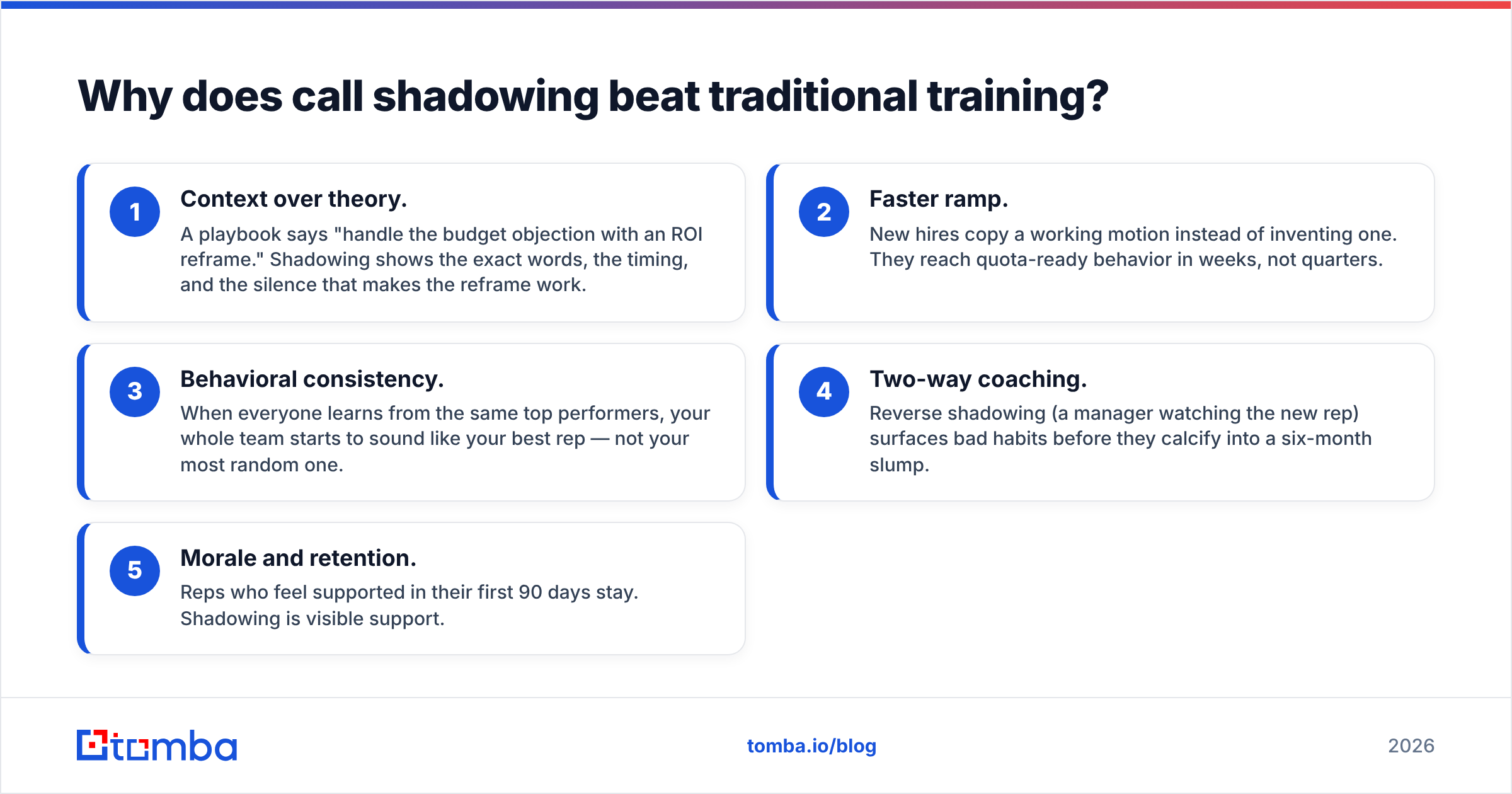
- Context over theory. A playbook says "handle the budget objection with an ROI reframe." Shadowing shows the exact words, the timing, and the silence that makes the reframe work.
- Faster ramp. New hires copy a working motion instead of inventing one. They reach quota-ready behavior in weeks, not quarters.
- Behavioral consistency. When everyone learns from the same top performers, your whole team starts to sound like your best rep — not your most random one.
- Two-way coaching. Reverse shadowing (a manager watching the new rep) surfaces bad habits before they calcify into a six-month slump.
- Morale and retention. Reps who feel supported in their first 90 days stay. Shadowing is visible support.
Research from sales-enablement leaders consistently ties structured peer learning to higher win rates and shorter ramp. The mechanism is simple: humans learn complex social skills by imitation, and selling is a complex social skill.
What are the types of call shadowing?#
There is no single "right" format. The format should match where the rep is in their journey. Forcing a week-one hire into live cold calls is as wrong as making a tenured AE sit through recorded onboarding calls.
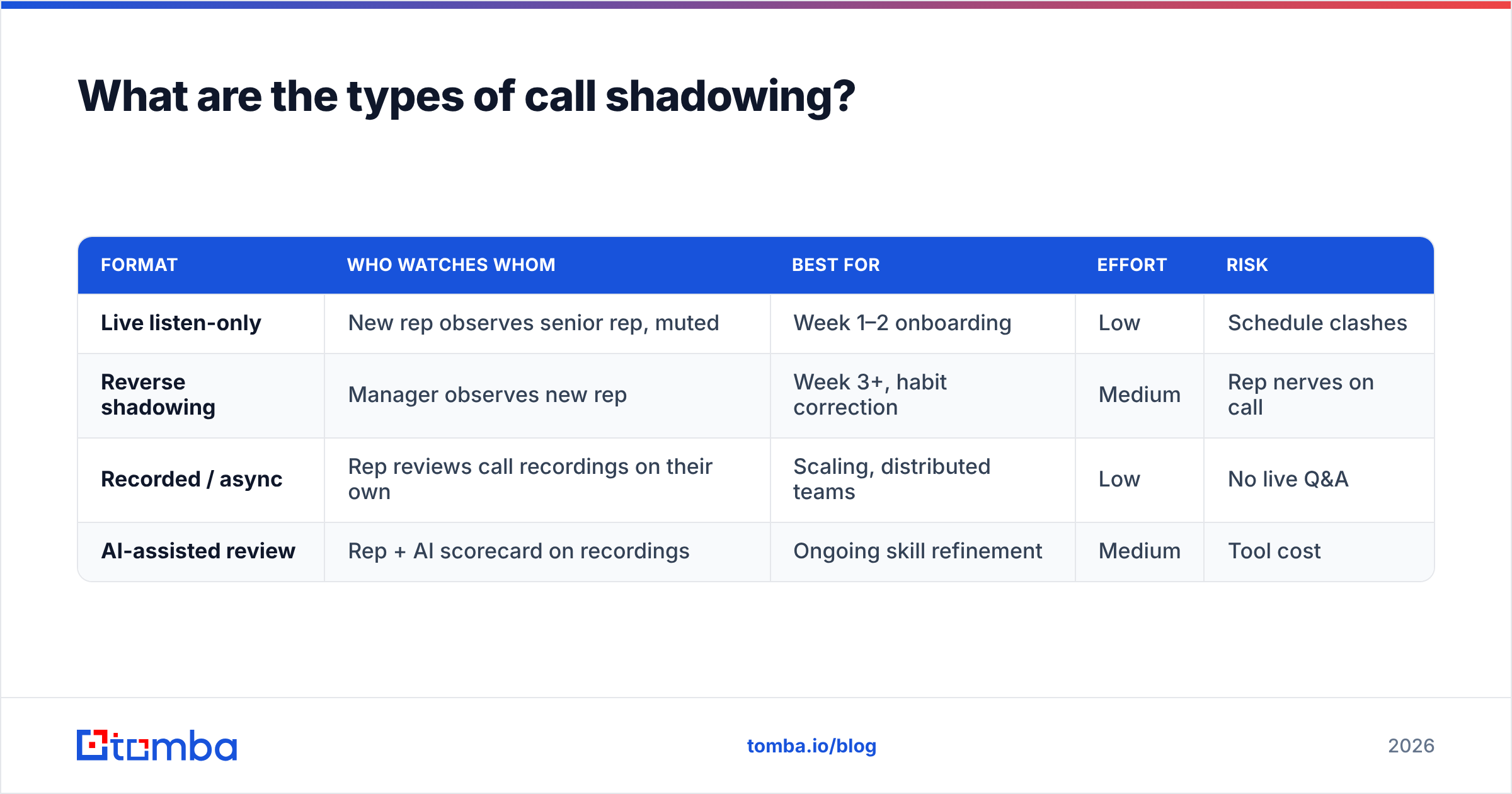
| Format | Who watches whom | Best for | Effort | Risk |
|---|---|---|---|---|
| Live listen-only | New rep observes senior rep, muted | Week 1–2 onboarding | Low | Schedule clashes |
| Reverse shadowing | Manager observes new rep | Week 3+, habit correction | Medium | Rep nerves on call |
| Recorded / async | Rep reviews call recordings on their own | Scaling, distributed teams | Low | No live Q&A |
| AI-assisted review | Rep + AI scorecard on recordings | Ongoing skill refinement | Medium | Tool cost |
Live listen-only is the classic. The trainee dials in muted, listens, and takes notes against a scorecard. Pair it with a screen share so they see the CRM and the deal context, not just the audio.
Reverse shadowing flips it. The new rep runs the call; the manager listens and coaches afterward. This is where you catch the habits a rep does not know they have — talking over prospects, skipping discovery, discounting too early.
Recorded async scales shadowing across time zones. A rep in one region learns from a call that happened yesterday in another. Modern conversation-intelligence platforms like Gong make this searchable, so a rep can pull "every call where we beat the incumbent" and binge them.
AI-assisted review layers automated scoring on top — talk-to-listen ratio, filler words, monologue length, sentiment shifts — so the human debrief focuses on judgment rather than counting "ums."
How do you run a call shadowing program step by step?#
A shadowing program is a process, not an invitation. Here is the framework that separates the teams who get results from the ones who waste an afternoon.
1. Set a single objective per session#
"Go listen to some calls" produces nothing. "Watch how Maya runs discovery and note every open-ended question she asks" produces a list the rep can copy tomorrow. One objective per session.
2. Pick the right rep to shadow#
Match the model to the goal. If the rep needs help with objection handling, they shadow your objection-handling specialist — not just whoever is free. Your highest closer is not always your best teacher; pick reps who can explain what they do.
3. Prep the shadower with a scorecard#
Hand the observer a structured sheet before the call. Without it, they watch passively and remember nothing. With it, they watch actively and walk out with notes.
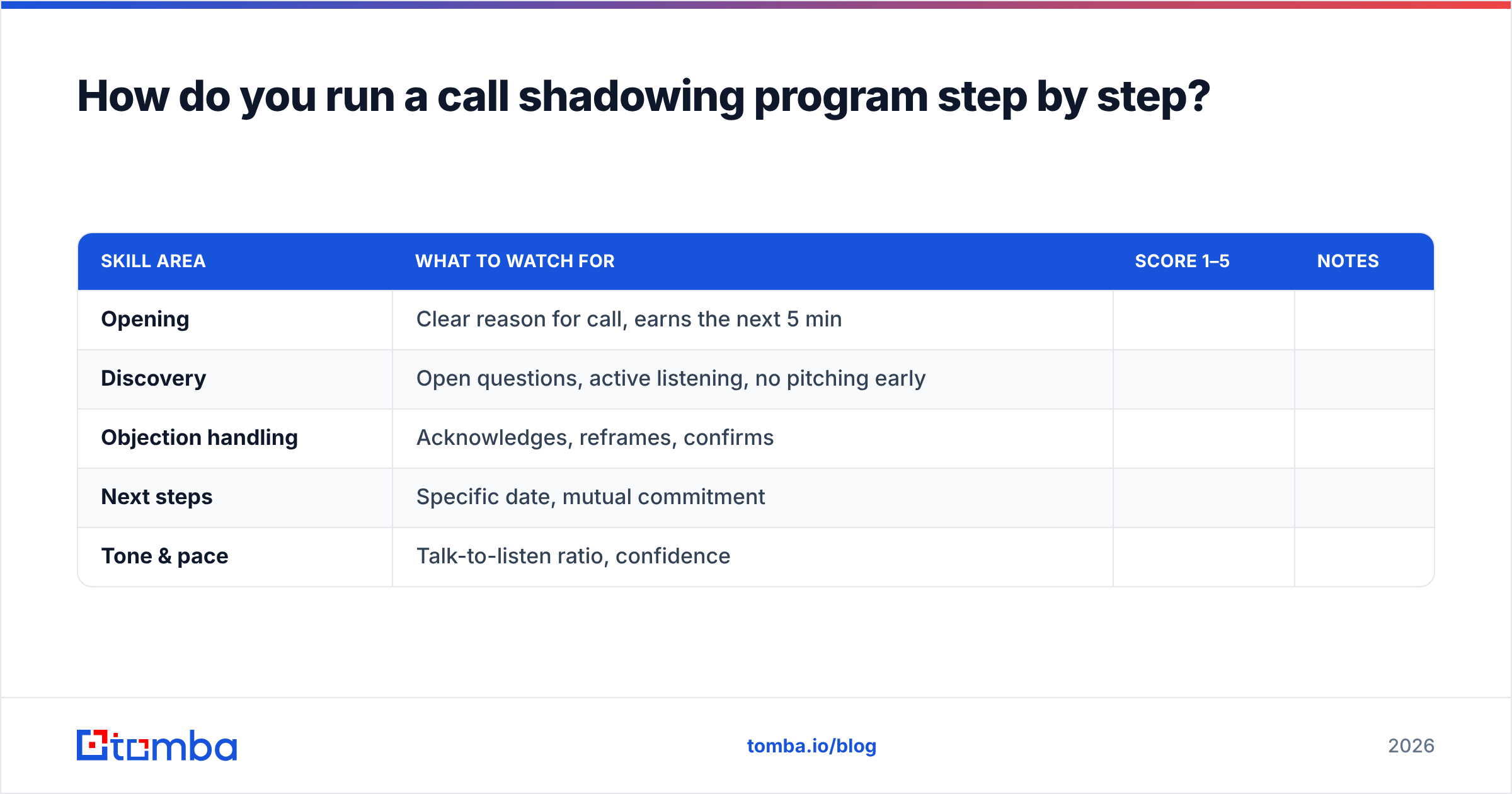
A simple shadowing scorecard:
| Skill area | What to watch for | Score 1–5 | Notes |
|---|---|---|---|
| Opening | Clear reason for call, earns the next 5 min | ||
| Discovery | Open questions, active listening, no pitching early | ||
| Objection handling | Acknowledges, reframes, confirms | ||
| Next steps | Specific date, mutual commitment | ||
| Tone & pace | Talk-to-listen ratio, confidence |
4. Debrief within 24 hours#
The debrief is the program. The call is just the raw material. Sit down, walk the scorecard, and ask the rep three questions: What worked? What would you do differently? What will you copy on your next call? Skip this and you have run a podcast, not a training.
5. Assign one action and follow up#
End every debrief with a single, testable change for the rep's next call. "Ask two more discovery questions before mentioning price." Then shadow that call to confirm the behavior changed. This is how shadowing compounds instead of evaporating.

What metrics prove call shadowing is working?#
If you cannot measure it, you cannot defend the time it costs. Track leading and lagging indicators together.
- Ramp time to first deal — the headline number. Shadowing should pull it down.
- Quota attainment by cohort — compare reps who shadowed structured sessions vs. those who did not.
- Talk-to-listen ratio — a behavioral proxy. New reps talk too much; good shadowing pushes the ratio toward listening.
- Objection-to-advance rate — how often a handled objection still moves to next steps.
- Response rate on follow-up sequences the rep writes after shadowing strong closers.
Log these in your CRM so the data lives next to the deals. Salesforce, HubSpot, and Pipedrive all let you tag onboarding cohorts; HubSpot's own sales enablement guidance is a reasonable baseline if you are building the program from scratch.
What are the common call shadowing mistakes?#
Most failed programs share the same handful of errors. Avoid these and you are ahead of 80% of teams.
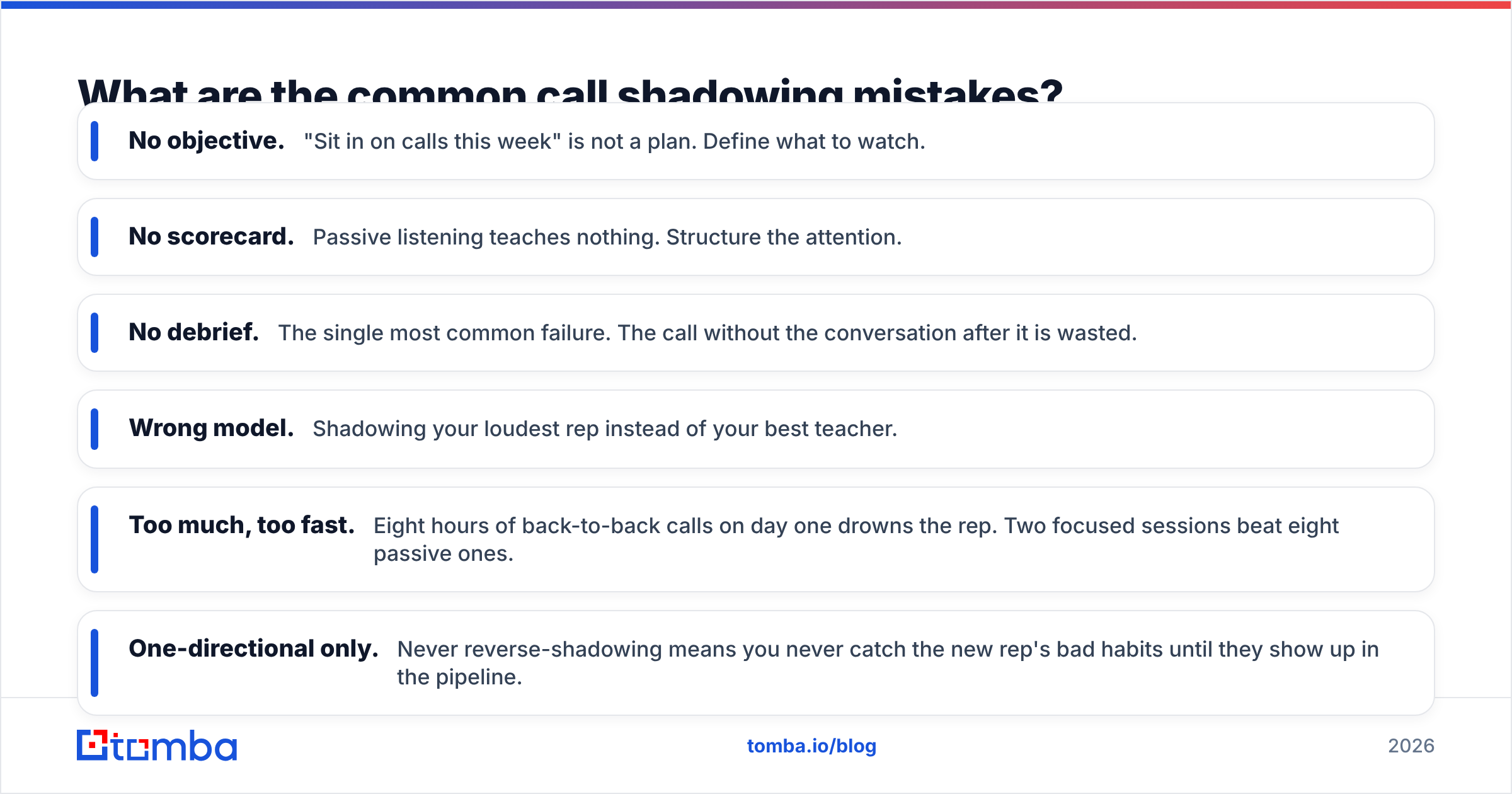
- No objective. "Sit in on calls this week" is not a plan. Define what to watch.
- No scorecard. Passive listening teaches nothing. Structure the attention.
- No debrief. The single most common failure. The call without the conversation after it is wasted.
- Wrong model. Shadowing your loudest rep instead of your best teacher.
- Too much, too fast. Eight hours of back-to-back calls on day one drowns the rep. Two focused sessions beat eight passive ones.
- One-directional only. Never reverse-shadowing means you never catch the new rep's bad habits until they show up in the pipeline.
- Ignoring the data layer. Reps who spend half the call confirming the contact is even reachable are not learning to sell — they are doing data entry. Clean data is a prerequisite, not a luxury.
That last point matters more than teams admit. Shadowing teaches the conversation; it cannot fix a list full of dead numbers and bounced emails. If your reps burn shadowing sessions on prospects who never pick up, you are coaching against noise.
How does data quality change what reps learn on calls?#
Conclusion first: garbage data poisons the lesson. When a rep shadows a call that connects on the first ring to the right decision-maker, they learn selling. When they shadow ten calls that go to voicemail because the number was wrong, they learn frustration.
Good shadowing assumes the contact data is already solid. That is upstream work. Before a rep ever dials, the list should be enriched and verified — accurate direct numbers, confirmed email addresses, and current titles. With reliable B2B phone numbers and validated contacts, every shadowed call is a real selling rep instead of a connectivity lottery.
This is where tooling and coaching meet. A platform that handles data enrichment and verification keeps the top of the funnel clean, so shadowing sessions teach conversation skills rather than data hygiene. Reps watch deals advance, not phones ring out.
| Without clean data | With clean data |
|---|---|
| Half the shadowed calls hit voicemail | Calls connect to real decision-makers |
| Rep learns "this is hard and random" | Rep learns repeatable conversation moves |
| Talk time wasted confirming who you reached | Talk time spent on discovery and value |
| Coaching debrief is about connectivity | Coaching debrief is about selling |
You can read more about where reliable contact data comes from if you want to understand what "clean" actually requires under the hood.
Is call shadowing worth it for small teams?#
Yes — arguably more so. A two-person team cannot afford a six-month bad hire, and formal training programs are overkill at that size. Shadowing is the highest-leverage onboarding a small team has: zero software required to start, and the only cost is a few hours of your best closer's time.
Start lean. One live session, one scorecard, one debrief. Record calls if your tools allow it so you build a library you can reuse for the next hire. As the team grows, layer in reverse shadowing and AI review. The practice scales from two reps to two hundred without changing its core logic.
For teams comparing the broader tool landscape, sites like G2 list conversation-intelligence and coaching platforms with verified reviews — useful once you outgrow manual shadowing and want recording, transcription, and automated scorecards.
Final takeaway and where to start#
Call shadowing is not "let the new person listen in." It is a structured loop: objective, scorecard, observation, debrief, one action, follow-up. Run that loop and reps ramp faster, sound more consistent, and close more. Skip the structure and you are just paying two people to be on one call.
The prerequisite nobody mentions is data. Shadowing teaches reps how to win conversations — but only if those conversations happen with the right people. Before your next session, make sure your reps are dialing verified contacts, not guesses.
Start there. Use the Tomba Email Finder to build clean, verified contact lists so every shadowed call connects to a real decision-maker. Check the Tomba pricing to find the plan that fits your team — the Free tier gives you 25 searches a month to test it, and Starter is $49/mo when you scale. Clean data in, better calls to shadow, faster ramp out.
// get started
Find, verify and enrich your first contacts today
Start on the free plan with 25 searches a month, then scale when your team is ready.
Free plan · No credit card required · GDPR & CCPA
// about the author