CaptivateIQ Pricing, Reviews, Pros and Cons (2026 Guide)
A neutral breakdown of CaptivateIQ pricing, real user reviews, and the honest pros and cons of the commission platform before you sign a 2026 contract.
Sales compensation is where motivation meets math, and CaptivateIQ is one of the best-known tools for getting that math right. But "best-known" doesn't always mean "best fit for your team." Before you commit budget for 2026, you need the unvarnished version of the CaptivateIQ pricing, reviews, pros and cons story — not the demo-day highlight reel.
This guide pulls together public pricing signals, real user sentiment, and the trade-offs that matter when you're choosing a commission engine for your revenue org.
TL;DR#
- CaptivateIQ is a no-code sales commission and incentive compensation management (ICM) platform built to replace error-prone spreadsheets.
- Pricing is quote-only — there's no public price list, and most teams land in the four- to six-figure annual range depending on payee count and complexity.
- Reviews are strong on flexibility and UI (4.7/5 on G2 across thousands of reviews) but soft on implementation time and admin learning curve.
- Best fit: mid-market and enterprise teams with complex, frequently changing comp plans. Weak fit: tiny teams that just need a simple percentage calculator.
- The data feeding your comp plans matters as much as the engine — bad contact and account data sinks even a perfect commission model.
What is CaptivateIQ?#
CaptivateIQ is a sales commission management platform. In plain terms, it's the system that takes your closed deals, applies your comp plan rules, and tells every rep exactly what they earned and why — without a finance analyst rebuilding a spreadsheet every month.
Think of it like payroll software, but for variable pay. Payroll handles the predictable salary; CaptivateIQ handles the messy, conditional, "if the rep hit 90% of quota in a multi-year deal with a 12% accelerator" part. It connects to your CRM, your billing system, and your HRIS, then runs the calculations automatically and gives reps a self-service portal to see their statements.
The platform competes in the same space as Spiff (now Salesforce), Xactly, CaptivateIQ, and Everstage. Its pitch is "no-code flexibility" — comp admins can model plans without writing SQL or filing an engineering ticket for every change.
Who actually uses it?#
- RevOps and sales-comp teams that own plan design and monthly payouts.
- Finance that needs accurate accruals and ASC 606 commission expensing.
- Sales reps and managers who want real-time visibility into earnings instead of waiting for a month-end email.
If your comp plans change every quarter, span multiple roles, and involve accelerators, SPIFs, draws, and clawbacks, this is the category of tool you're shopping for. If you pay a flat 10% on every deal, you're overbuying.
How much does CaptivateIQ cost in 2026?#
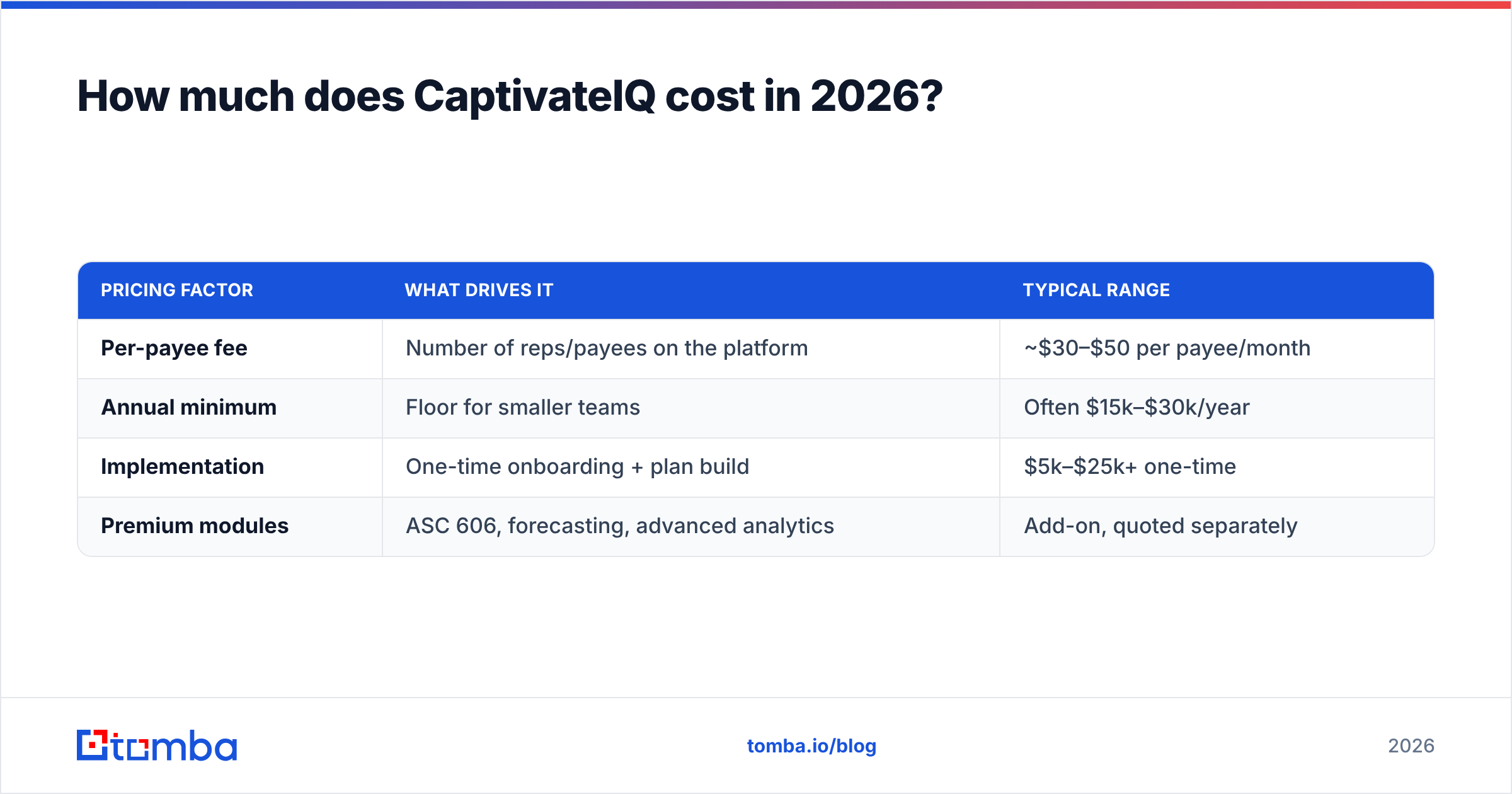
Short answer: there is no public price — CaptivateIQ uses custom, quote-based pricing. You request a demo, they scope your payee count and plan complexity, and you get a contract. That's standard for the ICM category, but it makes budgeting harder than a tool with a published pricing page.
Based on public review-site data, third-party marketplaces, and buyer reports, here's the realistic shape of CaptivateIQ pricing:
| Pricing factor | What drives it | Typical range |
|---|---|---|
| Per-payee fee | Number of reps/payees on the platform | ~$30–$50 per payee/month |
| Annual minimum | Floor for smaller teams | Often $15k–$30k/year |
| Implementation | One-time onboarding + plan build | $5k–$25k+ one-time |
| Premium modules | ASC 606, forecasting, advanced analytics | Add-on, quoted separately |
A few honest caveats: those numbers are directional, not a quote. Two companies with the same headcount can pay very differently based on plan complexity, contract length, and how hard they negotiate. Annual prepayment and multi-year commitments are the usual levers for a discount.
Is CaptivateIQ worth the price?#
For the right buyer, yes. If you're spending 40 hours a month wrangling commission spreadsheets, paying reps late, and fielding disputes, the cost of CaptivateIQ is often less than the loaded cost of that manual labor — plus the trust you lose every time a payout is wrong. For a five-person team with simple plans, the ROI math rarely works.
What do CaptivateIQ reviews say?#
CaptivateIQ holds a strong 4.7 out of 5 on G2 across thousands of reviews, and similar marks on Capterra. That's a genuinely good score for enterprise software. But aggregate stars hide the texture, so here's what reviewers consistently say once you read past the rating.
What users praise:
- Plan flexibility. Reviewers repeatedly call out the ability to model unusual comp structures without engineering help. This is the #1 reason teams pick it.
- Rep-facing transparency. The self-service statements reduce "where's my commission?" tickets and disputes.
- Responsive support and CSM relationships during and after onboarding.
- Clean, modern UI compared to legacy ICM tools that feel like 2009.
What users criticize:
- Implementation takes time. Standing up complex plans is a project, not an afternoon. Several reviewers mention weeks-to-months timelines.
- Admin learning curve. "No-code" still means learning CaptivateIQ's logic model. Power users love it; occasional admins find it steep.
- Reporting gaps. Some teams want deeper, more customizable analytics out of the box.
- Pricing opacity. Buyers dislike not being able to compare costs without a sales call.
The pattern is typical for the category: the tool is powerful, and that power has a setup cost. None of these are dealbreakers — they're expectations to set before you sign.
CaptivateIQ pros and cons at a glance#
Here's the honest balance sheet.
- Pro — No-code plan builder. Change comp logic without filing engineering tickets. This is the headline strength.
- Pro — Rep transparency. Real-time statements cut disputes and build trust with the sales floor.
- Pro — Strong integrations. Connects to Salesforce, HubSpot, Snowflake, NetSuite, and major HRIS systems.
- Con — Opaque, quote-only pricing. Hard to budget or comparison-shop without a sales cycle.
- Con — Implementation lift. Complex plans need real onboarding time and an internal owner.
- Con — Overkill for simple teams. If your plan fits on one spreadsheet tab, you don't need this.
The takeaway: CaptivateIQ rewards complexity. The more tangled your comp plans, the more value you extract. The simpler your plans, the more you're paying for capability you won't use.
How does CaptivateIQ compare to alternatives?#
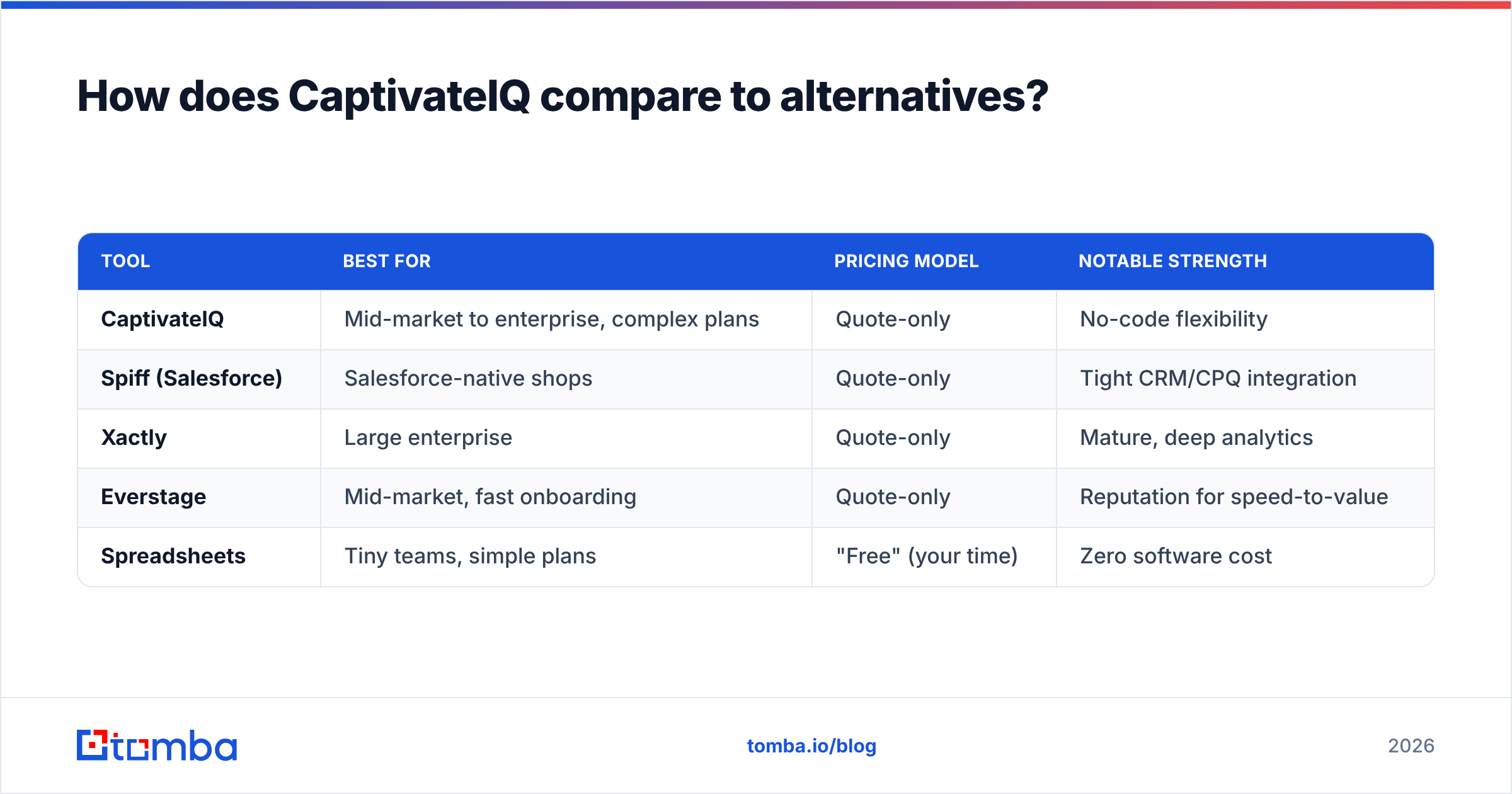
You're rarely choosing CaptivateIQ in a vacuum. The realistic shortlist for 2026 looks like this:
| Tool | Best for | Pricing model | Notable strength |
|---|---|---|---|
| CaptivateIQ | Mid-market to enterprise, complex plans | Quote-only | No-code flexibility |
| Spiff (Salesforce) | Salesforce-native shops | Quote-only | Tight CRM/CPQ integration |
| Xactly | Large enterprise | Quote-only | Mature, deep analytics |
| Everstage | Mid-market, fast onboarding | Quote-only | Reputation for speed-to-value |
| Spreadsheets | Tiny teams, simple plans | "Free" (your time) | Zero software cost |
If you live inside Salesforce, Spiff's native fit is worth weighing. If you're a massive enterprise with armies of analysts, Xactly's depth appeals. If onboarding speed is your priority, Everstage markets aggressively on that. CaptivateIQ tends to win when you want enterprise-grade flexibility with a more modern admin experience than the legacy incumbents.
What's the hidden cost that no comp tool fixes?#
Bad source data. A commission engine is only as accurate as the deal, account, and contact data feeding it — and this is where most comp problems actually start. CaptivateIQ will faithfully calculate the wrong payout if the CRM record behind it is wrong: duplicate accounts, misattributed deals, stale owner fields, or contacts that bounced before the deal ever had a chance.
This is the part of the stack that sits upstream of CaptivateIQ, and it's where a lot of revenue teams quietly bleed money. If your reps are working off incomplete or inaccurate contact data, your pipeline is distorted before comp ever enters the picture. Clean, enriched records make every downstream system — CRM, forecasting, and commissions — more trustworthy.
That's the layer Tomba operates in. Before a deal becomes a commission line, someone had to find the right buyer, reach them, and log accurate data. Using a reliable email finder and ongoing data enrichment keeps the contact and account records feeding your CRM accurate — which means the deals feeding CaptivateIQ are clean too. A healthy B2B database at the top of the funnel pays dividends all the way down to payout accuracy.

Who should buy CaptivateIQ — and who shouldn't?#
Buy it if:
- You have 25+ payees and comp plans that change at least quarterly.
- You're currently running commissions in spreadsheets and it's breaking.
- Finance needs audit-ready ASC 606 commission expensing.
- Rep disputes and payout errors are costing you trust and time.
Skip it (for now) if:
- You have a handful of reps on flat-percentage plans.
- Your comp logic genuinely fits in one well-built spreadsheet.
- You can't assign an internal owner to run implementation and ongoing admin.
The honest rule of thumb: ICM software earns its keep when manual comp management has become a recurring monthly fire drill. If it hasn't yet, you have runway to wait — but plan ahead, because migrating off spreadsheets gets harder as headcount grows.
How do you evaluate CaptivateIQ in a demo?#
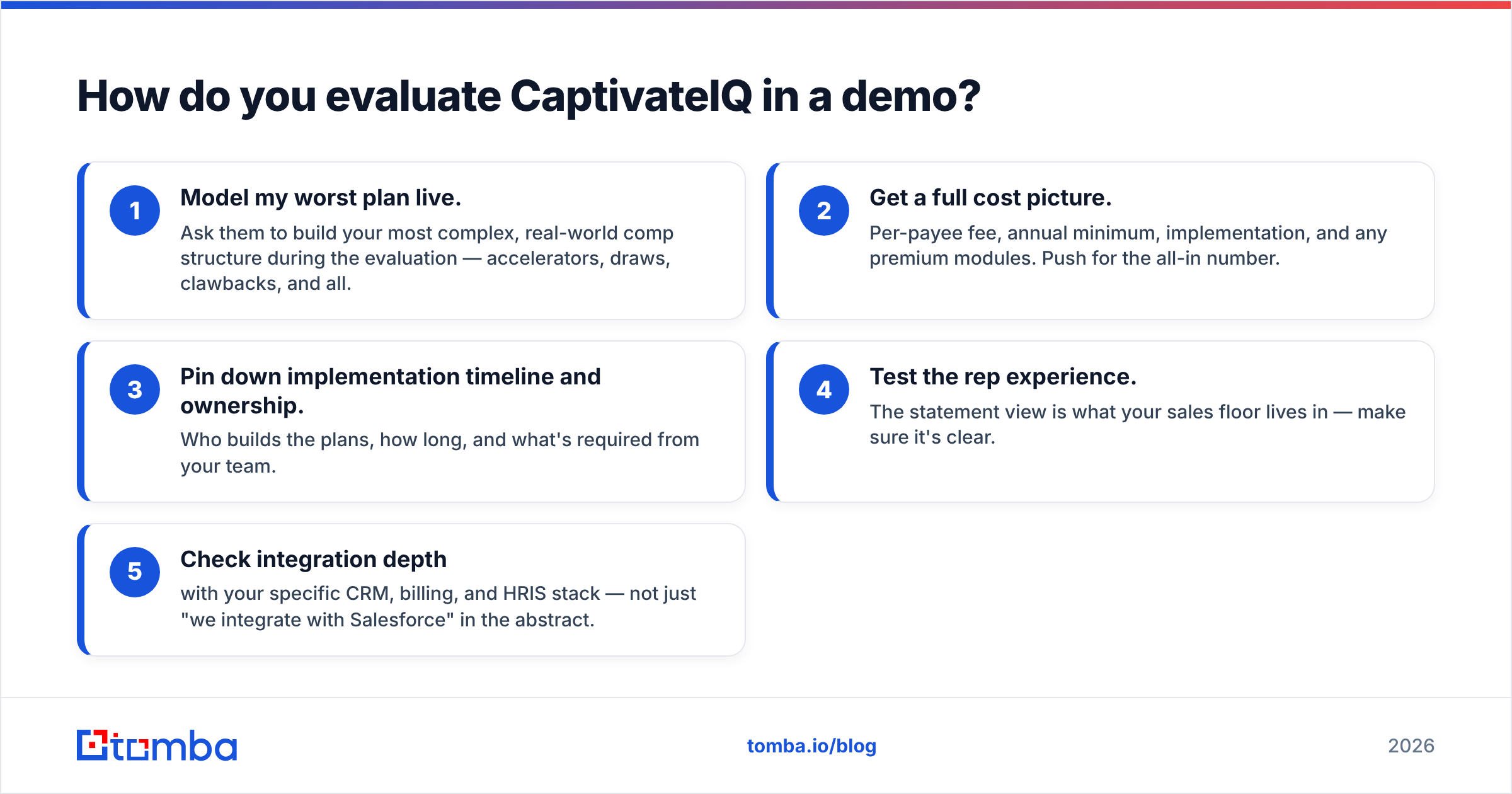
Don't let the demo drive you. Walk in with your hardest comp plan and these questions:
- Model my worst plan live. Ask them to build your most complex, real-world comp structure during the evaluation — accelerators, draws, clawbacks, and all.
- Get a full cost picture. Per-payee fee, annual minimum, implementation, and any premium modules. Push for the all-in number.
- Pin down implementation timeline and ownership. Who builds the plans, how long, and what's required from your team.
- Test the rep experience. The statement view is what your sales floor lives in — make sure it's clear.
- Check integration depth with your specific CRM, billing, and HRIS stack — not just "we integrate with Salesforce" in the abstract.
Treat the trial like a stress test, not a tour. The vendors that handle your ugliest plan gracefully are the ones worth shortlisting.
The bottom line on CaptivateIQ pricing, reviews, pros and cons#
CaptivateIQ is a strong, well-reviewed commission platform that genuinely shines for mid-market and enterprise teams with complex, evolving comp plans. The pros — no-code flexibility, rep transparency, solid integrations — are real. The cons — opaque pricing, implementation lift, and overkill for simple teams — are equally real and easy to underestimate.
Price it against your actual pain: if manual commissions are eating real hours and trust every month, the investment usually pays back. If they're not, you have time to grow into it.
And whichever comp tool you choose, remember that it sits at the end of your revenue process. The accuracy of every payout depends on the accuracy of the data that started the deal. If your team is still chasing prospects with guesswork contact info, start there: use the Tomba Email Finder to find verified professional emails by name or domain, keep your CRM clean with enrichment, and make sure every deal that eventually hits CaptivateIQ was built on data you can trust. Clean inputs, correct payouts — that's the order it has to happen in.
// get started
Find, verify and enrich your first contacts today
Start on the free plan with 25 searches a month, then scale when your team is ready.
Free plan · No credit card required · GDPR & CCPA
// about the author