How to Use Case Studies for Sales to Close Deals in 2026
Most sales case studies sit unread in a folder. Here's how to build, structure, and deploy case studies for sales that actually move deals to closed-won.
TL;DR
- A sales case study is proof, not marketing fluff. Its only job is to help a prospect picture themselves getting the same result.
- The best case studies for sales follow a tight problem → action → result arc, lead with a hard number, and run under one page.
- Distribution beats production. A great case study no rep ever sends is worthless — map each story to a deal stage and a buyer persona.
- Build a small, well-targeted prospect list first, then send the right proof to the right account. Accurate contact data is what makes the story land in the right inbox.
- Measure case study influence on win rate, not downloads. If a story does not move deals, replace it.
What is a case study for sales (and what it is not)?#
A sales case study is a short, structured account of how one customer used your product to solve a specific problem and got a measurable result. That is it. It is a proof artifact a rep hands a skeptical buyer to shrink the gap between "this sounds nice" and "this could work for us."
Here is the analogy: a case study is a restaurant review from someone who eats exactly what your prospect wants to order. A generic five-star rating ("great food!") does nothing. A review that says "I came in gluten-free and skeptical, and the chef rebuilt the tasting menu in ten minutes" — that sells the table. Specificity is the entire product.
What a sales case study is not:
- A press release celebrating your own launch.
- A feature list dressed up with a customer logo.
- A 12-page PDF that only the marketing team has ever finished reading.
The difference matters because buyers have changed. According to Gartner, B2B buyers spend the majority of their purchase journey researching independently and talking to peers — not to your reps. Your case study is how you get a seat in that independent research. Get it right and it does selling work while your reps sleep.

Wait — ignore that placeholder. The point stands without a benchmark chart: proof beats assertion every time.
Why do case studies for sales outperform every other type of content?#
Because they reduce perceived risk, and risk is what actually kills B2B deals. A prospect rarely says no because they doubt your product works. They say no because they doubt it will work for them, in their stack, with their constraints, without blowing up their quarter. A case study answers that doubt with evidence from someone who looked just like them.
Consider the hierarchy of persuasion a buyer runs through:
- You say it works. Lowest trust. You are biased; everyone knows it.
- A review site says it works. Better — third-party platforms like G2 carry weight because they are harder to game.
- A customer exactly like the buyer says it worked, with numbers. Highest trust. This is the case study.
The gap between level one and level three is where deals are won. That is why a single well-matched case study often outperforms a deck of feature slides. It moves the conversation from "convince me" to "show me how we'd start."
There is also a velocity benefit. Stories travel inside buying committees in a way feature lists do not. The champion who has to sell your product internally to a CFO and a head of IT needs ammunition. A one-page case study with a CFO-friendly number is the artifact they forward. You are not just persuading your contact — you are arming them.
What makes a sales case study actually convert?#
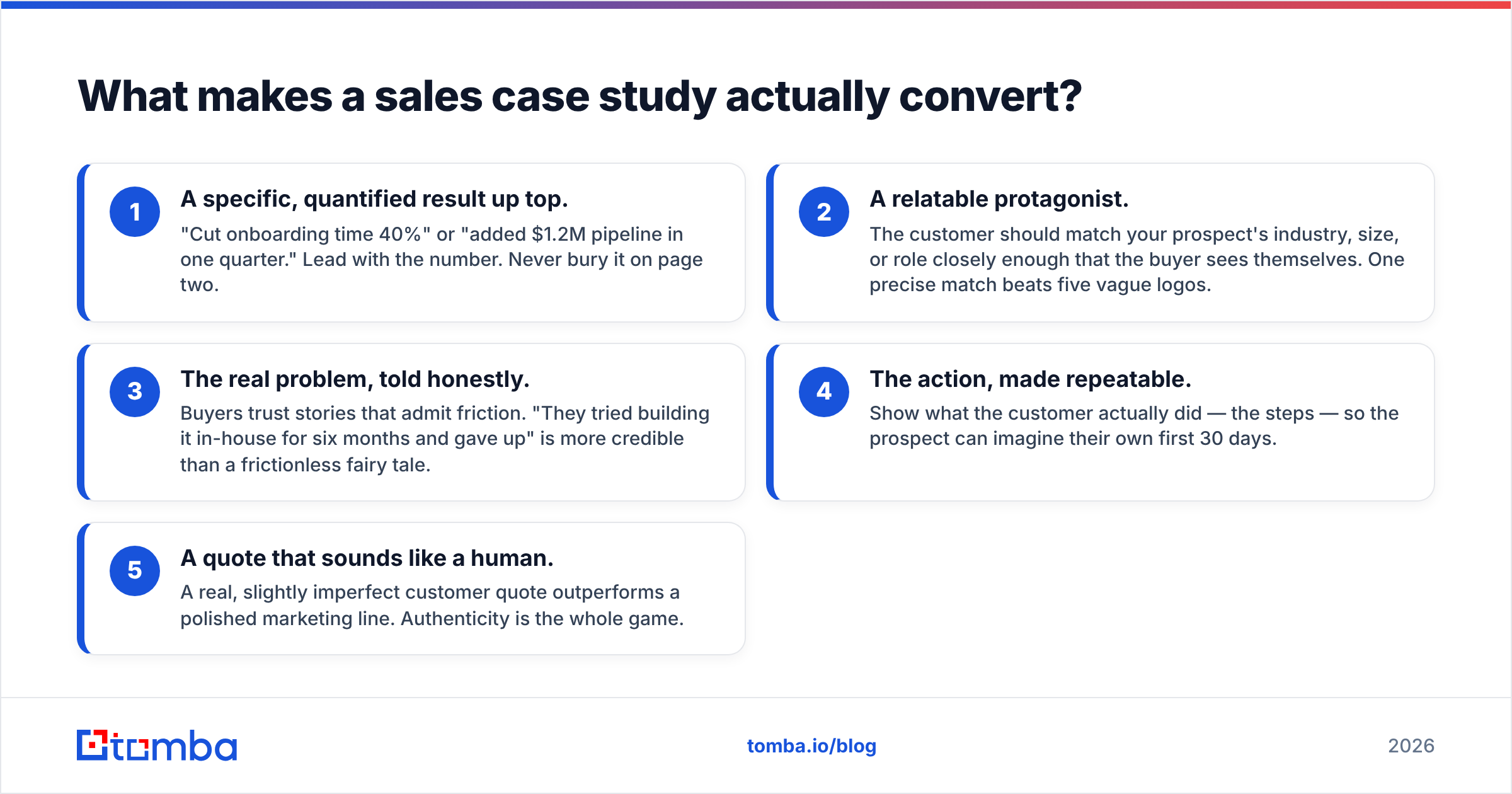
Five things, in order of importance. Miss the first and the rest do not matter.
- A specific, quantified result up top. "Cut onboarding time 40%" or "added $1.2M pipeline in one quarter." Lead with the number. Never bury it on page two.
- A relatable protagonist. The customer should match your prospect's industry, size, or role closely enough that the buyer sees themselves. One precise match beats five vague logos.
- The real problem, told honestly. Buyers trust stories that admit friction. "They tried building it in-house for six months and gave up" is more credible than a frictionless fairy tale.
- The action, made repeatable. Show what the customer actually did — the steps — so the prospect can imagine their own first 30 days.
- A quote that sounds like a human. A real, slightly imperfect customer quote outperforms a polished marketing line. Authenticity is the whole game.
A note on length: shorter wins. The case study a rep can summarize in two sentences and attach to an email gets used. The one that needs a meeting to walk through gathers dust.
What is the best structure for a sales case study in 2026?#
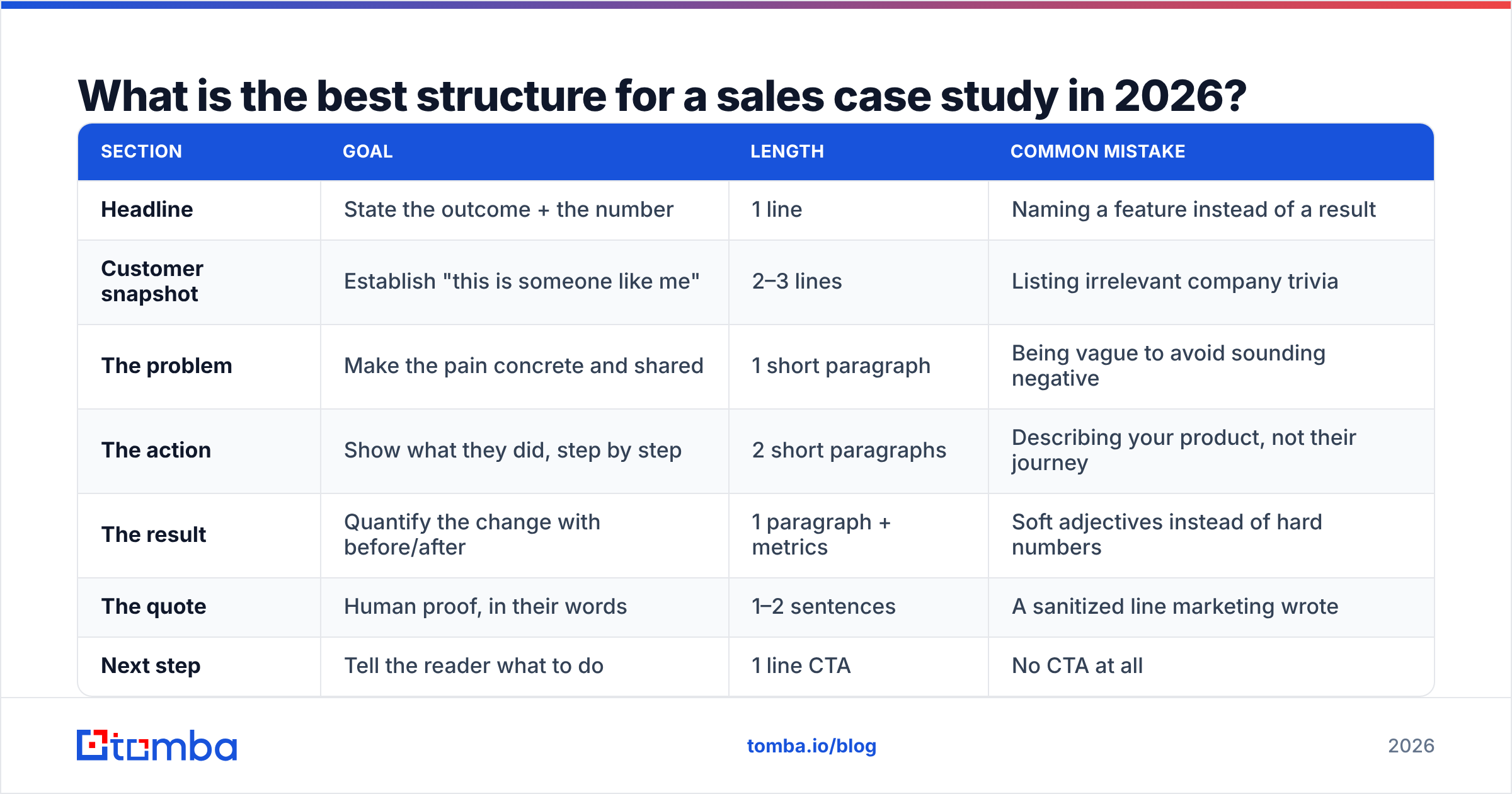
Use the Problem–Action–Result (PAR) arc. It is the spine of every story that has ever sold anything, and it keeps you from drifting into feature-dump territory. Here is the full skeleton with target lengths.
| Section | Goal | Length | Common mistake |
|---|---|---|---|
| Headline | State the outcome + the number | 1 line | Naming a feature instead of a result |
| Customer snapshot | Establish "this is someone like me" | 2–3 lines | Listing irrelevant company trivia |
| The problem | Make the pain concrete and shared | 1 short paragraph | Being vague to avoid sounding negative |
| The action | Show what they did, step by step | 2 short paragraphs | Describing your product, not their journey |
| The result | Quantify the change with before/after | 1 paragraph + metrics | Soft adjectives instead of hard numbers |
| The quote | Human proof, in their words | 1–2 sentences | A sanitized line marketing wrote |
| Next step | Tell the reader what to do | 1 line CTA | No CTA at all |
A few rules that separate a working case study from a vanity one:
- One page or one screen. If it scrolls forever, it will not get sent.
- Numbers in the headline and the result. A case study with no metric is a testimonial.
- Before/after framing. "From 12% reply rate to 31%" tells a story; "31% reply rate" is a stat.
- A skimmable layout. Bold the metrics. Most readers scan first and commit second.
If you want a deeper benchmark on what "good" looks like, HubSpot's case study research is a solid neutral reference for structure and format conventions.
How do you get the raw material to write one?#
You interview the customer — but the harder, more common bottleneck is finding the right customers and contacts in the first place. You need two lists: happy customers willing to be quoted, and prospects who match those customers closely enough to be persuaded by their story.
This is where contact data quietly decides everything. A perfect case study mailed to a stale or wrong address never gets read. Building a clean, accurate target list is the unglamorous half of "case studies for sales" that nobody puts in the blog headline.
A practical workflow:
- Identify look-alike accounts. Pull companies that resemble your best case study subjects by industry and size.
- Find the right decision-maker, not a generic inbox. Use an email finder to get the verified address of the actual buyer — the VP, not info@.
- Verify before you send. Run addresses through an email verifier so your proof lands instead of bouncing and torching your sender reputation.
- Enrich for personalization. Layer on data enrichment — role, company size, tech stack — so you can attach the case study that actually matches each account.
Get this layer right and your best case study reaches the exact buyer most likely to be moved by it. Get it wrong and your best work bounces.
How should reps actually deploy case studies in the pipeline?#
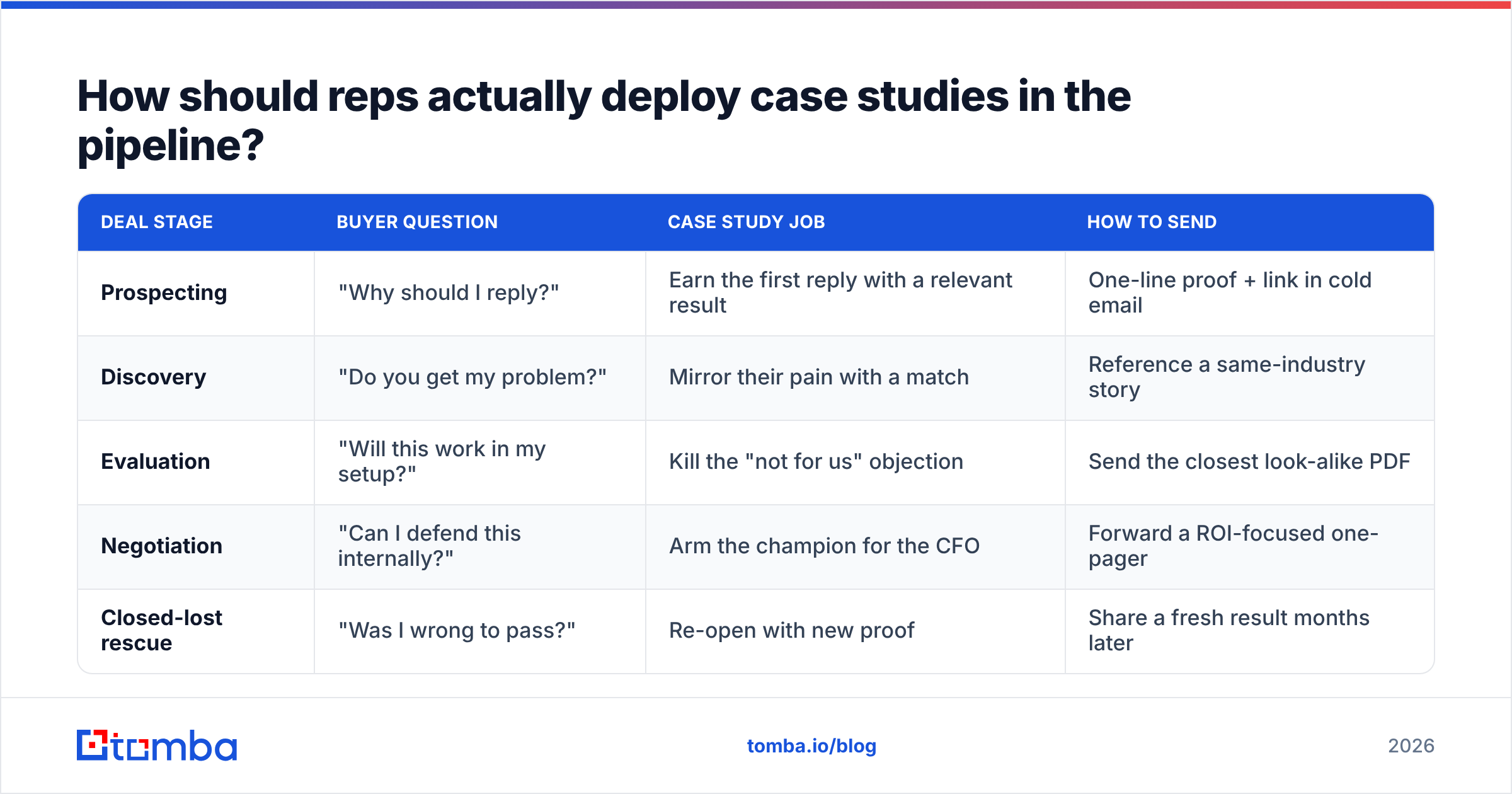
Production is the easy part; deployment is where most teams lose the value. A case study is a tool, and tools belong at specific points in the deal. Map each story to a stage and a job.
| Deal stage | Buyer question | Case study job | How to send |
|---|---|---|---|
| Prospecting | "Why should I reply?" | Earn the first reply with a relevant result | One-line proof + link in cold email |
| Discovery | "Do you get my problem?" | Mirror their pain with a match | Reference a same-industry story |
| Evaluation | "Will this work in my setup?" | Kill the "not for us" objection | Send the closest look-alike PDF |
| Negotiation | "Can I defend this internally?" | Arm the champion for the CFO | Forward a ROI-focused one-pager |
| Closed-lost rescue | "Was I wrong to pass?" | Re-open with new proof | Share a fresh result months later |
Two principles tie this together:
- Match before you send. A SaaS founder does not care about a manufacturing logo. The relevance of the match matters more than the size of the result. A modest result from an identical company beats a huge result from an unrelated one.
- Make it forwardable. Your contact is rarely the final decision-maker. Build the one-pager so it survives being forwarded with zero context — headline, number, quote, logo, CTA, done.
Keeping all of this organized is a job for your CRM. Tag each case study by industry, persona, and objection it answers, so a rep in a live deal can pull the right proof in ten seconds instead of digging through a shared drive. The teams that win with case studies are not the ones with the most stories — they are the ones whose reps can find the right story instantly.
How do you measure whether your case studies are working?#
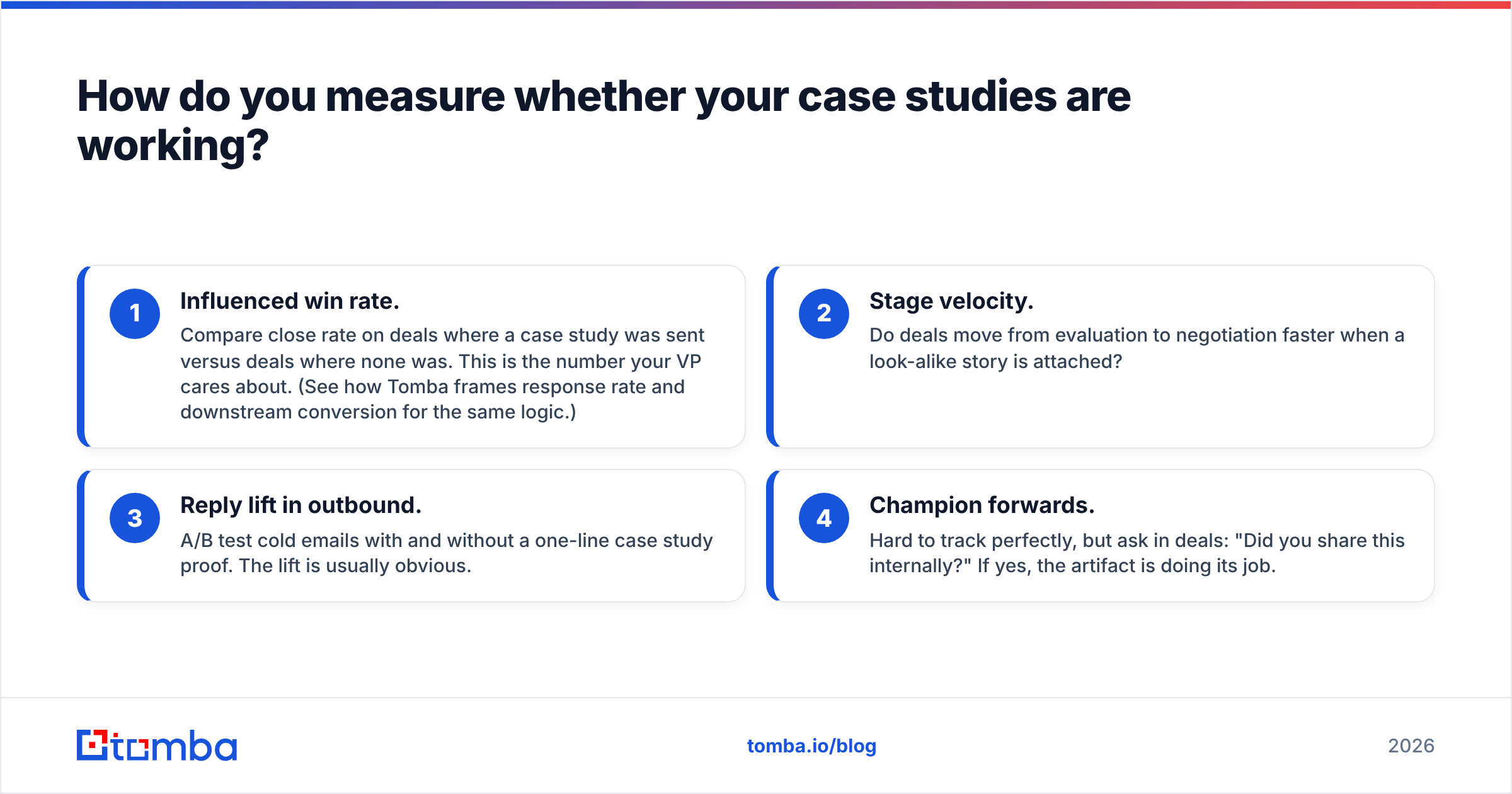
Stop counting downloads. Downloads measure curiosity, not influence. Measure whether deals that touched a case study close at a higher rate and move faster than deals that did not.
Track these instead:
- Influenced win rate. Compare close rate on deals where a case study was sent versus deals where none was. This is the number your VP cares about. (See how Tomba frames response rate and downstream conversion for the same logic.)
- Stage velocity. Do deals move from evaluation to negotiation faster when a look-alike story is attached?
- Reply lift in outbound. A/B test cold emails with and without a one-line case study proof. The lift is usually obvious.
- Champion forwards. Hard to track perfectly, but ask in deals: "Did you share this internally?" If yes, the artifact is doing its job.
Then prune ruthlessly. If a case study has been in circulation for a quarter and shows no measurable influence, it is not a keeper — retire it and build one for a segment that needs proof. A library of six high-converting, well-matched stories beats forty generic ones nobody sends.
A quick reality check on cadence: refresh your numbers. A case study that says "results from 2023" reads as stale in 2026. Re-interview your best references annually, update the metrics, and bump the date. Proof has a shelf life.
What are the most common case study mistakes to avoid?#
- Leading with your company instead of the customer. Nobody opens a case study to read about you. They open it to read about themselves.
- No number. If there is no metric, you wrote a testimonial. Useful, but not a case study.
- One generic version for everyone. Build variants by persona. A CFO and a practitioner need different headlines from the same story.
- Writing it once and never updating it. Stale results undercut the credibility you were trying to build.
- Producing dozens and distributing none. The single biggest waste in B2B content. Production without a distribution plan is a hobby, not a sales motion.
- Sending to the wrong contact. A perfect story to a bounced or junior inbox is invisible. This is why the data layer comes first.
Turn your proof into pipeline#
Case studies for sales only work when the right story reaches the right buyer in a verified inbox at the right moment in the deal. The story is your craft. The targeting is your infrastructure — and that is where most teams quietly leak their best work.
Start with the list. Use the Tomba Email Finder to find and verify the exact decision-makers at accounts that look like your best customers, then send each one the case study built for their world. You can test it free — the Tomba pricing free tier gives you 25 searches a month, with paid plans starting at $49/mo when you scale your outbound. Pair great proof with accurate contact data, and your case studies stop gathering dust and start closing deals.
// get started
Find, verify and enrich your first contacts today
Start on the free plan with 25 searches a month, then scale when your team is ready.
Free plan · No credit card required · GDPR & CCPA
// about the author