The Challenger Sale Book: 2026 Summary, Review & Playbook
A no-fluff 2026 breakdown of the Challenger Sale book: the five rep profiles, the Teach-Tailor-Take Control model, what still holds up, and how to run it.
TL;DR
- The Challenger Sale book (Dixon & Adamson, 2011) makes a blunt case. In complex B2B deals, the best reps aren't relationship-builders. They're "Challengers" who teach, tailor, and take control.
- The research scored about 6,000 reps across five profiles. Challengers dominated high-complexity sales, while Relationship Builders fell behind.
- The core method is Commercial Teaching. You lead with a sharp insight about the customer's business, then reframe it toward your solution.
- It works best for high-consideration, multi-stakeholder deals. And it depends on reaching the right people with the right data.
- Below: a full summary, the five profiles, an honest critique, a comparison with other methods, and a practical 2026 playbook.
What is the Challenger Sale book about?#
The Challenger Sale book makes one uncomfortable claim. The friendly, relationship-driven rep your sales culture probably celebrates is not your top performer in complex deals. Authors Matthew Dixon and Brent Adamson worked out of the research firm CEB (now part of Gartner). They studied thousands of B2B sales reps. Performance clustered into five distinct profiles. The profile that won the hardest deals was the one that pushed customers, raised tension, and challenged their thinking. It was not the one that built warm rapport.
The book reframes selling. The old way says "build trust, then ask what the customer needs." The Challenger Sale book says "teach the customer something they didn't know about their own business, then guide them to act." That shift made it one of the most cited B2B sales texts of the last 15 years. It gave structure to something good salespeople did by instinct.
This summary covers what the book actually says. It walks through each profile, where the model holds up in 2026, where it gets criticized, and how to use it without turning your team into a room full of argumentative know-it-alls.
Who are the five Challenger Sale profiles?#
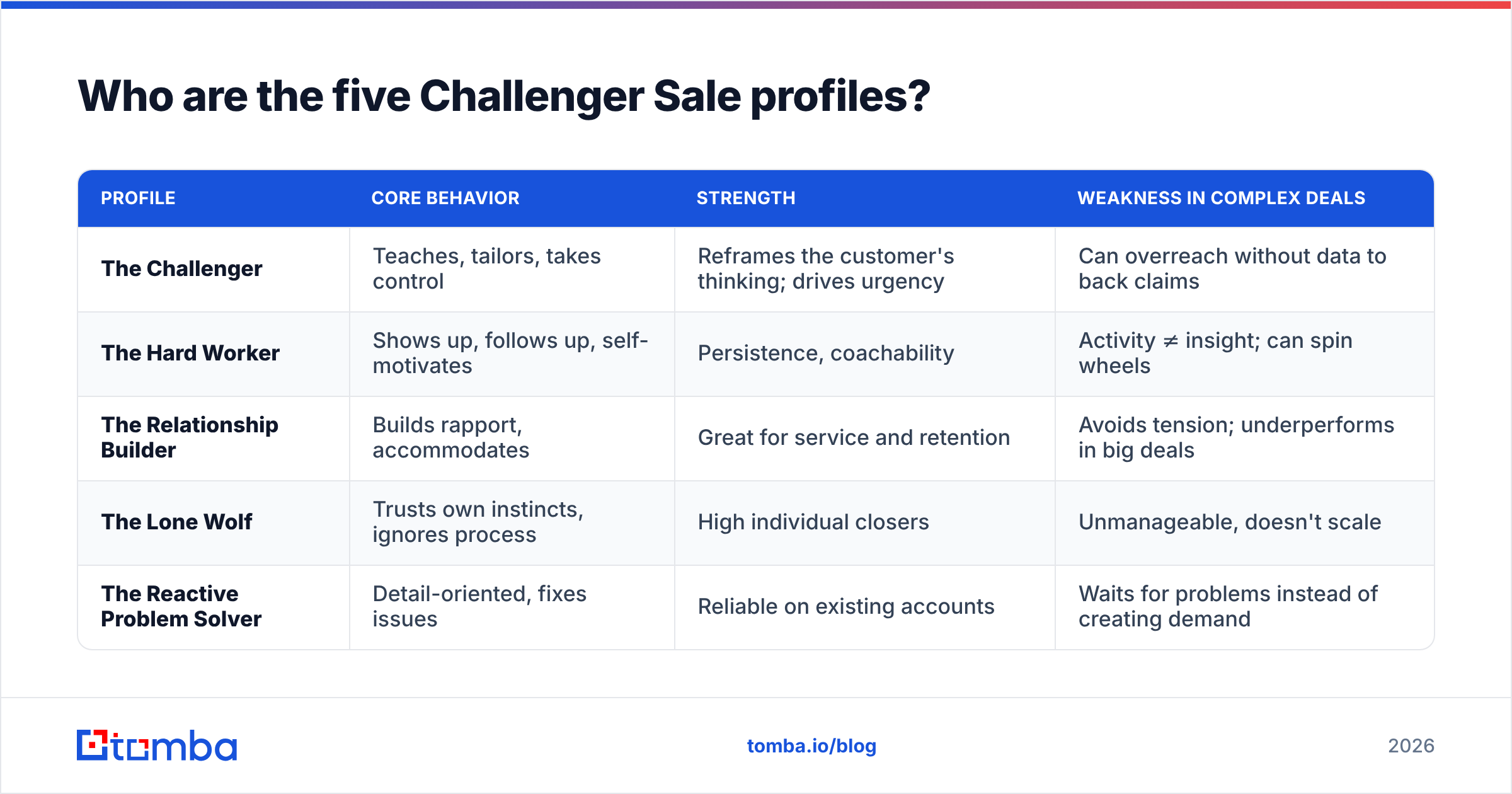
The book's spine is its taxonomy of five rep types. Dixon and Adamson argue that every seller leans toward one dominant style. That style predicts performance more than experience or charisma does.
| Profile | Core behavior | Strength | Weakness in complex deals |
|---|---|---|---|
| The Challenger | Teaches, tailors, takes control | Reframes the customer's thinking; drives urgency | Can overreach without data to back claims |
| The Hard Worker | Shows up, follows up, self-motivates | Persistence, coachability | Activity ≠ insight; can spin wheels |
| The Relationship Builder | Builds rapport, accommodates | Great for service and retention | Avoids tension; underperforms in big deals |
| The Lone Wolf | Trusts own instincts, ignores process | High individual closers | Unmanageable, doesn't scale |
| The Reactive Problem Solver | Detail-oriented, fixes issues | Reliable on existing accounts | Waits for problems instead of creating demand |
The headline finding is stark. 40% of high performers were Challengers. Relationship Builders made up the largest share of under-performers. In the hardest deals, the gap got wider. Challengers were roughly half of all star performers.
The book raises a few honest caveats. These are tendencies, not boxes. Most reps blend traits. The data also skews toward complex, high-consideration B2B sales. In transactional or low-stakes purchases, the Challenger edge shrinks or disappears. If you sell a $40/month tool with a self-serve checkout, you do not need to challenge anyone's worldview.
What is the Teach-Tailor-Take Control model?#
The Challenger's advantage isn't personality. It's a repeatable three-part skill set. This is the part of the book worth memorizing.
- Teach for differentiation. Lead with a commercial insight. That means a fresh, data-backed view of a problem the customer didn't know they had, or was underrating. The insight must point back to a capability where you're uniquely strong. This is the opposite of "what keeps you up at night?" discovery.
- Tailor for resonance. Adapt that insight to the specific person in the room. A CFO cares about cash flow and risk. A VP of Ops cares about throughput and headcount. Same insight, different framing per stakeholder.
- Take control of the sale. Be assertive about money and process. Challengers don't fear talking price, pushing timelines, or telling a prospect their current plan is wrong. They hold a steady, constructive tension instead of caving to "send me some info."
One mechanism ties it together. Dixon and Adamson call it Commercial Teaching. It often follows a "Reframe → Rational Drowning → Emotional Impact → A New Way → Your Solution" pitch arc. You open by challenging an assumption. You prove it with evidence. You make it feel personal. Then you reveal the path forward, with your product as the natural conclusion. Done well, the customer feels you understand their business better than they do.
Is the Challenger Sale still relevant in 2026?#
Mostly yes, with two big asterisks. The core logic has aged well. Buyers are more informed. Buying committees are larger. Research from sources like HubSpot and Gartner puts B2B buying groups at 6–10+ stakeholders. A rep who only parrots a product brochure adds nothing a website can't. Insight-led selling matters more now, not less.
The first asterisk is information saturation. In 2011, a sharp insight was rare. In 2026, every vendor claims a contrarian "you're doing it wrong" hook. Buyers are numb to manufactured tension. The bar for a genuinely novel, data-backed insight is far higher. Weak Challenger imitation reads as arrogance.
The second asterisk is execution risk. The book's own follow-up work admits a hard truth. A poorly trained Challenger is worse than a good Relationship Builder. They challenge without earning the right to, and they alienate buyers. Challenging is a high-variance move. It needs real preparation.
There's also a prerequisite the book spends little time on. You can't teach, tailor, or take control with a prospect you never reach. Insight-led outreach assumes you have accurate contact data, the right decision-makers mapped, and a way into the buying committee. Modern Challenger execution leans heavily on clean data enrichment and accurate targeting. The method is only as good as the list it runs on.
How does the Challenger Sale compare to other methodologies?#
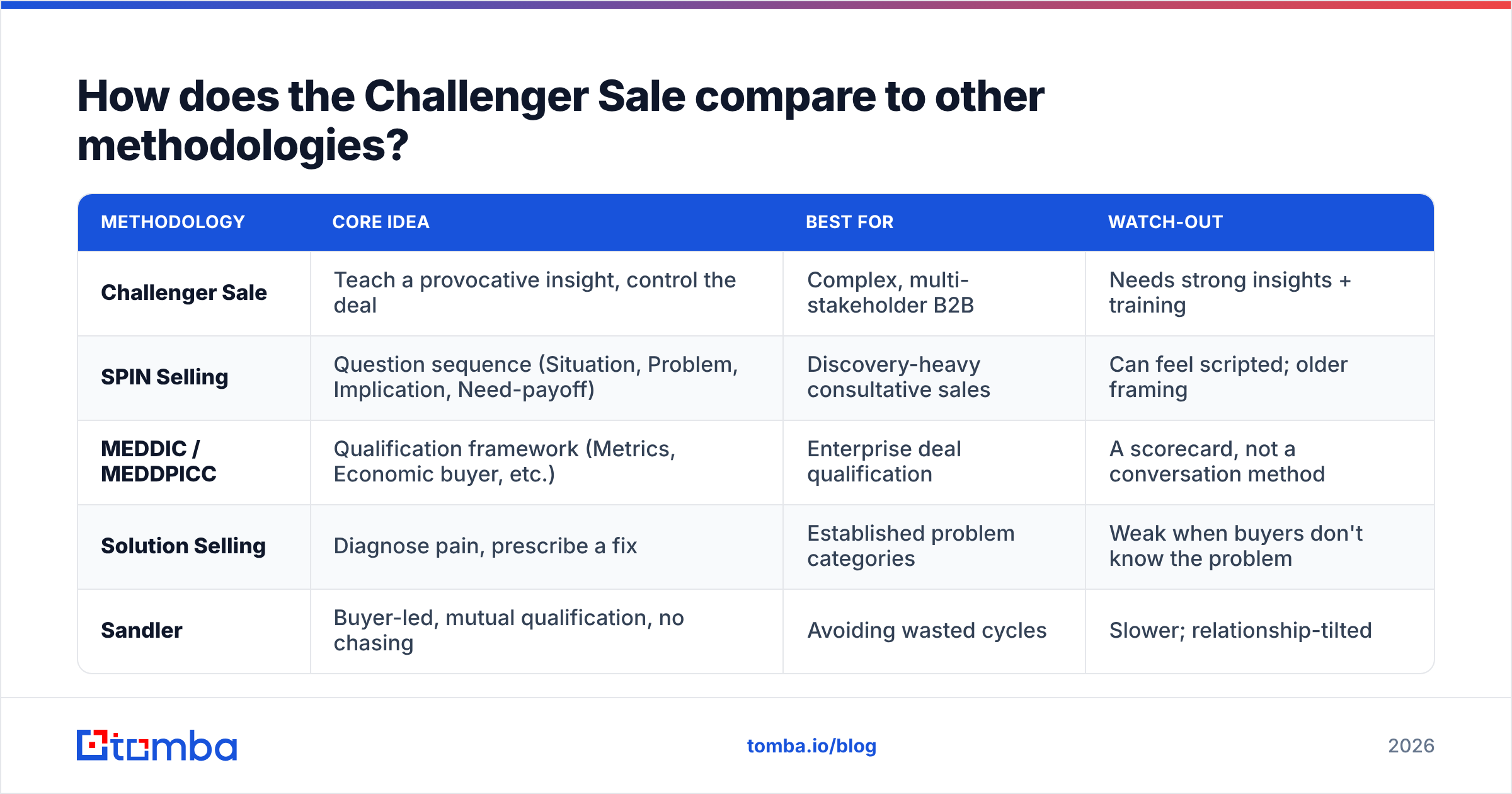
The Challenger Sale book doesn't exist in a vacuum. Here's how it stacks up against the methods it's most often weighed against.
| Methodology | Core idea | Best for | Watch-out |
|---|---|---|---|
| Challenger Sale | Teach a provocative insight, control the deal | Complex, multi-stakeholder B2B | Needs strong insights + training |
| SPIN Selling | Question sequence (Situation, Problem, Implication, Need-payoff) | Discovery-heavy consultative sales | Can feel scripted; older framing |
| MEDDIC / MEDDPICC | Qualification framework (Metrics, Economic buyer, etc.) | Enterprise deal qualification | A scorecard, not a conversation method |
| Solution Selling | Diagnose pain, prescribe a fix | Established problem categories | Weak when buyers don't know the problem |
| Sandler | Buyer-led, mutual qualification, no chasing | Avoiding wasted cycles | Slower; relationship-tilted |
The useful takeaway is simple. These aren't mutually exclusive. Most strong teams in 2026 run a hybrid. They use Challenger-style insight to create demand. They use SPIN-style questions to deepen discovery. They use MEDDIC to qualify the opportunity. The Challenger Sale is the front-end demand-creation engine, not your entire sales process. Treating it as the whole pipeline is a common misread.
What are the main criticisms of the Challenger Sale?#
A balanced review has to name the pushback, because there's plenty of it.
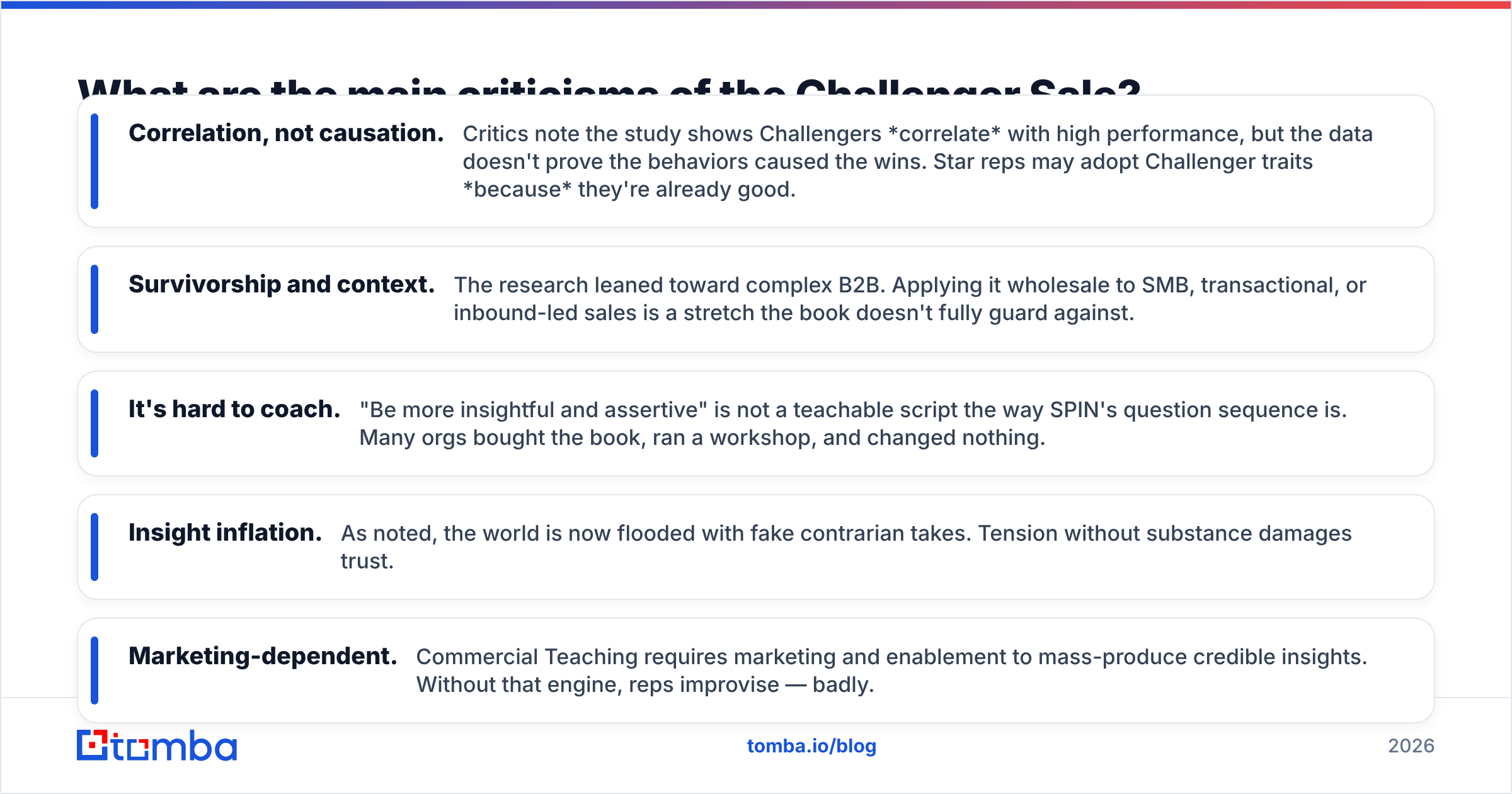
- Correlation, not causation. Critics note the study shows Challengers correlate with high performance. The data doesn't prove the behaviors caused the wins. Star reps may adopt Challenger traits because they're already good.
- Survivorship and context. The research leaned toward complex B2B. Applying it wholesale to SMB, transactional, or inbound-led sales is a stretch the book doesn't fully guard against.
- It's hard to coach. "Be more insightful and assertive" is not a teachable script the way SPIN's question sequence is. Many orgs bought the book, ran a workshop, and changed nothing.
- Insight inflation. The world is now flooded with fake contrarian takes. Tension without substance damages trust.
- Marketing-dependent. Commercial Teaching needs marketing and enablement to mass-produce credible insights. Without that engine, reps improvise badly.
None of these sink the book. They just argue against treating it as gospel. The honest position is this. The Challenger model is a powerful lens for complex deals and a poor fit for simple ones. Its results depend almost entirely on execution quality.
How do you actually run a Challenger play?#
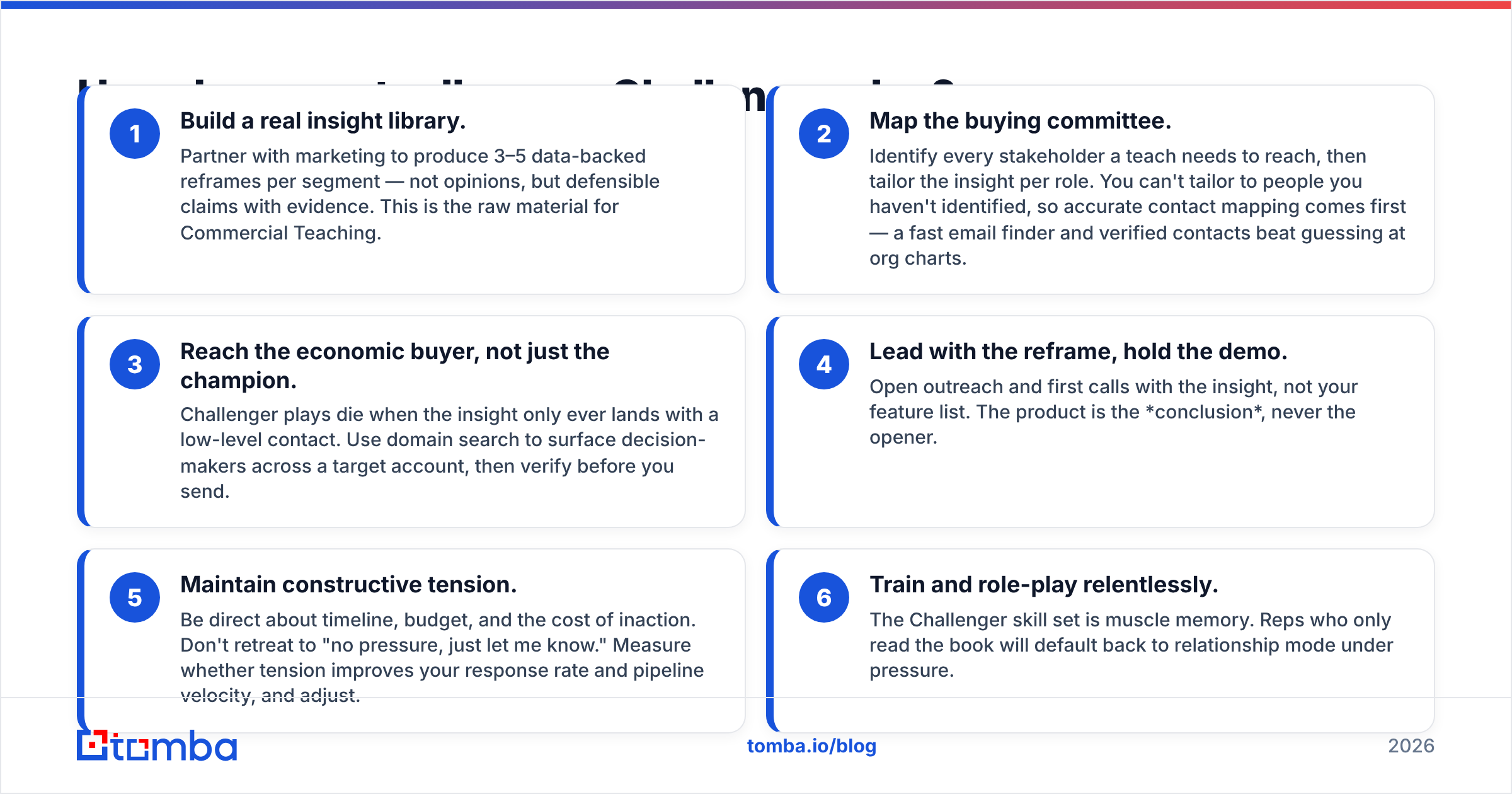
Do you want to apply the Challenger Sale book rather than just shelve it? Here's a pragmatic sequence. It respects both the method and the data it depends on.
- Build a real insight library. Partner with marketing to produce 3–5 data-backed reframes per segment. Not opinions, but defensible claims with evidence. This is the raw material for Commercial Teaching.
- Map the buying committee. Identify every stakeholder a teach needs to reach. Then tailor the insight per role. You can't tailor to people you haven't identified, so accurate contact mapping comes first. A fast email finder and verified contacts beat guessing at org charts.
- Reach the economic buyer, not just the champion. Challenger plays die when the insight only ever lands with a low-level contact. Use domain search to surface decision-makers across a target account. Then verify before you send.
- Lead with the reframe, hold the demo. Open outreach and first calls with the insight, not your feature list. The product is the conclusion, never the opener.
- Keep a constructive tension. Be direct about timeline, budget, and the cost of inaction. Don't retreat to "no pressure, just let me know." Track whether tension improves your response rate and pipeline velocity, then adjust.
- Train and role-play often. The Challenger skill set is muscle memory. Reps who only read the book will default back to relationship mode under pressure.
The throughline is clear. The method supplies the what to say. Accurate, verified contact data supplies the who to say it to and how to reach them. Skip the second half and even a perfect insight goes to the wrong inbox.
Who should read the Challenger Sale book?#
Read the Challenger Sale book if you sell complex, considered B2B products into multi-stakeholder accounts. Read it if you lead a sales team that over-indexes on rapport and under-delivers on big deals. Read it if you run enablement and need a framework for demand creation. Skim it if you sell transactional, self-serve, or low-consideration products. The core insight still helps, but the full apparatus is overkill.
It pairs especially well with a qualification framework like MEDDIC and a discovery method like SPIN. On its own, it's a demand-creation philosophy, not an end-to-end operating system. Treat it as the front of your funnel, not the whole machine. That's how you'll get the most out of it.
The bottom line#
The Challenger Sale book earns its reputation. In complex B2B, teaching beats pleasing, and constructive tension beats passive rapport. Its weaknesses are real but manageable: coachability, insight inflation, and context limits. Treat it as one lens rather than a religion. The teams that win with it in 2026 marry sharp insights to disciplined execution. They also lean on clean data about who they're selling to.
That last piece is where most Challenger programs quietly stall. You can craft the perfect reframe and still lose, because it reached a former employee's dead inbox. Before your reps teach, tailor, and take control, make sure they're reaching the right decision-maker. Start with the Tomba Email Finder to find and verify professional emails by name, company, or domain. Then check the Tomba pricing plans (a free tier, plus Starter at $49/mo) to put accurate contact data behind every Challenger play.
Ready to find emails that actually work?
Join 150,000+ professionals who stopped guessing and started sending. Free credits on signup — no credit card required.
Get the Tomba newsletter
Practical outbound tactics and product updates — once every two weeks.
About the author