The Challenger Sales Model in 2026: A Complete Playbook
The Challenger Sales Model rewired B2B selling around teaching, not rapport. Here's how it works in 2026, who it fits, and how to run it without burning pipeline.
TL;DR
- The Challenger Sales Model says your best reps win by teaching prospects something new, tailoring the message to each stakeholder, and taking control of the deal — not by building friendly relationships.
- It came out of CEB (now Gartner) research on thousands of reps and found that "Relationship Builders" were the worst performers in complex B2B sales.
- It works best for high-consideration, multi-stakeholder deals where the buyer doesn't fully understand their own problem yet.
- Running it well needs three things most teams skip: a real commercial insight, clean stakeholder data, and managers who coach the behavior weekly.
- It is not a replacement for prospecting hygiene — you still need accurate contact data to get the meeting in the first place.
What is the Challenger Sales Model?#
The Challenger Sales Model is a B2B selling methodology built on one uncomfortable finding: in complex deals, the reps who push customers to think differently outperform the reps who just build rapport. It was published in 2011 by Matthew Dixon and Brent Adamson in The Challenger Sale, based on research from CEB (later acquired by Gartner).
The core claim is that top performers don't sell products — they sell a new way of seeing the problem. They walk in with a point of view, challenge the prospect's assumptions, and use that tension to move the deal forward. The relationship is the output of a good sale, not the input.
That reframing is why the model still dominates enablement decks in 2026. Buying committees keep growing, deals keep stalling in "no decision," and the old "discover their pain and mirror it back" script doesn't cut through when the buyer can't articulate the pain in the first place.
What are the five sales rep profiles?#
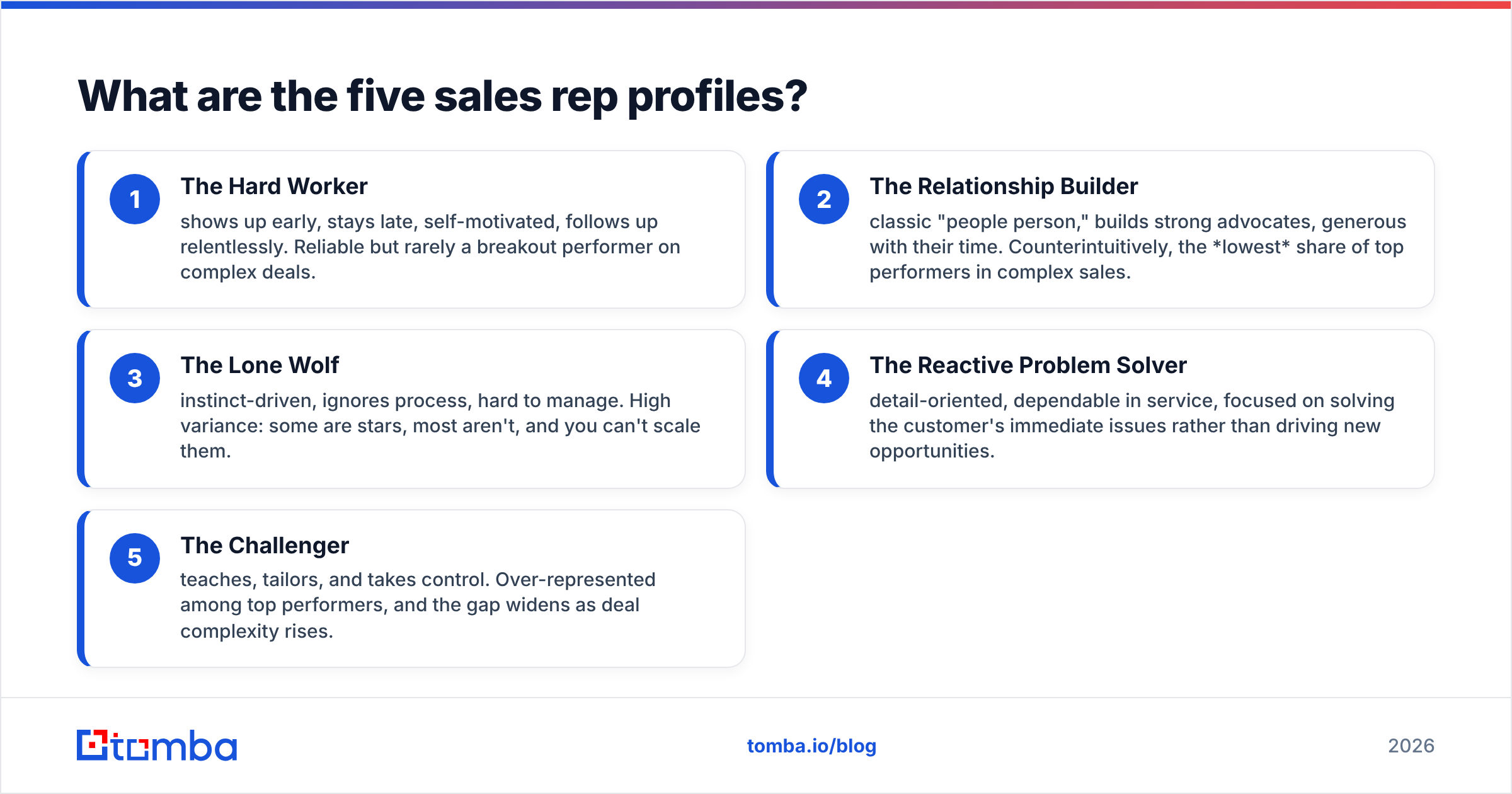
The original CEB research sorted reps into five profiles based on observed behavior. Understanding them is the fastest way to grasp what "Challenger" actually means.
- The Hard Worker — shows up early, stays late, self-motivated, follows up relentlessly. Reliable but rarely a breakout performer on complex deals.
- The Relationship Builder — classic "people person," builds strong advocates, generous with their time. Counterintuitively, the lowest share of top performers in complex sales.
- The Lone Wolf — instinct-driven, ignores process, hard to manage. High variance: some are stars, most aren't, and you can't scale them.
- The Reactive Problem Solver — detail-oriented, dependable in service, focused on solving the customer's immediate issues rather than driving new opportunities.
- The Challenger — teaches, tailors, and takes control. Over-represented among top performers, and the gap widens as deal complexity rises.
The headline stat from the study: Challengers made up roughly 40% of top performers in complex sales, while Relationship Builders made up the smallest slice. The more complicated the sale, the bigger the Challenger advantage.
How does the teach, tailor, take control framework work?#
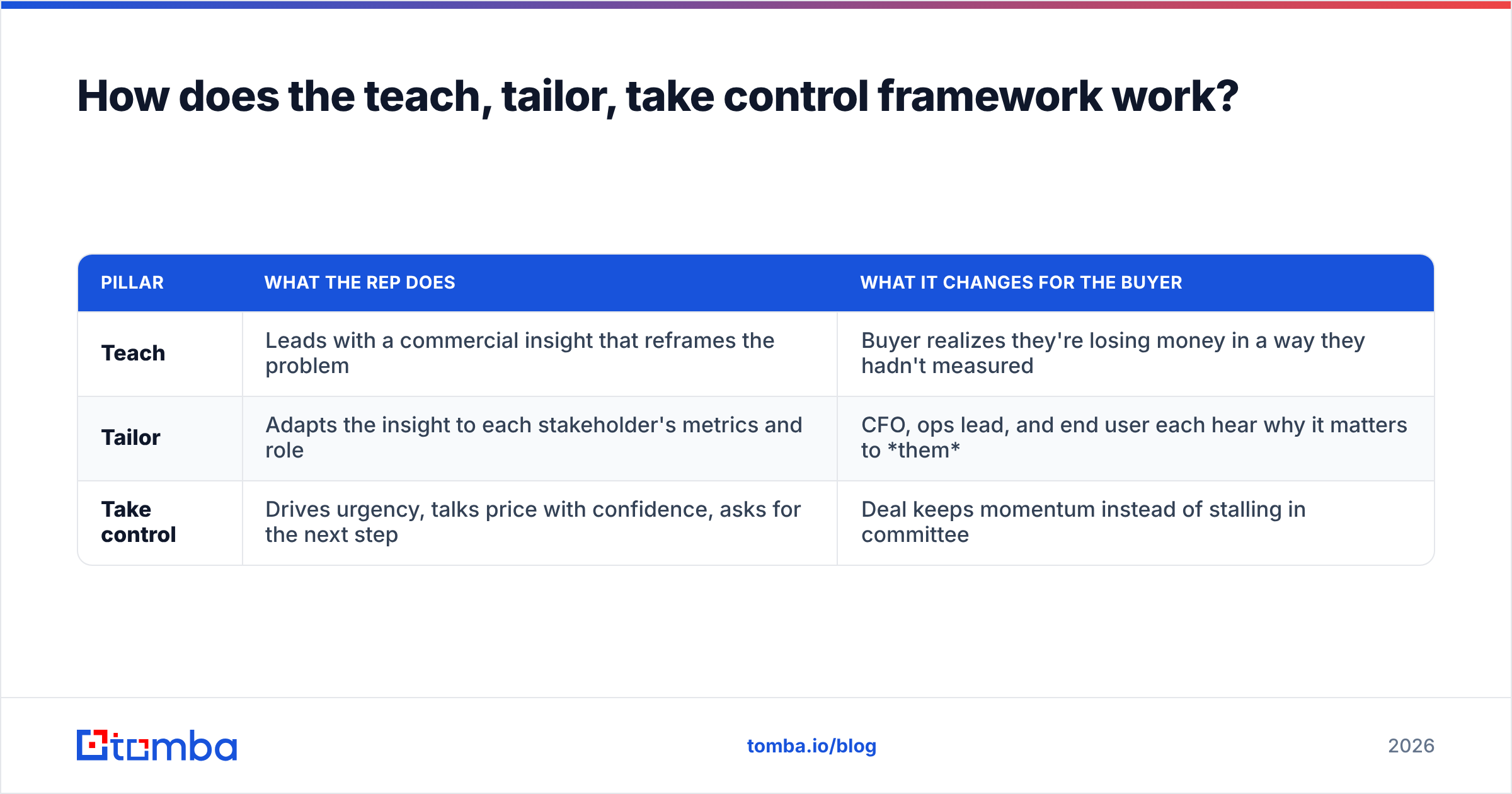
Challenger selling runs on three behaviors, usually summarized as teach, tailor, take control. Each one maps to a specific moment in the deal.
| Pillar | What the rep does | What it changes for the buyer |
|---|---|---|
| Teach | Leads with a commercial insight that reframes the problem | Buyer realizes they're losing money in a way they hadn't measured |
| Tailor | Adapts the insight to each stakeholder's metrics and role | CFO, ops lead, and end user each hear why it matters to them |
| Take control | Drives urgency, talks price with confidence, asks for the next step | Deal keeps momentum instead of stalling in committee |
Teach is the heart of it. You don't open with "tell me about your challenges." You open with a perspective the buyer hasn't heard — ideally one that exposes a cost they didn't know they were paying. Good teaching pitches lead to your solution as the logical conclusion, not as a product pitch bolted on at the end.
Tailor is where most reps fail. A single insight rarely lands the same way across a six-person buying committee. The economic buyer cares about payback period; the practitioner cares about whether it makes their day harder. Tailoring means you've done the homework on who sits on the committee and what each person is measured on — which is impossible without accurate contact and role data.
Take control is the part that scares reps trained on "always be agreeable." Taking control isn't being aggressive. It's being comfortable with constructive tension: pushing back on a lowball ask, naming the real timeline, and refusing to let the deal drift into the "we'll circle back next quarter" graveyard.
Why did relationship selling stop working?#
Relationship selling didn't stop working because relationships stopped mattering. It stopped working because the buying process changed.
Three shifts broke the old model:
- Bigger committees. Gartner's later research pegged the average B2B buying group at six to ten stakeholders. Being liked by your champion is worthless if five other people veto the deal.
- Self-service research. By the time a buyer talks to a rep, they've often done most of their research alone. A rep who only confirms what the buyer already knows adds no value.
- Consensus paralysis. More stakeholders means more ways to say "no" — or worse, to say nothing and pick no vendor at all. "No decision" became the most common competitor.
A Challenger cuts through this by giving the committee a reason to act now and a shared frame for the decision. That's leadership the buyer can't generate on their own. If you want the deeper definition of how this fits the modern funnel, our B2B glossary breaks down the adjacent terms.
Is the Challenger Sales Model right for your team?#
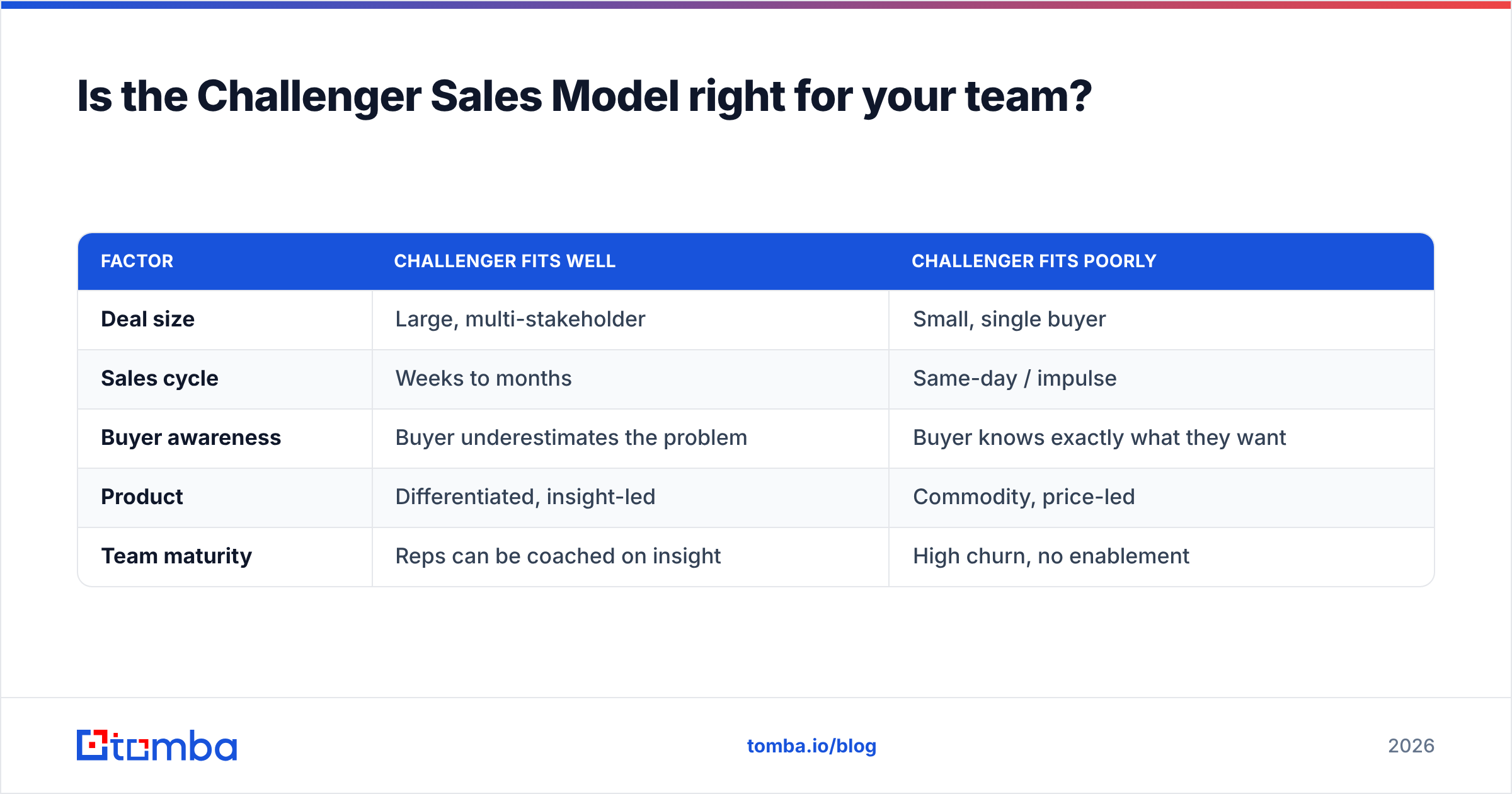
Not every team should adopt it. The model rewards complexity; in simple, transactional sales it can feel like overkill or even arrogance.
| Factor | Challenger fits well | Challenger fits poorly |
|---|---|---|
| Deal size | Large, multi-stakeholder | Small, single buyer |
| Sales cycle | Weeks to months | Same-day / impulse |
| Buyer awareness | Buyer underestimates the problem | Buyer knows exactly what they want |
| Product | Differentiated, insight-led | Commodity, price-led |
| Team maturity | Reps can be coached on insight | High churn, no enablement |
If you sell a commodity where the buyer already knows the spec and just wants the best price, leading with a contrarian teaching pitch wastes everyone's time. But if you sell something where buyers routinely under-scope the problem — security, data infrastructure, anything with hidden downstream cost — Challenger is built for you.
A practical middle path: most strong 2026 teams run a hybrid. They use Challenger teaching to create and reframe opportunities, then lean on relationship and consultative skills to navigate the committee once tension has done its job.
How do you build a commercial insight?#
A commercial insight is the engine of the whole model, and it's the piece teams most often get wrong. A real insight is not a product feature and not a generic industry stat. It's a specific, surprising claim about how the buyer is losing money — that leads naturally to your strengths.
Build one in four steps:
- Find a costly, under-measured problem your best customers had before they bought.
- Quantify it with data the buyer can't easily see on their own.
- Reframe the buyer's assumption ("you think the cost is X; it's actually 3X because of Y").
- Bridge to your unique strength so the path forward points at you, not a generic category.
The test of a good insight: if a competitor could deliver the exact same teaching pitch, it's not an insight — it's just education. Yours has to lead to your differentiation.
Where does data fit into Challenger selling?#
Here's the part the original book underplays in 2026: Challenger selling is only as good as the data behind your tailoring. You can't tailor an insight to a stakeholder you can't reach, and you can't map a buying committee you can't see.
Three data dependencies make or break the model:
- Reaching every stakeholder. Tailoring assumes you can actually contact the CFO, the ops lead, and the end user — not just your champion. That means verified, current email and phone data for the whole committee.
- Knowing each role's metrics. Tailoring without role and seniority data is guesswork. Enriched contact records tell you who is measured on what.
- Timing the take-control moment. Knowing when a company is hiring, expanding, or re-platforming tells you when your insight will land hardest.
This is where a clean top-of-funnel matters more than any script. If your reps burn the first call confirming whether an email even works, they never get to teach. Tools like the Tomba Email Finder and data enrichment exist to remove that friction — so reps spend their energy on the insight, not on chasing bounce-backs. For multi-stakeholder mapping, a domain search surfaces the full set of contacts at an account in one pass, and an email verifier keeps your committee list clean before you ever hit send.
How do you coach the Challenger model?#
Adopting Challenger is a management problem, not a training problem. A two-day workshop changes behavior for about two weeks. What sticks is weekly coaching on the specific behaviors.
Managers should inspect three things in deal reviews:
- Did the rep teach? Ask them to state the insight in one sentence. If they can't, they pitched features.
- Did the rep tailor? Make them name each stakeholder and that person's metric. Vagueness here predicts a stalled deal.
- Did the rep take control? Look for a clear, agreed next step with a date. "They'll get back to us" is a red flag.
Gartner's follow-up research (see their ongoing sales research) stressed that the Challenger model lives or dies on organizational support — marketing has to produce the insights, enablement has to package them, and managers have to reinforce them. A lone rep going Challenger inside a relationship-selling org usually gets ground down.
It's also worth tracking the right outcome metric. Don't measure "rapport." Measure deal velocity, win rate against "no decision," and average committee coverage. If you're unsure how those connect, our breakdown of win rate is a useful primer.
What are the common mistakes when adopting it?#
The model fails in predictable ways. Watch for these:
- Confusing aggression with control. Taking control is about confident direction, not steamrolling. Buyers can tell the difference instantly.
- Teaching without an insight. Reciting industry trends the buyer already knows isn't teaching — it's filler that erodes credibility.
- Tailoring to one person. Nailing the champion and ignoring the committee is the single most common cause of late-stage collapse.
- Skipping the data work. You cannot tailor or take control across stakeholders you never reach. Bad contact data quietly caps your win rate.
- No marketing alignment. If reps have to invent their own insights, quality is random. Insights are a content asset, not a rep skill.
How does Challenger compare to other methodologies?#
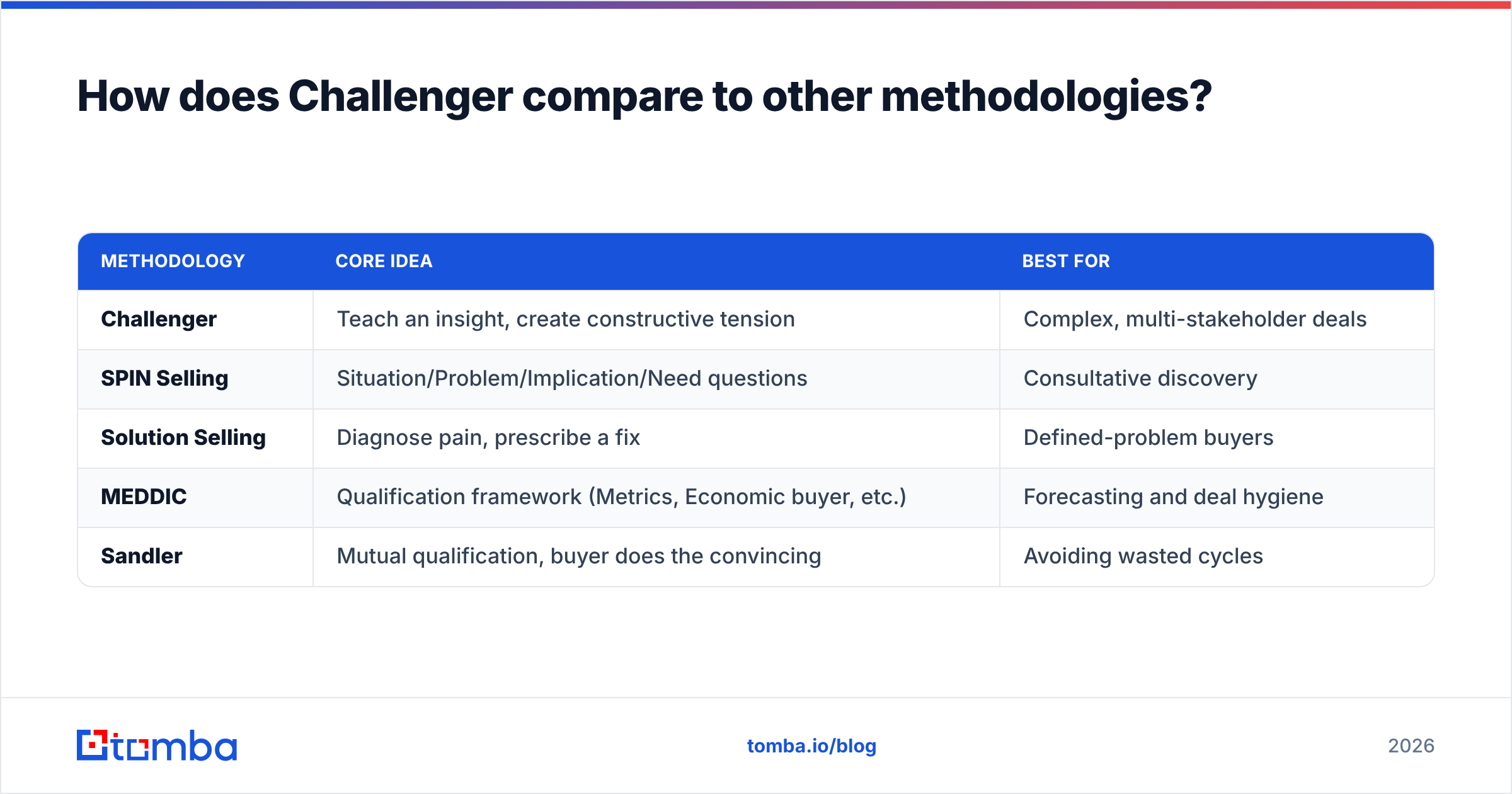
Challenger isn't the only game in town, and it overlaps with several. A quick orientation:
| Methodology | Core idea | Best for |
|---|---|---|
| Challenger | Teach an insight, create constructive tension | Complex, multi-stakeholder deals |
| SPIN Selling | Situation/Problem/Implication/Need questions | Consultative discovery |
| Solution Selling | Diagnose pain, prescribe a fix | Defined-problem buyers |
| MEDDIC | Qualification framework (Metrics, Economic buyer, etc.) | Forecasting and deal hygiene |
| Sandler | Mutual qualification, buyer does the convincing | Avoiding wasted cycles |
In practice these stack. Many strong teams use Challenger for the message, MEDDIC for qualification, and SPIN-style questions inside discovery. They answer different questions: Challenger asks what do I say to change their mind?, MEDDIC asks should I even be working this deal?
Putting it into practice in 2026#
The Challenger Sales Model has aged well because the trend it responded to — bigger committees, more self-educated buyers, more "no decision" outcomes — only intensified. The teach-tailor-take-control framework gives reps a way to lead buyers who can't lead themselves.
But the model quietly assumes a foundation that most teams underinvest in: you can only teach buyers you've reached, tailor to stakeholders you've mapped, and take control of deals where you know the full committee. That foundation is contact data, not charisma.
Start with the message — build one real commercial insight your competitors can't copy. Then make sure your reps can actually reach every stakeholder that insight needs to land with. The fastest way to do the second part is to stop letting reps waste prospecting time on dead contacts: put accurate email discovery and verification at the front of the motion with the Tomba Email Finder, map whole buying committees with domain search, and keep your lists clean so every tailored message actually arrives. Teach boldly — but reach reliably first. Start free with 25 searches a month and give your Challenger reps the data their method depends on.
// get started
Find, verify and enrich your first contacts today
Start on the free plan with 25 searches a month, then scale when your team is ready.
Free plan · No credit card required · GDPR & CCPA
// about the author