Challenger Sales Model Examples: 2026 Playbook & Scripts
Real challenger sales model examples, scripts, and a teach-tailor-take-control framework you can copy to win complex B2B deals in 2026.
The Challenger Sales Model isn't a personality test you pass or fail. It's a repeatable way of running a deal: you teach the buyer something they didn't know, tailor that lesson to who's in the room, and take control of the conversation about price and timing. The trouble is that most write-ups stop at theory. This post is the opposite — concrete challenger sales model examples, the exact language reps use, and a table you can lift into your own playbook.
TL;DR#
- Challenger reps win by teaching, not pitching. They reframe the buyer's problem with a commercial insight, then connect it to their solution.
- The model has three pillars: Teach for differentiation, Tailor for resonance, Take control of the sale.
- The examples below show the difference between a Relationship Builder ("How can I help?") and a Challenger ("Here's the risk you're not seeing").
- It works best on complex, multi-stakeholder B2B deals — not transactional, low-consideration purchases.
- The bottleneck is data, not scripts. A reframe only lands if you reach the right person with the right context, which is where accurate contact and company data earns its keep.
What is the Challenger Sales Model?#
The Challenger Sales Model comes from the 2011 book The Challenger Sale by Matthew Dixon and Brent Adamson, based on a study of thousands of B2B reps. The finding that made it famous: in complex sales, the highest performers weren't the friendliest "Relationship Builders." They were "Challengers" who pushed customers' thinking.
Dixon and Adamson sorted reps into five profiles — the Hard Worker, the Relationship Builder, the Lone Wolf, the Reactive Problem Solver, and the Challenger. Challengers dominated the high-performer group, especially as deal complexity rose. You can read the original framework summary on the official Challenger site.
A Challenger does three things well, and the order matters:
- Teach — bring a commercial insight that reframes how the customer thinks about their business.
- Tailor — adapt that message to the specific economic and emotional drivers of each stakeholder.
- Take control — drive the deal forward, talk money directly, and hold firm on value instead of caving on discounts.

What are the three pillars, with examples?#
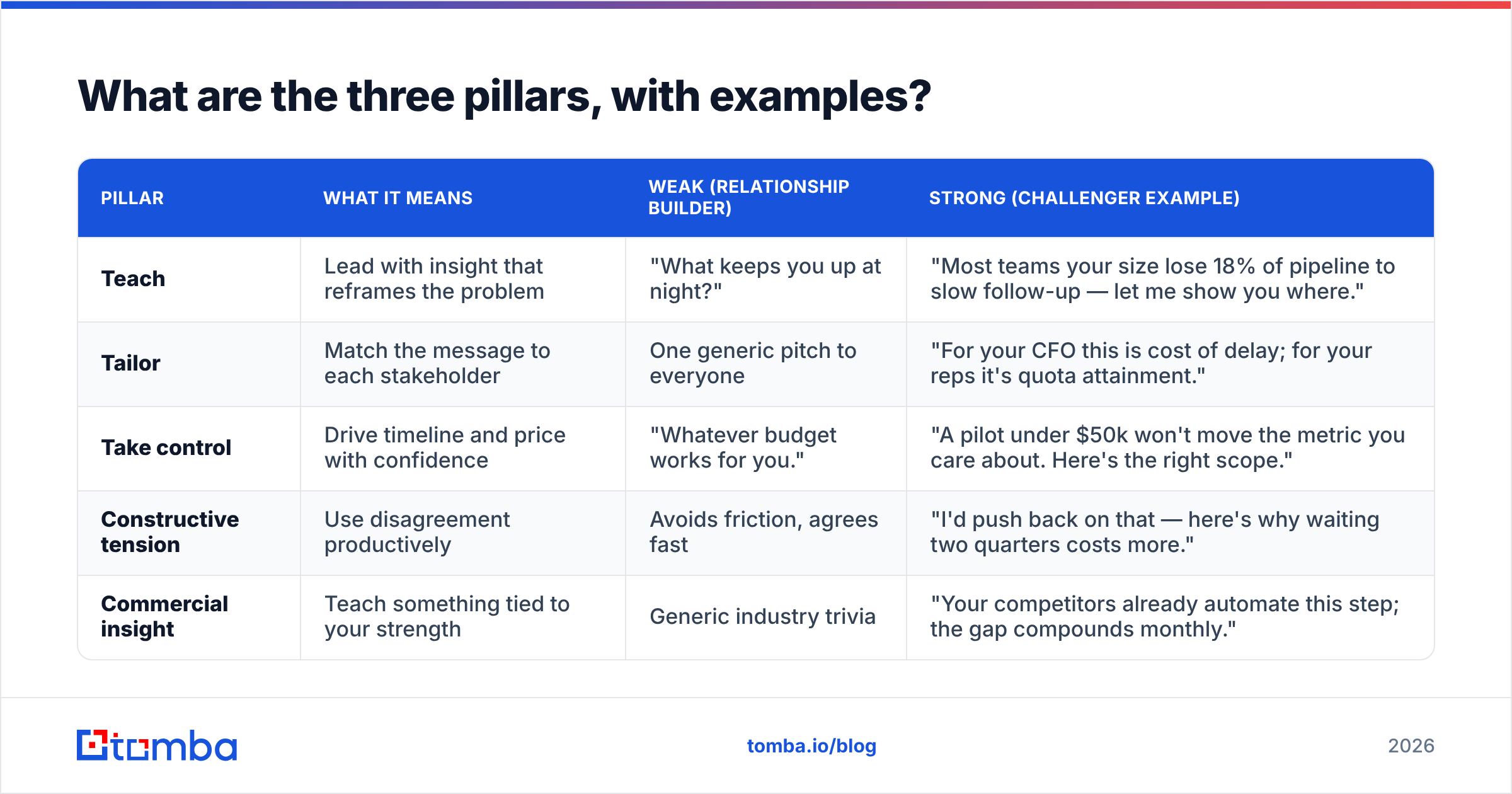
Here is the core of the method, broken into the behaviors and the literal phrasing a rep would use. This is the part most articles skip.
| Pillar | What it means | Weak (Relationship Builder) | Strong (Challenger example) |
|---|---|---|---|
| Teach | Lead with insight that reframes the problem | "What keeps you up at night?" | "Most teams your size lose 18% of pipeline to slow follow-up — let me show you where." |
| Tailor | Match the message to each stakeholder | One generic pitch to everyone | "For your CFO this is cost of delay; for your reps it's quota attainment." |
| Take control | Drive timeline and price with confidence | "Whatever budget works for you." | "A pilot under $50k won't move the metric you care about. Here's the right scope." |
| Constructive tension | Use disagreement productively | Avoids friction, agrees fast | "I'd push back on that — here's why waiting two quarters costs more." |
| Commercial insight | Teach something tied to your strength | Generic industry trivia | "Your competitors already automate this step; the gap compounds monthly." |
Notice the pattern. The Challenger isn't rude or pushy — the word people get wrong. The Challenger is informed. Every reframe is backed by data the buyer didn't have, and every push is in service of the buyer's own goals.
What does a Challenger sales pitch sound like?#
Let's walk a single deal end to end. Imagine you sell a revenue-intelligence platform to a 200-person SaaS company.
Opening (Teach). A Relationship Builder opens with rapport: "Thanks for the time, tell me about your priorities." A Challenger opens with a hook:
"Before we get into the product, I want to share something we found across 40 companies that look like yours. The ones growing fastest aren't the ones with the most reps — they're the ones whose reps spend under 30% of their week on admin. Most teams we benchmark are at 65%. I suspect you're closer to that second number, and it's quietly capping your growth."
That's a commercial insight. It reframes the buyer's mental model from "we need more reps" to "we're wasting the reps we have."
Middle (Tailor). Now you adapt by stakeholder. To the VP of Sales: "This is about quota attainment per head." To the CFO: "This is cost per acquired dollar." To a frontline manager: "This is two hours back per rep, per day." Same insight, three translations. Tailoring is why the Challenger needs to know exactly who is in the room — and that's a data problem before it's a messaging problem.
Close (Take control). When the buyer floats a tiny pilot, the Challenger doesn't just say yes:
"I'd actually advise against a 10-seat pilot. With that scope you won't see the follow-up-time metric move enough to trust it, and you'll conclude the wrong thing. Roll it out to one full team — 25 seats — for 60 days. That's the smallest test that gives you a real answer."
The rep is steering the deal, not following it. That's "take control."
Challenger vs other sales methodologies?#
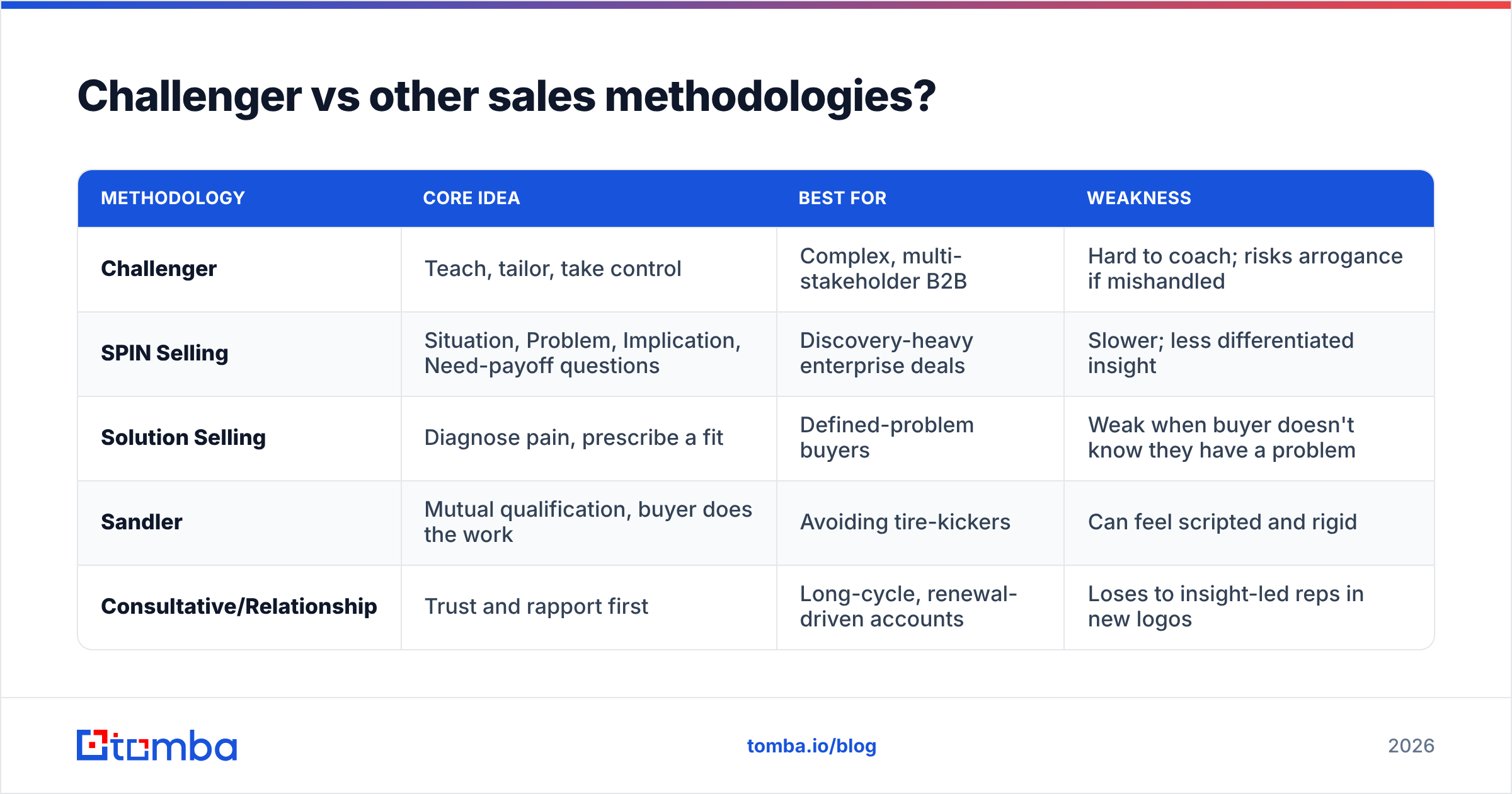
The Challenger model isn't the only game. Here's how it stacks up against the methods sales leaders most often weigh against it.
| Methodology | Core idea | Best for | Weakness |
|---|---|---|---|
| Challenger | Teach, tailor, take control | Complex, multi-stakeholder B2B | Hard to coach; risks arrogance if mishandled |
| SPIN Selling | Situation, Problem, Implication, Need-payoff questions | Discovery-heavy enterprise deals | Slower; less differentiated insight |
| Solution Selling | Diagnose pain, prescribe a fit | Defined-problem buyers | Weak when buyer doesn't know they have a problem |
| Sandler | Mutual qualification, buyer does the work | Avoiding tire-kickers | Can feel scripted and rigid |
| Consultative/Relationship | Trust and rapport first | Long-cycle, renewal-driven accounts | Loses to insight-led reps in new logos |
The honest take: Challenger shines when the buyer doesn't fully understand their own problem and the purchase touches many people. For a simple, well-understood, single-buyer purchase, a lighter consultative or transactional approach usually wins. Analysts like Gartner have repeatedly noted that buying groups in B2B now average six to ten stakeholders — exactly the environment where teaching and tailoring pay off.
What are real-world Challenger examples by role?#
Theory is cheap. Here's how the model shows up across functions:
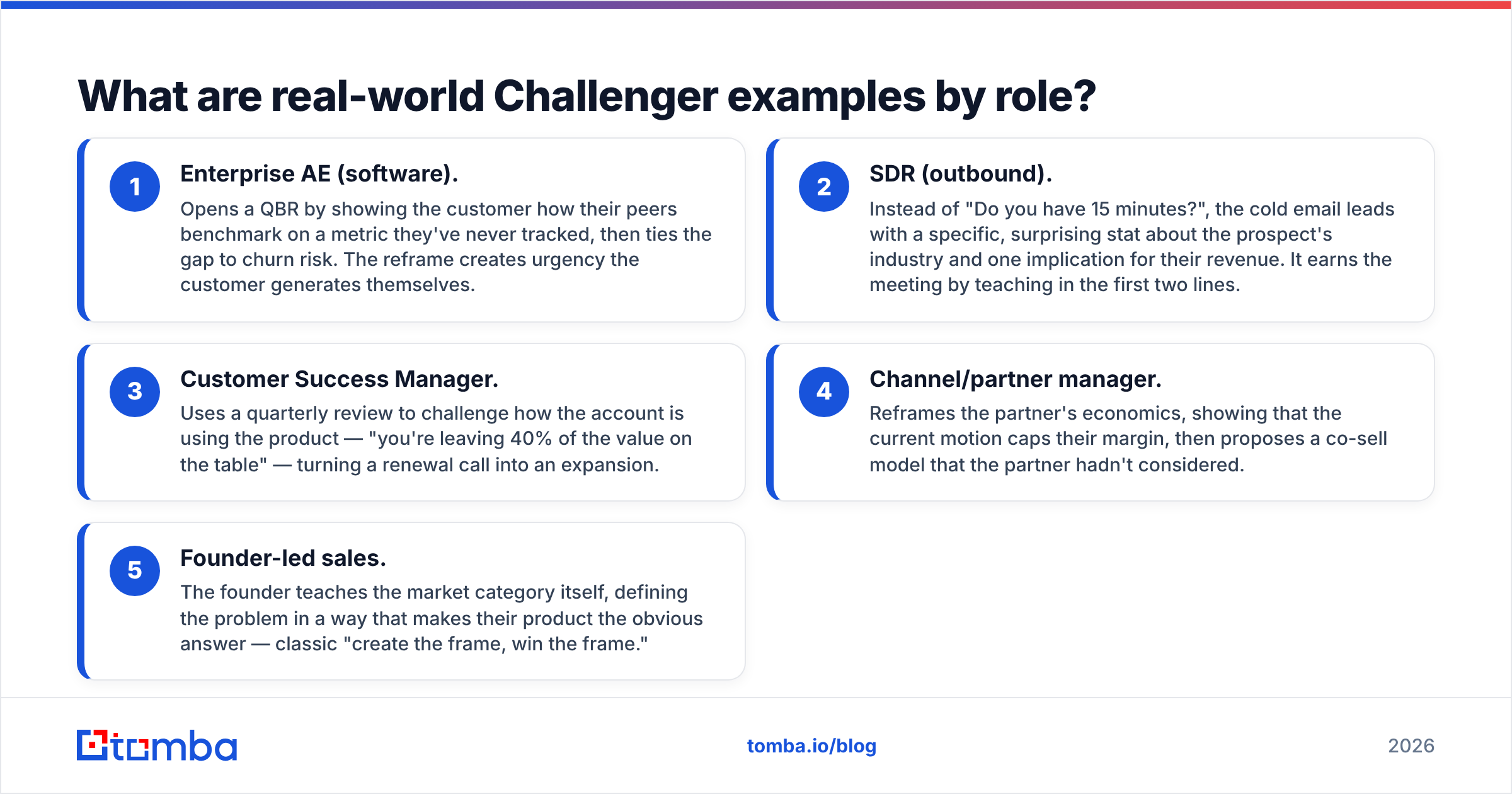
- Enterprise AE (software). Opens a QBR by showing the customer how their peers benchmark on a metric they've never tracked, then ties the gap to churn risk. The reframe creates urgency the customer generates themselves.
- SDR (outbound). Instead of "Do you have 15 minutes?", the cold email leads with a specific, surprising stat about the prospect's industry and one implication for their revenue. It earns the meeting by teaching in the first two lines.
- Customer Success Manager. Uses a quarterly review to challenge how the account is using the product — "you're leaving 40% of the value on the table" — turning a renewal call into an expansion.
- Channel/partner manager. Reframes the partner's economics, showing that the current motion caps their margin, then proposes a co-sell model that the partner hadn't considered.
- Founder-led sales. The founder teaches the market category itself, defining the problem in a way that makes their product the obvious answer — classic "create the frame, win the frame."
Across all five, the engine is the same: a sharp insight, delivered to the right person, backed by data they can't easily dismiss.
Why does Challenger live or die on data quality?#
Here's the part the original book underweights for a 2026 audience: a brilliant reframe delivered to the wrong person is worthless. The Challenger model assumes you already know who the economic buyer is, who the blockers are, and how to reach them. In practice, that's the hard part.
Tailoring requires knowing the actual stakeholders — their roles, their priorities, their contact details. Teaching requires current, specific data about the prospect's company, not last year's averages. Taking control requires reaching decision-makers directly instead of getting stuck with a gatekeeper. Every one of those is an enrichment and contact-data problem.
This is where your prospecting stack matters as much as your methodology. To run a Challenger motion at scale you need to:
- Map the buying group. Use domain search to pull every relevant contact at a target account, so you can tailor a message per role instead of guessing.
- Reach the economic buyer. A verified email finder gets your insight in front of the person who controls budget, not just the champion.
- Open the multi-channel door. When email stalls, a phone finder lets a Challenger "take control" with a direct call instead of waiting.
- Personalize the teach. Data enrichment gives you the firmographic and role context that makes a reframe feel built for that buyer.
Think of it like a courtroom argument. The Challenger reframe is your closing statement — but it only works if you've subpoenaed the right witnesses and have the evidence in hand. Skip the data work and even the best script lands in an empty room.
How do you start coaching Challenger behaviors?#
You don't flip a team to Challenger overnight. The model is the hardest of the major methodologies to coach because it asks reps to risk tension. A staged rollout works better:
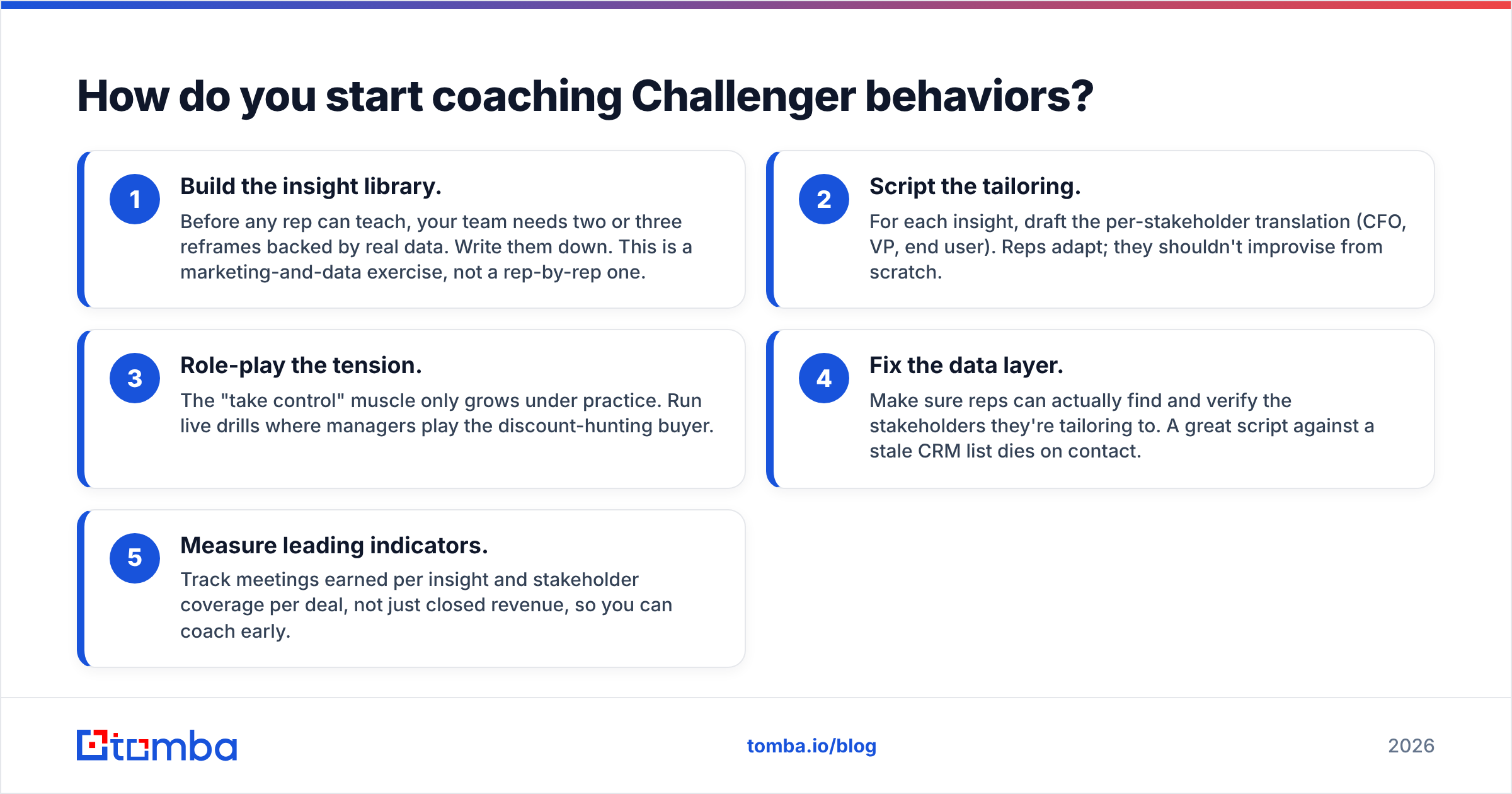
- Build the insight library. Before any rep can teach, your team needs two or three reframes backed by real data. Write them down. This is a marketing-and-data exercise, not a rep-by-rep one.
- Script the tailoring. For each insight, draft the per-stakeholder translation (CFO, VP, end user). Reps adapt; they shouldn't improvise from scratch.
- Role-play the tension. The "take control" muscle only grows under practice. Run live drills where managers play the discount-hunting buyer.
- Fix the data layer. Make sure reps can actually find and verify the stakeholders they're tailoring to. A great script against a stale CRM list dies on contact.
- Measure leading indicators. Track meetings earned per insight and stakeholder coverage per deal, not just closed revenue, so you can coach early.
You can compare implementation notes and peer reviews of these methodologies on G2 before committing budget to formal training.
Where does Challenger fall short?#
Be honest with your team about the limits, or the method gets a bad name:
- It can curdle into arrogance. "Challenger" gets misread as "be combative." The insight must serve the buyer, always.
- It needs real insight. If you don't have proprietary data or a genuinely fresh frame, you're just a pushy rep. No insight, no Challenger.
- It's overkill for simple deals. A single-buyer, low-cost purchase doesn't need a reframe — it needs a fast, frictionless path.
- It's data-hungry. As covered above, tailoring at scale collapses without accurate contact and company data.
The bottom line#
The Challenger Sales Model wins complex B2B deals because it changes the conversation: from "How can I help?" to "Here's what you're missing." The examples in this post — the benchmark hook, the per-stakeholder tailoring, the controlled close — are the repeatable moves behind that shift. But none of them fire without knowing exactly who to teach and how to reach them.
That's the unglamorous foundation under every great Challenger pitch. Before you script the reframe, build the list: every stakeholder in the buying group, verified and enriched. Start with the Tomba Email Finder to map the decision-makers at your target accounts, then layer your insight on top. The free tier gives you 25 searches a month to test it, and paid plans start at $49/mo — see full Tomba pricing to scale your outbound motion. Teach, tailor, and take control — once you're sure the right person is on the other end of the message.
Ready to find emails that actually work?
Join 150,000+ professionals who stopped guessing and started sending. Free credits on signup — no credit card required.
Get the Tomba newsletter
Practical outbound tactics and product updates — once every two weeks.
About the author