Challenger Sales Profiles: The 5 Rep Types Explained (2026)
The 5 Challenger sales profiles decoded — who really wins complex B2B deals, why the Challenger beats the Relationship Builder, and how to build the profile on your team in 2026.
The phrase "Challenger sales profiles" comes from one of the most cited B2B sales studies of the last two decades — and most teams still misread it. They treat "Challenger" as a personality test instead of a set of teachable behaviors. This guide fixes that.
TL;DR#
- There are five Challenger sales profiles: the Hard Worker, the Relationship Builder, the Lone Wolf, the Reactive Problem Solver, and the Challenger.
- The Challenger wins complex deals. In the original CEB/Gartner research, Challengers made up the largest share of top performers in solution-selling environments, while Relationship Builders were the weakest.
- Challenger is a skill set, not a birth trait. Teach, Tailor, and Take Control are coachable across most of your team.
- Profiles are a coaching map, not a hiring filter. Your job is to move reps toward Challenger behaviors, not to fire everyone who isn't one.
- The model only works on accurate data. Tailored insight collapses if your contact and account data is wrong — which is where tooling matters.
What are the Challenger sales profiles?#
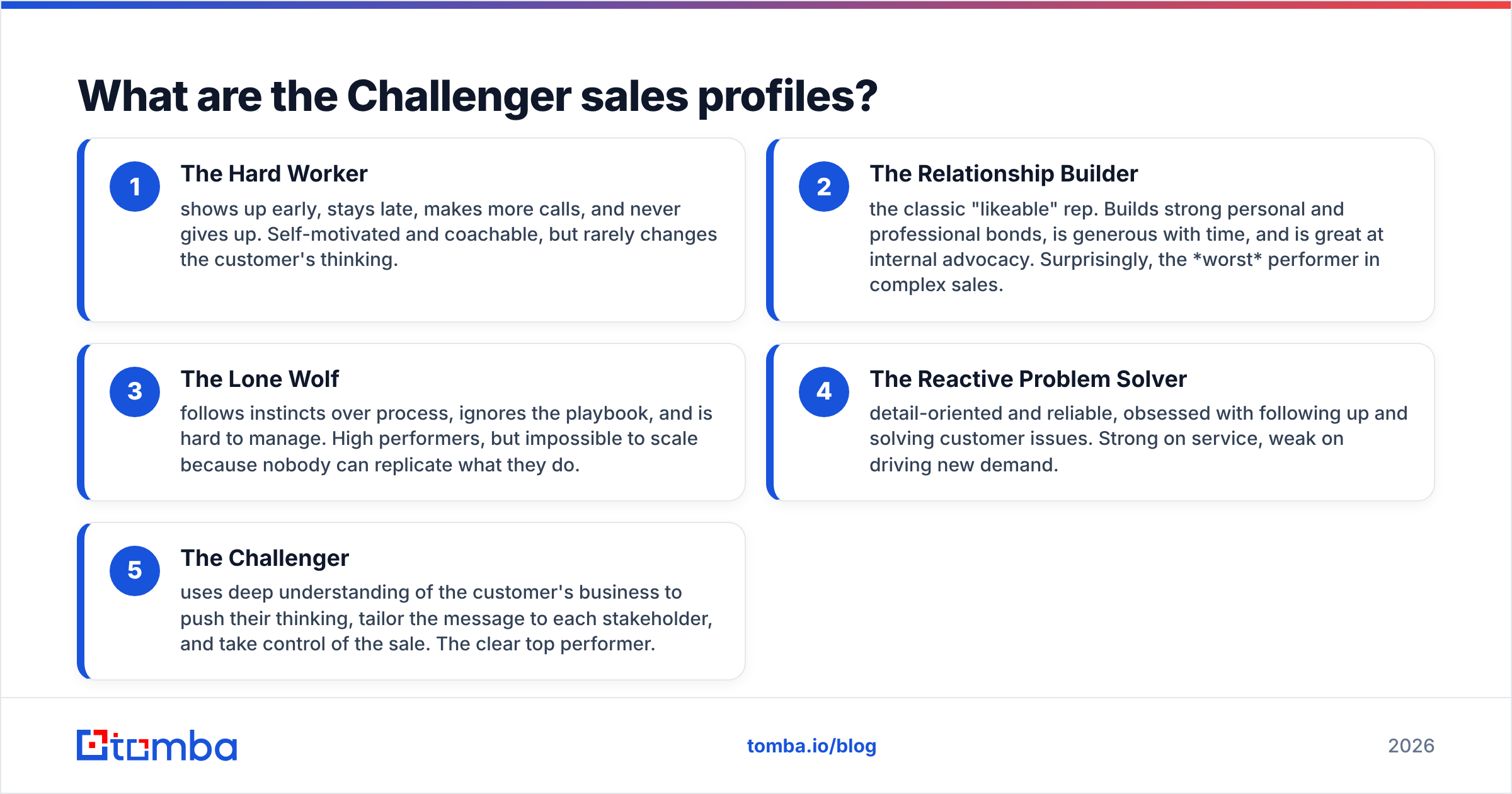
The Challenger sales profiles are five distinct types of sales rep identified in The Challenger Sale by Matthew Dixon and Brent Adamson, based on research from CEB (now part of Gartner). The authors surveyed thousands of reps and managers and found that nearly every seller falls into one of five behavioral patterns.
The five profiles are:
- The Hard Worker — shows up early, stays late, makes more calls, and never gives up. Self-motivated and coachable, but rarely changes the customer's thinking.
- The Relationship Builder — the classic "likeable" rep. Builds strong personal and professional bonds, is generous with time, and is great at internal advocacy. Surprisingly, the worst performer in complex sales.
- The Lone Wolf — follows instincts over process, ignores the playbook, and is hard to manage. High performers, but impossible to scale because nobody can replicate what they do.
- The Reactive Problem Solver — detail-oriented and reliable, obsessed with following up and solving customer issues. Strong on service, weak on driving new demand.
- The Challenger — uses deep understanding of the customer's business to push their thinking, tailor the message to each stakeholder, and take control of the sale. The clear top performer.
The headline finding: when deals got complex, 40% of top performers were Challengers, while Relationship Builders made up only 7% of stars. The "be likeable and they'll buy" model — the one most sales training was built on — turned out to be the least effective approach for hard sales.
Why does the Challenger profile win?#
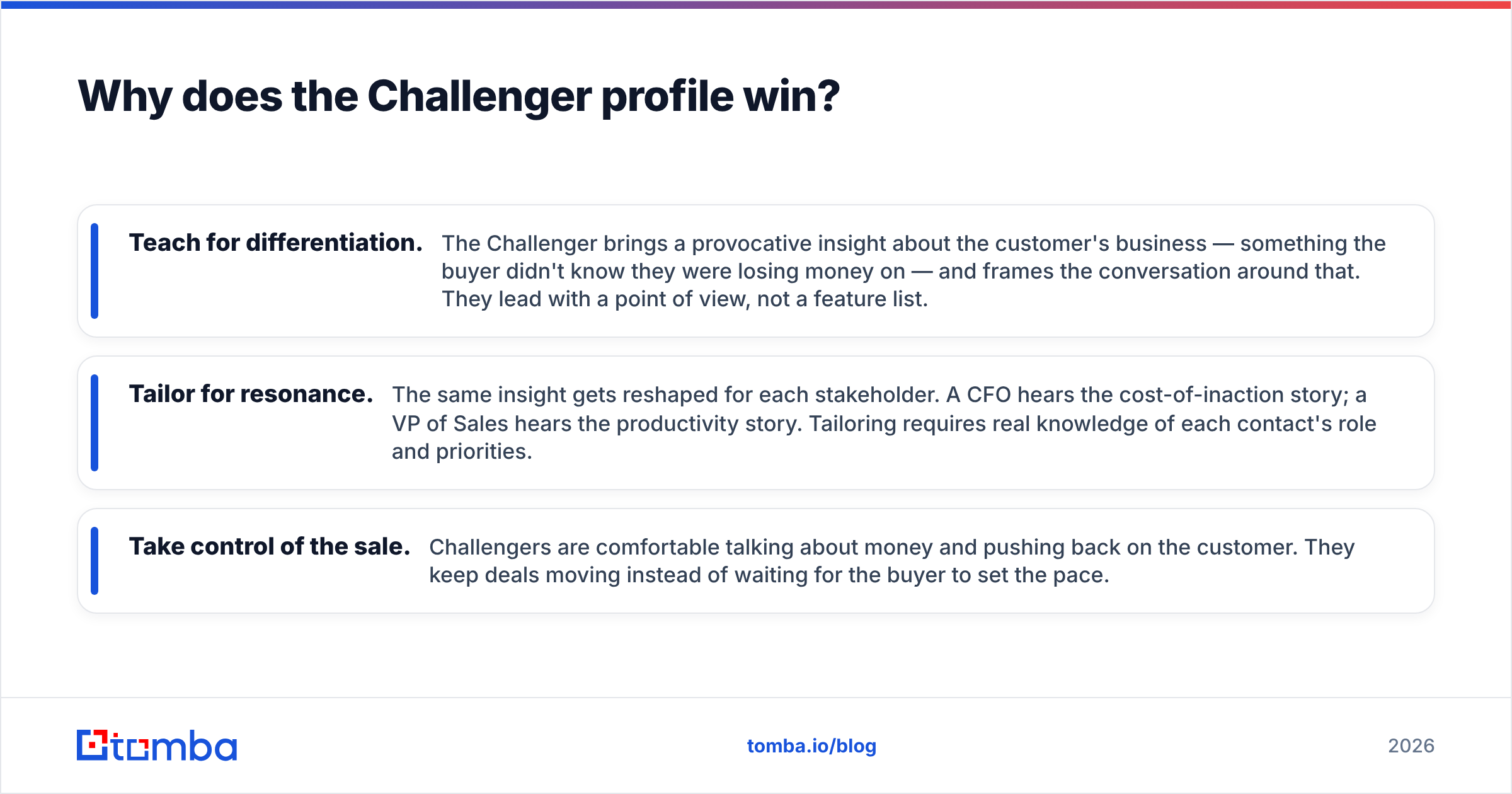
The Challenger wins because of three behaviors that map to how modern B2B buyers actually decide. Dixon and Adamson summarize them as Teach, Tailor, and Take Control.
- Teach for differentiation. The Challenger brings a provocative insight about the customer's business — something the buyer didn't know they were losing money on — and frames the conversation around that. They lead with a point of view, not a feature list.
- Tailor for resonance. The same insight gets reshaped for each stakeholder. A CFO hears the cost-of-inaction story; a VP of Sales hears the productivity story. Tailoring requires real knowledge of each contact's role and priorities.
- Take control of the sale. Challengers are comfortable talking about money and pushing back on the customer. They keep deals moving instead of waiting for the buyer to set the pace.
The reason this matters more every year: buyers now complete most of their research before they ever talk to a rep. If your seller only "responds to needs," they arrive too late to shape the decision. The Challenger's whole value is reframing the problem before the buyer has locked in their criteria.
This is also why the model is so dependent on data quality. Tailored insight is only as good as your knowledge of the account and the people in it. If you're tailoring to the wrong job title, an outdated org chart, or a contact who left the company six months ago, the "insight" lands flat. Strong data enrichment is what turns a generic pitch into a tailored one.
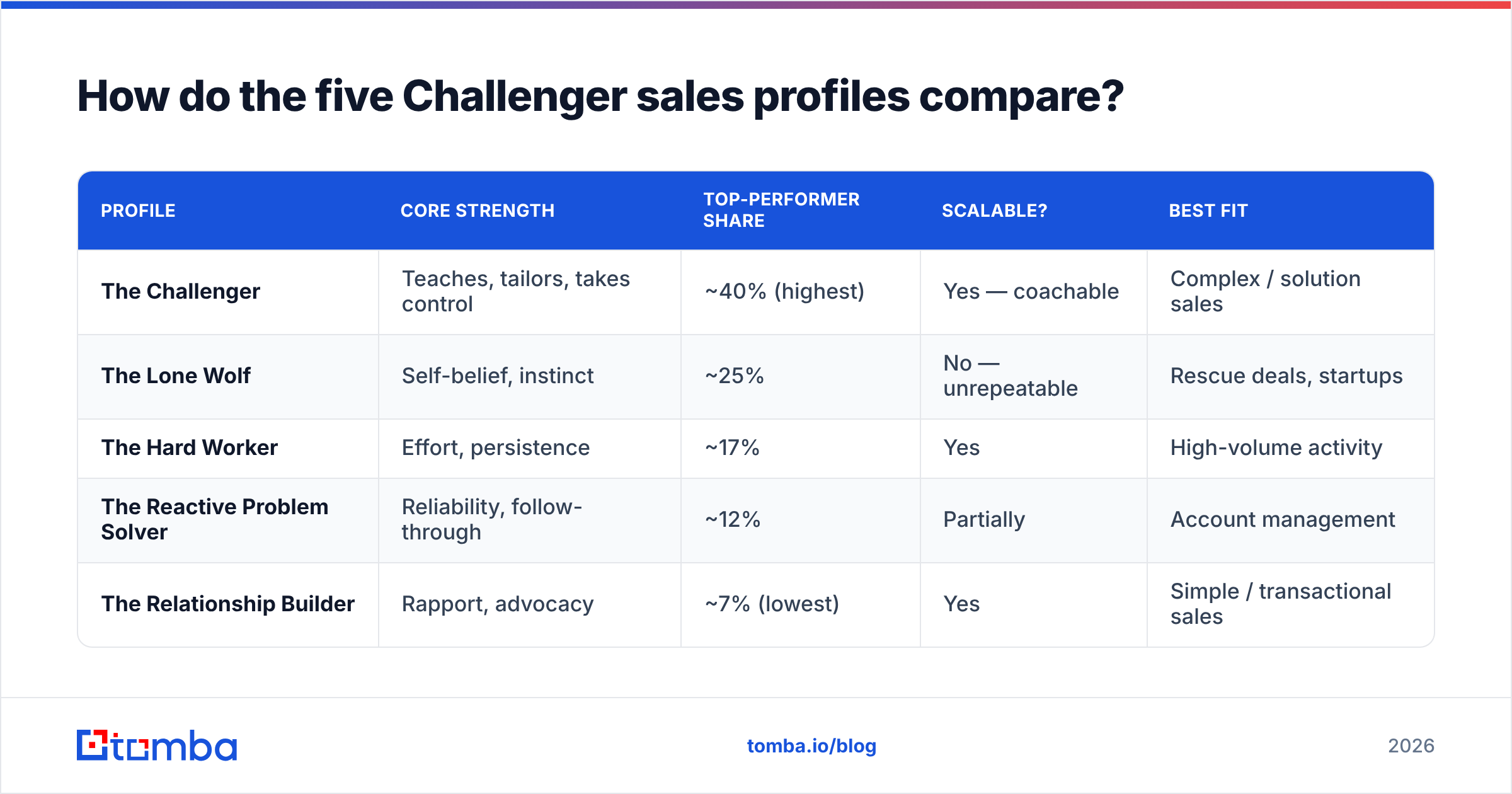
How do the five Challenger sales profiles compare?#
Here's how the five profiles stack up across the attributes that actually predict performance in complex B2B sales.
| Profile | Core strength | Top-performer share | Scalable? | Best fit |
|---|---|---|---|---|
| The Challenger | Teaches, tailors, takes control | ~40% (highest) | Yes — coachable | Complex / solution sales |
| The Lone Wolf | Self-belief, instinct | ~25% | No — unrepeatable | Rescue deals, startups |
| The Hard Worker | Effort, persistence | ~17% | Yes | High-volume activity |
| The Reactive Problem Solver | Reliability, follow-through | ~12% | Partially | Account management |
| The Relationship Builder | Rapport, advocacy | ~7% (lowest) | Yes | Simple / transactional sales |
A few things jump out. First, the Lone Wolf is the second-best performer but the worst hire at scale — you can't build a team you can't coach. Second, the Relationship Builder isn't useless — in simple, transactional sales they do fine; they just collapse when deals get complicated and require challenging the customer. Third, Challenger and Hard Worker are both coachable, which is the real strategic insight: you can manufacture more Challengers.
Important nuance: these percentages come from the original CEB study of high performers in complex environments. In simple, transactional sales the rankings flatten out. Don't treat the model as a universal law — treat it as a strong signal for solution selling.
Is the Challenger model still relevant in 2026?#
Yes — arguably more than when the book launched. The shift to self-serve research, larger buying committees (Gartner's own data puts the typical B2B buying group at six to ten people), and AI-assisted buyers all reward the rep who can reframe a problem and orchestrate consensus. That's the Challenger's home turf.
But two things have changed since the original research:
- The follow-on model, Challenger Customer, matters more. The bottleneck isn't usually the economic buyer — it's building consensus across a committee. Modern Challenger selling is about mobilizing internal champions, not just out-arguing one person.
- Insight is commoditizing. When everyone has access to the same AI-generated "industry insights," the differentiator becomes specific, account-level insight. That depends on knowing the real contacts, the real org structure, and the real signals — not generic talking points.
This is the part teams underestimate. A Challenger motion built on bad contact data is just confident guessing. Before you coach Teach-Tailor-Take-Control, make sure your reps can actually reach the right people with the right context. A reliable email finder and clean account data are the unglamorous foundation under the whole methodology.
How do you build the Challenger profile on your team?#
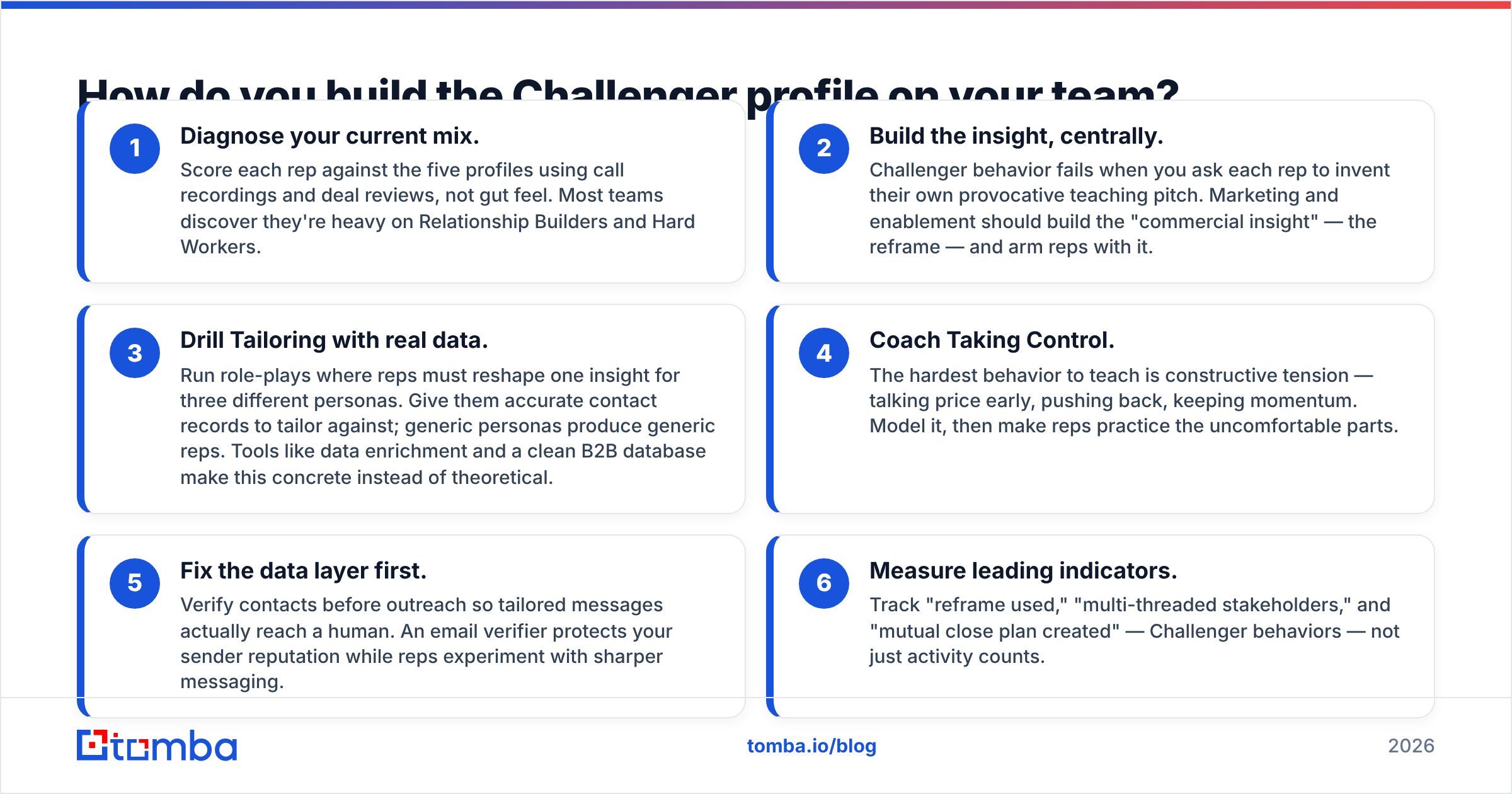
You don't hire your way to a Challenger team — you coach your way there. Here's a practical sequence.
- Diagnose your current mix. Score each rep against the five profiles using call recordings and deal reviews, not gut feel. Most teams discover they're heavy on Relationship Builders and Hard Workers.
- Build the insight, centrally. Challenger behavior fails when you ask each rep to invent their own provocative teaching pitch. Marketing and enablement should build the "commercial insight" — the reframe — and arm reps with it.
- Drill Tailoring with real data. Run role-plays where reps must reshape one insight for three different personas. Give them accurate contact records to tailor against; generic personas produce generic reps. Tools like data enrichment and a clean B2B database make this concrete instead of theoretical.
- Coach Taking Control. The hardest behavior to teach is constructive tension — talking price early, pushing back, keeping momentum. Model it, then make reps practice the uncomfortable parts.
- Fix the data layer first. Verify contacts before outreach so tailored messages actually reach a human. An email verifier protects your sender reputation while reps experiment with sharper messaging.
- Measure leading indicators. Track "reframe used," "multi-threaded stakeholders," and "mutual close plan created" — Challenger behaviors — not just activity counts.
For a deeper benchmark of what good looks like, HubSpot's sales research and peer reviews on G2 are useful reality checks against vendor hype.
What tools support a Challenger sales motion?#
The Challenger model is a behavior framework, not software — but the behaviors collapse without supporting infrastructure. Here's where tooling plugs in.
- Account & contact data. Tailoring requires knowing who you're talking to. A domain search maps the org; enrichment fills in roles and seniority.
- Reach. Insight is worthless if it never lands. An accurate email finder plus phone finder gets the reframe in front of the committee.
- List hygiene. Multi-threading a six-person committee means more contacts, more risk of bounces. Bulk verification keeps deliverability intact.
- Workflow. Native integrations push verified, enriched contacts straight into your CRM so reps spend time selling, not cleaning data.
None of this makes a Challenger. But every one of these removes friction that turns a Challenger motion into a Hard Worker grind — reps burning hours hunting for contacts instead of crafting and delivering insight.
Common mistakes with the Challenger profiles#
- Treating it as a hiring filter. "We only hire Challengers" misreads the research. Challenger is coachable; screen for learning agility and constructive assertiveness instead.
- Confusing Challenger with aggressive. The Challenger creates constructive tension grounded in insight — not a pushy closer who argues for sport.
- Skipping the central insight. If you tell reps to "be more Challenger" without arming them with a reframe, you get inconsistent, off-message pitches.
- Ignoring the data foundation. Tailoring to stale contacts produces irrelevant outreach that reads as spam. Garbage in, Challenger-out.
- Applying it to simple sales. In transactional, low-complexity deals the Relationship Builder does fine. Match the profile to the sale.
Frequently asked questions#
What are the 5 Challenger sales profiles? The Hard Worker, the Relationship Builder, the Lone Wolf, the Reactive Problem Solver, and the Challenger. They come from CEB/Gartner research published in The Challenger Sale.
Which Challenger profile performs best? The Challenger, especially in complex solution sales, where roughly 40% of top performers fit the profile. The Relationship Builder performs worst in those same environments.
Is the Challenger profile a personality type? No. It's a set of behaviors — Teach, Tailor, Take Control — that can be coached across most of your team. That's the whole point of the model.
Can you turn a Relationship Builder into a Challenger? Partly, yes. Relationship Builders already understand stakeholders; coaching them on insight delivery and taking control moves them toward Challenger behavior.
The bottom line#
The Challenger sales profiles aren't a horoscope for your reps — they're a coaching map. The Challenger wins complex deals because they teach a reframe, tailor it to each stakeholder, and take control of the sale. Every one of those behaviors depends on knowing exactly who you're selling to and being able to reach them.
That data foundation is where Tomba fits. Before your team practices a single Challenger reframe, give them accurate, verified contacts to tailor against. Start free with the Tomba Email Finder — 25 searches a month on the free tier, then Tomba plans from $49/mo when you scale your outbound. Build the Challenger motion on data your reps can trust, not guesswork.
// get started
Find, verify and enrich your first contacts today
Start on the free plan with 25 searches a month, then scale when your team is ready.
Free plan · No credit card required · GDPR & CCPA
// about the author