Change Management in Sales: The 2026 Adoption Playbook
New tools and processes fail when reps quietly ignore them. Here is a practical 2026 framework for change management in sales that actually drives adoption.
You rolled out a new CRM stage, a new sequencing tool, or a new data source. Three weeks later, half the team is back to their spreadsheet and the deal notes live in someone's head. The tooling wasn't the problem. The change management was.
TL;DR#
- Change management in sales is the discipline of getting reps to actually adopt new tools, processes, and behaviors — not just announcing them in a Monday standup.
- Most sales-change failures are adoption failures, not technology failures. Reps abandon anything that adds friction without an obvious payoff to their number.
- A workable rollout has five moving parts: a clear "why," a small pilot, manager reinforcement, clean data, and measurable adoption metrics.
- Dirty contact data is the silent killer of new-tool adoption. If the first thing a rep sees is a bounced email or a wrong number, they stop trusting the system.
- Use a structured model (ADKAR, Kotter, or a lightweight version of both) plus weekly adoption tracking so you catch backsliding before it spreads.
What is change management in sales?#
Change management in sales is the structured process of moving a revenue team from how they work today to how you need them to work tomorrow — and making the new way stick. Think of it like renovating a kitchen while the restaurant stays open: you can't just shut down service, and you can't expect the line cooks to learn a new station mid-rush without a plan.
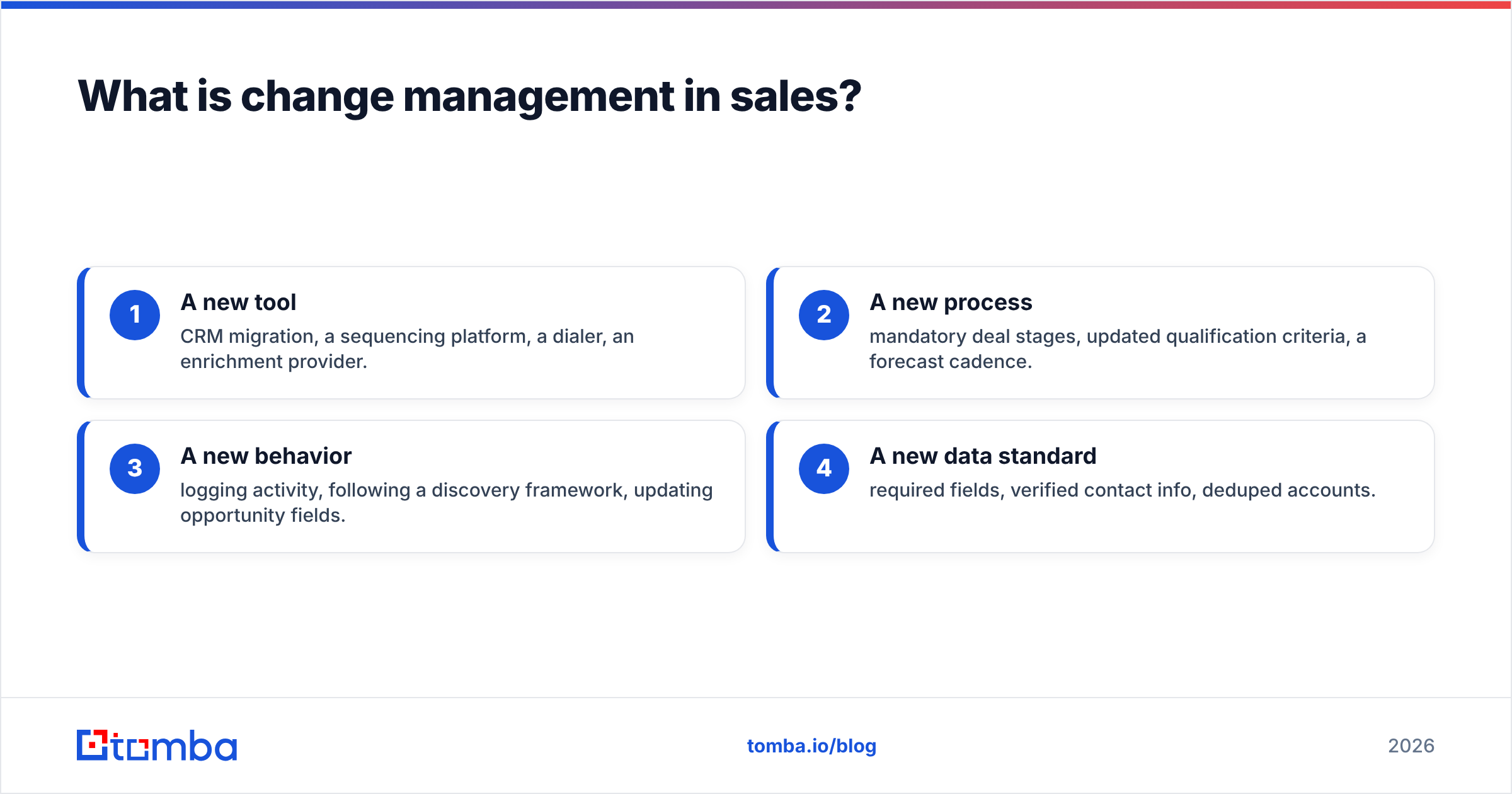
In practice, "change" usually means one of these:
- A new tool — CRM migration, a sequencing platform, a dialer, an enrichment provider.
- A new process — mandatory deal stages, updated qualification criteria, a forecast cadence.
- A new behavior — logging activity, following a discovery framework, updating opportunity fields.
- A new data standard — required fields, verified contact info, deduped accounts.
The technology is the easy part. Getting a quota-carrying rep to change a daily habit — when they're judged on pipeline, not process compliance — is the hard part. That gap between "deployed" and "adopted" is exactly where change management lives.
Why do most sales-process changes fail?#
They fail because leaders treat rollout as an announcement instead of a transition. According to Gartner research on change management, the average employee experienced more enterprise changes in recent years than they could absorb, and "change fatigue" directly lowers willingness to adopt the next initiative. Sales teams feel this acutely because every hour spent learning a new system is an hour not spent selling.
Here are the failure patterns that show up again and again:
- No "what's in it for me." Reps don't care that the VP wants cleaner Salesforce reports. They care about hitting quota. If the change doesn't visibly help them book meetings or close faster, it's overhead.
- Big-bang rollout. Flipping the switch for 40 reps on the same Monday guarantees 40 simultaneous support tickets and a wave of frustration.
- Manager ambivalence. If frontline managers don't model the new behavior, reps read that as permission to ignore it.
- Dirty data on day one. Nothing kills trust faster than a rep clicking a freshly imported contact and hitting a hard bounce. The tool gets blamed for the data.
- No feedback loop. Leaders assume silence means adoption. Silence usually means quiet reversion.
The throughline: people don't resist change, they resist loss. Loss of speed, loss of control, loss of a workflow they'd already optimized. Good change management minimizes that perceived loss.
Which change management framework works for sales?#
The two most-cited frameworks — Kotter's 8 steps and Prosci's ADKAR — both work, but sales teams need a slimmed-down version that respects how little patience a rep has for process theater. Prosci's ADKAR model is the more useful starting point because it's individual-centric: change only succeeds when each person moves through Awareness, Desire, Knowledge, Ability, and Reinforcement.
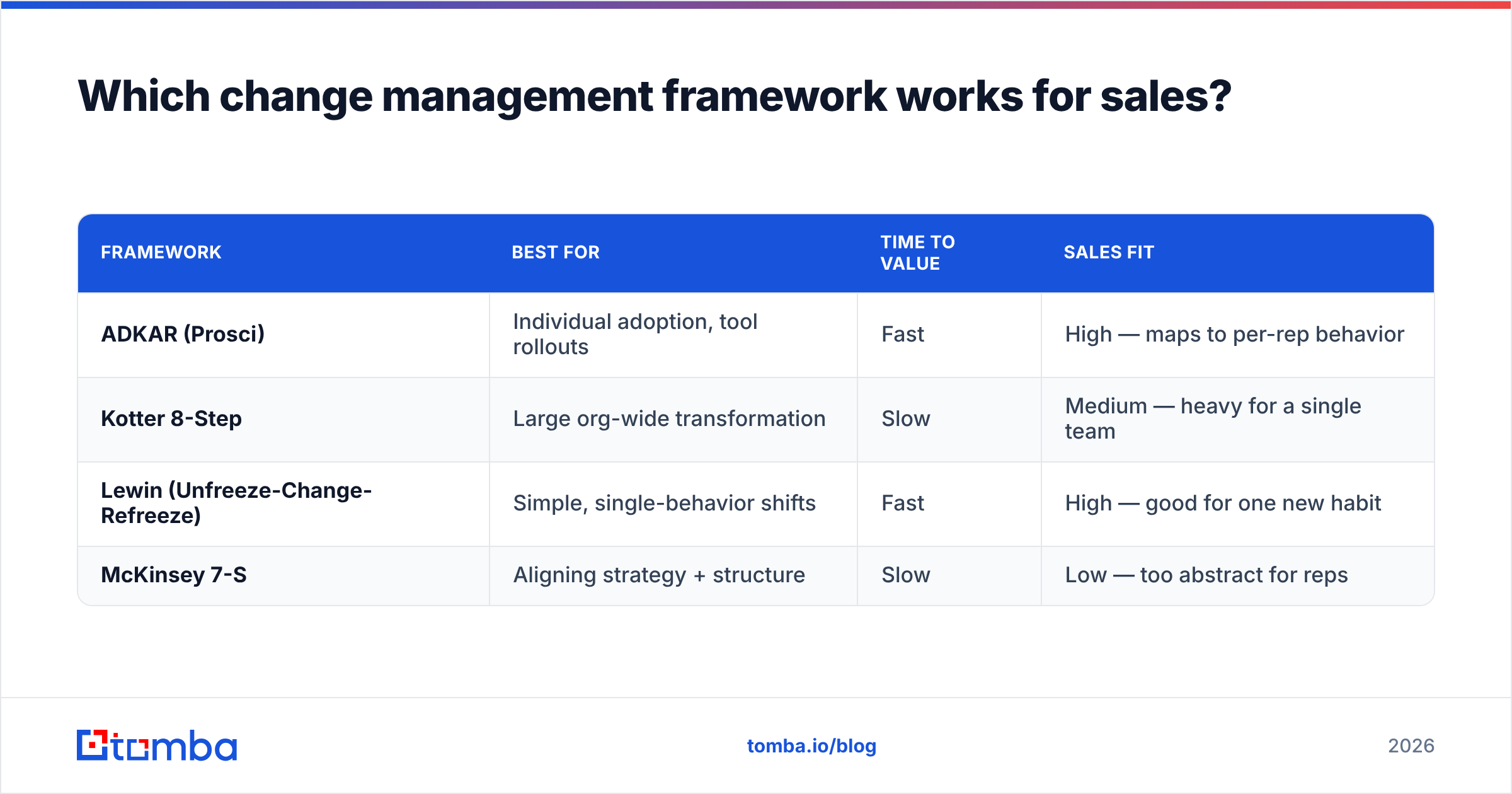
Here's how the major approaches compare for a typical sales rollout:
| Framework | Best for | Time to value | Sales fit |
|---|---|---|---|
| ADKAR (Prosci) | Individual adoption, tool rollouts | Fast | High — maps to per-rep behavior |
| Kotter 8-Step | Large org-wide transformation | Slow | Medium — heavy for a single team |
| Lewin (Unfreeze-Change-Refreeze) | Simple, single-behavior shifts | Fast | High — good for one new habit |
| McKinsey 7-S | Aligning strategy + structure | Slow | Low — too abstract for reps |
For most sales orgs, the pragmatic move is ADKAR for the per-rep journey wrapped in two or three of Kotter's org-level steps (create urgency, build a guiding coalition, generate short-term wins). You don't need all eight steps to change how a 12-person SDR team books meetings.
A lightweight five-stage rollout#
If you want something you can run next quarter without a consultant, use this sequence:
- Build the case (Awareness + Urgency). State the problem in rep terms: "Our bounce rate is 14% and it's costing each of you ~30 wasted dials a week." Tie it to quota, not to dashboards.
- Run a pilot (Desire + short-term win). Pick 3–4 respected reps — your guiding coalition. Let them use the new tool or process for two weeks and surface a concrete win ("Priya booked 6 extra meetings").
- Train for ability (Knowledge + Ability). Short, role-specific sessions. Show the exact clicks for the exact job, not a generic vendor demo.
- Reinforce through managers (Reinforcement). Managers inspect the new behavior in 1:1s and call out adopters publicly. What gets inspected gets adopted.
- Measure and iterate. Track adoption weekly and fix friction fast.
How do you measure sales change adoption?#
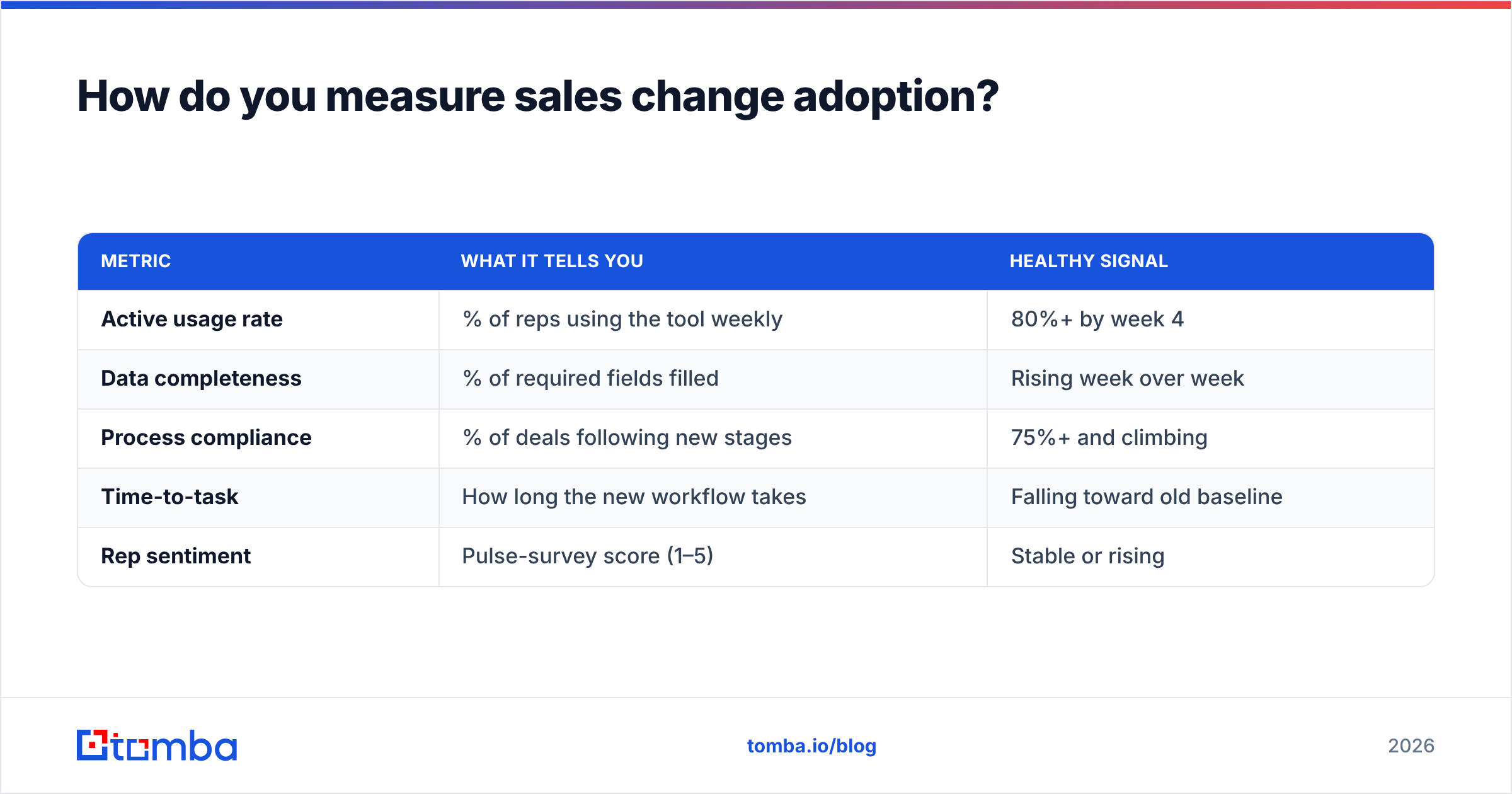
You measure adoption with leading behavioral metrics, not just the lagging revenue number — because revenue moves too slowly to tell you whether a rollout is working in week two. The goal is to see, within days, whether reps are actually using the new way.
Track a small, honest set:
| Metric | What it tells you | Healthy signal |
|---|---|---|
| Active usage rate | % of reps using the tool weekly | 80%+ by week 4 |
| Data completeness | % of required fields filled | Rising week over week |
| Process compliance | % of deals following new stages | 75%+ and climbing |
| Time-to-task | How long the new workflow takes | Falling toward old baseline |
| Rep sentiment | Pulse-survey score (1–5) | Stable or rising |
Two cautions. First, don't weaponize these metrics in week one — early numbers reflect the learning curve, not resistance. Second, pair every adoption metric with an outcome metric (meetings booked, reply rate, win rate) so you can prove the change is paying off, which is what sustains desire to keep going.
Why is data quality the hidden lever in sales change?#
Because the fastest way to lose a team's trust in a new system is to feed it bad data. You can run a textbook ADKAR rollout, and it all unravels the moment a rep imports a list and watches a third of their emails bounce. The rep doesn't think "bad list." The rep thinks "this new tool is broken," and reverts to whatever they trusted before.
This is why data hygiene belongs inside your change plan, not as an afterthought. When you're standing up a new sequencing platform or migrating a CRM, the contacts you load on day one set the emotional tone for the whole initiative.
A few concrete moves that protect adoption:
- Verify before you migrate. Run your existing contact lists through an email verifier so the first thing reps see in the new system is deliverable. A clean import is the cheapest trust-builder you have.
- Enrich the gaps. Migrations expose missing titles, phone numbers, and company fields. Use data enrichment to fill them automatically rather than asking reps to hand-research, which they won't.
- Standardize how new contacts enter. Give reps one approved way to add a verified contact — for example, a Chrome extension or a find email addresses workflow — so the "new process" includes a fast, reliable data source instead of free-typing guesses.
- Dedupe relentlessly. Duplicate accounts make every new dashboard look wrong, and a dashboard nobody believes is a dashboard nobody uses.
When the data is clean, the new workflow feels faster than the old one almost immediately — and that perceived speed is what converts skeptics. The change stops being something done to reps and becomes something that obviously helps them.
What does a 90-day sales change rollout look like?#
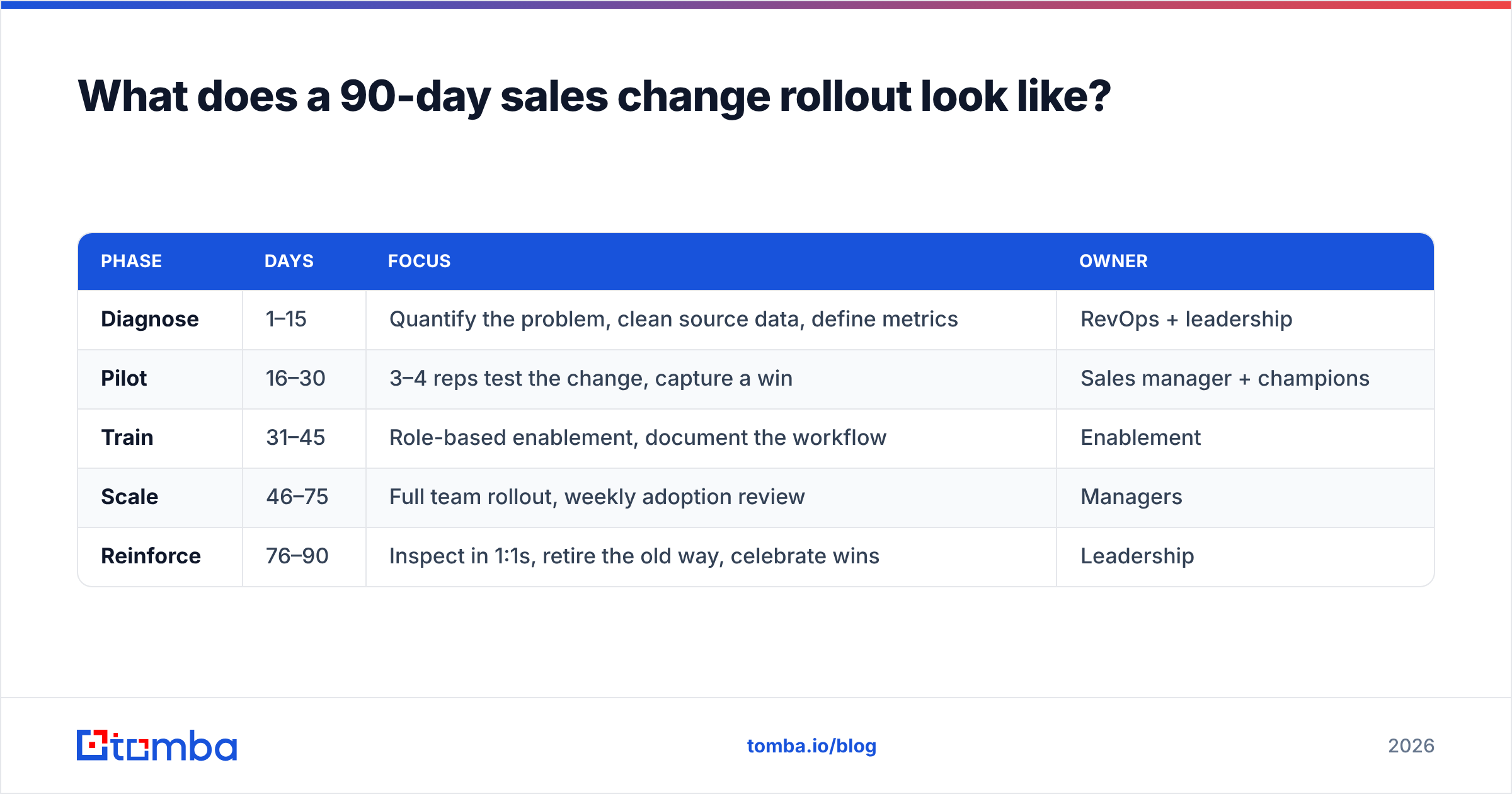
A realistic timeline keeps urgency high without overwhelming the team. Here's a 90-day shape you can adapt:
| Phase | Days | Focus | Owner |
|---|---|---|---|
| Diagnose | 1–15 | Quantify the problem, clean source data, define metrics | RevOps + leadership |
| Pilot | 16–30 | 3–4 reps test the change, capture a win | Sales manager + champions |
| Train | 31–45 | Role-based enablement, document the workflow | Enablement |
| Scale | 46–75 | Full team rollout, weekly adoption review | Managers |
| Reinforce | 76–90 | Inspect in 1:1s, retire the old way, celebrate wins | Leadership |
The single most-skipped step is "retire the old way." If reps can still update the legacy spreadsheet, some always will. Once adoption is healthy, remove the fallback — politely, with notice, but firmly. A change isn't complete while the old path is still open.
Common objections and how to answer them#
- "This is slower." Often true in week one. Acknowledge it, show the week-four data, and remove friction (pre-filled fields, verified data, fewer required clicks).
- "My old way works fine." Reframe around the team metric the old way can't deliver — accurate forecasting, shared visibility, clean handoffs.
- "I don't trust the data." This is the big one. Solve it with verification and enrichment before the complaint, not after.
- "Nobody asked me." Involve respected reps in the pilot. People support what they help build.
How does tooling support sales change management?#
Tooling can't replace leadership, but the right integrations remove the friction that causes reversion. The principle: every new step should be at least as fast as the old one, and the data behind it should be trustworthy by default.
A few high-leverage integrations:
- CRM-native enrichment. Push verified contacts straight into your HubSpot integration or Salesforce integration so reps never leave the system you're asking them to adopt.
- Spreadsheet bridges. Reps live in spreadsheets during transitions; a Google Sheets workflow lets them verify and enrich without breaking habit cold-turkey.
- API-driven hygiene. For larger orgs, automate verification at the point of entry with the email finder API so bad data never reaches a rep's screen.
The pattern across all three: make the trustworthy path the path of least resistance. When clean, verified data is the default, adoption stops being a willpower problem.
For context on where contact data fits in the broader stack, HubSpot's research on sales productivity consistently shows reps spend a large share of their week on non-selling work — much of it data cleanup. Remove that drag during a change initiative and you turn a perceived burden into an obvious win.
What separates the rollouts that stick?#
The teams that make change stick share four traits, regardless of framework:
- They sell the change internally the way reps sell to prospects — with a clear problem, a quantified payoff, and social proof from peers.
- They start small and visible. A two-week pilot with one undeniable win beats a company-wide mandate every time.
- They protect data trust from day one, because a single bounce or wrong number can undo weeks of buy-in.
- They reinforce through managers and inspect behavior until the new way is just "the way."
Change management in sales is less about pushing reps and more about removing every reason they'd want to push back. Clear the friction, prove the payoff, and keep the data honest — and adoption follows.
Make your next sales rollout stick with clean data#
The fastest trust-killer in any sales change is bad contact data, and the cheapest insurance is verifying and enriching before reps ever touch the new system. Tomba's Email Finder helps you load any new CRM, sequencer, or process with deliverable, enriched contacts from the first day — so the new workflow feels faster and more reliable than the old one, and reps adopt it because it obviously works. Start free with 25 searches a month, or scale up on the Starter plan at $49/mo; see Tomba pricing for the full breakdown. Give your next rollout the one thing most change initiatives forget: data your team can trust.
// get started
Find, verify and enrich your first contacts today
Start on the free plan with 25 searches a month, then scale when your team is ready.
Free plan · No credit card required · GDPR & CCPA
// about the author