Channel Sales Enablement: The 2026 Partner Playbook
Channel sales enablement decides whether your partners sell or sit idle. Here is the 2026 playbook for partner onboarding, content, data, and metrics that actually move revenue.
TL;DR
- Channel sales enablement is the system of content, training, tools, and data that lets your partners sell your product as well as your own reps do — and most programs fail because they stop at a one-time PDF dump.
- The highest-leverage fixes are faster partner onboarding, role-specific content, co-branded assets partners can actually use, and clean prospect data so partners spend time selling instead of hunting for contacts.
- Measure partner-sourced and partner-influenced revenue, time-to-first-deal, and content usage — not how many partners signed a contract.
- A modern stack pairs a PRM (partner relationship management) tool with a CRM, a learning platform, and a contact-data source like an email finder so partners get verified leads, not stale lists.
- Treat partners like an extension of your sales team: same data quality, same playbooks, same accountability.
What is channel sales enablement?#
Channel sales enablement is everything you do to make your partners — resellers, VARs, agencies, system integrators, and referral partners — capable of selling your product without you in the room. Think of it like franchising a restaurant: you do not just hand someone your logo and wish them luck. You give them the recipes, the supplier list, the training, and the operating manual so every location serves the same quality you would.
Direct sales enablement equips people you employ. Channel enablement equips people you do not control, do not pay a salary, and who are usually selling three other products at the same time. That distinction changes everything. Your partners have divided attention, no obligation to prioritize you, and far less product knowledge than your own reps. If your enablement is friction-heavy or out of date, partners quietly default to selling whatever is easiest — and that will not be you.
The goal is simple to state and hard to execute: make selling your product the path of least resistance for a busy partner.
Why do most channel enablement programs fail?#
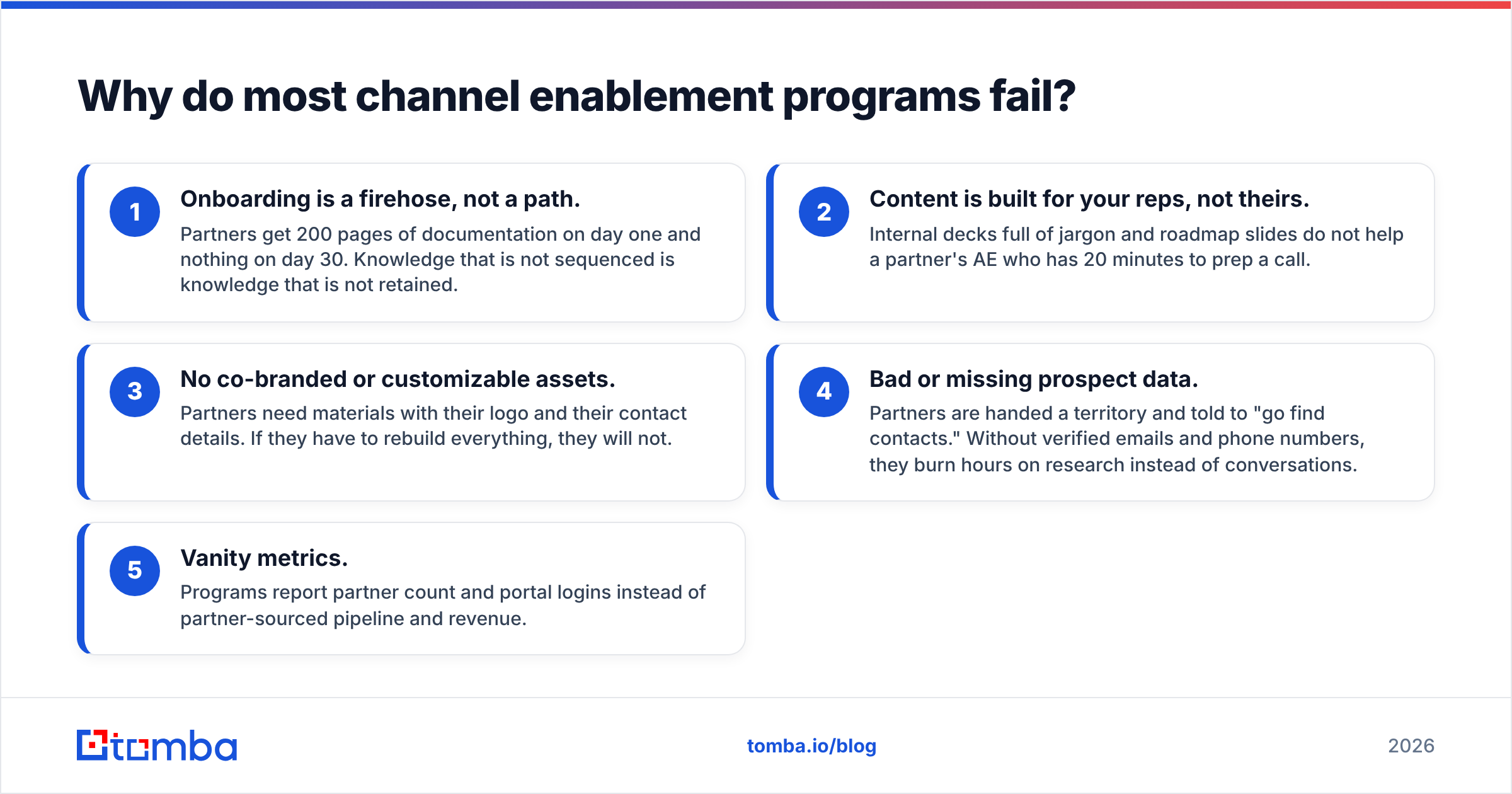
Most programs fail because they confuse recruitment with enablement. A vendor signs 40 partners, sends a welcome email with a slide deck, and then wonders why 32 of them never close a deal. Signing a partner is the start line, not the finish.
Here are the failure patterns that show up again and again:
- Onboarding is a firehose, not a path. Partners get 200 pages of documentation on day one and nothing on day 30. Knowledge that is not sequenced is knowledge that is not retained.
- Content is built for your reps, not theirs. Internal decks full of jargon and roadmap slides do not help a partner's AE who has 20 minutes to prep a call.
- No co-branded or customizable assets. Partners need materials with their logo and their contact details. If they have to rebuild everything, they will not.
- Bad or missing prospect data. Partners are handed a territory and told to "go find contacts." Without verified emails and phone numbers, they burn hours on research instead of conversations.
- Vanity metrics. Programs report partner count and portal logins instead of partner-sourced pipeline and revenue.
According to Gartner research on sales and channel strategy, buyers increasingly move through digital and partner-led channels, which means the cost of weak partner enablement is no longer a rounding error — it is lost market coverage.

What are the core pillars of channel sales enablement?#
A durable program rests on five pillars. Treat any one as optional and the whole structure wobbles.
- Onboarding & certification. A structured, time-boxed path that takes a new partner rep from zero to first qualified conversation. Certification gives partners status to earn and you a quality bar to enforce.
- Content & playbooks. Role-specific, stage-specific assets: pitch decks, battlecards, objection handlers, ROI calculators, and email templates partners can send without rewriting.
- Tools & systems. A PRM for deal registration and asset distribution, a CRM that syncs partner deals, and sales automation so partners are not stuck doing manual admin.
- Data & leads. Verified contact data so partners prospect into real buyers. This is the pillar vendors most often forget, and the one that most directly determines whether a partner books meetings.
- Measurement & feedback. A scorecard the partner and you both see, plus a feedback loop so your worst content gets fixed and your best content gets cloned.
The pillars compound. Great content with bad data still leaves partners emailing dead inboxes. Great data with no playbook leaves partners with contacts they do not know how to convert.
How is channel enablement different from direct sales enablement?#
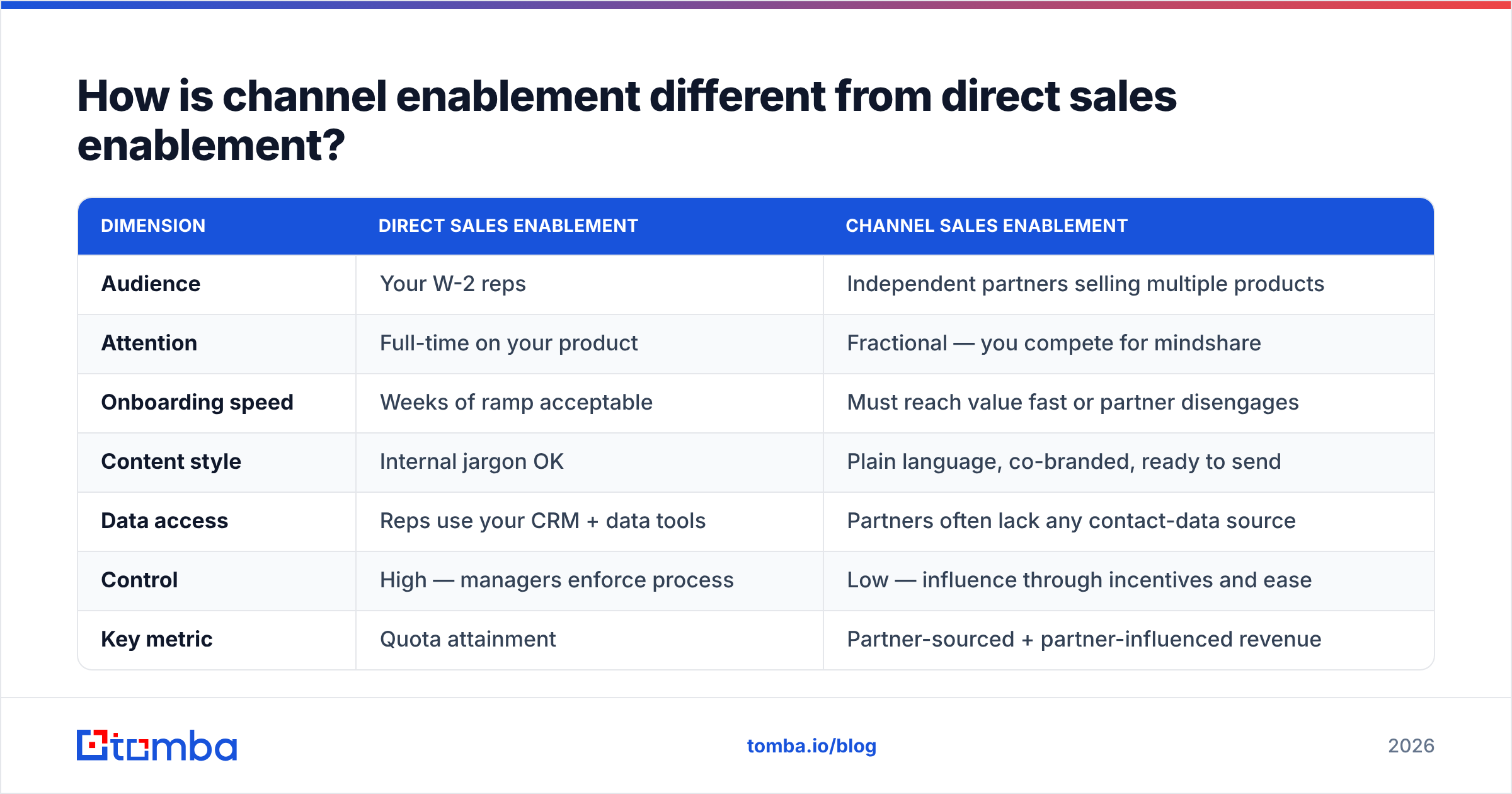
The mechanics overlap, but the constraints are different enough that copy-pasting your internal enablement onto partners rarely works. Here is the comparison that matters when you plan budget and tooling.
| Dimension | Direct sales enablement | Channel sales enablement |
|---|---|---|
| Audience | Your W-2 reps | Independent partners selling multiple products |
| Attention | Full-time on your product | Fractional — you compete for mindshare |
| Onboarding speed | Weeks of ramp acceptable | Must reach value fast or partner disengages |
| Content style | Internal jargon OK | Plain language, co-branded, ready to send |
| Data access | Reps use your CRM + data tools | Partners often lack any contact-data source |
| Control | High — managers enforce process | Low — influence through incentives and ease |
| Key metric | Quota attainment | Partner-sourced + partner-influenced revenue |
The headline takeaway: with direct teams you can mandate behavior, but with partners you can only make the right behavior the easiest one. That is why removing friction — especially around finding and verifying contacts — pays off faster in the channel than anywhere else.
How do you speed up partner onboarding?#
Cut time-to-first-deal by sequencing onboarding into small, outcome-based steps instead of dumping everything at once. A partner who books a meeting in week one stays engaged; a partner still reading documentation in week six is already gone.
A workable 30-day onboarding path looks like this:
- Day 1–3: Product fundamentals. A 45-minute recorded overview plus a one-page "who we beat and why" battlecard. Nothing longer.
- Day 4–7: Ideal customer profile + first list. Define exactly who the partner should target, then hand them a starter list of verified contacts so their first outreach happens this week, not next month.
- Day 8–14: Pitch certification. Partner reps record a 5-minute pitch and pass a short check. This forces active recall and surfaces gaps early.
- Day 15–21: Co-selling shadow. Partner joins one of your reps on a live call to see the motion in practice.
- Day 22–30: First registered deal. Partner registers their first opportunity in the PRM, with you on standby for support.
The single biggest accelerator in that path is step two. When you remove the "I don't have anyone to call" problem on day four, partners build momentum while motivation is still high. Pairing a clean contact source — pulled with data enrichment or a domain search of target accounts — with the onboarding flow turns abstract training into real conversations fast.
What content do channel partners actually use?#
Partners use content that is ready, relevant, and customizable — and ignore everything else. The test is brutal: if an asset cannot be used in under five minutes, it does not exist as far as a busy partner is concerned.
Prioritize building these, in this order:
- Co-brandable one-pagers and decks. Partners need their logo on it. Lock the messaging, open the branding.
- Battlecards and objection handlers. Short, scannable, organized by competitor and by objection. This is the highest-usage asset type in most programs.
- Email and outreach templates. Plug-and-play sequences partners can load into their tools. Pair these with a subject line generator so partner reps are not guessing at open rates.
- ROI calculators and case studies. Proof that converts skeptics, especially for higher-priced deals.
- Demo environments or recorded demos. Not every partner can demo well; give them a fallback.

The pattern that wins is "edit, don't author." Partners are not content creators. Every asset you ship should be 90% done, with the last 10% being their branding and a few fields. Anything that asks them to start from a blank page will be skipped.
What does the channel enablement tech stack look like?#
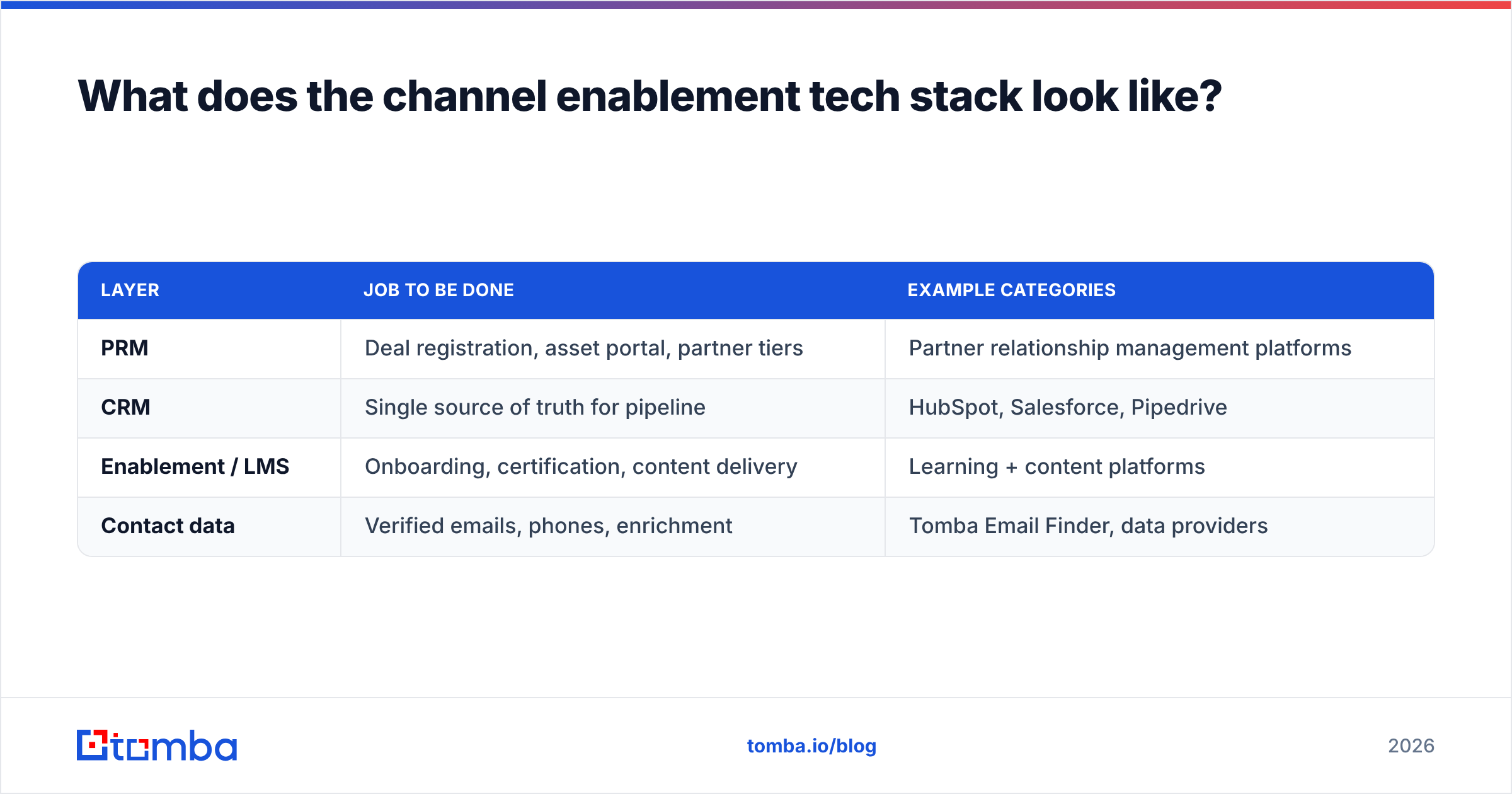
The modern channel stack has four layers, and the data layer is the one most programs under-invest in. You can have a beautiful PRM and a polished LMS, but if partners cannot find verified buyer contacts, the whole machine idles.
| Layer | Job to be done | Example categories |
|---|---|---|
| PRM | Deal registration, asset portal, partner tiers | Partner relationship management platforms |
| CRM | Single source of truth for pipeline | HubSpot, Salesforce, Pipedrive |
| Enablement / LMS | Onboarding, certification, content delivery | Learning + content platforms |
| Contact data | Verified emails, phones, enrichment | Tomba Email Finder, data providers |
A few integration notes that save real pain:
- Connect your PRM to your CRM so partner-registered deals do not live in a silo. If you run HubSpot, a native HubSpot integration keeps partner-sourced contacts flowing into the same pipeline your direct team uses.
- Give partners self-serve access to contact data rather than gatekeeping it through your ops team. A bulk email finder lets a partner enrich an entire account list in one pass instead of one contact at a time.
- Verify before partners send. A bounced cold email from a partner damages your domain reputation by association, so an email verifier belongs in every partner's workflow.
You do not need every tool on day one. Start with CRM + a contact-data source, add a lightweight PRM as partner count grows, and layer in a formal LMS once your onboarding content stabilizes. Tomba's full pricing for the data layer is transparent and starts free — see Tomba pricing before you over-buy seats you will not use.
How do you measure channel sales enablement success?#
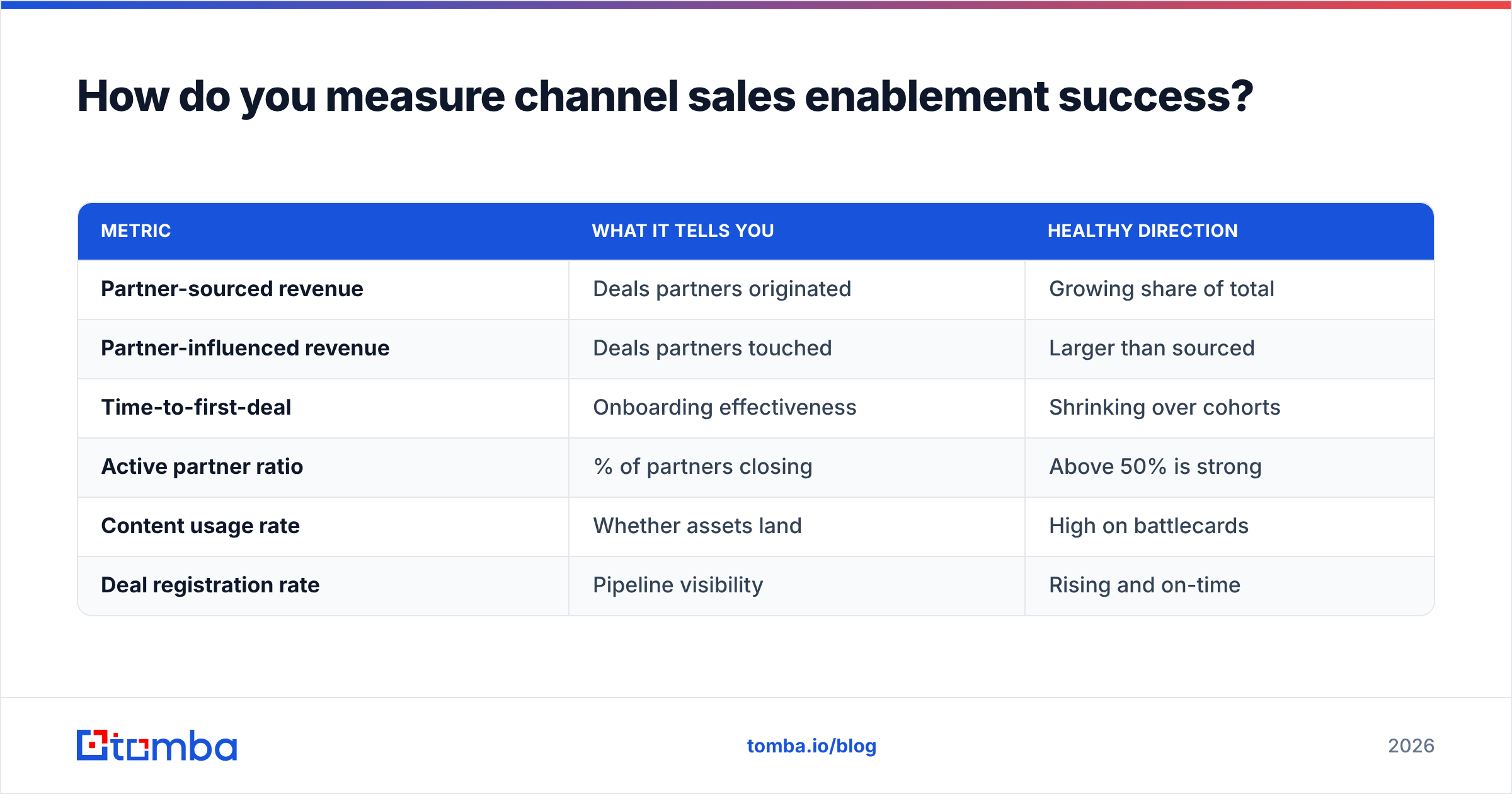
Measure outcomes partners create, not activities they perform. Portal logins and "partners trained" feel productive to report but tell you nothing about revenue. The metrics below correlate with actual channel health.
| Metric | What it tells you | Healthy direction |
|---|---|---|
| Partner-sourced revenue | Deals partners originated | Growing share of total |
| Partner-influenced revenue | Deals partners touched | Larger than sourced |
| Time-to-first-deal | Onboarding effectiveness | Shrinking over cohorts |
| Active partner ratio | % of partners closing | Above 50% is strong |
| Content usage rate | Whether assets land | High on battlecards |
| Deal registration rate | Pipeline visibility | Rising and on-time |
Two metrics deserve special attention. Time-to-first-deal is the cleanest early signal of whether your onboarding works — if it drops cohort over cohort, your program is improving. Active partner ratio kills the vanity-count problem: 100 signed partners with 12 active is a 12-partner program with extra overhead.
Per G2 and broad market data on partner platforms, the vendors who win the channel are the ones who treat partner data and partner enablement as a single discipline, not separate budgets. Tie every metric back to one question: are partners selling more, faster, because of what we gave them?
What is the fastest win to start with?#
Fix the data problem first, because it unblocks everything else. Content, training, and PRM rollouts all take weeks to show ROI. Handing partners verified contacts shows ROI in days, because it directly produces conversations.
Run this 7-day pilot with three partners:
- Pick three engaged partners who already believe in your product.
- Define one tight ICP per partner — industry, company size, role.
- Hand each a list of 50 verified contacts built from a domain search of target accounts and validated with an email verifier.
- Pair the list with one battlecard and one email template.
- Track meetings booked in seven days and compare against partners working without the list.
If the pilot partners book meaningfully more meetings — and they almost always do — you have your business case for scaling the data layer across the whole channel.
Putting it together#
Channel sales enablement is not a portal you launch once; it is a system you run continuously. Recruit deliberately, onboard in sequenced steps, ship content partners can use in five minutes, give them verified data so they sell instead of search, and measure the revenue they actually create. Vendors who do this turn partners into a true extension of their sales force. Vendors who skip it end up with a logo wall and an empty pipeline.
The cheapest, fastest pillar to fix is data — and it is the one that makes every other pillar work harder. Give your partners the Tomba Email Finder so every partner rep starts each week with verified, ready-to-contact buyers instead of a stale spreadsheet. Start on the free tier (25 searches a month), prove the lift with one partner cohort, and scale the data layer as your channel grows. Your partners will sell more because, for the first time, selling your product is the easiest thing on their desk.
Ready to find emails that actually work?
Join 150,000+ professionals who stopped guessing and started sending. Free credits on signup — no credit card required.
Get the Tomba newsletter
Practical outbound tactics and product updates — once every two weeks.
About the author