Channel Sales Incentive Programs: The 2026 Playbook
A practical 2026 guide to channel sales incentive programs: SPIFFs, MDF, rebates, and deal registration — how to design payouts partners actually chase.
Channel partners sell for dozens of vendors at once. Your incentive program is the lever that decides whether your product gets pitched first on Monday morning or buried at the bottom of a price sheet. Get the design right and partners self-select into your pipeline. Get it wrong and you fund discounts that would have closed anyway.
This guide breaks down how to build channel sales incentive programs that actually change partner behavior in 2026 — the program types, the math, the common traps, and a step-by-step framework you can copy.
TL;DR#
- Channel sales incentive programs reward partners (resellers, VARs, MSPs, agencies) for driving revenue you don't sell directly. The four workhorses are SPIFFs, rebates, MDF, and deal registration.
- Reward behavior, not just bookings. Pay for new-logo acquisition, certifications, and registered deals — not only raw volume you'd win regardless.
- Tiering beats flat payouts. A bronze/silver/gold structure gives mid-tier partners a reason to grow into the next bracket.
- Clean partner and prospect data is the hidden dependency. Attribution disputes and stale contact lists quietly kill more programs than bad payout math.
- Measure ROI per dollar of incentive, not gross partner revenue. A program that pays 8% to win deals you'd close at 4% margin is a loss.
What are channel sales incentive programs?#
Channel sales incentive programs are structured rewards a vendor offers to indirect sales partners to motivate them to sell, market, or support the vendor's product. Instead of compensating your own reps, you're compensating an external company's reps and owners — people who have no employment loyalty to you and a shelf full of competing products.
That distinction changes everything about design. An internal rep shows up regardless; a partner is a free agent allocating finite selling time. Your incentive competes for mindshare, not just effort. Think of it like a supermarket end-cap: the product at eye level sells, and brands pay for that placement. Your incentive program buys eye-level placement inside a partner's sales motion.
The major program types each solve a different problem:
- SPIFFs (Sales Performance Incentive Funds) — short-term cash bonuses paid directly to partner reps for selling a specific product or hitting a sprint target. Fast, tactical, great for launches or end-of-quarter pushes.
- Rebates — volume-based rewards paid to the partner organization after they hit thresholds (e.g., 3% back above $250K in quarterly bookings). They drive sustained volume and reward growth.
- Market Development Funds (MDF) — co-marketing dollars partners spend on demand generation: events, ads, content. They build pipeline rather than reward closed deals.
- Deal registration — protects a partner who sources an opportunity by granting them an exclusive discount or margin on that deal, eliminating channel conflict.
- Certification and enablement bonuses — payouts for training reps, achieving competencies, or maintaining a specialization tier.
- Tiered partner programs — an umbrella structure (bronze/silver/gold/platinum) that bundles escalating discounts, MDF, and support as partners commit more.
Which channel incentive type should you use?#
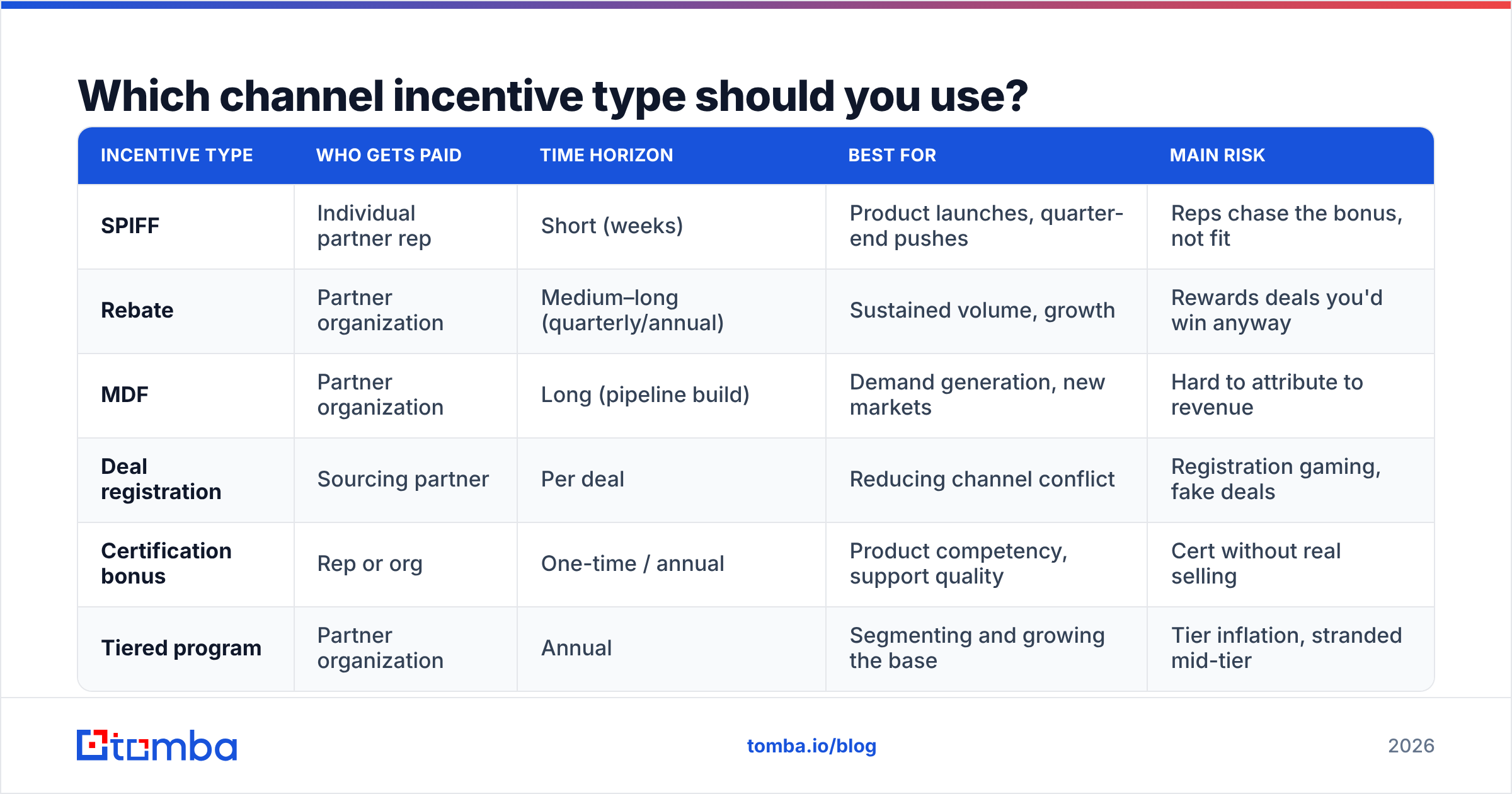
Match the incentive to the behavior you need right now. Launching a new SKU? SPIFFs create urgency. Trying to grow your largest resellers? Rebates and tiers reward the long game. Pipeline looks thin two quarters out? MDF is your demand-gen lever.
Here's how the main program types compare across the dimensions that matter when you're choosing:
| Incentive type | Who gets paid | Time horizon | Best for | Main risk |
|---|---|---|---|---|
| SPIFF | Individual partner rep | Short (weeks) | Product launches, quarter-end pushes | Reps chase the bonus, not fit |
| Rebate | Partner organization | Medium–long (quarterly/annual) | Sustained volume, growth | Rewards deals you'd win anyway |
| MDF | Partner organization | Long (pipeline build) | Demand generation, new markets | Hard to attribute to revenue |
| Deal registration | Sourcing partner | Per deal | Reducing channel conflict | Registration gaming, fake deals |
| Certification bonus | Rep or org | One-time / annual | Product competency, support quality | Cert without real selling |
| Tiered program | Partner organization | Annual | Segmenting and growing the base | Tier inflation, stranded mid-tier |
A practical rule: layer, don't pick one. Mature channel programs run a tiered foundation (the long-term commitment structure), rebates for volume, deal registration for conflict, and SPIFFs as the tactical overlay you switch on and off. MDF sits alongside for partners who can actually execute marketing.
How do you design a channel incentive program that works?#
Start from the behavior, work backward to the payout. Most failed programs invert this — they pick a payout percentage first, then hope behavior follows.
Step 1 — Define the target behavior. Be specific. "Grow revenue" is not a behavior. "Register 5 new-logo deals per quarter in healthcare" is. The narrower the behavior, the cleaner the measurement.
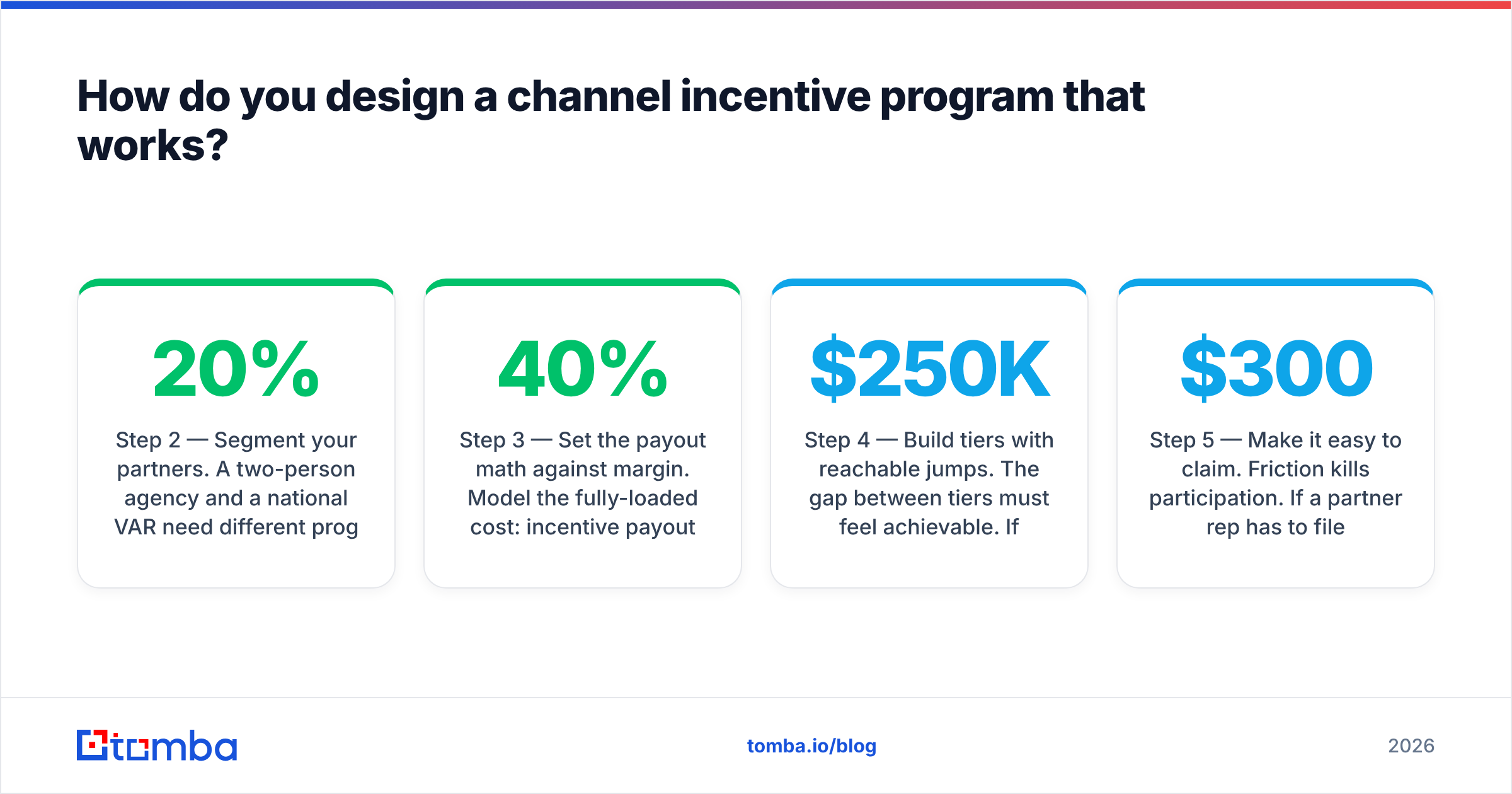
Step 2 — Segment your partners. A two-person agency and a national VAR need different programs. Use revenue contribution, capability, and growth potential to bucket partners. The Pareto reality holds in nearly every channel: roughly 20% of partners drive 80% of indirect revenue, so design your richest incentives for the partners who can move the number.
Step 3 — Set the payout math against margin. Model the fully-loaded cost: incentive payout + program admin + MDF + support. If a deal carries 40% gross margin and your stacked incentives consume 22 points, you need to be sure those deals wouldn't have closed without the spend. This is where incremental ROI matters more than gross channel revenue.
Step 4 — Build tiers with reachable jumps. The gap between tiers must feel achievable. If silver is $250K and gold is $2M, every silver partner stalls — there's no next step. Closer rungs (e.g., $250K → $500K → $1M) keep partners climbing.
Step 5 — Make it easy to claim. Friction kills participation. If a partner rep has to file a four-page form to claim a $300 SPIFF, they won't. Automate registration, approval, and payout wherever possible.
Step 6 — Instrument attribution before launch. Decide upfront how you'll credit a deal to a partner and resolve disputes. This is the step everyone skips and everyone regrets.
Why does data quality make or break channel incentives?#
Bad data turns a well-designed program into a dispute factory. Two partners both claim the same deal. A SPIFF gets paid to a rep whose "new logo" was already an existing customer under a different entity name. MDF goes to a campaign aimed at contacts who left the company a year ago.
Every one of those failures traces back to the same root cause: you can't reward the right behavior if you can't reliably identify the company, the contact, and who actually touched the deal.
This is where contact and company data infrastructure quietly earns its keep:
- Deduplication and entity resolution. Before you credit a "new logo," confirm it's genuinely new. Matching company records across partner submissions prevents double-payment and inflated new-logo claims. Cleaning your CRM with a B2B database and removing duplicates avoids paying twice for one account.
- Verified partner contacts. Programs depend on reaching the right people at partner firms — channel managers, partner principals, certified reps. When those contacts churn, your enablement and SPIFF comms bounce. Keeping partner rosters current with an email verifier protects deliverability on every program announcement.
- Enriched deal records. MDF and co-selling work better when partners can target real, reachable prospects. Feeding partners accurate firmographics through data enrichment raises the conversion on the pipeline your incentives are paying to create.
- Attribution-grade source data. Deal registration only prevents conflict if you can verify who sourced the contact first. Tools like a reverse email lookup help confirm which partner first engaged a buyer.
The point isn't to bolt on tools for their own sake. It's that incentive payouts are only as trustworthy as the records they're calculated from. A program built on a dirty CRM pays the loud partner, not the deserving one — and partners notice fast.
How do you measure channel incentive ROI?#
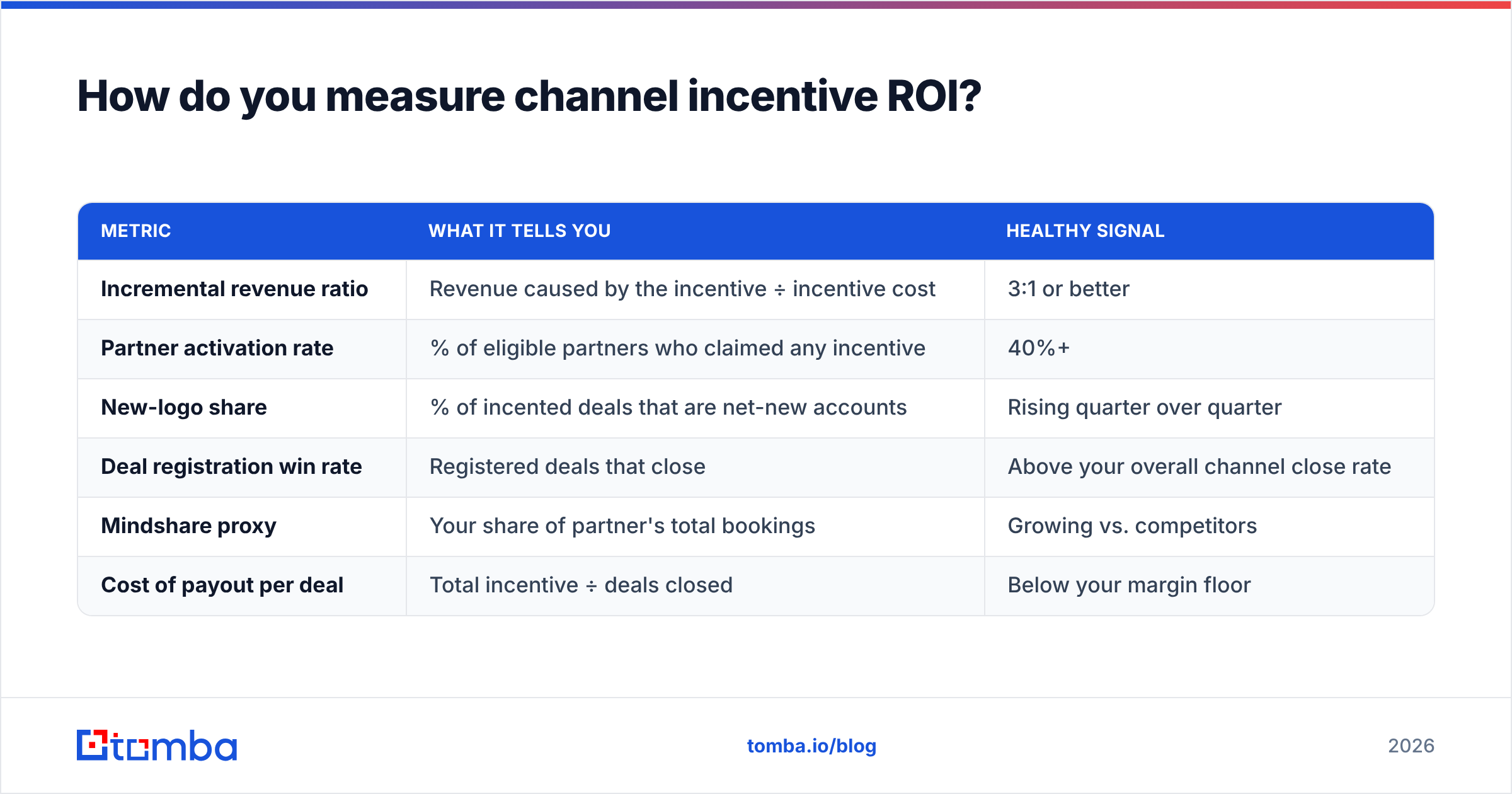
Measure incremental revenue per incentive dollar, not gross partner bookings. The number that matters is: how much revenue did this program generate that you would not have captured otherwise, divided by what you spent to generate it?
Track these core metrics:
| Metric | What it tells you | Healthy signal |
|---|---|---|
| Incremental revenue ratio | Revenue caused by the incentive ÷ incentive cost | 3:1 or better |
| Partner activation rate | % of eligible partners who claimed any incentive | 40%+ |
| New-logo share | % of incented deals that are net-new accounts | Rising quarter over quarter |
| Deal registration win rate | Registered deals that close | Above your overall channel close rate |
| Mindshare proxy | Your share of partner's total bookings | Growing vs. competitors |
| Cost of payout per deal | Total incentive ÷ deals closed | Below your margin floor |
A few interpretation rules. Low activation means your program is too complex or the reward is too small — not that partners are lazy. Flat new-logo share means you're funding existing demand — your SPIFFs are paying for deals that were coming anyway. And if registered-deal win rate is below your normal close rate, partners are registering speculative junk to lock margin; tighten qualification.
For a deeper benchmark on healthy ratios, industry analysts like Forrester and Gartner publish channel-program research worth comparing your numbers against. Peer review sites such as G2 are also useful for vetting the partner relationship management (PRM) platforms that automate this tracking.
What are the most common channel incentive mistakes?#
The same handful of errors show up across programs of every size:
- Paying for volume you'd win anyway. If your biggest reseller already moves $1M of your product, a blanket 5% rebate on that base is pure margin erosion. Tie rewards to growth over baseline, not total volume.
- Overcomplicated rules. Partners manage many vendor programs. If yours requires a spreadsheet to understand, it loses to the simpler competitor. Simplicity is a competitive advantage.
- Ignoring the partner rep. Org-level rebates motivate owners; individual SPIFFs motivate the rep who actually pitches. You usually need both. The rep on the floor is who decides which product to lead with.
- No deal registration. Without it, partners won't invest in prospecting your product because they fear another partner — or your direct team — swooping the deal. Registration is table stakes for serious channel selling.
- Stale partner data. Sending program updates to bounced addresses, crediting deals to the wrong entity, and double-paying duplicates all stem from neglected data hygiene.
- Set-and-forget. Markets shift. A SPIFF that drove a launch becomes a tax on deals that now close on their own. Review and sunset incentives quarterly.
Avoiding these is mostly discipline, not genius. Define the behavior, keep the rules legible, instrument attribution, and review the spend like you'd review any other line item.
How does Tomba fit into channel incentive programs?#
Tomba isn't a PRM, and it won't calculate your rebate tiers. What it does is fix the data layer those calculations depend on — the part most programs get wrong.
When you onboard new partners, you need verified contacts for their principals and certified reps so enablement and SPIFF announcements actually land. When partners submit deal registrations, you need to confirm the sourcing contact and dedupe against existing accounts before you pay. And when you fund MDF, partners convert better with accurate, enriched prospect lists. The Tomba Email Finder gives you verified professional emails by name, company, or domain, so every record feeding your incentive math is one you can trust.
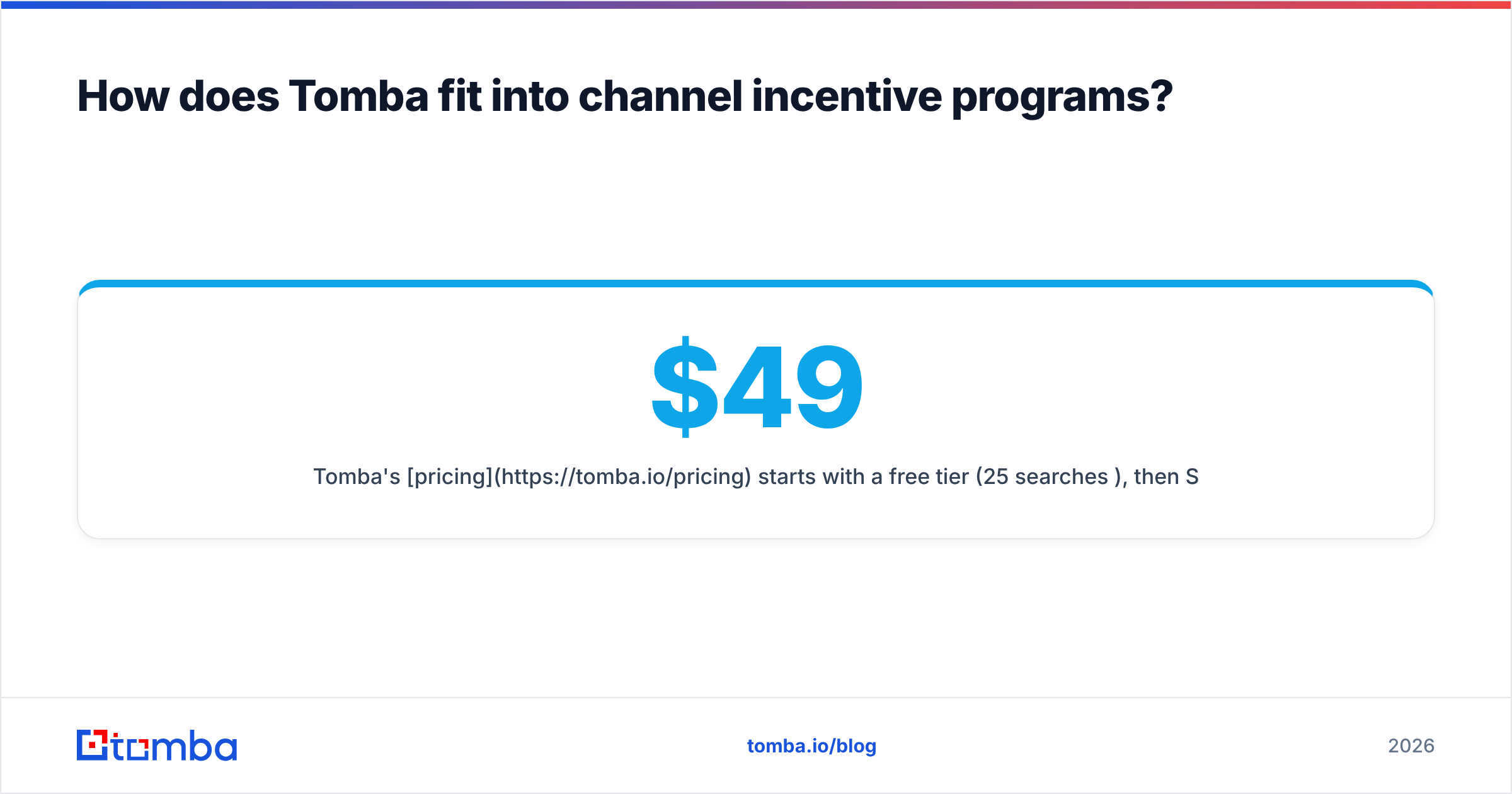
Tomba's pricing starts with a free tier (25 searches/month), then Starter at $49/mo, Growth at $99/mo, and Pro at $249/mo — so you can validate partner and prospect data at the scale your channel actually needs. Start free, clean the records your payouts ride on, and let your incentive program reward the partners who genuinely earned it.
Build your channel program on data you can defend. Try the Tomba Email Finder and stop paying incentives to the loudest partner instead of the right one.
// get started
Find, verify and enrich your first contacts today
Start on the free plan with 25 searches a month, then scale when your team is ready.
Free plan · No credit card required · GDPR & CCPA
// about the author