Channel Sales Management in 2026: The Complete Guide
Channel sales management done right turns partners into your highest-leverage revenue engine. Here is the 2026 playbook: structure, metrics, tooling, and the data that keeps partner pipelines honest.
placeholder
TL;DR
- Channel sales management is the discipline of recruiting, enabling, and measuring third-party partners (resellers, VARs, MSPs, agencies, affiliates) so they sell on your behalf profitably.
- The model only works when partner data is clean: stale partner contacts and unverified end-customer records are the silent killer of channel pipeline.
- The metrics that matter are partner-sourced revenue, time-to-first-deal, partner activation rate, and deal-registration win rate — not logo count.
- A modern stack pairs a PRM (partner relationship management) tool with a CRM and a data layer that keeps partner and prospect records accurate.
- Start narrow: pick one partner type, build a repeatable enablement motion, then scale. Breadth before depth is how channel programs die.
What is channel sales management?#
Channel sales management is the practice of running a network of external partners who sell, implement, or refer your product — and doing it deliberately enough that the revenue is predictable.
Think of it like franchising a restaurant. You do not cook every meal yourself; you hand a proven recipe, brand, and supply chain to operators who already have the locations and the local relationships. Your job shifts from cooking to making sure every franchisee follows the recipe, hits quality standards, and stays motivated. Channel sales is the same trade: you exchange direct control for reach and leverage.
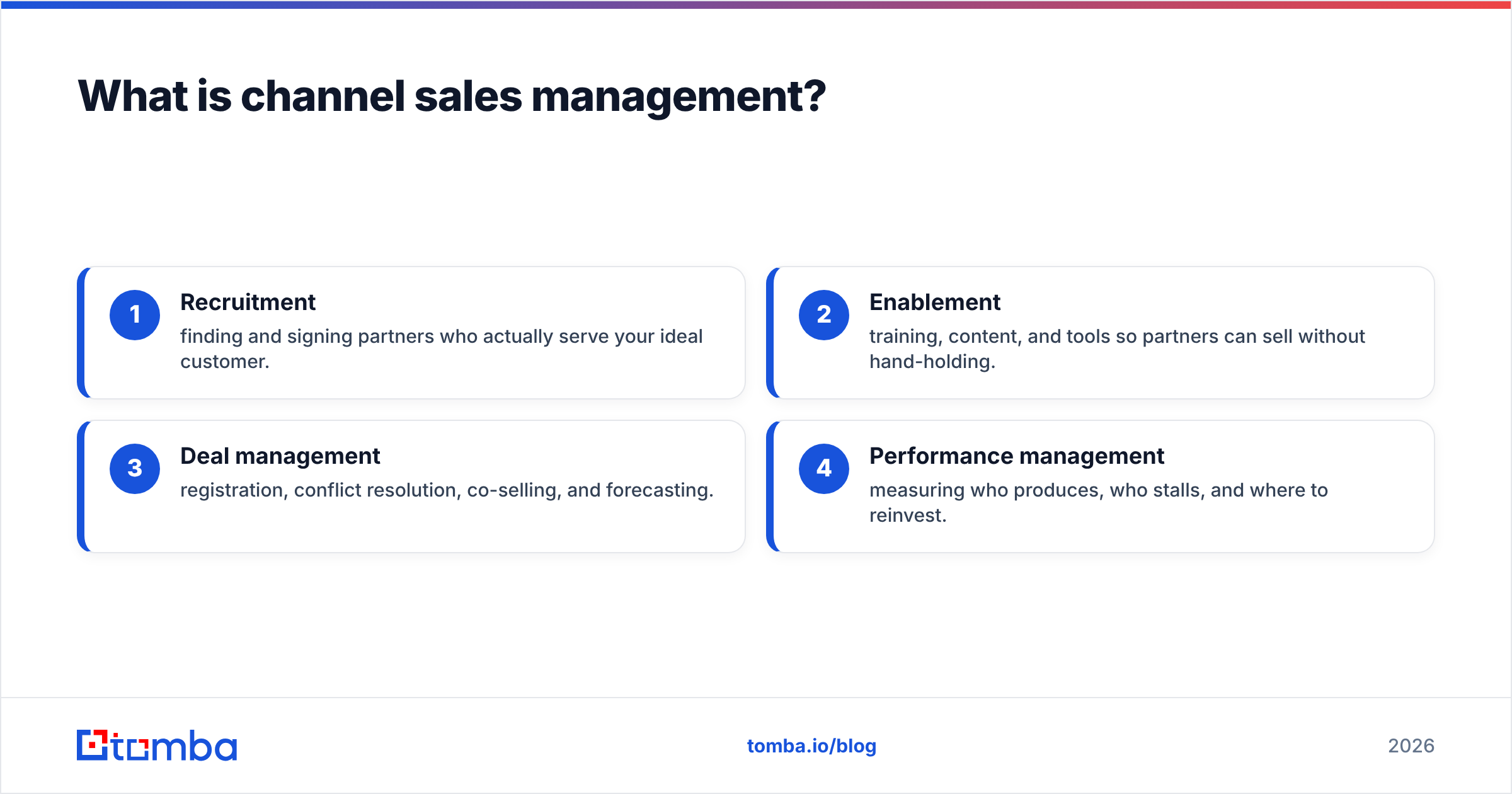
Technically, channel sales management spans four jobs that never stop:
- Recruitment — finding and signing partners who actually serve your ideal customer.
- Enablement — training, content, and tools so partners can sell without hand-holding.
- Deal management — registration, conflict resolution, co-selling, and forecasting.
- Performance management — measuring who produces, who stalls, and where to reinvest.
The contrast with direct sales is sharp. In direct sales you own the rep, the pipeline, and the customer relationship. In channel sales you own a relationship with someone who owns the customer relationship. That extra hop is the whole point — and the whole risk.
What are the main channel sales models?#
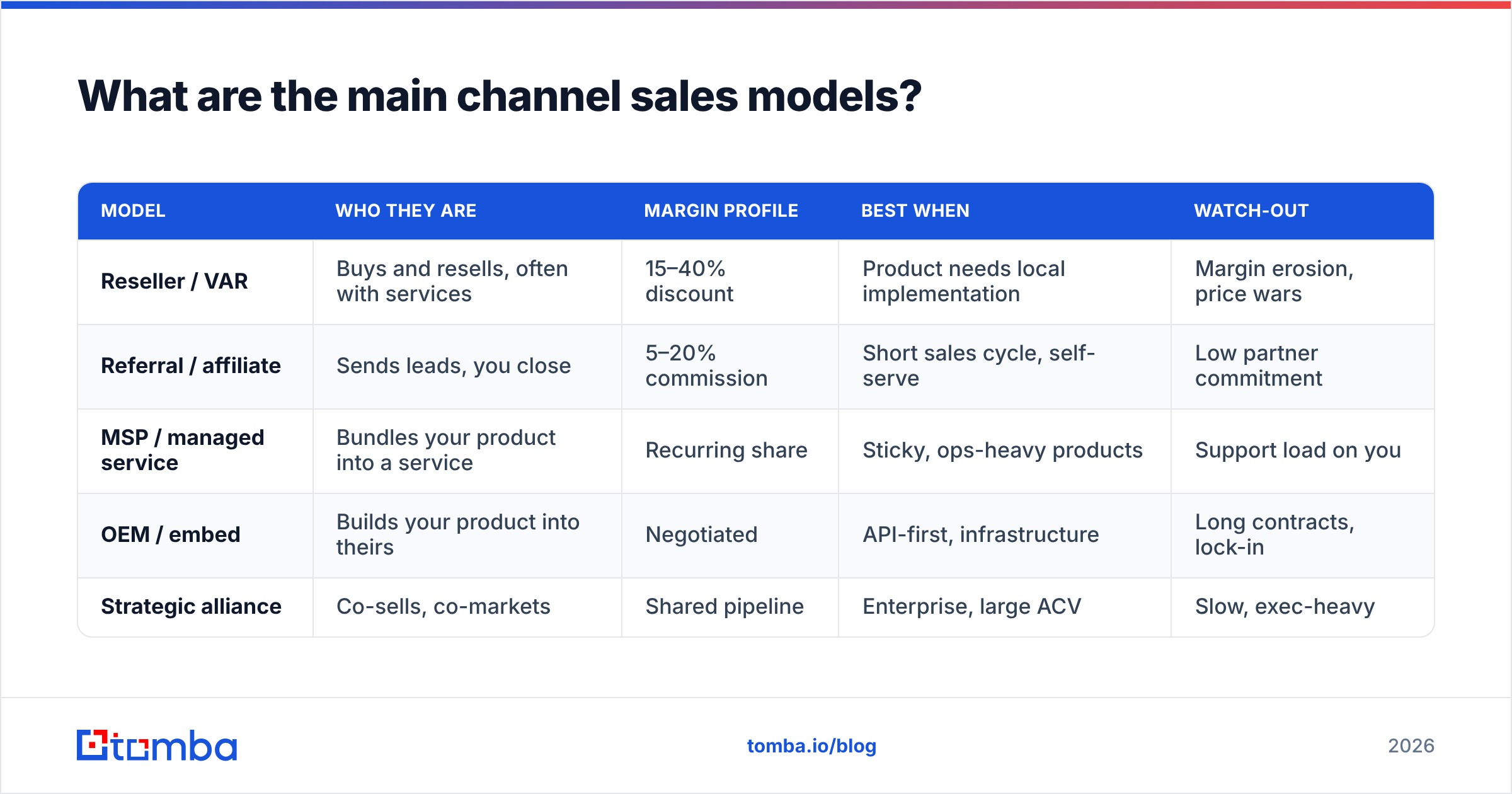
There is no single channel model. Picking the wrong one for your product is the most common early mistake, so it helps to see them side by side before committing budget.
| Model | Who they are | Margin profile | Best when | Watch-out |
|---|---|---|---|---|
| Reseller / VAR | Buys and resells, often with services | 15–40% discount | Product needs local implementation | Margin erosion, price wars |
| Referral / affiliate | Sends leads, you close | 5–20% commission | Short sales cycle, self-serve | Low partner commitment |
| MSP / managed service | Bundles your product into a service | Recurring share | Sticky, ops-heavy products | Support load on you |
| OEM / embed | Builds your product into theirs | Negotiated | API-first, infrastructure | Long contracts, lock-in |
| Strategic alliance | Co-sells, co-markets | Shared pipeline | Enterprise, large ACV | Slow, exec-heavy |
Most programs blend two or three of these. A SaaS company might run an affiliate tier for volume, a reseller tier for mid-market implementation, and a small alliance motion with one or two platform vendors. The discipline of channel sales management is keeping each tier's rules, margins, and expectations distinct so partners never compete on the same deal by accident.
Why do most channel programs underperform?#
The honest answer: partner programs fail on data and enablement far more often than on strategy.
A reseller signs, gets a login, downloads a deck, and then... nothing. The number-one cause of dormant partners is not laziness — it is friction. The partner can not find the right contact at a target account, the lead list you handed over is half-bounced, or the deal-registration form takes 20 minutes. Every point of friction is an excuse to sell something easier.
The second killer is dirty data flowing in both directions:
- Inbound: partners submit deal registrations with end-customer contacts that do not verify, so your team can not validate or support the deal.
- Outbound: the account lists and co-marketing audiences you give partners are stale, so partner reps waste cycles on disconnected numbers and dead inboxes.
This is where a clean data layer earns its keep. Before you hand a partner a target-account list, the contacts should be found and validated. Using an email finder to source decision-maker addresses by domain, then an email verifier to strip the bounces, means your partners spend their time selling instead of cleaning. Partners notice. A program that ships verified, ready-to-work lists gets activation; a program that ships a CSV graveyard gets ignored.
The third issue is measurement theater — counting signed logos instead of producing partners. Two hundred partners with five active is a worse program than thirty partners with twenty active, but the first number looks better in a board deck. Resist it.
How do you structure a channel sales team?#
A channel team is not a direct sales team with a different label. The roles map to the partner lifecycle, not to a quota territory.
- Channel Account Managers (CAMs) own a book of partners the way an AE owns accounts — they drive partner-sourced pipeline and are measured on it.
- Partner enablement / onboarding builds the training, certification, and content that turn a signed partner into a selling partner.
- Channel operations / RevOps owns deal registration, partner data hygiene, commission accuracy, and the reporting that the rest of the company trusts. See how this connects to broader revenue operations practice — channel ops is RevOps applied to an indirect motion.
- Partner marketing runs co-marketing, market development funds (MDF), and the demand programs partners plug into.
The reporting line matters. When channel reports into direct sales leadership, channel deals get deprioritized the moment the direct number is at risk. Mature organizations give channel its own P&L and its own leader so the indirect motion is protected from quarter-end panic.
Which channel sales KPIs actually matter?#
Conclusion first: measure production and velocity, not population. Here are the metrics worth a dashboard, grouped by what they tell you.
- Partner-sourced revenue — the percent of total revenue originating from partners. This is the headline number; everything else explains it.
- Partner activation rate — the share of signed partners who closed at least one deal in the period. Below 30% means your recruiting or onboarding is broken.
- Time-to-first-deal — days from signed to first closed-won. The single best leading indicator of onboarding quality.
- Deal-registration win rate — registered deals that convert. Low rates signal poor lead quality or channel conflict.
- Partner pipeline coverage — registered pipeline vs. partner quota. Tells you if the channel can hit its number before the quarter ends.
- MDF ROI — revenue influenced per dollar of market development funds spent. Stops co-marketing from becoming a slush fund.
Notice what is missing: total partner count. Logos signed is a vanity input, not an outcome. Track it for context, never as a goal.
What does the channel sales tech stack look like in 2026?#
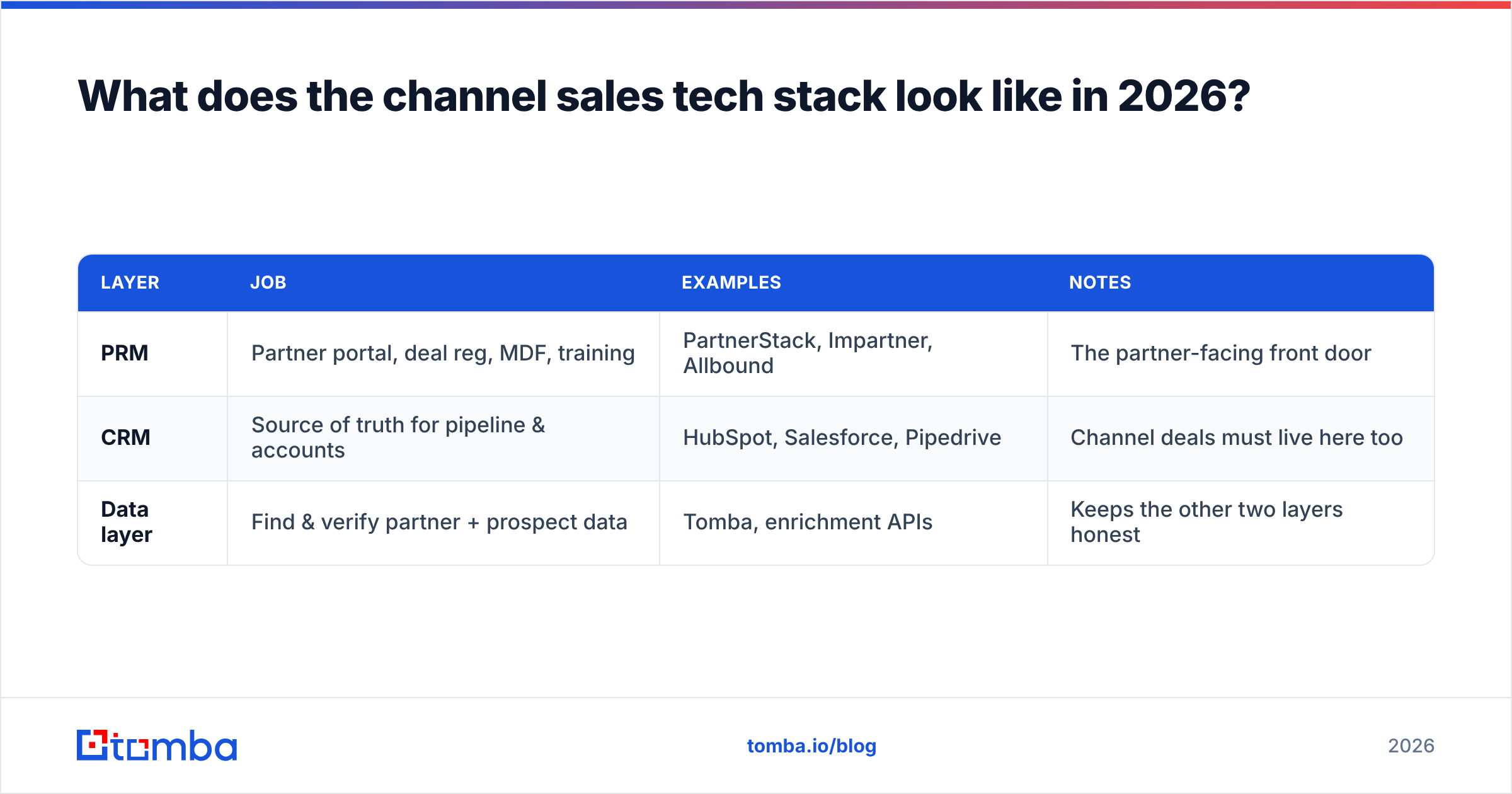
A working channel stack has three layers, and they have to talk to each other.
| Layer | Job | Examples | Notes |
|---|---|---|---|
| PRM | Partner portal, deal reg, MDF, training | PartnerStack, Impartner, Allbound | The partner-facing front door |
| CRM | Source of truth for pipeline & accounts | HubSpot, Salesforce, Pipedrive | Channel deals must live here too |
| Data layer | Find & verify partner + prospect data | Tomba, enrichment APIs | Keeps the other two layers honest |
The PRM is where partners live; the CRM is where revenue is forecast; the data layer is the connective tissue that stops both from rotting. Most teams buy the first two and forget the third — which is exactly why their partner lists decay.
If you are evaluating PRM vendors, cross-reference real reviews on G2 rather than vendor decks; the category moves fast and feature parity is closer than marketing suggests.
On the data side, integrations decide whether the layer is actually used. A HubSpot integration or Salesforce integration that enriches partner-submitted records the moment they hit the CRM means your ops team is not exporting CSVs at 6pm. For programs that recruit partners or build co-sell lists at volume, a bulk email finder turns a list of target partner companies into verified contacts in one pass.

How do you onboard and enable partners that actually sell?#
The goal of onboarding is one thing: get the partner to a first closed deal as fast as possible. Everything in the program should bend toward shrinking time-to-first-deal.
A repeatable enablement motion has five parts:
- A 30-60-90 plan per partner with one concrete outcome at each gate — not "complete training" but "register first deal by day 45."
- Role-based certification so a partner's sales rep and technical rep get different, short paths instead of one bloated course.
- Ready-to-use assets — pitch decks, battle cards, and pre-built outreach. Hand partners working cold email templates and they start conversations on day one instead of writing copy from scratch.
- Verified target lists, not raw account names. The difference between "here are 50 companies" and "here are 50 companies with verified decision-maker contacts" is the difference between a dormant and an active partner.
- A named human — a CAM who checks in on a cadence. Self-serve scales recruitment; it does not scale activation.
The partners who close early stay engaged. The ones who stall in week one rarely recover. Front-load your attention accordingly.
How do you handle channel conflict?#
Channel conflict — two partners, or a partner and your direct team, chasing the same deal — is inevitable. Managing it is mostly about rules set in advance, not heroics after the fact.
- Deal registration is the referee. First partner to register a qualified, verified deal gets protection for a defined window. This only works if registrations are validated quickly, which again comes back to clean contact data.
- Publish rules of engagement. Who owns what segment, what triggers direct involvement, and how splits work. Ambiguity breeds resentment.
- Segment the field. Give partners distinct territories, verticals, or deal sizes so overlap is rare by design.
- Protect direct/channel boundaries. If your direct team can poach a partner-sourced account, partners will stop registering deals — and you lose visibility into the pipeline entirely.
The fastest way to lose a channel is to let one big direct deal override a partner's registration. Do it once and word travels.
Channel vs. direct sales: which should you invest in?#
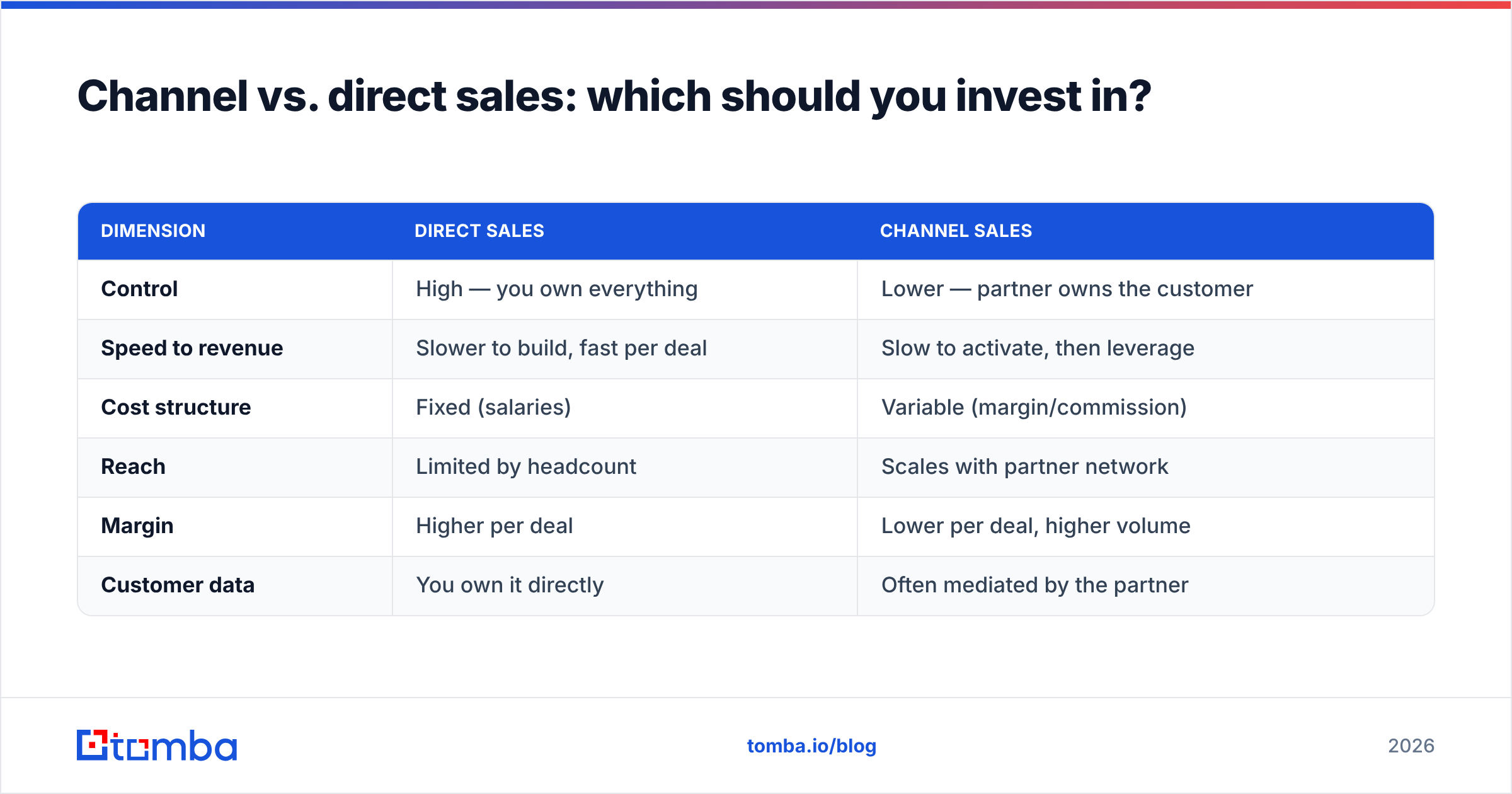
It is rarely either/or, but the trade-offs are real and worth naming.
| Dimension | Direct sales | Channel sales |
|---|---|---|
| Control | High — you own everything | Lower — partner owns the customer |
| Speed to revenue | Slower to build, fast per deal | Slow to activate, then leverage |
| Cost structure | Fixed (salaries) | Variable (margin/commission) |
| Reach | Limited by headcount | Scales with partner network |
| Margin | Higher per deal | Lower per deal, higher volume |
| Customer data | You own it directly | Often mediated by the partner |
The "customer data" row is the one most teams underestimate. When a partner owns the relationship, you can lose visibility into who the actual buyer is. A reverse lookup workflow — using data enrichment to fill in firmographics and reverse email lookup to attach a real person to a partner-submitted email — keeps your CRM trustworthy even when the partner is the front line. Pricing for that data layer is straightforward; see current Tomba pricing tiers, which start free at 25 searches per month and scale to Starter at $49/mo and Growth at $99/mo as your registration volume grows.
For most B2B companies the answer is sequencing: prove the motion with a small direct team, then add channel to scale reach once you have a repeatable, documented sales process worth handing to a partner. You can not franchise a recipe you have not written down.
A 90-day channel sales management starter plan#
If you are standing up or fixing a program, here is a focused first quarter.
- Days 1–30: Pick one partner model and one ideal partner profile. Document the sales process you will hand over. Stand up deal registration and clean your existing partner contact data.
- Days 31–60: Recruit 5–10 high-fit partners. Build the 30-60-90 onboarding plan and ship verified target-account lists with each. Set your KPI dashboard — activation rate and time-to-first-deal first.
- Days 61–90: Drive first deals. Run weekly CAM check-ins, resolve the first conflicts by your published rules, and double down on whatever partner type activated fastest.
Resist the urge to sign 50 partners in month one. Thirty active partners you can support beats two hundred you can not.
Closing: keep your partner pipeline honest#
Channel sales management lives or dies on data quality. The strategy, the PRM, the enablement decks — none of it matters if your partners are working stale lists and your CRM is full of unverifiable deal registrations.
That is the gap Tomba Email Finder closes. Use it to source verified decision-maker contacts for the target-account lists you hand partners, to validate the end-customer records that come back on deal registrations, and — through the HubSpot and Salesforce integrations — to keep your channel pipeline clean automatically instead of in a frantic end-of-quarter export. Start on the free tier, wire it into your channel ops, and give your partners lists they can actually sell from. The partners who get clean data are the partners who close.
// get started
Find, verify and enrich your first contacts today
Start on the free plan with 25 searches a month, then scale when your team is ready.
Free plan · No credit card required · GDPR & CCPA
// about the author