Chief Sales Officer (CSO): Role, Salary & Skills in 2026
What does a chief sales officer actually do, how much do they earn, and how is the CSO role different from a VP of Sales or CRO? A no-fluff 2026 breakdown.
The chief sales officer is the single executive accountable for whether a company hits its revenue number. Everyone else can do their job perfectly and still miss; the CSO owns the miss. That accountability is what makes the role one of the highest-paid and shortest-tenured seats in the C-suite.
If you are trying to understand what a chief sales officer does, what they earn, or whether your company even needs one, this guide breaks it down without the LinkedIn-influencer filler.
TL;DR#
- A chief sales officer (CSO) is the top sales executive, accountable for revenue targets, sales strategy, and the performance of the entire sales organization.
- Typical 2026 total compensation runs $300K–$600K+ (base + variable + equity), with wide swings by company stage and region.
- The CSO is broader than a VP of Sales (who runs execution) and narrower than a CRO (who also owns marketing, success, and RevOps).
- The job is increasingly data- and systems-driven: forecasting accuracy, pipeline hygiene, and clean contact data matter as much as charisma.
- Most companies should hire a CSO only when they have product-market fit and a repeatable sales motion — not before.
What is a chief sales officer?#
A chief sales officer is the senior-most leader of a company's sales function, sitting in the C-suite and usually reporting to the CEO. Where a sales manager owns a team and a VP owns a region or segment, the CSO owns the entire go-to-market revenue engine on the sales side.
Think of the sales organization as a factory. Reps are the line workers, managers are shift supervisors, and the VP of Sales keeps the line running on time. The chief sales officer is the plant director deciding what the factory builds, how many lines to run, which markets to ship to, and whether to retool the whole operation when demand shifts.
In practice, the CSO is judged on a small number of brutal questions: Did we hit the number? Is the pipeline healthy enough to hit next quarter's number? Are we acquiring customers efficiently, or burning cash to do it? Everything else — culture, enablement, tooling, comp plans — is in service of those answers.
What does a chief sales officer actually do?#
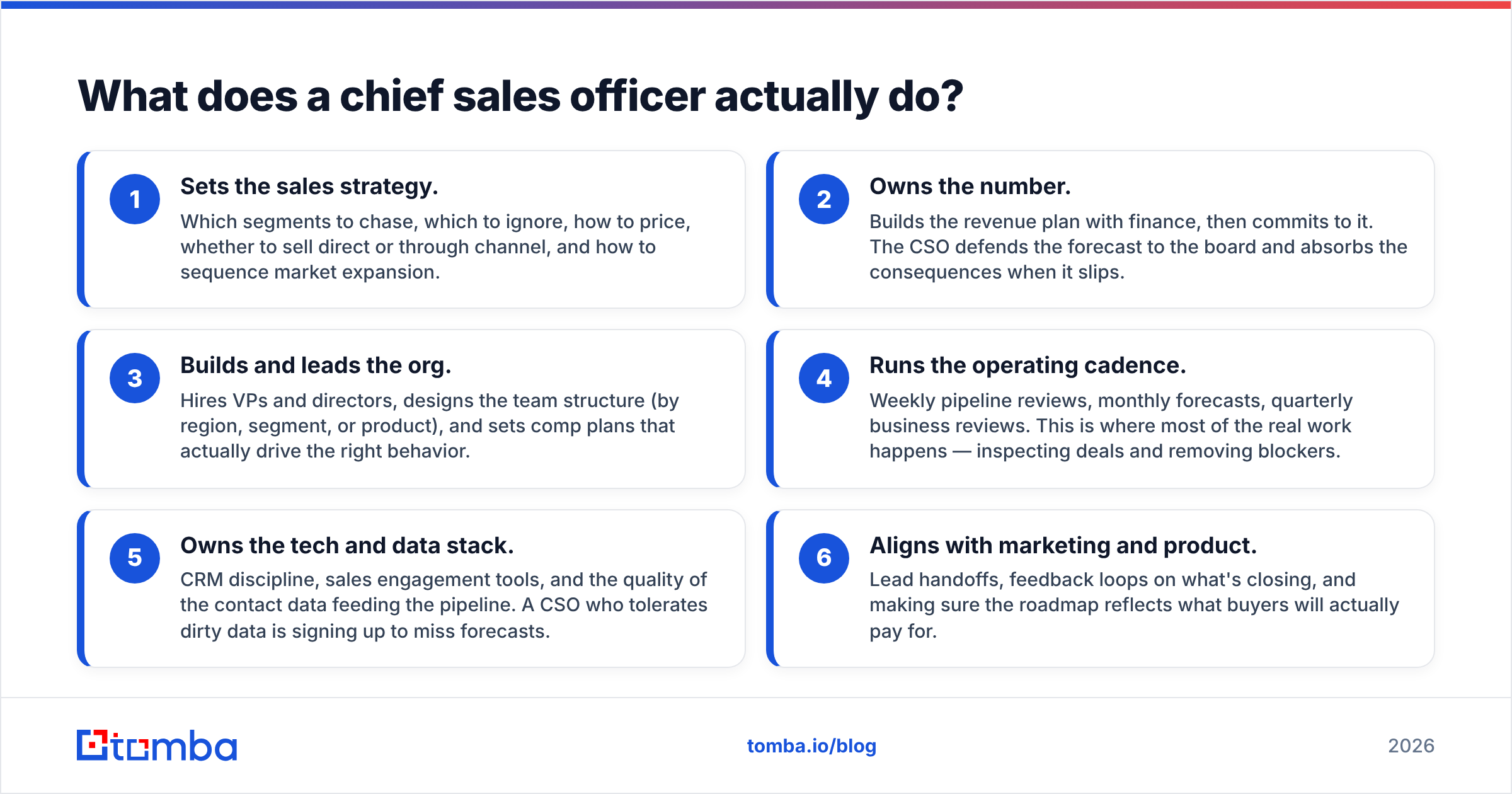
The day-to-day varies by company size, but the mandate clusters into six areas:
- Sets the sales strategy. Which segments to chase, which to ignore, how to price, whether to sell direct or through channel, and how to sequence market expansion.
- Owns the number. Builds the revenue plan with finance, then commits to it. The CSO defends the forecast to the board and absorbs the consequences when it slips.
- Builds and leads the org. Hires VPs and directors, designs the team structure (by region, segment, or product), and sets comp plans that actually drive the right behavior.
- Runs the operating cadence. Weekly pipeline reviews, monthly forecasts, quarterly business reviews. This is where most of the real work happens — inspecting deals and removing blockers.
- Owns the tech and data stack. CRM discipline, sales engagement tools, and the quality of the contact data feeding the pipeline. A CSO who tolerates dirty data is signing up to miss forecasts.
- Aligns with marketing and product. Lead handoffs, feedback loops on what's closing, and making sure the roadmap reflects what buyers will actually pay for.
The unglamorous truth: most of a great CSO's impact comes from the operating cadence and data discipline, not from heroic closing. You can read more about how this connects to broader revenue operations in our glossary.
How is a CSO different from a VP of Sales and a CRO?#
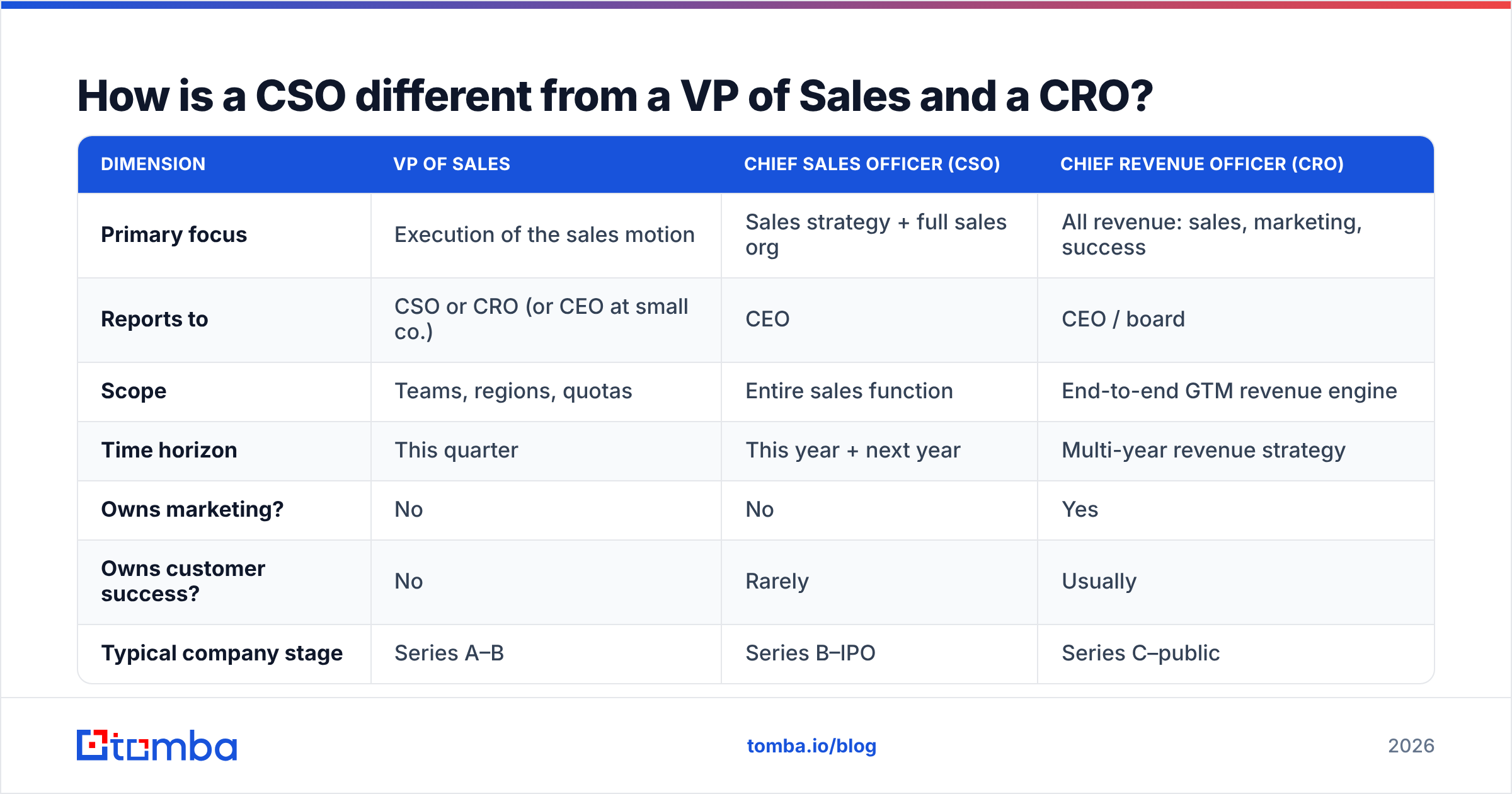
This is the question that trips up most people, including boards. The titles overlap, but the scope does not. Here is the clean version.
| Dimension | VP of Sales | Chief Sales Officer (CSO) | Chief Revenue Officer (CRO) |
|---|---|---|---|
| Primary focus | Execution of the sales motion | Sales strategy + full sales org | All revenue: sales, marketing, success |
| Reports to | CSO or CRO (or CEO at small co.) | CEO | CEO / board |
| Scope | Teams, regions, quotas | Entire sales function | End-to-end GTM revenue engine |
| Time horizon | This quarter | This year + next year | Multi-year revenue strategy |
| Owns marketing? | No | No | Yes |
| Owns customer success? | No | Rarely | Usually |
| Typical company stage | Series A–B | Series B–IPO | Series C–public |
The short rule: a VP of Sales runs the play, a CSO writes the playbook and owns the sales scoreboard, and a CRO owns every scoreboard that touches revenue. Many companies never have all three — a startup might jump straight from a VP of Sales to a CRO, while an enterprise sales-led org might keep a CSO and a CRO as peers or merge the roles entirely.
How much does a chief sales officer make in 2026?#
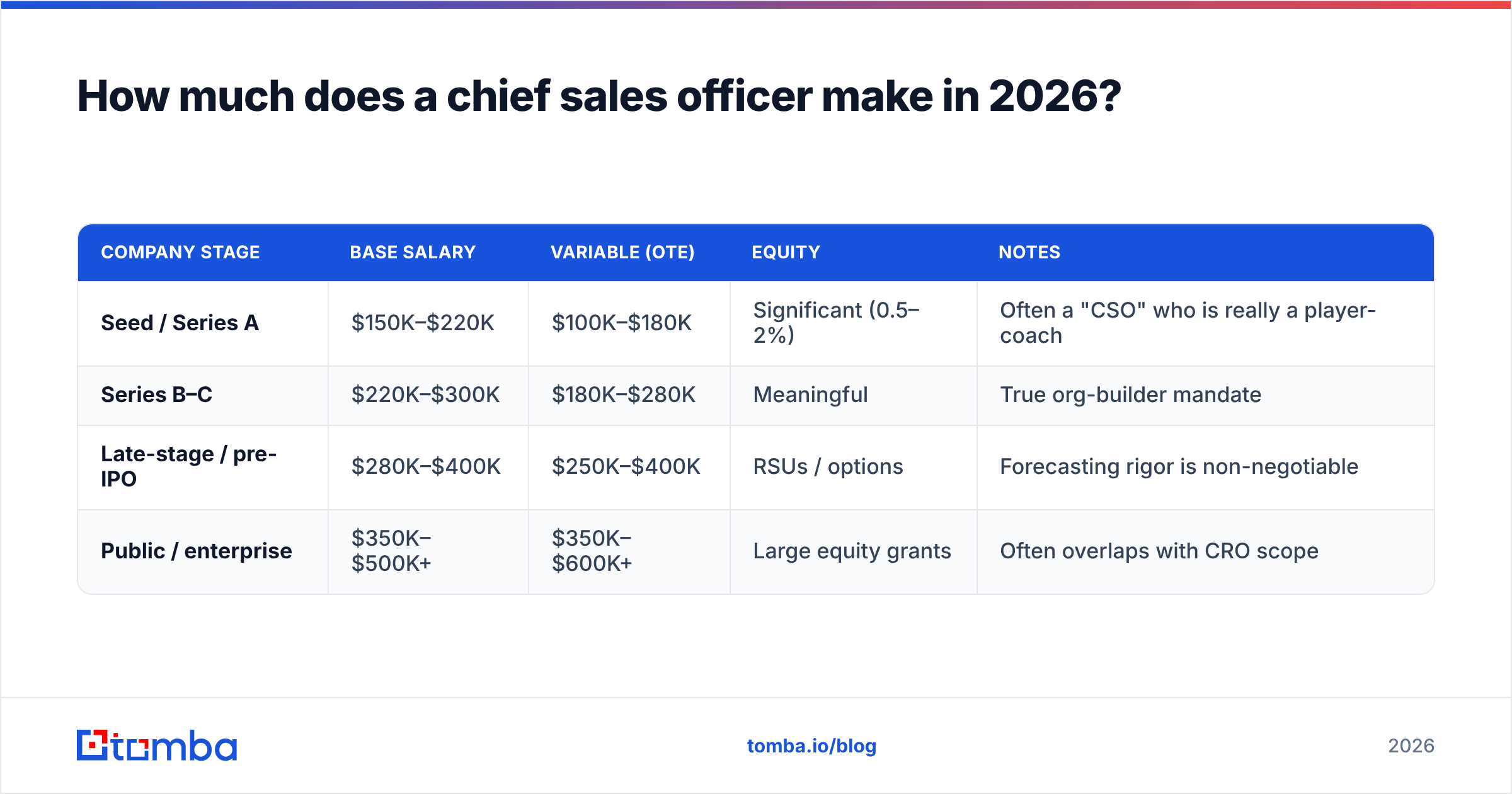
Total compensation for a chief sales officer typically lands between $300,000 and $600,000+, but the spread is enormous because the title means different things at a 50-person startup versus a public company.
| Company stage | Base salary | Variable (OTE) | Equity | Notes |
|---|---|---|---|---|
| Seed / Series A | $150K–$220K | $100K–$180K | Significant (0.5–2%) | Often a "CSO" who is really a player-coach |
| Series B–C | $220K–$300K | $180K–$280K | Meaningful | True org-builder mandate |
| Late-stage / pre-IPO | $280K–$400K | $250K–$400K | RSUs / options | Forecasting rigor is non-negotiable |
| Public / enterprise | $350K–$500K+ | $350K–$600K+ | Large equity grants | Often overlaps with CRO scope |
A few things move these numbers: the base-to-variable split (the more strategic the role, the higher the base proportion), region (US Bay Area and NYC sit well above EMEA and APAC), and whether the equity is in a company with a realistic exit. For external benchmarks, sites like G2 and analyst firms such as Gartner publish role and compensation research worth cross-checking before any negotiation.
What skills does a great chief sales officer need?#
The era of the pure relationship-driven sales boss is fading. Boards in 2026 want operators who can model a pipeline and coach a deal in the same afternoon. The non-negotiables:
- Forecasting accuracy. A CSO whose forecast swings 30% quarter to quarter loses board trust fast. This is a data and process skill, not a gut skill.
- Org design and hiring. Knowing when to specialize roles (SDR, AE, CS), how to structure territories, and how to spot a great rep in an interview.
- Comp plan design. Compensation is the most powerful behavior lever a CSO has. Get it wrong and reps optimize for the wrong outcomes.
- Data literacy. Reading cohort retention, CAC payback, and pipeline conversion — and refusing to make decisions on dirty CRM data.
- Cross-functional influence. Half the CSO job is negotiating with marketing, product, and finance for resources and alignment.
- Coaching at scale. Building managers who build reps, rather than personally carrying every big deal.
Notice how many of those depend on clean inputs. You cannot forecast accurately or measure conversion honestly if the contact and account data underneath is wrong, stale, or full of duplicates.
Why data quality decides whether a CSO succeeds#
Here is the connection most "CSO role" articles skip: a chief sales officer's strategy is only as good as the data it runs on. Pipeline reviews, forecasts, and territory plans all assume the records in your CRM are real, reachable, and current. In most organizations, they are not.
When 20–30% of your contact records are outdated, your reps waste hours chasing bounced emails and disconnected phone numbers, your forecast inherits that noise, and your CSO makes strategic calls on a distorted picture. This is why modern sales leaders treat data hygiene as a first-class part of the operating cadence, not an IT afterthought.
Practical moves a CSO can make here:
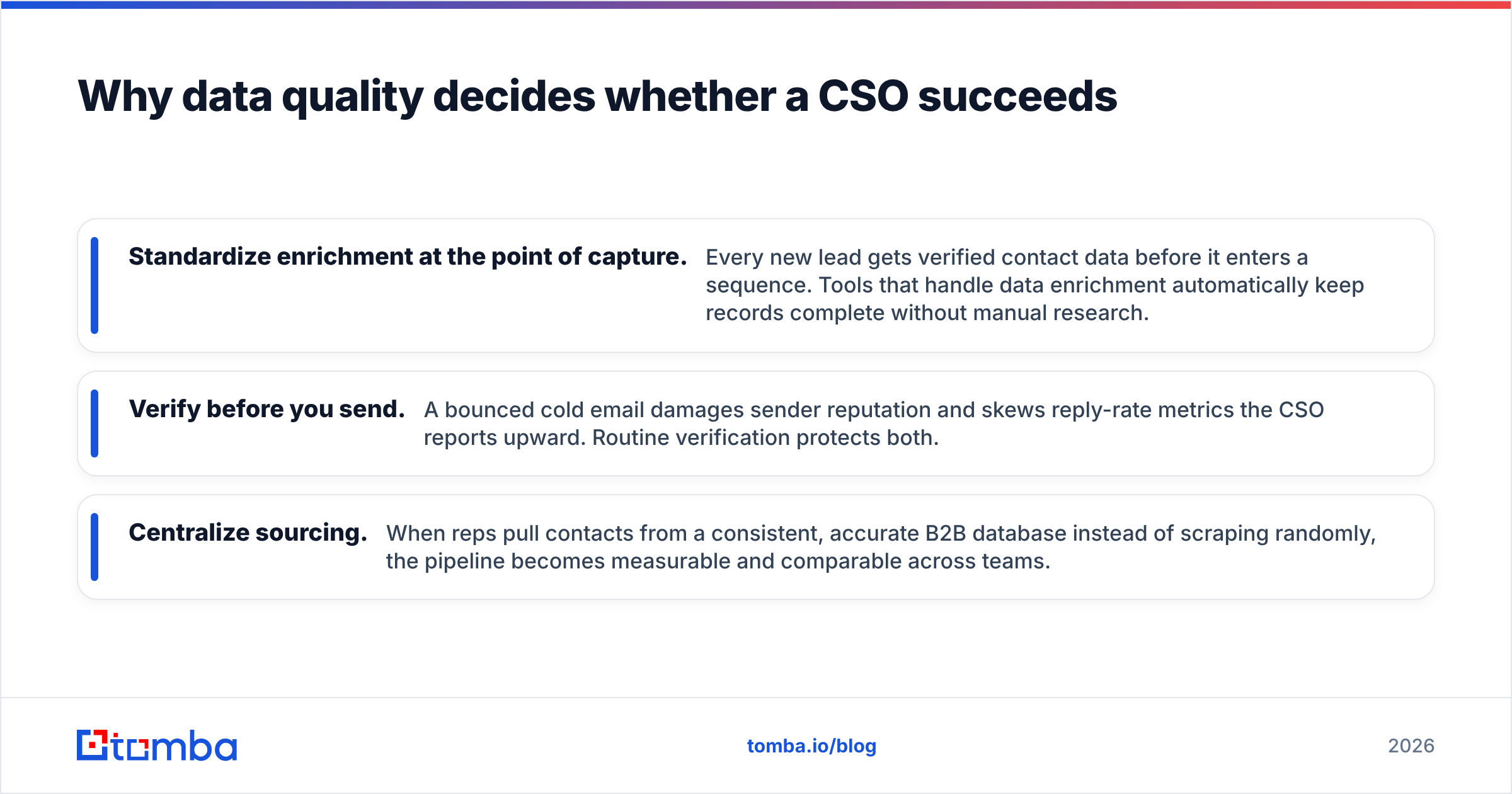
- Standardize enrichment at the point of capture. Every new lead gets verified contact data before it enters a sequence. Tools that handle data enrichment automatically keep records complete without manual research.
- Verify before you send. A bounced cold email damages sender reputation and skews reply-rate metrics the CSO reports upward. Routine verification protects both.
- Centralize sourcing. When reps pull contacts from a consistent, accurate B2B database instead of scraping randomly, the pipeline becomes measurable and comparable across teams.
A CSO who institutionalizes clean data gets a compounding advantage: better forecasts, less wasted rep time, and a sales motion that scales without multiplying the noise.
When should a company hire a chief sales officer?#
Hiring a CSO too early is one of the most expensive mistakes a startup makes. The signal to hire is not "we want more revenue" — it is "we have a repeatable motion and need someone to scale it."
You are likely ready for a CSO when:
- You have clear product-market fit and a sales process that closes predictably, not just because the founder is in the room.
- Revenue is large enough that a $400K+ leader pays for themselves several times over.
- You need to build layers — managers, specialized roles, multiple segments — that a single VP can no longer cover.
- The board wants forecasting discipline and a credible multi-year revenue plan.
You are not ready if the founder is still figuring out who the customer is, or if a strong VP of Sales would solve the actual problem at a third of the cost. Plenty of companies thrive for years with a VP of Sales and never need a CSO at all.
CSO vs CRO: which title should you hire for?#
If you are deciding between titles, anchor on scope rather than prestige. Hire a chief sales officer when sales is the function that needs senior ownership and marketing/success are handled elsewhere. Hire a chief revenue officer when you need one throat to choke for the entire revenue engine — sales, marketing, and retention aligned under a single strategy.
Getting this wrong creates turf wars. A CSO and a CMO who both think they own the funnel will fight over leads; a CRO with no real authority over marketing is a CSO with an inflated title. Define the scope in the job description, not after the hire.
For deeper context on the surrounding org, HubSpot and Salesforce both publish solid frameworks on sales leadership structure — see HubSpot's sales resources and Salesforce's sales leadership content for execution-level detail.
How does the CSO role connect to the rest of the sales stack?#
A chief sales officer rarely touches tooling directly, but they set the standard for it. The reps and ops teams below them rely on a stack that turns strategy into pipeline:
- Prospecting and sourcing — finding the right accounts and reachable contacts. A reliable email finder feeds the top of the funnel with verified addresses.
- Verification and hygiene — keeping the database clean so forecasts stay honest.
- CRM and engagement — where the operating cadence lives.
- Reporting — the dashboards the CSO reads every Monday.
The CSO's job is to make sure these layers reinforce each other instead of leaking data between them. A great strategy on top of a broken data layer still misses the number.
The bottom line#
A chief sales officer is the executive who owns the revenue number, the sales strategy, and the team that delivers both. The role pays well because the accountability is total — and it is increasingly won or lost on data discipline, not just deal instinct. If you are building toward that seat, or hiring for it, start by making sure the pipeline underneath is built on accurate, verified contact data.
That foundation starts at the rep level. If your team is sourcing prospects from guesswork or scraped lists, give them a single source of truth: try the Tomba Email Finder to find and verify professional email addresses by name, domain, or company — and check the Tomba pricing plans (free tier with 25 searches/month, Starter at $49/mo) to see which fits your sales org. Clean inputs are how a chief sales officer turns a strategy into a number that actually lands.
// get started
Find, verify and enrich your first contacts today
Start on the free plan with 25 searches a month, then scale when your team is ready.
Free plan · No credit card required · GDPR & CCPA
// about the author