Chief Sales Officer vs VP of Sales: Key Differences 2026
CSO or VP of Sales — who owns strategy, who owns the number, and which one does your org actually need in 2026? A clear, honest breakdown.
You are hiring for the top of your sales org and two titles keep surfacing: Chief Sales Officer and VP of Sales. They sound interchangeable. They are not. Picking the wrong one — or stacking both before you can afford them — is one of the most expensive org-design mistakes a scaling company makes.
This guide breaks down what each role actually does, how they differ in scope, pay, and KPIs, and how to decide which one your company needs right now.
TL;DR#
- A Chief Sales Officer (CSO) owns strategy and the long game — market entry, org design, board-level forecasting, and aligning sales with the rest of go-to-market. It's a C-suite seat.
- A VP of Sales owns execution and the number — quota attainment, rep coaching, pipeline hygiene, and the day-to-day of the sales floor.
- Most companies under ~$20M ARR need a VP of Sales, not a CSO. The CSO becomes worth it when you have multiple sales teams, channels, or regions to coordinate.
- They can coexist: at scale, the VP (or several VPs) reports up to the CSO.
- Both roles live or die on data quality. A flawless strategy on a stale contact list still misses quota.
What is a Chief Sales Officer?#
A Chief Sales Officer is the most senior sales executive in a company — a C-level peer to the CFO, CMO, and CTO. Think of the CSO as the general who decides which wars to fight and how to resource them, not the captain leading a single charge.
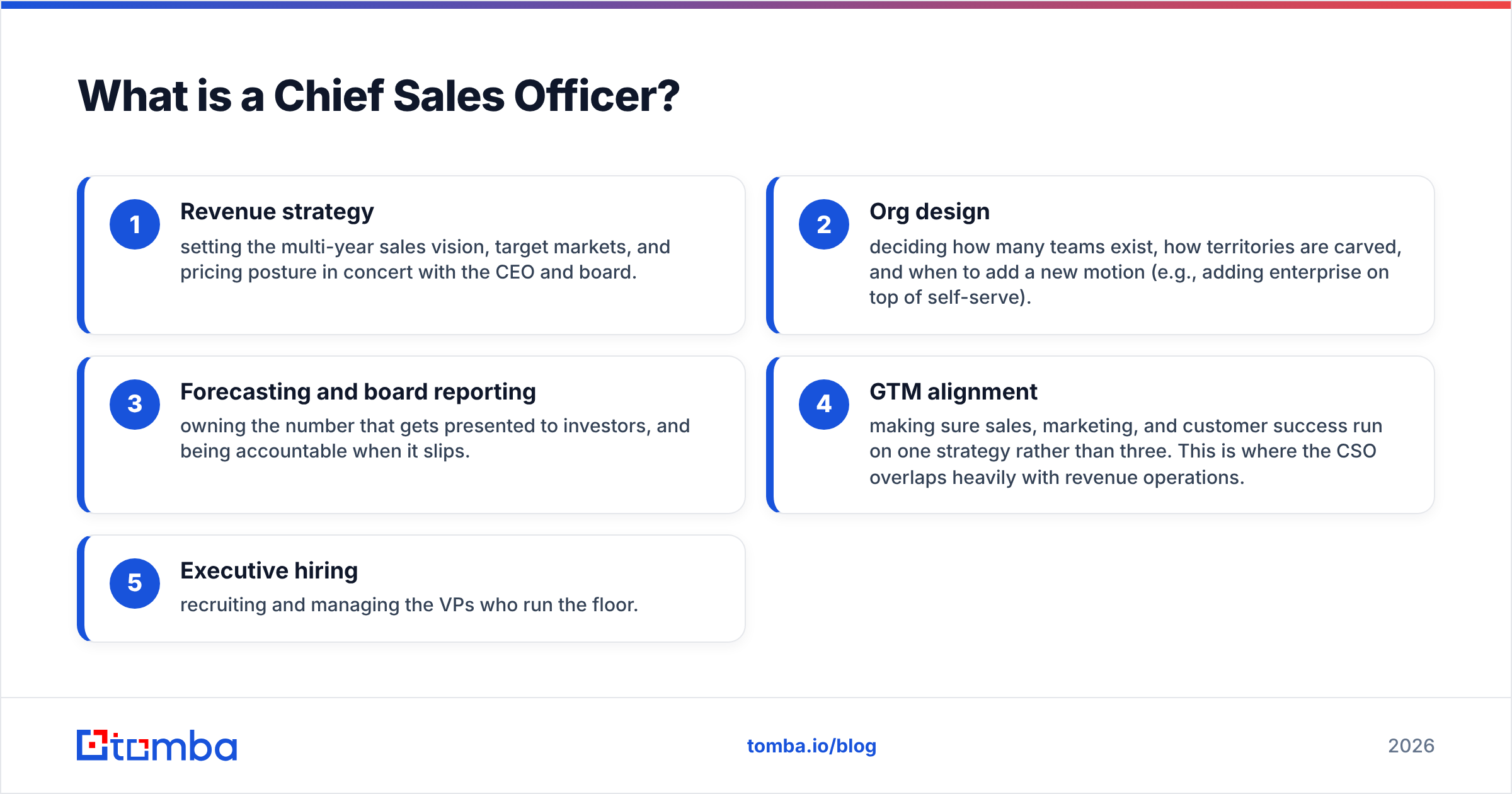
The CSO's mandate is strategic and cross-functional:
- Revenue strategy — setting the multi-year sales vision, target markets, and pricing posture in concert with the CEO and board.
- Org design — deciding how many teams exist, how territories are carved, and when to add a new motion (e.g., adding enterprise on top of self-serve).
- Forecasting and board reporting — owning the number that gets presented to investors, and being accountable when it slips.
- GTM alignment — making sure sales, marketing, and customer success run on one strategy rather than three. This is where the CSO overlaps heavily with revenue operations.
- Executive hiring — recruiting and managing the VPs who run the floor.
A CSO rarely coaches an individual rep on a deal. If they're doing that regularly, something is broken — either the org is too small for the title or the VP layer is missing.

What is a VP of Sales?#
A VP of Sales runs the sales organization day to day and is measured on whether the team hits quota. If the CSO is the general, the VP is the field commander who actually wins or loses the battle this quarter.
Core responsibilities:
- Quota attainment — the single number the VP is hired to deliver.
- Team management — hiring, ramping, coaching, and (when needed) managing out reps and front-line managers.
- Pipeline and process — enforcing CRM hygiene, qualification standards, and stage definitions so the forecast is trustworthy.
- Playbook execution — turning the CSO's (or CEO's) strategy into scripts, sequences, and repeatable motions.
- Deal involvement — jumping into late-stage or strategic deals to push them over the line.
A strong VP of Sales is hands-on. They know their reps' pipelines by heart, they sit in on calls, and they feel every missed forecast personally. That operational closeness is the point of the role.
Chief Sales Officer vs VP of Sales: side-by-side comparison#
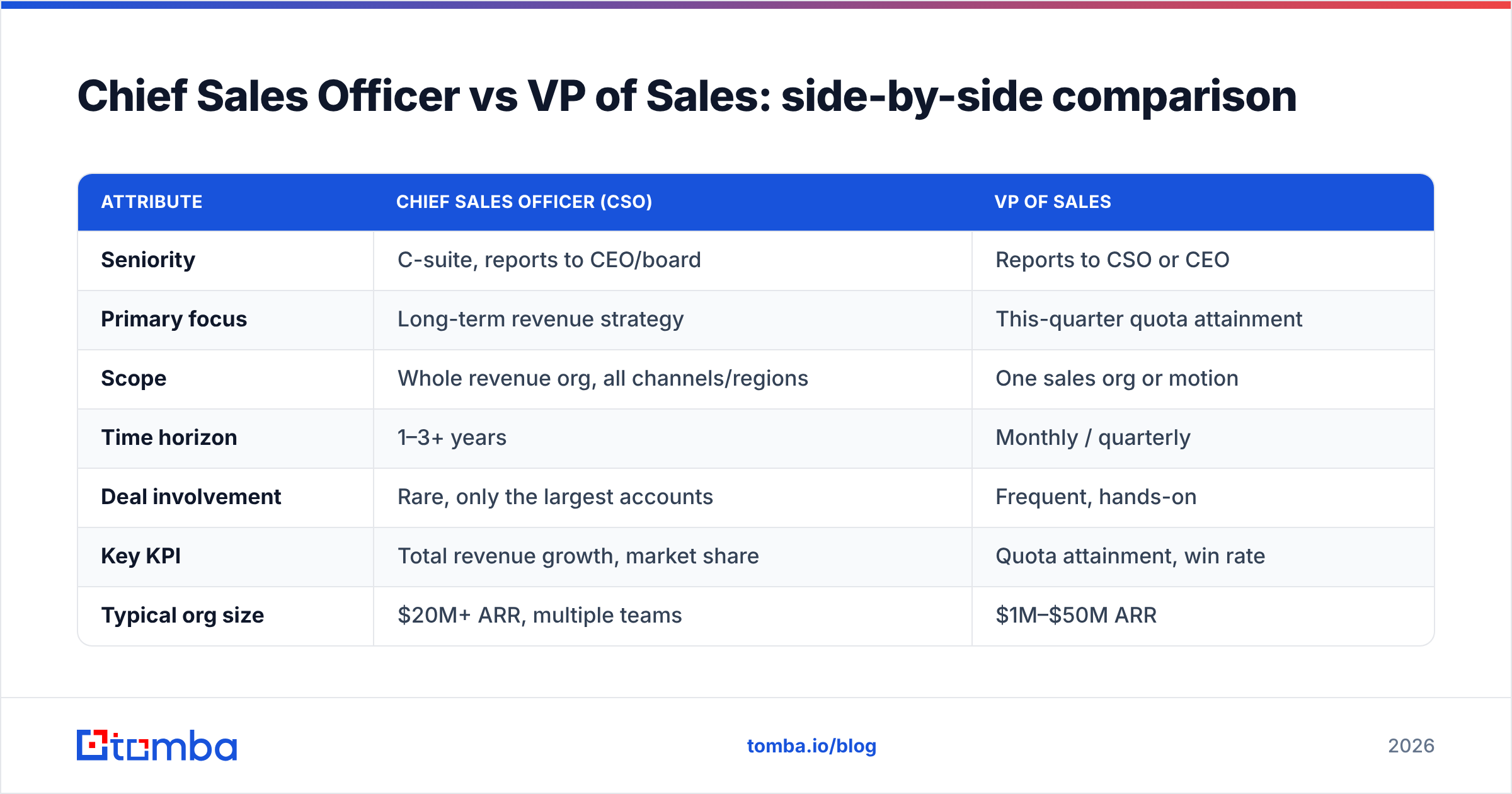
Here's the clearest way to see the split. The two roles differ less in function and more in altitude — how far above the daily grind each one operates.
| Attribute | Chief Sales Officer (CSO) | VP of Sales |
|---|---|---|
| Seniority | C-suite, reports to CEO/board | Reports to CSO or CEO |
| Primary focus | Long-term revenue strategy | This-quarter quota attainment |
| Scope | Whole revenue org, all channels/regions | One sales org or motion |
| Time horizon | 1–3+ years | Monthly / quarterly |
| Deal involvement | Rare, only the largest accounts | Frequent, hands-on |
| Key KPI | Total revenue growth, market share | Quota attainment, win rate |
| Typical org size | $20M+ ARR, multiple teams | $1M–$50M ARR |
| US base pay (2026, approx.) | $250K–$400K+ base, large equity | $160K–$250K base |
| Reports who? | VPs of Sales, sometimes RevOps | Sales managers, AEs, SDRs |
Compensation figures are directional and vary widely by region, stage, and equity mix — benchmark against current data on G2 or industry surveys before you set a band, and review how peers structure leadership comp in resources like the HubSpot Sales Blog.
Is a CSO better than a VP of Sales?#
Neither is "better" — they solve different problems, and seniority is not the question. Asking whether a CSO beats a VP of Sales is like asking whether an architect beats a site foreman. You need the architect when you're designing a city and the foreman when you're putting up the building. Most companies are still putting up the building.
The honest framing: a CSO without enough scale is an overpaid strategist with no army to direct, and a VP of Sales asked to set three-year board strategy is being stretched outside their lane. The mistake isn't choosing one — it's matching the title to the wrong stage.
When does your company need a VP of Sales?#
Hire a VP of Sales when you have product-market fit and a repeatable motion that needs scaling. Signals:
- You're past founder-led sales. The CEO is closing deals and it doesn't scale.
- You have 3+ reps who need consistent coaching and a manager.
- Your pipeline is leaky — deals stall, forecasts miss, and nobody owns CRM discipline.
- The strategy is reasonably clear but execution is inconsistent.
This is the right hire for most startups between roughly $1M and $20M ARR. The VP turns a scrappy, founder-dependent process into a system. Pair them with the tooling that keeps the top of funnel full — a reliable email finder and accurate B2B phone numbers so reps spend time selling, not hunting for contact details.
When does your company need a Chief Sales Officer?#
Hire a CSO when coordination across multiple sales motions becomes the bottleneck, not execution within one. Signals:
- Multiple teams or regions that need a unifying strategy (SMB + enterprise, US + EMEA).
- Multiple channels — direct, partner/channel, and self-serve all competing for resources.
- Board-level complexity — investors want a credible multi-year revenue plan and a single accountable owner.
- GTM friction — sales, marketing, and CS are pulling in different directions and someone senior must own alignment.
If you have one sales team chasing one ICP, a CSO is premature. The role earns its seat when the org chart itself becomes the problem to solve.
Do CSO and VP of Sales roles overlap?#
Yes, and the overlap is where titles get muddy. In a mature org the relationship is a clean hierarchy: VPs of Sales (often several, split by segment or region) report up to a single CSO. The CSO sets direction and owns the aggregate number; each VP owns their slice of it.
In smaller companies the same person frequently wears both hats — a "VP of Sales" who also does CSO-level strategy because there's no one else to. That's fine temporarily. The risk is title inflation: handing a startup's first sales leader the CSO badge to win the recruit, then discovering they're great at strategy decks and weak at coaching reps through a quota miss. At early stage, you almost always need the coach first.
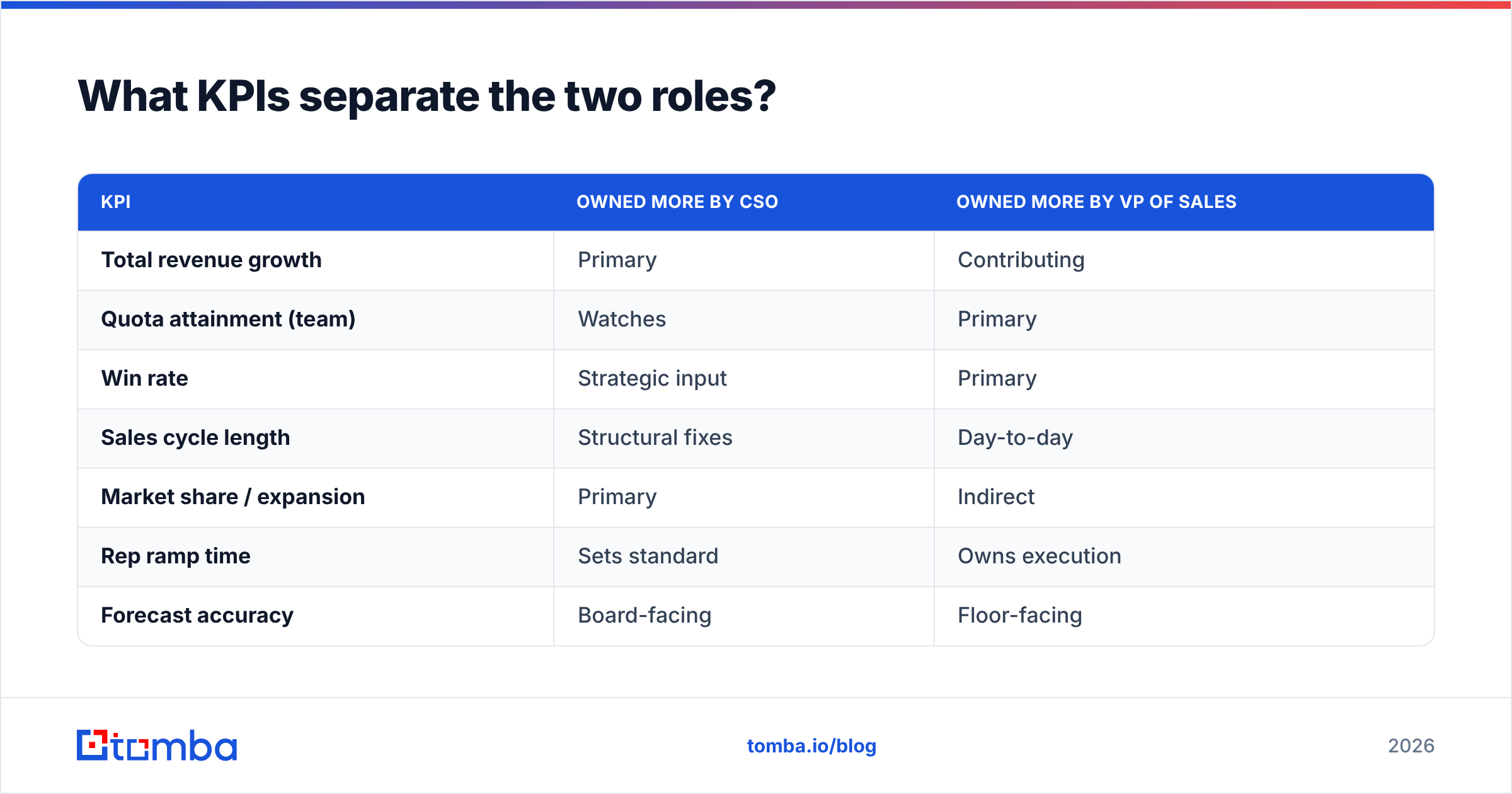
What KPIs separate the two roles?#
The metrics each role is judged on reveal the difference more honestly than any job description.
| KPI | Owned more by CSO | Owned more by VP of Sales |
|---|---|---|
| Total revenue growth | Primary | Contributing |
| Quota attainment (team) | Watches | Primary |
| Win rate | Strategic input | Primary |
| Sales cycle length | Structural fixes | Day-to-day |
| Market share / expansion | Primary | Indirect |
| Rep ramp time | Sets standard | Owns execution |
| Forecast accuracy | Board-facing | Floor-facing |
Notice that both ends of this table depend on the same foundation: trustworthy data. A VP can't improve win rate if reps are dialing wrong numbers, and a CSO can't forecast market share off a CRM full of bounced contacts. Garbage in, missed quota out — regardless of title.
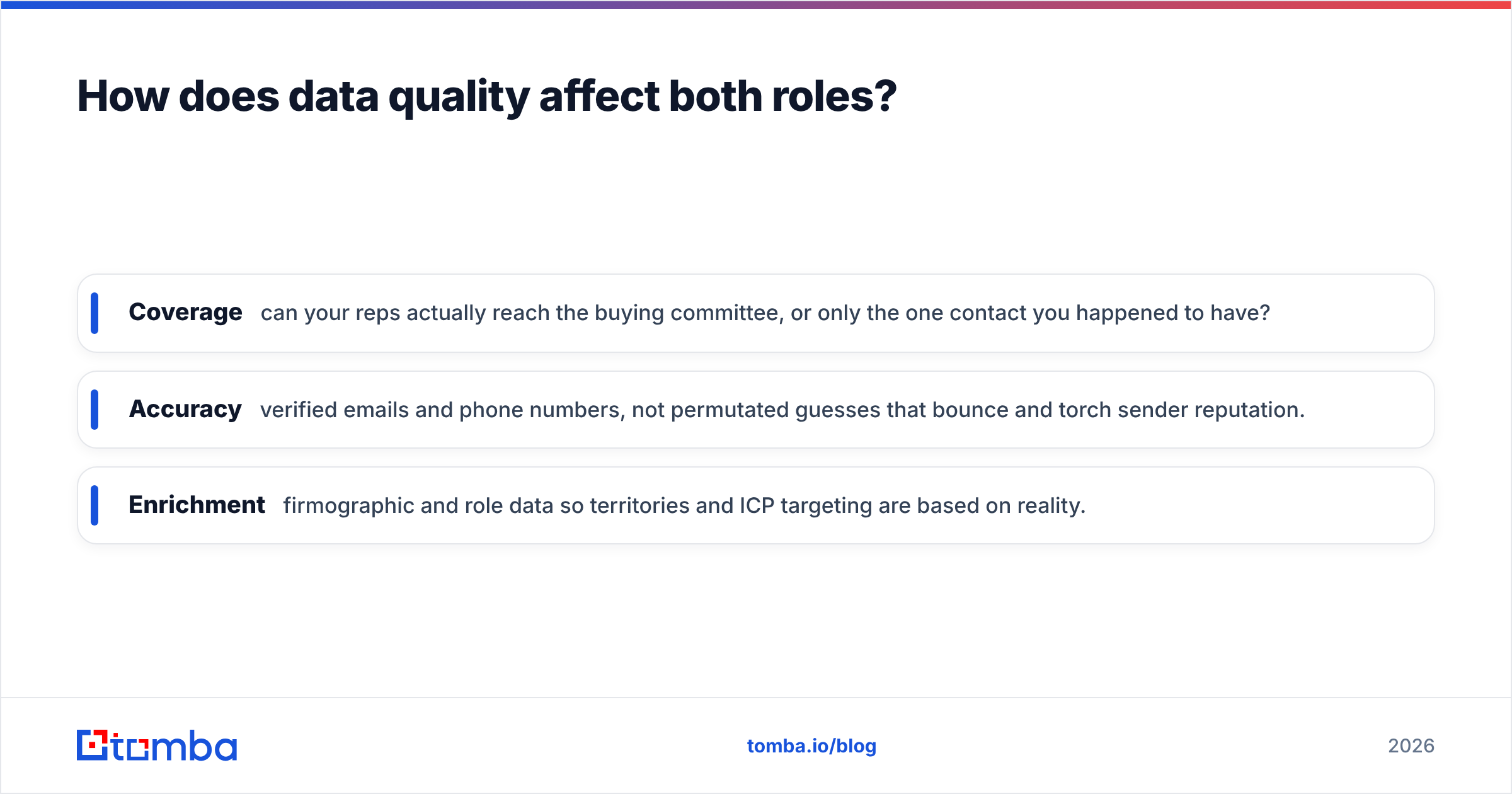
How does data quality affect both roles?#
Both the CSO's strategy and the VP's execution sit on top of your contact and account data, and bad data quietly taxes every layer above it. A 2026 strategy built on a prospect list that's 30% stale isn't a strategy — it's a guess with a deck.
This is the unglamorous part of sales leadership that rarely makes the job description but determines whether either role succeeds:
- Coverage — can your reps actually reach the buying committee, or only the one contact you happened to have?
- Accuracy — verified emails and phone numbers, not permutated guesses that bounce and torch sender reputation.
- Enrichment — firmographic and role data so territories and ICP targeting are based on reality.
Whether you hire a CSO, a VP, or both, give them a clean foundation. Keeping records fresh with ongoing data enrichment and verified contact discovery means leadership argues about strategy and coaching — the things they're paid for — instead of debating whether the numbers are even real. For how sources and accuracy are handled under the hood, vendors like Salesforce and specialized data providers publish their methodology; it's worth scrutinizing before you trust a list.
Which should you hire first?#
For nearly every company, the answer is VP of Sales first. You hire execution before you hire strategy because, early on, the strategy is simpler than the execution. One ICP, one motion, one number — what you lack is someone to make the team consistently hit it.
Bring in a CSO later, when you've got multiple VPs, channels, or regions and the binding constraint shifts from "can we sell" to "can we coordinate selling across the whole org." If you genuinely need both qualities in your first hire, look for a VP with C-suite range — and be honest about which skill you'll lean on this year.
The bottom line#
A Chief Sales Officer architects revenue; a VP of Sales delivers it. The CSO operates in years and across the whole org; the VP operates in quarters and inside one team. Match the title to your stage — VP for scaling a repeatable motion, CSO for coordinating many of them — and resist title inflation that hands strategy seats to people you actually need on the floor.
And whichever you hire, remember that leadership is only as good as the data underneath it. Before you spend $300K on a sales executive, spend a fraction of that making sure their team can reach the right people. Start with the Tomba Email Finder to give your new sales leader verified, accurate contact data from day one — so the only thing they have to worry about is the number. Check Tomba pricing to find the plan that fits your team, starting free with 25 searches a month.
// get started
Find, verify and enrich your first contacts today
Start on the free plan with 25 searches a month, then scale when your team is ready.
Free plan · No credit card required · GDPR & CCPA
// about the author