Clay vs 6sense (2026): Which GTM Data Platform Wins?
Clay and 6sense both promise smarter pipeline, but they solve different problems. Here's an honest breakdown of pricing, data, intent, and fit for 2026.
You are choosing between two tools that get lumped into the same "modern GTM stack" bucket but barely overlap in what they actually do. Clay is a spreadsheet-shaped data orchestration engine. 6sense is an account-based intent and predictive platform. Picking the wrong one wastes a year and a six-figure contract.
This guide cuts through the marketing. We compare Clay vs 6sense on what they do, who they fit, pricing reality, data quality, and where a leaner stack beats both.
TL;DR — Clay vs 6sense in 30 seconds#
- Clay is a no-code data engine: you pull lists, enrich them through 100+ providers, run AI research, and push clean records into your CRM or sequencer. Best for RevOps and outbound teams who want control.
- 6sense is an account-based platform: it predicts which accounts are in-market using intent signals, de-anonymizes web traffic, and orchestrates ABM advertising. Best for enterprise demand-gen teams.
- They are not direct competitors. Many teams run both — 6sense for "who to target," Clay for "get me the contacts and enrich them."
- Pricing gap is huge. Clay starts at a few hundred dollars a month; 6sense routinely lands in the $60K–$120K+ annual range.
- If your real need is accurate contact data on a budget, neither is the cheapest answer. A focused email finder plus data enrichment covers most of the job for a fraction of the cost.

What is Clay and what problem does it solve?#
Clay is a data orchestration platform that looks like a spreadsheet and behaves like a workflow engine. Each row is a company or person; each column can call an API, scrape a source, run an AI prompt, or trigger an enrichment provider.
The core idea: instead of paying for one data vendor and accepting its coverage gaps, Clay lets you waterfall across many providers. If provider A misses an email, it falls through to B, then C, until a record is filled. You pay credits for what hits.
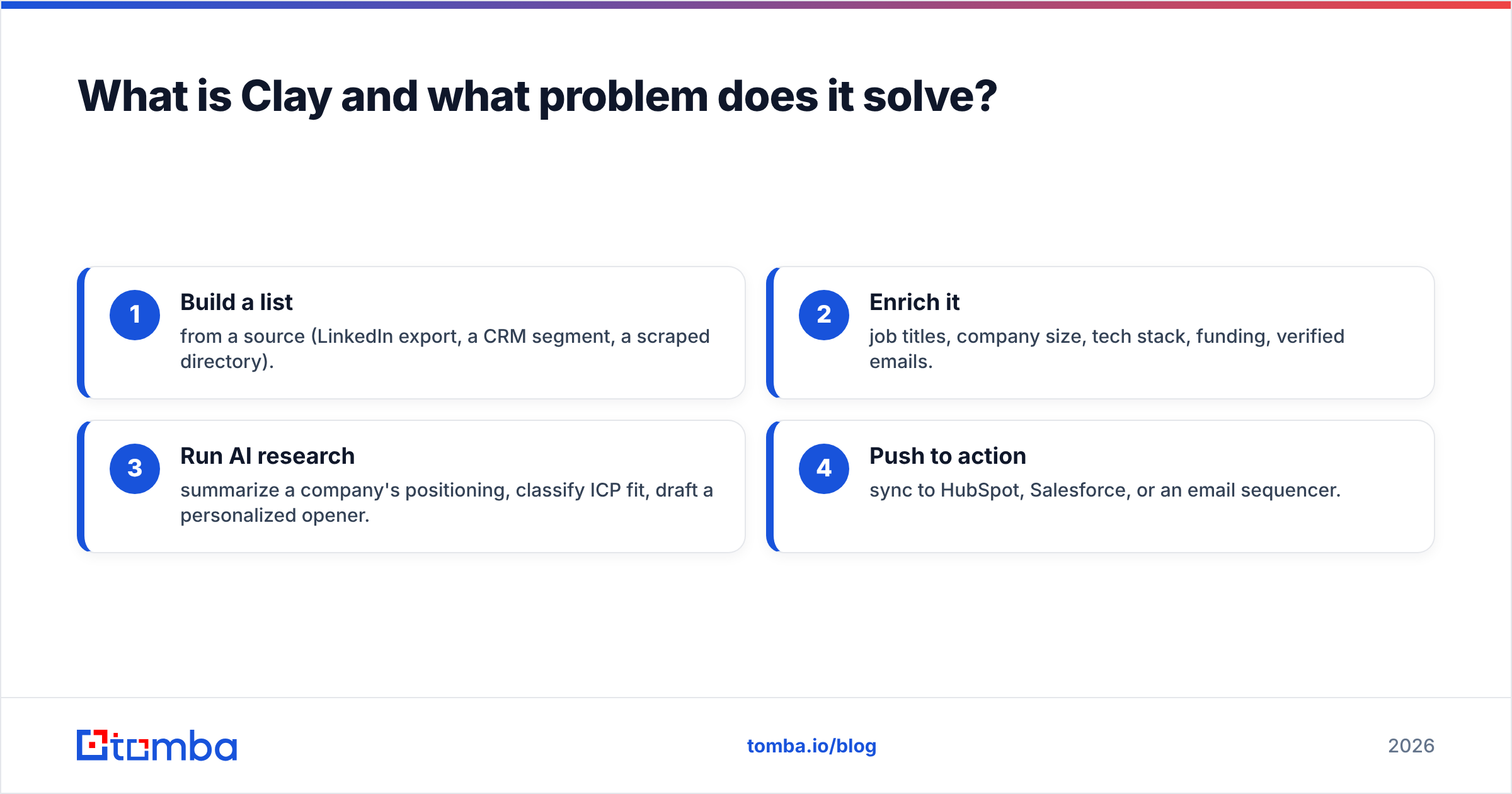
Typical Clay jobs:
- Build a list from a source (LinkedIn export, a CRM segment, a scraped directory).
- Enrich it — job titles, company size, tech stack, funding, verified emails.
- Run AI research — summarize a company's positioning, classify ICP fit, draft a personalized opener.
- Push to action — sync to HubSpot, Salesforce, or an email sequencer.
Clay's strength is flexibility. Its weakness is that flexibility means complexity: it rewards people who think in tables and workflows, and the credit math can get expensive at scale if you don't tune your waterfalls.
According to Clay's own site, the platform connects 100+ data sources into a single enrichment layer — that aggregation is the actual product, not any one dataset.
What is 6sense and what problem does it solve?#
6sense is an account-based experience (ABX) platform built around predictive intent. It watches buying signals across the web — research activity, keyword consumption, anonymous visits to your site — and scores which accounts are likely in an active buying cycle.
Where Clay helps you act on a known list, 6sense helps you decide which accounts deserve attention in the first place. Its main capabilities:
- Intent data and predictive scoring — ranking accounts by buying-stage probability.
- Web de-anonymization — identifying companies visiting your site before they fill a form. (Tomba offers a lighter-weight take on this with website visitor reveal.)
- ABM orchestration — coordinated display advertising and audience targeting.
- Sales intelligence — surfacing accounts and contacts to SDRs at the right moment.
6sense is an enterprise product. It sells to demand-gen and marketing-ops leaders who run coordinated, multi-channel ABM motions and have the budget and headcount to operate it. You can read peer reviews on G2 to see the recurring themes: powerful signal, steep price, real implementation lift.
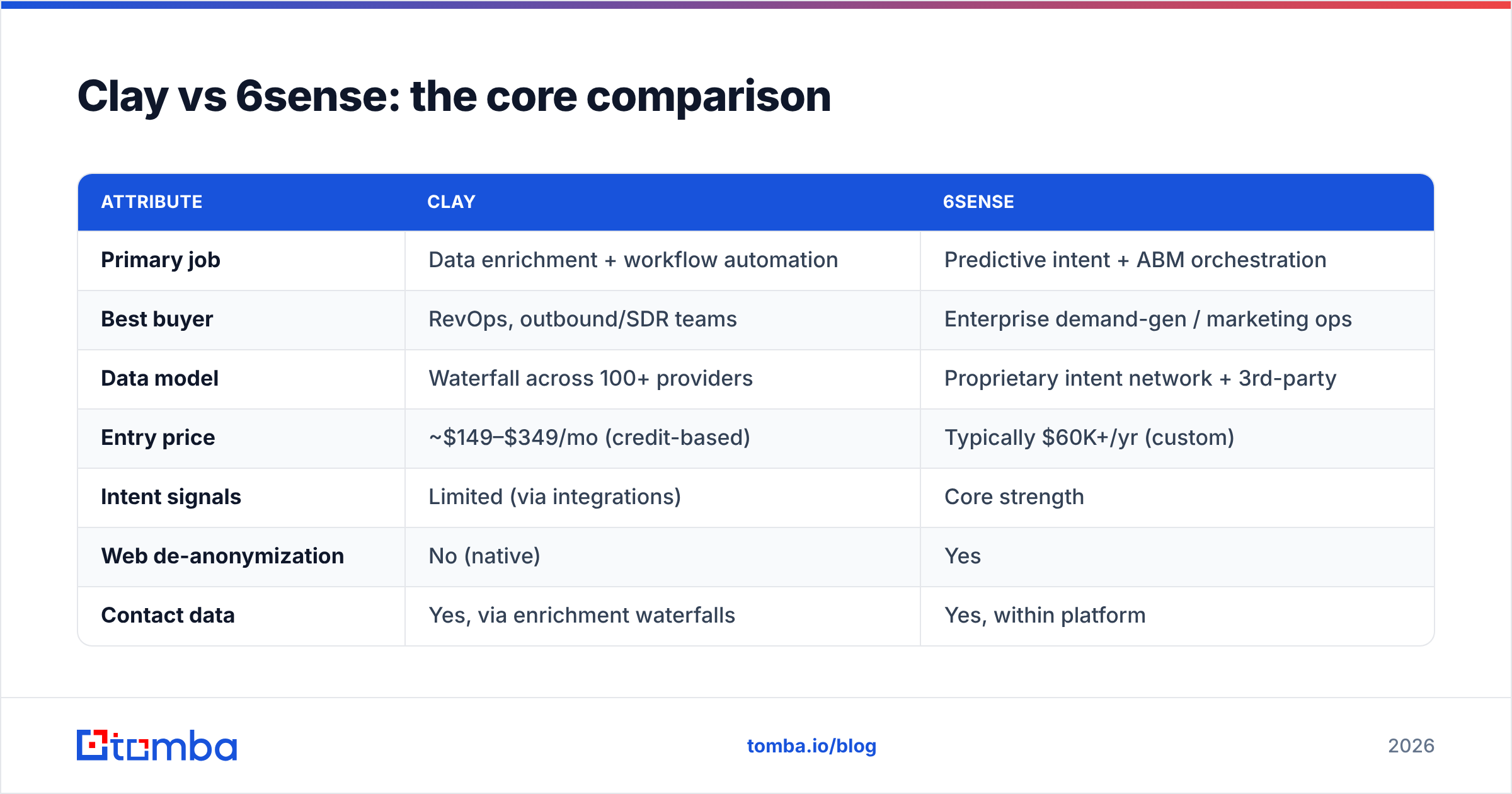
Clay vs 6sense: the core comparison#
| Attribute | Clay | 6sense |
|---|---|---|
| Primary job | Data enrichment + workflow automation | Predictive intent + ABM orchestration |
| Best buyer | RevOps, outbound/SDR teams | Enterprise demand-gen / marketing ops |
| Data model | Waterfall across 100+ providers | Proprietary intent network + 3rd-party |
| Entry price | ~$149–$349/mo (credit-based) | Typically $60K+/yr (custom) |
| Intent signals | Limited (via integrations) | Core strength |
| Web de-anonymization | No (native) | Yes |
| Contact data | Yes, via enrichment waterfalls | Yes, within platform |
| Learning curve | Moderate–high (table/workflow thinking) | High (full platform, onboarding required) |
| Time to value | Days | Weeks to months |
| Contract | Monthly or annual | Annual, sales-led |
The honest read: these tools answer different questions. If you already know which accounts to chase and need clean, actionable contact data, Clay is the relevant tool. If you don't know which of 10,000 accounts are warming up right now, that's the 6sense problem.
Is Clay better than 6sense?#
It depends entirely on the question you're trying to answer — "who's in-market?" or "how do I enrich and act on a list?"
Choose Clay if:
- Your motion is outbound and you live in lists, not ad audiences.
- You want to control enrichment logic and only pay for hits.
- You have a RevOps person (or a curious SDR) who enjoys building workflows.
- Budget is measured in hundreds-to-low-thousands per month, not tens of thousands per year.
Choose 6sense if:
- You run enterprise ABM and need to prioritize a large account universe.
- Anonymous web traffic is a meaningful slice of your demand.
- Marketing and sales need a shared, signal-driven account view.
- You have the budget and the team to operationalize predictive intent.
Most teams under ~50 reps do not need 6sense's full machinery. Most enterprise demand-gen orgs find Clay alone doesn't replace a predictive intent layer. That's why the two coexist more often than they compete — a fact worth remembering before you frame this as a winner-take-all decision. For the broader context, see how revenue operations teams typically layer these tools.
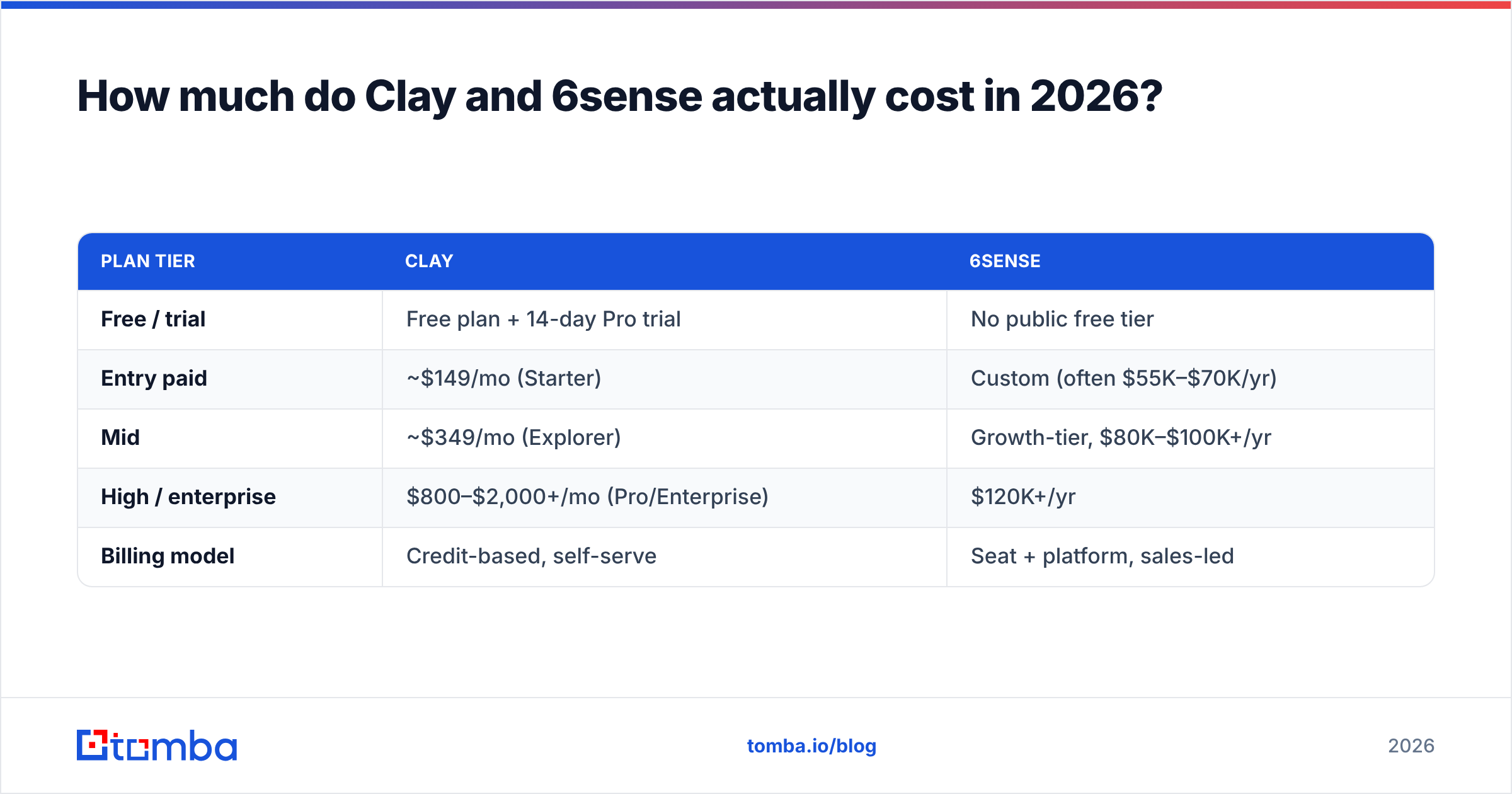
How much do Clay and 6sense actually cost in 2026?#
Pricing is where the gap becomes obvious — and where teams most often overspend.
| Plan tier | Clay | 6sense |
|---|---|---|
| Free / trial | Free plan + 14-day Pro trial | No public free tier |
| Entry paid | ~$149/mo (Starter) | Custom (often $55K–$70K/yr) |
| Mid | ~$349/mo (Explorer) | Growth-tier, $80K–$100K+/yr |
| High / enterprise | $800–$2,000+/mo (Pro/Enterprise) | $120K+/yr |
| Billing model | Credit-based, self-serve | Seat + platform, sales-led |
Two caveats. First, Clay's credit model means real cost scales with volume and how many waterfall steps you run — a heavy team can spend well into four figures monthly. Second, 6sense pricing is opaque and negotiated; published ranges come from buyer reports, not a price page. Treat both as starting points and model your own usage.
The takeaway: if the thing you actually need is verified contacts and basic firmographic enrichment, you are paying a large premium for capabilities you won't use. That's the gap a focused data tool fills.
How accurate is the data in Clay vs 6sense?#
Data quality is the part marketing pages gloss over, so be precise about what "accurate" means here.
Clay doesn't own a dataset — it aggregates. Accuracy depends on which providers you waterfall and in what order. Configured well, this beats any single vendor because it fills gaps. Configured lazily, you get the lowest-common-denominator result and burn credits on bad hits. You're effectively the data-quality engineer.
6sense owns a large proprietary intent network, which is its real moat. For intent signals, that data is strong. For contact-level data (emails, direct dials), it's solid but not its differentiator, and many teams still verify before they send.
Both share one universal truth: B2B data decays fast. People change jobs constantly, so any contact record needs verification at the point of use. Running addresses through an email verifier before a campaign protects your sender reputation regardless of where the data came from. No platform — Clay, 6sense, or otherwise — exempts you from that step.
If your buying universe is mid-market and you mostly need reliable, verifiable contacts pulled from a B2B database, the proprietary-intent advantage of 6sense isn't doing much for you, and Clay's waterfall is more machinery than you need.
Do you need Clay, 6sense, or something simpler?#
Here's the question most comparison posts dodge: a lot of teams comparing Clay vs 6sense are actually trying to solve a smaller, cheaper problem — get accurate contact data and act on it.
If that's you, map your real need before signing anything:
- "I need to know which accounts are in-market." → That's 6sense (or a dedicated intent vendor). Neither Clay nor an email finder replaces it.
- "I have target accounts and need contacts + enrichment." → Clay works, but so does a focused email finder with domain search and enrichment, often at a tenth of the cost.
- "I need to build and clean lists at scale." → Compare Clay against a bulk email finder plus verification before assuming you need the full platform.
Spending $70K/year to find emails is like buying a freight truck to carry your groceries. It works, but the tool is wildly oversized for the job. Right-size the spend to the actual problem.
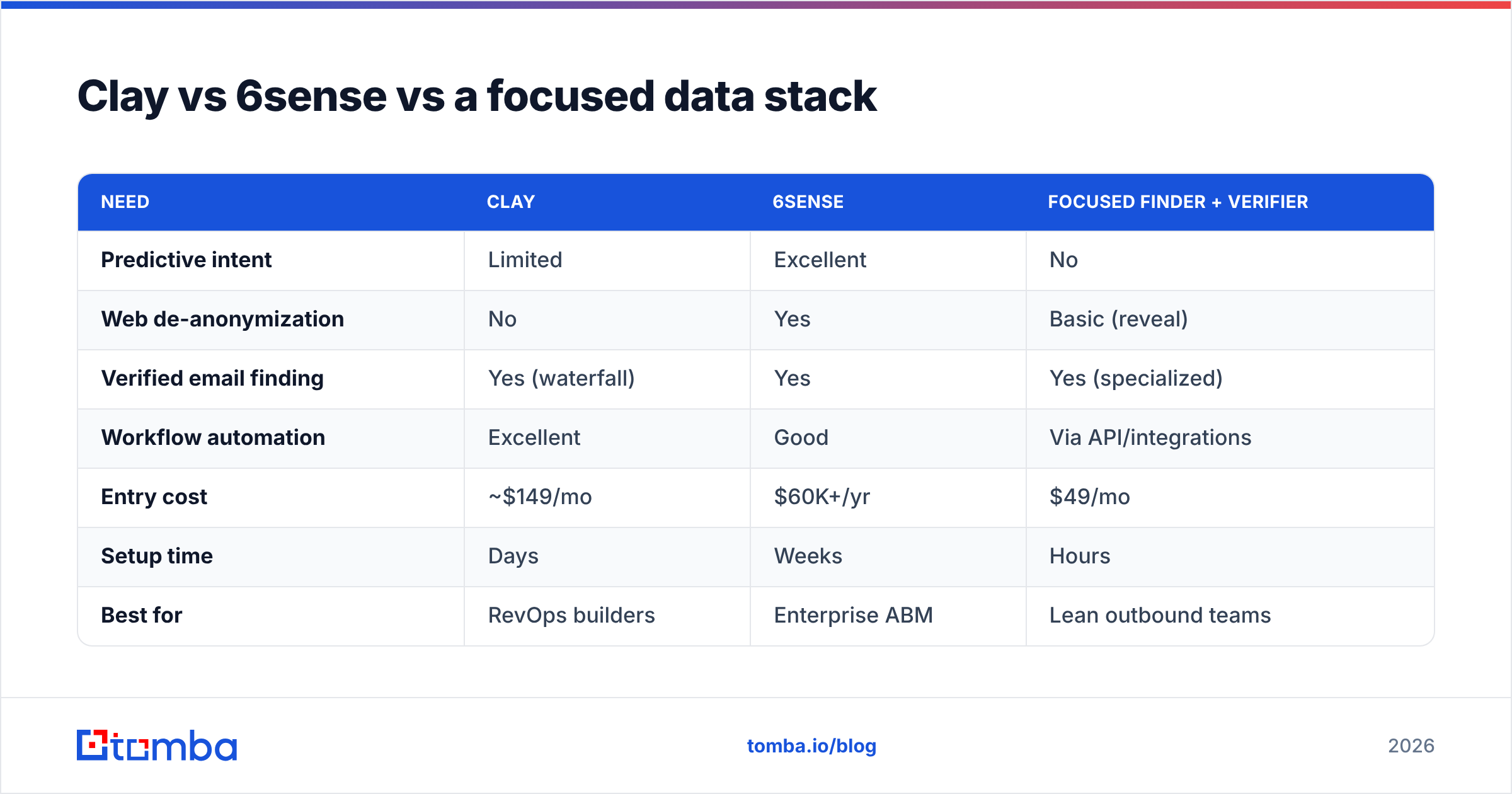
Clay vs 6sense vs a focused data stack#
For teams whose core need is contact data — not predictive ABM — it's worth seeing all three side by side honestly.
| Need | Clay | 6sense | Focused finder + verifier |
|---|---|---|---|
| Predictive intent | Limited | Excellent | No |
| Web de-anonymization | No | Yes | Basic (reveal) |
| Verified email finding | Yes (waterfall) | Yes | Yes (specialized) |
| Workflow automation | Excellent | Good | Via API/integrations |
| Entry cost | ~$149/mo | $60K+/yr | $49/mo |
| Setup time | Days | Weeks | Hours |
| Best for | RevOps builders | Enterprise ABM | Lean outbound teams |
The point isn't that one row wins everything. It's that "which is better, Clay or 6sense" is the wrong frame if you never needed enterprise intent or a full orchestration engine in the first place.
How do these tools fit together in a real stack?#
A common, sane 2026 setup at a mid-to-large company looks like this:
- 6sense identifies in-market accounts and de-anonymizes traffic.
- Clay takes those accounts, enriches contacts, and runs AI research.
- A verifier cleans the emails before send.
- A sequencer/CRM executes and tracks.
A leaner team swaps steps 1–2 for a single email finder and enrichment layer, skipping the predictive intent spend until volume justifies it. Both are legitimate. The difference is budget and stage, not "good stack vs bad stack." If you're scaling outbound, also weigh proven Apollo alternatives that bundle finding and sequencing.
Frequently asked questions#
Is Clay a 6sense competitor? Not really. Clay is data enrichment and workflow automation; 6sense is predictive intent and ABM orchestration. They overlap slightly on contact data but solve different problems, and many teams run both.
Does 6sense find email addresses? Yes, within its platform — but contact data isn't its differentiator. Its value is intent and predictive scoring. For pure email finding, a specialized tool is cheaper and often more accurate.
Is Clay worth it for a small team? If you enjoy building workflows and your volume justifies the credits, yes. If you just need verified contacts, a dedicated finder is simpler and cheaper.
What's the cheapest way to get accurate B2B emails? A focused email finder with built-in verification. You skip the platform overhead and pay only for the data job you actually have.
The bottom line#
Clay and 6sense are both strong tools aimed at different buyers: Clay for hands-on RevOps and outbound teams that want enrichment control, 6sense for well-funded enterprise demand-gen orgs that need predictive intent. Decide by the question you're answering, not the logo.
But be honest about your actual need. If you landed on "Clay vs 6sense" because you need accurate, verified contact data without a five-figure contract, the right tool is neither giant platform. Tomba's Email Finder finds professional emails by name, domain, or company, with verification built in — starting free (25 searches/mo) and scaling at $49/mo on the Starter plan. Check the full Tomba pricing and right-size your spend to the problem you actually have.
Ready to find emails that actually work?
Join 150,000+ professionals who stopped guessing and started sending. Free credits on signup — no credit card required.
Get the Tomba newsletter
Practical outbound tactics and product updates — once every two weeks.
About the author