Clearalist vs UpLead: B2B Data & Email Finder Compared (2026)
Clearalist vs UpLead in 2026: a neutral breakdown of data accuracy, pricing, verification, and credits — plus where a finder-first tool like Tomba fits.
Clearalist vs UpLead: Which B2B Data Tool Wins in 2026?
Picking between Clearalist and UpLead comes down to one question most comparison posts dodge: do you need a broad prospecting database, or do you need accurate emails you can actually send to? These tools answer that differently, and the gap matters more than the pricing page suggests.
TL;DR#
- UpLead is a mature B2B prospecting database (160M+ contacts) with real-time email verification baked into the search flow — strong for building targeted lists from filters.
- Clearalist is a leaner, lower-cost data-and-verification play aimed at teams that want clean contact records without enterprise pricing — newer, smaller database footprint.
- Accuracy is the real battleground. UpLead markets a 95% data guarantee; Clearalist leans on verification at export. Neither replaces a dedicated email finder for hard-to-reach domains.
- Credits behave differently: UpLead charges per revealed contact, Clearalist bundles verification differently — read the per-credit math before you commit.
- If your bottleneck is finding and verifying the right email rather than browsing a database, a finder-first tool like Tomba Email Finder often beats both on cost-per-valid-email.
What is Clearalist and what is UpLead?#
UpLead is a sales intelligence platform built around a searchable database of company and contact records. You filter by industry, title, location, technology stack, revenue, and dozens of other attributes, then reveal verified emails and direct dials. Its pitch is data quality: every email is checked in real time before it counts against your credits, which is why it carries a published accuracy guarantee. It's a known quantity, reviewed heavily on G2 and used widely by SMB sales teams.
Clearalist is the newer entrant. It positions itself as a more affordable way to get clean B2B contact data and verification without the price tag of legacy intelligence platforms. The database is smaller and the brand is less established, but for teams that mostly need accurate records on companies they already know, the lower cost is the draw.
Here's the honest framing: both tools blur the line between "database" and "verification." Neither is a pure email verifier, and neither is purely an email finder. They sit in the middle — and that middle is exactly where buyers get confused.

How do Clearalist and UpLead compare on features?#
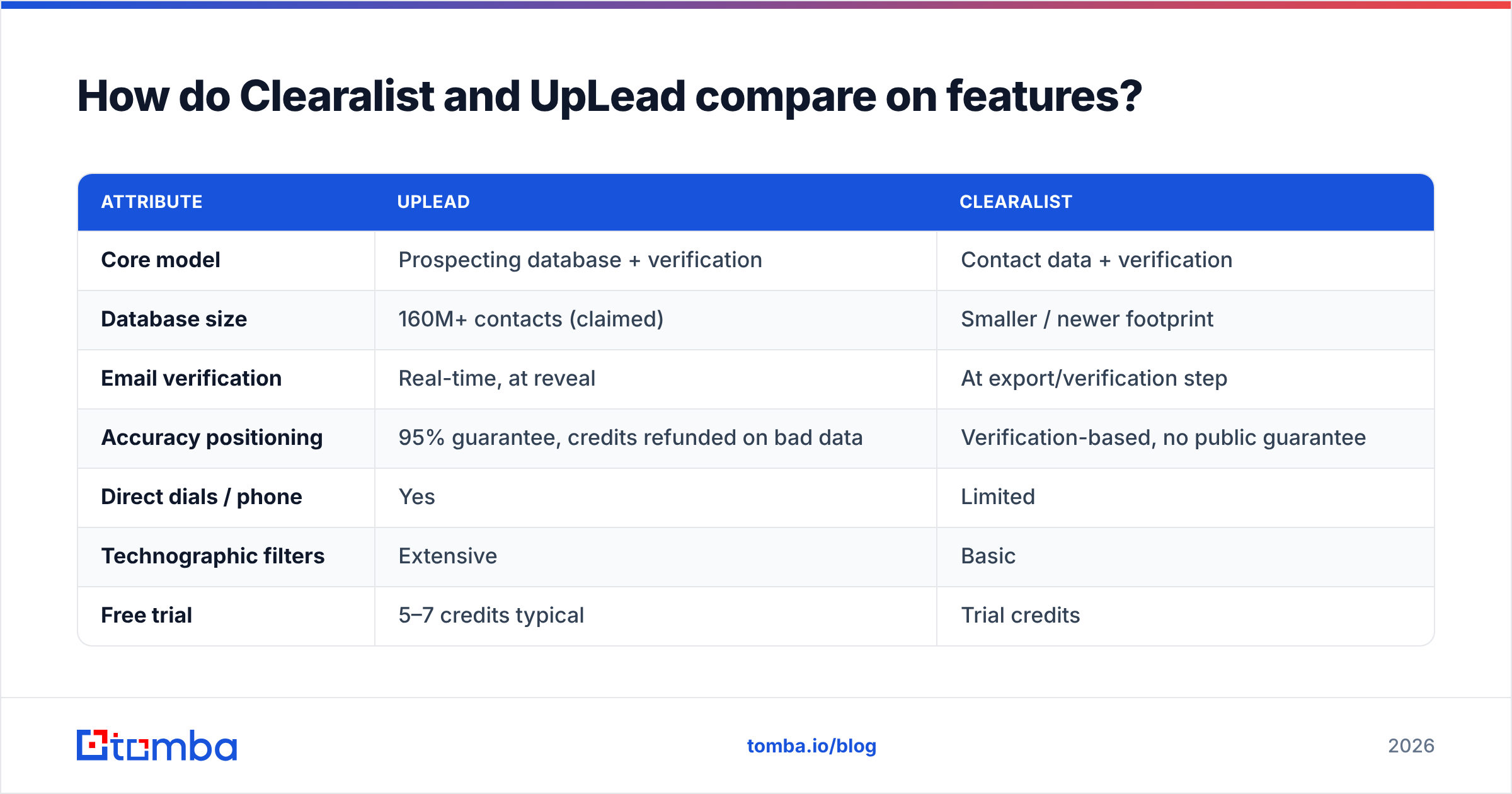
The fastest way to see the difference is attribute by attribute. Database size, verification model, and how credits are consumed drive most of the real-world cost.
| Attribute | UpLead | Clearalist |
|---|---|---|
| Core model | Prospecting database + verification | Contact data + verification |
| Database size | 160M+ contacts (claimed) | Smaller / newer footprint |
| Email verification | Real-time, at reveal | At export/verification step |
| Accuracy positioning | 95% guarantee, credits refunded on bad data | Verification-based, no public guarantee |
| Direct dials / phone | Yes | Limited |
| Technographic filters | Extensive | Basic |
| Free trial | 5–7 credits typical | Trial credits |
| Best for | List-building from rich filters | Budget-conscious clean-data needs |
Two takeaways. First, UpLead's filter depth and technographics make it the stronger discovery engine — if you don't already have a target list, it helps you build one. Second, Clearalist competes mostly on price, not on database breadth, so it rewards teams who bring their own target accounts and just need contacts filled in.
For a deeper look at where any provider's records actually come from, it's worth understanding data sources and how accuracy is measured before you trust a single guarantee number.
Which has better data accuracy?#
UpLead wins on stated accuracy, but the number deserves context. A 95% guarantee applies to emails verified at the moment you reveal them — it does not mean 95% of every record in the database is permanently correct. People change jobs roughly every 2–3 years, so any B2B dataset decays whether the vendor admits it or not.
Clearalist's accuracy depends on its verification step at export. Without a published guarantee, you're trusting the verification engine more than a marketing claim. That's not automatically worse — a strong verifier at export can match a database-time check — but it shifts the burden onto you to spot-check.
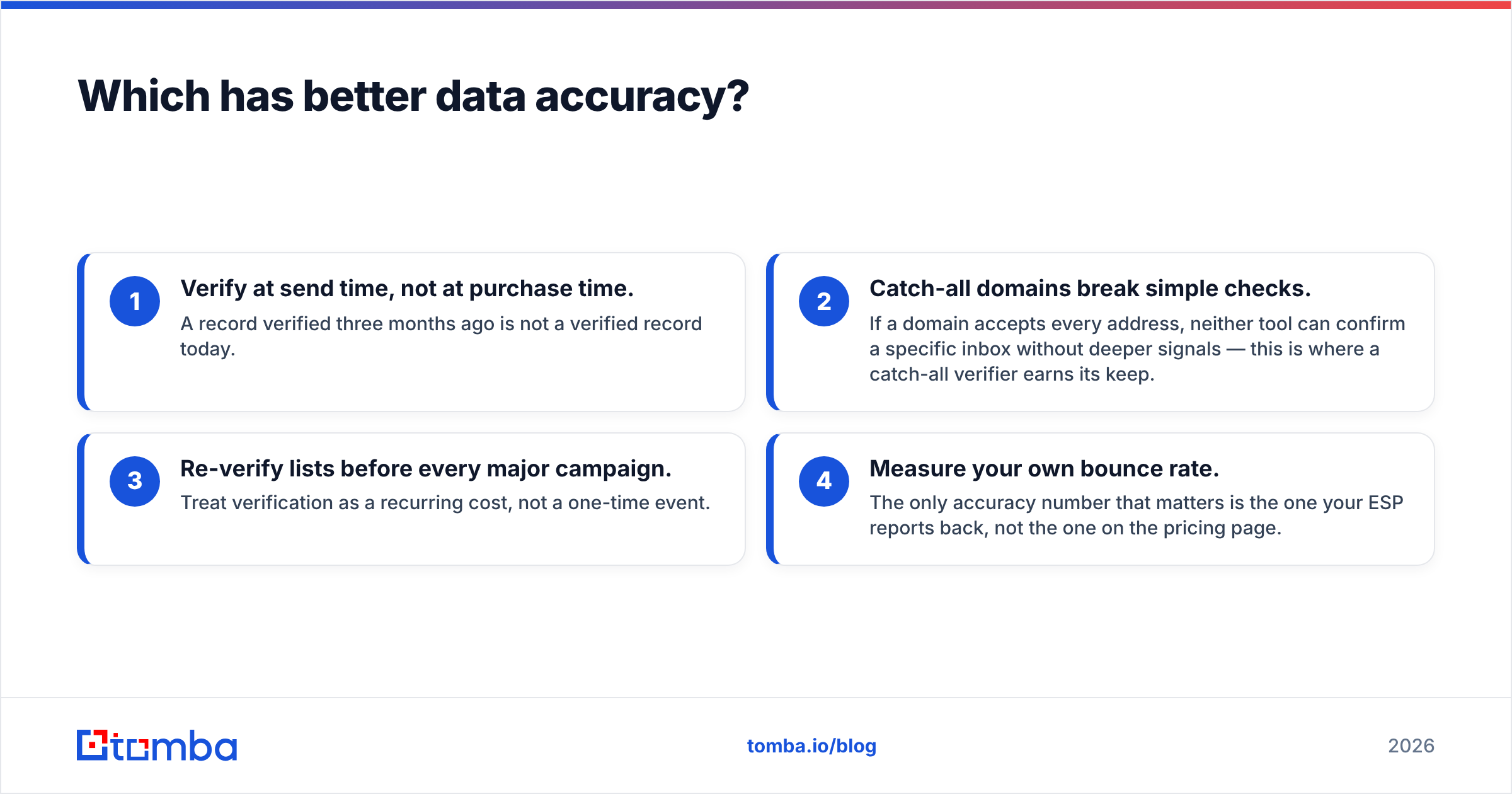
The practical accuracy rules that hold regardless of vendor:
- Verify at send time, not at purchase time. A record verified three months ago is not a verified record today.
- Catch-all domains break simple checks. If a domain accepts every address, neither tool can confirm a specific inbox without deeper signals — this is where a catch-all verifier earns its keep.
- Re-verify lists before every major campaign. Treat verification as a recurring cost, not a one-time event.
- Measure your own bounce rate. The only accuracy number that matters is the one your ESP reports back, not the one on the pricing page.

If you keep landing on the same hard-to-reach prospects that neither database covers, that's a signal you've outgrown a database-only workflow and need a finder that works directly from name + domain.
How much do Clearalist and UpLead cost?#
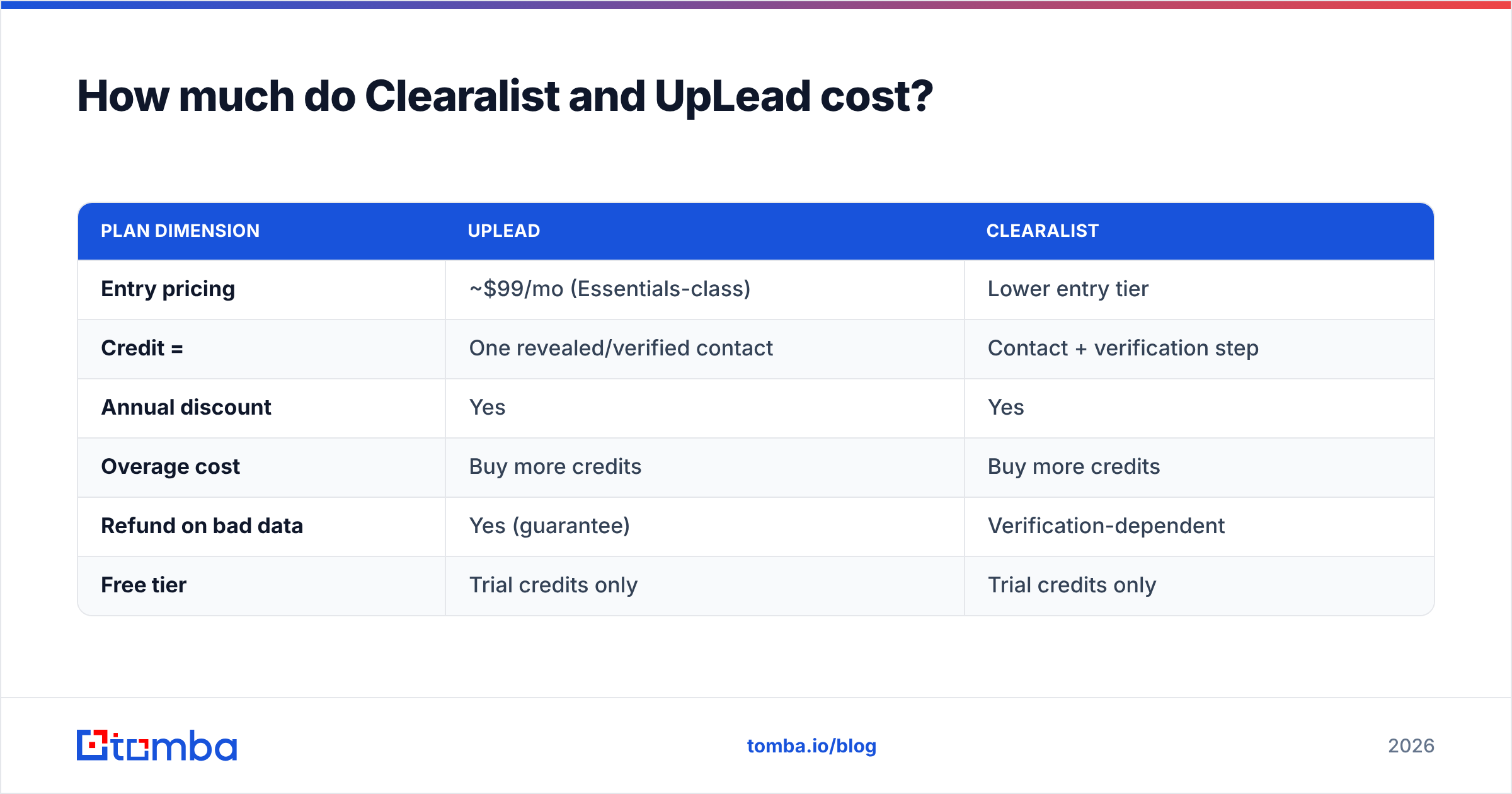
Pricing is where the "vs" gets messy, because the two tools meter credits differently. UpLead sells credit packs and subscription tiers where one credit roughly equals one revealed contact. Clearalist undercuts on headline price, but you have to check whether verification is bundled or metered separately.
| Plan dimension | UpLead | Clearalist |
|---|---|---|
| Entry pricing | ~$99/mo (Essentials-class) | Lower entry tier |
| Credit = | One revealed/verified contact | Contact + verification step |
| Annual discount | Yes | Yes |
| Overage cost | Buy more credits | Buy more credits |
| Refund on bad data | Yes (guarantee) | Verification-dependent |
| Free tier | Trial credits only | Trial credits only |
The trap in both models is the same: cost-per-valid-email, not cost-per-credit, is the metric that matters. If a cheaper tool burns two credits to land one usable email, it's not cheaper. Run a small paid test on a real target list and divide total spend by the number of emails that actually passed verification and didn't bounce.
This is also where a finder-first alternative changes the math. Tomba's pricing is straightforward — a free tier with 25 searches, then Starter at $49/mo, Growth at $99/mo, and Pro at $249/mo — and it charges for finding and verifying the specific contacts you ask for rather than for browsing a database you may not fully use. For teams whose real job is "get the right person's verified email," that often produces a lower cost-per-valid-email than a database subscription.
Is there a better alternative for finding verified emails?#
For prospecting from broad filters, UpLead is hard to beat at its price point. But a large share of "I need this person's email" tasks don't require a 160M-row database at all — they require accuracy on a known name and a known company. That's a different tool category.
This is where Tomba's stack fits alongside (or instead of) a database:
- Email finder — give it a name and domain, get the most likely address with a confidence score and verification.
- Domain search — pull every discoverable email pattern for a company in one call, ideal when you don't know who to contact yet.
- Bulk email finder — process a CSV of names and domains at once instead of paying per database reveal.
- Email verifier and catch-all verifier — clean a list before any campaign, including the catch-all domains that trip up most tools.
- Tomba API — wire finding and verification directly into your CRM or enrichment workflow, which neither database tool exposes as cleanly for developers.
The point isn't that Tomba replaces every UpLead use case — if your workflow is "browse, filter, build a list from scratch," a database is the right shape. The point is that many buyers reach for a database when what they actually needed was a precise, verifiable finder.

Which should you choose: Clearalist, UpLead, or a finder?#
Match the tool to the bottleneck, not the brand:
- Choose UpLead if discovery is your problem — you need to find companies and people you don't yet know, using deep technographic and firmographic filters, and you're willing to pay for a guarantee-backed database.
- Choose Clearalist if you already have your target accounts, want clean contact data, and price sensitivity outweighs database breadth or brand maturity.
- Choose a finder like Tomba if you constantly hit "I know the company and the person — I just need their verified email," want bulk processing, or need an API to automate enrichment.
A common winning setup is hybrid: use a database for top-of-funnel discovery, then run those records through a dedicated finder and verifier to lift accuracy before outreach. Many teams find the database becomes optional once their ICP is well-defined and they're working from known account lists.
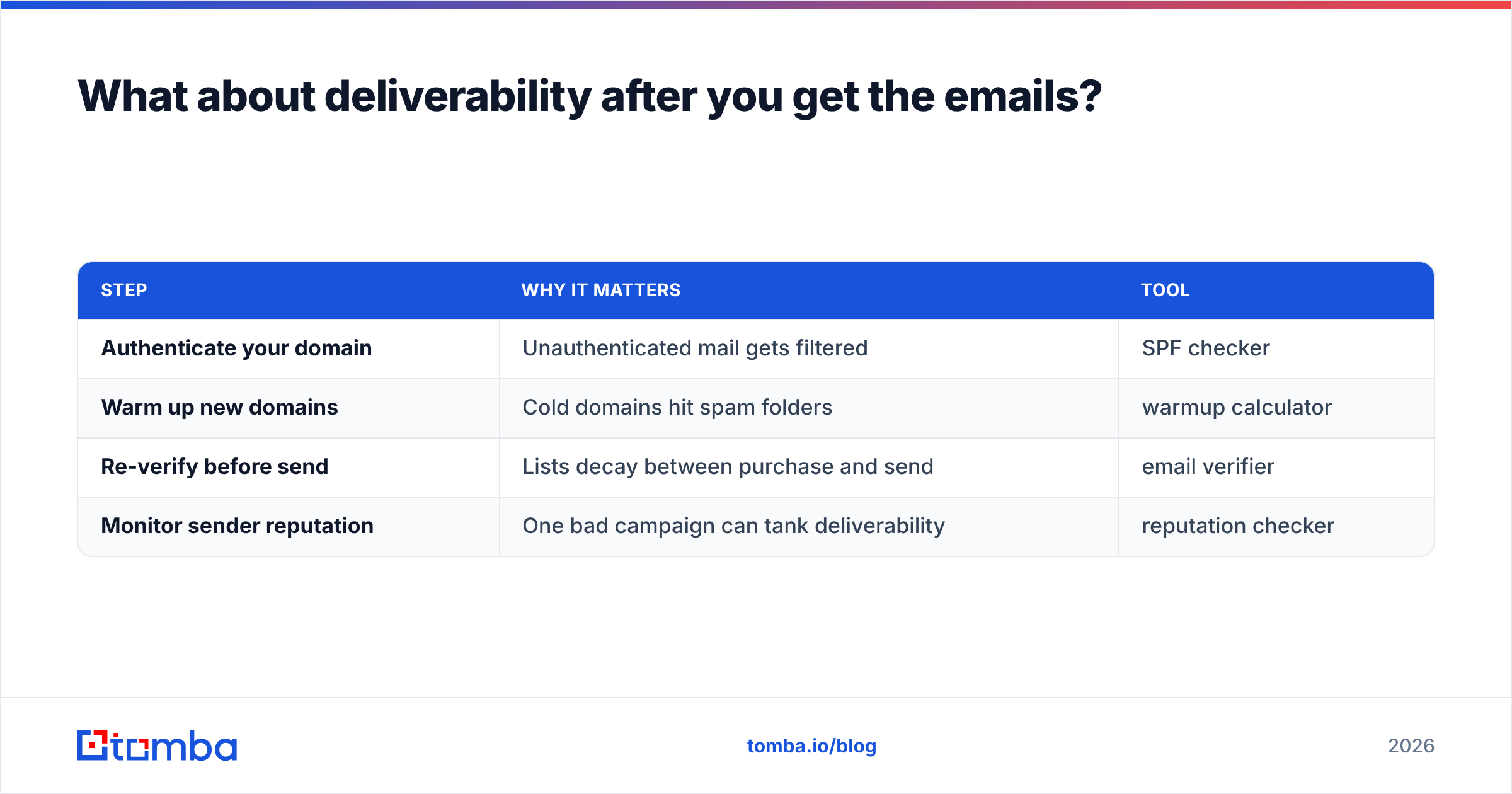
What about deliverability after you get the emails?#
Accurate emails are necessary but not sufficient. Even a perfectly verified list bounces if your sending domain isn't healthy. Before scaling outbound:
| Step | Why it matters | Tool |
|---|---|---|
| Authenticate your domain | Unauthenticated mail gets filtered | SPF checker |
| Warm up new domains | Cold domains hit spam folders | warmup calculator |
| Re-verify before send | Lists decay between purchase and send | email verifier |
| Monitor sender reputation | One bad campaign can tank deliverability | reputation checker |
Skipping these turns even a 95%-accurate list into a deliverability problem. The vendor you choose for data doesn't fix sending hygiene — that's on your stack.
Frequently asked questions#
Is UpLead more accurate than Clearalist? UpLead publishes a 95% accuracy guarantee with credit refunds on bad data, which is a stronger formal commitment than Clearalist's verification-at-export model. In practice, your own measured bounce rate is the only number that settles it — test both on a real list.
Is Clearalist cheaper than UpLead? Clearalist generally has a lower entry price, but headline price isn't cost-per-valid-email. A cheaper tool that burns extra credits on bad records can cost more per usable contact. Run a paid test and divide spend by verified, non-bouncing emails.
Do I need a database tool at all? Only if discovery is your bottleneck. If you already know which companies and people to target, an email finder plus verifier usually delivers a lower cost-per-valid-email than a full database subscription.
Can I use both a database and a finder? Yes, and many teams do. Use the database for discovery, then push records through a finder and email verification step to maximize accuracy before outreach.
The bottom line#
UpLead is the stronger discovery database; Clearalist is the budget alternative for clean data on accounts you already know. But if your actual job is turning a name and a company into a verified, sendable email — at scale, with an API, without paying for a database you half-use — start with the Tomba Email Finder. Spin up the free tier of 25 searches, run it against your real target list, and compare cost-per-valid-email head to head before you commit to any annual contract.
// get started
Find, verify and enrich your first contacts today
Start on the free plan with 25 searches a month, then scale when your team is ready.
Free plan · No credit card required · GDPR & CCPA
// about the author