Top 7 Clevenio Alternatives for Cold Outreach in 2026
Clevenio is a solid cold outreach tool, but it isn't the only option. Compare the 7 best Clevenio alternatives in 2026 on price, deliverability, and built-in data.
Clevenio built a name for itself as a no-frills cold outreach platform: multichannel sequences, follow-up automation, and reply detection without the bloat of an enterprise suite. But "good enough" stops being good enough the moment your list outgrows the tool, your deliverability dips, or you realize you're paying for sending without paying for the data that makes sending worthwhile.
If you're shopping for Clevenio alternatives in 2026, this guide compares the seven platforms most teams switch to — across pricing, deliverability features, built-in contact data, and the kind of outreach they're actually best at. No vendor will be perfect for every team, so the goal here is to match the tool to your motion, not to crown one winner.
TL;DR#
- Clevenio is a sequencing tool, not a data tool. Its biggest gap is that you still need a separate source for verified emails and phone numbers — budget for that before you compare prices.
- For inbox-volume senders, Instantly and Saleshandy win on deliverability infrastructure (rotating inboxes, warmup).
- For all-in-one prospecting, Apollo bundles a B2B database with sequencing, but its data accuracy is inconsistent.
- For data quality first, pair a focused sequencer with a dedicated email finder and email verifier like Tomba to keep bounce rates low.
- The right answer depends on your bottleneck: sending volume, data freshness, or budget. The comparison table below maps each.
What is Clevenio and why look for alternatives?#
Clevenio is a cold email and multichannel outreach platform aimed at small sales teams and founders. It handles sequence building, automated follow-ups, email and LinkedIn touches, and basic reply tracking. It's lightweight, reasonably priced, and easy to learn — which is exactly why it appeals to teams running their first structured outbound motion.
The reasons people outgrow it are predictable:
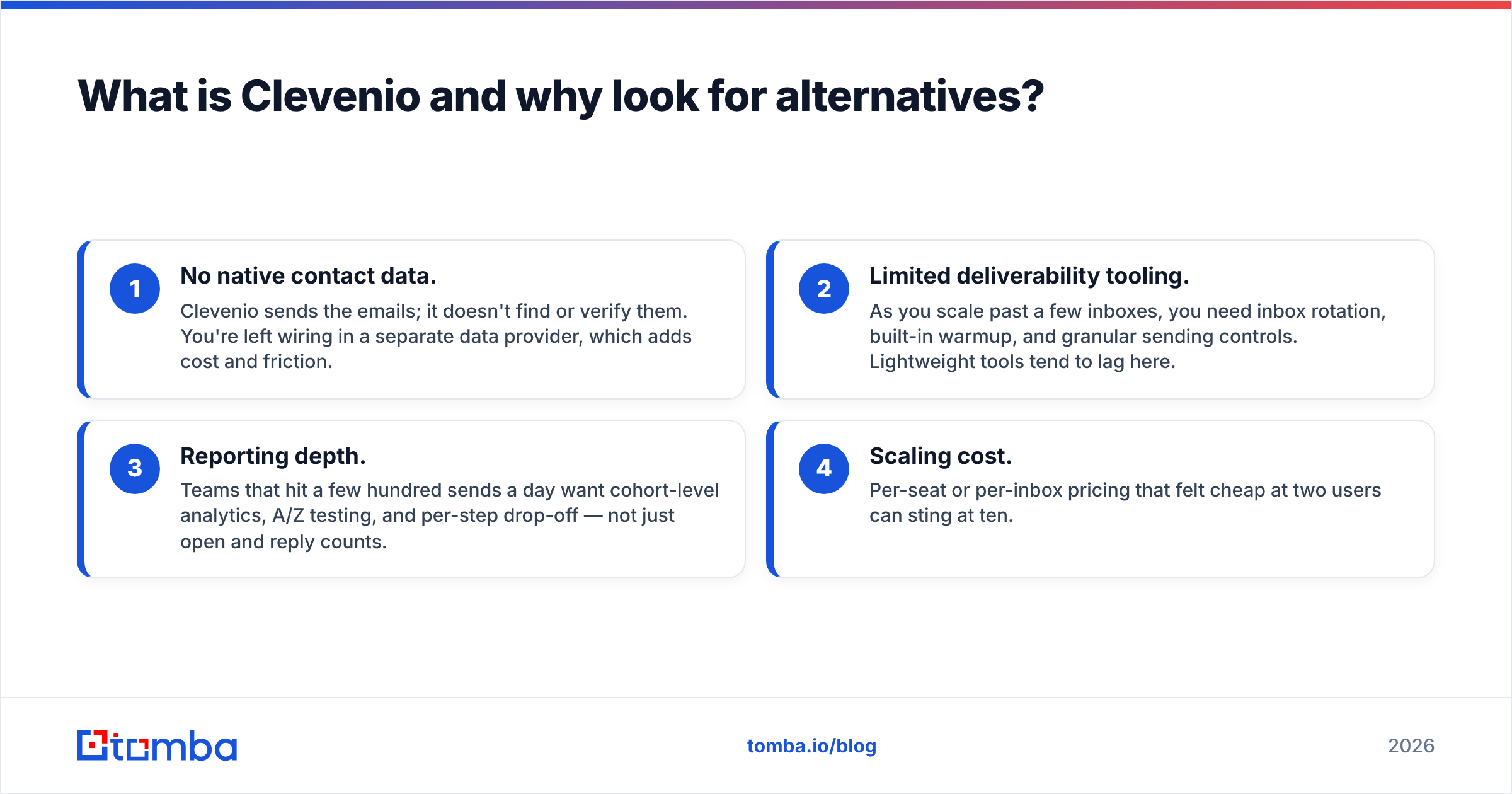
- No native contact data. Clevenio sends the emails; it doesn't find or verify them. You're left wiring in a separate data provider, which adds cost and friction.
- Limited deliverability tooling. As you scale past a few inboxes, you need inbox rotation, built-in warmup, and granular sending controls. Lightweight tools tend to lag here.
- Reporting depth. Teams that hit a few hundred sends a day want cohort-level analytics, A/Z testing, and per-step drop-off — not just open and reply counts.
- Scaling cost. Per-seat or per-inbox pricing that felt cheap at two users can sting at ten.
None of these make Clevenio a bad tool. They just mean a different tool may fit your current stage better.

How should you evaluate Clevenio alternatives?#
Before you compare logos, get clear on which of these four levers is actually your constraint. Most teams misdiagnose this and buy the wrong category of tool.
- Deliverability infrastructure — Do you need rotating inboxes, automated warmup, and spam-rate monitoring to land in the primary inbox at volume? This is a sending-engine problem.
- Data acquisition — Is your real bottleneck finding and verifying accurate emails and phone numbers? That's a data problem, and no sequencer solves it.
- Channel breadth — Do you need email plus LinkedIn, calls, and SMS in one orchestrated sequence, or is email-only fine?
- Budget and team size — Are you a solo founder optimizing for cost-per-send, or a team that needs seats, roles, and shared analytics?
A quick rule: if your bounce rate is over 3–4%, fix data before you touch sequencing. A tool that sends faster just sends more bad emails faster. Run your list through an email verifier first, then pick a sequencer.
Which are the best Clevenio alternatives in 2026?#
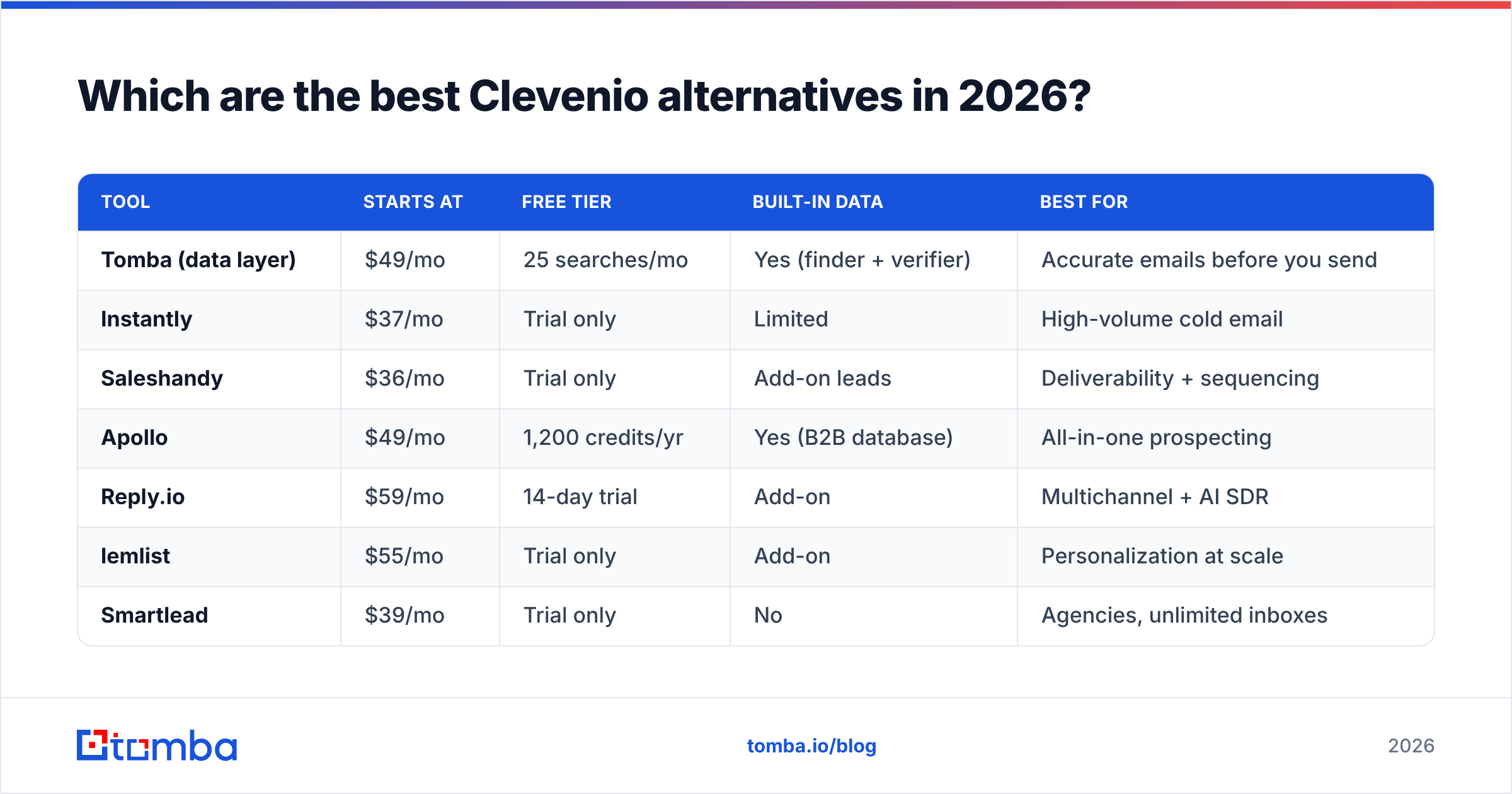
Here's the at-a-glance comparison. Prices reflect entry paid tiers as of 2026 and are rounded; always confirm on the vendor's own pricing page since plans change.
| Tool | Starts at | Free tier | Built-in data | Best for |
|---|---|---|---|---|
| Tomba (data layer) | $49/mo | 25 searches/mo | Yes (finder + verifier) | Accurate emails before you send |
| Instantly | $37/mo | Trial only | Limited | High-volume cold email |
| Saleshandy | $36/mo | Trial only | Add-on leads | Deliverability + sequencing |
| Apollo | $49/mo | 1,200 credits/yr | Yes (B2B database) | All-in-one prospecting |
| Reply.io | $59/mo | 14-day trial | Add-on | Multichannel + AI SDR |
| lemlist | $55/mo | Trial only | Add-on | Personalization at scale |
| Smartlead | $39/mo | Trial only | No | Agencies, unlimited inboxes |
A few honest caveats: "built-in data" varies wildly in quality, free tiers shift often, and the cheapest sticker price usually excludes the data add-on you'll end up needing. Read each profile below before deciding.
1. Tomba — fix the data before you sequence#
Tomba isn't a sequencing tool, and that's the point. The most common reason cold campaigns underperform isn't the copy or the cadence — it's that 10–20% of the list bounces or never existed. Tomba sits upstream of whatever sequencer you choose.
Use the domain search to pull every public email pattern at a target company, the email finder to get specific contacts by name, and the verifier (including a catch-all verifier) to scrub the list before a single send. There's also a phone finder for multichannel plays and a bulk email finder for list-building at scale.
- Pricing: Free (25 searches/mo), Starter $49/mo, Growth $99/mo, Pro $249/mo, Enterprise custom. See full Tomba pricing.
- Best paired with: Any sequencer below.
- Watch out for: It doesn't send emails — you still need an outreach tool alongside it.
2. Instantly — built for cold-email volume#
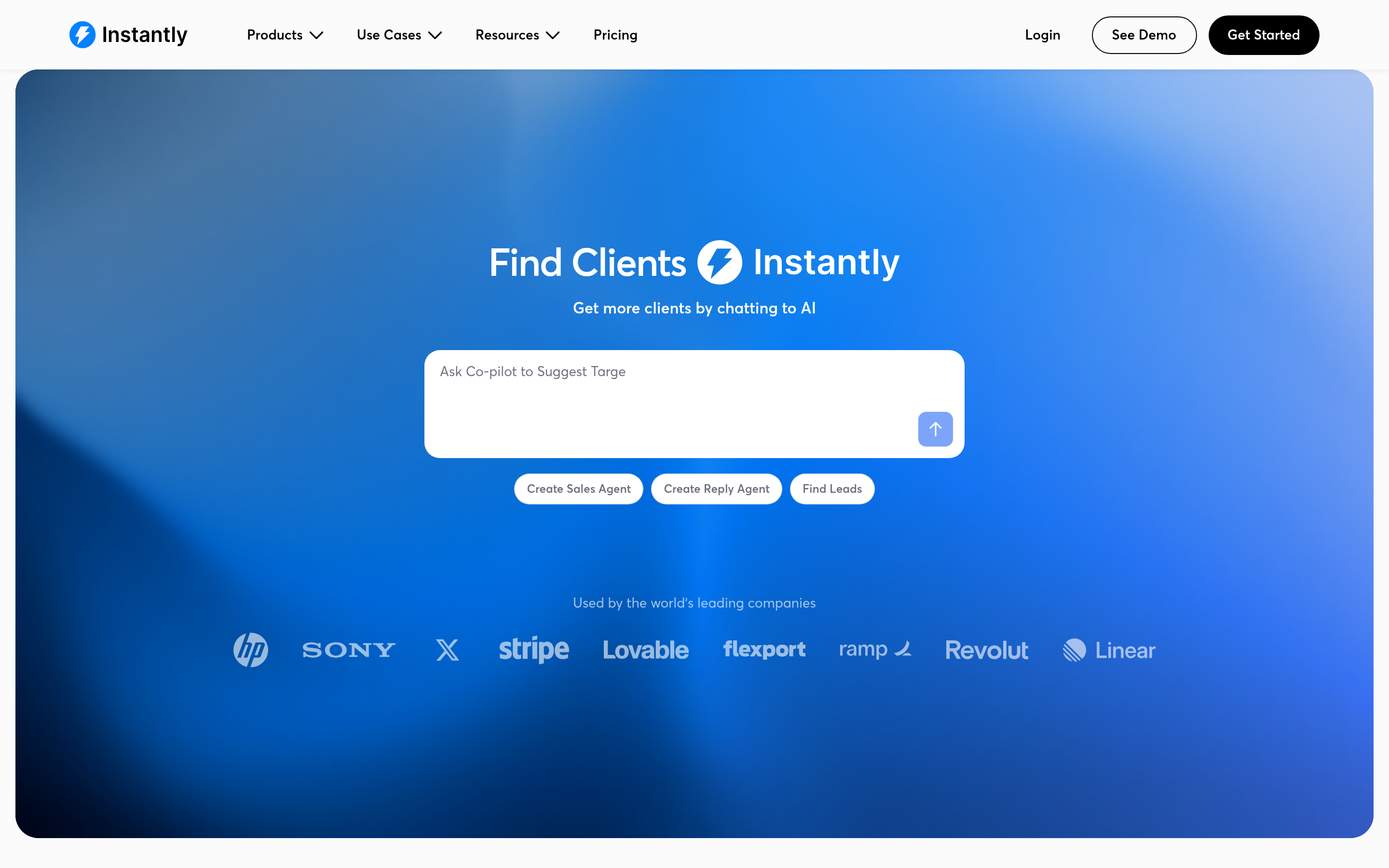
Instantly is the go-to for teams whose whole motion is high-volume cold email. Its strength is sending infrastructure: connect dozens of inboxes, rotate sends across them, and run automated warmup to protect sender reputation. The unified inbox keeps replies manageable when you're running many domains at once.
- Pricing: From ~$37/mo for the growth tier.
- Best for: Agencies and founders sending thousands of cold emails a week.
- Watch out for: Lead database quality is thinner than dedicated data tools, and it's email-centric — limited native LinkedIn or calling. Compare it as an Instantly alternative if data depth matters.
3. Saleshandy — deliverability with a sequencing brain#
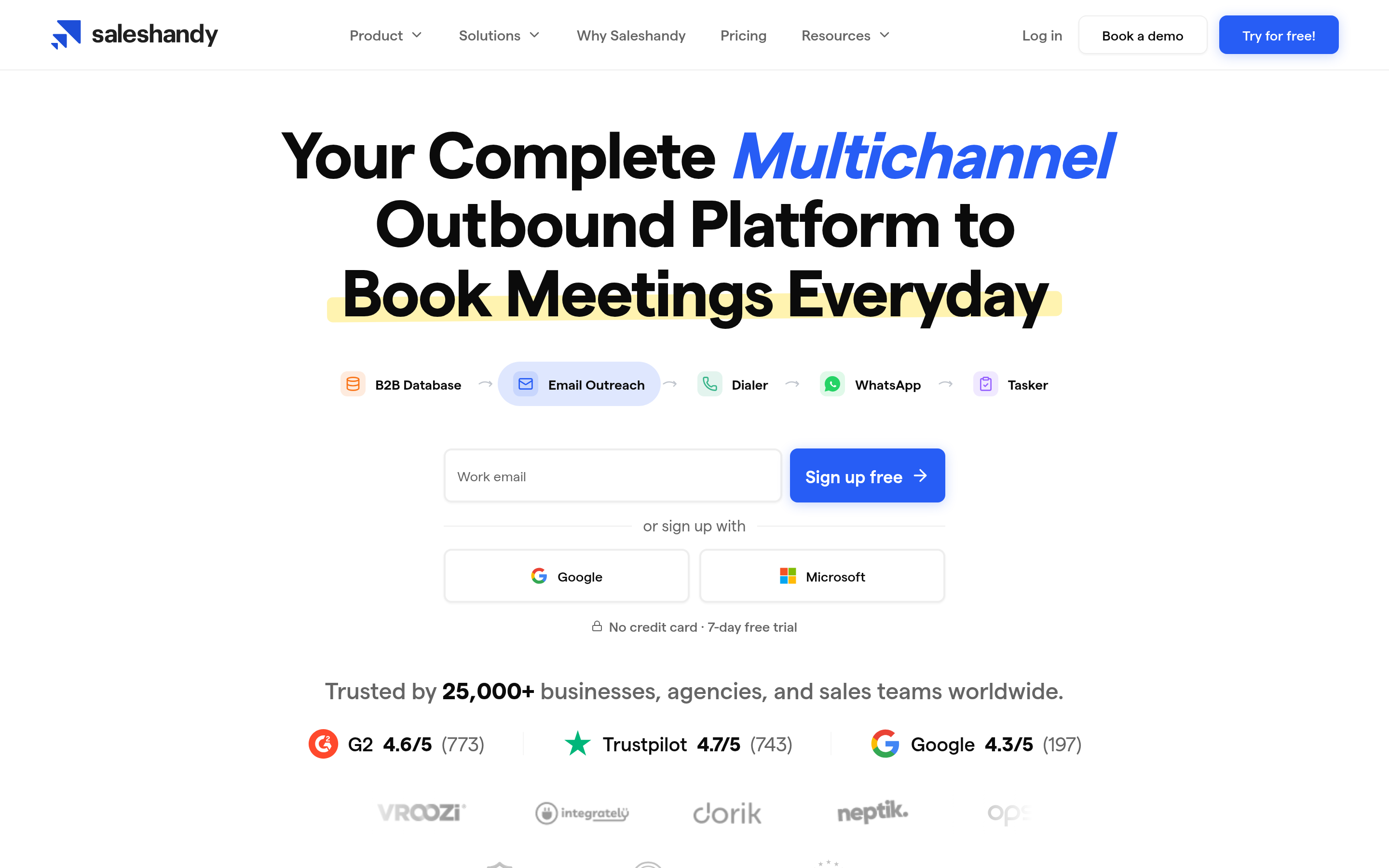
Saleshandy blends the deliverability features of a cold-email engine (inbox rotation, warmup, spam testing) with respectable sequencing and reporting. It's a balanced middle ground between a pure sending tool and a full sales-engagement suite, which makes it a natural Clevenio replacement for teams that want a bit more depth without enterprise pricing.
- Pricing: From ~$36/mo.
- Best for: SMB sales teams scaling from "first campaign" to "repeatable pipeline."
- Watch out for: Lead data is an add-on, not the core strength. See how it stacks up as a Saleshandy alternative.
4. Apollo — the all-in-one bet#
Apollo bundles a large B2B database with sequencing, dialer, and basic CRM features. If you want one login for finding contacts and emailing them, Apollo is the obvious candidate. The trade-off is the classic all-in-one tension: nothing is best-in-class.
- Pricing: Free tier (limited credits), paid from $49/mo.
- Best for: Teams that value consolidation over specialization.
- Watch out for: Data accuracy is inconsistent — many users verify Apollo exports before sending. If that's your experience, an Apollo alternative focused on data quality may serve better.
5. Reply.io — multichannel and AI-assisted#

Reply.io leans into multichannel: email, LinkedIn, calls, SMS, and WhatsApp in coordinated sequences, plus AI features for drafting and an "AI SDR" that can run parts of the motion autonomously. It's a strong fit if your buyers respond across channels and you want orchestration in one place.
- Pricing: From ~$59/mo.
- Best for: Teams running genuine multichannel cadences.
- Watch out for: Pricing climbs with seats and AI usage; the feature surface can be more than a small team needs. Evaluate it as a Reply.io alternative.
6. lemlist — personalization at scale#
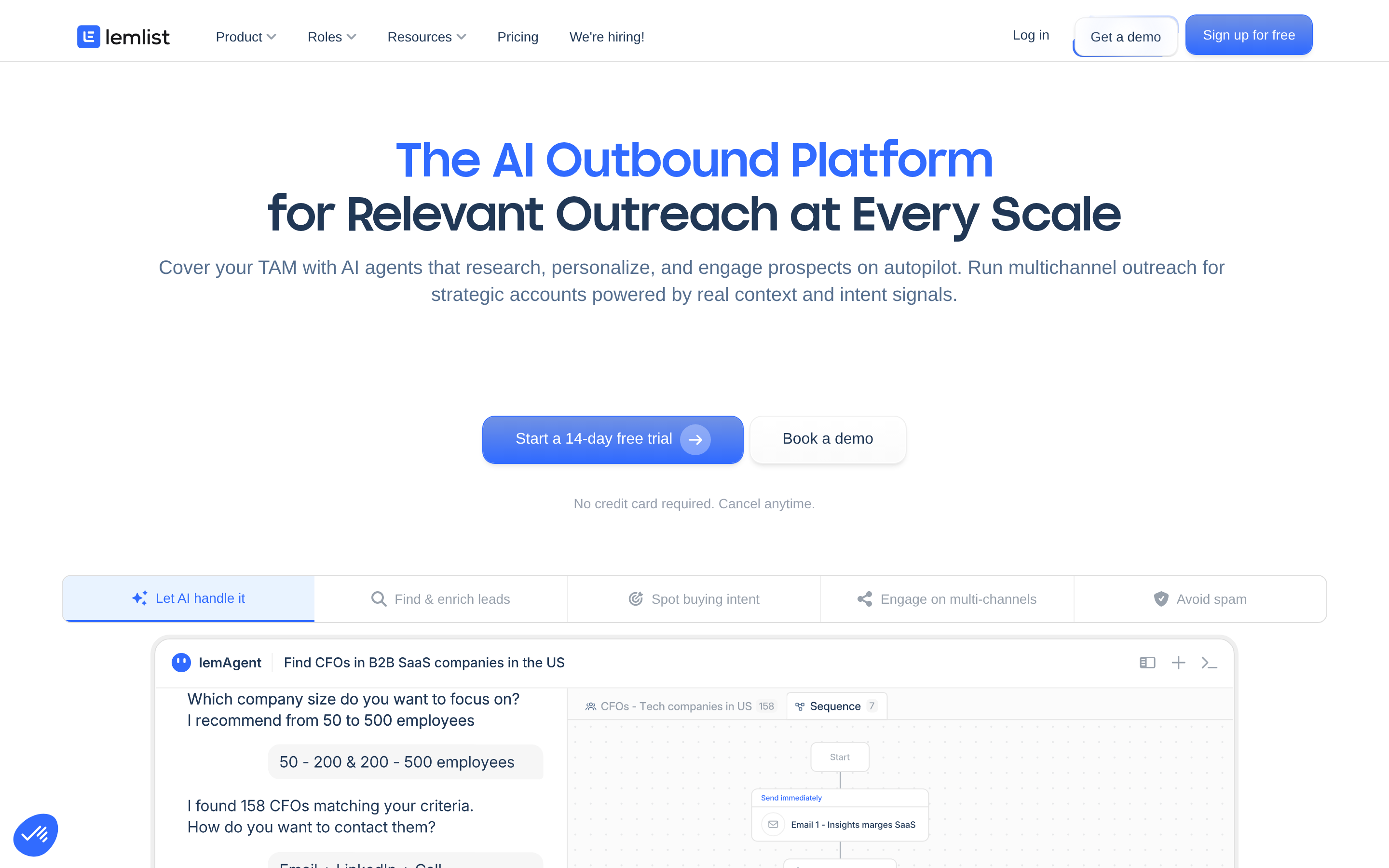
lemlist made its name on personalization — dynamic images, custom landing pages, and liquid-syntax variables that make a mass send feel one-to-one. It also added warmup and a lead database over time. If your reply rates live or die on personalization, lemlist is purpose-built for it.
- Pricing: From ~$55/mo (email-focused tiers).
- Best for: Teams whose differentiator is creative, highly personalized outreach.
- Watch out for: The personalization features add a learning curve, and costs rise quickly across channels.
7. Smartlead — the agency workhorse#
Smartlead targets agencies and power users with unlimited email accounts on most plans, automated warmup, and a unified master inbox. The pitch is scale without per-inbox penalties, which is exactly what agencies managing many clients need.
- Pricing: From ~$39/mo.
- Best for: Agencies and high-volume operators.
- Watch out for: No native contact data at all — you must bring your own verified lists, which loops you right back to needing a bulk email finder.
Is Apollo or Instantly the better Clevenio replacement?#
It depends on your bottleneck — and notice the pattern across all seven tools above.
Choose Apollo if consolidation matters more than precision: one tool for finding and emailing, accepting that you'll verify the riskier records yourself. Choose Instantly (or Smartlead, or Saleshandy) if you already have a data source and your problem is sending — landing in the primary inbox at volume.
But here's the thread that runs through every comparison on this page: the sequencer is rarely the actual constraint. Sending tools are mature and largely interchangeable on core mechanics. What separates a 1% reply rate from a 5% reply rate is usually list quality — are you emailing real people at real addresses, with the right context? That's a data problem, and switching from Clevenio to another sequencer doesn't touch it.
This is why many teams stop thinking in terms of "Clevenio vs. Apollo" and start thinking in two layers: a data layer that finds and verifies contacts, and a sending layer that sequences them. Get the data layer right and almost any competent sequencer performs well.
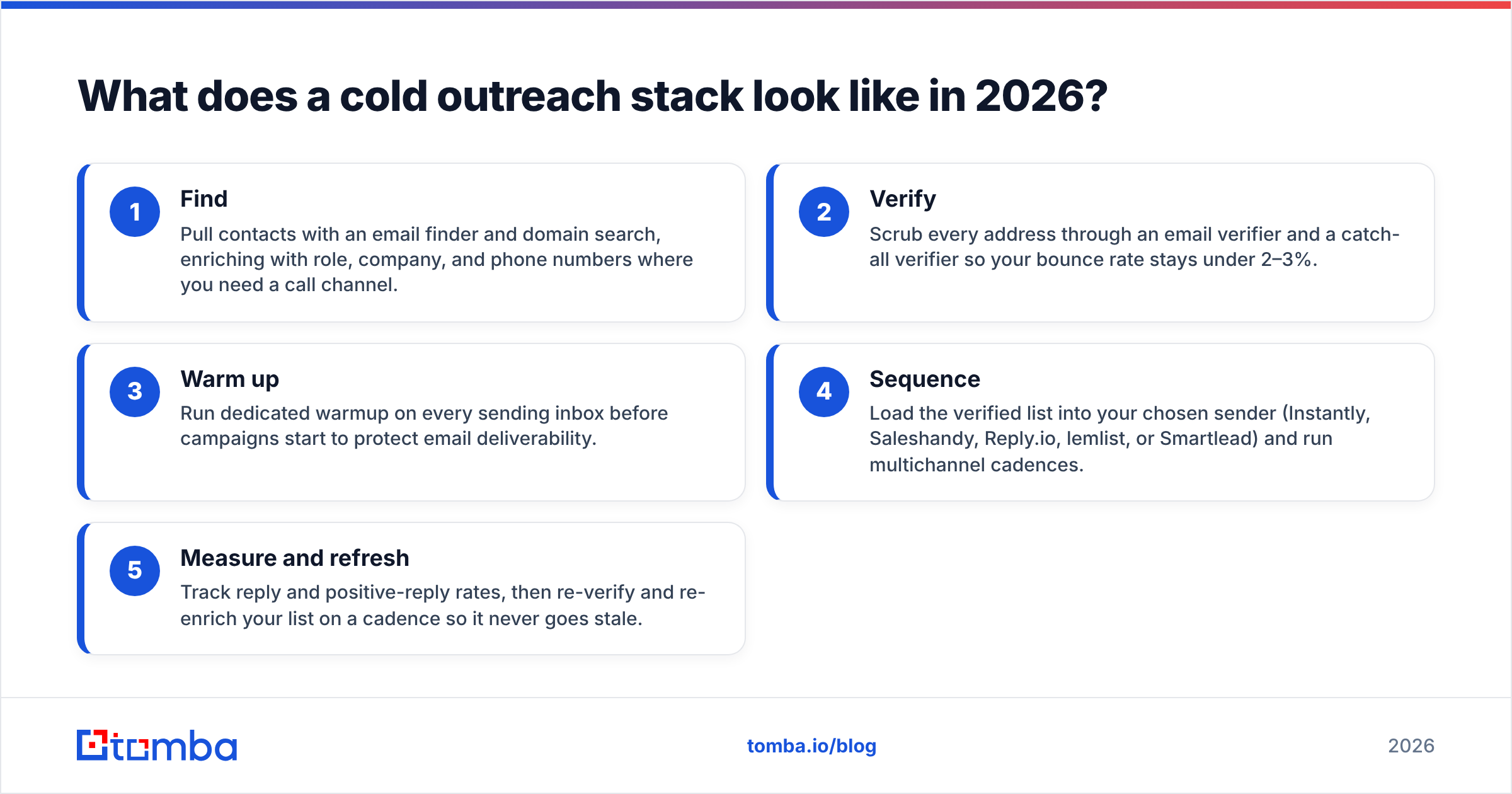
What does a cold outreach stack look like in 2026?#
A clean, modern setup separates concerns instead of forcing one tool to do everything:
- Find — Pull contacts with an email finder and domain search, enriching with role, company, and phone numbers where you need a call channel.
- Verify — Scrub every address through an email verifier and a catch-all verifier so your bounce rate stays under 2–3%.
- Warm up — Run dedicated warmup on every sending inbox before campaigns start to protect email deliverability.
- Sequence — Load the verified list into your chosen sender (Instantly, Saleshandy, Reply.io, lemlist, or Smartlead) and run multichannel cadences.
- Measure and refresh — Track reply and positive-reply rates, then re-verify and re-enrich your list on a cadence so it never goes stale.
You can validate the sending-side fundamentals with free utilities too — an SPF checker, a spam checker, and a blacklist checker catch deliverability problems before they tank a campaign. For deeper benchmarks on outreach platforms, third-party review sites like G2 and Capterra are worth scanning for recent, verified user reviews rather than relying on vendor marketing.
How much should you budget for a Clevenio alternative?#
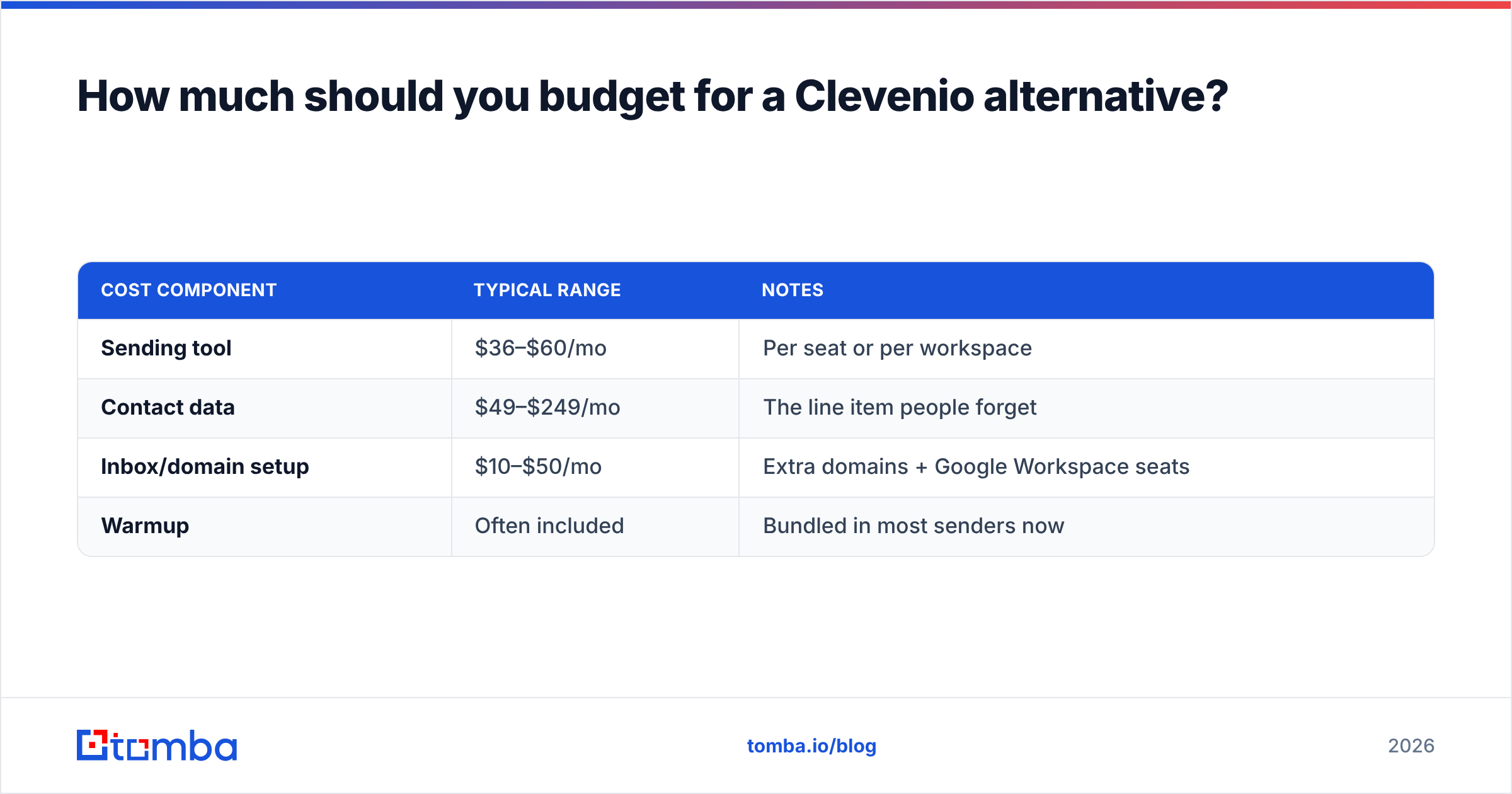
Sticker prices mislead because they almost always exclude data. A $37/mo sending tool with a $99/mo data add-on is a $136/mo stack, not a $37/mo one. When you compare, normalize on total monthly cost for your actual volume:
| Cost component | Typical range | Notes |
|---|---|---|
| Sending tool | $36–$60/mo | Per seat or per workspace |
| Contact data | $49–$249/mo | The line item people forget |
| Inbox/domain setup | $10–$50/mo | Extra domains + Google Workspace seats |
| Warmup | Often included | Bundled in most senders now |
The takeaway: a focused data tool plus a lean sender frequently beats an expensive all-in-one on both cost and results, because you're paying for best-in-class data instead of an average database bolted onto a sender. For context on how data sourcing affects accuracy, see where Tomba gets its data.
The bottom line#
Clevenio is a capable, affordable sequencer — and if sequencing is genuinely your only gap, a peer like Saleshandy or Instantly is a lateral move you may not need. But most teams searching for Clevenio alternatives are really feeling a data problem in disguise: high bounce rates, stale lists, and reply rates that won't budge no matter how good the copy is.
Fix that layer first. Find verified contacts, scrub them before you send, and then let your sequencer do its job. Start free with the Tomba Email Finder — 25 searches a month, no card required — and feed your next campaign a list that actually lands. Your sending tool will look a lot smarter when the data behind it is right.
// get started
Find, verify and enrich your first contacts today
Start on the free plan with 25 searches a month, then scale when your team is ready.
Free plan · No credit card required · GDPR & CCPA
// about the author