Clodura.ai vs MorphyMail (2026): Which Sales Tool Wins?
Clodura.ai is an AI sales-intelligence platform; MorphyMail is bulk email software. They solve different halves of outreach—here's which one fits your pipeline, plus where a dedicated data tool beats both.
Clodura.ai and MorphyMail get lumped together in "email outreach tool" searches, but they are not really competitors. One is an AI-driven B2B sales-intelligence platform that finds contacts and builds sequences. The other is desktop bulk-email software built to send large volumes of mail. Pick the wrong one and you either overpay for features you never touch, or you blast a list you never verified. This comparison breaks down what each does, where each wins, and how to plug the data gap both leave open.
TL;DR: Clodura.ai vs MorphyMail at a glance#
- Clodura.ai is a cloud sales-intelligence platform: a B2B contact database, email finder, buyer-intent signals, and multi-step sequencing in one subscription.
- MorphyMail is Windows desktop bulk-email software: you supply the list, it personalizes and sends high volumes through your own SMTP or server.
- They overlap only at "send an email." Clodura helps you find and target; MorphyMail helps you mass-send.
- Data quality is the deciding factor, and neither tool is a pure email-verification specialist—so pair whichever you choose with a dedicated email verifier.
- Best combo for most teams: a focused data source like Tomba for accurate contacts, then a sender you already trust.
What is Clodura.ai?#
Clodura.ai is a sales-prospecting and go-to-market platform aimed at outbound teams. Its pitch is "everything before the reply": a database of business contacts and companies, a built-in email finder, direct-dial phone numbers, org charts, technographic and intent data, plus email sequencing and cadence tools so reps can run outreach without leaving the app.
Think of Clodura as a scout plus a dispatcher. It tells you who to contact, why now (buying signals, funding, hiring), and gives you a way to run the first few touches. It sells on annual plans and is popular with SMB and mid-market SDR teams that want database access and sequencing bundled together instead of stitching three vendors together.
Where Clodura earns its keep is targeting. If your problem is "I don't have a list and I don't know which accounts are in-market," a data-and-intent platform solves that. Independent reviews on G2 and Capterra consistently flag the same trade-off, though: the contact data is broad but uneven, so you still need a verification step before you send at scale.
What is MorphyMail?#
MorphyMail is a different animal: it is installed bulk-email marketing software, historically Windows-based, built by ByteMobile/ByteplexSoft-style desktop tooling. You bring your own contact list and your own sending infrastructure (SMTP relay, your server, or configured accounts), and MorphyMail handles mail-merge personalization, template building, attachments, and sending large batches.
The analogy: MorphyMail is a printing press, not a mailing list. It will personalize and push out thousands of messages efficiently, but it does not tell you who those people are, whether the addresses are live, or whether they want to hear from you. That is your job to supply.
This model has two consequences. First, cost can be low—desktop software with a one-time or lower recurring fee, versus a per-seat SaaS subscription. Second, deliverability sits entirely on your shoulders. Sending bulk mail from your own domain without warmup, list hygiene, and authentication is the fastest way to torch your sender reputation. MorphyMail gives you the throttle; it does not install the guardrails.
Clodura.ai vs MorphyMail: feature and pricing comparison#
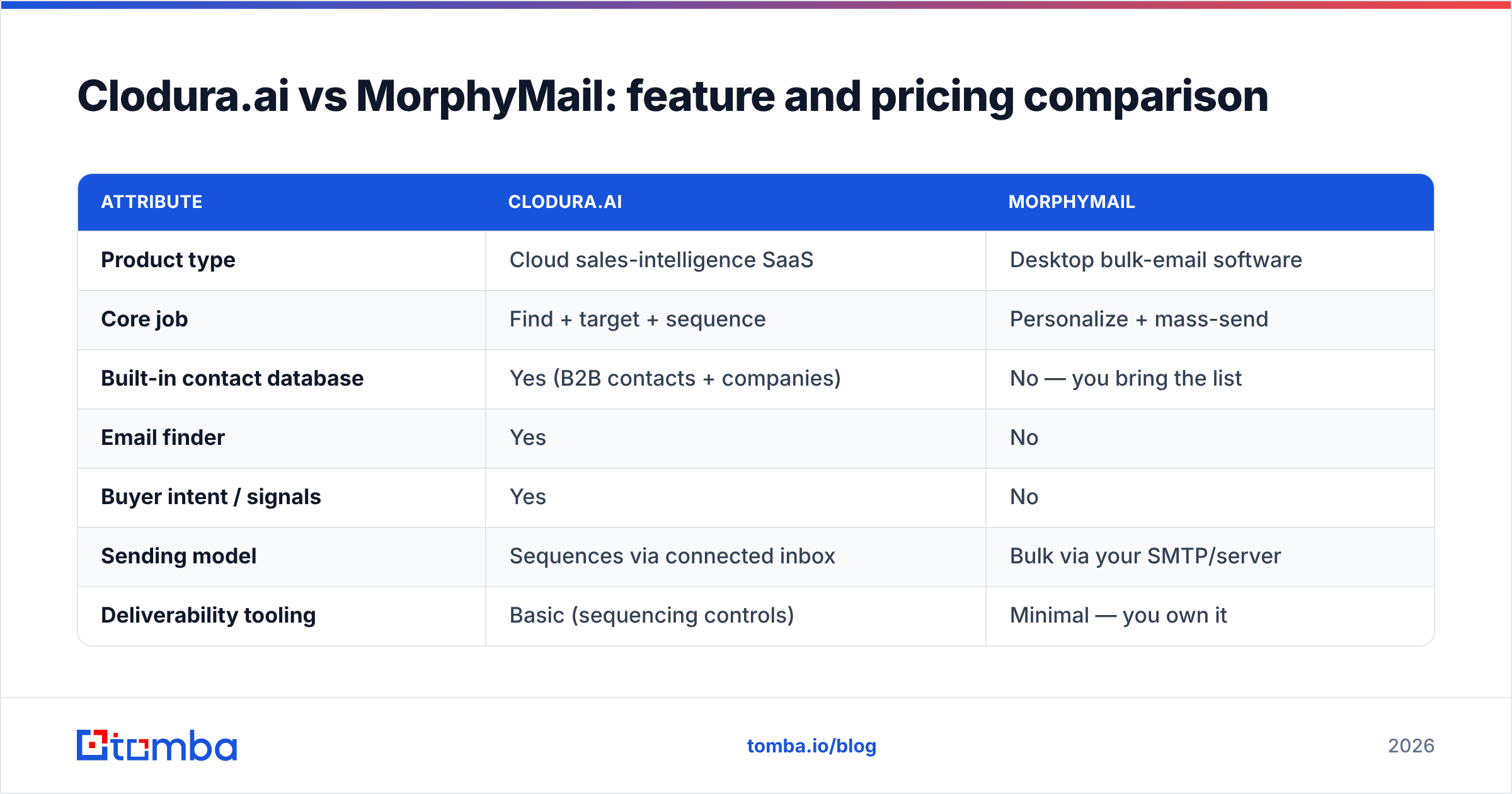
Here is the head-to-head on the attributes that actually change your buying decision.
| Attribute | Clodura.ai | MorphyMail |
|---|---|---|
| Product type | Cloud sales-intelligence SaaS | Desktop bulk-email software |
| Core job | Find + target + sequence | Personalize + mass-send |
| Built-in contact database | Yes (B2B contacts + companies) | No — you bring the list |
| Email finder | Yes | No |
| Buyer intent / signals | Yes | No |
| Sending model | Sequences via connected inbox | Bulk via your SMTP/server |
| Deliverability tooling | Basic (sequencing controls) | Minimal — you own it |
| Verification depth | Light | None |
| Typical pricing | Per-seat annual SaaS | Lower / one-time desktop license |
| Best for | SDR teams needing data + intent | High-volume senders with a list |
The table makes the split obvious. Clodura is the choice when your gap is data and targeting. MorphyMail is the choice when you already own a clean list and just need cheap volume. They are not really "either/or"—they sit at opposite ends of the same funnel.
Which one is better for cold outreach in 2026?#
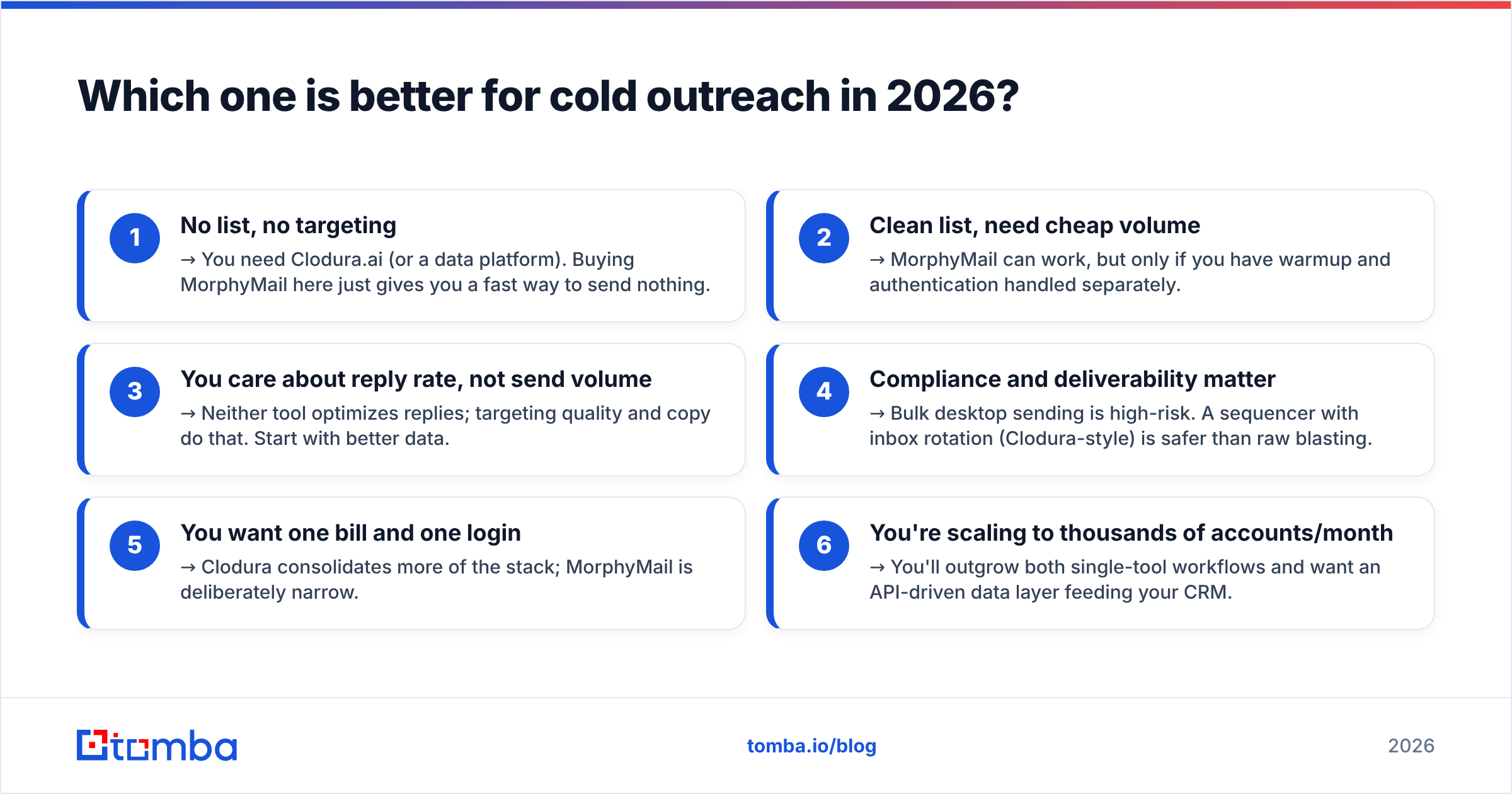
It depends on which half of the problem you have—but for most teams, neither is complete on its own. Run through this decision list:
- No list, no targeting → You need Clodura.ai (or a data platform). Buying MorphyMail here just gives you a fast way to send nothing.
- Clean list, need cheap volume → MorphyMail can work, but only if you have warmup and authentication handled separately.
- You care about reply rate, not send volume → Neither tool optimizes replies; targeting quality and copy do that. Start with better data.
- Compliance and deliverability matter → Bulk desktop sending is high-risk. A sequencer with inbox rotation (Clodura-style) is safer than raw blasting.
- You want one bill and one login → Clodura consolidates more of the stack; MorphyMail is deliberately narrow.
- You're scaling to thousands of accounts/month → You'll outgrow both single-tool workflows and want an API-driven data layer feeding your CRM.
The recurring theme: outreach fails on data quality far more often than on send mechanics. A verified, well-targeted list of 500 gets more meetings than a scraped list of 50,000 pushed through the best sender on earth.
Where both tools leave a gap: data accuracy#
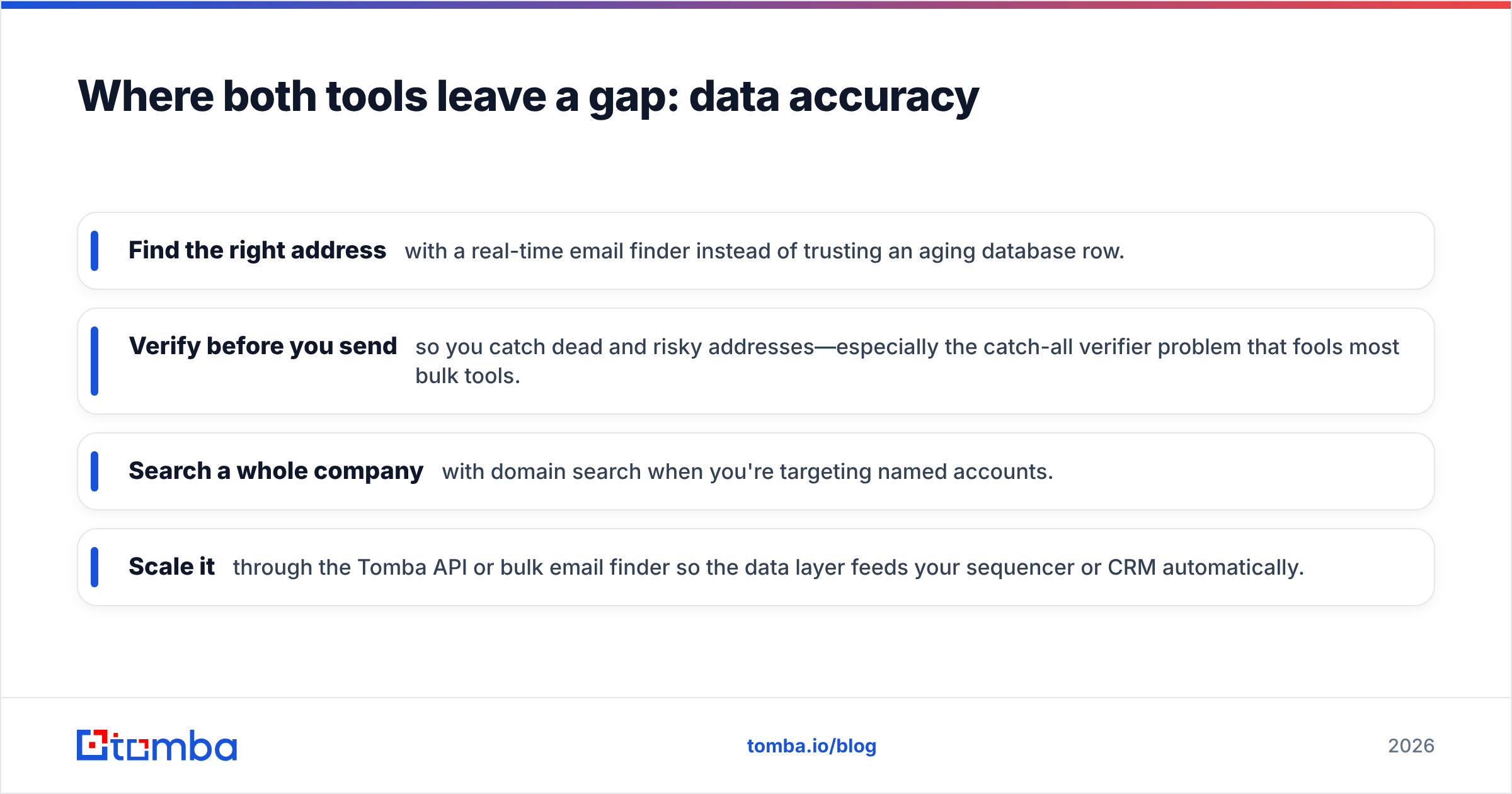
Here is the honest part. Clodura.ai gives you a database, but database contacts drift—people change jobs, domains, and titles constantly, so a chunk of any provider's records are stale on the day you export them. MorphyMail gives you a sender, but garbage in means bounces out, and every bounce chips at your domain's reputation and email deliverability.
Neither product is a dedicated verification and finding specialist, and that is exactly the layer that protects your results. This is where a focused tool earns its place next to whatever platform you choose:
- Find the right address with a real-time email finder instead of trusting an aging database row.
- Verify before you send so you catch dead and risky addresses—especially the catch-all verifier problem that fools most bulk tools.
- Search a whole company with domain search when you're targeting named accounts.
- Scale it through the Tomba API or bulk email finder so the data layer feeds your sequencer or CRM automatically.
Tomba's data is sourced and verified rather than only scraped and cached, which is why teams often keep their sequencer or bulk sender and simply swap the source of contacts underneath it. You don't have to rip out Clodura or MorphyMail to fix accuracy—you fix the input.
How do the three approaches compare on cost and risk?#
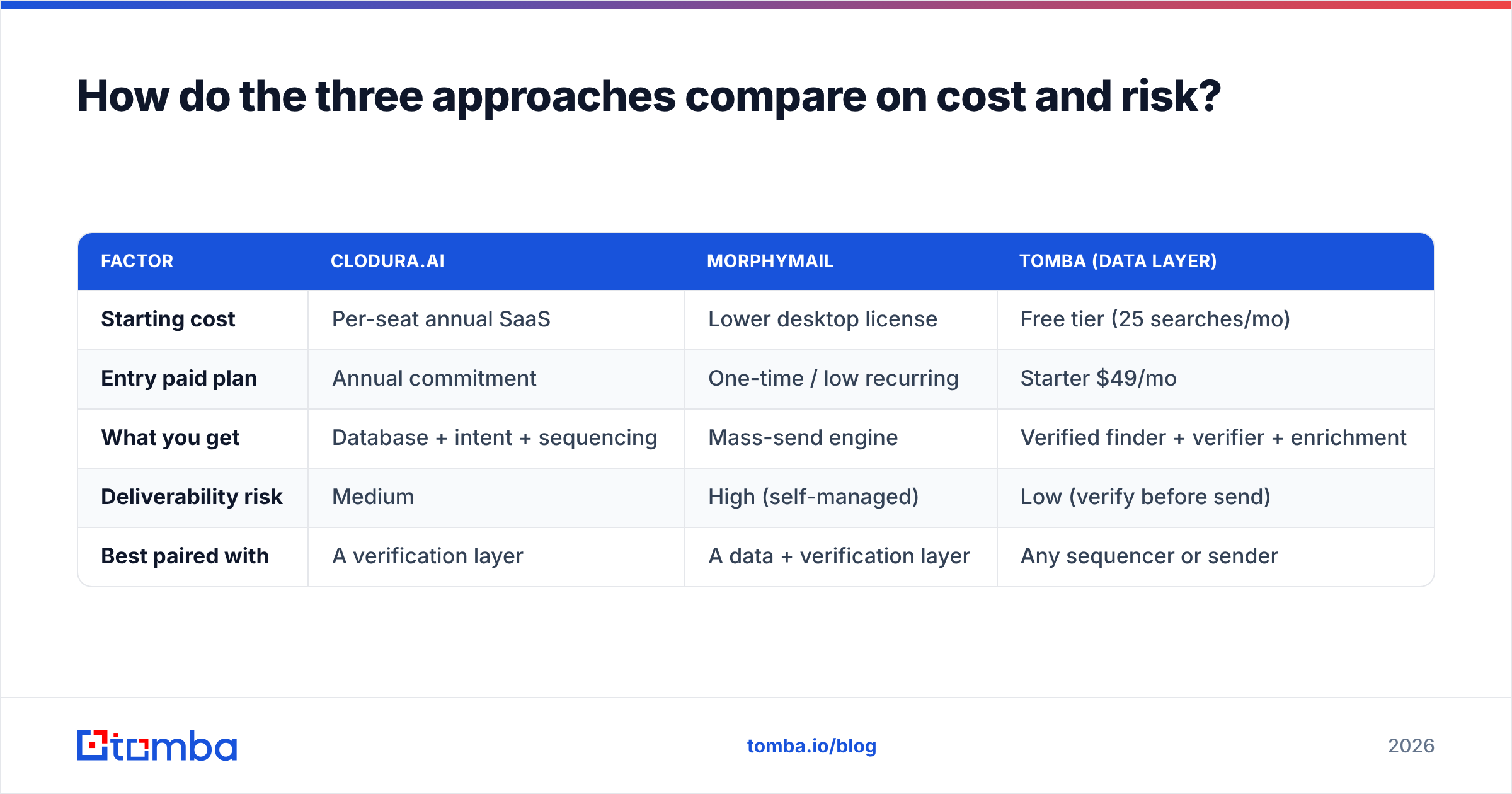
| Factor | Clodura.ai | MorphyMail | Tomba (data layer) |
|---|---|---|---|
| Starting cost | Per-seat annual SaaS | Lower desktop license | Free tier (25 searches/mo) |
| Entry paid plan | Annual commitment | One-time / low recurring | Starter $49/mo |
| What you get | Database + intent + sequencing | Mass-send engine | Verified finder + verifier + enrichment |
| Deliverability risk | Medium | High (self-managed) | Low (verify before send) |
| Best paired with | A verification layer | A data + verification layer | Any sequencer or sender |
A quick note on pricing transparency: SaaS platforms like Clodura publish per-seat annual tiers, desktop tools like MorphyMail lean on lower license fees, and a data specialist like Tomba runs a usage-based ladder—Free (25 searches/mo), Starter $49/mo, Growth $99/mo, Pro $249/mo, and custom Enterprise. Compare the full Tomba pricing against a seat-based annual contract before you commit; usage-based often wins for teams that prospect in bursts.
Is Clodura.ai or MorphyMail the right call for your team?#
Choose Clodura.ai if you're an SDR or founder-led sales team without a good list and you want database, intent signals, and sequencing under one login. Budget for a verification step on top; the data is broad but not send-ready as-is.
Choose MorphyMail if you already own a clean, permission-based list, you understand SMTP and warmup, and you want inexpensive, high-volume desktop sending without a per-seat SaaS bill. Go in knowing deliverability is 100% your responsibility.
Choose neither as a standalone if reply rate is your real metric. In that case, the smartest 2026 stack is a focused data source feeding whatever sender you trust—because the meeting is won at targeting and verification, not at send speed.
The bottom line#
Clodura.ai and MorphyMail answer different questions. Clodura answers "who should I contact and why now." MorphyMail answers "how do I send a lot of mail cheaply." Both skip the one question that decides your results: "is this contact real and reachable right now?"
That is the job to hand to a specialist. Tomba's email finder and verification tools give you accurate, verified contacts you can drop into Clodura's sequences, MorphyMail's send queue, or your own CRM—so you stop bouncing, protect your domain, and book more meetings from a smaller, cleaner list. Start on the free tier, test the data against your current source, and only scale the send once the input is clean. Better data beats a bigger blast every time.
Related guides#
Ready to find emails that actually work?
Join 150,000+ professionals who stopped guessing and started sending. Free credits on signup — no credit card required.
Get the Tomba newsletter
Practical outbound tactics and product updates — once every two weeks.
About the author