Clodura.ai vs No2Bounce (2026): Which Tool Do You Need?
Clodura.ai finds and enriches B2B leads; No2Bounce verifies email lists to cut bounces. Here's how they actually compare, where each wins, and the all-in-one alternative that does both.
Clodura.ai vs No2Bounce is not a fair fight. The two tools solve different problems. Clodura.ai is a sales-intelligence platform that helps you find B2B leads. No2Bounce is an email-verification service that helps you clean the list before you send. A head-to-head only makes sense once you know which job you need done. It also helps to ask if one platform could do both.
TL;DR#
- Clodura.ai is a lead-generation and sales-intelligence tool: contact database, org charts, email finding, and cadence features. Use it to source prospects.
- No2Bounce is a bulk email-verification tool: it validates addresses, detects catch-alls, and reduces bounce rate. Use it to protect deliverability.
- They are complementary, not competitors. Most teams that buy one soon need the other.
- If you'd rather not pay for two tools, an all-in-one like Tomba covers finding and verifying on one plan, starting at $49/mo.
- Your real question is not "which one wins." It's "do I need sourcing, hygiene, or both?"
What is Clodura.ai?#
Clodura.ai is a B2B sales-intelligence platform built around a large contact database. Its main job is to shorten the top of your funnel. You search by industry, title, technology, or location, and it returns verified business contacts. Each one can include direct-dial numbers, org charts, and buying-intent signals. It also adds a basic email cadence tool, so reps can go from list to outreach without leaving the app.
In practice, teams reach for Clodura.ai when the hard part is finding people to talk to. If your reps spend hours building lists by hand, a database tool turns that work into a few filters. You can read real user reviews on Clodura.ai's G2 profile to see how it scores for data depth and support.
Where Clodura.ai is weaker is list hygiene at scale. Every database ages. People change jobs, domains move, and mailboxes get retired. A finder gives you candidate addresses. Confirming that they still accept mail is a separate job, and that is the gap No2Bounce fills.
What is No2Bounce?#
No2Bounce is a dedicated email-verification service. You upload a list, or connect it through the API, and it checks each address. The checks cover syntax, MX records, SMTP handshakes, and catch-all or spam-trap detection. The output is a clean file, sorted into valid, invalid, risky, and unknown. That way you only send to addresses that are likely to land.
Teams buy verification tools to protect one asset that is hard to rebuild: sender reputation. Every hard bounce tells inbox providers that your data is dirty. Once your bounce rate passes about 2%, providers start to throttle your deliverability. For the mechanics, Wikipedia's overview of email verification is a neutral primer. Tomba's own email deliverability glossary entry explains why the bounce threshold matters.
The catch: No2Bounce cannot find anyone. It only tells you if an address you already have is safe to mail. Hand it an empty spreadsheet and it has nothing to do.
Clodura.ai vs No2Bounce: how do they actually compare?#
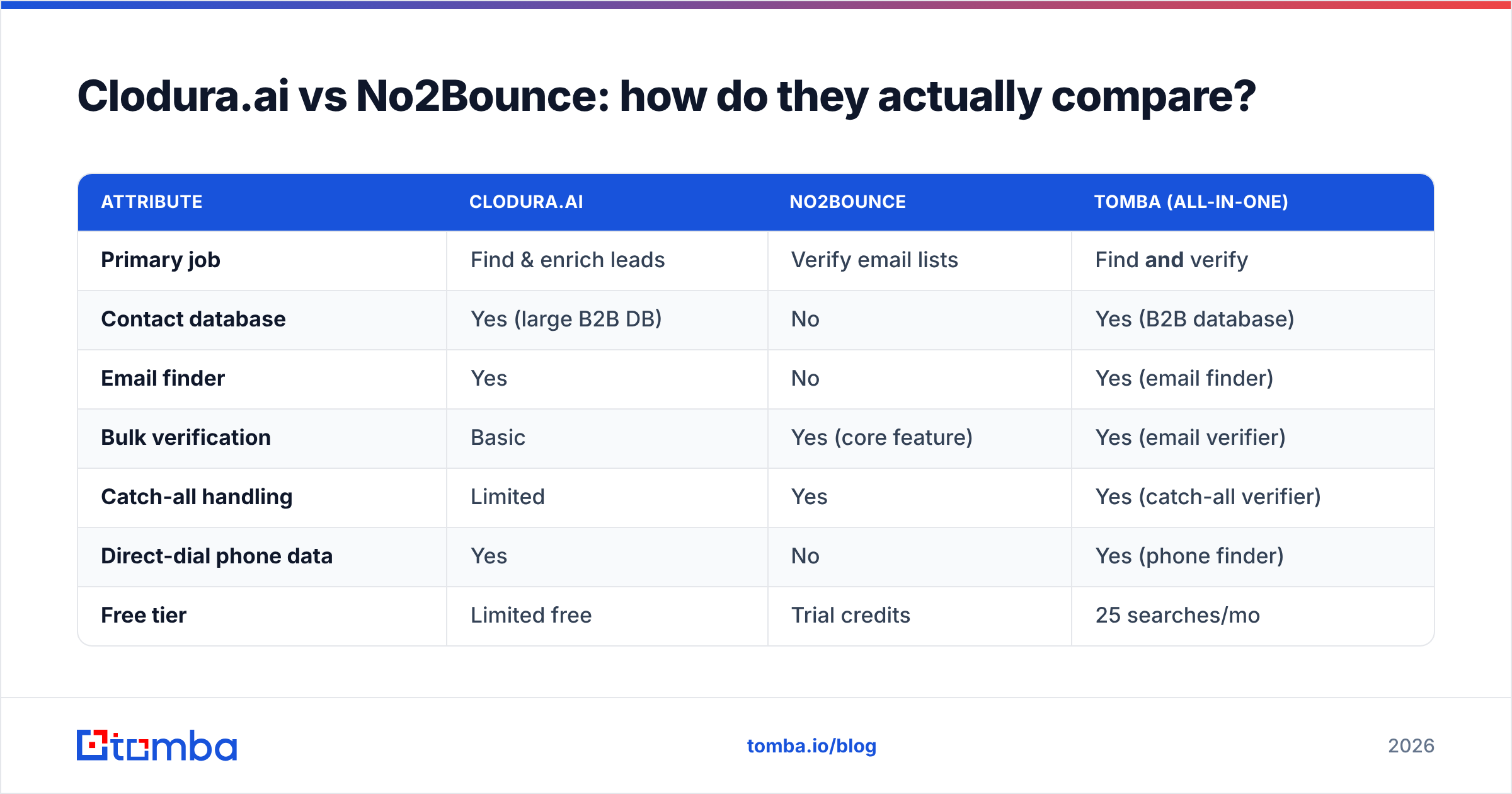
Here is the honest side-by-side. Notice how little the feature sets overlap. That is the whole point.
| Attribute | Clodura.ai | No2Bounce | Tomba (all-in-one) |
|---|---|---|---|
| Primary job | Find & enrich leads | Verify email lists | Find and verify |
| Contact database | Yes (large B2B DB) | No | Yes (B2B database) |
| Email finder | Yes | No | Yes (email finder) |
| Bulk verification | Basic | Yes (core feature) | Yes (email verifier) |
| Catch-all handling | Limited | Yes | Yes (catch-all verifier) |
| Direct-dial phone data | Yes | No | Yes (phone finder) |
| Free tier | Limited free | Trial credits | 25 searches/mo |
| Entry price | Custom / mid-market | Per-credit | $49/mo |
| Best for | Building pipeline | Protecting deliverability | Small teams wanting one bill |
The pattern is clear: Clodura.ai is a sourcing engine, and No2Bounce is a hygiene layer. A mature outbound stack usually runs both. You find contacts, then you clean them before the first send.

When Clodura.ai is the right buy#
- You have no reliable source of net-new contacts and need a database to prospect from.
- Your reps sell into mid-market or enterprise and rely on org charts and intent signals.
- Direct-dial phone numbers matter to your motion (outbound calling, multithreading).
When No2Bounce is the right buy#
- You already have lead lists — from events, sign-ups, partners, or scraping — and need them clean.
- Your bounce rate is creeping up and deliverability is at risk.
- You send high volume and every percentage point of bounce rate costs you inbox placement.
Do you actually need both tools?#
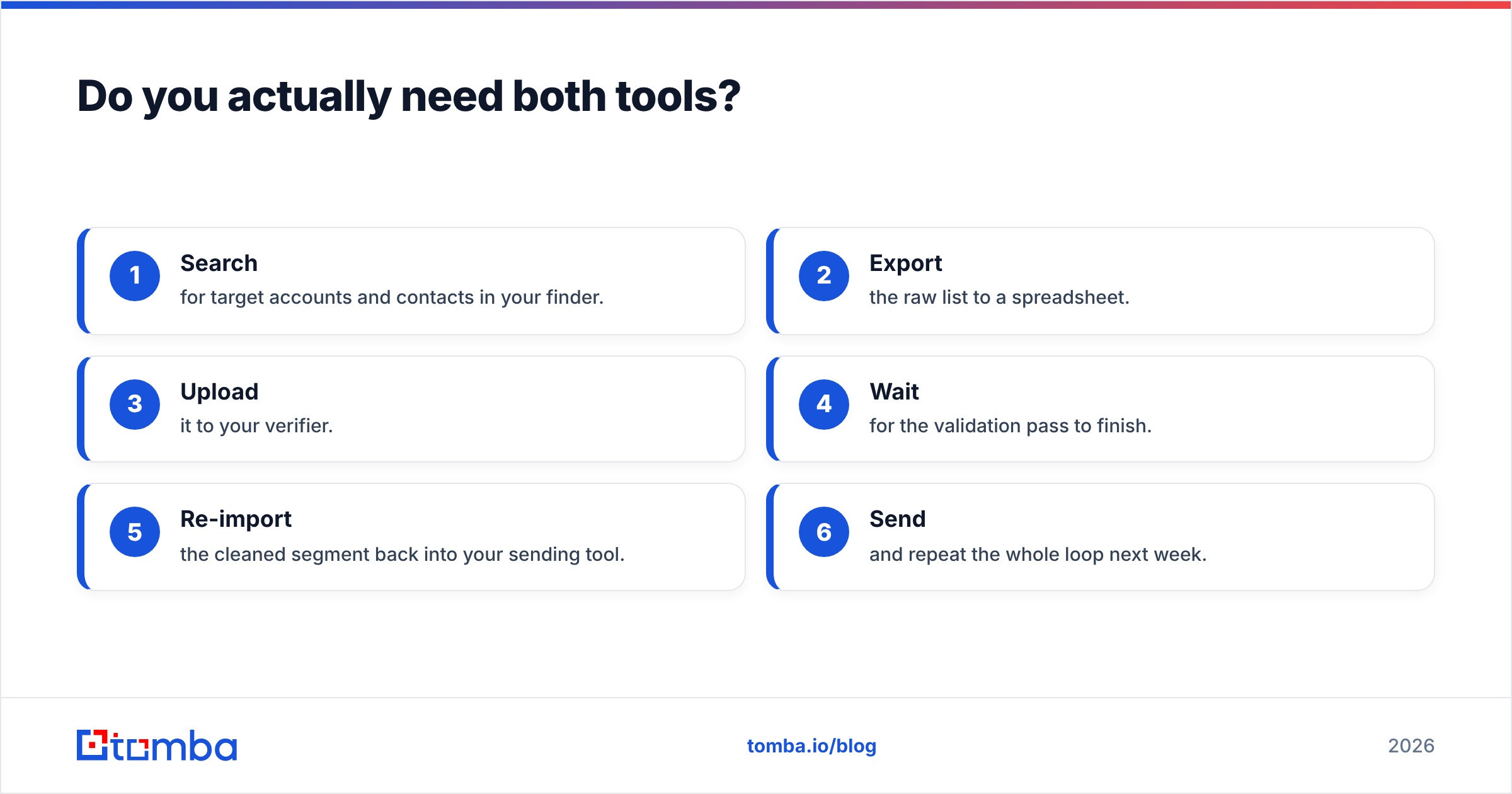
Most growing outbound teams do. That is the hidden cost of the Clodura.ai vs No2Bounce framing. A finder alone leaves you sending to stale addresses. A verifier alone leaves you with nothing to verify. So teams end up with two tools, two logins, two bills, and a manual CSV export-import dance between them.
That workflow looks like this:
- Search for target accounts and contacts in your finder.
- Export the raw list to a spreadsheet.
- Upload it to your verifier.
- Wait for the validation pass to finish.
- Re-import the cleaned segment back into your sending tool.
- Send — and repeat the whole loop next week.
Every hand-off is a place where data goes stale or a step gets missed. The more you scale, the worse that friction gets. This is the exact seam that all-in-one platforms were built to close.
Is there a tool that does both?#
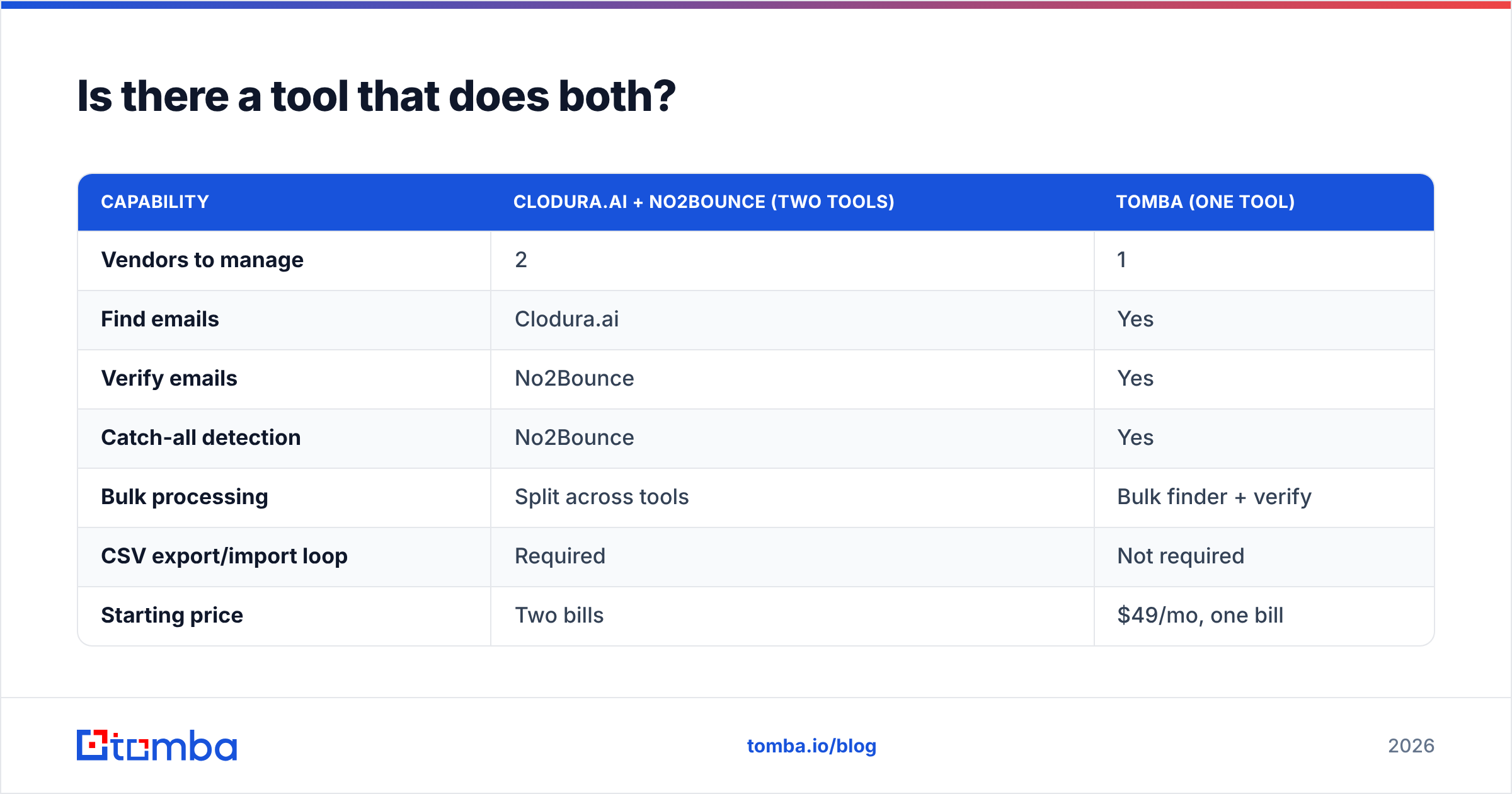
Yes. This is where a single platform like Tomba changes the math. Instead of pairing a sourcing tool with a separate verifier, Tomba runs finding and verification in one workflow. You search a domain or a person and get the email, verified in the same call. There is no export, no second vendor, and no re-import.
For anyone weighing Clodura.ai against No2Bounce to cover both sides of the funnel, that is the real story. Here is a quick comparison:
| Capability | Clodura.ai + No2Bounce (two tools) | Tomba (one tool) |
|---|---|---|
| Vendors to manage | 2 | 1 |
| Find emails | Clodura.ai | Yes |
| Verify emails | No2Bounce | Yes |
| Catch-all detection | No2Bounce | Yes |
| Bulk processing | Split across tools | Bulk finder + verify |
| CSV export/import loop | Required | Not required |
| Starting price | Two bills | $49/mo, one bill |
| API for both jobs | Two APIs | One email finder API |
Tomba's pricing is public and easy to read. There is a free tier at 25 searches a month, then Starter at $49/mo, Growth at $99/mo, and Pro at $249/mo. Enterprise is custom. You can see the full breakdown on the Tomba pricing page. That single-vendor model is worth weighing before you commit to two tools at once.
How do I choose between Clodura.ai, No2Bounce, and an all-in-one?#
Work backward from the job, not the brand. Ask three questions:
- What is my bottleneck, sourcing or hygiene? If you cannot find contacts, you need a finder (Clodura.ai or Tomba). If your list is dirty, you need a verifier (No2Bounce or Tomba).
- Will I need the other half soon? If the answer is likely yes, buying two point tools now means a migration later. An all-in-one saves that step.
- How much vendor overhead can I absorb? Two contracts, two APIs, and two support queues add real cost, especially for a lean team.
If you are a large enterprise with a dedicated ops team and deep data needs, running best-of-breed point tools can make sense. If you are a startup, agency, or small sales team that just wants clean, findable contacts without a spreadsheet relay race, the all-in-one route almost always wins on cost and time.
It is also worth checking review sites like Capterra for current user sentiment before you commit. Feature sets and pricing shift, and neutral reviews show the edge cases that vendors do not advertise.
The verdict#
Clodura.ai and No2Bounce are not rivals. They are two halves of the same outbound workflow. Clodura.ai gets you contacts. No2Bounce keeps your sends clean. If you only have one of these problems, buy the tool that solves it and move on.
But if you need both, and most teams eventually do, the smarter question is not "Clodura.ai or No2Bounce." It is "why run two tools when one does the job?" Putting finding and verification together removes the export-import loop, cuts your vendor count, and keeps your data fresh, because it is verified the moment you find it.
That is exactly what the Tomba Email Finder is built for. Search by domain, name, or company, and get professional email addresses that are verified on the spot. Scale it in bulk when you are ready, all on one plan that starts free at 25 searches a month. Skip the two-subscription tax, keep your bounce rate low, and spend your time selling instead of shuffling CSVs. Start with Tomba's free tier and see how much of your stack it replaces.
Related guides#
Ready to find emails that actually work?
Join 150,000+ professionals who stopped guessing and started sending. Free credits on signup — no credit card required.
Get the Tomba newsletter
Practical outbound tactics and product updates — once every two weeks.
About the author