Cloduraai vs Salutary Data (2026): Which B2B Data Tool Wins?
Clodura.ai and Salutary Data both sell B2B contact data, but they solve very different problems. Here's an honest breakdown of pricing, accuracy, and fit so you pick the right one for your outbound team.
Cloduraai vs Salutary Data comes down to one question. Do you want a platform that finds, sequences, and manages prospects for you? Or do you want a raw data feed you pipe into your own stack? These are two different products. They target two different buyers. Pick the wrong one and you waste a quarter of budget.
This is a neutral breakdown. Both tools are legitimate. Both have real customers. Neither is a scam. The goal is simple: match the tool to your workflow. We'll also be honest about where a leaner, verify-first approach beats both.
Cloduraai vs Salutary Data: the TL;DR#
- Clodura.ai is an all-in-one sales prospecting platform. It bundles a B2B contact database, an email finder, sequencing, and buyer-intent signals into one dashboard. Best for small-to-mid outbound teams that want everything in one seat.
- Salutary Data is a B2B data compiler and list provider. It sells curated, human-verified contact and account data, often as licensed files or feeds. It is not a self-serve app. Best for RevOps and data teams that own their own tooling.
- Pricing models differ. Clodura.ai is subscription and credit SaaS. Salutary Data quotes custom deals based on volume and segments.
- Data freshness is the real battleground. Both claim high accuracy. Verify any list before you send, no matter the vendor.
- If you mostly need accurate emails on demand, a focused finder-plus-verifier stack like Tomba is cheaper than a full platform or a bulk license you only half-use.
What is Clodura.ai?#
Clodura.ai is a sales prospecting and go-to-market platform. It is built around a proprietary B2B database. It bundles several jobs into one interface. You can search for companies and contacts. You can pull verified emails and direct dials. You can detect buyer-intent and technographic signals. You can run basic email sequences. See the current feature set on the Clodura.ai site.
The pitch is consolidation. You don't stitch together a database, a finder, a verifier, and a sequencer. A rep logs into one tool and works the whole top of the funnel. That helps a founder-led sales motion or a small SDR team that doesn't want five subscriptions.
The trade-off with any all-in-one is depth. One vendor owns the database, the outreach engine, and the intent layer. Each layer is usually "good enough" rather than best-in-class. Teams that outgrow one module often bolt on a specialist tool anyway.
What is Salutary Data?#
Salutary Data is a B2B data provider. It is a compiler that assembles, cleans, and licenses contact and account data. Its focus is curated, verified records: business emails, phone numbers, titles, and firmographics. It sells data, not a self-serve app. See how they position it on the Salutary Data site.
The buyer here is different. Salutary Data appeals to marketing ops, RevOps, and data engineering teams. These teams already have a CRM, a sequencer, and an enrichment pipeline. They just need a clean source of records to feed in. If you run your own data enrichment workflows, a licensed feed slots in naturally.
The downside is simple. Raw data is only as good as the day it was compiled. B2B data decays fast. People change jobs. Companies get acquired. Domains change. A file that was 95% accurate at compile time can drift in a few months. That is not a knock on Salutary. It is true of every compiled list, which is why verification at send time matters more than the number on the sales deck.
Clodura.ai vs Salutary Data: side-by-side comparison#
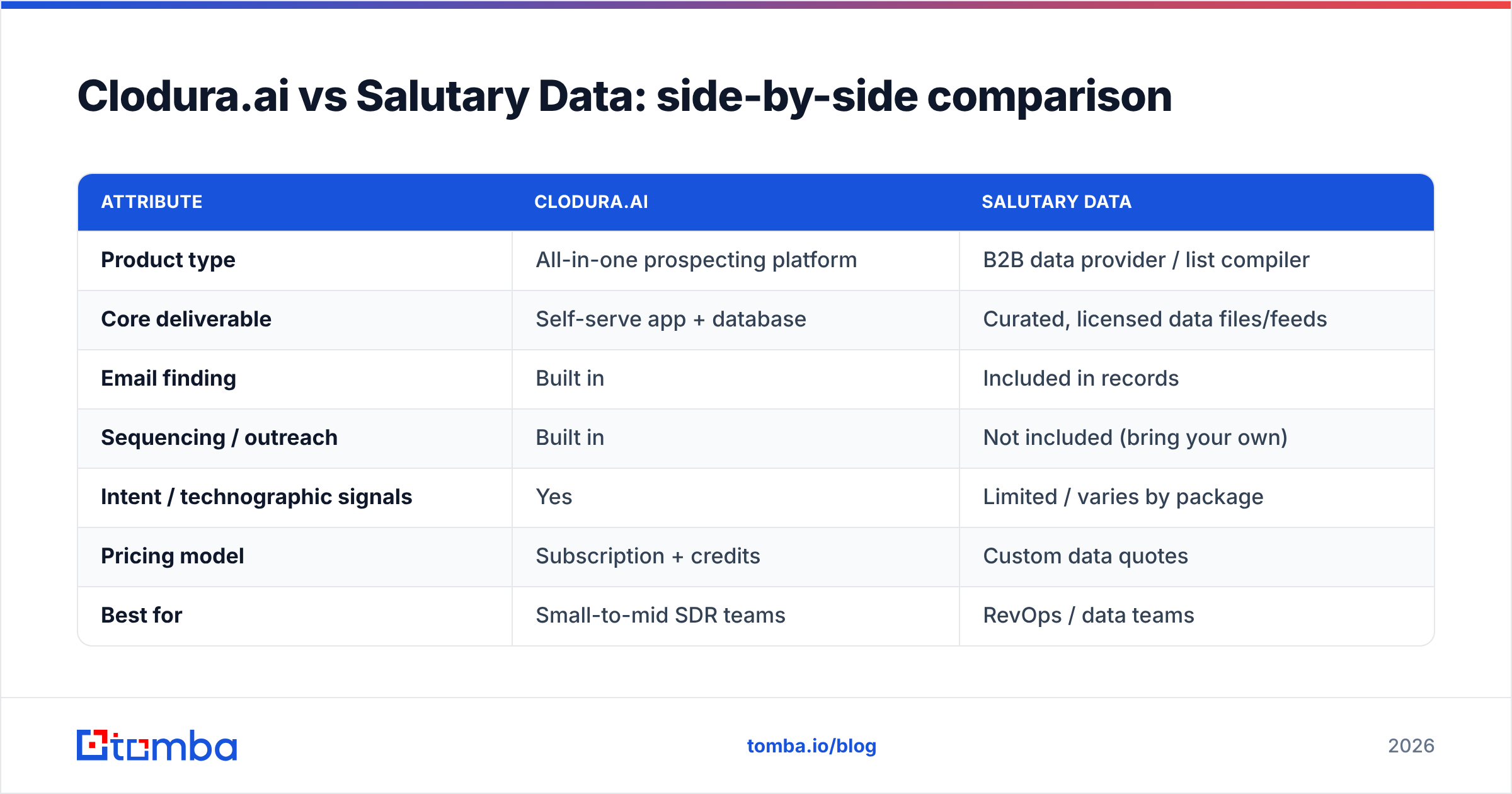
| Attribute | Clodura.ai | Salutary Data |
|---|---|---|
| Product type | All-in-one prospecting platform | B2B data provider / list compiler |
| Core deliverable | Self-serve app + database | Curated, licensed data files/feeds |
| Email finding | Built in | Included in records |
| Sequencing / outreach | Built in | Not included (bring your own) |
| Intent / technographic signals | Yes | Limited / varies by package |
| Pricing model | Subscription + credits | Custom data quotes |
| Best for | Small-to-mid SDR teams | RevOps / data teams |
| Self-serve free trial | Typically yes | Usually sales-led |
The pattern is clear. Clodura.ai sells a workflow. Salutary Data sells a dataset. If your team wants to log in and prospect today, Clodura.ai fits better. If your team already owns its outbound engine and needs clean input, Salutary Data fits better.
Which has more accurate data?#
Neither vendor can promise inbox-ready accuracy without verification. Don't buy on the accuracy-percentage claim alone. Here is how to think about it:
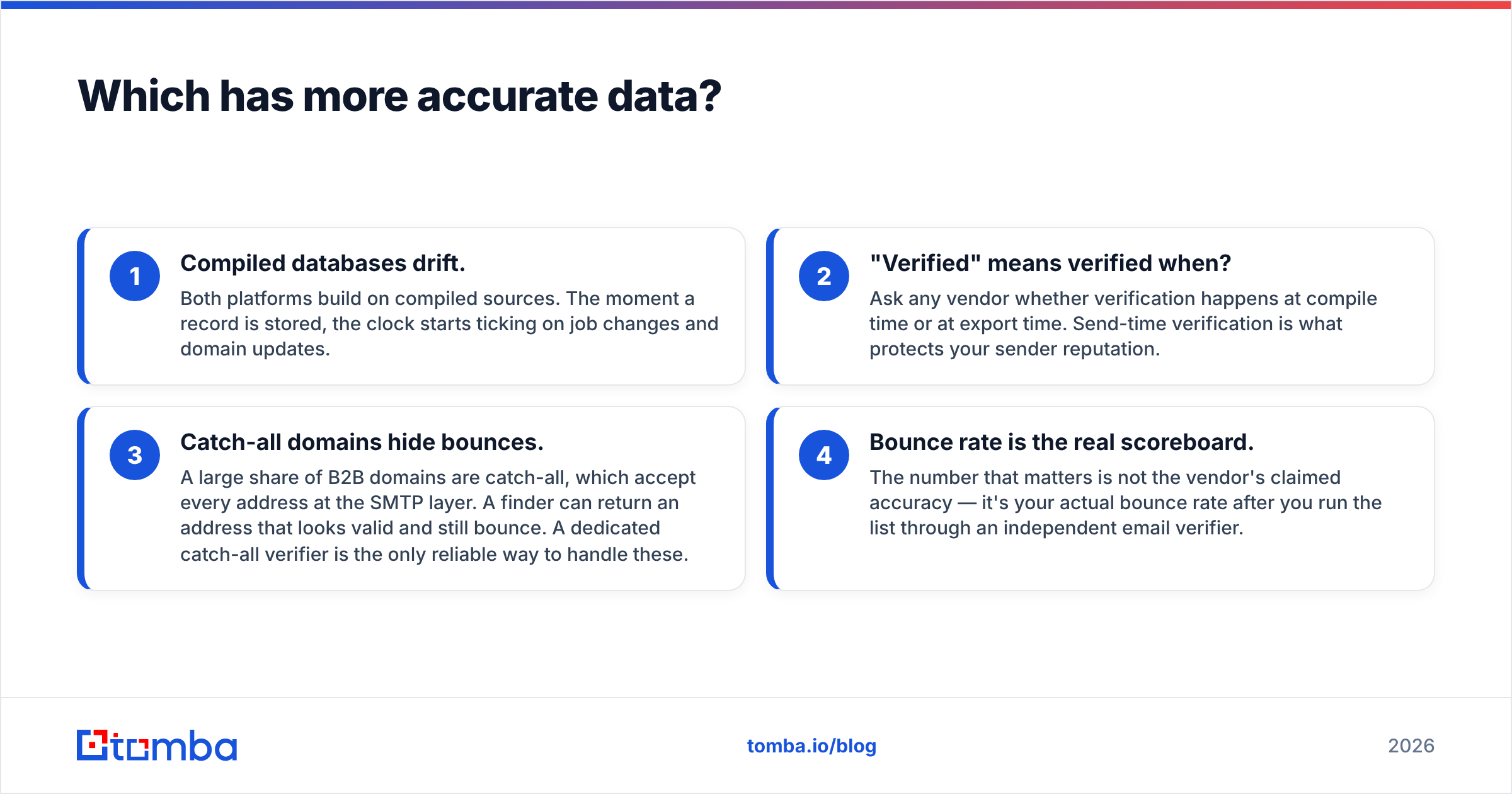
- Compiled databases drift. Both platforms build on compiled sources. The moment a record is stored, the clock starts on job changes and domain updates.
- "Verified" means verified when? Ask each vendor whether verification happens at compile time or at export time. Send-time verification is what protects your sender reputation.
- Catch-all domains hide bounces. Many B2B domains are catch-all. They accept every address at the SMTP layer. A finder can return an address that looks valid and still bounces. A dedicated catch-all verifier is the only reliable way to handle these.
- Bounce rate is the real scoreboard. The number that matters is not the vendor's claimed accuracy. It is your actual bounce rate after you run the list through an independent email verifier.

The takeaway is practical. Whichever platform you choose, run the output through a verification pass before your first send. Treat vendor accuracy claims as a starting point, not a guarantee.
How does pricing compare?#
The two pricing models are hard to compare apples-to-apples. That is the point.
Clodura.ai uses a SaaS structure. You get tiered subscriptions with monthly credit allowances for contact reveals and verifications, plus paid add-ons. It is predictable and self-serve. Check current numbers on Clodura's pricing page, since tiers change.
Salutary Data uses custom quoting. You describe the segment: industry, geography, titles, and volume. They price the data to match. This can be cost-effective at high volume. It also requires a sales conversation and usually a minimum spend.
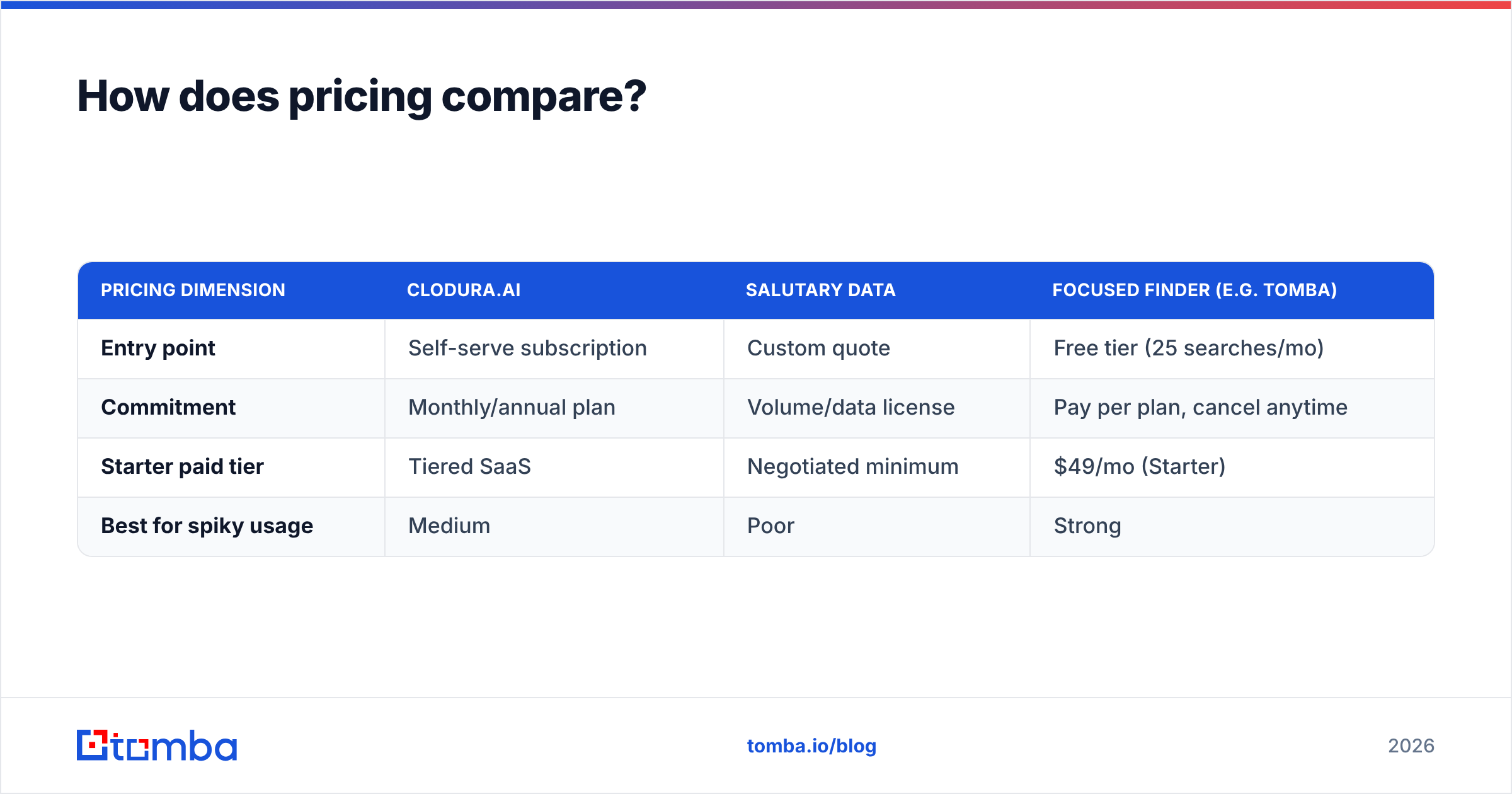
Here is a rough shape of how the models line up against a focused, pay-for-what-you-use finder:
| Pricing dimension | Clodura.ai | Salutary Data | Focused finder (e.g. Tomba) |
|---|---|---|---|
| Entry point | Self-serve subscription | Custom quote | Free tier (25 searches/mo) |
| Commitment | Monthly/annual plan | Volume/data license | Pay per plan, cancel anytime |
| Starter paid tier | Tiered SaaS | Negotiated minimum | $49/mo (Starter) |
| Best for spiky usage | Medium | Poor | Strong |
If your usage is spiky, both a subscription platform and a bulk license risk paying for capacity you don't use. One busy month, one quiet month. A credit-based finder scales down as easily as it scales up. Compare the tiers on the Tomba pricing page.
When should you pick Clodura.ai?#
Choose Clodura.ai if most of these describe you:
- You want one tool, not five. A single dashboard for finding, verifying, and sequencing beats juggling separate subscriptions.
- Your team is small. Founders and lean SDR teams get the most from an all-in-one. They don't have a data ops function.
- You value intent signals. If buyer-intent and technographic filters change how you rank accounts, that bundled layer earns its keep.
- You want to start today. Self-serve onboarding gets a rep prospecting within the hour.
When should you pick Salutary Data?#
Choose Salutary Data if most of these describe you:
- You already own your stack. You have a CRM, a sequencer, and an enrichment pipeline. You need clean input, not another app.
- You buy data in volume. Large, well-defined segments are where custom-quoted pricing pays off.
- You need specific curation. Niche titles, industries, or regions where a human-checked file beats a generic database pull.
- Compliance and sourcing matter. Data teams that vet provenance often prefer a dedicated provider.
Is there a leaner alternative to both?#
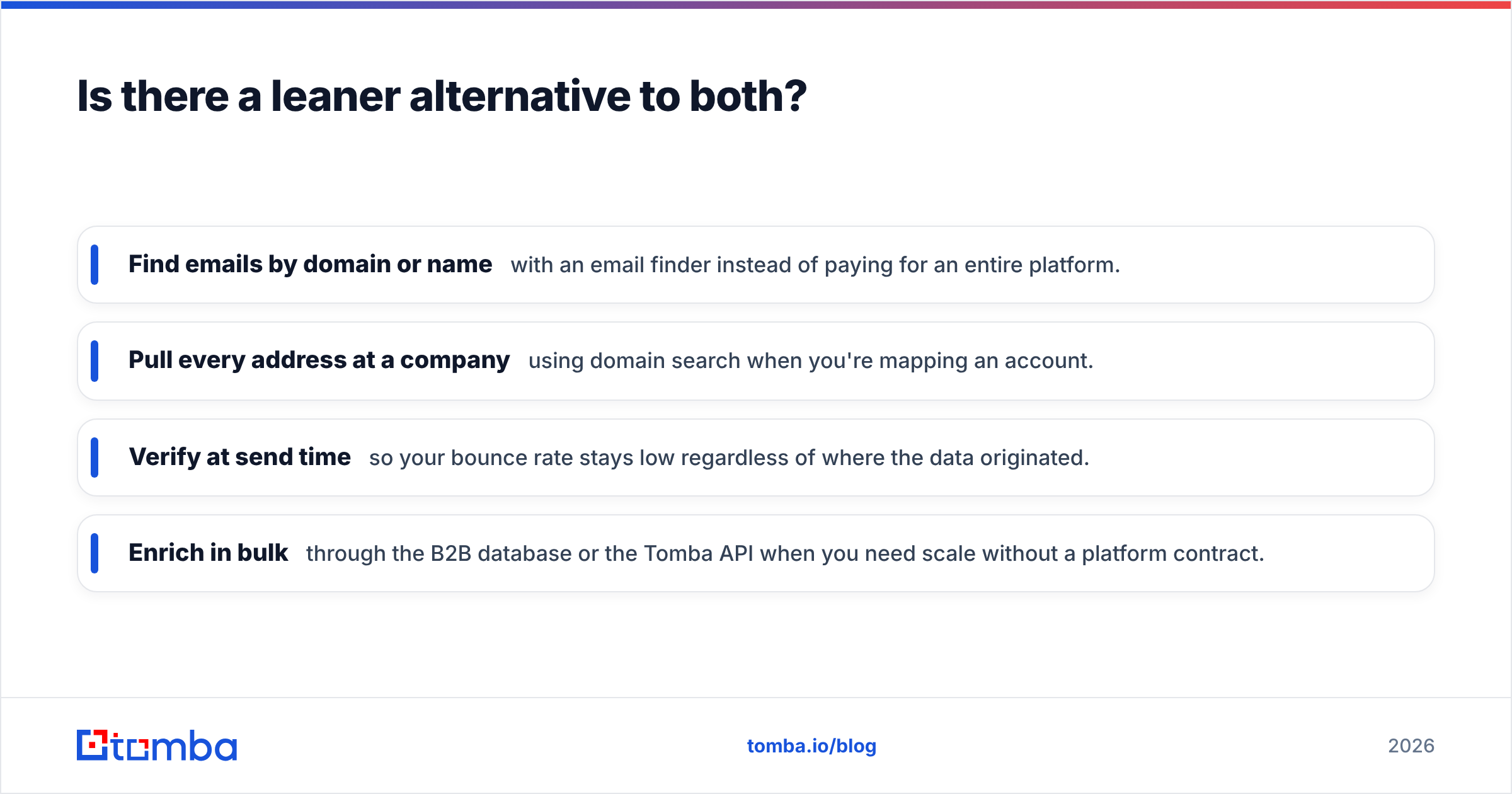
Yes. For many teams it is the honest answer. Most companies don't need a full prospecting platform or a bulk data license. They need accurate emails for specific people and companies, on demand, verified before send.
That is a narrower job. A focused tool does it for less. With a dedicated stack you can:
- Find emails by domain or name with an email finder instead of paying for a whole platform.
- Pull every address at a company with domain search when you map an account.
- Verify at send time so your bounce rate stays low, wherever the data came from.
- Enrich in bulk through the B2B database or the Tomba API when you need scale without a platform contract.
This approach also plays well with the other two vendors. It does not replace them outright. Buy data from Salutary, or reveal contacts in Clodura.ai, then run everything through an independent verifier before it hits your sequencer. Verification is not vendor-loyal. It protects deliverability no matter the source.
For a broader view of how compiled databases stack up, third-party review sites like G2 help. You get unfiltered customer feedback on both platforms.
The verdict#
Here is the short version of Cloduraai vs Salutary Data. Clodura.ai wins for lean teams that want an all-in-one prospecting app. Salutary Data wins for data-mature teams that need a clean, curated feed for a stack they already own. They don't really compete for the same buyer. They compete for the same budget line.
But most teams overthink the platform-vs-provider choice. Before you commit to a full SaaS suite or a bulk data license, be honest about how many bundled features you'll actually use. If the core need is "accurate, verified emails when I need them," a focused finder-and-verifier stack is cheaper, simpler, and portable.
Whichever way you go, verify before you send. The vendor's accuracy claim is a marketing number. Your bounce rate is the truth.
Start with accurate, verified contacts#
Want to test the leaner path first? Start with the Tomba Email Finder before you commit to a platform contract or a data license. Find professional emails by domain, name, or company. Verify them before your first send. Scale up only when the numbers prove out. The free tier gives you 25 searches a month to benchmark accuracy against your current source. No sales call required. Match the tool to the job, keep your sender reputation clean, and let real bounce data make the call.
Related guides#
// get started
Find, verify and enrich your first contacts today
Start on the free plan with 25 searches a month, then scale when your team is ready.
Free plan · No credit card required · GDPR & CCPA
// about the author