Clodura.ai vs SMTP Ghost: The Honest 2026 Comparison
Clodura.ai and SMTP Ghost solve two different halves of outbound. Here is which one you actually need in 2026 — plus where a dedicated data layer beats both.
Choosing between Clodura.ai and SMTP Ghost feels like a head-to-head, but it usually isn't. One is a B2B database and prospecting engine. The other is a cold email sending and inbox-rotation tool. You can end up buying both — or realize you're paying for overlap you don't need. This comparison cuts through the positioning so you know which one earns a line in your 2026 budget.
TL;DR — Clodura.ai vs SMTP Ghost at a glance#
- Clodura.ai is a sales-intelligence platform: a B2B contact database, buyer-intent signals, org charts, and a built-in sequencer. You go there to find and organize prospects.
- SMTP Ghost is a cold email sending tool: multi-inbox rotation, warmup, and high-volume campaign delivery. You go there to send at scale without torching your domain.
- They are complements, not true rivals — many teams run Clodura for data and a sending tool for delivery.
- The weak link in both stacks is contact-data accuracy. Stale emails wreck deliverability no matter how good your sender is.
- If your priority is verified, current email addresses, a dedicated finder like the Tomba Email Finder plugs the gap that neither tool fully closes.
What is Clodura.ai?#
Clodura.ai is an all-in-one sales prospecting platform built around a proprietary B2B database. Its pitch is that you can research an account, pull direct dials and emails, map the buying committee, catch technographic and intent signals, and launch a sequence — all without leaving the app.
The strengths are real:
- Large contact database with company and contact-level filters.
- Buyer-intent and trigger data (funding, hiring, tech adoption) to time outreach.
- Org charts that help you find the actual decision-maker instead of guessing.
- Built-in email sequencing so smaller teams don't need a separate cadence tool.
The trade-off is that a bundled database is only as fresh as its last refresh. Direct-dial coverage and email accuracy vary by region and seniority, and like every static database, some records drift out of date between updates. That's not a knock unique to Clodura — it's the nature of warehoused data. You can verify their current coverage and reviews on G2 and the official Clodura.ai site.
What is SMTP Ghost?#
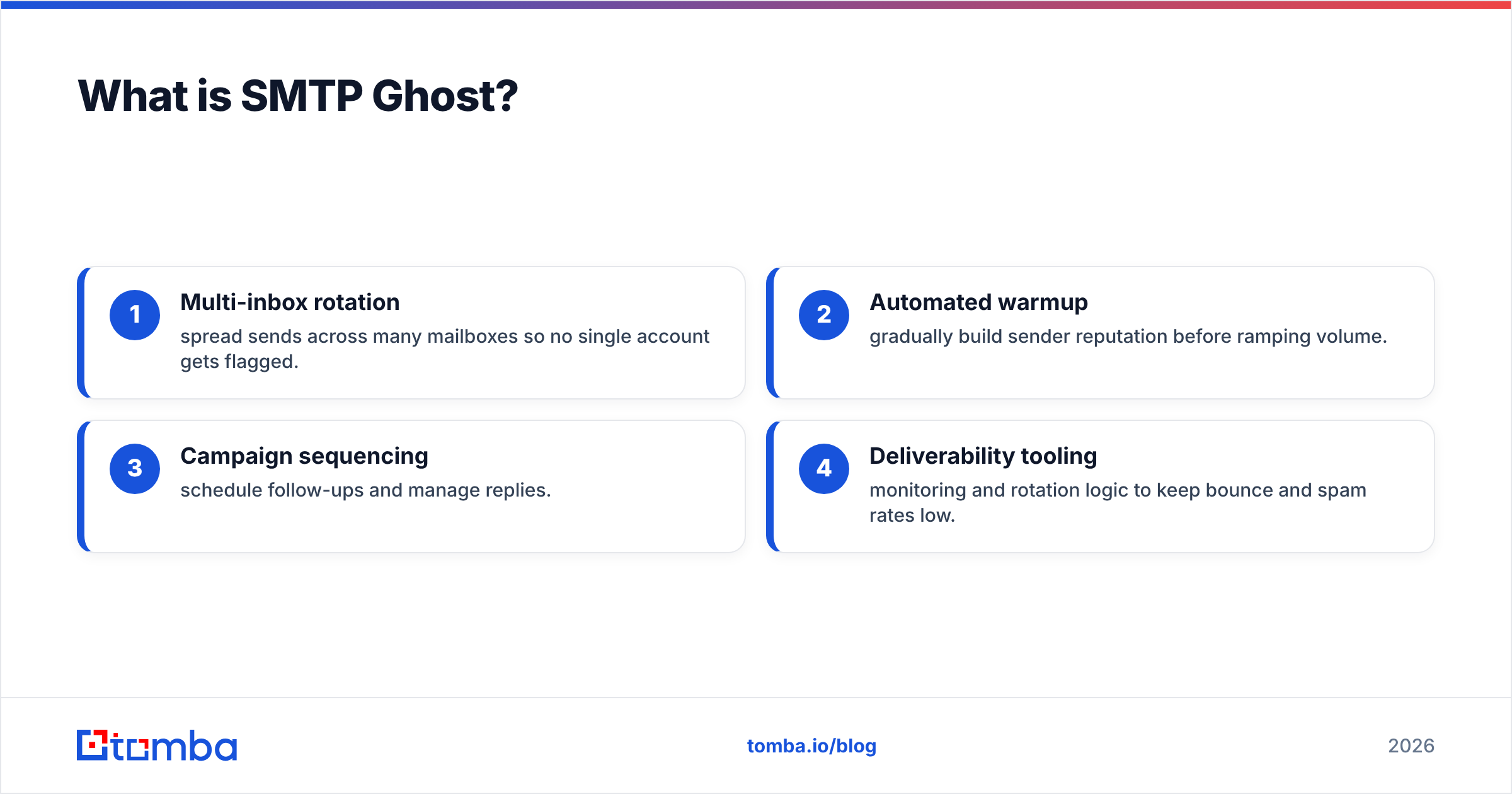
SMTP Ghost sits at the opposite end of the outbound pipeline. It's a cold email sending and deliverability tool designed to push volume while protecting your reputation. The core features cluster around getting messages into the inbox:
- Multi-inbox rotation — spread sends across many mailboxes so no single account gets flagged.
- Automated warmup — gradually build sender reputation before ramping volume.
- Campaign sequencing — schedule follow-ups and manage replies.
- Deliverability tooling — monitoring and rotation logic to keep bounce and spam rates low.
SMTP Ghost assumes you already have a list. It doesn't build your contact database for you — it delivers to whatever addresses you feed it. That's the important part: garbage in, garbage out. A sending tool amplifies whatever data quality you bring. If your list is full of dead addresses, rotation and warmup won't save your email deliverability — bounces still stack up and your sender reputation still suffers.
Clodura.ai vs SMTP Ghost: side-by-side comparison#
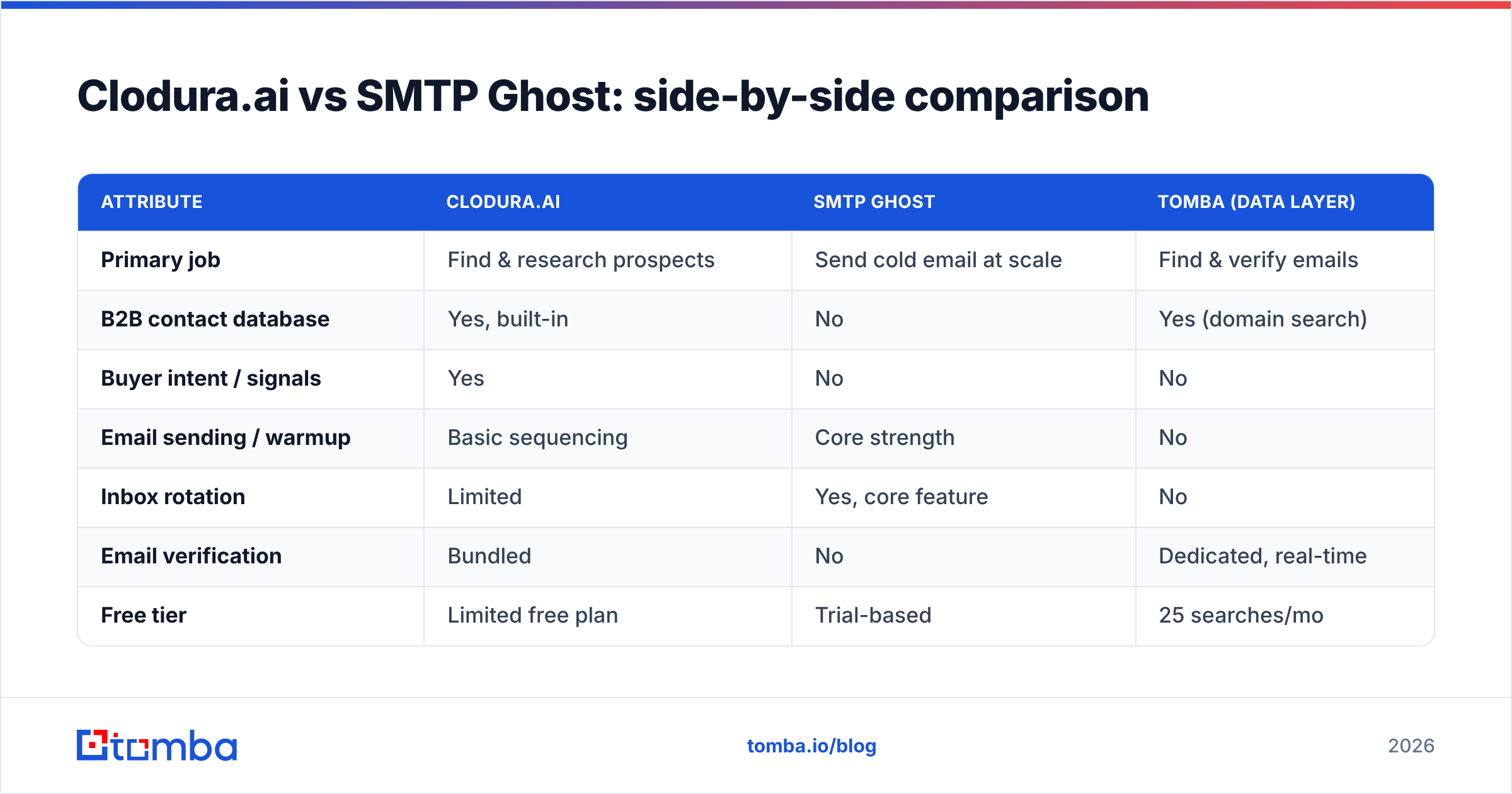
Here's the honest breakdown. Note that these two tools live in different categories, so the comparison is about what job each does, not a spec race.
| Attribute | Clodura.ai | SMTP Ghost | Tomba (data layer) |
|---|---|---|---|
| Primary job | Find & research prospects | Send cold email at scale | Find & verify emails |
| B2B contact database | Yes, built-in | No | Yes (domain search) |
| Buyer intent / signals | Yes | No | No |
| Email sending / warmup | Basic sequencing | Core strength | No |
| Inbox rotation | Limited | Yes, core feature | No |
| Email verification | Bundled | No | Dedicated, real-time |
| Free tier | Limited free plan | Trial-based | 25 searches/mo |
| Entry price | Paid tiers vary | Paid tiers vary | $49/mo Starter |
| Best for | Data + prospecting | High-volume delivery | Accuracy-first teams |
The pattern is clear: Clodura owns the front of the funnel (data and research), SMTP Ghost owns the back (delivery), and a verification-first finder owns the quality of what flows between them.
Is Clodura.ai better than SMTP Ghost?#
Wrong question — but here's the useful answer. Neither is "better"; they solve different problems. Ask yourself what you're missing:
- You have no reliable prospect list. You need Clodura.ai (or another data provider). SMTP Ghost has nothing to send without a list.
- You have a great list but keep landing in spam. You need SMTP Ghost's rotation and warmup. Clodura's basic sequencer won't match a dedicated sender at high volume.
- You have volume but your bounce rate is ugly. Neither tool fully fixes this. You need a verification layer between data and delivery.
Most teams that "compare" these two actually need a small stack: a data source, a sender, and a verifier gluing them together. Buying only one leaves a hole.

Where both tools leave a gap: contact-data accuracy#
Here's the uncomfortable truth about outbound in 2026: your deliverability problem is usually a data problem wearing a sending costume.
Cold email platforms like SMTP Ghost report that keeping bounce rates under roughly 2–3% is the difference between the inbox and the spam folder — mailbox providers read high bounce rates as a spammer signal. Industry guidance from vendors like HubSpot consistently ties list hygiene directly to deliverability. So even a perfect sending setup collapses if a quarter of your addresses are stale.
Clodura gives you contacts, but no static database stays 100% current. SMTP Ghost delivers, but it trusts your list blindly. That's the gap. To close it, run every address through real-time validation before it hits a campaign:
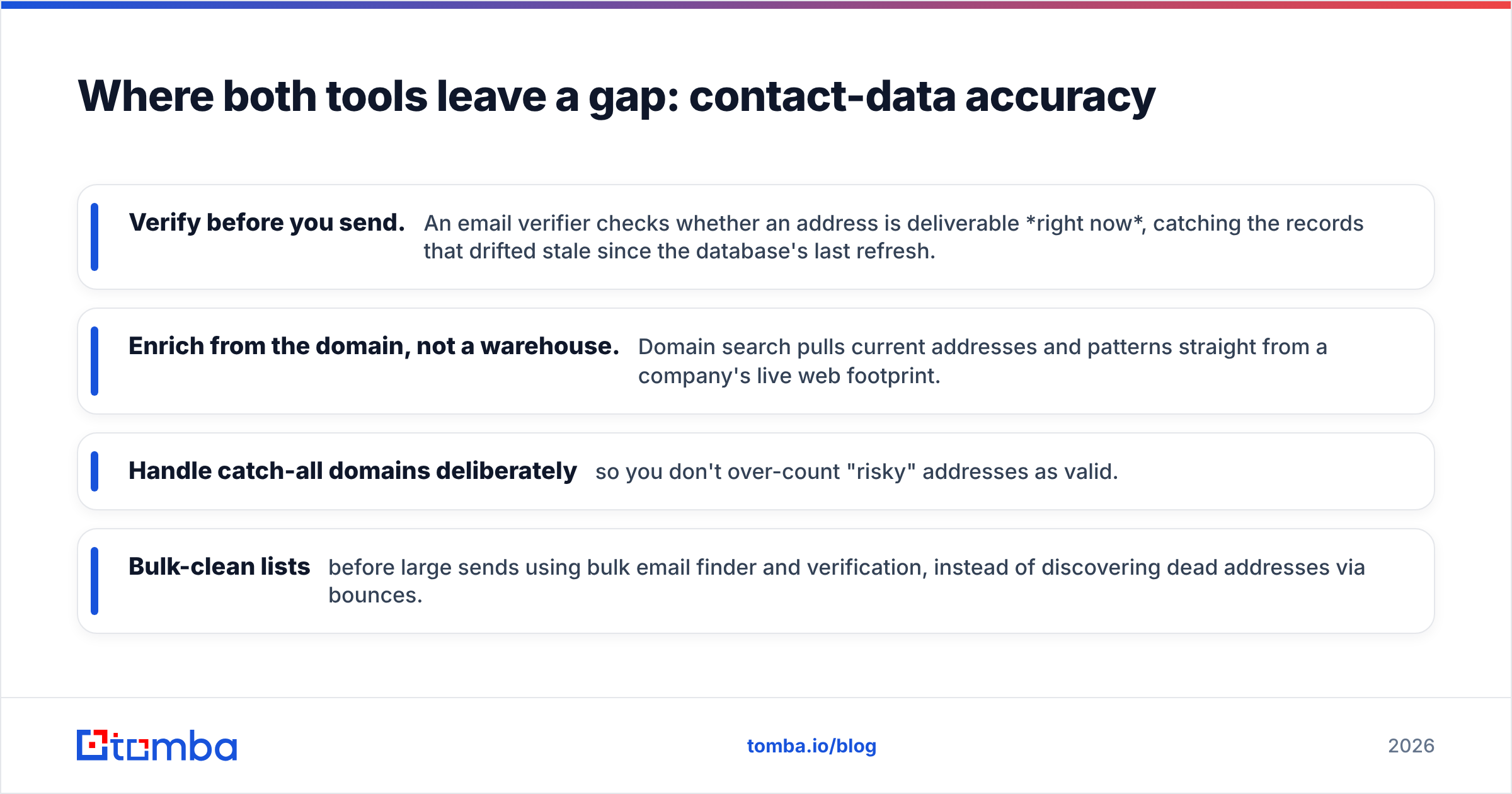
- Verify before you send. An email verifier checks whether an address is deliverable right now, catching the records that drifted stale since the database's last refresh.
- Enrich from the domain, not a warehouse. Domain search pulls current addresses and patterns straight from a company's live web footprint.
- Handle catch-all domains deliberately so you don't over-count "risky" addresses as valid.
- Bulk-clean lists before large sends using bulk email finder and verification, instead of discovering dead addresses via bounces.
This is exactly where a dedicated tool earns its place next to — not instead of — a prospecting or sending platform.
Pricing: what you'll actually pay#
Both Clodura.ai and SMTP Ghost use tiered pricing that shifts with seats, credits, and volume, so always confirm current numbers on their sites before committing. Clodura offers a limited free plan and paid tiers scaled by credits and features; SMTP Ghost is trial-then-paid, scaled by sending volume and inbox count.
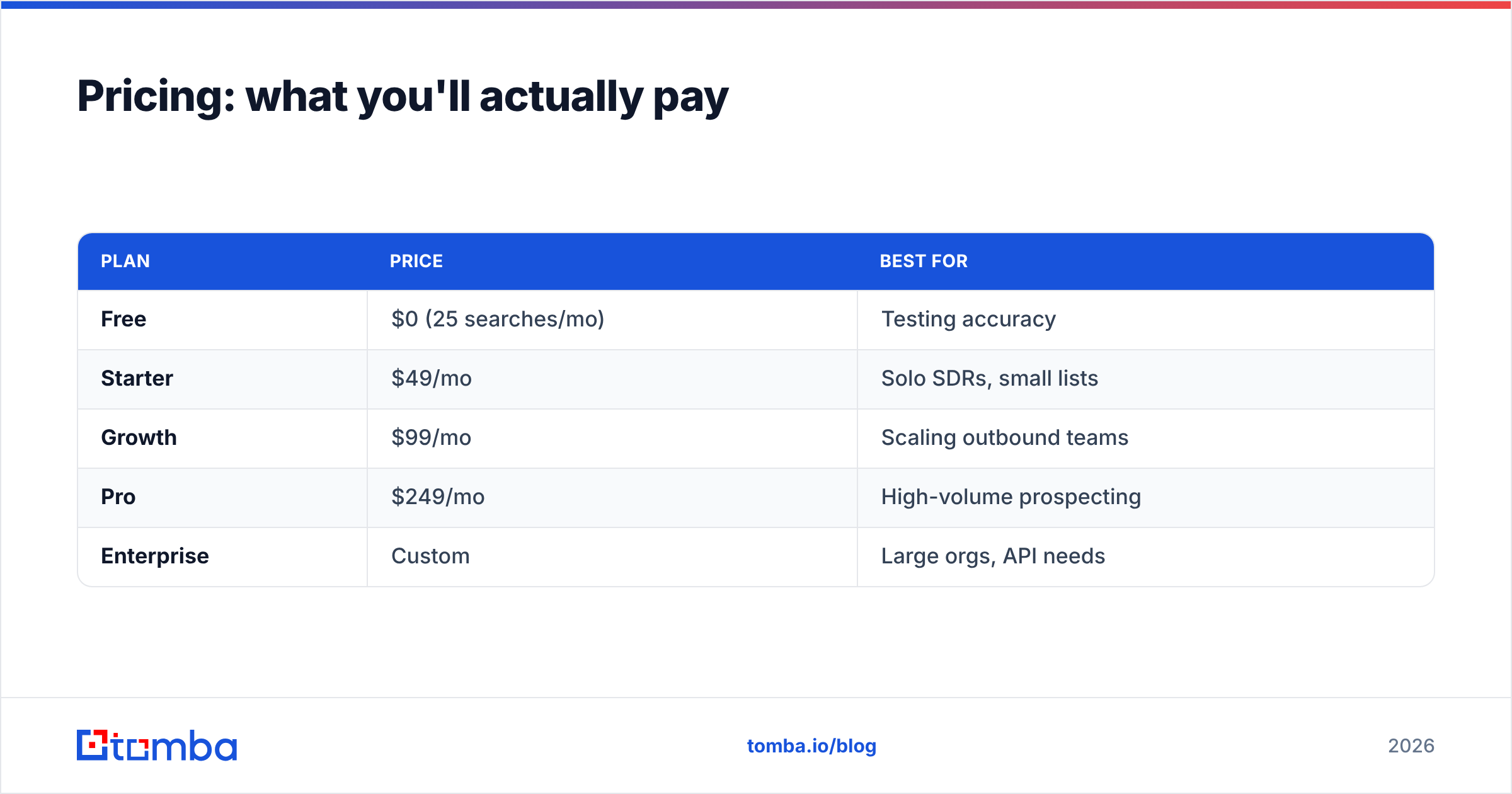
For the data-and-verification layer, Tomba pricing is straightforward:
| Plan | Price | Best for |
|---|---|---|
| Free | $0 (25 searches/mo) | Testing accuracy |
| Starter | $49/mo | Solo SDRs, small lists |
| Growth | $99/mo | Scaling outbound teams |
| Pro | $249/mo | High-volume prospecting |
| Enterprise | Custom | Large orgs, API needs |
The point isn't that one is "cheapest." It's that a data problem solved for $49–$99/mo can save you far more than that in wasted sends, blocked domains, and warmup time on a $200+/mo sender.
Which should you choose in 2026?#
Match the tool to the hole in your funnel:
- Choose Clodura.ai if you lack a prospect database and want research, intent signals, and org charts in one place — and you're okay verifying its data before big campaigns.
- Choose SMTP Ghost if you already have quality lists and your bottleneck is delivery at scale — inbox rotation and warmup are its reason to exist.
- Add a dedicated finder + verifier in either case, because both platforms are only as strong as the data flowing through them.
If you're a lean team that has to pick one line item first, start where the leverage is highest: clean, current contact data. You can send from a modest setup and still win if your addresses are real. You cannot win with a world-class sender pointed at a dead list.
The bottom line#
Clodura.ai and SMTP Ghost aren't really competitors — they're two stages of the same pipeline. Clodura finds and researches; SMTP Ghost delivers. The recurring failure point across both is contact-data accuracy, and that's the one thing neither fully owns.
Before you spend on a database or a sender, make sure the emails you're working with are verified and current. The Tomba Email Finder gives you accurate, verified professional emails by domain, name, or company — the clean input layer that makes every prospecting platform and every sending tool actually perform. Start free with 25 searches a month, confirm the accuracy against your own targets, and only then decide how much of your budget belongs to data versus delivery.
Related guides#
// get started
Find, verify and enrich your first contacts today
Start on the free plan with 25 searches a month, then scale when your team is ready.
Free plan · No credit card required · GDPR & CCPA
// about the author