Clodura.ai vs Sparkle (2026): Which Sales Prospecting Tool Wins?
Clodura.ai vs Sparkle compared on data accuracy, pricing, automation, and fit. See which sales prospecting platform actually earns your budget in 2026 — and where a leaner stack wins.
Clodura.ai vs Sparkle usually comes down to one question. Do you want an all-in-one prospecting suite that also sends sequences? Or a lighter data layer you plug into the outbound stack you already run? Both promise clean B2B contacts and less manual work. But they get there in very different ways. Pick wrong, and you pay for seats and features your team never touches.
This is a neutral, head-to-head breakdown. We compare data quality, pricing, automation depth, and real-world fit for SMB and mid-market sales teams. No vendor spin — just the trade-offs.
TL;DR: Clodura.ai vs Sparkle at a glance#
- Clodura.ai is a broader sales-intelligence and engagement platform. It packs a large B2B database, buyer-intent signals, technographics, and a native email sequencer. Best if you want one login for data and outreach.
- Sparkle is a lighter, contact-data tool built for fast lookups and list building. Best if you already own a sequencer (Instantly, Smartlead, Apollo) and just need contacts feeding it.
- Pricing: Clodura runs a freemium-to-mid-market ladder. Sparkle is cheaper and simpler, but it has fewer enterprise controls. Always check current tiers on each vendor's site.
- Accuracy is the real battleground. Every database ages. The teams that win pair any finder with a dedicated email verifier before they send.
- Neither is your only option. A focused stack — a precise email finder plus your sequencer — often beats a bundled suite on cost and deliverability.
What is Clodura.ai?#
Clodura.ai bills itself as an end-to-end sales prospecting platform. Its pitch is coverage. You get a large contact and company database (tens of millions of records), buyer-intent data, technographic filters, org charts, and direct-dial numbers. A native sequencing engine sits on top, so reps go from "build a list" to "send a cadence" without leaving the tool.
Think of it as a sales department in a box. For a small team without a mature stack, that consolidation helps a lot. You get one subscription, one onboarding, and fewer integrations to babysit. The trade-off is simple. Jack-of-all-trades suites rarely lead any single category. The database is broad, but it varies by region and seniority. The sequencer is solid, yet it is not best-in-class next to specialists like Outreach or Salesloft.
What is Sparkle?#
Sparkle is the leaner contender. It focuses on fast, clean contact discovery. Find the person, get a verified email, then export or push it onward. There is less emphasis on native cadences and intent scoring. Instead, it aims to be a quick, affordable data source that does not try to own your whole workflow.
That narrow scope is a feature, not a bug — for the right buyer. Some teams have already standardized on a sending platform and a CRM. They will not rip that out just to adopt a database. For them, Sparkle is a component, not a platform. The risk is the one every standalone data tool faces. Coverage can gap in certain industries or regions. And accuracy drifts as the data ages between refreshes.
Clodura.ai vs Sparkle: the core comparison#
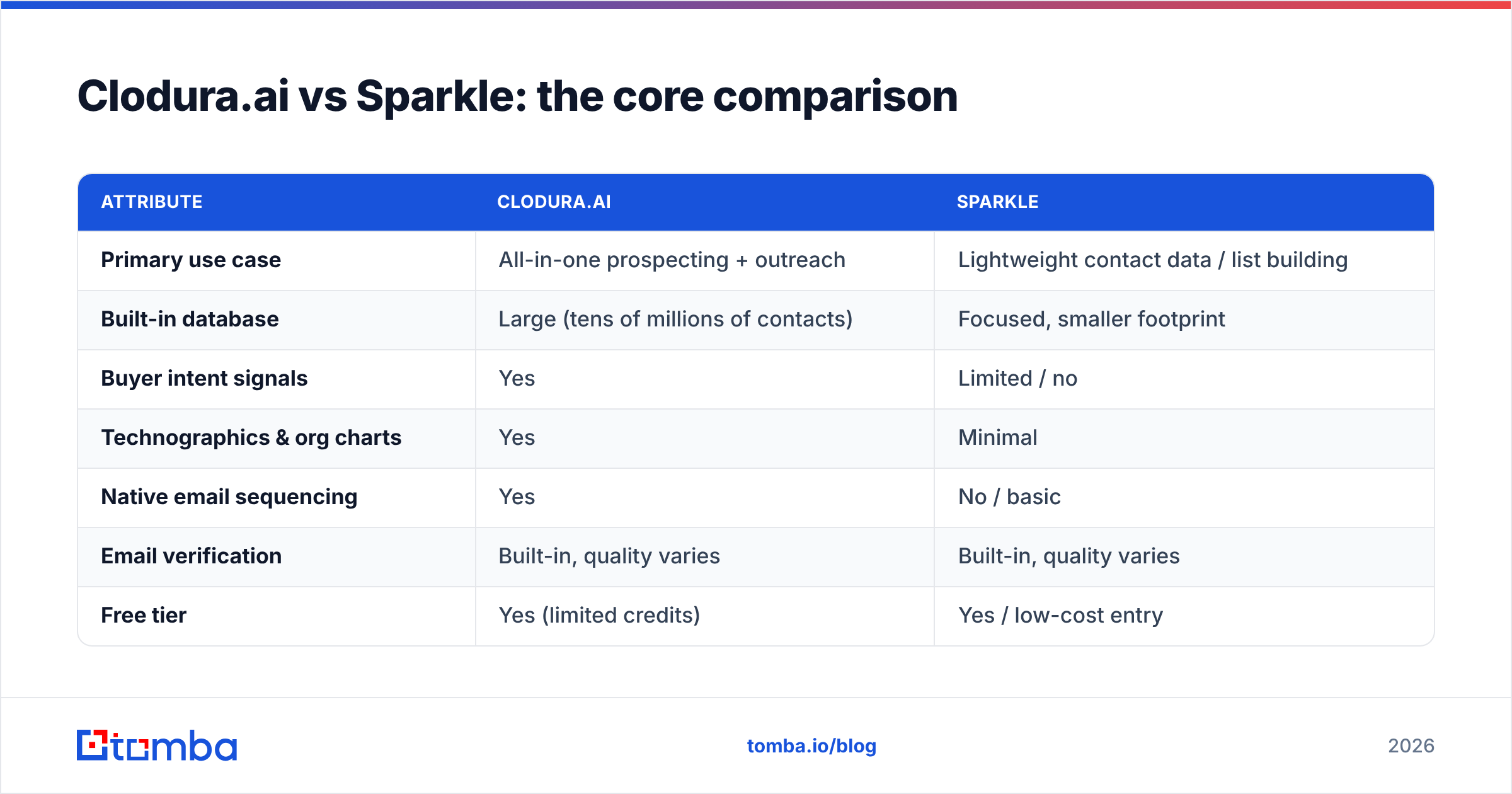
Here is the side-by-side on the attributes that actually change a buying decision. Treat pricing as directional. Both vendors adjust tiers, so confirm on their live pages.
| Attribute | Clodura.ai | Sparkle |
|---|---|---|
| Primary use case | All-in-one prospecting + outreach | Lightweight contact data / list building |
| Built-in database | Large (tens of millions of contacts) | Focused, smaller footprint |
| Buyer intent signals | Yes | Limited / no |
| Technographics & org charts | Yes | Minimal |
| Native email sequencing | Yes | No / basic |
| Email verification | Built-in, quality varies | Built-in, quality varies |
| Free tier | Yes (limited credits) | Yes / low-cost entry |
| Best fit | SMB wanting one suite | Teams with an existing sender |
| Learning curve | Higher (more features) | Lower |
The pattern is clear. Clodura wins on breadth. Sparkle wins on simplicity and price. Which one matters more depends on what you already own.
Which has better data accuracy?#
Accuracy is where both tools live or die. It is also the hardest thing to judge from a marketing page. Every provider quotes a high accuracy number. But those numbers are measured under ideal conditions. They drop the moment a contact changes jobs — and across B2B, a large share of your list moves every year.
Clodura's larger database gives it a raw-coverage edge, especially in North American mid-market accounts. But bigger databases also hold more stale rows. Sparkle's smaller, curated set can be fresher in the niches it covers well. It will also miss whole segments that Clodura would surface.
The honest takeaway: do not trust either vendor's stated accuracy as your send-time reality. Whichever you choose, run contacts through an independent check. A dedicated catch-all verifier matters here too. Catch-all domains are exactly where bundled verifiers quietly wave emails through and wreck your bounce rate. Want to know why coverage claims differ so much? Vendor transparency about data sources tells you more than any headline percentage.

Which is better for automation and sequencing?#
On scope, this one is not close. Clodura.ai has native sequencing built in. Sparkle mostly expects you to bring your own sender. But "more features" does not always mean "better outcome."
- If you have no outbound stack yet, Clodura's bundled cadences remove a whole integration project. You get data-to-send in one place.
- If you already run Instantly, Smartlead, Apollo, or Reply.io, Sparkle's neutrality wins. It feeds your proven sender instead of asking you to migrate.
- Deliverability caveat: all-in-one senders share IP pools and reputation across many customers. Specialist platforms often give you finer control over warmup, inbox rotation, and email deliverability. Convenience can cost you inbox placement.
- Data portability matters. Whatever you pick, confirm you can export and route contacts cleanly — via CRM sync, Zapier integration, or API. That way you are never locked into one vendor's sender.
For teams that value modularity, a neutral data layer plus a best-in-class sequencer usually beats a suite. For teams that value one bill and one dashboard, the suite wins.
Which is more affordable?#
Sparkle is usually cheaper at the entry level. That fits its narrower scope. Clodura charges more because you are also buying intent data, technographics, and a sequencer. That is only worth it if you will actually use them.
The trap with all-in-one pricing is real. You pay a platform premium for modules you ignore. If your reps never open the intent dashboard, you still fund it. The reverse trap exists too. Buy Sparkle for price, then bolt on a separate sequencer, a separate enrichment tool, and a separate verifier. Your "cheap" stack can quietly cost more than the suite.
So run the math on total stack cost, not per-tool sticker price. Then compare both against a transparent third option. For reference, Tomba pricing starts with a free tier (25 searches/month). Paid plans run Starter at $49/mo, Growth at $99/mo, and Pro at $249/mo. Now you can benchmark what a focused finder-plus-verifier layer really costs against a full suite.
When should you pick Clodura.ai over Sparkle?#
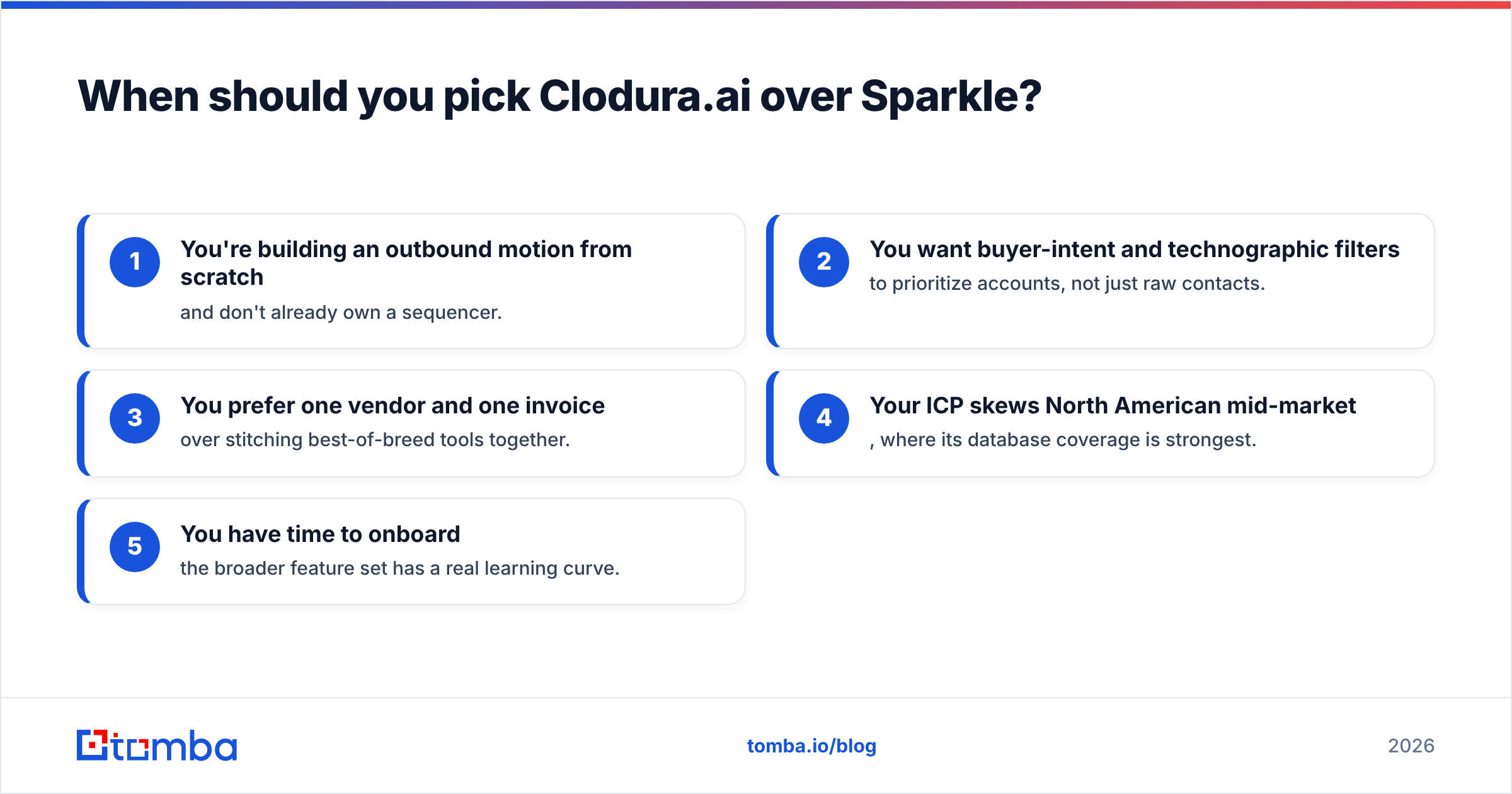
Choose Clodura.ai if most of these are true:
- You are building an outbound motion from scratch and do not already own a sequencer.
- You want buyer-intent and technographic filters to prioritize accounts, not just raw contacts.
- You prefer one vendor and one invoice over stitching best-of-breed tools together.
- Your ICP skews North American mid-market, where its database coverage is strongest.
- You have time to onboard — the broader feature set has a real learning curve.
Is your team small, non-technical, and after "log in and start prospecting" without an integration project? Then Clodura's consolidation is worth the premium.
When should you pick Sparkle over Clodura.ai?#
Choose Sparkle if most of these are true:
- You already run a sender you trust (Instantly, Smartlead, Apollo, Reply.io) and will not switch.
- You want a low-cost, fast contact-lookup layer, not a platform.
- Your workflows live in the CRM, and you just need clean data flowing in.
- You value simplicity and a short learning curve over feature depth.
- You would rather assemble a modular stack than accept a suite's opinionated workflow.
Sparkle is the pragmatic pick. It suits teams that treat contact data as a simple input to a pipeline they have already built.
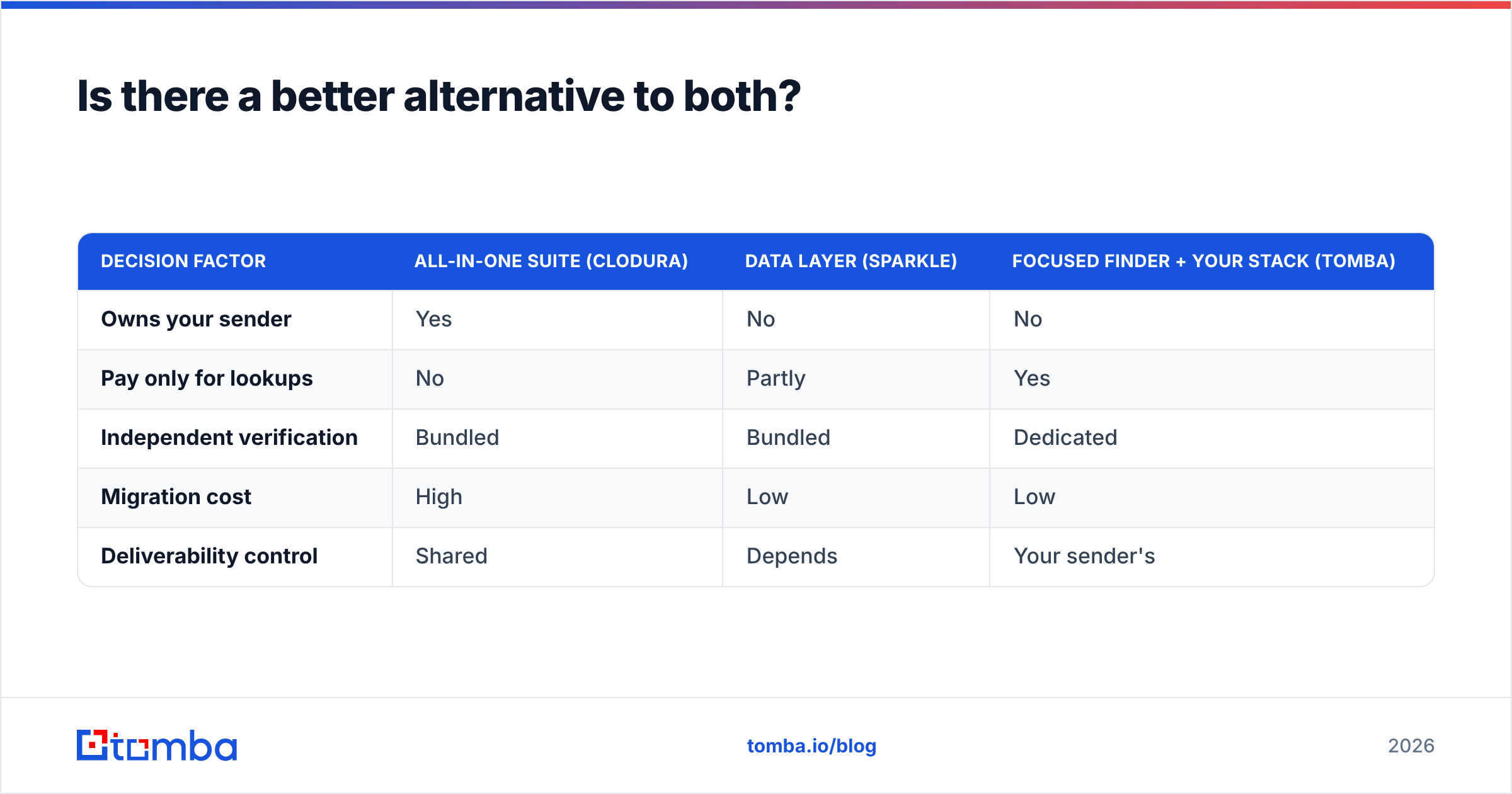
Is there a better alternative to both?#
Sometimes the smart move is to stop bundling and buy exactly what you need. Both Clodura and Sparkle ask you to accept their whole data footprint. A focused finder lets you pay only for the lookups you run. You then pair them with your own sequencer and CRM.
This is where a specialist like Tomba fits. Instead of a suite, you get a precise find email addresses engine and a standalone verifier. You also get domain search to map every contact at a target company, plus a real email finder API and native connectors to HubSpot and Salesforce. You keep the sender you already trust and swap in a cleaner data layer.
| Decision factor | All-in-one suite (Clodura) | Data layer (Sparkle) | Focused finder + your stack (Tomba) |
|---|---|---|---|
| Owns your sender | Yes | No | No |
| Pay only for lookups | No | Partly | Yes |
| Independent verification | Bundled | Bundled | Dedicated |
| Migration cost | High | Low | Low |
| Deliverability control | Shared | Depends | Your sender's |
For a wider view, cross-check user reviews on G2 and Capterra before you commit. Both surface the coverage and accuracy complaints vendors do not advertise. And if you want the mechanics of contact data spelled out, HubSpot's sales resources are a solid, neutral primer.
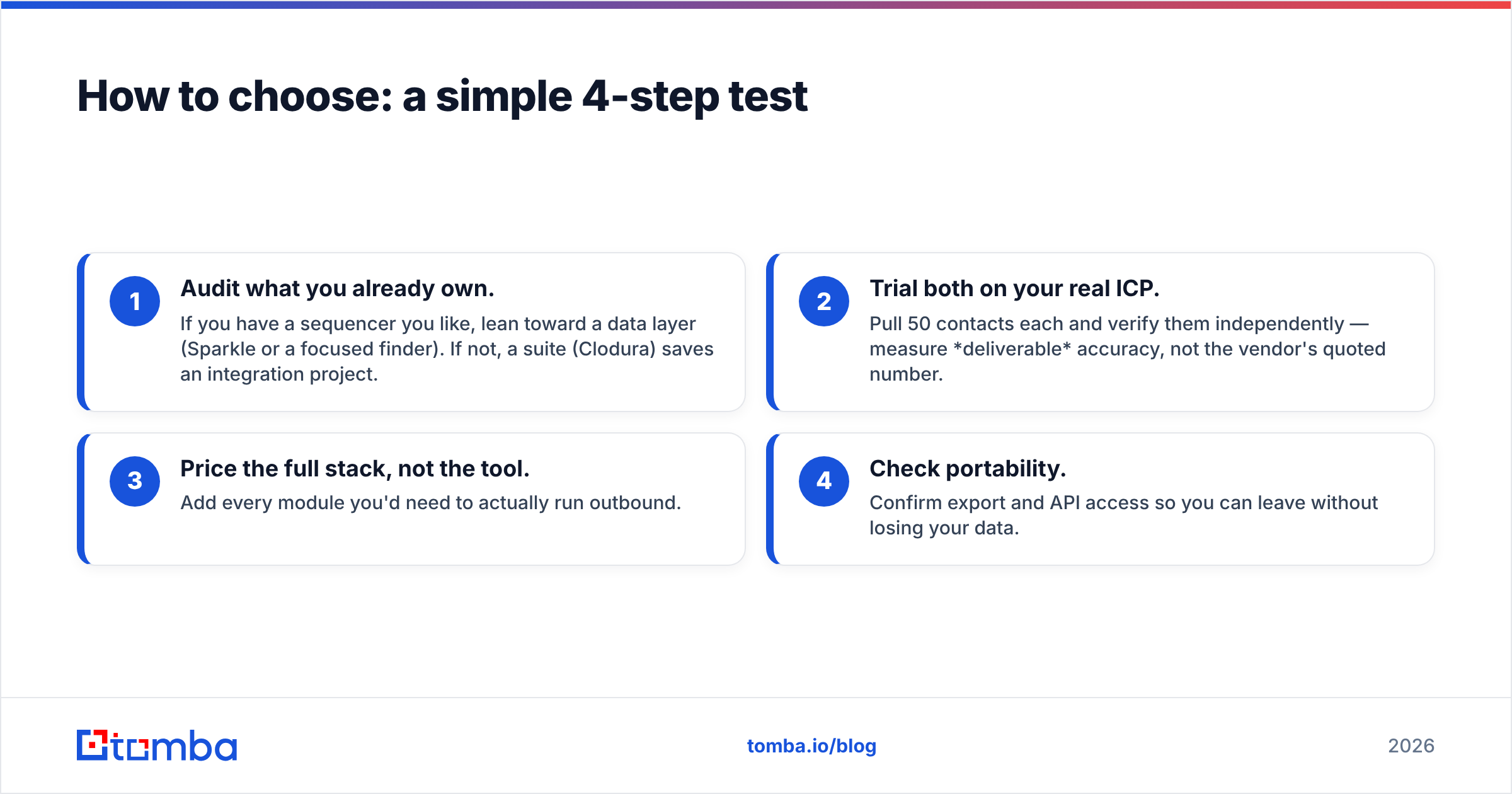
How to choose: a simple 4-step test#
- Audit what you already own. If you like your sequencer, lean toward a data layer (Sparkle or a focused finder). If not, a suite (Clodura) saves an integration project.
- Trial both on your real ICP. Pull 50 contacts each and verify them yourself. Measure deliverable accuracy, not the vendor's quoted number.
- Price the full stack, not the tool. Add every module you would need to actually run outbound.
- Check portability. Confirm export and API access so you can leave without losing your data.
Teams that run this test — instead of picking on brand name — almost always end up with a cheaper, cleaner stack.
Final verdict#
Clodura.ai wins for teams that want one platform for data and outreach. Sparkle wins for teams that only need clean contacts feeding a sender they already run. Neither is objectively "better." They are built for different buyers.
But if your priority is send-time accuracy and a stack you control, do not default to a bundle just for convenience. Start with a precise, verification-first finder and keep the sequencer you trust. Spin up the free tier of the Tomba Email Finder — 25 searches a month, no card. Pull a sample of your exact ICP, verify it, and compare deliverable results against Clodura and Sparkle. Let your own bounce rate pick the winner.
Related guides#
Ready to find emails that actually work?
Join 150,000+ professionals who stopped guessing and started sending. Free credits on signup — no credit card required.
Get the Tomba newsletter
Practical outbound tactics and product updates — once every two weeks.
About the author