Clodura.AI vs Tami.AI (2026): Which B2B Data Tool Wins?
Clodura.AI and Tami.AI both promise AI-driven B2B prospecting, but they solve different problems. Here's an honest breakdown of data, features, pricing, and where each one actually fits.
Clodura.AI vs Tami.AI comes down to one question: what is your pipeline missing? Do you need more contacts and cadence, or better audience signal and messaging? The two tools look alike on a feature grid. But they pull your team in different directions once you run outbound with them.
This is a neutral, hands-on comparison. It is not a sales page for either tool. We will cover what each platform does, where its data comes from, and how pricing works. We will also show the honest cases where one tool beats the other. And we will flag when a focused email finder plus verifier ends up cheaper and more accurate than a bundled suite.
TL;DR — Clodura.AI vs Tami.AI at a glance#
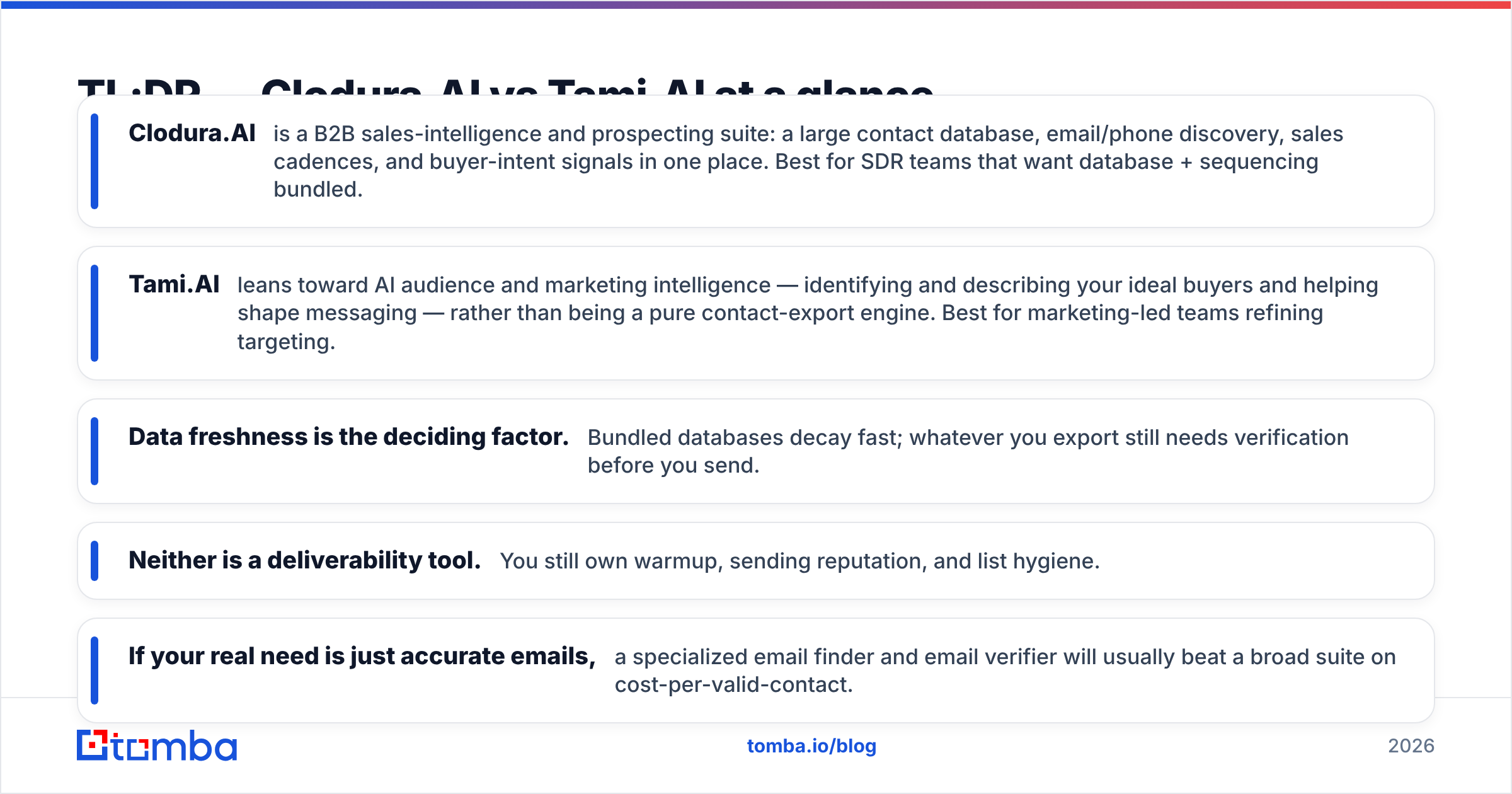
- Clodura.AI is a B2B sales-intelligence suite. You get a large contact database, email and phone lookup, sales cadences, and buyer-intent signals in one place. It fits SDR teams that want data plus sequencing bundled.
- Tami.AI leans toward AI audience and marketing intelligence. It helps you find and describe your ideal buyers and shape your messaging. It is not a pure contact-export engine. It fits marketing-led teams that want sharper targeting.
- Data freshness decides the winner. Bundled databases decay fast. Whatever you export still needs a verification pass before you send.
- Neither tool handles deliverability. You still own warmup, sending reputation, and list hygiene.
- If you just need accurate emails, a focused email finder and email verifier usually beat a broad suite on cost per valid contact.
What is Clodura.AI?#
Clodura.AI calls itself an all-in-one sales prospecting platform. The pitch is simple. An SDR can find a company, pull decision-maker contacts, check intent signals, and start an email cadence without leaving the tool. Its core parts usually include:
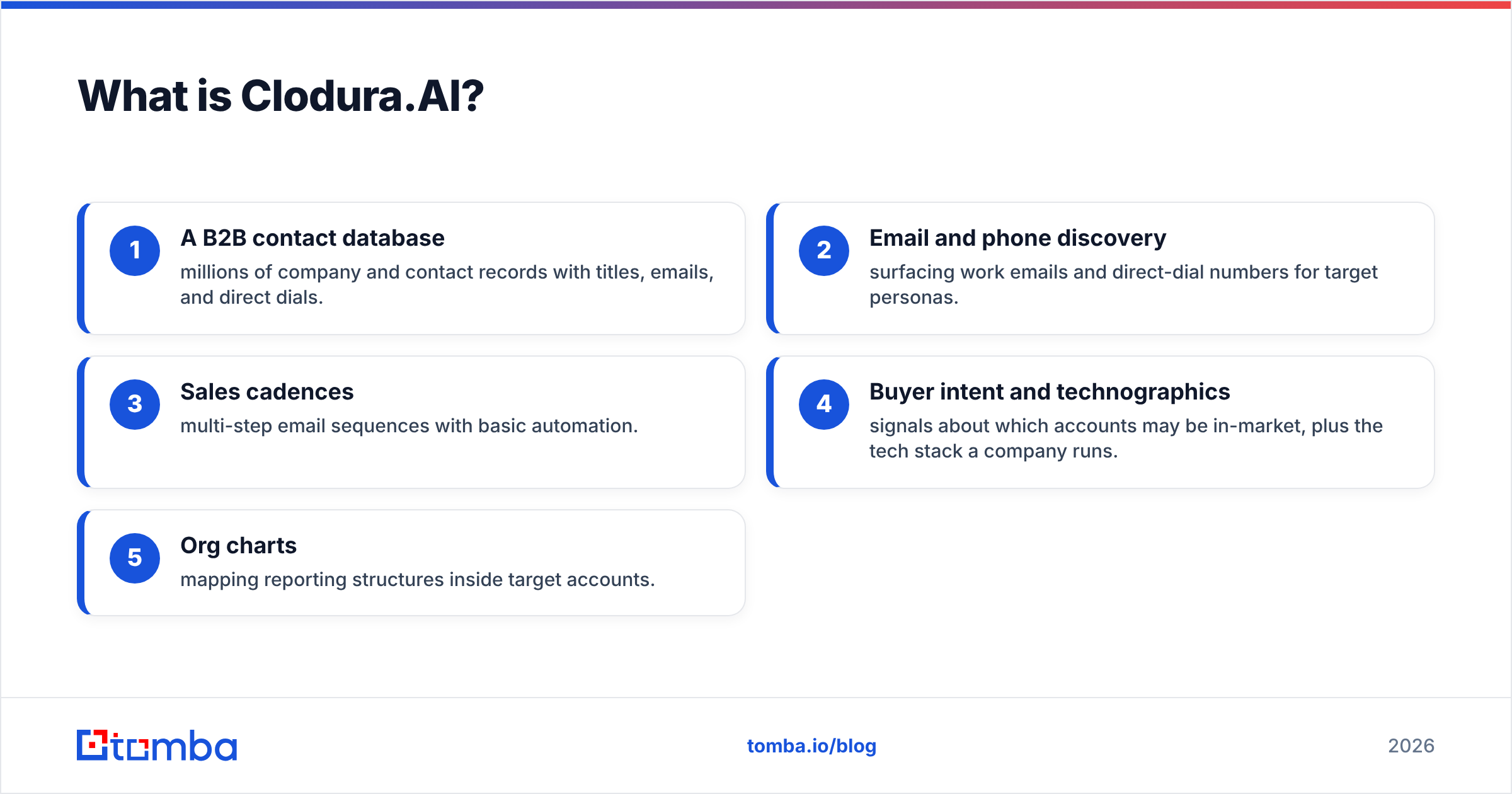
- A B2B contact database — millions of company and contact records with titles, emails, and direct dials.
- Email and phone lookup — work emails and direct-dial numbers for your target personas.
- Sales cadences — multi-step email sequences with basic automation.
- Buyer intent and technographics — signals about which accounts may be in-market, plus the tech a company runs.
- Org charts — a map of who reports to whom inside target accounts.
The appeal is consolidation. You pay for one login instead of a database, a sequencer, and an intent tool separately. You can see how the market rates it on review sites like G2 and Capterra, and on the vendor site at clodura.ai. As with any bundled database, treat the headline record count as a ceiling. It is not a promise of accuracy for your niche.
What is Tami.AI?#
Tami.AI sits closer to the marketing and audience side of the funnel. It is not built mainly to export a CSV of 10,000 contacts. Its strength is understanding who your best buyers are and helping you speak to them. Think audience modeling, segmentation, and AI-assisted messaging.
That difference matters. Expect Tami.AI to act like a raw lead-list machine and you may be let down. Want help defining an ideal customer profile and shaping campaigns around it, and it plays a useful, complementary role. Because the two tools do different jobs, "which is better" depends on your bottleneck. Is it volume of contacts or clarity of targeting? Check the live feature set on the vendor site first, since AI marketing tools change fast.
A quick honesty note: exact plan pricing for both tools shifts often, and some plans are quote-based. Check live numbers on each vendor's pricing page before you buy. Do not trust any comparison table (including this one) as gospel on price.
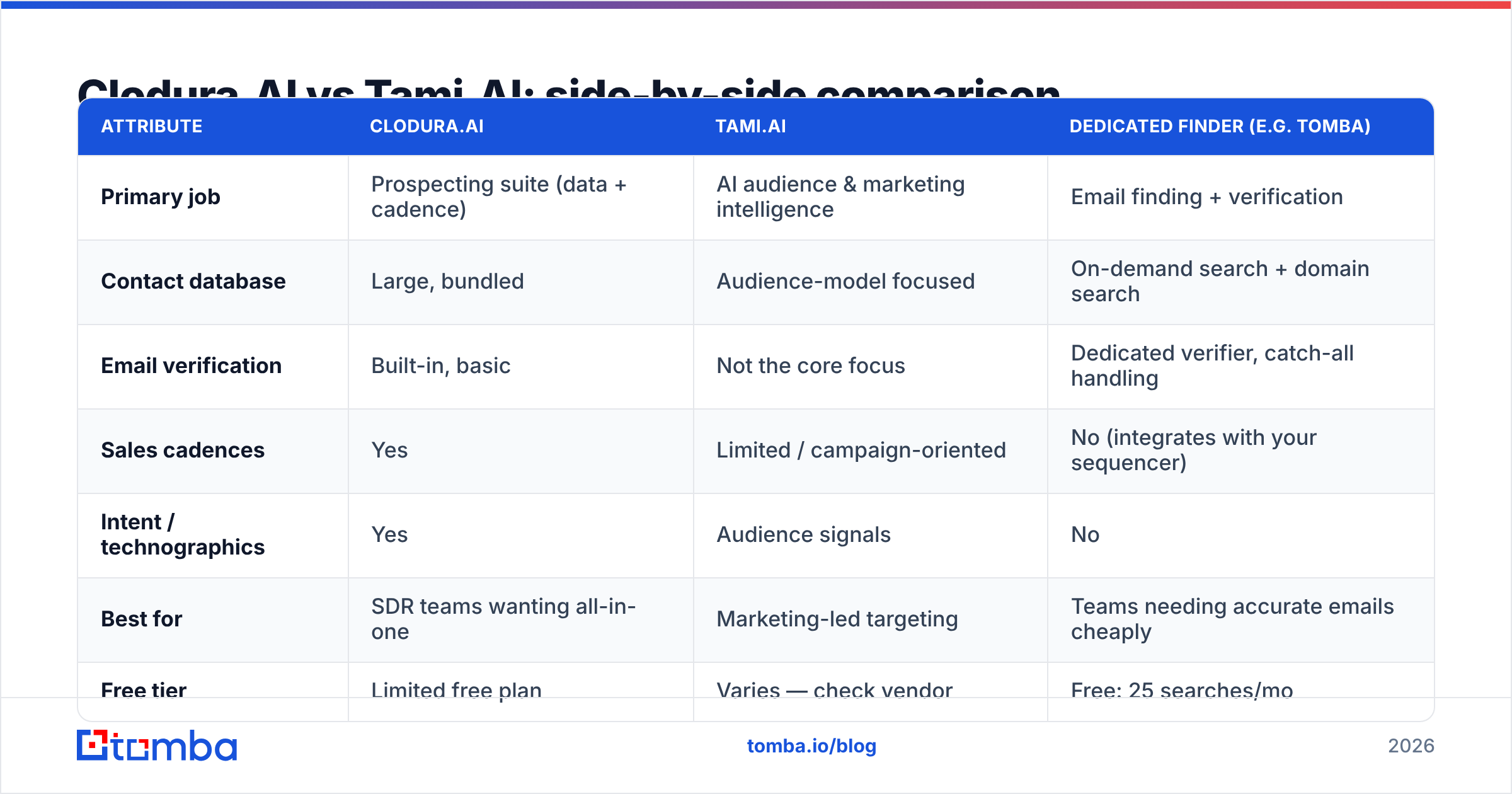
Clodura.AI vs Tami.AI: side-by-side comparison#
Here is how the two compare on the things that actually change a buying decision. We add a dedicated data tool as a reference point for the "I just need clean emails" case.
| Attribute | Clodura.AI | Tami.AI | Dedicated finder (e.g. Tomba) |
|---|---|---|---|
| Primary job | Prospecting suite (data + cadence) | AI audience & marketing intelligence | Email finding + verification |
| Contact database | Large, bundled | Audience-model focused | On-demand search + domain search |
| Email verification | Built-in, basic | Not the core focus | Dedicated verifier, catch-all handling |
| Sales cadences | Yes | Limited / campaign-oriented | No (integrates with your sequencer) |
| Intent / technographics | Yes | Audience signals | No |
| Best for | SDR teams wanting all-in-one | Marketing-led targeting | Teams needing accurate emails cheaply |
| Free tier | Limited free plan | Varies — check vendor | Free: 25 searches/mo |
| Pricing transparency | Public tiers + upsells | Often quote-based | Public: Starter $49/mo |
The pattern is clear. Clodura.AI wins on breadth for a sales team. Tami.AI wins on targeting for marketers. A focused finder wins on accuracy per dollar when contacts are the only gap.
Which one has more accurate data?#
Neither vendor can honestly claim "accurate" data forever. B2B contact data decays about 20–30% each year as people change jobs. Understand that before you compare record counts. A database of 600 million contacts that is 18 months stale will bounce harder than a smaller, freshly verified list.
So the smartest teams treat any bundled database — Clodura's included — as a sourcing layer. Then they run a separate verification pass before sending. Bounces above 3–5% start to drag down your sender reputation. No amount of clever cadence copy fixes a domain that lands in spam.
If accuracy is your top priority, use a cleaner setup. Source contacts from your suite or database. Then push them through an independent verifier and a data enrichment step. When you split sourcing from verification, you never trust one vendor to grade its own homework.
How does pricing compare?#
Bundled suites assume you will use most of the bundle. That is great if you truly need database plus cadence plus intent. It gets expensive if you pay for four modules to use one.
- Clodura.AI usually offers a limited free plan and paid tiers. Prices scale with credits, users, and advanced features like intent and exports. The more contacts and seats you need, the faster the bill climbs.
- Tami.AI pricing is often quote-based. That makes budgeting harder for small teams, and it is a common friction point when you cannot self-serve.
- A focused stack — an email finder plus verifier — is usually the cheapest path when contacts are your only gap. For reference, Tomba pricing starts with a free tier of 25 searches a month. Paid plans are Starter at $49/mo and Growth at $99/mo, with no forced bundle.
The honest math is simple. Add up the modules you will actually use and compare that to a la carte tools. Many teams find they are buying a whole suite for one feature they could get for far less.
Is a suite better than a focused tool?#
It depends on your team, and the honest answer is "sometimes."
Choose a suite (Clodura.AI) when:
- You have a dedicated SDR team that lives in one prospecting tool all day.
- You want database, sequencing, and intent under one login and one invoice.
- Your ops team can accept slightly lower per-field accuracy in exchange for one workflow.
Choose an audience tool (Tami.AI) when:
- Marketing owns targeting and needs help defining and refining the ICP.
- Messaging and segmentation matter more than raw export volume.
- You already have a data source and just want to sharpen who you aim at.
Choose a focused data stack when:
- Your only real gap is accurate, verified contact emails.
- You want to plug data into an existing CRM or sequencer through integrations rather than switch platforms.
- Cost per valid contact is the metric you care about.
There is no universal winner. There is a winner for your bottleneck. Map the gap honestly before you sign an annual contract.
What do these tools not do?#
Both Clodura.AI and Tami.AI are acquisition and targeting tools. They are not deliverability platforms, and that trips teams up all the time.
A perfect list means nothing if your emails do not land. You still own:
- Warmup and sending reputation — a new domain needs weeks of slow ramp.
- Authentication — SPF, DKIM, and DMARC set up correctly.
- List hygiene — remove risky, catch-all, and role-based addresses before you send.
A great contact will still bounce if you send it from a cold, misconfigured domain. Keep deliverability as its own discipline, no matter which prospecting tool you pick.
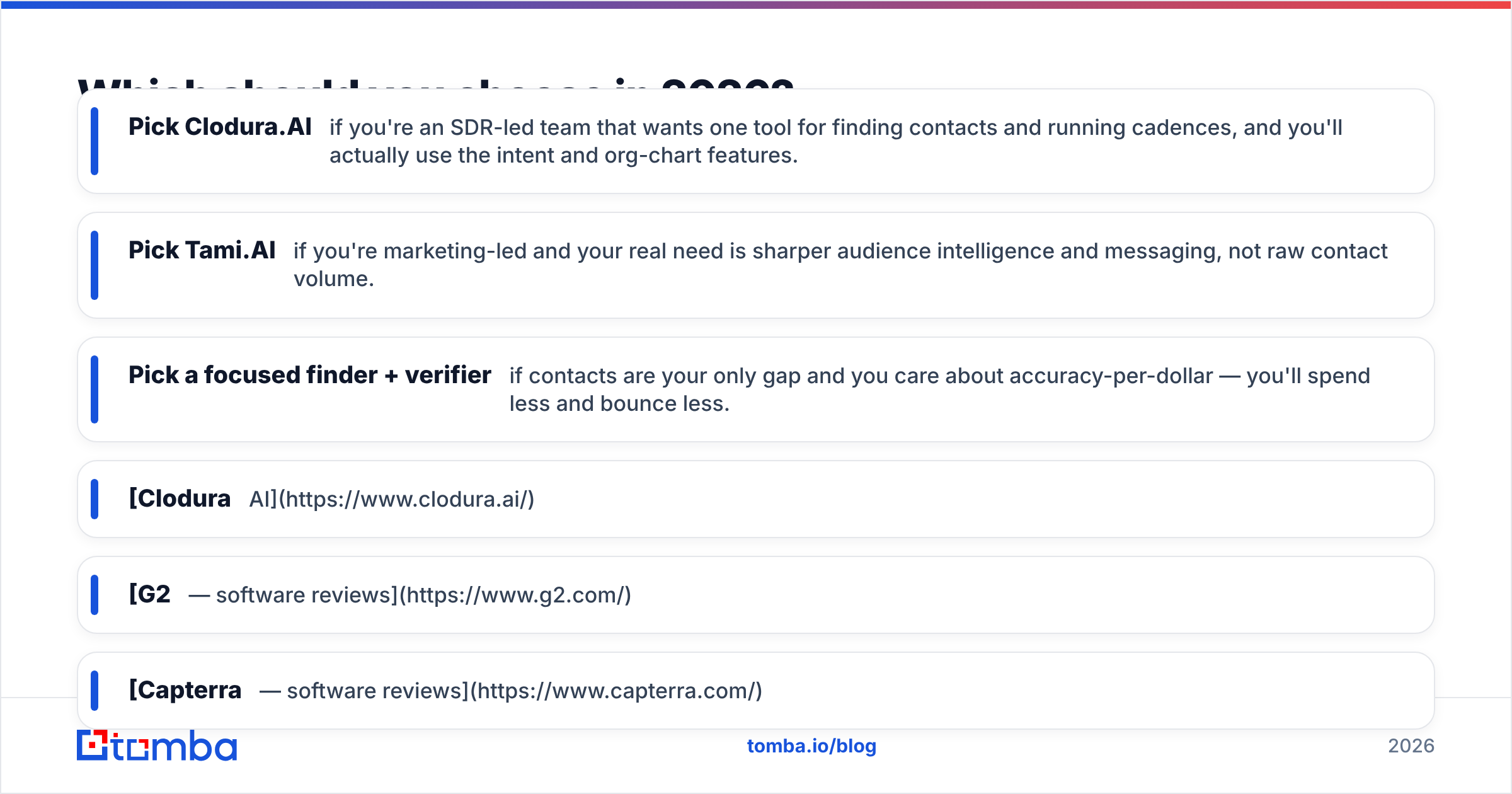
Which should you choose in 2026?#
Here is the short verdict:
- Pick Clodura.AI if you are an SDR-led team that wants one tool to find contacts and run cadences. You should also plan to use the intent and org-chart features.
- Pick Tami.AI if you are marketing-led and your real need is sharper audience intelligence and messaging, not raw contact volume.
- Pick a focused finder plus verifier if contacts are your only gap and you care about accuracy per dollar. You will spend less and bounce less.
Most teams overbuy. They buy a broad suite to solve a narrow problem, then pay for modules that gather dust. Before you commit, write down the one job you are hiring the tool to do. If that job is "get me accurate, verified emails I can drop into my workflow," you do not need a suite at all.
That is where a purpose-built tool earns its keep. The Tomba Email Finder finds professional emails by name, domain, or company. It pairs with a dedicated verifier to keep bounce rates low. It starts free at 25 searches a month, with transparent $49/mo Starter pricing and no bundle you will never use. Source your contacts wherever you like, then verify before you send. Start with the free tier, test it against your own list, and let bounce rate — not a feature grid — make the call.
Sources:
Related guides#
// get started
Find, verify and enrich your first contacts today
Start on the free plan with 25 searches a month, then scale when your team is ready.
Free plan · No credit card required · GDPR & CCPA
// about the author