Clodura.ai vs TrueVerify (2026): Sales Data vs Email Hygiene
Clodura.ai vs TrueVerify: one builds prospecting lists, the other scrubs them clean. Here's which tool fits your outbound stack in 2026 — and where a third option beats both.
Clodura.ai vs TrueVerify (2026): Sales Data vs Email Hygiene
Clodura.ai vs TrueVerify is a matchup people often get wrong. One tool builds your prospecting lists. The other cleans them before you hit send. This guide covers what each does, how they price, and where a combined tool beats running both.
TL;DR
- Clodura.ai is a B2B prospecting platform: a contact database, email finder, sequences, and buyer-intent signals. It answers "who do I email?"
- TrueVerify is an email verification tool. It answers "will this email bounce?" It does not build lists — it cleans them.
- They are not really competitors. Most teams that run cold outbound end up needing both a data source and a verifier.
- For raw email-finder accuracy plus built-in verification, a focused tool like Tomba often beats stitching two single-purpose products together.
- Pick Clodura.ai if you have no data source. Pick TrueVerify if you already have lists and just need hygiene. Pick a combined finder-plus-verifier if you want one bill and one API.
What are Clodura.ai and TrueVerify?#
Short version: they solve different halves of the same problem.
Clodura.ai (clodura.ai) is an all-in-one sales prospecting platform. It ships a self-reported database of hundreds of millions of B2B contacts, a domain-level email finder, direct-dial phone numbers, email sequencing, and buyer-intent and technographic signals. Think of it as a lead-generation engine: you search by title, industry, geography, or company, and it hands you contact records to load into a campaign.
TrueVerify is an email verification service. You feed it a list of addresses — from a form, a scraped export, a purchased CSV — and it tells you which ones are deliverable, which are risky, which are catch-all domains, and which will hard-bounce. It is the quality-control checkpoint between your raw list and your sending tool.
Here's the analogy: Clodura.ai is the supplier that stocks your warehouse. TrueVerify is the inspector who checks the boxes before they ship. One fills the pipeline; the other stops you from shipping garbage. This mix-up is the most common mistake teams make when they compare Clodura.ai vs TrueVerify side by side. It's like judging a grocery store against a food-safety lab.

How do Clodura.ai and TrueVerify compare head-to-head?#
The two tools overlap only a little. So the real Clodura.ai vs TrueVerify question is about workflow coverage, not a feature-by-feature duel. Here's where each one earns its keep.
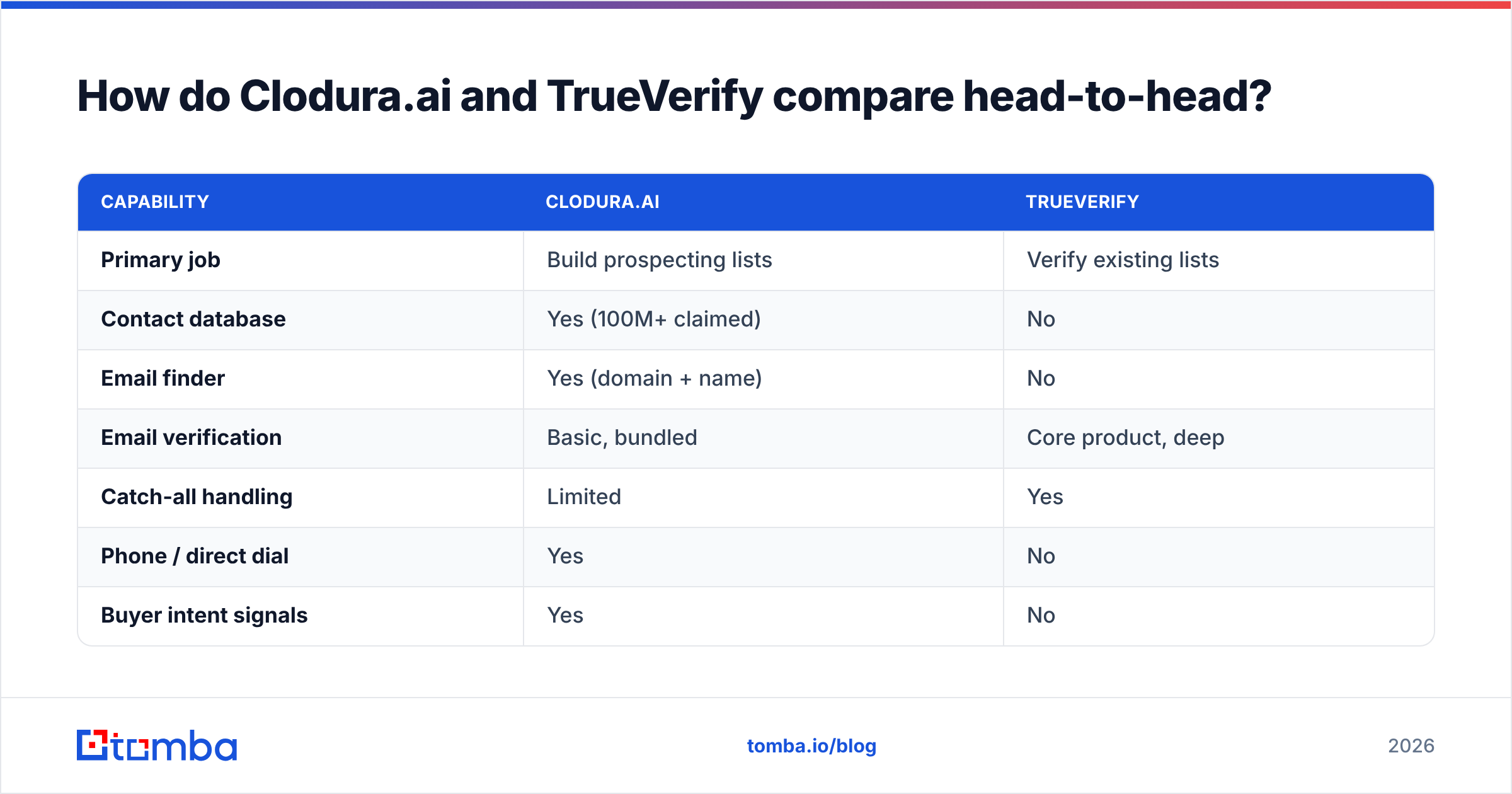
| Capability | Clodura.ai | TrueVerify |
|---|---|---|
| Primary job | Build prospecting lists | Verify existing lists |
| Contact database | Yes (100M+ claimed) | No |
| Email finder | Yes (domain + name) | No |
| Email verification | Basic, bundled | Core product, deep |
| Catch-all handling | Limited | Yes |
| Phone / direct dial | Yes | No |
| Buyer intent signals | Yes | No |
| Sequencing / sending | Yes | No |
| Bulk CSV cleaning | Secondary | Primary |
| Best for | Teams with no data source | Teams with lists to clean |
The pattern is clear. Clodura.ai is wide and shallow on verification. TrueVerify is narrow and deep on it. If your only pain is bounce rate, TrueVerify's focus wins. If your pain is "I have no leads at all," TrueVerify can't help you, and Clodura.ai is the obvious pick.
But notice the gap in the middle. A team running real outbound needs both halves — accurate finding and rigorous verification. Buying two tools means two logins, two bills, and two data models to reconcile. That's the opening a combined platform exploits.
Which tool is more accurate for finding and verifying emails?#
Accuracy splits into two questions in any Clodura.ai vs TrueVerify comparison. Never accept a single vendor number for both.
For finding: Clodura.ai's accuracy depends on how fresh its database is for your target segment. Large databases decay. People change jobs, companies rebrand, and domains lapse. A self-reported "100M+ contacts" claim says nothing about how many are right today for the 200 accounts you care about. So always run a sample before you trust it.
For verifying: TrueVerify's job is to catch the bounces Clodura (or any source) misses. A good verifier checks MX records, runs SMTP handshakes, and flags role accounts (info@, sales@). It also makes a judgment call on catch-all domains, which accept every address and defeat naive verification.

The uncomfortable truth: if you find with Tool A and verify with Tool B, you pay twice. You also stack two vendors' error bars on top of each other. This is why one platform that does both can be more accurate end to end. The email finder and the email verifier share the same sources. So a verified result rests on the same evidence that found the address. Catch-all domains — the hardest case — get their own dedicated catch-all verifier rather than a best-guess flag.
Rule of thumb before committing to either tool:
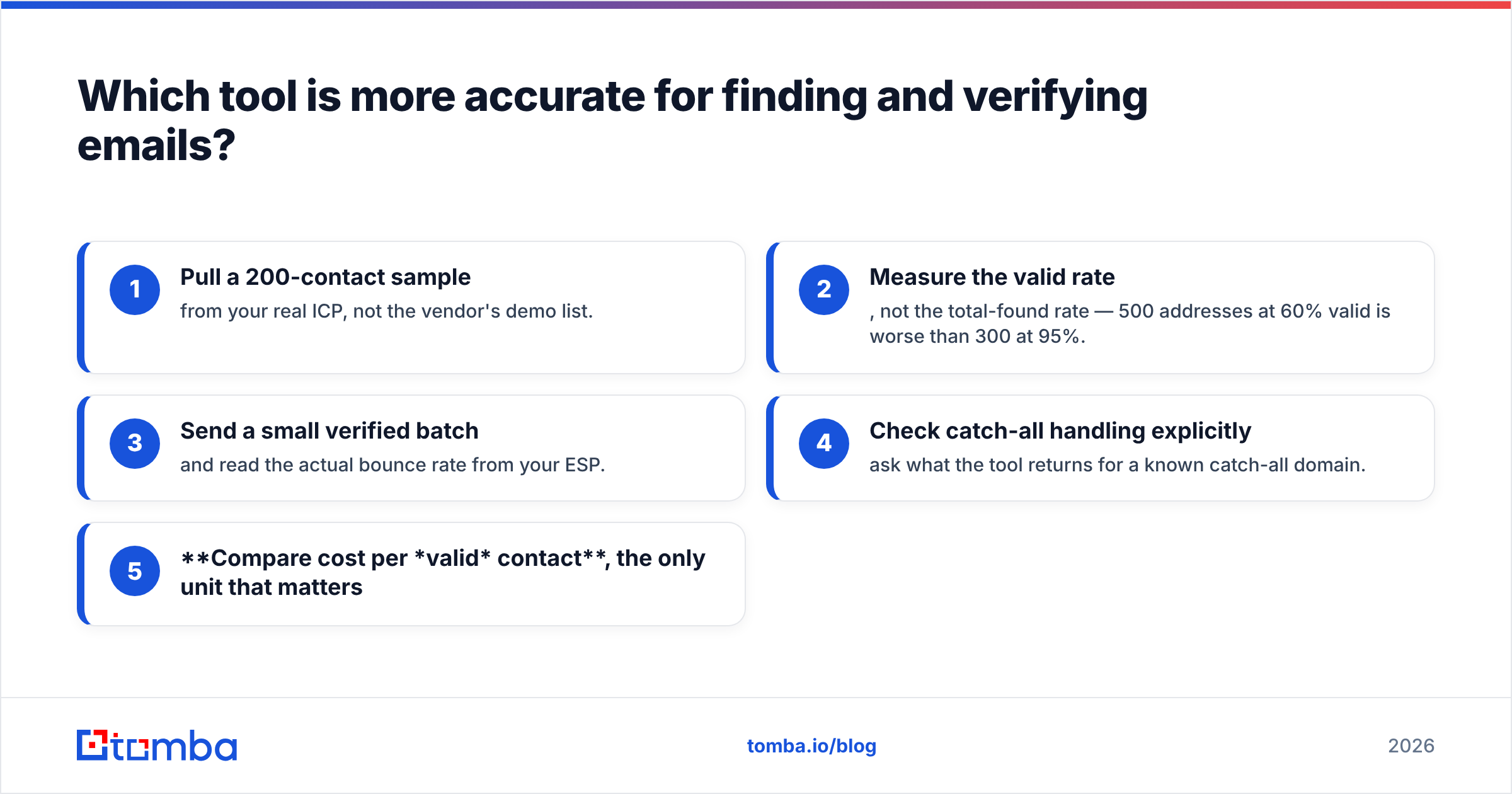
- Pull a 200-contact sample from your real ICP, not the vendor's demo list.
- Measure the valid rate, not the total-found rate — 500 addresses at 60% valid is worse than 300 at 95%.
- Send a small verified batch and read the actual bounce rate from your ESP.
- Check catch-all handling explicitly — ask what the tool returns for a known catch-all domain.
- Compare cost per valid contact, the only unit that matters.
What does Clodura.ai vs TrueVerify pricing look like?#
Pricing structures differ because the products differ. Clodura.ai sells access to data and sequences, usually on a per-seat annual plan with credit limits. TrueVerify sells verification volume, typically as pay-as-you-go credit packs or monthly buckets.
That makes a straight Clodura.ai vs TrueVerify price comparison misleading. A Clodura.ai seat that includes finding, phones, intent, and sequencing looks expensive next to a TrueVerify credit pack. But the TrueVerify pack doesn't find a single lead. You're comparing a full kitchen to a knife.
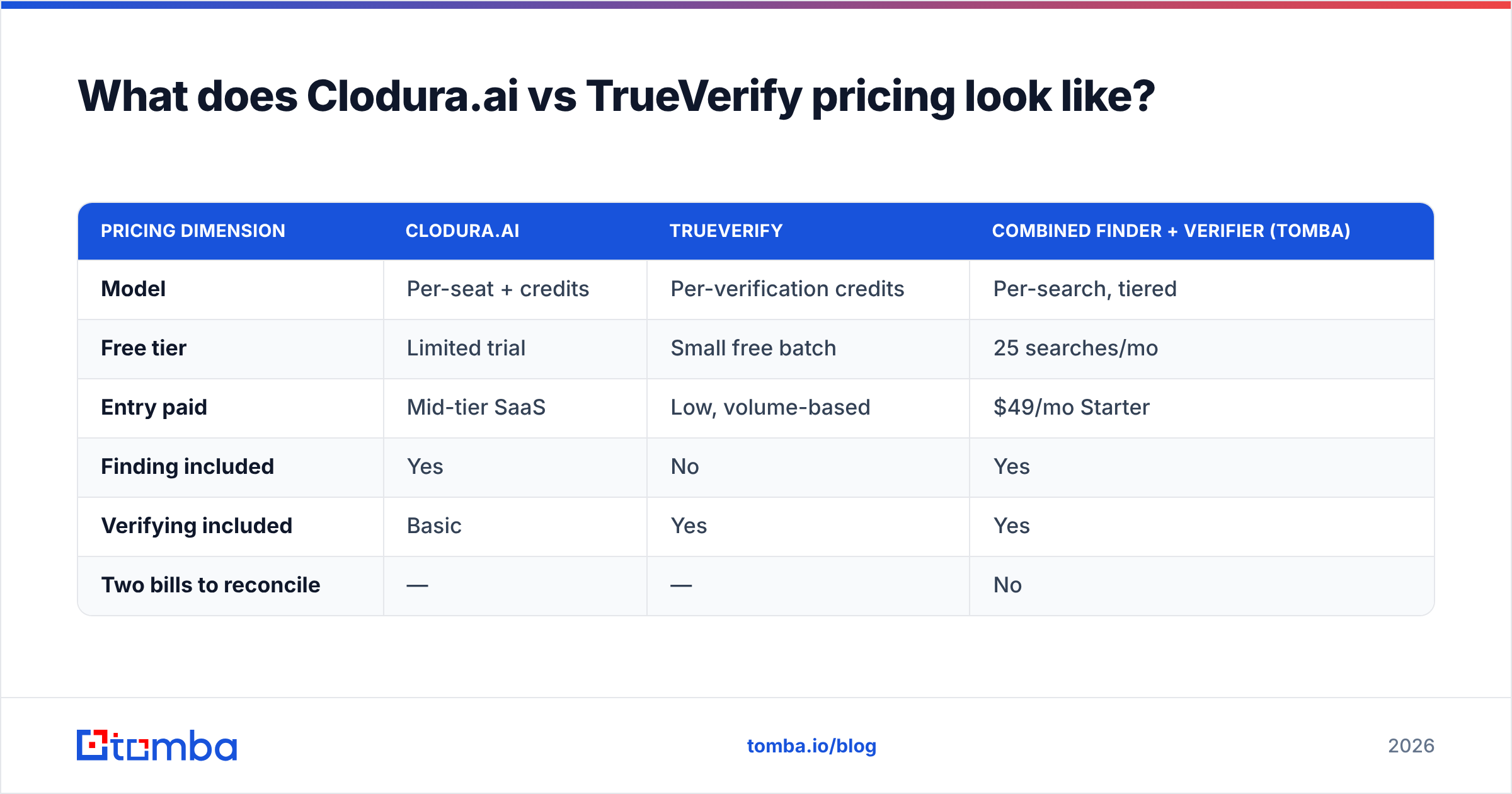
| Pricing dimension | Clodura.ai | TrueVerify | Combined finder + verifier (Tomba) |
|---|---|---|---|
| Model | Per-seat + credits | Per-verification credits | Per-search, tiered |
| Free tier | Limited trial | Small free batch | 25 searches/mo |
| Entry paid | Mid-tier SaaS | Low, volume-based | $49/mo Starter |
| Finding included | Yes | No | Yes |
| Verifying included | Basic | Yes | Yes |
| Two bills to reconcile | — | — | No |
If you go the two-tool route, budget for both line items and the hidden cost of moving data between them. If you'd rather consolidate, compare the bundled option's pricing against the sum of a database subscription plus a verification pack. The combined number is usually where the surprise lives.

When should you pick each tool?#
Decision rules, not vibes.
Pick Clodura.ai when:
- You have no B2B data source and need one platform for finding, dialing, and sequencing.
- You value buyer-intent and technographic signals to prioritize accounts.
- You're okay with lighter native verification and will scrub externally.
Pick TrueVerify when:
- You already have lists — inbound signups, event scans, purchased data — and bounce rate is your problem.
- You need deep catch-all and role-account detection more than you need new leads.
- You want a cheap, focused verifier bolted onto whatever finder you already run.
Pick a combined finder + verifier when:
- You want one API, one bill, and one data model instead of gluing two vendors together.
- Your workflow is find → verify → export in a single motion (a classic bulk job).
- You'd rather your verified result reflect the same source that found the address.

Most teams don't actually want to become integration engineers. If you're comparing Clodura.ai vs TrueVerify because you're missing one half of the workflow, the cleaner fix is one tool that already has both. Pair a domain-level domain search with built-in verification and skip the second contract.
Are there better alternatives to running two tools?#
Yes. For most SMB and mid-market outbound teams, consolidating beats stacking.
The two-vendor stack (Clodura.ai for data, TrueVerify for hygiene) makes sense at scale. It fits when you have engineering to maintain the pipeline and volume that justifies two best-of-breed tools. Enterprise RevOps teams live here happily. You can validate that with peer reviews on G2 before you commit — read the one-star reviews, not the five-star ones.
For everyone else, the overhead is real. You sync records, dedupe across sources, reconcile two definitions of "valid," and pay two subscriptions to cover one workflow. A focused platform that finds and verifies — plus offers phone lookup, enrichment, and a clean API — removes that seam. You search, the result comes back already scored, and you export. No CSV round-trip between vendors.
That's the case for Tomba as the third option here. It isn't trying to out-database Clodura.ai's 100M records or out-verify TrueVerify's SMTP checks in isolation. It bets that most teams get better results from one accurate, verification-aware finder than from two single-purpose tools taped together. Verifying at the moment you find an address beats verifying later. (For the logic behind that, HubSpot's guide to email bounce rates is a solid primer.)
The bottom line#
The Clodura.ai vs TrueVerify choice isn't really a rivalry. The two are halves of one outbound stack. Clodura.ai builds the list. TrueVerify checks it. If you only need one half, buy the half you're missing and move on.
But if you're standing up outbound from scratch, or you're tired of paying two vendors to cover one find-then-verify workflow, consolidate. Tomba's Email Finder gives you accurate, source-backed email discovery with verification built in — catch-all handling, bulk processing, and a real API included — starting at $49/mo, with a free tier of 25 searches so you can benchmark it against your own ICP before you pay. Run the 200-contact sample test above on all three, measure cost per valid contact, and let the bounce rate decide.
Related guides#
// get started
Find, verify and enrich your first contacts today
Start on the free plan with 25 searches a month, then scale when your team is ready.
Free plan · No credit card required · GDPR & CCPA
// about the author