Clodura.ai vs Xverum: B2B Data Platform Comparison 2026
Clodura.ai bundles sales intelligence and outreach; Xverum sells raw B2B data at scale. Here's an honest breakdown of which one fits your GTM stack in 2026.
Choosing between Clodura.ai and Xverum comes down to one question: do you want a finished sales-intelligence workflow, or a raw data pipe you plumb into your own systems? They are not the same product, and picking the wrong one wastes budget fast.
TL;DR — Clodura.ai vs Xverum in 30 seconds#
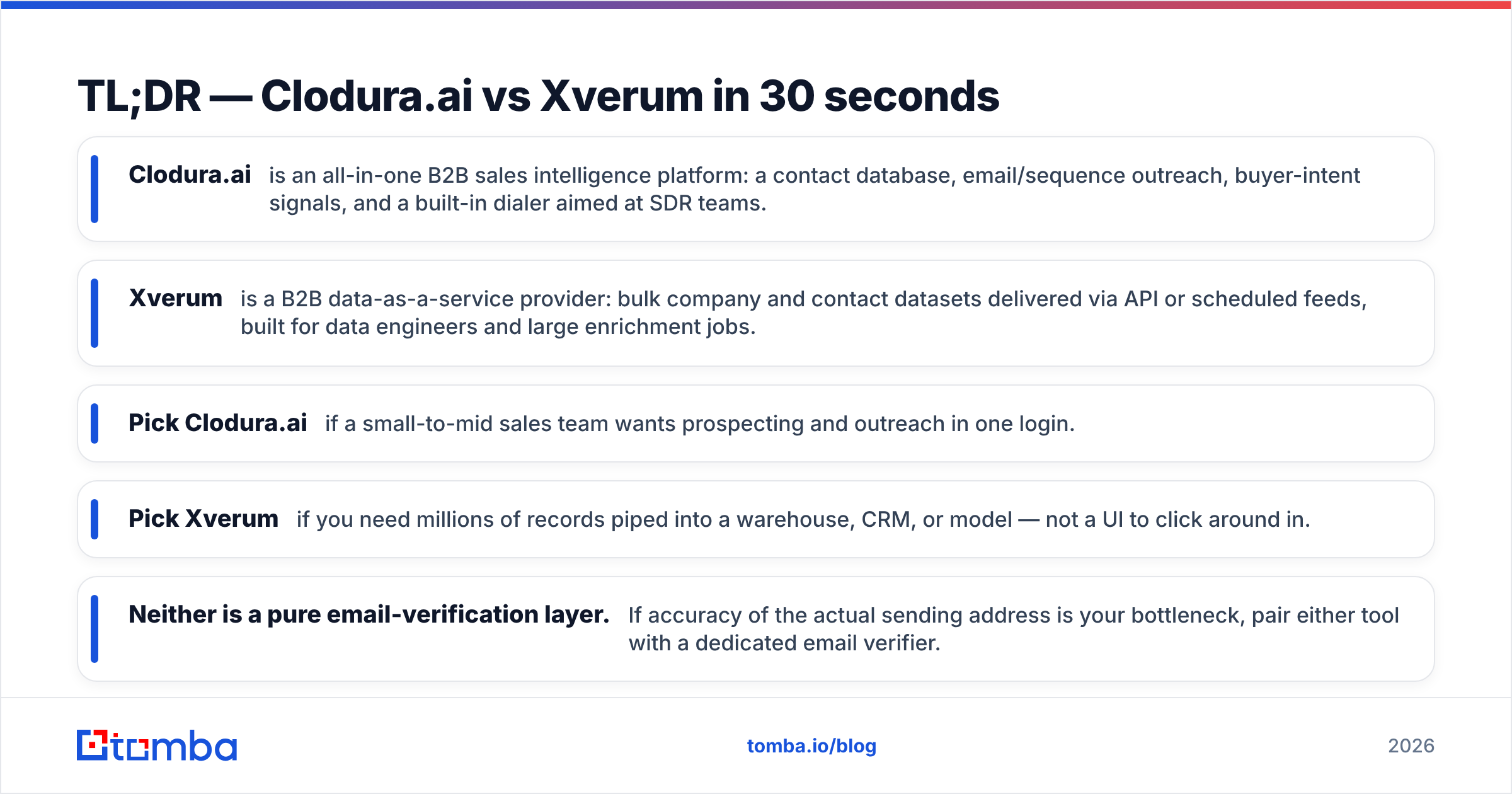
- Clodura.ai is an all-in-one B2B sales intelligence platform: a contact database, email/sequence outreach, buyer-intent signals, and a built-in dialer aimed at SDR teams.
- Xverum is a B2B data-as-a-service provider: bulk company and contact datasets delivered via API or scheduled feeds, built for data engineers and large enrichment jobs.
- Pick Clodura.ai if a small-to-mid sales team wants prospecting and outreach in one login.
- Pick Xverum if you need millions of records piped into a warehouse, CRM, or model — not a UI to click around in.
- Neither is a pure email-verification layer. If accuracy of the actual sending address is your bottleneck, pair either tool with a dedicated email verifier.

What is Clodura.ai?#
Clodura.ai positions itself as a sales prospecting and engagement platform. In practice, it tries to compress three jobs into one subscription:
- Prospecting — a self-reported database of roughly 600M+ B2B contacts with direct dials and org charts.
- Engagement — email sequencing, cadences, and a cloud dialer so reps can act on a list without exporting it.
- Intelligence — buyer-intent topics, technographics, and "smart" alerts (job changes, funding) that nudge reps toward warm accounts.
The pitch is convenience: an SDR logs in, builds a list, and starts sequencing without stitching together four vendors. That's genuinely useful for a lean team. The trade-off is depth — a platform that does everything rarely matches a specialist in any single lane, and Clodura's contact accuracy is middling compared to tools that do nothing but verify.
What is Xverum?#
Xverum is a data provider, not an app. You don't "use" Xverum the way a rep uses a dashboard; you ingest it. Its core offering is large-scale B2B and company data — profiles, firmographics, and contact records — delivered as bulk datasets, scheduled feeds, or API responses.
The buyer here is different. Xverum is aimed at data teams, RevOps engineers, and product builders who want to:
- Enrich an existing CRM or warehouse with fresh firmographic fields.
- Power a lead-scoring model or an internal app with structured company data.
- Run a one-time or recurring bulk pull of a whole market segment.
If you asked a Xverum customer to "send a sequence," they'd look at you funny. That's a job for the tool sitting downstream of the data. Xverum's strength is volume and structure; its weakness (for a solo seller) is that there's no outreach layer at all.
Clodura.ai vs Xverum: the core difference#
Here's the mental model. Clodura.ai is a restaurant — you sit down, order, and eat. Xverum is a wholesale grocery supplier — it delivers pallets of ingredients to a kitchen that cooks its own meals. Both feed you; they operate at completely different points in the pipeline.
Technically: Clodura.ai owns the last mile (UI, sequencing, dialing), while Xverum owns the supply (bulk records, delivery infrastructure). Comparing them head-to-head only makes sense when you're deciding which layer of your stack you're actually short on.
How do Clodura.ai and Xverum compare on features and pricing?#
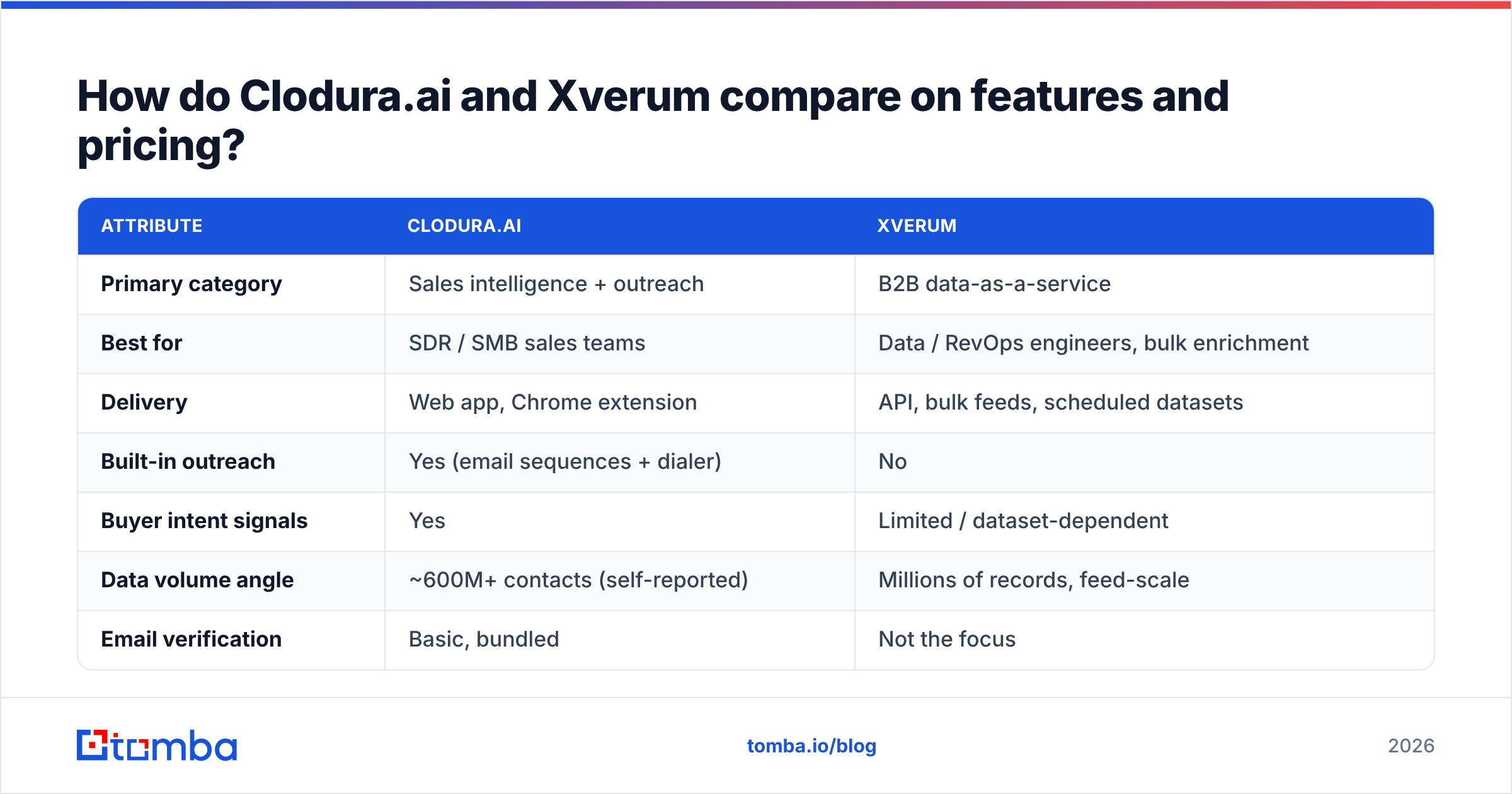
| Attribute | Clodura.ai | Xverum |
|---|---|---|
| Primary category | Sales intelligence + outreach | B2B data-as-a-service |
| Best for | SDR / SMB sales teams | Data / RevOps engineers, bulk enrichment |
| Delivery | Web app, Chrome extension | API, bulk feeds, scheduled datasets |
| Built-in outreach | Yes (email sequences + dialer) | No |
| Buyer intent signals | Yes | Limited / dataset-dependent |
| Data volume angle | ~600M+ contacts (self-reported) | Millions of records, feed-scale |
| Email verification | Basic, bundled | Not the focus |
| Free option | Free tier available | Sample data / trial by request |
| Typical entry price | ~$33–$79/user/mo (annual) | Custom, volume-based quote |
Two honesty notes. First, self-reported database sizes are marketing numbers across this entire category — treat "600M contacts" as a ceiling, not a promise of reachable, verified inboxes. Second, Xverum's pricing is quote-based because data volume, refresh cadence, and fields drive cost; there is no clean per-seat sticker to compare against Clodura.
Check current numbers directly on Clodura.ai and Xverum before you commit, and cross-reference user reviews on G2 — vendor pages and reality drift over time.
Which one is more accurate?#
Accuracy splits by what you're measuring. For firmographic and company-level data, Xverum's feed model tends to be fresher at scale because refreshing a structured dataset is its whole business. For direct-dial and email contact data, Clodura.ai is convenient but inconsistent — bundled contact platforms routinely ship a meaningful share of stale or catch-all addresses.
The uncomfortable truth is that neither tool removes your need to verify before you send. A bounced cold email doesn't just fail to land — it damages your sender reputation and drags down every future campaign from that domain. Whatever database you pull from, run the addresses through verification and catch-all detection first.

This is where a focused layer earns its keep. Tomba's email finder resolves and confirms professional addresses at the point of send, and data enrichment fills the firmographic gaps around them. It's the "cook the ingredients" step neither Clodura nor Xverum fully owns for you.
Which should you choose?#
Match the tool to the shape of your problem, not to a feature checklist.
- Choose Clodura.ai if you're a founder-led or SMB sales team that wants prospecting, sequencing, and dialing behind one login, and you value speed-to-first-email over data purity.
- Choose Xverum if you have engineering resources, need records at feed scale, and want to own the enrichment and outreach logic yourself downstream.
- Choose neither as a complete stack. Both are strong at their layer and weak at the one next door. The common failure mode is buying Clodura for its database and being disappointed by deliverability, or buying Xverum and realizing you still need an app to act on the data.
A simple decision checklist#
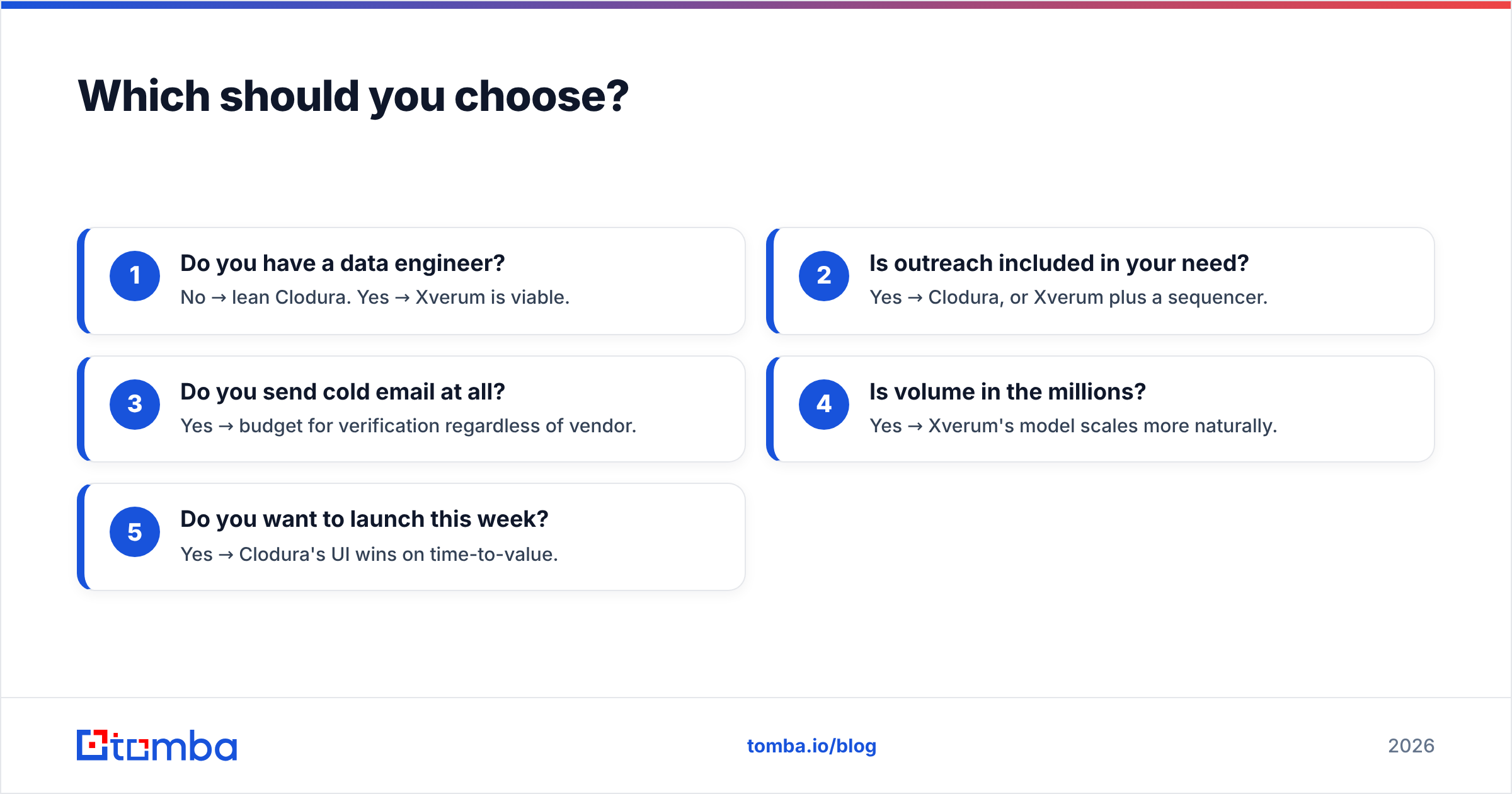
- Do you have a data engineer? No → lean Clodura. Yes → Xverum is viable.
- Is outreach included in your need? Yes → Clodura, or Xverum plus a sequencer.
- Do you send cold email at all? Yes → budget for verification regardless of vendor.
- Is volume in the millions? Yes → Xverum's model scales more naturally.
- Do you want to launch this week? Yes → Clodura's UI wins on time-to-value.
Where does Tomba fit against both?#
Tomba isn't trying to be a full outreach suite like Clodura or a raw feed like Xverum. It's the accuracy layer that makes either one usable. Where Clodura bundles verification as an afterthought and Xverum leaves it to you, Tomba specializes in finding and confirming the specific address you're about to email — with catch-all handling, email verification, and enrichment as first-class features rather than bolt-ons.
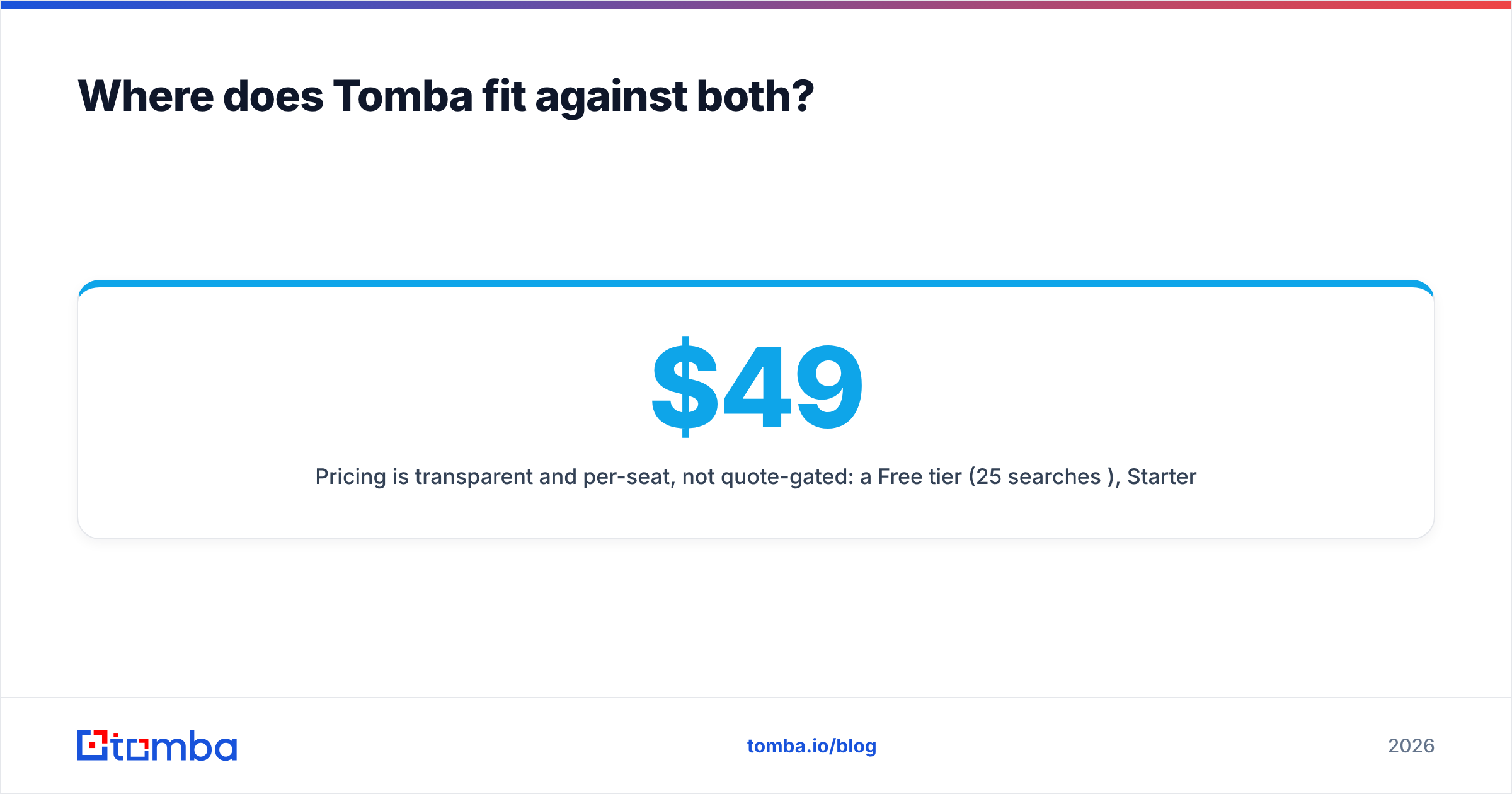
Pricing is transparent and per-seat, not quote-gated: a Free tier (25 searches/mo), Starter at $49/mo, Growth at $99/mo, and Pro at $249/mo. You can see the full breakdown on the Tomba pricing page. That predictability matters when you're comparing against a custom Xverum quote or Clodura's per-user math.
A practical stack looks like this: use Clodura or Xverum for reach and raw records, then run every address through Tomba before it enters a sequence. You get the volume of a big database and the deliverability of a verification-first tool — instead of choosing one and eating the downside of the other.
Frequently asked questions#
Is Clodura.ai a direct competitor to Xverum? Not really. Clodura.ai is a sales-intelligence and outreach app; Xverum is a bulk data supplier. They overlap only on "we have B2B contact data," and they serve different buyers.
Does Xverum have an outreach tool? No. Xverum delivers data via API and feeds. You bring your own sequencer, CRM, or model to act on it.
Which is cheaper, Clodura.ai or Xverum? Clodura.ai has published per-user pricing and a free tier, so it's cheaper to start. Xverum is volume-quoted and can be more cost-effective per record at very large scale.
Do I still need an email verifier with either tool? Yes. Bundled or bulk data both degrade over time. Verifying before you send protects deliverability and inbox placement.
The bottom line#
Clodura.ai and Xverum solve different halves of the same pipeline: Clodura is the app your reps live in, Xverum is the data your systems consume. There's no single "winner" — only the right fit for whether you're short on a workflow or short on records.
What both leave exposed is the accuracy of the exact address you hit send on. Close that gap with the Tomba Email Finder: find, verify, and enrich professional emails so the leads you pulled from anywhere actually reach a human. Start free and only pay when volume demands it.
Related guides#
// get started
Find, verify and enrich your first contacts today
Start on the free plan with 25 searches a month, then scale when your team is ready.
Free plan · No credit card required · GDPR & CCPA
// about the author