Clodura.ai vs Zintlr (2026): Full Feature and Pricing Comparison
Clodura.ai and Zintlr both promise clean B2B contact data and faster outbound — but they win at different jobs. Here is an honest, side-by-side breakdown of data, pricing, and features to help you pick.
This Clodura.ai vs Zintlr comparison comes down to one question. Do you want an all-in-one outbound engine? Or a sharp contact-and-intelligence layer you bolt onto tools you already trust? Both platforms sell B2B contact data. Both promise "verified" emails and direct dials. Both target the same mid-market sales teams. But they are built on different ideas. Pick the wrong one, and you waste budget on features you never touch.
This guide breaks down data quality, pricing, workflows, and the honest trade-offs. You will see which tool earns a seat in your stack. You will also see where a dedicated data source like Tomba fits alongside either one.
TL;DR: Clodura.ai vs Zintlr at a glance#
- Clodura.ai is a broader sales-engagement suite. It bundles a prospecting database, buyer-intent signals, email sequencing, and a built-in dialer. Best if you want fewer tools and one contract.
- Zintlr leans into contact intelligence and "personality intelligence." It pairs a B2B database with enrichment and behavioral insights for reps who tailor their pitch.
- Data accuracy is comparable on paper. Both rely on database matches that decay over time, so verifying before you send still matters.
- Pricing favors Clodura.ai for teams that want one integrated platform. Zintlr can be cheaper if you only need data and enrichment.
- Neither replaces a real-time verification layer. Pairing either with a specialist email verifier keeps bounce rates low.
What is Clodura.ai?#
Clodura.ai is an all-in-one sales prospecting and engagement platform. Think of it as a Swiss Army knife for outbound. You get a database of company and contact records, buyer-intent and technographic signals, an email-sequencing engine, and a phone dialer, all under one login. The pitch is simple: consolidation. Instead of stitching a data vendor to a sequencer to a dialer, you run the whole motion inside one product.
For a small SDR team that hates managing five subscriptions, that appeal is real. You build a list from the database, load it into a cadence, and start dialing. You never export a single CSV. The trade-off is familiar for suites. No single module is best-in-class. The database is solid but not the deepest. The sequencer works, but it won't dethrone a specialist like Instantly or Salesloft. You are buying convenience, not category leadership.
You can see the full feature set on the Clodura.ai homepage.
What is Zintlr?#
Zintlr is a B2B sales intelligence platform built around contact data and enrichment. It adds a distinctive "personality intelligence" layer that tries to profile how a prospect likely communicates. The core is familiar. You search a database of companies and decision-makers, pull emails and phone numbers, and enrich your existing records. But Zintlr differentiates on insight, not automation.
Clodura.ai wants to run your whole outbound engine. Zintlr wants to make each touch smarter. Reps who personalize heavily tend to like the extra context. That includes consultative sellers, founders doing their own outbound, and agencies pitching varied buyers. Teams that just want volume and a dialer will find less to grab onto. You can review the current offering on the Zintlr site.
Clodura.ai vs Zintlr: side-by-side comparison#
Here is the head-to-head on the attributes that actually change a buying decision. Pricing tiers shift over time. Treat the numbers as directional, and confirm on each vendor's page before you commit.
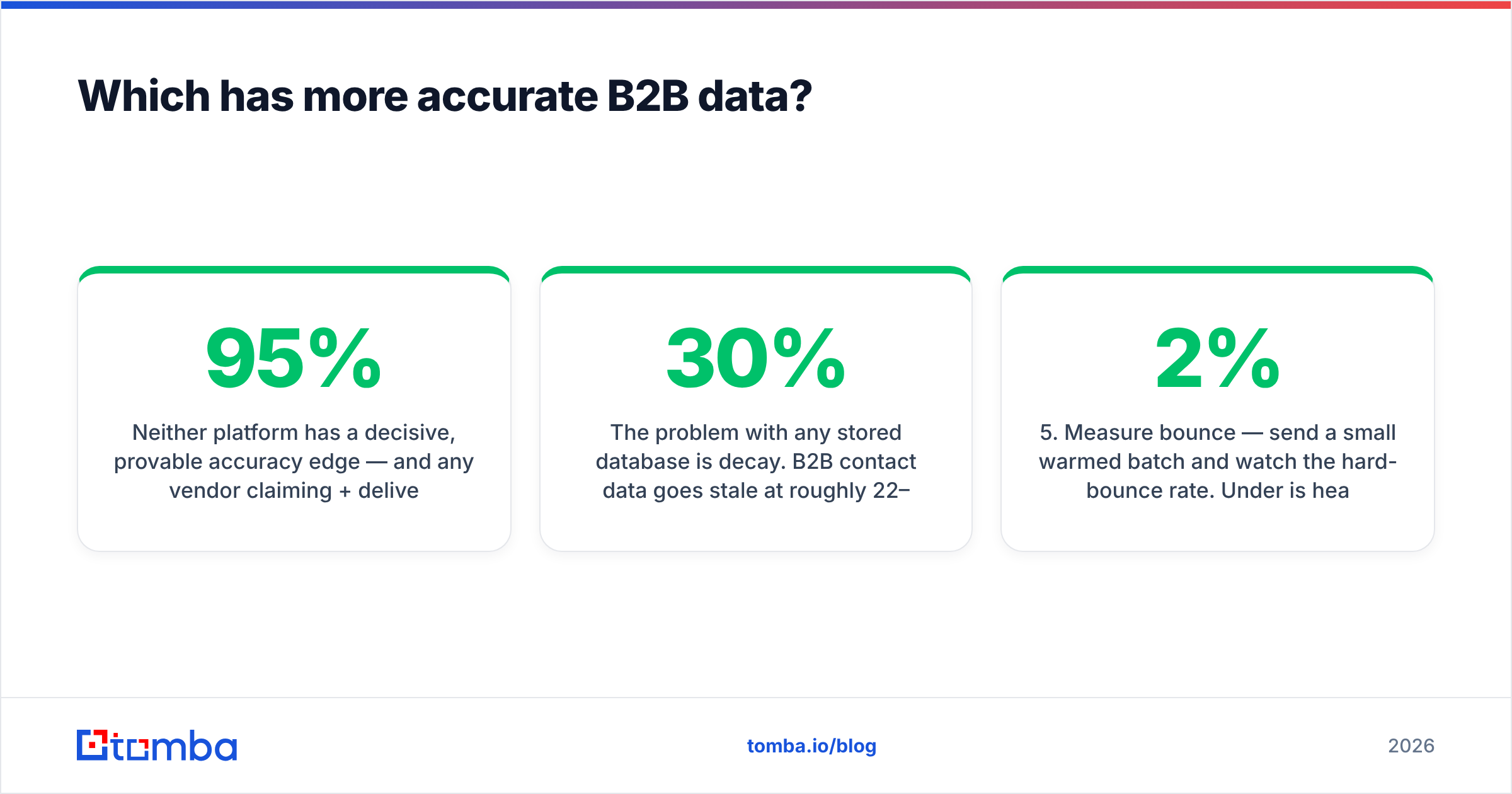
| Attribute | Clodura.ai | Zintlr |
|---|---|---|
| Core focus | All-in-one prospecting + engagement | Contact data + personality intelligence |
| B2B database | Yes, global coverage | Yes, strong on direct dials |
| Buyer-intent signals | Yes, built in | Limited |
| Email sequencing | Yes, native | No / partner integrations |
| Built-in dialer | Yes | No |
| Enrichment | Yes | Yes, a core strength |
| Free trial / tier | Free plan with limited credits | Free trial credits |
| Best for | Teams wanting one integrated tool | Reps who personalize outreach |
| Learning curve | Steeper (more modules) | Lighter (focused scope) |
The pattern is clear. Clodura.ai wins on breadth. Zintlr wins on focus and per-contact insight. Neither is objectively "better." The right pick depends on whether you value one contract or best-fit depth.
Which has more accurate B2B data?#
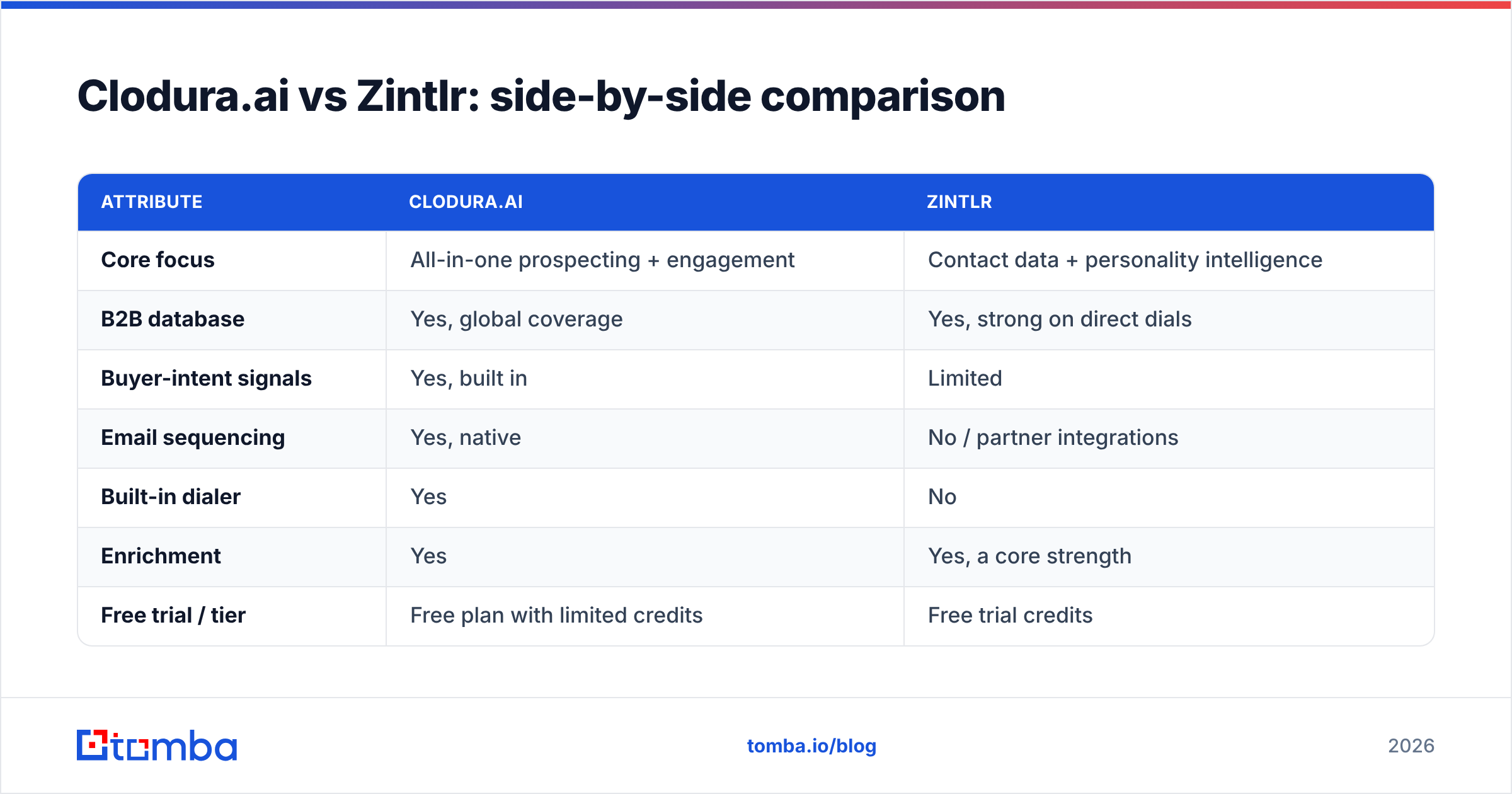
Neither platform has a clear, provable accuracy edge. Any vendor claiming 95%+ deliverability across the board deserves skepticism. Clodura.ai and Zintlr build their databases the same way most players do. They aggregate public sources, partner feeds, and crowdsourced records. Then they match your search against stored profiles.
The problem with any stored database is decay. B2B contact data goes stale at roughly 22–30% per year. People change jobs, companies rebrand, and inboxes get retired. A record that was right when it entered the database can be wrong by the time you email it. That is true for Clodura.ai. It is true for Zintlr. It is true for every database-first tool on the market.
This is why a real-time verification step matters, whichever platform you choose. Before you load a list into a sequence, run it through a dedicated checker. Tomba's approach to data accuracy leans on live SMTP checks rather than static matches. That is a different mechanism than a database lookup, and the two work well together. Use the platform to find prospects. Use a verifier to confirm the address is still live.
How to sanity-check any vendor's data before you pay:
- Pull a sample — export 100 contacts in your actual target segment, not the vendor's demo list.
- Verify independently — run that sample through a third-party email verifier and note the valid-vs-risky split.
- Check the direct dials — call 10 numbers; connect rate tells you more than any accuracy claim.
- Test recency — spot-check five LinkedIn profiles against the vendor's job titles for role changes.
- Measure bounce — send a small warmed batch and watch the hard-bounce rate. Under 2% is healthy.
- Compare coverage — note how many target accounts returned zero contacts. Coverage gaps hurt more than accuracy misses.
How do Clodura.ai and Zintlr price their plans?#
Clodura.ai bundles data, sequencing, and dialing into tiered plans. So the headline price buys more surface area. That makes it feel costly next to a data-only tool. But it can be cheaper than assembling three separate subscriptions. Zintlr is narrower. It can come in at a lower entry point if you only need data and enrichment. You are not paying for a sequencer you won't use.
Here is the honest framing. Compare total cost of ownership, not sticker price. Say you already pay for a sequencer and dialer you love. Then Zintlr's focused scope may be the cheaper net choice. Say you are starting from scratch and want one bill. Then Clodura.ai's bundle usually wins on math.
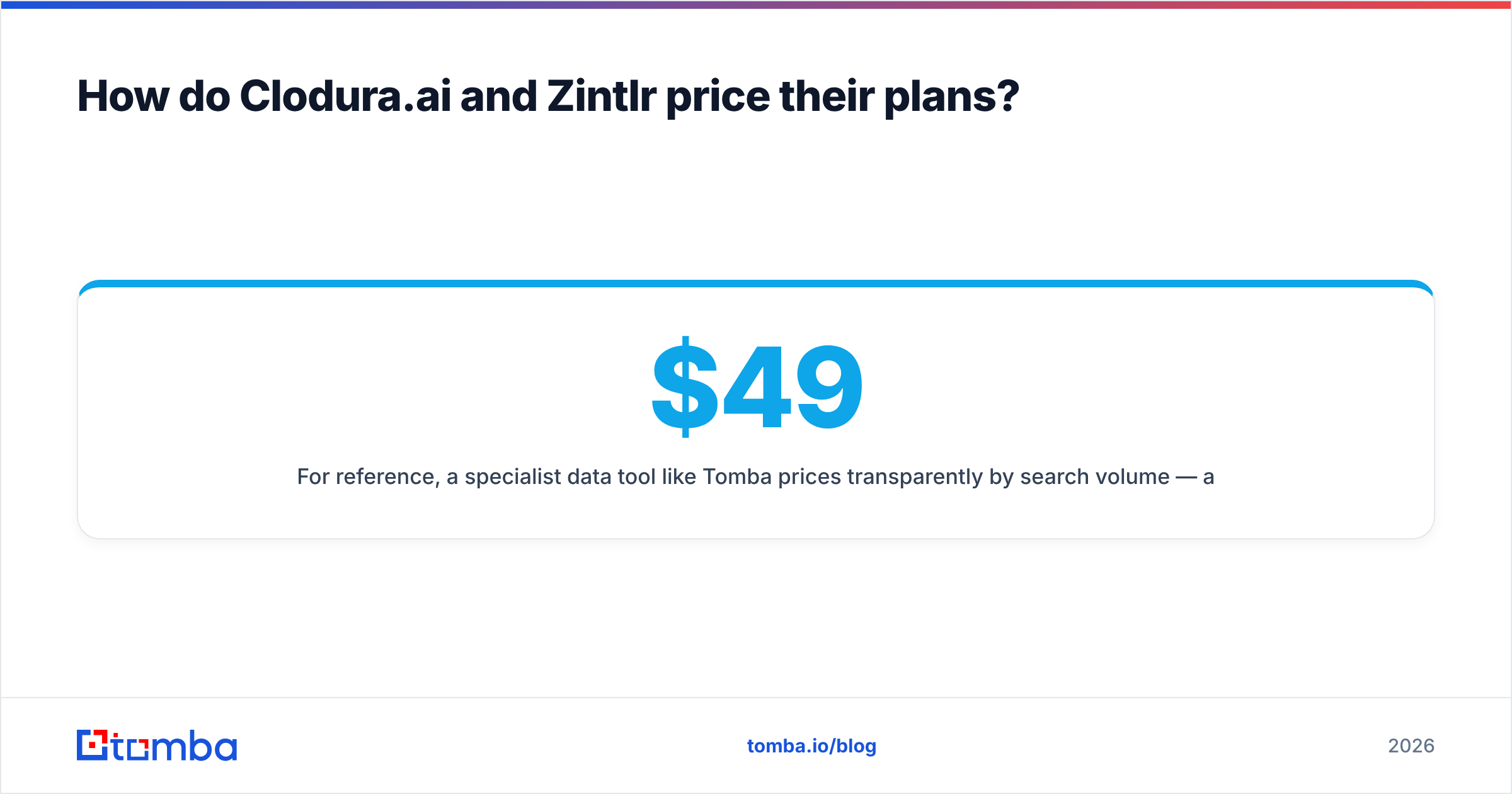
For reference, a specialist data tool like Tomba prices by search volume. There is a free tier with 25 searches a month, Starter at $49/mo, Growth at $99/mo, and Pro at $249/mo. You can see the full Tomba pricing breakdown. It helps you benchmark what pure email-finding should cost, separate from bundled engagement features.

Is Clodura.ai or Zintlr better for cold email?#
Clodura.ai is the more natural fit if you want cold email inside the same tool. Native sequencing means you build the list and launch the cadence without leaving the platform. Zintlr expects you to bring your own sending tool. That is fine if you have one, and a gap if you don't.
But "handled inside the same tool" comes with a caveat. It applies to every all-in-one. Sequencers bundled into data platforms rarely match dedicated senders on deliverability controls, warmup, and inbox rotation. Is cold email your primary channel at high volume? Then a specialist sender will outperform a bundled one. Is email just one of several touches? Then the built-in option is good enough.
Whichever you use, the deliverability basics don't change. Clean your list. Verify addresses. Warm your domain. Keep bounce rates low. No database protects your sender reputation for you, whether it is Clodura, Zintlr, or anything else. That part is on your process.
When should you use a dedicated email finder instead?#
Reach for a focused email finder when your bottleneck is finding and verifying accurate addresses at scale. That is a different job than running sequences. Say you already have a CRM, a sender, and a dialer you like. Then layering a full suite on top is overkill. You would pay for modules you'll never open.
In that case, a specialist tool is the leaner play. Tomba's email finder locates professional addresses by domain, name, or company, and verifies them in real time. The data enrichment layer fills in the rest of the record. It plugs into your existing stack through an API and integrations. You don't have to migrate your whole outbound motion. For teams whose only real gap is data, that is a cheaper, sharper answer than either broader platform.
A useful rule of thumb:
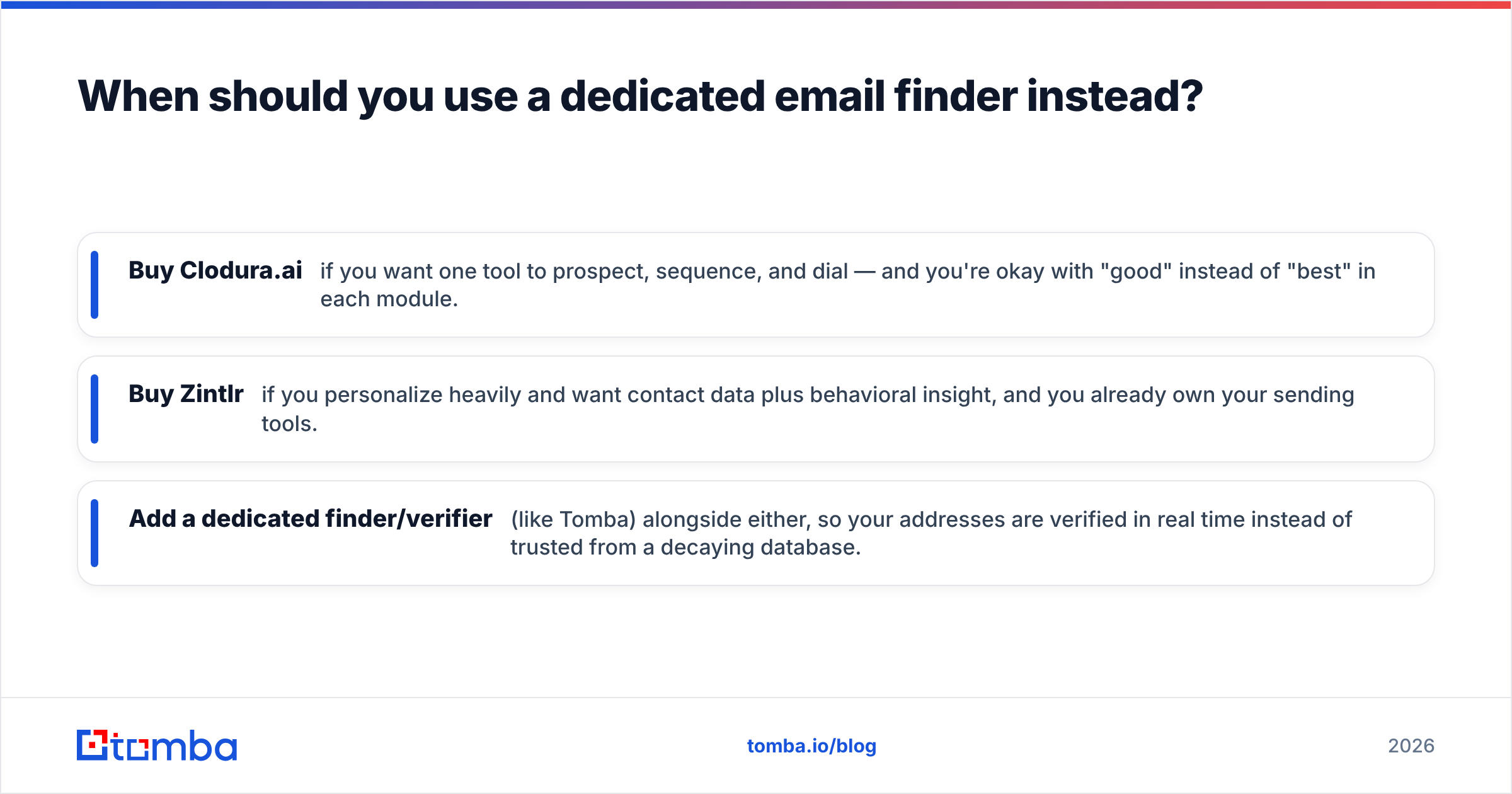
- Buy Clodura.ai if you want one tool to prospect, sequence, and dial — and you're okay with "good" instead of "best" in each module.
- Buy Zintlr if you personalize heavily and want contact data plus behavioral insight, and you already own your sending tools.
- Add a dedicated finder/verifier (like Tomba) alongside either, so your addresses are verified in real time instead of trusted from a decaying database.
The verdict: which one should you pick?#
There is no universal winner. There is a winner for your setup. Clodura.ai is the stronger choice for teams that want consolidation and are starting outbound near zero. The integrated database, intent signals, and dialer justify the bundle. Zintlr is the stronger choice for reps who live by personalization and already trust their sending tools. The enrichment and personality layer add real signal per touch.
Cross-referencing verified reviews on G2 before you buy is worth ten minutes. Pay attention to comments about data coverage in your region and industry. That is where averages hide the most variance.
Both tools share one weakness, the same one every database-first platform has. Static data decays, and neither verifies in real time the way a specialist does. That is not a reason to skip them. It is a reason to pair them. Use Clodura.ai or Zintlr to source and organize prospects. Then let a dedicated verification layer confirm the address is still good before you hit send.
Get accurate contact data without the guesswork#
Is your real problem finding and verifying business emails, not buying another sequencer? Then start with the tool built for exactly that. The Tomba Email Finder locates professional addresses by domain, name, or company, and verifies each one in real time. Your lists stay clean and your bounce rates stay low. It slots in beside Clodura.ai, Zintlr, or whatever engagement stack you already run, through a simple API and native integrations. Start free with 25 searches a month. Scale up only when the pipeline proves it out.
Related guides#
// get started
Find, verify and enrich your first contacts today
Start on the free plan with 25 searches a month, then scale when your team is ready.
Free plan · No credit card required · GDPR & CCPA
// about the author