Coefficy Pros and Cons: An Honest 2026 Review and Verdict
Thinking about Coefficy for prospecting? Here's an honest breakdown of the real pros, the hidden cons, pricing traps, and how it stacks up against alternatives in 2026.

Coefficy shows up on a lot of shortlists when teams hunt for contact data. But the real Coefficy pros and cons are harder to judge than the marketing page admits. This is a neutral, hands-on look at where Coefficy helps, where it quietly costs you, and who should skip it.
TL;DR — Coefficy pros and cons at a glance#
- Best for: small teams that want a simple, single-purpose lead lookup without a heavy CRM-style platform.
- Biggest pro: a low learning curve and fast time-to-first-contact — you can pull emails within minutes of signing up.
- Biggest con: credit and overage economics get expensive at scale, and verification depth trails specialist tools.
- Watch out for: catch-all domains, thin coverage outside major markets, and pricing that changes as you add seats.
- Bottom line: fine as a starter tool, but many teams outgrow it and move to a provider with stronger data sourcing and verification.
What is Coefficy?#
Coefficy is a B2B contact and email-lookup tool aimed at sales and marketing teams that need to turn a name, company, or domain into a usable email address. In plain terms, think of it like a phone book that guesses and checks: you give it who you're trying to reach, and it returns a best-guess address plus a confidence signal.
That category — email finding and enrichment — is crowded. Coefficy competes with dedicated email finder platforms, all-in-one sales engagement suites, and free browser scrapers. Where it lands depends on two things most demos skip: how accurate the data is on your target accounts, and what you actually pay once you scale past the trial. Those two questions shape most of the Coefficy pros and cons that follow.
Before you commit budget, read live user reviews on a neutral site like G2 or Capterra, not the vendor's own testimonials. Patterns in the 3-star reviews tell you more than the 5-star ones.
What are the main pros of Coefficy?#
Let's start with what genuinely works. These are the reasons Coefficy keeps landing on shortlists.
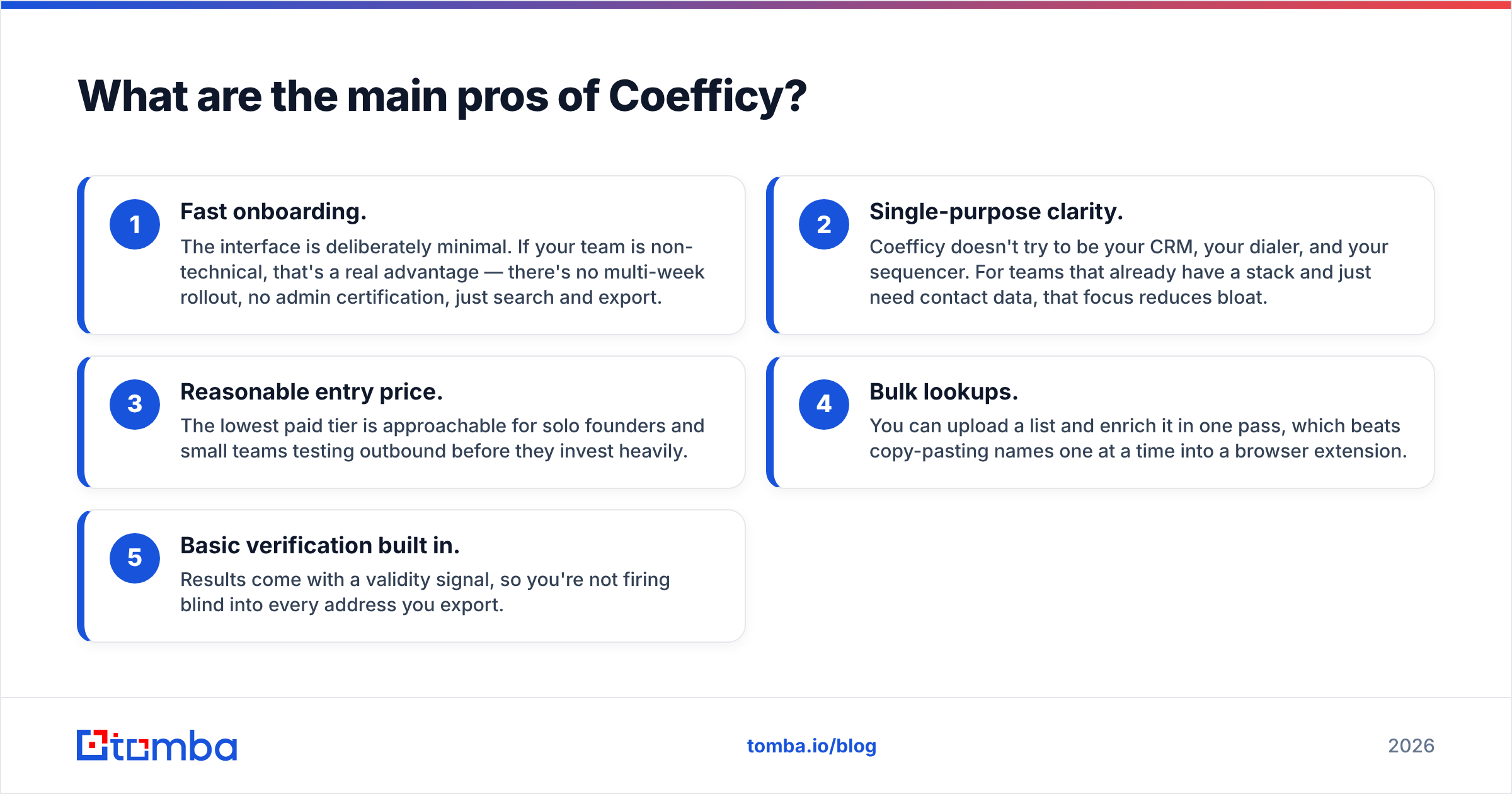
- Fast onboarding. The interface is deliberately minimal. If your team is non-technical, that's a real advantage — there's no multi-week rollout, no admin certification, just search and export.
- Single-purpose clarity. Coefficy doesn't try to be your CRM, your dialer, and your sequencer. For teams that already have a stack and just need contact data, that focus reduces bloat.
- Reasonable entry price. The lowest paid tier is approachable for solo founders and small teams testing outbound before they invest heavily.
- Bulk lookups. You can upload a list and enrich it in one pass, which beats copy-pasting names one at a time into a browser extension.
- Basic verification built in. Results come with a validity signal, so you're not firing blind into every address you export.
Those pros are real. For a two-person team sending 200 emails a week, Coefficy can be perfectly adequate. Still, the Coefficy pros and cons tilt once your volume, your geography, or your accuracy bar goes up.
What are the cons of Coefficy?#
Here's the honest side that the pricing page won't lead with.
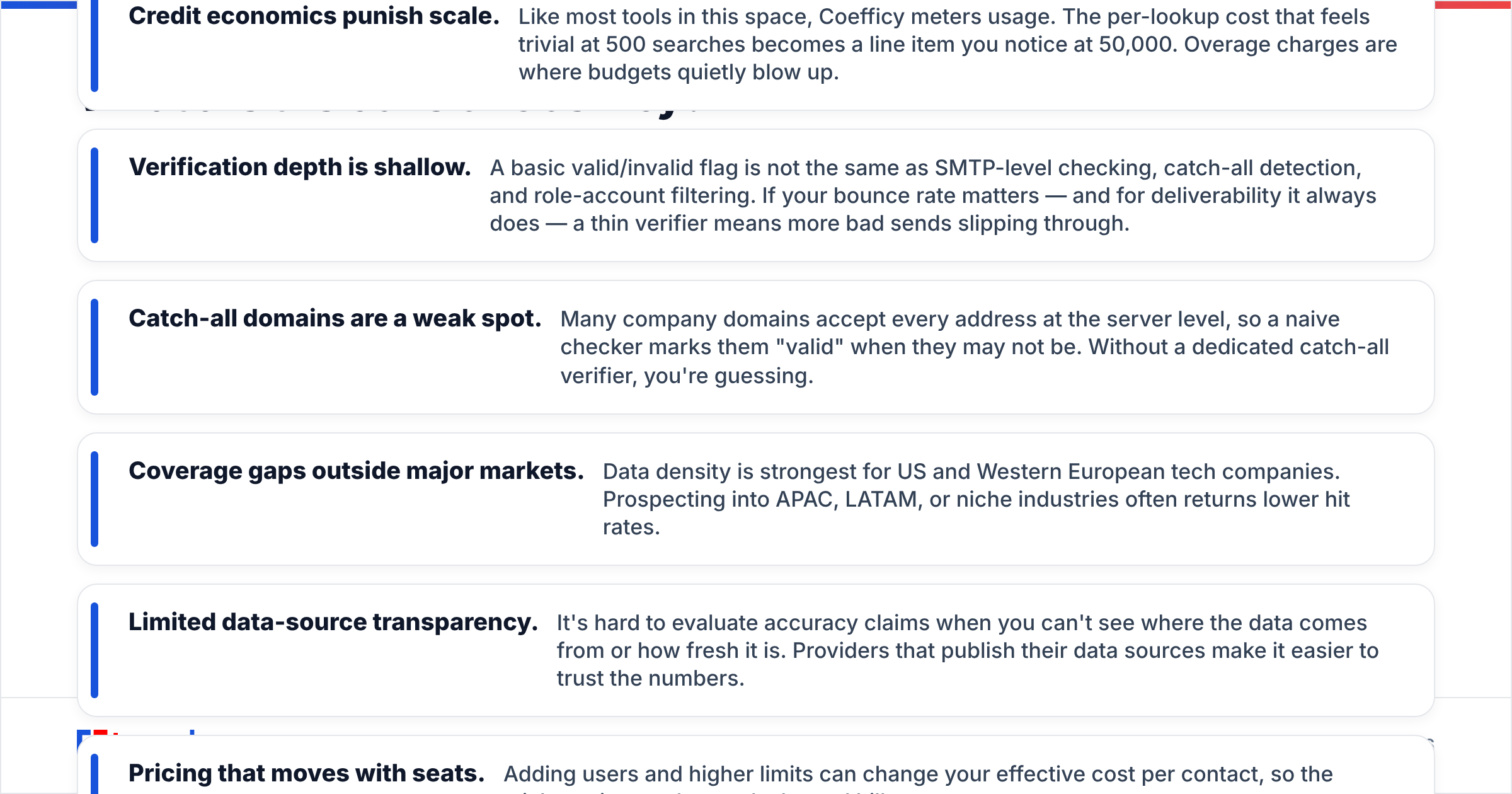
- Credit economics punish scale. Like most tools in this space, Coefficy meters usage. The per-lookup cost that feels trivial at 500 searches becomes a line item you notice at 50,000. Overage charges are where budgets quietly blow up.
- Verification depth is shallow. A basic valid/invalid flag is not the same as SMTP-level checking, catch-all detection, and role-account filtering. If your bounce rate matters — and for deliverability it always does — a thin verifier lets more bad sends slip through.
- Catch-all domains are a weak spot. Many company domains accept every address at the server level, so a naive checker marks them "valid" when they may not be. Without a dedicated catch-all verifier, you're guessing.
Those first three cons all trace back to verification. The rest of the Coefficy pros and cons are about reach and price:
- Coverage gaps outside major markets. Data density is strongest for US and Western European tech companies. Prospecting into APAC, LATAM, or niche industries often returns lower hit rates.
- Limited data-source transparency. It's hard to evaluate accuracy claims when you can't see where the data comes from or how fresh it is. Providers that publish their data sources make it easier to trust the numbers.
- Pricing that moves with seats. Adding users and higher limits can change your effective cost per contact, so the sticker price rarely equals the real bill.
None of these are disqualifying on their own. Stacked together, they explain why teams frequently start with a lightweight tool and migrate once outbound becomes a serious revenue channel.
How accurate is Coefficy's data?#
Accuracy is the whole ballgame, so treat any single headline number with suspicion — including Coefficy's. It sits at the center of most Coefficy pros and cons. "95% accurate" means little unless it's measured on domains like yours, checked against live SMTP responses, and reported honestly on catch-all and role addresses.
The practical test is simple. Take 100 of your real target contacts, run them through the tool, send verification, and measure the bounce rate on the survivors. That's the only accuracy number that matters, and it's the one to run during any free trial before you pay.

For context, accuracy is not just a data-sourcing problem — it's a verification problem. A tool can find the right pattern (first.last@company.com) and still hand you a dead mailbox if it doesn't validate at the server. That's why pairing any finder with a rigorous email verifier usually cuts bounces more than switching finders does.
Coefficy vs Tomba: how do they compare?#
Here's a side-by-side on the attributes that actually drive cost and deliverability. Coefficy figures below reflect commonly reported ranges and will vary by plan and seat count — confirm current numbers on their site before buying.

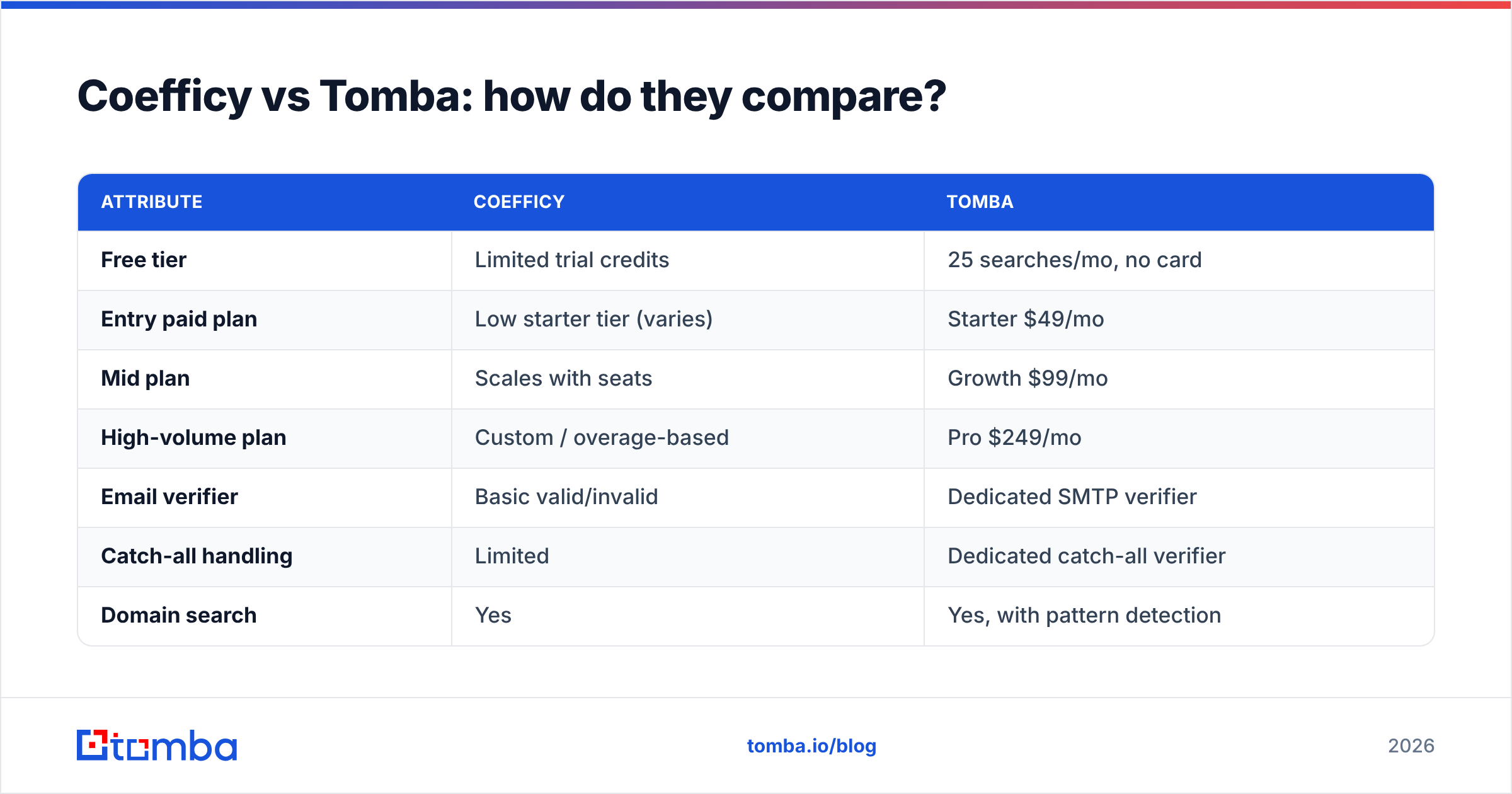
| Attribute | Coefficy | Tomba |
|---|---|---|
| Free tier | Limited trial credits | 25 searches/mo, no card |
| Entry paid plan | Low starter tier (varies) | Starter $49/mo |
| Mid plan | Scales with seats | Growth $99/mo |
| High-volume plan | Custom / overage-based | Pro $249/mo |
| Email verifier | Basic valid/invalid | Dedicated SMTP verifier |
| Catch-all handling | Limited | Dedicated catch-all verifier |
| Domain search | Yes | Yes, with pattern detection |
| Data-source transparency | Limited | Published sources |
| API / integrations | Available | API, CLI, Sheets, HubSpot, more |
This head-to-head surfaces the Coefficy pros and cons that actually affect your bill. The takeaway isn't that one tool wins every row — it's that the comparison you care about is your accounts, your volume, your geography. Run both trials against the same 100 contacts and let the bounce rate decide. You can review current Tomba pricing to see how the tiers line up against Coefficy's overage model.
Who should use Coefficy — and who should skip it?#
Here's how the Coefficy pros and cons map to real teams.
Coefficy is a reasonable fit if you:
- Send low-to-moderate volume (a few hundred emails a week).
- Prospect mostly into US/EU tech companies where data density is high.
- Want the simplest possible tool with no platform overhead.
- Are testing outbound before committing to a larger stack.
You should probably look elsewhere if you:
- Run high-volume outbound where per-lookup and overage costs compound fast.
- Care deeply about deliverability and need strong catch-all and SMTP verification.
- Prospect into markets outside the tool's coverage sweet spot.
- Need transparent data sourcing to satisfy compliance or internal accuracy audits.
- Want deep workflow integrations (CRM sync, Sheets, API automation) as a first-class feature, not an add-on.
A useful rule of thumb: the cheaper the entry tier looks, the more you should model your cost at real volume. Cheap-per-credit tools often become expensive-per-outcome once overages and rework from bounces are counted. For a primer on why bounces matter so much, HubSpot's sales and marketing resources cover deliverability fundamentals in depth.
What are the best Coefficy alternatives in 2026?#
If Coefficy's cons are dealbreakers for you, the alternatives generally fall into three buckets:
- Specialist finders + verifiers — tools built primarily to find and validate emails accurately, with dedicated catch-all handling and published data sourcing. Best when deliverability is the priority.
- All-in-one sales suites — platforms that bundle finding, sequencing, and CRM. Powerful but heavier, pricier, and often overkill if you just need clean data.
- Free/scraper tools — browser extensions and one-off lookups. Fine for tiny volume, but coverage and verification are weakest here.
Tomba sits in the first bucket. Beyond the core finder, it offers a dedicated verifier, domain search with email-pattern detection, catch-all verification, and a full API — the pieces that most directly address Coefficy's weak spots around verification depth and coverage transparency. It's not the only good option, but if your complaint about Coefficy is "the data isn't clean enough at scale," a verification-first tool is the logical next step.
How do you actually evaluate a tool like this?#
Skip the demo theater and run a controlled test:
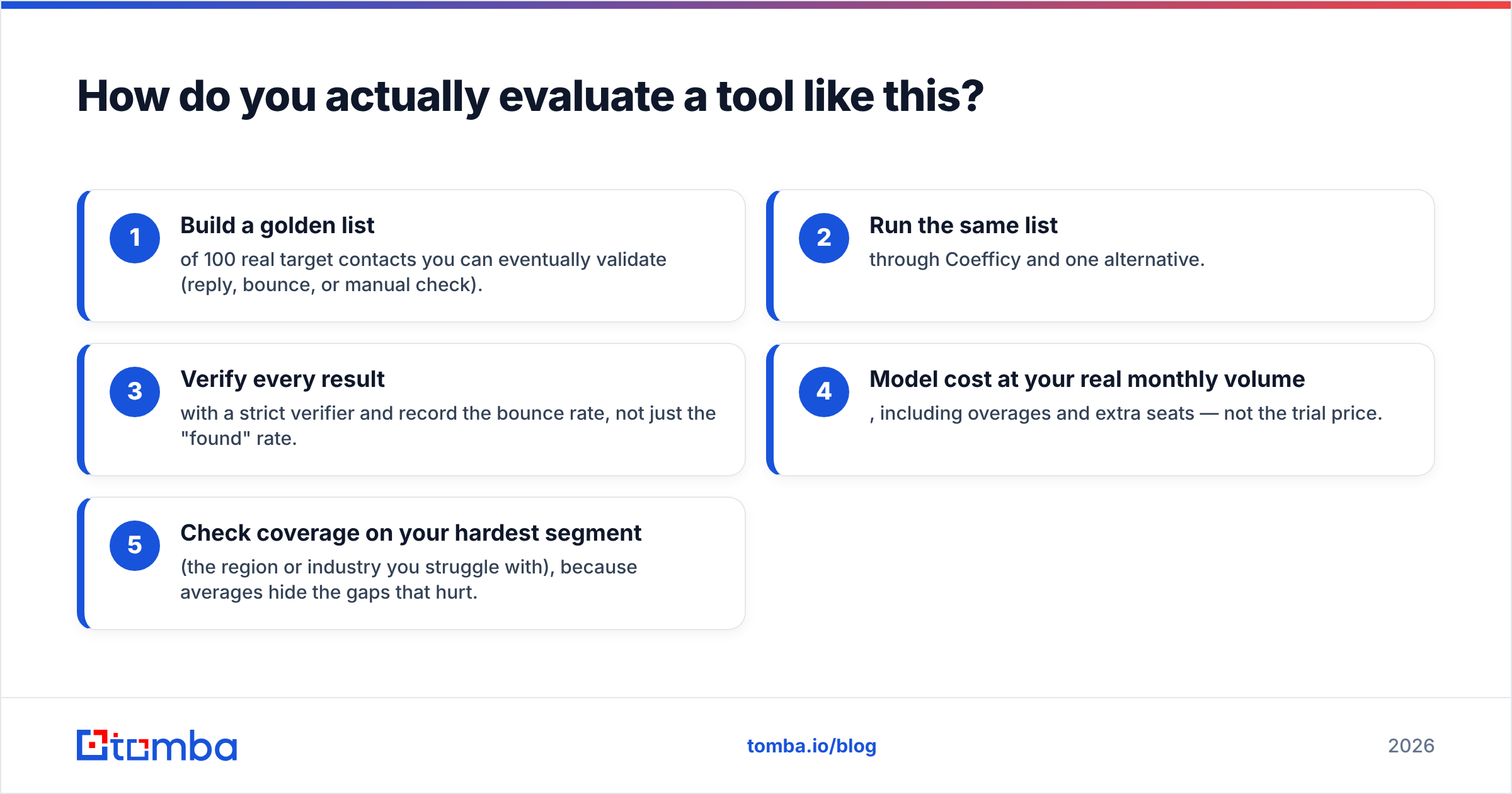
- Build a golden list of 100 real target contacts you can eventually validate (reply, bounce, or manual check).
- Run the same list through Coefficy and one alternative.
- Verify every result with a strict verifier and record the bounce rate, not just the "found" rate.
- Model cost at your real monthly volume, including overages and extra seats — not the trial price.
- Check coverage on your hardest segment (the region or industry you struggle with), because averages hide the gaps that hurt.
Whichever tool wins that test is the right answer for you, regardless of who has the slicker landing page.
The verdict on Coefficy's pros and cons#
So how do the Coefficy pros and cons net out? Coefficy is a competent, simple email-finding tool that does its job for small, focused teams — the pros are real and the onboarding is genuinely painless. But the cons compound as you scale. Overage-driven pricing, shallow verification, weaker catch-all handling, and limited data transparency are exactly the things that start to matter once outbound becomes a serious revenue engine. If you're a solo founder testing the waters, it may be all you need. If bounce rates, coverage, and predictable cost keep you up at night, trial a verification-first alternative side by side before you commit.
If clean, verified contact data is the goal, put Tomba's email finder head to head with Coefficy on your own golden list. Start on the free tier — 25 searches a month, no card required — run the same 100 contacts through both, and let the bounce rate pick the winner instead of the marketing copy.
Related guides#
Ready to find emails that actually work?
Join 150,000+ professionals who stopped guessing and started sending. Free credits on signup — no credit card required.
Get the Tomba newsletter
Practical outbound tactics and product updates — once every two weeks.
About the author