Cognism vs Enrichley: Data Accuracy, Pricing, and Coverage Compared
Cognism and Enrichley both promise clean B2B contact data, but they price, source, and verify it very differently. Here's an honest breakdown — plus a cheaper alternative worth testing first.
Choosing a B2B data vendor is really a bet on two things: how accurate the records are, and how much you'll pay to keep them fresh. Cognism and Enrichley both sell that promise, but they sit at very different points on the price-and-scale curve. This comparison breaks down where each one earns its keep, where it doesn't, and how to decide without signing a year-long contract you'll regret in month three.
TL;DR: Cognism vs Enrichley in 30 seconds#
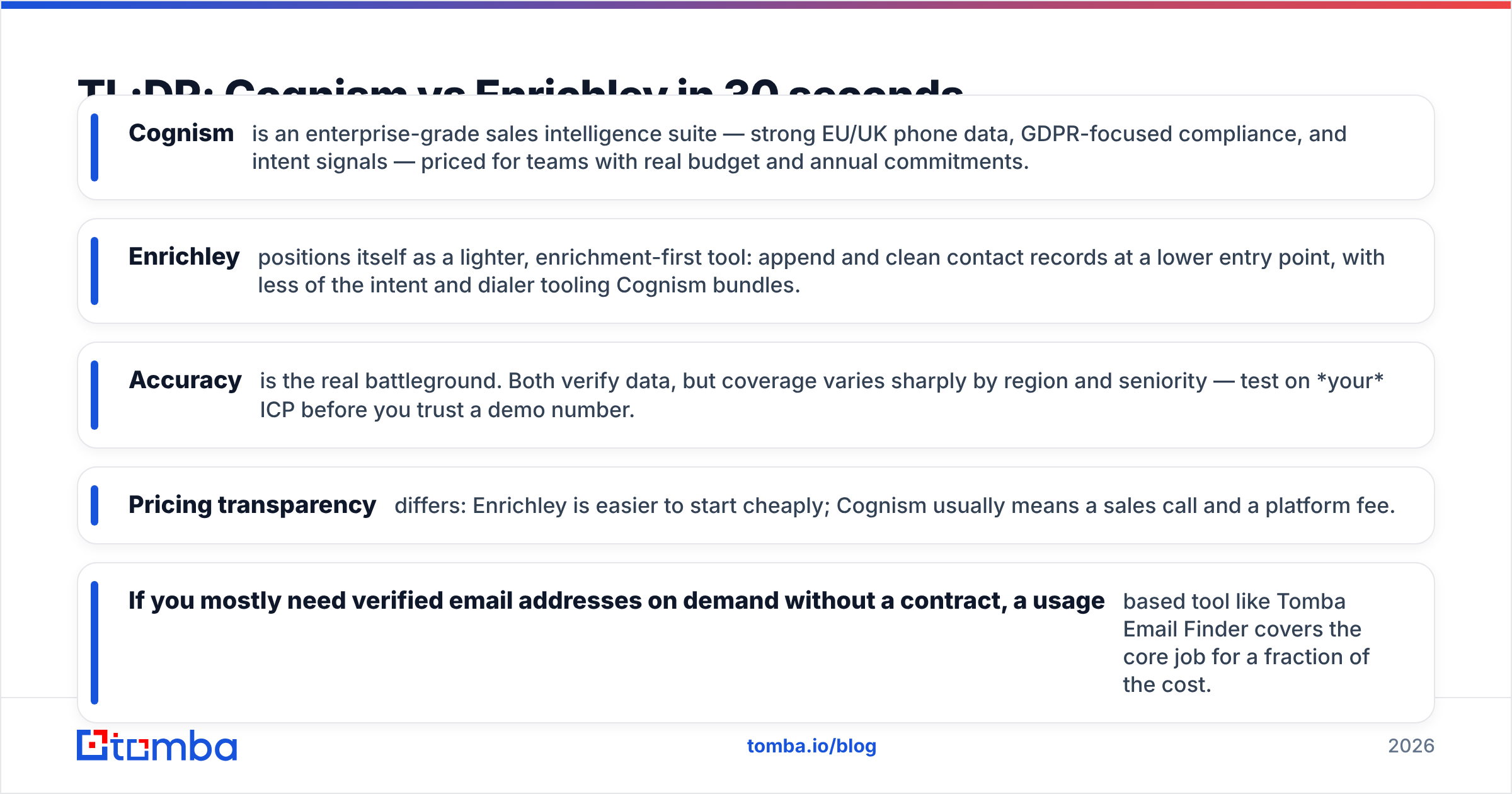
- Cognism is an enterprise-grade sales intelligence suite — strong EU/UK phone data, GDPR-focused compliance, and intent signals — priced for teams with real budget and annual commitments.
- Enrichley positions itself as a lighter, enrichment-first tool: append and clean contact records at a lower entry point, with less of the intent and dialer tooling Cognism bundles.
- Accuracy is the real battleground. Both verify data, but coverage varies sharply by region and seniority — test on your ICP before you trust a demo number.
- Pricing transparency differs: Enrichley is easier to start cheaply; Cognism usually means a sales call and a platform fee.
- If you mostly need verified email addresses on demand without a contract, a usage-based tool like Tomba Email Finder covers the core job for a fraction of the cost.

What is Cognism?#
Cognism is a sales intelligence platform aimed at mid-market and enterprise revenue teams. Its pitch is "compliant, phone-verified data" — most notably its Diamond Data mobile numbers, which are human-verified, and its strong European coverage where many US-built databases go thin. Beyond raw contacts, Cognism bundles intent data, technographics, and workflow integrations into CRMs and sales engagement tools.
The trade-off is packaging and price. Cognism sells platform-style: you buy a seat-based license, often annually, and coverage/credits are negotiated. That's a fit for teams running structured outbound at scale, and a poor fit for a two-person startup that just needs a few hundred verified emails a month.
You can confirm the current positioning on Cognism's own site and cross-check user sentiment on G2, where reviewers consistently praise EU phone accuracy and flag the annual-commitment pricing.
What is Enrichley?#
Enrichley is an enrichment-first data tool. The core job is taking a partial record — a name, a company, an email, a domain — and filling in the missing fields: job title, company size, LinkedIn URL, corporate email, sometimes phone. It leans toward the "clean and append your existing list" use case rather than the "build a net-new prospecting motion inside one platform" use case that Cognism targets.
Because it's narrower, Enrichley tends to be easier to adopt and cheaper to start with. You won't get the same depth of intent signals, dialer-grade mobile verification, or enterprise compliance tooling. For a lot of RevOps teams, that's fine — they already have a CRM and a sequencer, and they just need the data layer to be accurate and affordable.
Cognism vs Enrichley: side-by-side comparison#
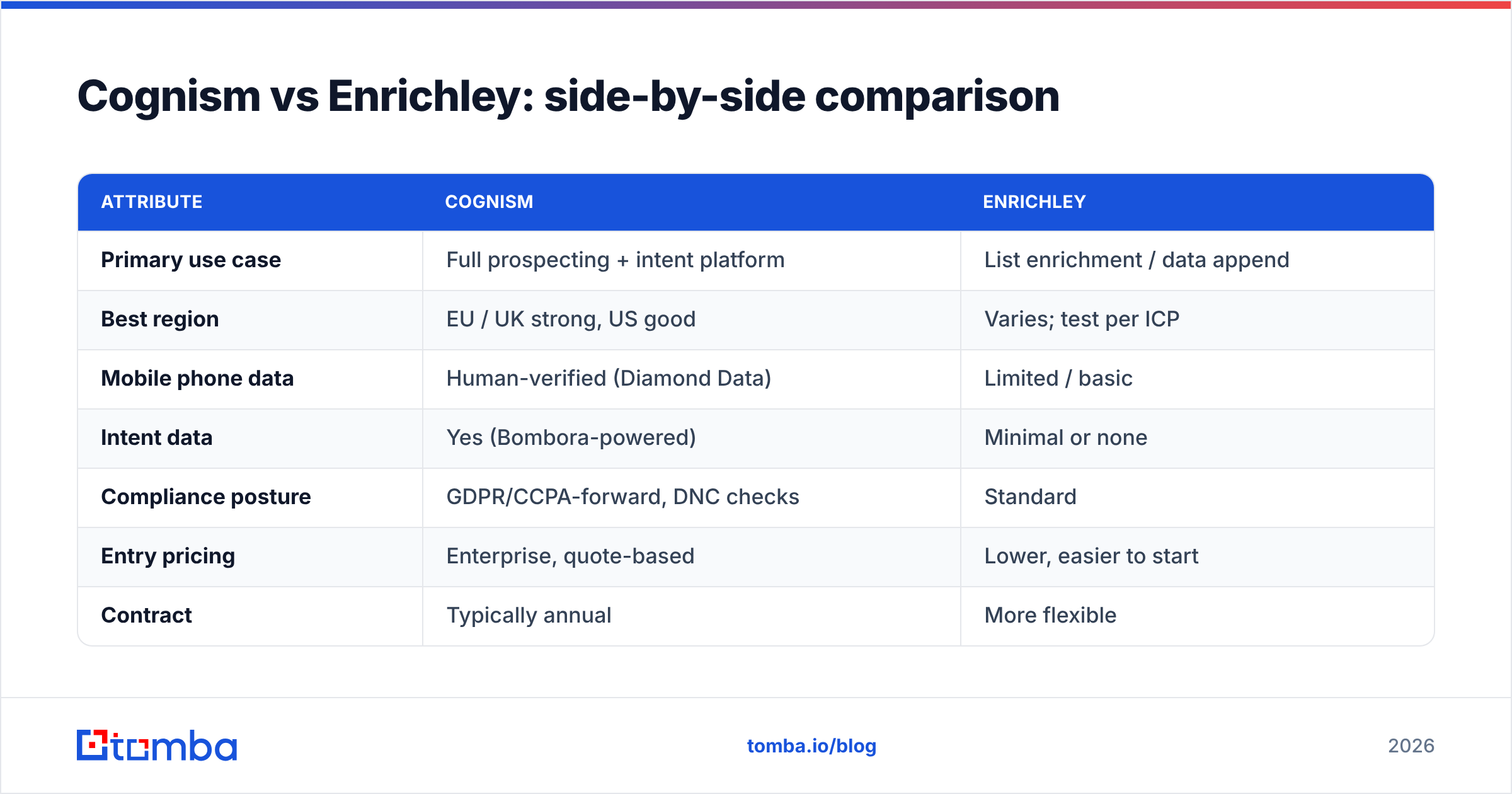
Here's the honest head-to-head. Treat any single "accuracy %" with skepticism — the number that matters is the one you measure on your target accounts.
| Attribute | Cognism | Enrichley |
|---|---|---|
| Primary use case | Full prospecting + intent platform | List enrichment / data append |
| Best region | EU / UK strong, US good | Varies; test per ICP |
| Mobile phone data | Human-verified (Diamond Data) | Limited / basic |
| Intent data | Yes (Bombora-powered) | Minimal or none |
| Compliance posture | GDPR/CCPA-forward, DNC checks | Standard |
| Entry pricing | Enterprise, quote-based | Lower, easier to start |
| Contract | Typically annual | More flexible |
| Best for | Enterprise SDR teams at scale | Lean RevOps / ops-led enrichment |
The pattern is clear: Cognism is the heavier, pricier, more complete platform; Enrichley is the lighter, cheaper, append-focused tool. Neither is "better" in the abstract — they're built for different buyers.
Is Cognism's data more accurate than Enrichley's?#
The honest answer: it depends entirely on your target region and seniority. Cognism's structural advantage is European mobile and direct-dial data, plus compliance screening that reduces the risk of dialing numbers on suppression lists. If your motion is EU/UK outbound calling, that edge is real and hard to replicate cheaply.
Enrichley competes on append quality for lower-friction fields — corporate email, title, firmographics — where the gap between vendors narrows considerably. For a US-centric email motion, the accuracy difference between a premium platform and a focused enrichment tool is often smaller than the price difference implies.

Three rules keep you honest when you evaluate:
- Test on your real ICP, not the vendor's sample. Demo lists are curated. Upload 200 of your actual target accounts and measure hit rate and bounce rate yourself.
- Separate "found" from "verified." A returned email isn't a valid one. Run every result through an email verifier before you send, regardless of which vendor produced it.
- Watch catch-all domains. Many corporate domains accept everything, inflating "valid" rates. A dedicated catch-all verifier tells you what's actually deliverable.
How do Cognism and Enrichley price their plans?#
This is where the two diverge most and where budget-conscious teams should pay attention.
Cognism uses platform pricing: a base license plus seats, with data credits and modules (intent, enrich, etc.) layered on. Expect a sales conversation, an annual term, and a four-to-five-figure starting point depending on team size. You're paying for breadth and compliance, not just records.
Enrichley's model is friendlier to a smaller team — lower entry cost, more willingness to sell you just the enrichment you need. That flexibility is the whole point: you don't buy an intent engine you'll never open.
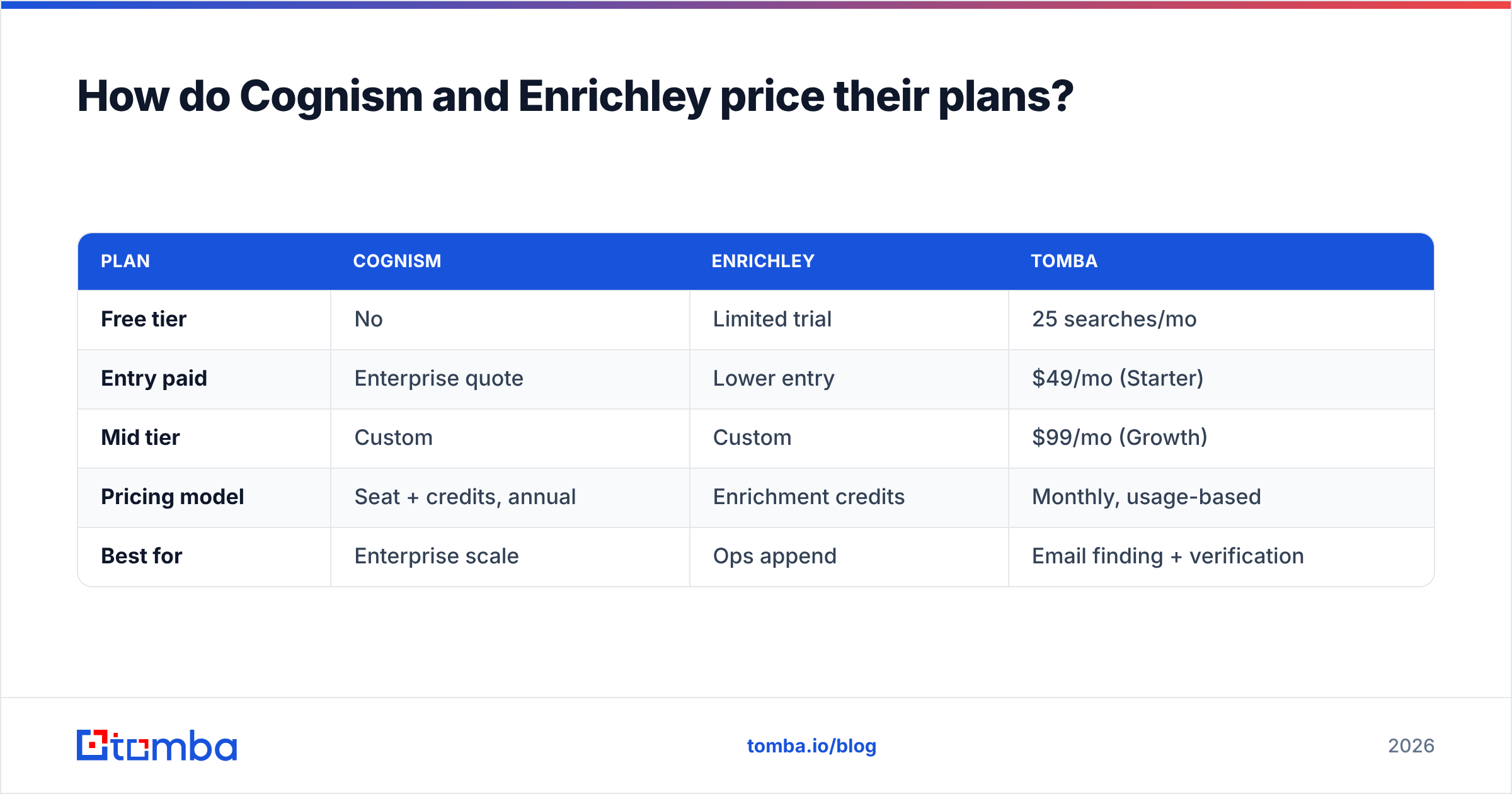
But there's a third option many teams overlook. If your actual recurring need is "find and verify professional emails by name, company, or domain," you don't need a full intelligence platform or a broad enrichment suite. A usage-based finder does that one job cheaply and transparently:
| Plan | Cognism | Enrichley | Tomba |
|---|---|---|---|
| Free tier | No | Limited trial | 25 searches/mo |
| Entry paid | Enterprise quote | Lower entry | $49/mo (Starter) |
| Mid tier | Custom | Custom | $99/mo (Growth) |
| Pricing model | Seat + credits, annual | Enrichment credits | Monthly, usage-based |
| Best for | Enterprise scale | Ops append | Email finding + verification |
Tomba's transparent pricing — Free (25 searches), Starter $49/mo, Growth $99/mo, Pro $249/mo — means you can start today without a contract and scale credits as you grow. See exactly where the data comes from before you commit.

Which one should you choose?#
Match the tool to the motion, not the marketing.
Choose Cognism if: you run a structured, multi-rep outbound team, you dial into the EU/UK where its mobile data shines, and compliance screening is a hard requirement. You have budget for an annual platform and you'll actually use the intent and technographic layers. For that buyer, Cognism's completeness justifies the cost. If you're only after the platform breadth but want to compare peers, review options like BookYourData, a respected data provider with a pay-as-you-go angle, alongside it.
Choose Enrichley if: you already own your stack (CRM + sequencer) and you need an affordable, focused way to clean and append records. You don't need dialer-grade mobile data or an intent engine, and you value a lower entry price and flexible terms over platform depth.
Choose a usage-based finder like Tomba if: your recurring job is finding verified emails on demand — by domain, by name, or in bulk — and you'd rather pay for what you use than sign a platform contract. It slots neatly beside either competitor when you just need to fill the email gap accurately.
Can you combine these tools?#
Yes, and many teams do. A common stack: use Cognism for compliant EU phone dials and intent triggers, then use a cheaper, high-accuracy email finder to top up the addresses those signals surface. Or use Enrichley to append firmographics to inbound leads while running a separate finder for outbound email discovery.
The Tomba API and native integrations make it easy to bolt email finding and verification onto whatever platform you standardize on, so you're not double-paying a premium vendor for the one field it happens to charge the most for.
The bottom line#
Cognism vs Enrichley isn't a fight for the same customer. Cognism wins for enterprise EU/UK calling teams that need compliance and intent under one roof. Enrichley wins for lean ops teams that want affordable append without the platform overhead. And for the specific, recurring task of finding and verifying professional emails, neither is the cheapest path.
Before you sign anything, benchmark all three on your own list. Start free with the Tomba Email Finder — 25 searches a month, no credit card, no sales call — find verified emails by name, company, or domain, and see how the accuracy stacks up against a demo number before you commit a quarter's budget to a contract.
Related guides#
// get started
Find, verify and enrich your first contacts today
Start on the free plan with 25 searches a month, then scale when your team is ready.
Free plan · No credit card required · GDPR & CCPA
// about the author