Cognism vs Extruct AI (2026): Which B2B Data Tool Wins?
Cognism sells a curated B2B contact database; Extruct AI builds custom company lists with AI research agents. Here's an honest, side-by-side breakdown of which one fits your GTM motion in 2026.
Cognism vs Extruct AI (2026): Which B2B Data Tool Wins?
Choosing between Cognism and Extruct AI is not a like-for-like decision. One is a mature, compliance-first contact database. The other is an AI research layer that builds custom company lists on demand. Picking the wrong one wastes budget and sends your reps chasing the wrong accounts.
TL;DR#
- Cognism is a phone-verified, GDPR-focused B2B contact and company database. Best when you need mobile numbers, verified emails, and intent data at scale.
- Extruct AI is an AI agent platform that researches the open web and assembles bespoke company lists with custom attributes. Best when your ICP is niche and no off-the-shelf database covers it.
- They solve different problems: Cognism gives you depth on known contacts; Extruct gives you discovery of unknown accounts.
- Cognism is priced for teams (annual seats, often four to five figures). Extruct is usage-based and lighter to start.
- Many teams run a hybrid: discover accounts with an AI researcher, then enrich contacts with a dedicated finder like Tomba's email finder. More on that below.
What is Cognism?#
Cognism is a sales intelligence platform built around a large, human-and-machine-verified contact database. Its reputation rests on two things: Diamond Data (phone-verified mobile numbers) and a compliance posture aimed at GDPR and CCPA markets. Reps use it to pull direct dials, verified work emails, firmographics, and buying-intent signals directly into a CRM or sequencer.
The core promise is coverage plus accuracy on people you already want to reach. If your ICP is "VP of Engineering at 200–2,000 employee SaaS companies in the EU," Cognism likely already has those records sitting in its database, refreshed on a schedule.
Where it gets rigid: you work inside the data Cognism has. If your target segment is unusual — say, "companies that just switched packaging suppliers" or "clinics running a specific EHR" — a static database rarely captures that nuance.
What is Extruct AI?#
Extruct AI takes the opposite approach. Instead of querying a pre-built database, it deploys AI research agents that crawl the live web, company sites, directories, and public sources to build a list from scratch against criteria you define in natural language. You describe the kind of company you want, add custom columns ("uses Shopify Plus," "has raised a Series B in the last 18 months," "hiring for RevOps"), and the agents populate a spreadsheet-style output.
This is powerful for top-of-funnel discovery in categories where no vendor sells a clean list. The trade-off is that AI-researched data is only as fresh and accurate as the sources it reads, and it typically returns company-level signals rather than a deep, phone-verified contact record for every individual.
Think of Cognism as a well-stocked warehouse and Extruct as a personal shopper who goes out and finds items the warehouse doesn't carry.
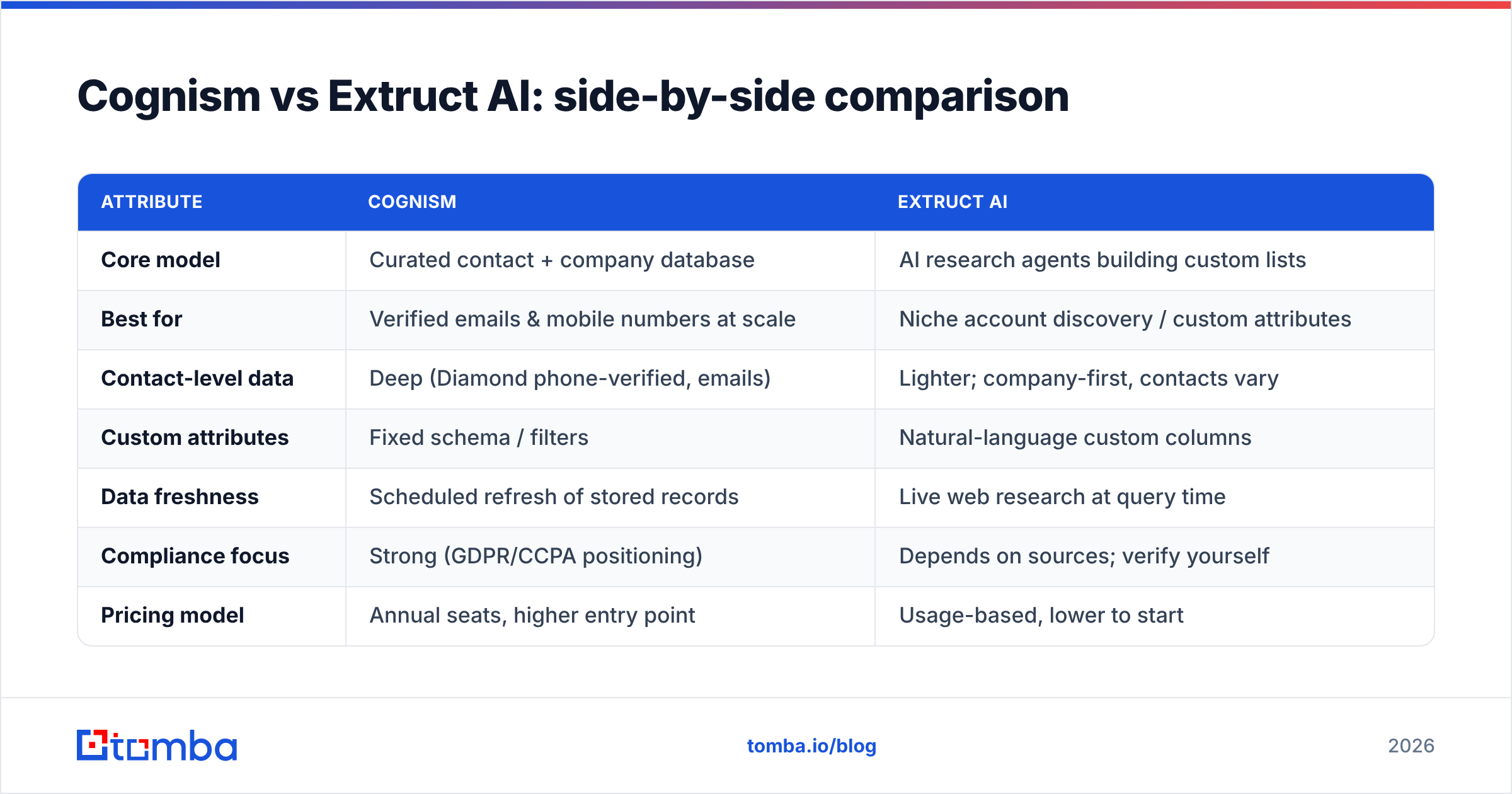
Cognism vs Extruct AI: side-by-side comparison#
| Attribute | Cognism | Extruct AI |
|---|---|---|
| Core model | Curated contact + company database | AI research agents building custom lists |
| Best for | Verified emails & mobile numbers at scale | Niche account discovery / custom attributes |
| Contact-level data | Deep (Diamond phone-verified, emails) | Lighter; company-first, contacts vary |
| Custom attributes | Fixed schema / filters | Natural-language custom columns |
| Data freshness | Scheduled refresh of stored records | Live web research at query time |
| Compliance focus | Strong (GDPR/CCPA positioning) | Depends on sources; verify yourself |
| Pricing model | Annual seats, higher entry point | Usage-based, lower to start |
| Learning curve | Moderate (platform + CRM setup) | Low (describe list in plain English) |
Which is more accurate?#
Accuracy depends on what you're measuring. For contact-level accuracy — is this the right mobile number, does this email deliver — Cognism generally leads because those records are verified before they reach you. For relevance accuracy — did I get exactly the weird segment I asked for — Extruct often wins, because the agent hunts for signals a fixed database never indexed.
The catch with any AI-researched list is that it needs a verification step. An agent can correctly identify a company and still guess an email pattern that bounces. Whichever tool you pick for discovery, run the output through a dedicated email verifier before you send. Bouncing 15% of a fresh list will torch your sender reputation faster than any tool can rebuild it.
Independent buyer reviews are worth reading before you commit — check current ratings on G2 and cross-reference the specific complaints (regional coverage gaps, credit burn, support responsiveness) against your own use case.
Which is better for pricing and budget?#
Cognism sits at the enterprise end. Pricing is quote-based, sold as annual seats, and typically lands in the four-to-five-figure range depending on data access and add-ons like intent. You commit up front, which is fine for a funded team with a defined ICP but heavy for a solo founder testing a motion.
Extruct's usage-based model is friendlier to experimentation. You pay closer to what you consume, which suits spiky, project-based list building — a launch, an event, a new market test.
If neither budget shape fits, the pragmatic move is to unbundle. Use an AI researcher or a targeted search for discovery, then pay per-lookup for contact data instead of a full seat. That's the logic behind usage-based tools like Tomba, whose transparent pricing starts with a free tier (25 searches/month) and a Starter plan at $49/mo — a fraction of an enterprise database seat.
When should you choose Cognism?#
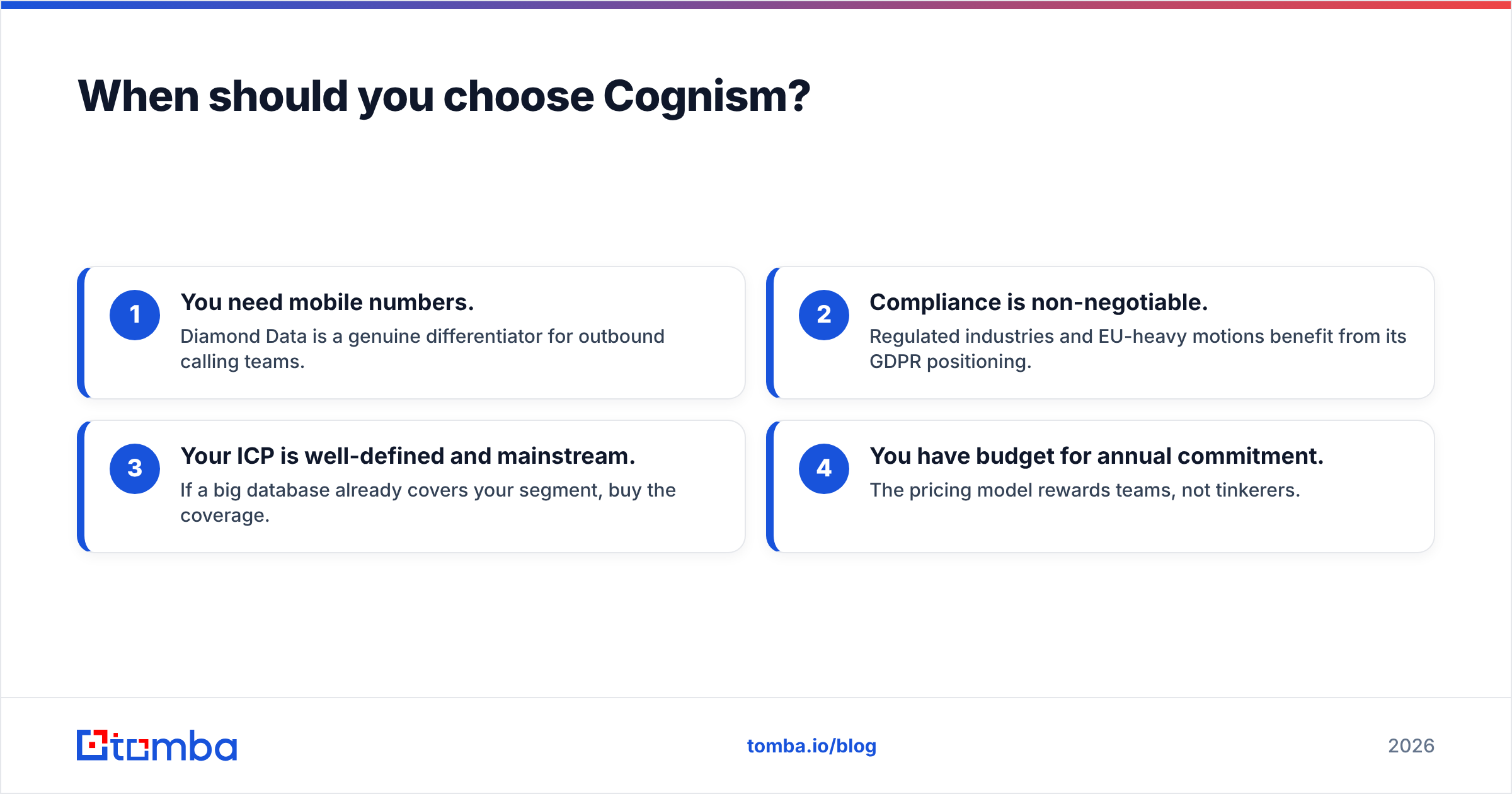
Pick Cognism when:
- You need mobile numbers. Diamond Data is a genuine differentiator for outbound calling teams.
- Compliance is non-negotiable. Regulated industries and EU-heavy motions benefit from its GDPR positioning.
- Your ICP is well-defined and mainstream. If a big database already covers your segment, buy the coverage.
- You have budget for annual commitment. The pricing model rewards teams, not tinkerers.
When should you choose Extruct AI?#
Pick Extruct when:
- Your ICP is niche or signal-based. No vendor sells "companies that just did X" as a clean list — an agent can assemble it.
- You need custom attributes. Natural-language columns beat a fixed filter schema for research-heavy segments.
- You want to start small. Usage-based pricing lowers the risk of testing a new market.
- Discovery matters more than depth. You're finding accounts, then enriching contacts elsewhere.
The hybrid approach: discovery plus enrichment#
Here's what experienced GTM teams actually do in 2026: they stop treating this as either/or. The workflow splits into two jobs.
- Discovery — find the right accounts. This is where an AI researcher (or Cognism's filters) earns its keep.
- Enrichment — turn a company name into a deliverable contact. This is a specialized job, and a purpose-built finder does it cheaper and more accurately than a general platform.
Once you have a target account, Tomba's domain search returns the email patterns and named contacts for that company, and its data enrichment fills the gaps in your existing records. Because it's API-first, you can wire it directly into the output of whichever discovery tool you chose. The Tomba database and API handle the contact layer so your expensive discovery credits aren't wasted re-finding emails.
This is why the "Cognism vs Extruct AI" question is slightly the wrong frame. The real question is: which tool owns discovery, and which owns contact accuracy? They rarely need to be the same product.
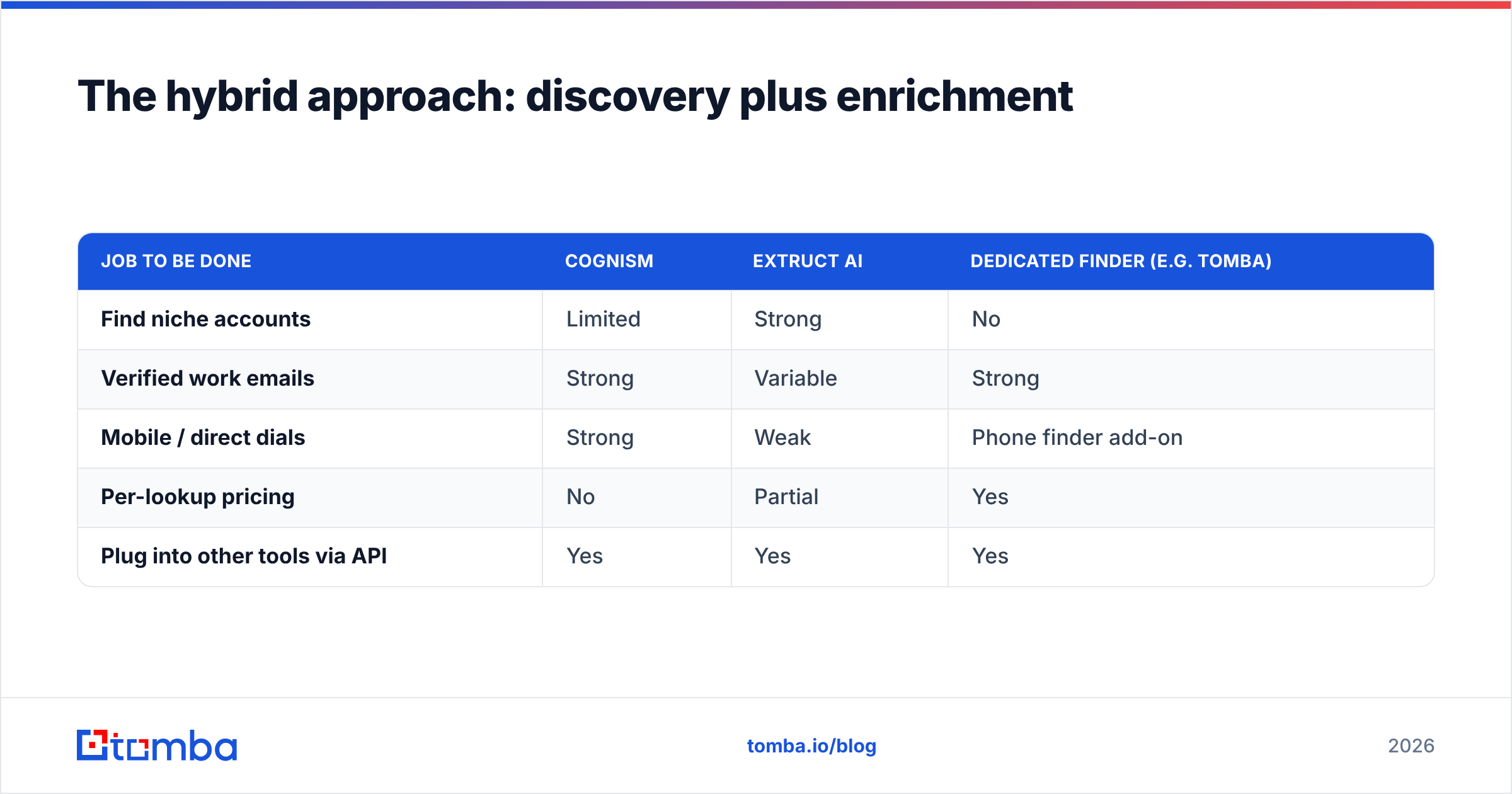
| Job to be done | Cognism | Extruct AI | Dedicated finder (e.g. Tomba) |
|---|---|---|---|
| Find niche accounts | Limited | Strong | No |
| Verified work emails | Strong | Variable | Strong |
| Mobile / direct dials | Strong | Weak | Phone finder add-on |
| Per-lookup pricing | No | Partial | Yes |
| Plug into other tools via API | Yes | Yes | Yes |
What about deliverability and list hygiene?#
No data tool, however good, ships a 100% clean list. Extruct's AI-researched emails and even parts of a large curated database will contain role accounts, catch-alls, and stale records. Before any of it hits your sequencer:
- Verify every address. Remove hard bounces and risky records.
- Check for catch-all domains, which accept everything and hide invalid boxes.
- Warm the sending domain if the volume is new.
Skipping this step is the single most common reason good data underperforms. A verified list from a "worse" tool will out-convert an unverified list from a "better" one every time.
Verdict: Cognism vs Extruct AI#
There's no universal winner — the honest answer is that they're built for different halves of the funnel.
- Choose Cognism if you need verified contacts and mobile numbers at scale, work in a compliance-sensitive market, and have the budget for an annual platform.
- Choose Extruct AI if your ICP is niche, you value custom research over raw coverage, and you want usage-based flexibility.
- Choose a hybrid — and most growing teams should — if you want to control cost: discover accounts with an AI researcher, then enrich and verify contacts with a dedicated, per-lookup finder.
If your bottleneck is turning a list of companies into deliverable, accurate email addresses without paying for a full enterprise seat, start with the Tomba Email Finder. The free tier covers 25 searches a month, plans start at $49/mo, and the API drops straight into whatever discovery tool you land on — so you pay for contact accuracy, not for re-finding data you already have.
Related guides#
Ready to find emails that actually work?
Join 150,000+ professionals who stopped guessing and started sending. Free credits on signup — no credit card required.
Get the Tomba newsletter
Practical outbound tactics and product updates — once every two weeks.
About the author