Cognism vs Fintrx: B2B Data Intelligence Compared (2026)
Cognism is broad B2B sales intelligence; Fintrx is deep private-wealth data. Here's an honest, side-by-side look at which fits your go-to-market and where a leaner tool wins.
Choosing between Cognism and Fintrx feels like comparing a Swiss Army knife to a scalpel. One does a lot across every B2B industry; the other does one thing — private wealth and family-office intelligence — extremely well. Picking wrong means paying five figures for coverage you never use, or missing the exact contacts your niche needs.
This guide breaks down where each platform earns its price, where it doesn't, and when a leaner email-finding stack beats both.
TL;DR: Cognism vs Fintrx at a glance#
- Cognism is broad, GDPR-focused B2B sales intelligence with phone-verified mobile data and strong EMEA coverage. Best for generalist SDR and mid-market teams.
- Fintrx is a specialized private-wealth and family-office data platform. Best for asset managers, fintech, and firms selling to wealth.
- Neither is cheap. Both are annual-contract, sales-gated platforms usually landing well into five figures per year.
- Coverage rarely overlaps. Cognism goes wide across industries; Fintrx goes deep into a single vertical. Your buyer defines the winner.
- If you mostly need accurate work emails and verification, a usage-priced tool like Tomba Email Finder covers that job for a fraction of either contract.
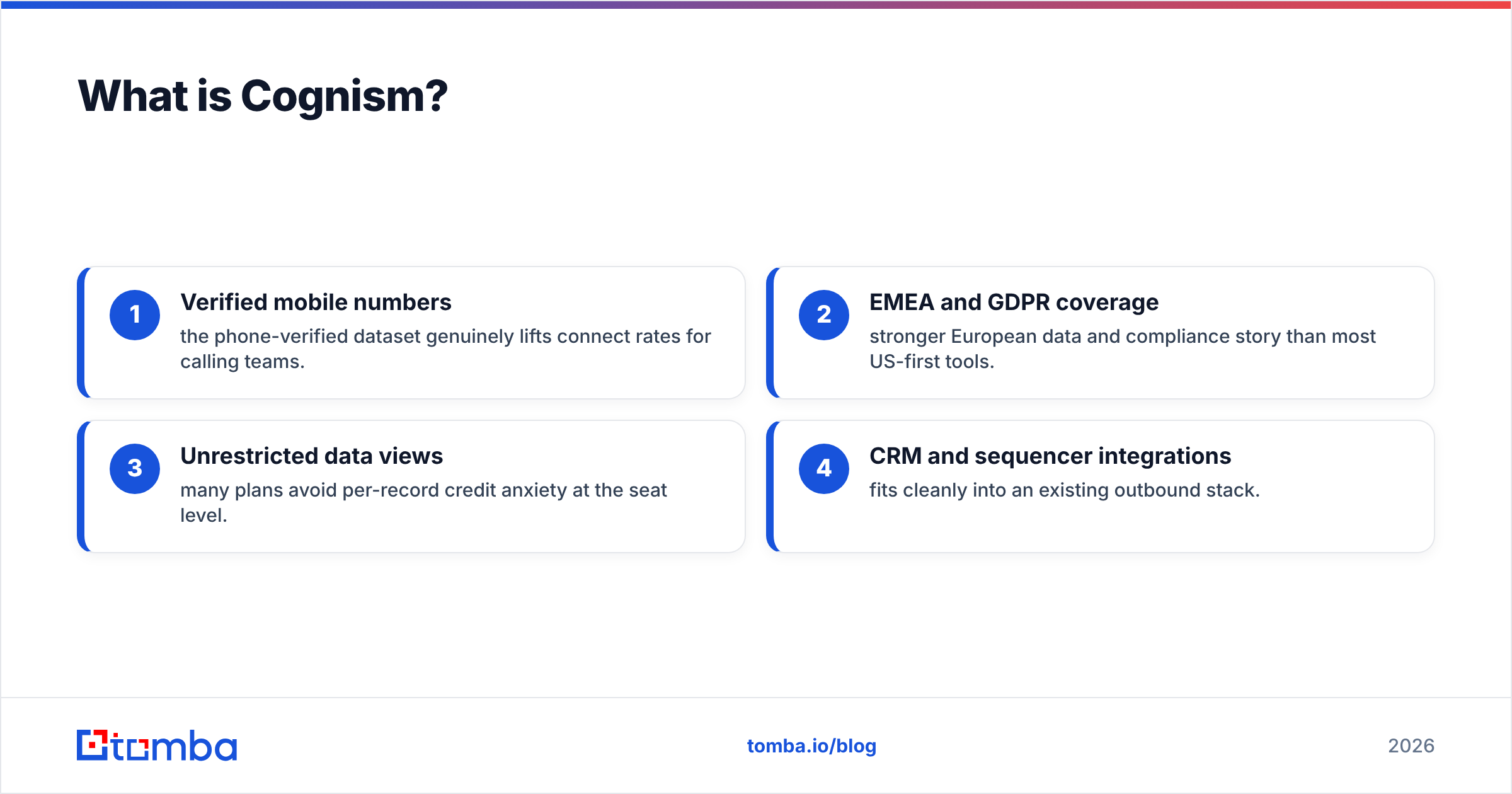
What is Cognism?#
Cognism is a B2B sales intelligence platform built around contact and company data — direct dials, verified mobile numbers, work emails, and firmographic/technographic signals. Its headline feature is "Diamond Data," a set of phone-verified mobile numbers, plus strong compliance positioning for GDPR and other privacy regimes.
Teams use Cognism to build prospect lists, enrich CRM records, and power outbound across a wide range of industries. It integrates with Salesforce, HubSpot, Outreach, and Salesloft, and it's especially popular with EMEA-based revenue teams that need defensible European coverage. You can read more about the category on the Cognism site and cross-check reviews on G2.
Where Cognism shines:
- Verified mobile numbers — the phone-verified dataset genuinely lifts connect rates for calling teams.
- EMEA and GDPR coverage — stronger European data and compliance story than most US-first tools.
- Unrestricted data views — many plans avoid per-record credit anxiety at the seat level.
- CRM and sequencer integrations — fits cleanly into an existing outbound stack.
Where it frustrates buyers: opaque annual pricing, seat minimums, and coverage that thins out in narrow verticals where you need specific named individuals rather than a broad TAM.
What is Fintrx?#
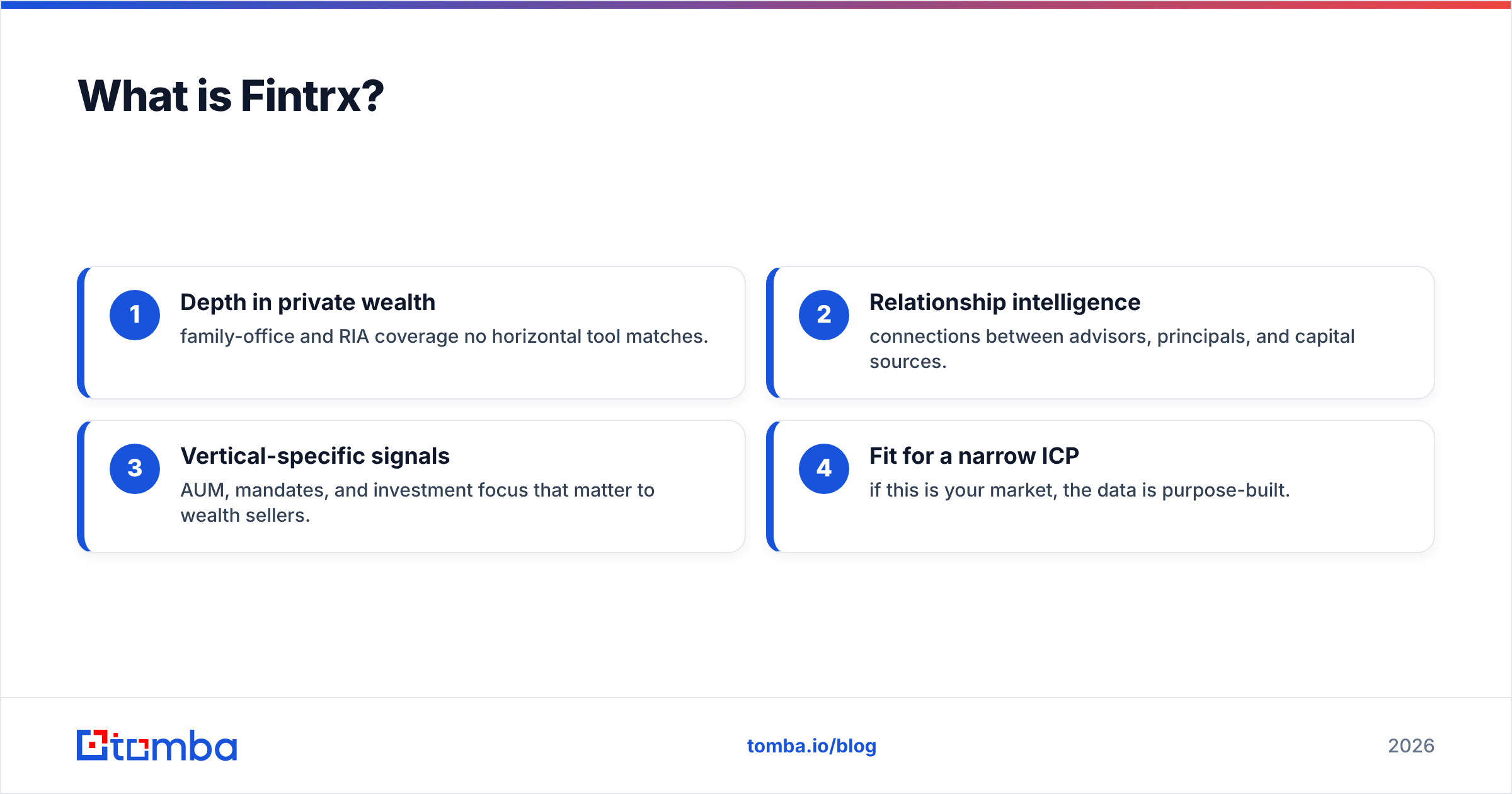
Fintrx is a private-wealth intelligence platform. It maps family offices, registered investment advisors (RIAs), private-wealth advisors, and the professionals and capital connected to them. Instead of covering every industry shallowly, it goes deep on one: the people and entities that move private capital.
If you sell alternative investments, wealth-tech, fund administration, insurance, or luxury services — and your buyers are family offices and advisors — Fintrx gives you relationship maps, AUM signals, and contact data that a generalist database simply doesn't carry. See their positioning on the Fintrx site.
Where Fintrx shines:
- Depth in private wealth — family-office and RIA coverage no horizontal tool matches.
- Relationship intelligence — connections between advisors, principals, and capital sources.
- Vertical-specific signals — AUM, mandates, and investment focus that matter to wealth sellers.
- Fit for a narrow ICP — if this is your market, the data is purpose-built.
Where it frustrates buyers: it's useless outside its niche. If your ICP isn't wealth-adjacent, you're paying premium prices for a dataset you can't use.

Cognism vs Fintrx: the core difference#
The honest one-line verdict: Cognism is a horizontal platform; Fintrx is a vertical one. They only compete when a wealth-focused team is deciding whether a generalist tool is "good enough" versus a specialist.
Think of it like maps. Cognism is a world atlas — every country, useful detail, but you won't find your neighbor's driveway. Fintrx is a street-level survey of one city — every home, owner, and connection, but only in that city. Buying the atlas to navigate one neighborhood wastes money; buying the city survey to plan a global trip is useless.
Your buyer decides which you need. Ask one question: is my ICP "any B2B company" or "family offices and wealth advisors"? That answer picks the platform faster than any feature list.
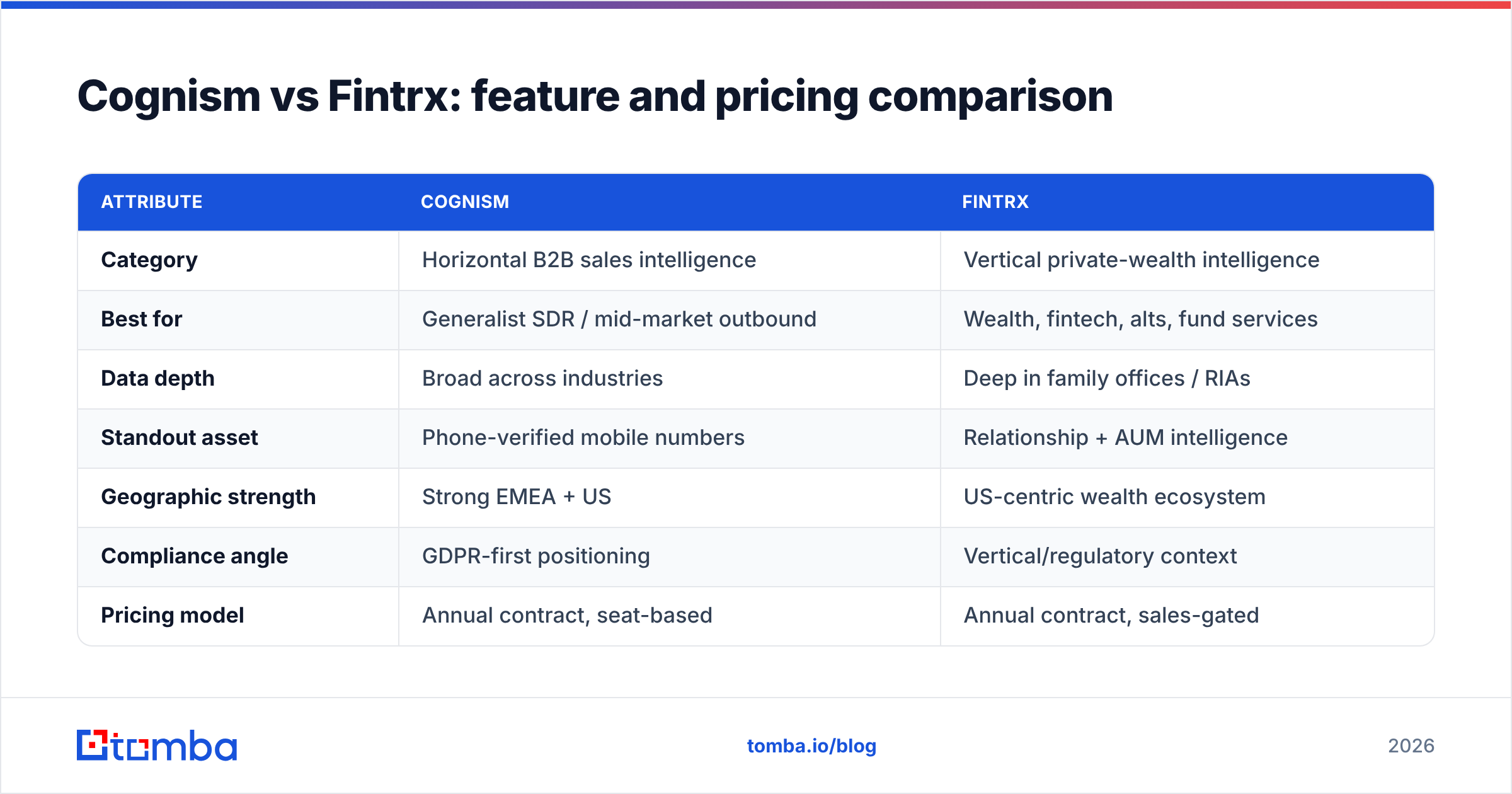
Cognism vs Fintrx: feature and pricing comparison#
Neither vendor publishes flat pricing — both run annual, sales-gated contracts. The figures below reflect typical market ranges reported by buyers on review sites, not official rate cards; verify with each vendor.
| Attribute | Cognism | Fintrx |
|---|---|---|
| Category | Horizontal B2B sales intelligence | Vertical private-wealth intelligence |
| Best for | Generalist SDR / mid-market outbound | Wealth, fintech, alts, fund services |
| Data depth | Broad across industries | Deep in family offices / RIAs |
| Standout asset | Phone-verified mobile numbers | Relationship + AUM intelligence |
| Geographic strength | Strong EMEA + US | US-centric wealth ecosystem |
| Compliance angle | GDPR-first positioning | Vertical/regulatory context |
| Pricing model | Annual contract, seat-based | Annual contract, sales-gated |
| Typical entry cost | ~$15k+/year (reported) | Five-figure/year (reported) |
| Free / self-serve tier | No | No |
| Contract commitment | Annual, minimum seats | Annual |
The pattern is clear: both are commitment-heavy platforms. There's no free tier, no "try 25 lookups this month," and no monthly self-serve option. That's fine if the ICP fit is exact and the ROI is proven. It's painful if you're still validating a market or only need email data.
Which one is more accurate?#
Accuracy is verticaldependent, not absolute — and that's the trap in most head-to-head reviews.
For a broad B2B motion (SaaS selling to operations, marketing, IT), Cognism's coverage and phone verification usually win: more records, verified mobiles, better EMEA hit rates. For a wealth motion (selling to a specific family office principal), Fintrx wins outright — Cognism may not even list the person, and if it does, the wealth context is missing.
So the real accuracy question isn't "which platform is more accurate?" It's "which platform is more accurate for the exact contacts I need this quarter?" Run a blind test: pull 50 real target accounts, ask each vendor for the named decision-makers, then verify the returned emails independently with an email verifier before you trust either provider's internal "valid" flag. Vendor-reported accuracy and deliverable accuracy are not the same number.
That verification step matters regardless of platform. A record marked "valid" in a database can still bounce if it's stale, and bounces damage your sender reputation and long-term email deliverability.
When should you skip both?#
Skip both when your real need is narrower than "a full sales-intelligence platform." A lot of teams buy Cognism or Fintrx to solve a problem that's actually just: I need correct, verified work emails for people I can already identify.
That's an email-finding job, not a platform commitment. If you can name the companies and roles you're targeting — or you already have a list of names and domains — you don't need a five-figure annual contract to reach them.
Signs you should skip both:
- You already know your accounts. You have the company list; you just need contacts at each. A domain search returns the people and email patterns per company.
- You're validating a new market. Committing annually before you've proven the ICP is premature. Usage-based pricing lets you test cheaply.
- You mostly need emails, not phones. If calling isn't your primary channel, you're paying for Diamond Data you won't dial.
- Budget is under $10k/year. Neither platform is realistically in reach; a per-lookup tool is.

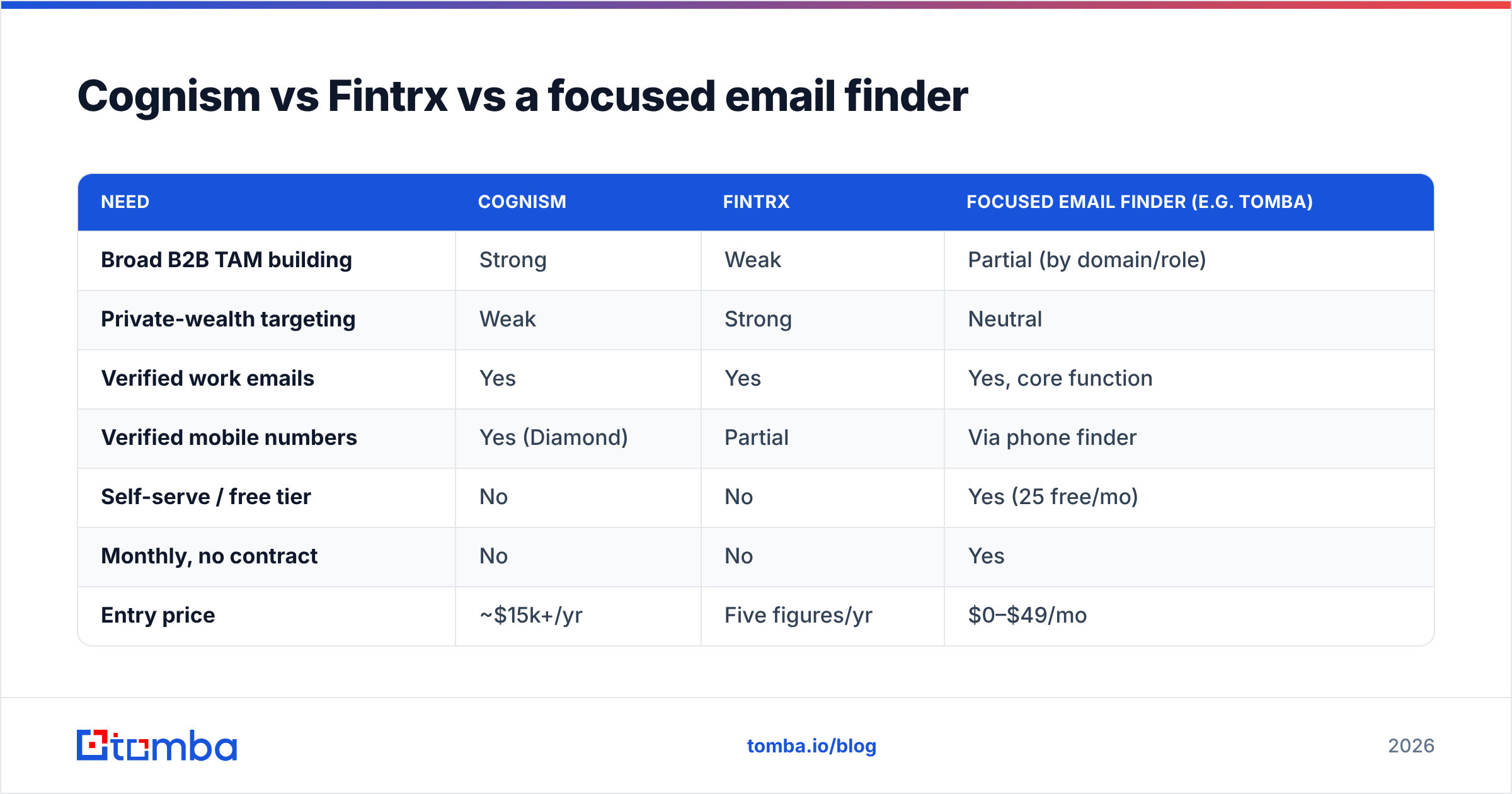
Cognism vs Fintrx vs a focused email finder#
Here's the three-way view most comparison posts skip — because the honest answer for many teams is "neither of these, at least not yet."
| Need | Cognism | Fintrx | Focused email finder (e.g. Tomba) |
|---|---|---|---|
| Broad B2B TAM building | Strong | Weak | Partial (by domain/role) |
| Private-wealth targeting | Weak | Strong | Neutral |
| Verified work emails | Yes | Yes | Yes, core function |
| Verified mobile numbers | Yes (Diamond) | Partial | Via phone finder |
| Self-serve / free tier | No | No | Yes (25 free/mo) |
| Monthly, no contract | No | No | Yes |
| Entry price | ~$15k+/yr | Five figures/yr | $0–$49/mo |
| Bulk enrichment | Yes | Yes | Yes (bulk) |
The point isn't that a focused email finder replaces a full intelligence platform — it doesn't carry Fintrx's wealth graph or Cognism's mobile verification. The point is that if the job is finding and verifying emails, you can do that job at Tomba pricing starting free (25 searches/month), then Starter at $49/mo, Growth at $99/mo, and Pro at $249/mo — no annual lock-in while you prove the motion.
Many teams end up running both layers: a specialist platform for the vertical intelligence they can't get elsewhere, and a lean finder-plus-verifier for everyday contact discovery and list hygiene. Paying platform prices for basic email lookups is the most common overspend in this category.
How to decide in five minutes#
Run this quick decision path:
- Is your ICP family offices, RIAs, or wealth advisors? → Fintrx is the only tool here purpose-built for it. Nothing else compares in that niche.
- Is your ICP broad B2B, and is calling a primary channel? → Cognism's verified mobiles justify the platform cost.
- Do you already know your target accounts and mainly need emails? → Skip both; use a domain search plus verification.
- Are you still validating the market or under ~$10k budget? → Start usage-based, upgrade to a platform only once ROI is proven.
- Do you need EMEA/GDPR-defensible data at scale? → Cognism's compliance story leads.
Most teams that think they need "Cognism vs Fintrx" actually sit on step 3 or 4 — they have accounts and need contacts, or they're not yet sure the market pays.
The verdict#
Cognism wins for broad, phone-led B2B outbound with strong EMEA needs. Fintrx wins — decisively and without real competition — for anyone selling into private wealth. They're not really rivals; they serve different buyers, and your ICP settles the argument before pricing ever enters it.
But before you sign either annual contract, be honest about the job. If it's "find and verify work emails for accounts I can identify," you don't need a platform commitment to start — you need accurate lookups and clean verification. That's exactly what a focused finder does, at a price that doesn't require a procurement cycle.
Start with the fundamentals: find email addresses by company and role, verify them before you send, and only graduate to a full intelligence platform once your motion proves it needs one. Try Tomba Email Finder free — 25 searches a month, no contract, no sales call — and layer a specialist like Cognism or Fintrx on top only where the vertical data genuinely pays for itself.
Related guides#
Ready to find emails that actually work?
Join 150,000+ professionals who stopped guessing and started sending. Free credits on signup — no credit card required.
Get the Tomba newsletter
Practical outbound tactics and product updates — once every two weeks.
About the author