Cognism vs GetProspect (2026): Which B2B Data Tool Wins?
Cognism sells enterprise-grade intent and phone data; GetProspect is a lean, LinkedIn-friendly email finder. Here's an honest 2026 breakdown of accuracy, pricing, and which one fits your team.
Choosing between Cognism and GetProspect usually comes down to one question: do you need an enterprise sales-intelligence suite, or a fast, affordable way to pull verified emails from LinkedIn and company domains? They get lumped together because both sell B2B contact data, but they solve different problems at very different price points.
This is a neutral, hands-on comparison. We'll look at data accuracy, coverage, pricing, compliance, and workflow fit — then help you decide which one (if either) belongs in your stack.
TL;DR#
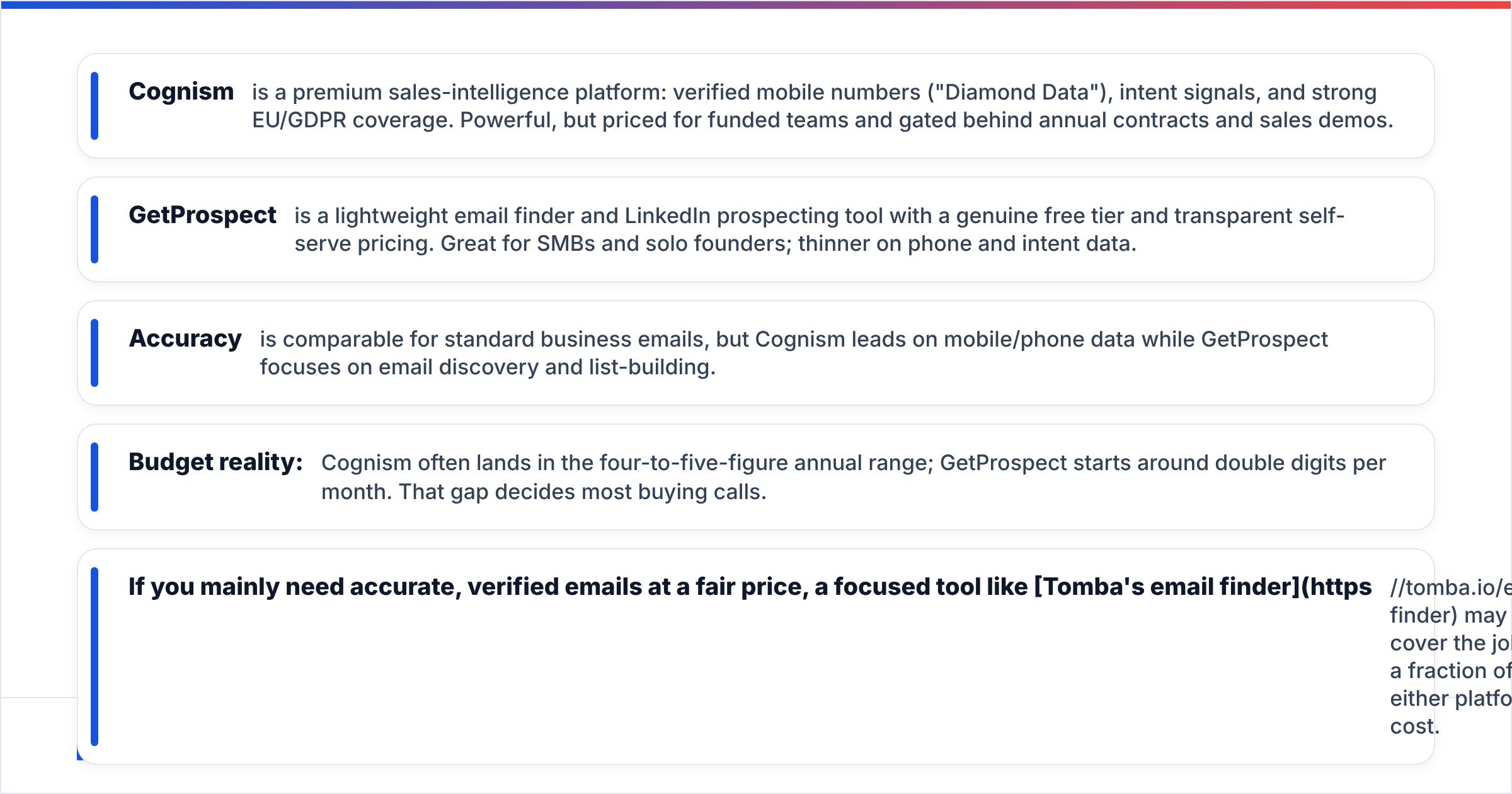
- Cognism is a premium sales-intelligence platform: verified mobile numbers ("Diamond Data"), intent signals, and strong EU/GDPR coverage. Powerful, but priced for funded teams and gated behind annual contracts and sales demos.
- GetProspect is a lightweight email finder and LinkedIn prospecting tool with a genuine free tier and transparent self-serve pricing. Great for SMBs and solo founders; thinner on phone and intent data.
- Accuracy is comparable for standard business emails, but Cognism leads on mobile/phone data while GetProspect focuses on email discovery and list-building.
- Budget reality: Cognism often lands in the four-to-five-figure annual range; GetProspect starts around double digits per month. That gap decides most buying calls.
- If you mainly need accurate, verified emails at a fair price, a focused tool like Tomba's email finder may cover the job for a fraction of either platform's cost.
What is Cognism?#
Cognism is a B2B sales-intelligence platform built for outbound teams that live and die by phone outreach. Its headline feature is phone-verified mobile data — marketed as "Diamond Data" — where numbers are human-checked before they reach you. On top of contact records, Cognism layers buyer-intent signals (via Bombora), technographics, and sales-trigger events so reps can time their outreach.
Its biggest differentiator is compliance-first European coverage. Cognism cross-checks contacts against Do-Not-Call lists across major EU markets and positions itself as GDPR- and CCPA-aligned, which is why a lot of teams selling into Europe choose it over US-centric databases.
The trade-off: Cognism is an enterprise product. Pricing is quote-based, typically annual, and you'll go through a demo and a sales conversation before you see a number. There's no meaningful free tier to kick the tires.

What is GetProspect?#
GetProspect is an email finder and B2B lead-generation tool designed to be self-serve and approachable. Its core loop is simple: find professional email addresses by name and company, or scrape them straight from LinkedIn and LinkedIn Sales Navigator using a Chrome extension, then export clean lists to your CRM or a spreadsheet.
It also bundles list management, basic email verification, and a growing enrichment database. The appeal is speed and price — you sign up, get free monthly credits, and start building lists without talking to anyone.
Where GetProspect is thinner: it doesn't pretend to be an intent-data or phone-verification powerhouse. You get emails and firmographic enrichment, not a full revenue-intelligence layer. For many SMB and mid-market teams, that's exactly enough.

Cognism vs GetProspect: side-by-side comparison#
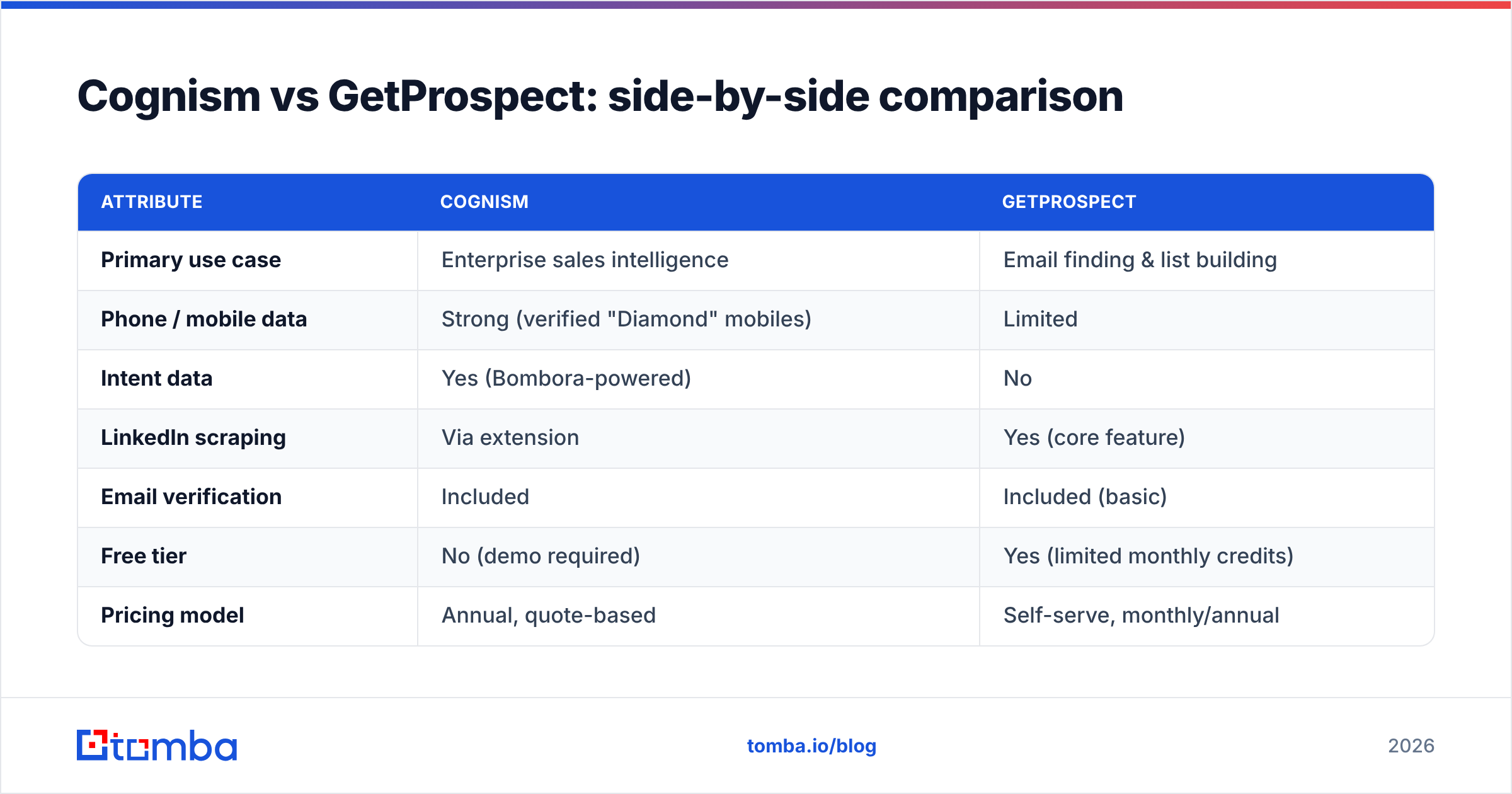
Here's how the two stack up on the attributes that actually change your day-to-day.
| Attribute | Cognism | GetProspect |
|---|---|---|
| Primary use case | Enterprise sales intelligence | Email finding & list building |
| Phone / mobile data | Strong (verified "Diamond" mobiles) | Limited |
| Intent data | Yes (Bombora-powered) | No |
| LinkedIn scraping | Via extension | Yes (core feature) |
| Email verification | Included | Included (basic) |
| Free tier | No (demo required) | Yes (limited monthly credits) |
| Pricing model | Annual, quote-based | Self-serve, monthly/annual |
| Entry price | High (four-to-five figures/yr typical) | Low (double digits/mo) |
| Best fit | Funded outbound teams, EU focus | SMBs, founders, lean teams |
| GDPR/compliance tooling | Advanced (DNC checks) | Standard |
The pattern is clear: Cognism is the heavyweight with breadth and compliance muscle, GetProspect is the nimble, budget-friendly specialist.
Is Cognism more accurate than GetProspect?#
For standard corporate email addresses, both tools are competitive — accuracy differences show up most in the harder categories: mobile numbers, catch-all domains, and EU contacts.
Cognism's advantage is phone accuracy. Because mobiles are human-verified, connect rates tend to be higher than database averages, which matters enormously if your motion is cold calling. Independent reviews on G2 consistently praise Cognism's phone data and EU coverage while noting the price.
GetProspect's strength is email discovery volume at a low cost. It's good at turning a LinkedIn profile or a name-plus-domain into a valid, deliverable email. It's less focused on phone verification and intent, so if calling is your bread and butter, it won't match Cognism.
One universal caveat regardless of vendor: always verify before you send. No database is 100% current — people change jobs, domains switch providers, and catch-all servers accept everything. Running your exports through an email verifier protects your sender reputation and keeps bounce rates low.

How does pricing compare?#
Pricing is where these two tools separate hard, and it's usually the deciding factor.
GetProspect is transparent and self-serve. A free plan gives you a small number of valid emails per month, and paid tiers scale up credits and features at published monthly prices you can see without a sales call. You can start small, upgrade when you outgrow it, and cancel without a renewal fight.
Cognism is quote-based and typically annual. You won't find a public price sheet; you'll book a demo, describe your team size and use case, and receive a custom proposal. Real-world contracts commonly land in the four-to-five-figure annual range, which is justified for large teams but overkill for a two-person startup.
Consider three buyer profiles:
- Solo founder / bootstrapped startup — GetProspect's free-to-cheap tiers win outright. Cognism's minimums are hard to justify.
- Mid-market outbound team selling into the EU — Cognism's compliance and phone data may pay for themselves in connect rates.
- SMB that mainly needs verified emails — Neither is strictly necessary; a focused email finder often does the job cheaper.
That third profile is worth pausing on. If your core need is "find and verify professional emails reliably," you're paying for a lot of unused surface area with either platform.
Where does Tomba fit in this comparison?#
If your bottleneck is email discovery and verification rather than intent scoring or phone dialing, a purpose-built email finder is frequently the smarter buy. Tomba is built around exactly that job: turn a domain, name, or company into a verified professional email, then confirm deliverability before it hits your sequence.
A few practical advantages worth weighing against both tools:
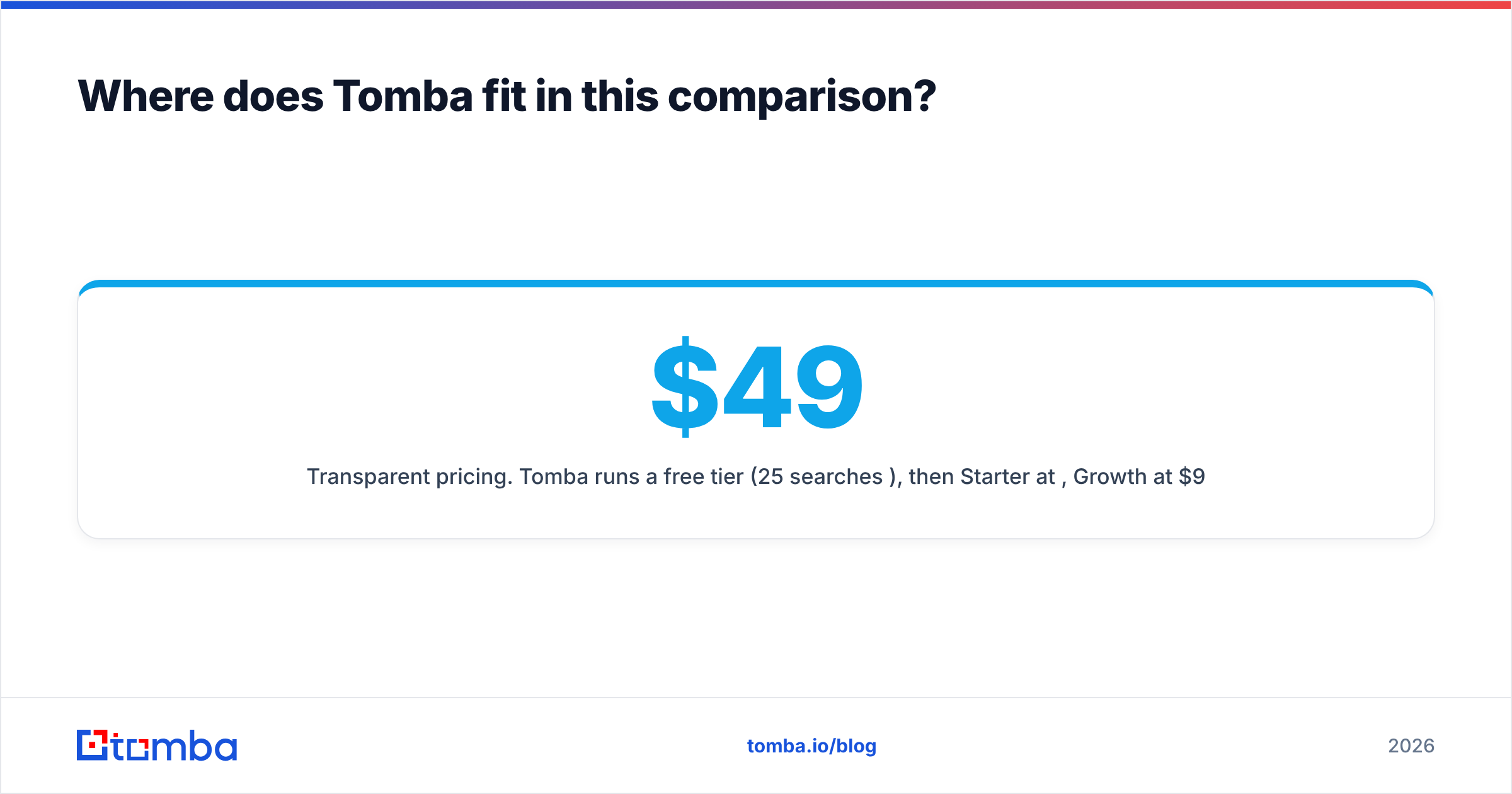
- Transparent pricing. Tomba runs a free tier (25 searches/mo), then Starter at $49/mo, Growth at $99/mo, and Pro at $249/mo. No demo gate, no annual lock-in — see full Tomba pricing before you commit.
- Domain-level search. Use domain search to pull every discoverable email and pattern for a target company in one pass.
- Built-in verification. Every result can be checked so you're not exporting guesses.
- Enrichment when you need it. Layer on data enrichment to fill in roles, companies, and social profiles without a separate contract.
Here's an honest boundary: Tomba is not an intent-data platform, and it doesn't sell human-verified mobile numbers the way Cognism does. If phone-first outbound into Europe is your entire motion, Cognism's specialty is real. But if you've been evaluating heavyweight platforms mostly to solve an email problem, a focused finder gets you there faster and cheaper.
Which one should you choose?#
Match the tool to your actual motion, not the feature list.
Choose Cognism if:
- Cold calling is a primary channel and connect rates drive revenue.
- You sell into the EU/UK and need serious compliance tooling.
- You have budget for an annual enterprise contract and a team big enough to use it.
- Buyer-intent signals materially change how your reps prioritize accounts.
Choose GetProspect if:
- You want a self-serve tool with a real free tier and no sales call.
- Your core need is finding and exporting emails, especially from LinkedIn.
- You're an SMB, founder, or lean team watching every dollar.
- You'd rather add complexity later than pay for it up front.
Consider a focused email finder like Tomba if:
- Verified emails — not intent or phone data — are your real requirement.
- You value transparent, self-serve pricing and an email finder API for automation.
- You want verification and enrichment in one place without an enterprise commitment.
The honest verdict#
There's no universal winner — there's a winner for your use case. Cognism is the stronger platform in absolute terms: deeper data, intent signals, and best-in-class EU phone accuracy. But that power comes with enterprise pricing and a procurement process that only pays off at scale.
GetProspect is the pragmatic pick for teams that mainly need emails and hate sales calls. It's affordable, self-serve, and genuinely useful for LinkedIn-driven prospecting — with the understanding that you're getting an email finder, not a full revenue-intelligence suite.
And if you strip the decision down to "I just need accurate, verified emails without overpaying," neither heavyweight may be the answer. Tools built specifically for email discovery tend to deliver that outcome at a lower price and with less overhead.
Whichever way you lean, apply the one rule that survives every comparison: verify your data before you send. Clean lists protect your domain, lift reply rates, and make every dollar of contact data actually convert.
Ready to test that on your own list? Start free with Tomba's Email Finder — find professional emails by domain, name, or company, verify them in the same workflow, and see how far a focused tool gets you before you sign an enterprise contract.
Related guides#
Ready to find emails that actually work?
Join 150,000+ professionals who stopped guessing and started sending. Free credits on signup — no credit card required.
Get the Tomba newsletter
Practical outbound tactics and product updates — once every two weeks.
About the author