Cognism vs LeadGenius: B2B Data Platforms Compared (2026)
Cognism sells verified phone-heavy EU/US data; LeadGenius sells human-researched custom datasets. Here's an honest breakdown of which B2B data platform fits your GTM motion in 2026.
Choosing between Cognism and LeadGenius comes down to one question: do you need a large pool of pre-verified contacts you can self-serve, or a team of researchers building a custom dataset to your exact spec? They sound similar on a feature page, but they solve different problems.
This is a neutral breakdown for revenue and demand-gen teams weighing the two in 2026. No fluff, no vendor spin — just where each one wins, where each one frustrates, and how to pressure-test them before you sign.
TL;DR — Cognism vs LeadGenius at a glance#
- Cognism is a self-serve B2B sales intelligence platform known for phone-verified mobile numbers (its "Diamond Data") and strong EMEA + US coverage. Best for outbound SDR teams that dial.
- LeadGenius is a human-in-the-loop data service that builds custom, hard-to-find datasets (niche firmographics, buying signals, non-standard attributes) on request. Best for GTM teams with specific ICP data no database already holds.
- Cognism wins on speed-to-value and compliance tooling; LeadGenius wins on data depth and bespoke fields.
- Pricing is opaque on both — expect annual contracts and a sales call. Neither publishes transparent per-credit rates.
- If your core need is simply finding and verifying professional emails at a predictable price, a focused tool like the Tomba Email Finder usually beats paying enterprise data-platform rates.
What is Cognism?#
Cognism is a sales intelligence platform that combines a contact and company database with intent data and compliance features. Its headline differentiator is phone-verified mobile numbers — the company manually verifies a subset of numbers ("Diamond Verified") so reps waste fewer dials on dead lines.
Teams use Cognism for outbound prospecting: build a list by firmographic and technographic filters, pull mobiles and emails, sync to the CRM, and dial. It leans hard into GDPR/CCPA compliance, including notified-jurisdiction phone checks against Do-Not-Call registries, which is why it's popular with EMEA-based sales orgs.
You can read more about how Cognism positions itself on its official site, and reviews aggregate on G2.
What is LeadGenius?#
LeadGenius is a data-as-a-service company, not a pure self-serve tool. It pairs software with a global team of human researchers to deliver custom datasets — the kind of attributes a standard database simply doesn't carry: store counts, fleet size, specific software installs, hiring signals, ESG attributes, or account-level buying triggers unique to your ICP.
Instead of logging in and running a search, you scope a project ("every DTC brand in North America using Shopify Plus with 50+ employees and a head of retention") and LeadGenius delivers and refreshes that dataset. It's built for demand-gen and RevOps teams whose targeting is too specific for an off-the-shelf list.

Cognism vs LeadGenius: the core comparison#
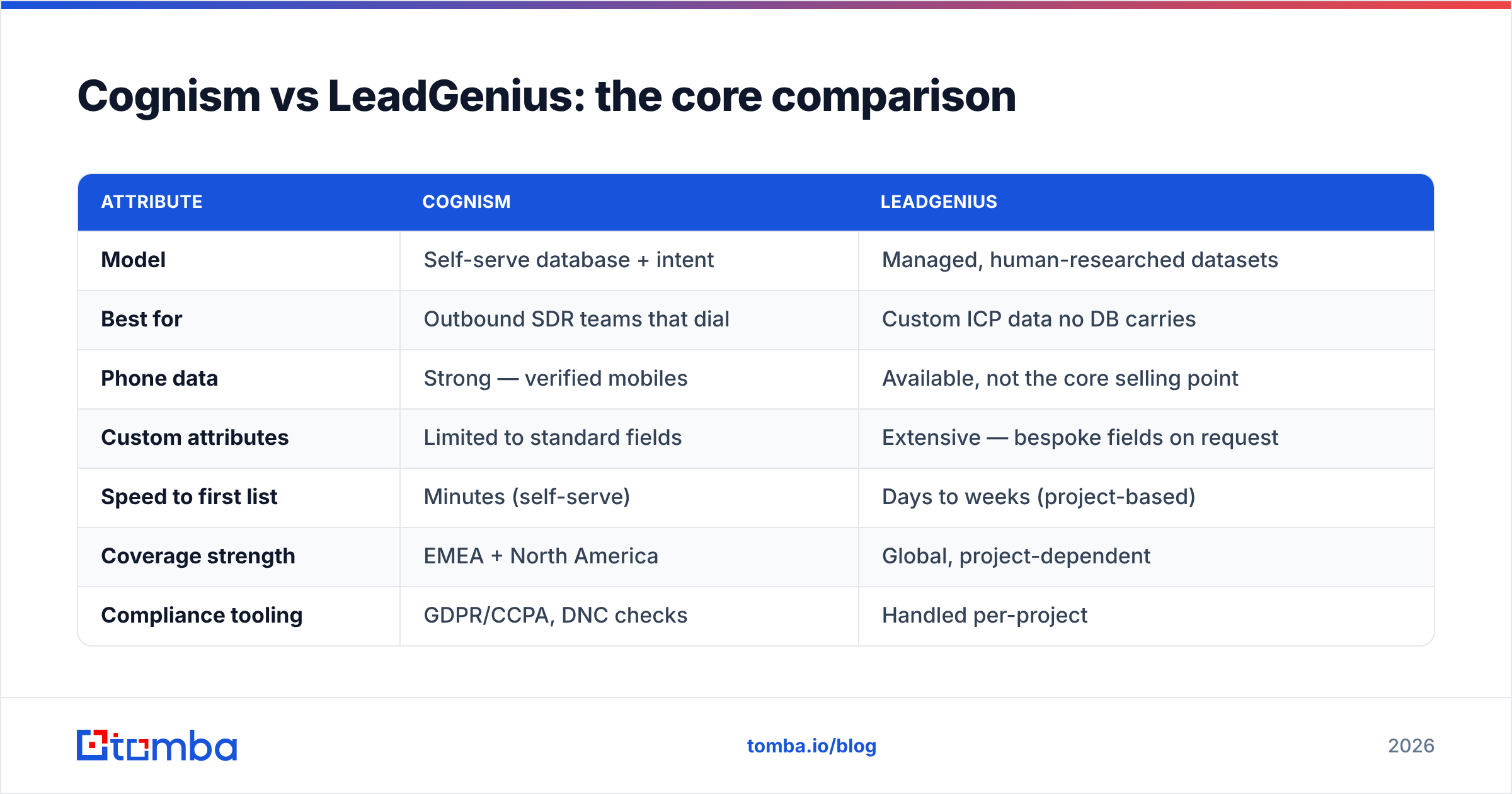
The fastest way to see the split is attribute by attribute. Both are legitimate platforms — they just optimize for different jobs.
| Attribute | Cognism | LeadGenius |
|---|---|---|
| Model | Self-serve database + intent | Managed, human-researched datasets |
| Best for | Outbound SDR teams that dial | Custom ICP data no DB carries |
| Phone data | Strong — verified mobiles | Available, not the core selling point |
| Custom attributes | Limited to standard fields | Extensive — bespoke fields on request |
| Speed to first list | Minutes (self-serve) | Days to weeks (project-based) |
| Coverage strength | EMEA + North America | Global, project-dependent |
| Compliance tooling | GDPR/CCPA, DNC checks | Handled per-project |
| Pricing model | Annual license, seat-based | Custom project / retainer |
| Transparency | Quote-only | Quote-only |
The pattern: Cognism is a product you operate; LeadGenius is a service you brief. If your team wants to log in Monday and start dialing, Cognism fits. If your competitive edge is a dataset nobody else can buy, LeadGenius fits.
How they compare on data accuracy#
Accuracy claims from data vendors are notoriously hard to verify because every provider measures it differently. Cognism's edge is in phone verification — human-checked mobiles reduce wrong-number dials, which matters enormously for cold-calling motions. LeadGenius's edge is in correctness of unusual fields, because a researcher confirmed them rather than a scraper guessing.
Neither replaces your own verification step. Whatever list you pull, you should still run addresses through an email verifier before a send to protect deliverability — bounced sends damage sender reputation regardless of how "verified" the source claimed to be.
Is Cognism better than LeadGenius?#
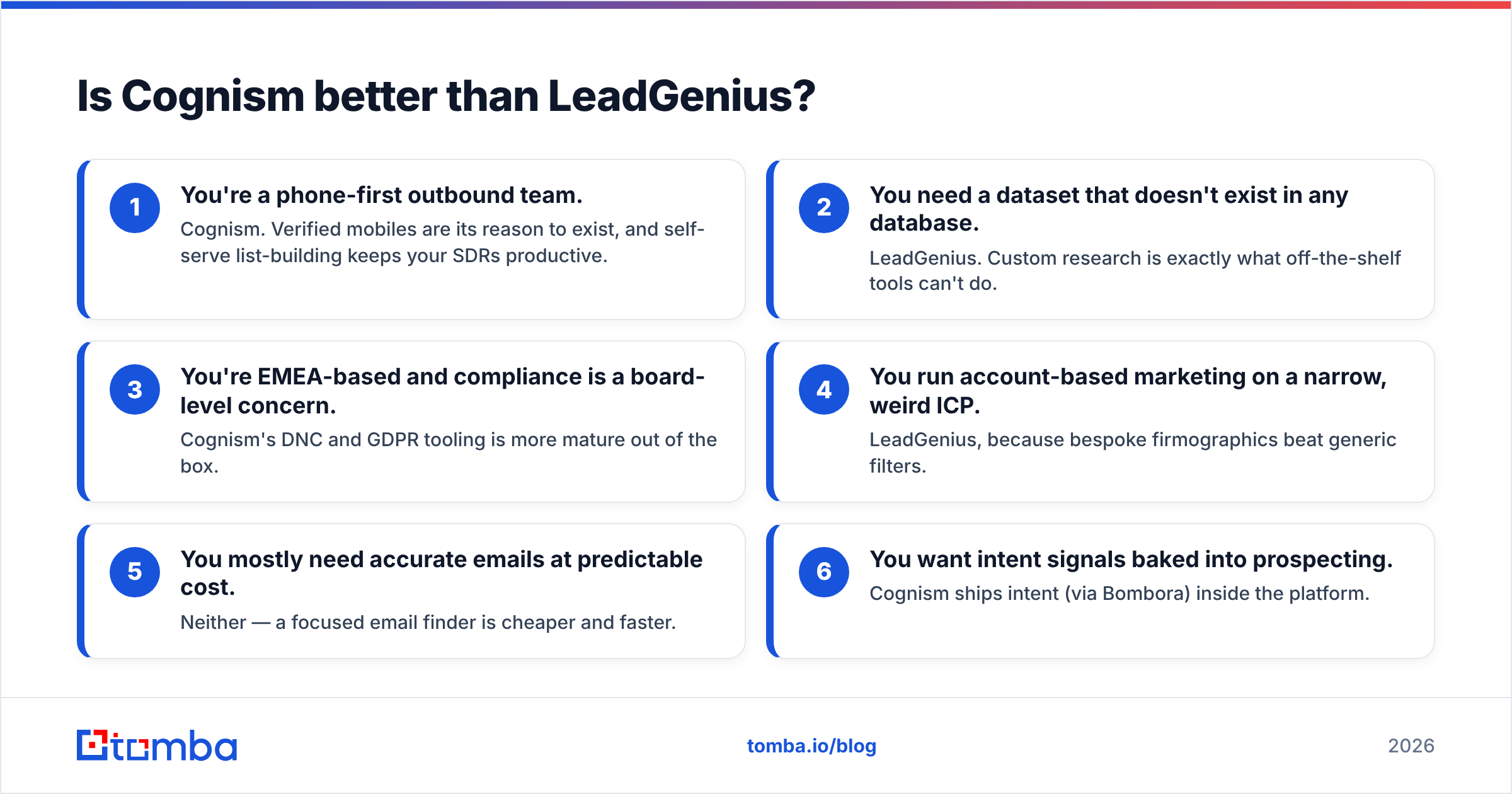
Neither is universally better — the honest answer depends on your motion. Here's how to decide by profile:
- You're a phone-first outbound team. Cognism. Verified mobiles are its reason to exist, and self-serve list-building keeps your SDRs productive.
- You need a dataset that doesn't exist in any database. LeadGenius. Custom research is exactly what off-the-shelf tools can't do.
- You're EMEA-based and compliance is a board-level concern. Cognism's DNC and GDPR tooling is more mature out of the box.
- You run account-based marketing on a narrow, weird ICP. LeadGenius, because bespoke firmographics beat generic filters.
- You mostly need accurate emails at predictable cost. Neither — a focused email finder is cheaper and faster.
- You want intent signals baked into prospecting. Cognism ships intent (via Bombora) inside the platform.
That last "neither" is worth sitting with. A large share of teams evaluating enterprise data platforms actually just need reliable contact discovery — and they overspend by buying a suite when a single tool would do.
What do Cognism and LeadGenius cost?#
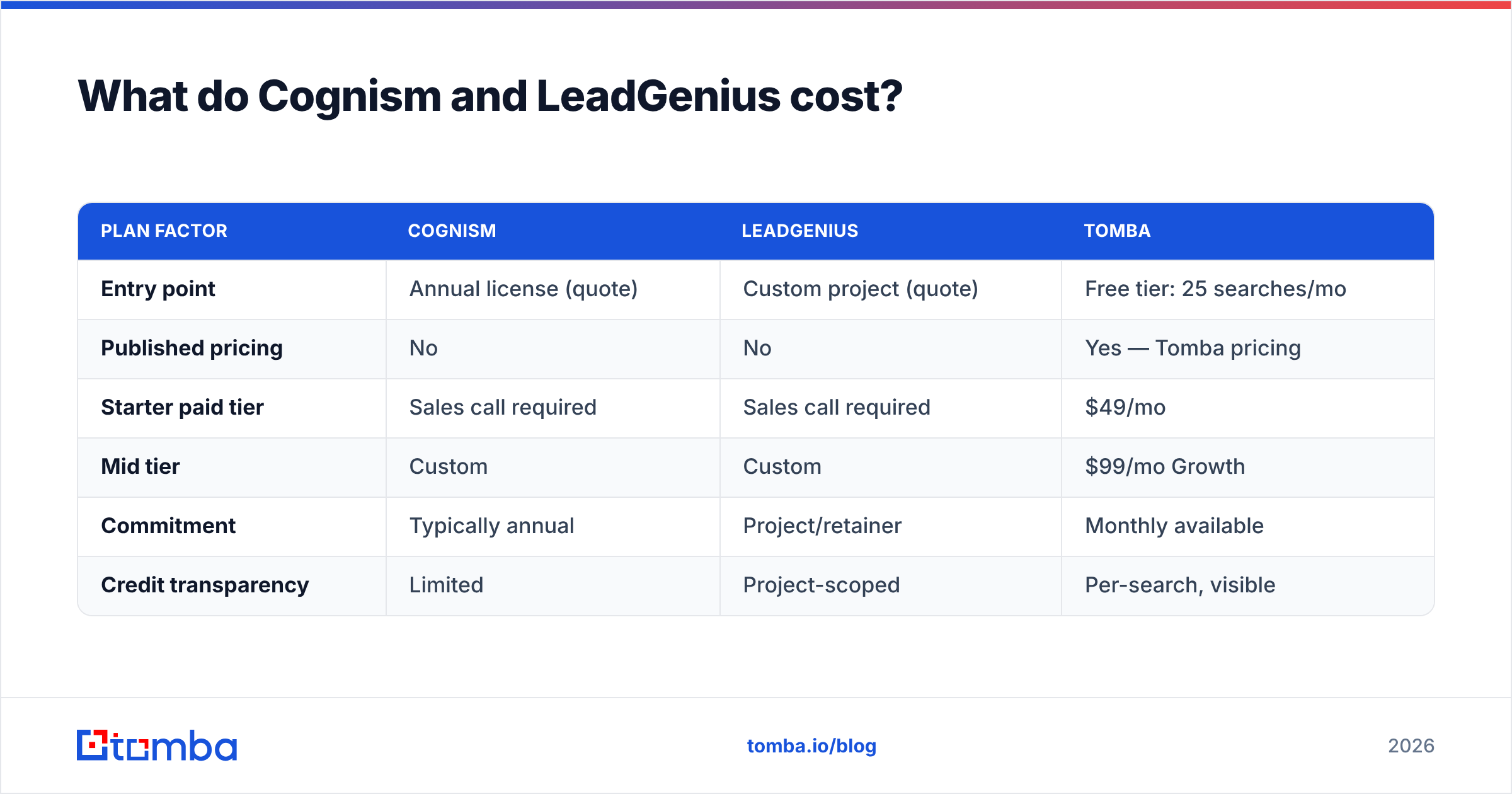
Both are quote-only, and both typically lock you into annual commitments. That's the biggest practical difference versus tool-based pricing.
| Plan factor | Cognism | LeadGenius | Tomba |
|---|---|---|---|
| Entry point | Annual license (quote) | Custom project (quote) | Free tier: 25 searches/mo |
| Published pricing | No | No | Yes — Tomba pricing |
| Starter paid tier | Sales call required | Sales call required | $49/mo |
| Mid tier | Custom | Custom | $99/mo Growth |
| Commitment | Typically annual | Project/retainer | Monthly available |
| Credit transparency | Limited | Project-scoped | Per-search, visible |
Enterprise data platforms justify opaque pricing with coverage and compliance — and for large teams that dial thousands of prospects a month, the math can work. But if you're a founder, a small SDR pod, or a marketer running targeted campaigns, the annual-contract-plus-sales-call model is friction you may not need.

Where a focused email finder fits instead#
Here's the split most comparison posts skip: contact discovery and full-suite sales intelligence are different purchases. You don't always need intent data, a research team, or a seat-based license to find the right person's email.
If your workflow is "I have a company and a name, I need the verified email," a purpose-built tool is faster and far cheaper. Tomba's domain search returns the email pattern and known contacts for any company, the email finder resolves a specific person, and the bulk email finder handles lists — all with per-search transparency instead of a quote.
For teams that live in spreadsheets, the Google Sheets add-on and the Tomba API let you enrich lists in place without exporting to yet another platform. That's often all the "data platform" a lean team actually needs.
Where Cognism and LeadGenius genuinely earn their price is the extras: verified mobiles for a heavy dialing motion, or truly custom research for a niche ICP. If you need those, buy them deliberately. If you don't, you're paying enterprise rates for a job a $49/mo tool does better.
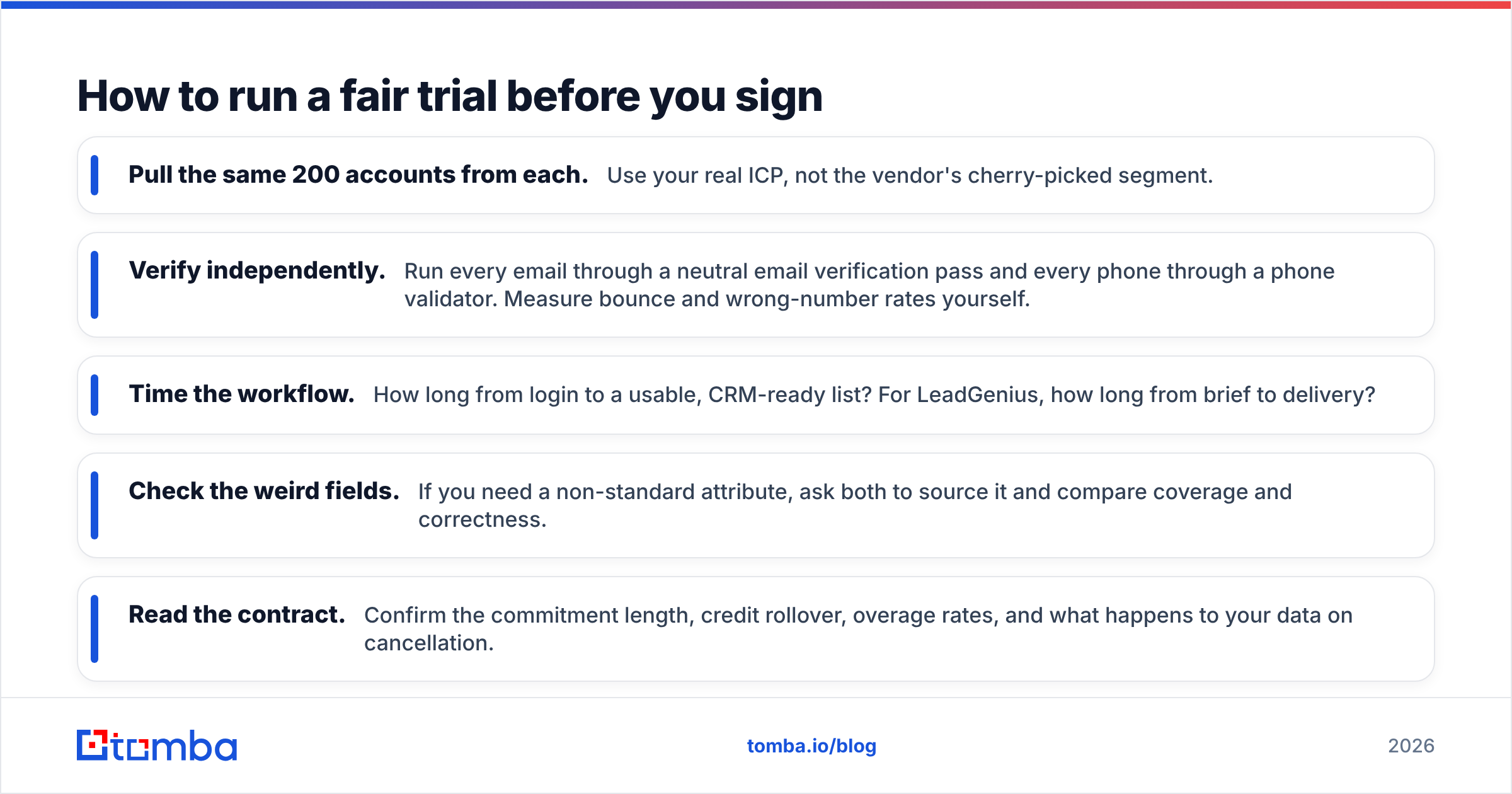
How to run a fair trial before you sign#
Vendor demos are optimized to look great. Force an apples-to-apples test:
- Pull the same 200 accounts from each. Use your real ICP, not the vendor's cherry-picked segment.
- Verify independently. Run every email through a neutral email verification pass and every phone through a phone validator. Measure bounce and wrong-number rates yourself.
- Time the workflow. How long from login to a usable, CRM-ready list? For LeadGenius, how long from brief to delivery?
- Check the weird fields. If you need a non-standard attribute, ask both to source it and compare coverage and correctness.
- Read the contract. Confirm the commitment length, credit rollover, overage rates, and what happens to your data on cancellation.
Whatever you find, keep your own verification layer in the stack permanently. No source stays fresh forever — people change jobs, domains go catch-all, and lists decay 2–3% a month.
Final verdict: which should you choose?#
Choose Cognism if you're a dialing-heavy outbound team that wants verified mobiles, self-serve list-building, and mature EMEA compliance in one place — and you can commit annually.
Choose LeadGenius if your competitive edge is a custom dataset no off-the-shelf database carries, and you'd rather brief a research team than run searches yourself.
Choose neither — start with a focused finder if your real need is accurate, verifiable professional emails at a predictable price. That's the majority of teams, and it's the cheapest way to prove out your outreach before committing to a five-figure data contract.
Want to test contact discovery without a sales call or an annual lock-in? Start free with the Tomba Email Finder — 25 searches a month at no cost, transparent per-search pricing after that, and a verifier built in so what you find actually lands. Run the same 200 accounts you'd hand a Cognism or LeadGenius rep, and let the bounce rate settle the debate.
Related guides#
Ready to find emails that actually work?
Join 150,000+ professionals who stopped guessing and started sending. Free credits on signup — no credit card required.
Get the Tomba newsletter
Practical outbound tactics and product updates — once every two weeks.
About the author