Cognism vs Lfbbd Lead For Business: 2026 B2B Data Comparison
Cognism and Lfbbd Lead For Business both promise clean B2B contact data, but they solve very different problems. Here's an honest, side-by-side look at pricing, accuracy, coverage, and who each one actually fits in 2026.
Choosing between Cognism and Lfbbd Lead For Business usually comes down to one question you can't Google your way out of: do you need a premium, compliance-heavy sales-intelligence platform, or do you need a large, affordable list you can work today? These two options sit at opposite ends of the B2B data market, and picking the wrong one wastes either budget or deliverability.
This comparison breaks down pricing, accuracy, coverage, and fit — with no pretending one is perfect. Where a lighter, pay-for-what-you-verify approach makes more sense than either, we'll say so.
TL;DR: Cognism vs Lfbbd Lead For Business#
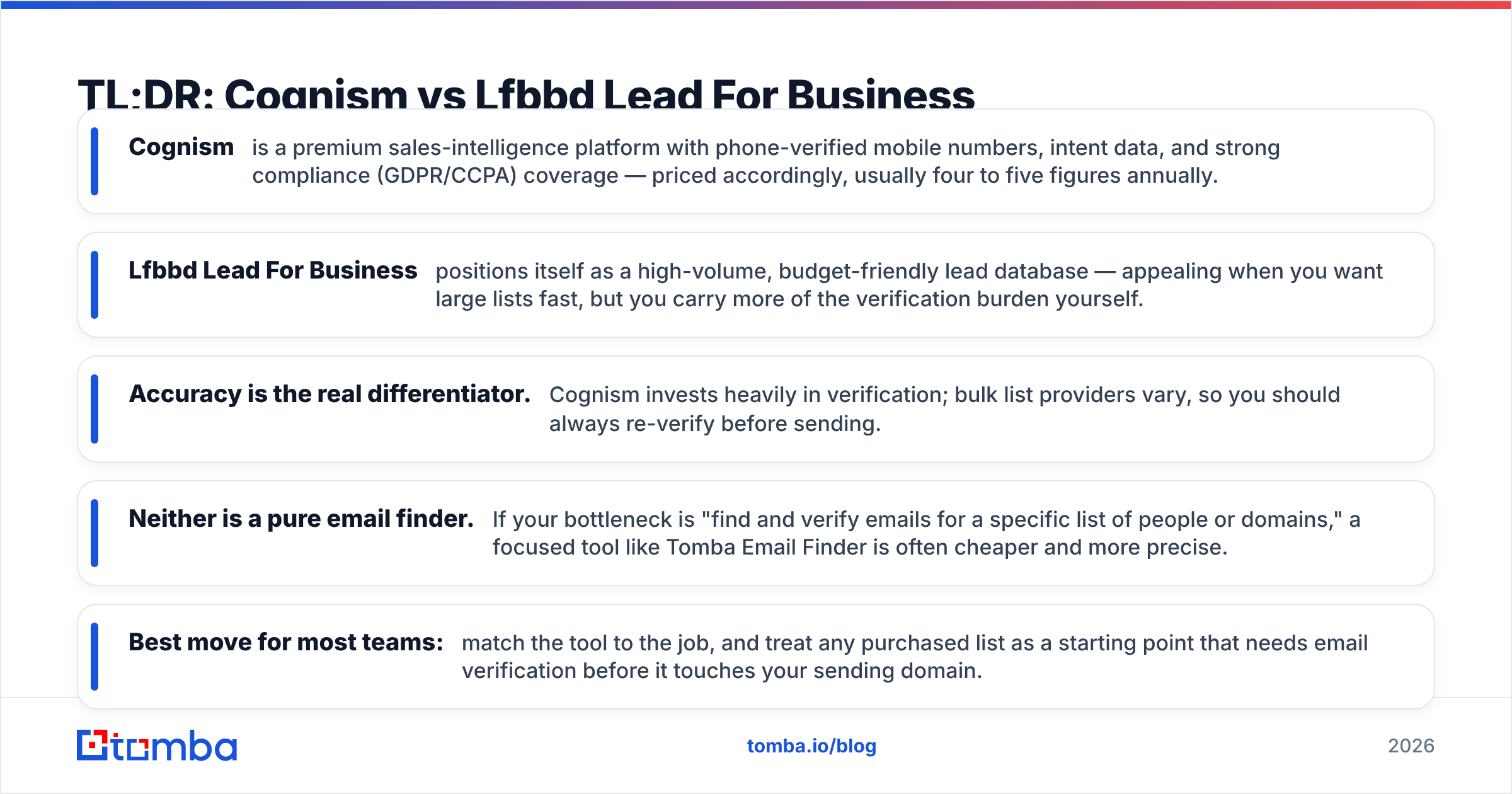
- Cognism is a premium sales-intelligence platform with phone-verified mobile numbers, intent data, and strong compliance (GDPR/CCPA) coverage — priced accordingly, usually four to five figures annually.
- Lfbbd Lead For Business positions itself as a high-volume, budget-friendly lead database — appealing when you want large lists fast, but you carry more of the verification burden yourself.
- Accuracy is the real differentiator. Cognism invests heavily in verification; bulk list providers vary, so you should always re-verify before sending.
- Neither is a pure email finder. If your bottleneck is "find and verify emails for a specific list of people or domains," a focused tool like Tomba Email Finder is often cheaper and more precise.
- Best move for most teams: match the tool to the job, and treat any purchased list as a starting point that needs email verification before it touches your sending domain.
What is Cognism?#
Cognism is a sales-intelligence platform built for mid-market and enterprise revenue teams. Its pitch is quality over raw quantity: phone-verified mobile numbers (marketed as "Diamond Data"), buyer-intent signals, technographics, and a compliance posture designed for regulated markets in Europe and North America.
You don't just buy a list from Cognism — you buy a workflow. The platform integrates with CRMs and sequencers, layers on intent scoring, and aims to tell you who to call and when, not just who exists. That's the value, and it's also why it's expensive.
The trade-offs are predictable. Pricing is annual-contract, seat-based, and rarely transparent on the website — you talk to sales. Credit limits and "click-to-reveal" caps can frustrate high-volume prospectors. And for a solo founder or a small team doing targeted outbound, a lot of that platform depth goes unused.
What is Lfbbd Lead For Business?#
Lfbbd Lead For Business sits in the high-volume, lower-cost segment of the market. The core promise is scale and price: large downloadable contact lists across industries and regions, aimed at teams that want to fill a pipeline quickly without an enterprise contract.
For certain jobs this is genuinely useful. If you're running broad, top-of-funnel campaigns, testing a new market, or feeding a nurture sequence where volume matters more than surgical precision, an affordable bulk source can beat paying premium per-contact rates.
The honest caveat is the same one that applies to every volume-first provider: you inherit the verification work. Bulk databases age fast — people change jobs, domains switch providers, catch-all servers hide dead mailboxes. A list that looks great in a spreadsheet can still torch your sender reputation if you blast it unverified. That's not a knock unique to any one vendor; it's the physics of bulk B2B data.
Cognism vs Lfbbd Lead For Business: side-by-side#
Here's the honest breakdown across the attributes that actually change your results.
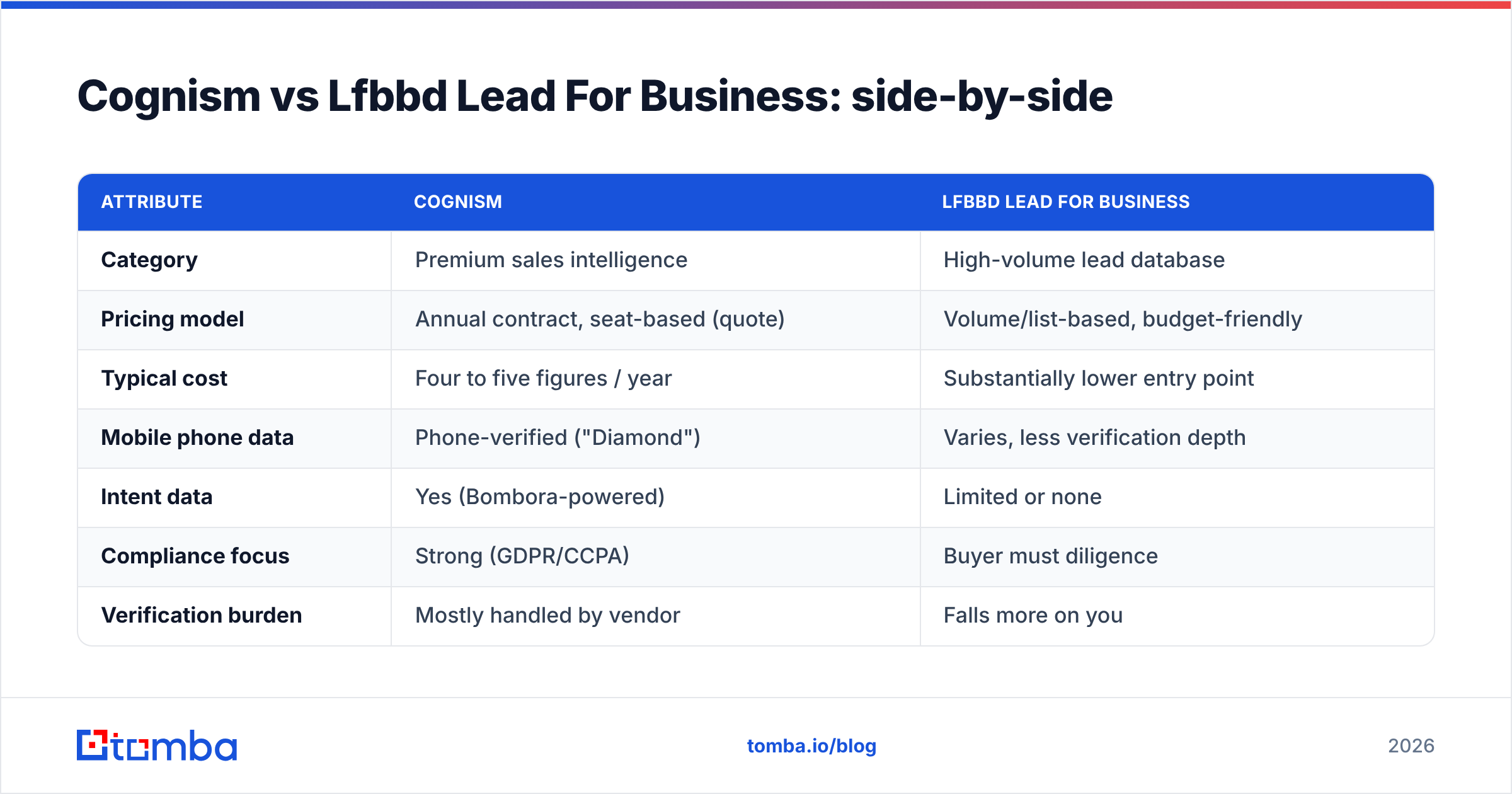
| Attribute | Cognism | Lfbbd Lead For Business |
|---|---|---|
| Category | Premium sales intelligence | High-volume lead database |
| Pricing model | Annual contract, seat-based (quote) | Volume/list-based, budget-friendly |
| Typical cost | Four to five figures / year | Substantially lower entry point |
| Mobile phone data | Phone-verified ("Diamond") | Varies, less verification depth |
| Intent data | Yes (Bombora-powered) | Limited or none |
| Compliance focus | Strong (GDPR/CCPA) | Buyer must diligence |
| Verification burden | Mostly handled by vendor | Falls more on you |
| Best for | Enterprise, regulated markets | Broad, high-volume outreach |
| Free tier | No | Varies |
Read that table as a fit chart, not a scoreboard. Cognism wins on verified depth and compliance; a volume provider wins on cost-per-contact and speed. The right answer depends on whether your constraint is budget or precision.
Which one is more accurate?#
Cognism generally holds the accuracy edge, because verification is its business model — but "accurate at purchase" still isn't "accurate at send." Even premium data decays roughly 2–3% per month as people change roles, so the discipline that protects you is the same regardless of source: re-verify right before you send.
This is where a lot of buyers get the framing wrong. They treat the purchase decision as the accuracy decision. It isn't. The accuracy decision is your verification step. A cheaper list you clean thoroughly can outperform a premium list you trust blindly, because the premium list also ages between the day it was compiled and the day you email it.
Two practical habits protect deliverability with either provider:
- Verify every address before the first send. Run the list through an email verifier to strip invalids and reduce bounces.
- Handle catch-all domains deliberately. Catch-all servers accept everything at the MX layer, so they need dedicated logic — a catch-all verifier tells you which "valid" addresses are actually risky.
Do that, and the accuracy gap between a premium and a budget source narrows to something your margin can absorb.
How does pricing really compare?#
Cognism is a planned annual investment; Lfbbd Lead For Business is an operational, lower-commitment spend. That difference matters more than the sticker numbers.
Cognism's annual contracts make sense when data is core infrastructure for a full sales team — you're amortizing platform value (intent, integrations, verified mobiles) across many seats and thousands of touches. For a two-person team or a founder-led motion, that same contract is mostly shelfware.
A volume provider flips the math: low entry cost, pay for what you pull, no year-long lock-in. The hidden cost shows up later — in the verification and deduplication you now own. Budget for a cleaning step, or the "cheap" list gets expensive in bounces and blocked domains.
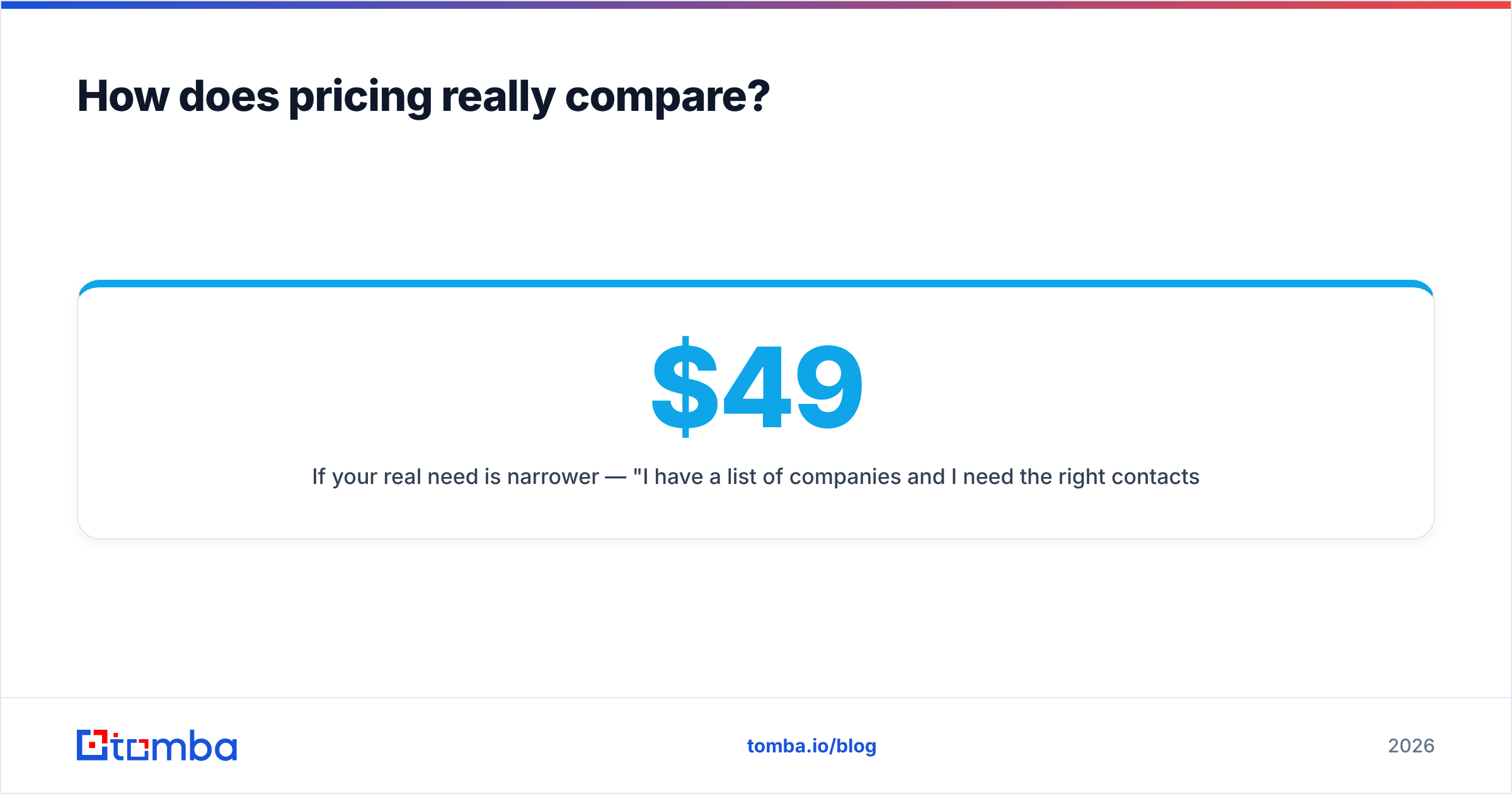
If your real need is narrower — "I have a list of companies and I need the right contacts and emails" — neither enterprise pricing nor bulk-list pricing is optimal. A usage-based email finder is. For reference, Tomba's pricing runs a free tier (25 searches/mo), Starter at $49/mo, Growth at $99/mo, and Pro at $249/mo — you pay for the lookups you actually make instead of an annual platform commitment or a giant list you have to clean.
Who should choose which?#
Choose Cognism if:
- You run a mid-market or enterprise sales team in a regulated region.
- Verified mobile numbers and intent signals directly drive your motion (heavy cold calling, ABM).
- You want a platform, not a file — CRM sync, scoring, and workflow baked in.
- The annual contract is justified by seat count and touch volume.
Choose Lfbbd Lead For Business if:
- Your constraint is budget and speed, not surgical precision.
- You're running broad top-of-funnel or entering a new market to test.
- You have (or will build) a solid verification and dedupe step.
- You'd rather pay per list than sign a yearly platform deal.
Consider a focused email-finding stack if:
- Your bottleneck is finding and verifying emails for specific people or domains.
- You want to control cost per contact and avoid unused platform features.
- You value a clean workflow over an all-in-one suite.
For that third path, a domain search to pull every contact at a target company, paired with verification, often covers 80% of what teams actually buy Cognism or a bulk list for — at a fraction of the cost. It also plugs into the same CRMs via Tomba's integrations and a straightforward email finder API when you need to automate.
What about compliance and data sourcing?#
Compliance is where premium platforms earn their price. Cognism markets GDPR and CCPA alignment, notification workflows, and do-not-call screening as first-class features — real advantages if you sell into Europe or handle regulated verticals.
With any lower-cost bulk source, do your own diligence. Ask where the data comes from, how consent is handled, and how often it's refreshed. This isn't about assuming bad faith; it's basic risk management. When you understand a provider's data sources, you can make an informed call about how to use the list and what guardrails to add. If a vendor won't explain sourcing clearly, treat that as a signal.
Whatever you choose, keep human-in-the-loop review for regulated outreach. Data quality and compliance are related but distinct — a technically accurate record can still be one you're not permitted to contact the way you intend.
The verdict#
There's no universal winner — there's a winner for your constraint. Cognism is the stronger choice when verified depth, intent, and compliance justify an enterprise contract. Lfbbd Lead For Business is the pragmatic pick when volume and price matter more than precision and you're prepared to clean what you buy.
But step back and the most common mistake is buying a platform or a bulk list when the actual job was find and verify a defined set of contacts. If that's you, skip the false binary. Start with targeted finding, verify before you send, and only graduate to a heavier platform when intent data and team-wide workflow genuinely become the bottleneck.
Independent reviews are worth reading before you commit either way — compare user feedback on G2 and category analysis from Gartner against the vendor's own claims on the Cognism website, and weigh them against your real use case rather than the marketing.
Start with precise, verified contacts#
If your goal is accurate emails for the accounts you actually care about — not a warehouse of records you have to police — start with the Tomba Email Finder. Search by name, company, or domain, pull the right contacts, and verify them before the first send, all on a usage-based plan that scales from a free tier up as you grow. It's the leanest way to get the outcome both Cognism and Lfbbd Lead For Business are ultimately selling: clean data that lands in the inbox. Pair it with the B2B database and data enrichment when you're ready to go deeper — and skip paying for scale you don't need yet.
Related guides#
// get started
Find, verify and enrich your first contacts today
Start on the free plan with 25 searches a month, then scale when your team is ready.
Free plan · No credit card required · GDPR & CCPA
// about the author