Cognism vs Reachstream (2026): B2B Data Platforms Compared
Cognism and Reachstream both sell B2B contact data, but they target very different buyers and budgets. Here's an honest, side-by-side breakdown of accuracy, coverage, compliance, and price to help you choose.
Choosing a B2B data vendor usually comes down to a trade-off you can't see until the invoice and the bounce report both land. Cognism and Reachstream sit on opposite ends of that trade-off: one is a premium, compliance-first sales-intelligence suite; the other is a budget-friendly contact database built for volume. This comparison breaks down where each one actually earns its price, and where a leaner email-finding stack beats both.
TL;DR — Cognism vs Reachstream at a glance#
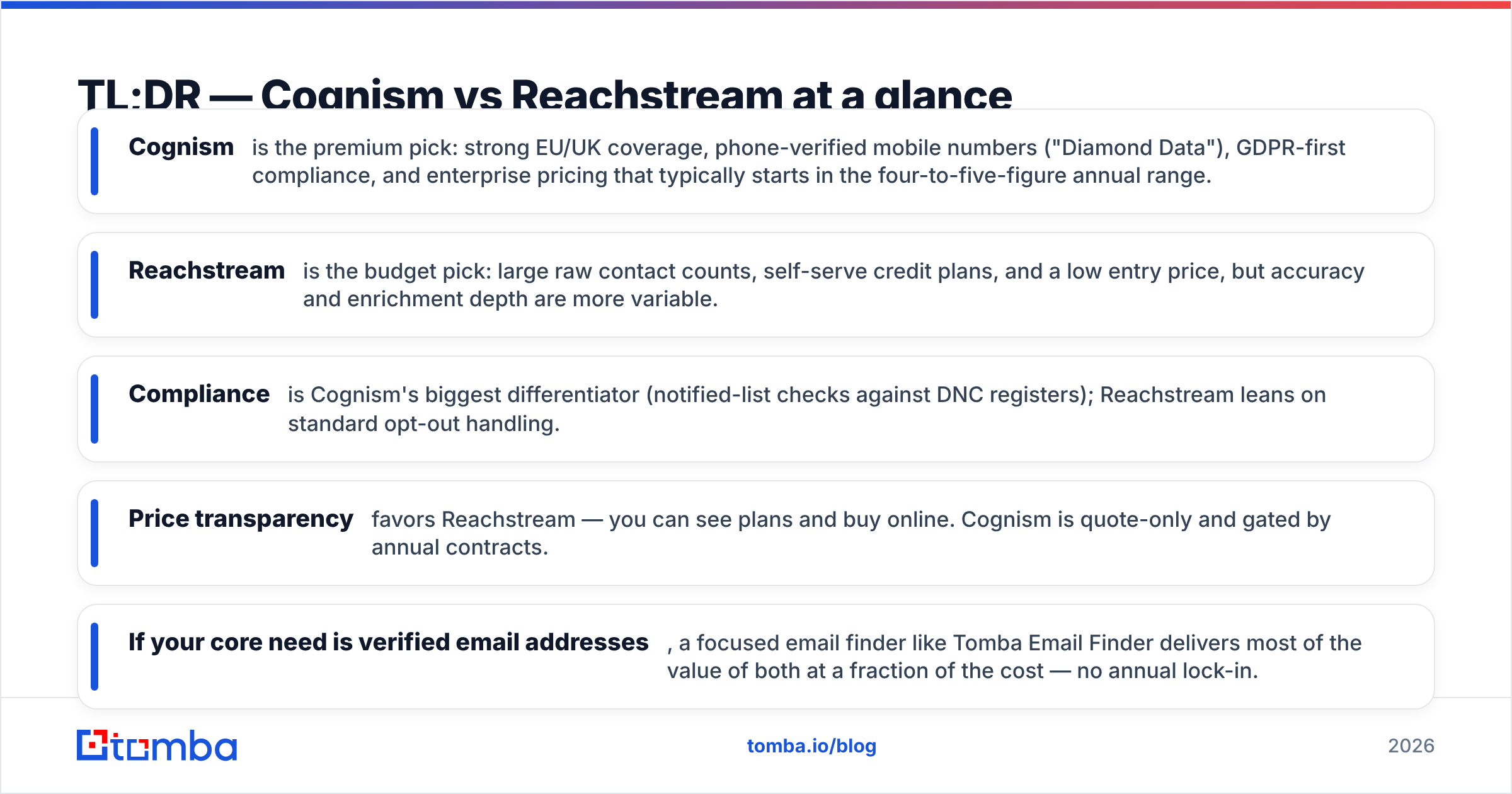
- Cognism is the premium pick: strong EU/UK coverage, phone-verified mobile numbers ("Diamond Data"), GDPR-first compliance, and enterprise pricing that typically starts in the four-to-five-figure annual range.
- Reachstream is the budget pick: large raw contact counts, self-serve credit plans, and a low entry price, but accuracy and enrichment depth are more variable.
- Compliance is Cognism's biggest differentiator (notified-list checks against DNC registers); Reachstream leans on standard opt-out handling.
- Price transparency favors Reachstream — you can see plans and buy online. Cognism is quote-only and gated by annual contracts.
- If your core need is verified email addresses, a focused email finder like Tomba Email Finder delivers most of the value of both at a fraction of the cost — no annual lock-in.
What are Cognism and Reachstream?#
Both platforms answer the same question — "who do I contact, and how?" — but they were built for different teams.
Cognism is a UK-headquartered sales-intelligence platform aimed at mid-market and enterprise revenue teams. Its pitch is quality over quantity: human- and phone-verified mobile numbers, a heavy compliance layer for European outbound, and native integrations with Salesforce, HubSpot, and major sequencers. You can read their positioning on the Cognism homepage. It's the tool a VP of Sales buys when a bounced email or a wrong-number dial costs real pipeline.
Reachstream is a self-serve B2B contact and company database aimed at SMBs, agencies, and founders who need lists fast without a procurement cycle. Its pitch is access: millions of contacts, filterable by industry, title, geography, and technographic signals, sold on transparent credit-based plans. You can browse plans on the Reachstream site. It's the tool a solo founder or a lean agency buys when the budget is $99, not $9,000.
The short version: Cognism sells confidence, Reachstream sells volume. Which one you need depends entirely on what a bad record costs you.

How do Cognism and Reachstream compare on features and price?#
Here's the head-to-head on the attributes that actually change your results in the field.
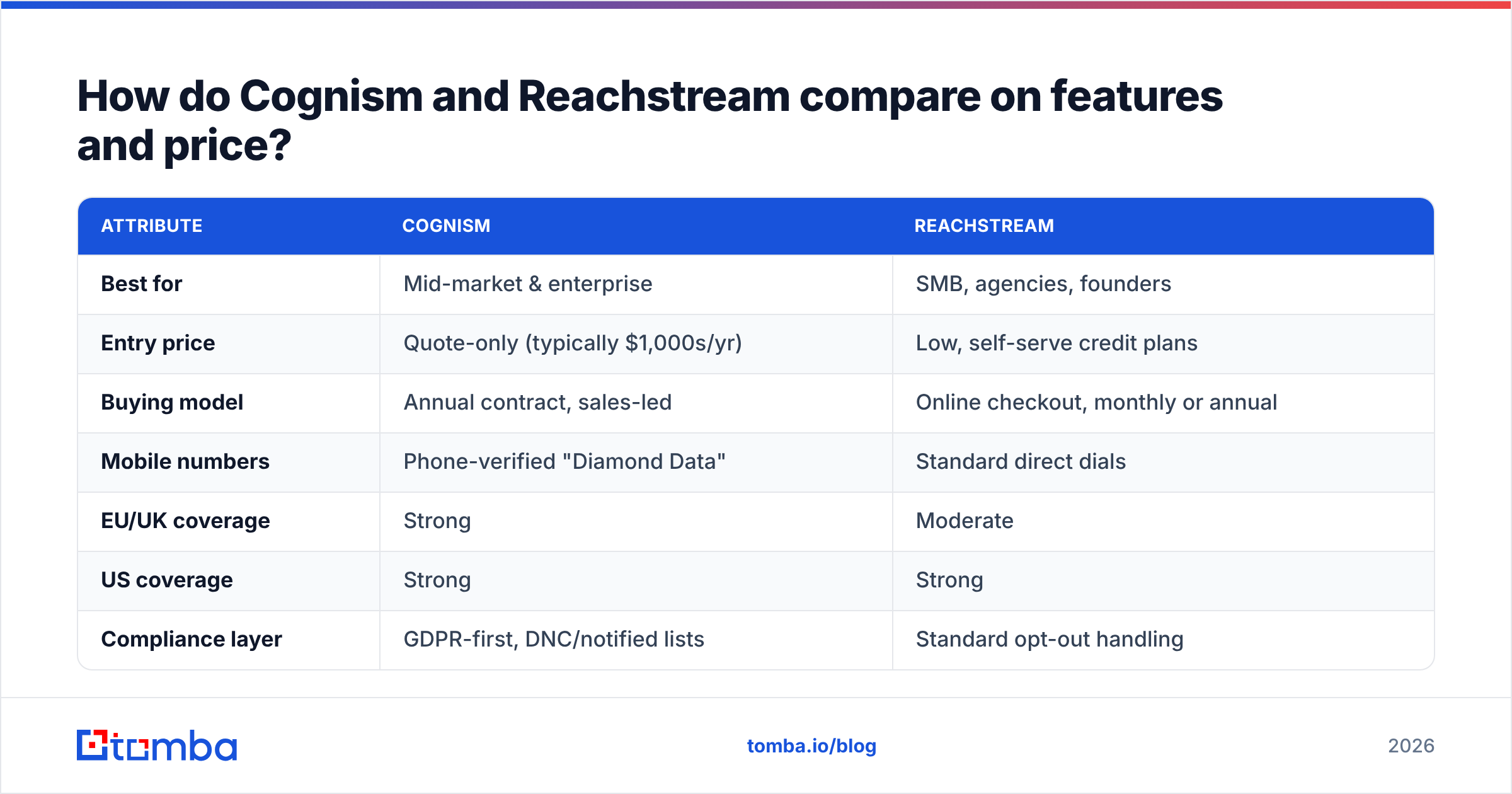
| Attribute | Cognism | Reachstream |
|---|---|---|
| Best for | Mid-market & enterprise | SMB, agencies, founders |
| Entry price | Quote-only (typically $1,000s/yr) | Low, self-serve credit plans |
| Buying model | Annual contract, sales-led | Online checkout, monthly or annual |
| Mobile numbers | Phone-verified "Diamond Data" | Standard direct dials |
| EU/UK coverage | Strong | Moderate |
| US coverage | Strong | Strong |
| Compliance layer | GDPR-first, DNC/notified lists | Standard opt-out handling |
| Email verification | Included | Included, variable depth |
| CRM integrations | Salesforce, HubSpot, sequencers | CSV export, core CRMs |
| Free trial | Limited, gated | Free credits on signup |
The pattern is consistent. Cognism wins on verification depth and compliance rigor; Reachstream wins on price and speed-to-list. Neither is "better" in the abstract — they're priced for different risk tolerances.
The five variables that decide the winner for you#
- Geography. If most of your prospects are in the EU or UK, Cognism's coverage and compliance are hard to match. For US-heavy outbound, Reachstream closes much of the gap at a lower price.
- Compliance exposure. Regulated industries and European B2B outbound benefit from Cognism's notified-list checks. If you're a US SMB, standard opt-out handling is usually enough.
- Contact type. Need verified mobile numbers for cold calling? Cognism. Need bulk email lists for sequenced outreach? Reachstream — or a dedicated finder.
- Budget and buying speed. Reachstream lets you swipe a card and start today. Cognism means a demo, a quote, and an annual commitment.
- Data hygiene downstream. Whatever you buy, plan to re-verify before you send. Both databases decay, and a good email verifier protects your sender reputation.
Which has better data accuracy?#
Cognism generally has the edge on verified accuracy — that's the whole premise of its pricing. Its phone-verified mobile data and stricter email validation mean fewer wasted dials and lower bounce rates, which matters when a sales rep's hour is expensive. Independent reviews on G2 tend to reflect this: Cognism scores well on data quality, less well on price.
Reachstream's accuracy is respectable for the price but more variable across segments. You'll find high-quality records in well-covered industries and thinner, staler data in niche verticals. For high-volume email outreach where you expect to filter and verify anyway, that trade-off is often acceptable.
The honest takeaway: no B2B database is "set and forget." Contact data decays at roughly 2–3% per month as people change jobs, so even Cognism's premium records need periodic re-checking. Build verification into your workflow regardless of vendor — running lists through an email verifier or a catch-all verifier before send is the single highest-ROI hygiene step you can take.
Is Cognism worth the premium over Reachstream?#
Cognism is worth it if three things are true: your outreach is EU/UK-heavy, compliance risk is real for your business, and a wrong contact costs you meaningful pipeline. In that scenario, the higher price buys fewer bounces, cleaner dials, and legal cover — and it pays for itself.
It's not worth it if you're a US-focused SMB or agency running high-volume email sequences on a tight budget. In that case you're paying enterprise prices for a compliance layer you may not need and a verification depth you can partly replicate with cheaper tools. Reachstream, or a focused email-finding stack, gets you 80% of the outcome for a fraction of the cost.
Where does a dedicated email finder fit in?#
Here's the part neither vendor will tell you: a large share of B2B teams don't actually need a full sales-intelligence suite. They need accurate email addresses for a known list of target companies and people — and they need them without a five-figure contract.
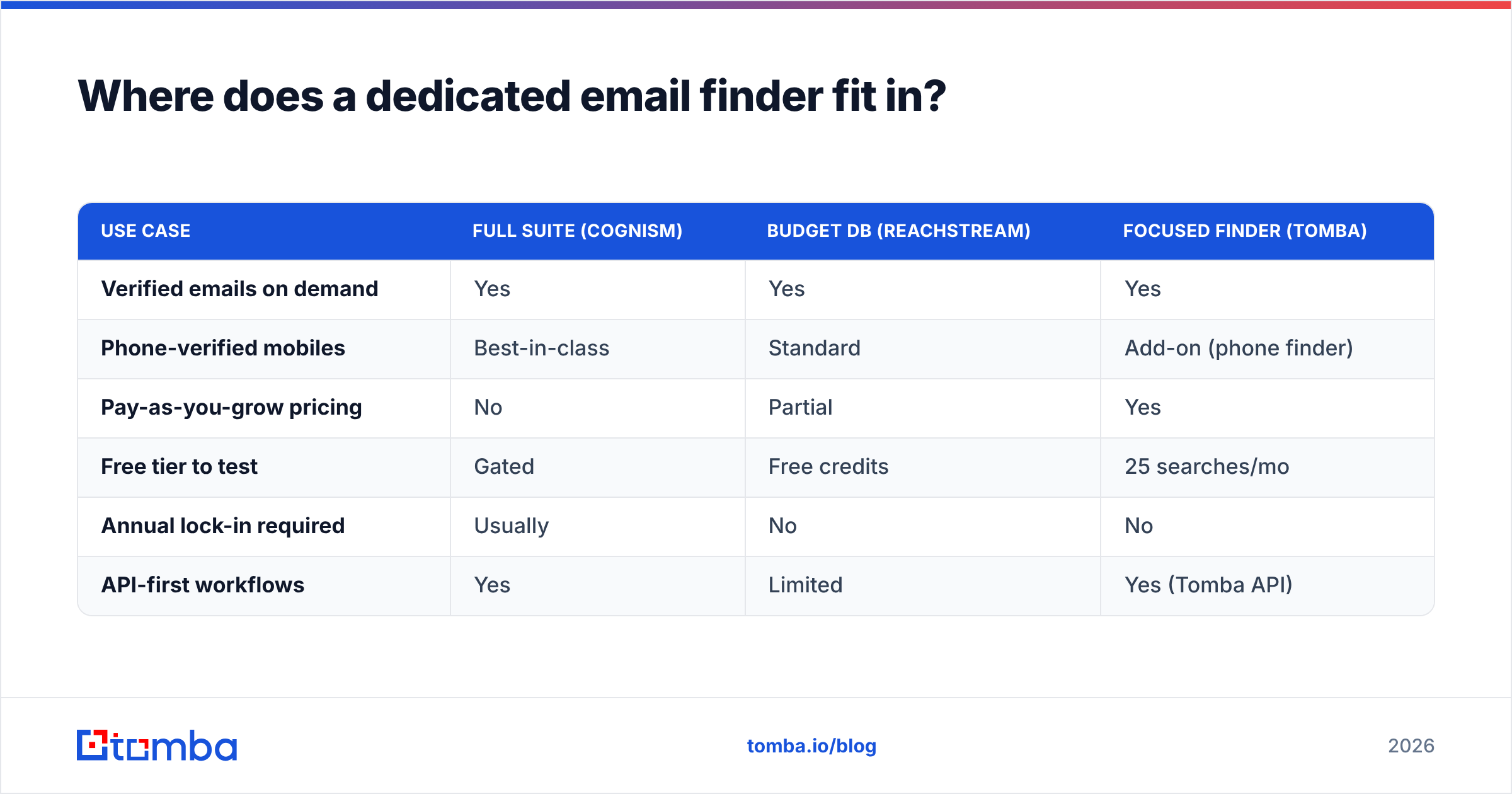
That's where a purpose-built finder changes the math. Instead of renting an entire database, you look up exactly the contacts you need, when you need them. A domain search pulls every discoverable email at a target company; an email finder resolves a specific name-plus-domain into a verified address; and data enrichment fills in the firmographic gaps on the records you already have.
| Use case | Full suite (Cognism) | Budget DB (Reachstream) | Focused finder (Tomba) |
|---|---|---|---|
| Verified emails on demand | Yes | Yes | Yes |
| Phone-verified mobiles | Best-in-class | Standard | Add-on (phone finder) |
| Pay-as-you-grow pricing | No | Partial | Yes |
| Free tier to test | Gated | Free credits | 25 searches/mo |
| Annual lock-in required | Usually | No | No |
| API-first workflows | Yes | Limited | Yes (Tomba API) |
For many teams, the winning move isn't "Cognism or Reachstream" — it's a lightweight finder plus a verifier, layered onto the CRM you already own. You avoid the annual commitment and only pay for the lookups you actually run. Compare the numbers on Tomba pricing: a Free tier of 25 searches/month, Starter at $49/mo, Growth at $99/mo, and Pro at $249/mo — no quote required.
What are the pros and cons of each?#
Cognism — pros: Best-in-class EU/UK coverage, phone-verified mobiles, strong compliance, deep CRM and sequencer integrations, reliable accuracy. Cognism — cons: Expensive, quote-only pricing, annual contracts, overkill for small teams and US-only SMB outbound.
Reachstream — pros: Low entry price, transparent self-serve plans, fast list-building, decent US coverage, free credits to test. Reachstream — cons: Variable accuracy in niche verticals, lighter compliance layer, shallower enrichment and integrations than premium suites.
Focused finder — pros: Pay-as-you-go, no lock-in, verification built in, API and spreadsheet integrations, generous free tier. Focused finder — cons: Not a full intent/technographic intelligence platform — pair it with a CRM and your own targeting.
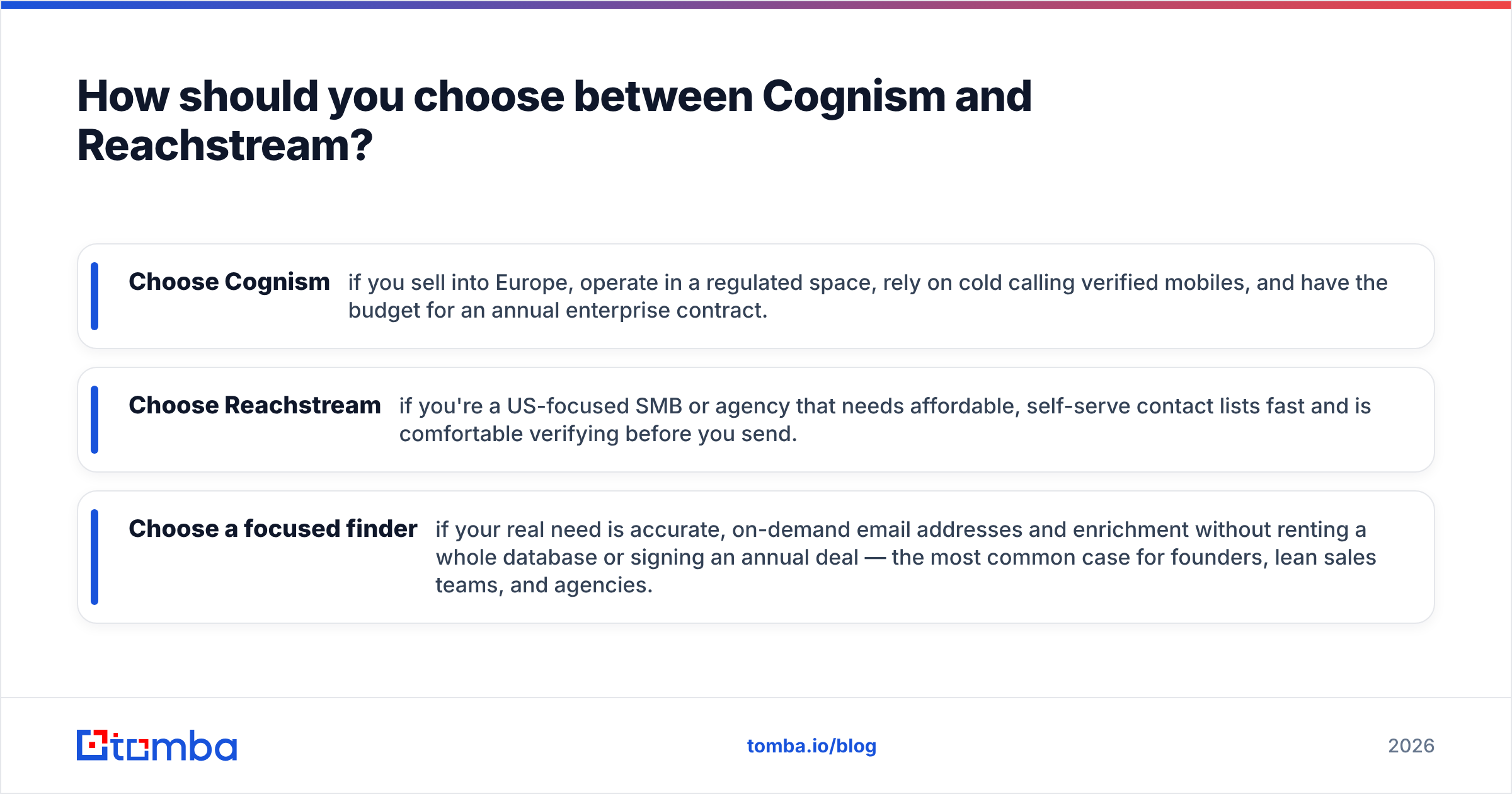
How should you choose between Cognism and Reachstream?#
Match the tool to the cost of being wrong.
- Choose Cognism if you sell into Europe, operate in a regulated space, rely on cold calling verified mobiles, and have the budget for an annual enterprise contract.
- Choose Reachstream if you're a US-focused SMB or agency that needs affordable, self-serve contact lists fast and is comfortable verifying before you send.
- Choose a focused finder if your real need is accurate, on-demand email addresses and enrichment without renting a whole database or signing an annual deal — the most common case for founders, lean sales teams, and agencies.
Most teams over-buy. They purchase an enterprise intelligence suite to solve what is, in practice, an "I need this person's verified email" problem. Diagnose the actual job before you sign anything.
The bottom line#
Cognism and Reachstream both do what they promise — Cognism sells verified confidence at a premium, Reachstream sells accessible volume on a budget. The right choice hinges on geography, compliance exposure, and how much a bad record costs you.
But before you commit to either annual bet, test whether your problem is smaller than a full data suite. If what you really need is verified professional emails for known targets — with a free tier to prove it out and no contract to escape — start with Tomba Email Finder. Find and verify the exact contacts you need, enrich them, push them to your CRM, and only scale up to a heavier platform when your workflow genuinely demands it. Run your first 25 searches free, then grow into a plan that matches your volume instead of your vendor's quota.
Related guides#
Ready to find emails that actually work?
Join 150,000+ professionals who stopped guessing and started sending. Free credits on signup — no credit card required.
Get the Tomba newsletter
Practical outbound tactics and product updates — once every two weeks.
About the author