Cognism vs SalesIntel (2026): Which B2B Data Tool Wins?
Cognism and SalesIntel both sell B2B contact data, but they win on different fronts — coverage and compliance versus human-verified accuracy. Here's the honest breakdown for 2026, plus a leaner option when you just need emails.
Choosing between Cognism and SalesIntel usually comes down to one question you can't answer from a pricing page: whose data is actually right for the region and roles you sell into? Both are respected B2B data platforms, both charge enterprise money, and both will happily quote you an annual contract. The differences that matter are underneath the marketing.
This is a neutral breakdown — what each does well, where each falls short, and how to decide without a six-week trial. If your real need is narrower than a full sales-intelligence suite, there's a cheaper path at the end too.
TL;DR: Cognism vs SalesIntel in five bullets#
- Cognism wins on international coverage (strong EMEA data), phone verification ("Diamond Data"), and built-in compliance workflows (GDPR, DNC screening). Best for teams selling into Europe.
- SalesIntel wins on human-verified US contacts, research-on-demand, and technographic + intent layering. Best for US-focused ABM teams that value re-verified accuracy.
- Pricing for both is quote-based, annual, and typically five figures — neither publishes transparent monthly plans.
- Accuracy claims are similar on paper (~95%+); in practice Cognism leans on automated verification at scale, SalesIntel on human re-verification cycles.
- If you mainly need verified email addresses by domain or name — not a full platform — a focused tool like Tomba costs a fraction and starts free.

What are Cognism and SalesIntel, exactly?#
Both are B2B sales-intelligence platforms: databases of company and contact records you search, filter, and push into your CRM or sequencer. Think of them as the difference between a phone book and a research team — you're not just paying for rows of data, you're paying for how fresh and how verified those rows stay.
Cognism (cognism.com) built its reputation on international data and compliance. Its standout feature is Diamond Data — phone numbers that have been manually verified so reps stop dialing dead lines. It also screens contacts against Do-Not-Call lists across regions and positions itself as GDPR-first, which matters if your reps prospect into Germany, France, or the UK.
SalesIntel (salesintel.io) built its reputation on human-verified US data. Rather than trusting automated crawls alone, SalesIntel runs contacts through a re-verification cycle and offers "Research on Demand" — if a contact you need isn't in the database, their team will go find and verify it. It layers technographics (what tools a company uses) and intent signals on top.
The overlap is real, but the center of gravity is different: Cognism is coverage-and-compliance-led; SalesIntel is accuracy-and-research-led.
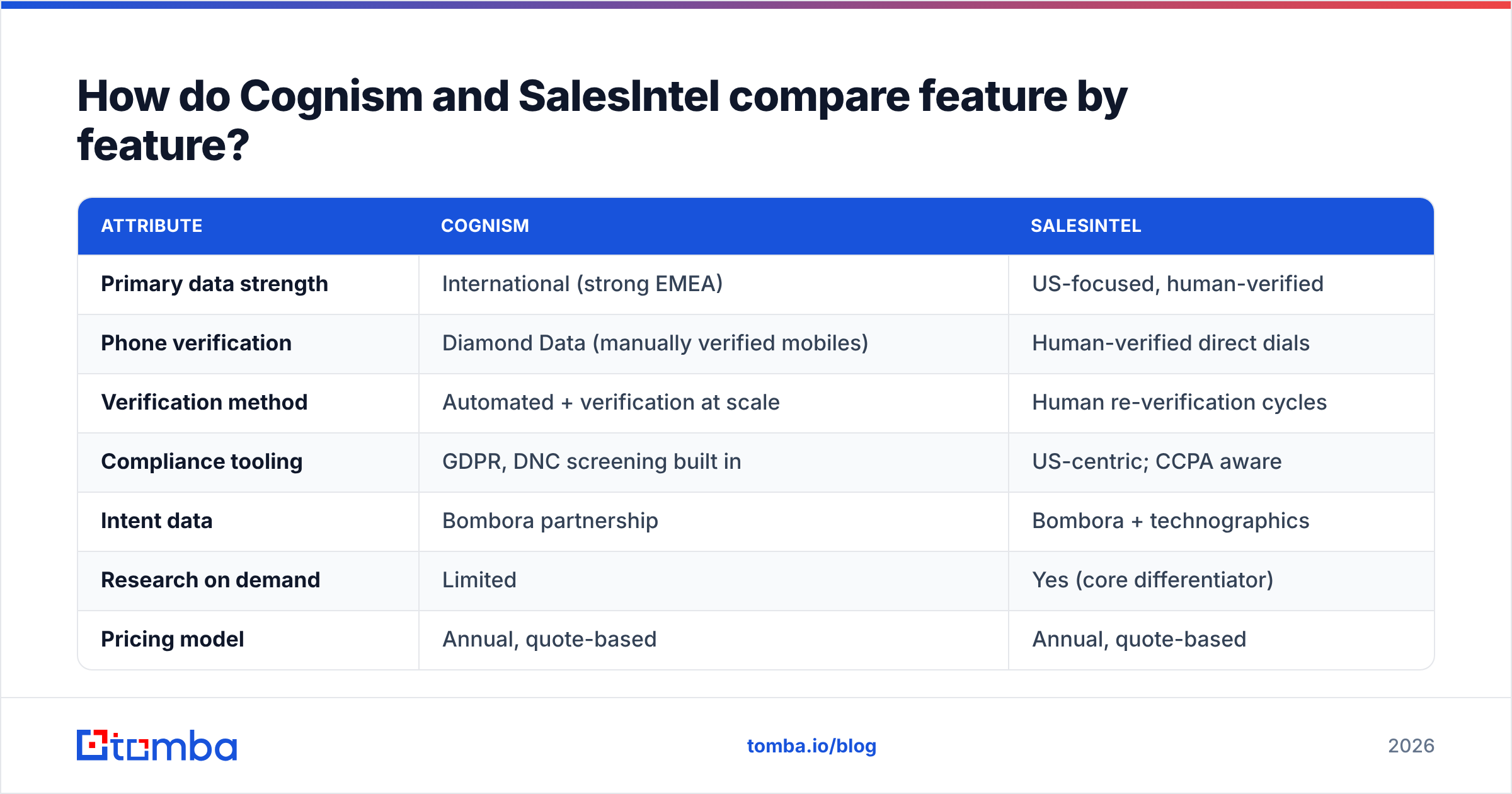
How do Cognism and SalesIntel compare feature by feature?#
Here's the side-by-side on the attributes that actually change a buying decision. Treat vendor accuracy percentages as directional, not audited.
| Attribute | Cognism | SalesIntel |
|---|---|---|
| Primary data strength | International (strong EMEA) | US-focused, human-verified |
| Phone verification | Diamond Data (manually verified mobiles) | Human-verified direct dials |
| Verification method | Automated + verification at scale | Human re-verification cycles |
| Compliance tooling | GDPR, DNC screening built in | US-centric; CCPA aware |
| Intent data | Bombora partnership | Bombora + technographics |
| Research on demand | Limited | Yes (core differentiator) |
| Pricing model | Annual, quote-based | Annual, quote-based |
| Free / self-serve tier | No | No |
| Best fit | EU + global outbound teams | US ABM and research-heavy teams |
Two honest caveats. First, both partner with Bombora for intent, so "intent data" is not a real tie-breaker between them. Second, database size numbers are marketing artifacts — a smaller, fresher database beats a larger stale one every time, so weigh verification recency over raw record counts.
Is Cognism better than SalesIntel for data accuracy?#
It depends on geography, and that's the whole answer. Cognism's accuracy is strongest where its verification pipeline is densest — Europe and global mobile numbers. SalesIntel's accuracy is strongest in the US, where its human re-verification model has the most coverage to work with.
If you sell into EMEA, Cognism's Diamond Data and compliance screening will save your reps from bad dials and legal headaches. If you run US-based account-based marketing and care about a specific named list being correct, SalesIntel's research-on-demand is genuinely useful — you can request the exact contacts you're missing.
What neither vendor will tell you on a demo: no database is 95% accurate on your niche without you testing it. Before signing an annual contract, pull 200 records in your exact ICP — right country, right seniority, right industry — and independently verify a sample. You can run those through an email verifier to check deliverability and catch bounces before they hit your sender reputation. That single test tells you more than any G2 badge.

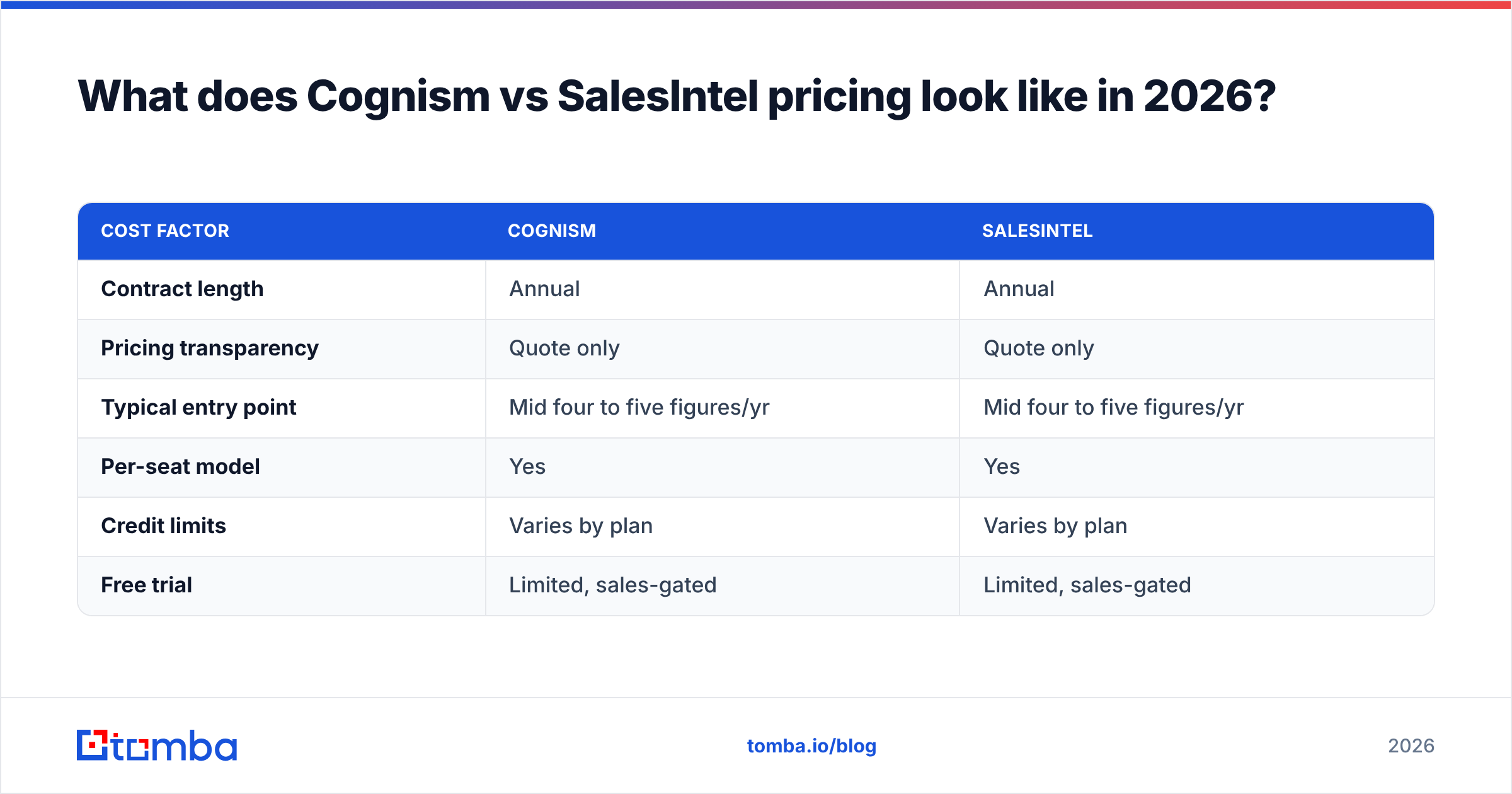
What does Cognism vs SalesIntel pricing look like in 2026?#
Neither publishes prices, and both sell annual contracts — expect to talk to a rep, sit through a demo, and negotiate. In practice, both land in the five-figures-per-year range for a small team, scaling with seats, credits, and add-ons like intent or research-on-demand.
| Cost factor | Cognism | SalesIntel |
|---|---|---|
| Contract length | Annual | Annual |
| Pricing transparency | Quote only | Quote only |
| Typical entry point | Mid four to five figures/yr | Mid four to five figures/yr |
| Per-seat model | Yes | Yes |
| Credit limits | Varies by plan | Varies by plan |
| Free trial | Limited, sales-gated | Limited, sales-gated |
The uncomfortable truth: if you're a two-person team that just needs verified emails to run outbound, a full sales-intelligence platform is overkill. You'll pay for research infrastructure, intent scoring, and compliance tooling you may never touch. That's the right spend for a 20-rep team running structured ABM into Europe — and the wrong spend for a founder-led team that needs 500 good emails this quarter.
Compare that to transparent, self-serve pricing where you can start free and scale monthly. Tomba's pricing is public: a free tier with 25 searches/month, Starter at $49/mo, Growth at $99/mo, and Pro at $249/mo. Different product, different job — but worth knowing the floor before you commit to an annual seat.
Which should you choose: Cognism, SalesIntel, or something leaner?#
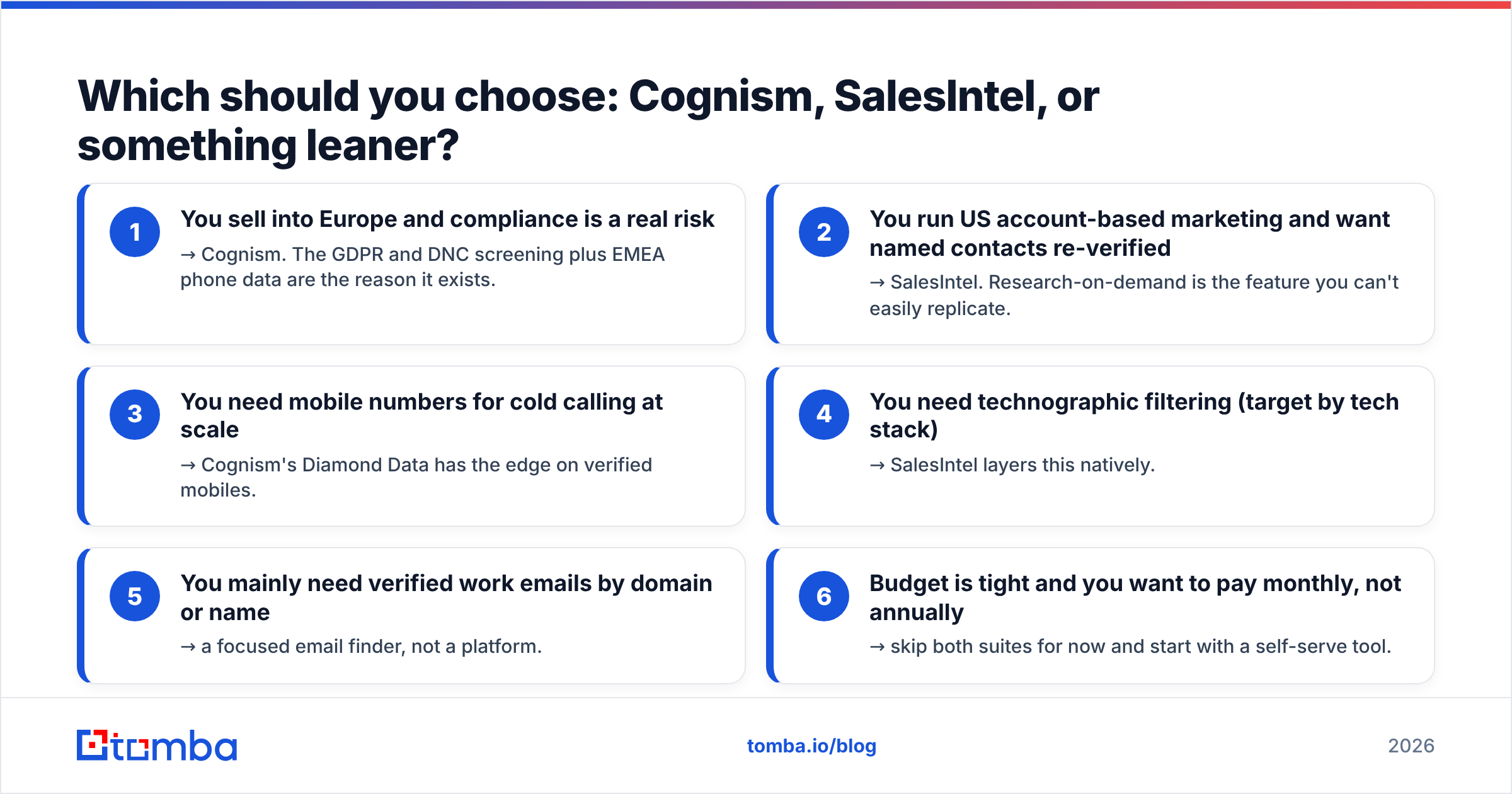
Match the tool to the job instead of the brand. Here's the decision framework:
- You sell into Europe and compliance is a real risk → Cognism. The GDPR and DNC screening plus EMEA phone data are the reason it exists.
- You run US account-based marketing and want named contacts re-verified → SalesIntel. Research-on-demand is the feature you can't easily replicate.
- You need mobile numbers for cold calling at scale → Cognism's Diamond Data has the edge on verified mobiles.
- You need technographic filtering (target by tech stack) → SalesIntel layers this natively.
- You mainly need verified work emails by domain or name → a focused email finder, not a platform.
- Budget is tight and you want to pay monthly, not annually → skip both suites for now and start with a self-serve tool.
That last two points are where most small and mid-market teams actually land. If your bottleneck is "I have a list of companies and I need the right person's email," you're buying a whole intelligence suite to use 5% of it.
Where does a focused email finder fit in?#
A dedicated email finder solves one problem completely instead of ten problems partially. If you know the company and the person, an email finder returns the verified professional address — no annual contract, no seat minimums.
With Tomba, you can find email addresses by name and domain, run a domain search to pull every public email pattern at a company, and enrich leads with firmographic detail — the same core jobs you'd use Cognism or SalesIntel for, minus the platform overhead. Tomba's core is the email finder; the verifier, domain search, catch-all verifier, and phone finder sit alongside it.
The trade-off is honest: Tomba won't give you Bombora intent scoring, research-on-demand, or a compliance dashboard for EMEA outbound. If those are core to your motion, buy the platform. If they're not, don't pay for them.
Here's the practical stack many lean teams run: use a full platform only if you truly need intent and international compliance; otherwise pair a focused email finder with a good sequencer and put the five-figure difference into ads or headcount.
How do the three approaches stack up?#
| Factor | Cognism | SalesIntel | Focused finder (e.g. Tomba) |
|---|---|---|---|
| Best for | EMEA + global outbound | US ABM, research-heavy | Verified emails on demand |
| Pricing | Annual, quote | Annual, quote | Public, from $49/mo, free tier |
| Compliance tooling | Strong (GDPR/DNC) | US-centric | Verification-focused |
| Intent data | Yes (Bombora) | Yes (Bombora) | No |
| Phone data | Diamond Data | Human-verified | Phone finder add-on |
| Time to value | Weeks (onboarding) | Weeks (onboarding) | Minutes (self-serve) |
| Contract risk | High (annual lock) | High (annual lock) | Low (monthly) |
Read across the "time to value" and "contract risk" rows — that's the real difference for a team that needs to move this quarter. Platforms are an investment; a finder is a utility.
The verdict#
Cognism wins for international, compliance-sensitive outbound; SalesIntel wins for US, research-heavy ABM. If those descriptions match your motion, run a real data test in your exact ICP, then negotiate hard on the annual price — both discount more than their first quote suggests. Cross-check any vendor claim against third-party reviews on G2 rather than the sales deck.
But if you got here because you just need accurate emails without a platform commitment, both of these are the wrong tool. Start with a Tomba Email Finder account — the free tier gives you 25 searches a month to test accuracy on your own list, and paid plans start at $49/mo with no annual lock-in. Verify the data yourself, keep your sender reputation clean, and only graduate to a full intelligence suite when intent and compliance actually become your bottleneck. Buy the job you have, not the platform you're sold.
Related guides#
// get started
Find, verify and enrich your first contacts today
Start on the free plan with 25 searches a month, then scale when your team is ready.
Free plan · No credit card required · GDPR & CCPA
// about the author