Cognism vs Salutary Data (2026): Which B2B Data Wins?
Cognism sells polished all-in-one prospecting; Salutary Data sells raw, hygiene-first records at scale. Here's an honest, side-by-side breakdown to help you pick the right B2B data source for your team in 2026.
Choosing a B2B data provider is really a bet on where your pipeline comes from next quarter. Get it right and reps spend their time selling; get it wrong and they spend it scrubbing bounced emails and apologizing for wrong numbers. Two names that come up in very different corners of that decision are Cognism and Salutary Data — and they are not the same kind of product at all.
This is a neutral, side-by-side look at how the two stack up in 2026, where each one genuinely wins, and where a leaner email-finder approach beats paying for a platform you'll only half-use.
TL;DR#
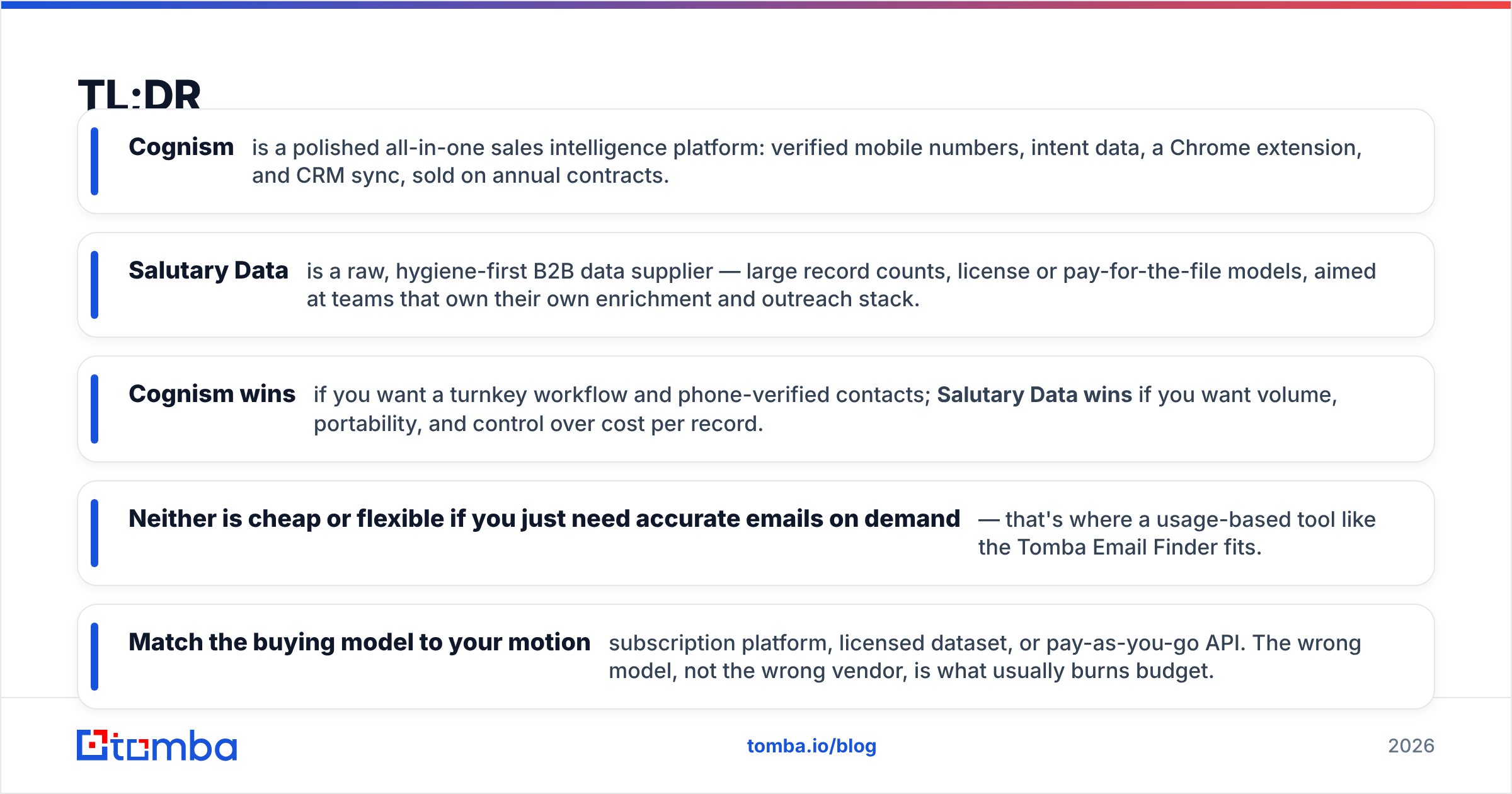
- Cognism is a polished all-in-one sales intelligence platform: verified mobile numbers, intent data, a Chrome extension, and CRM sync, sold on annual contracts.
- Salutary Data is a raw, hygiene-first B2B data supplier — large record counts, license or pay-for-the-file models, aimed at teams that own their own enrichment and outreach stack.
- Cognism wins if you want a turnkey workflow and phone-verified contacts; Salutary Data wins if you want volume, portability, and control over cost per record.
- Neither is cheap or flexible if you just need accurate emails on demand — that's where a usage-based tool like the Tomba Email Finder fits.
- Match the buying model to your motion: subscription platform, licensed dataset, or pay-as-you-go API. The wrong model, not the wrong vendor, is what usually burns budget.
What is Cognism?#
Cognism is a sales intelligence platform built around contact data plus a workflow to use it. Its pitch centers on phone-verified mobile numbers (marketed as "Diamond Data"), B2B emails, company firmographics, and buying-intent signals, all wrapped in a browser extension and native CRM integrations. It leans heavily on GDPR and CCPA compliance, including notified-contact and do-not-call screening for European markets.
In practice, Cognism is bought by mid-market and enterprise sales teams that want one login covering find, enrich, and prospect. You pay for that convenience on an annual license, and pricing is quote-based rather than published. If you want the official positioning, see cognism.com.
What is Salutary Data?#
Salutary Data is a B2B data provider focused on quality and hygiene at the record level rather than a prospecting app. Its model is closer to a licensed database: large volumes of contacts and companies, delivered as files or via integration, priced by license or volume instead of per-seat subscriptions. The brand emphasizes verification, deliverability, and clean records you can feed into your own tools.
Teams that pick Salutary Data usually already own their outreach stack — a sequencer, a CRM, maybe an in-house data enrichment pipeline — and want a portable, cost-controlled data source to pour into it. You can review their positioning at salutarydata.com.
Cognism vs Salutary Data: how do they compare?#
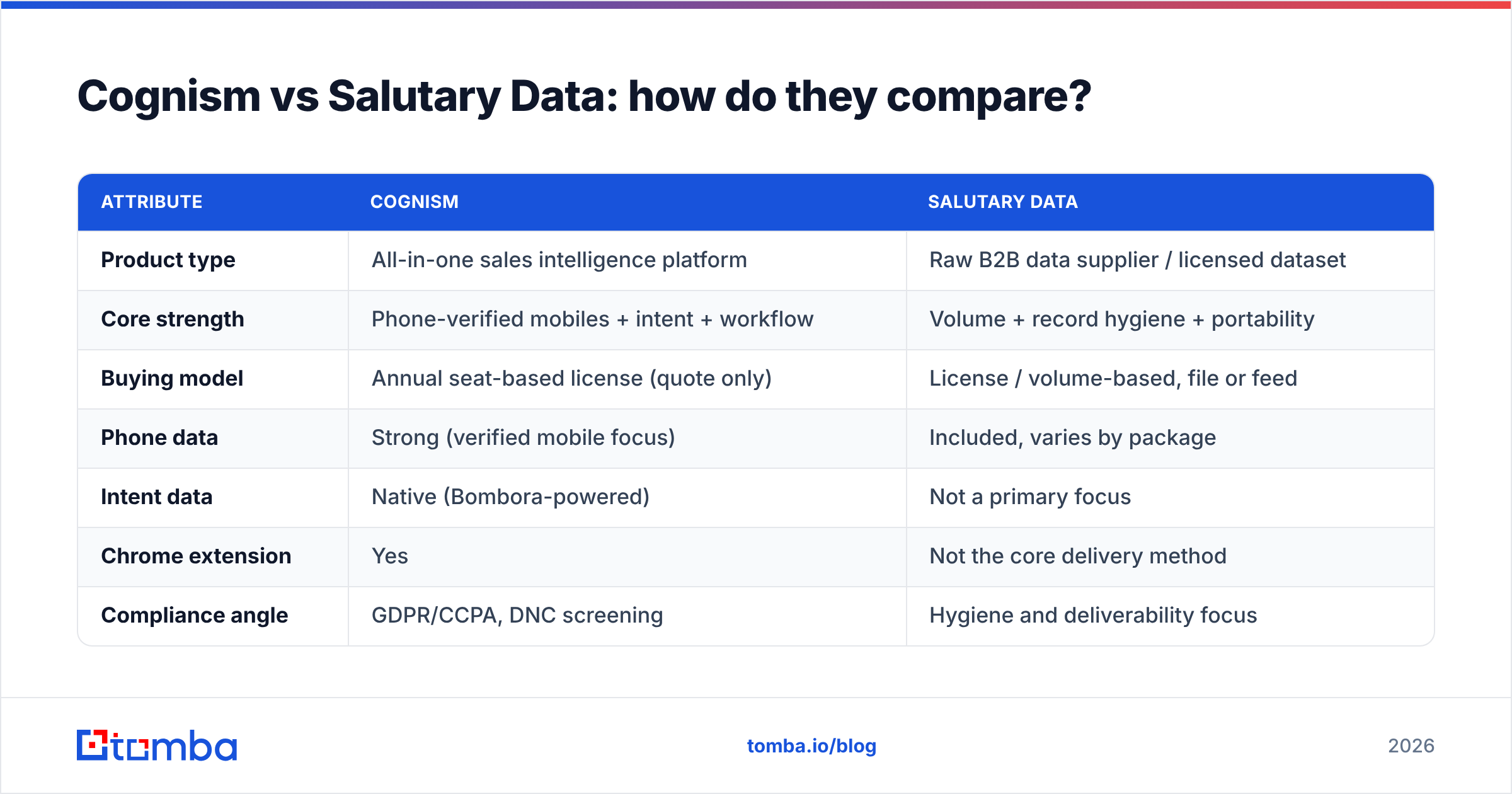
The cleanest way to frame this is not "which is better" but "which model matches your team." Here is the side-by-side.
| Attribute | Cognism | Salutary Data |
|---|---|---|
| Product type | All-in-one sales intelligence platform | Raw B2B data supplier / licensed dataset |
| Core strength | Phone-verified mobiles + intent + workflow | Volume + record hygiene + portability |
| Buying model | Annual seat-based license (quote only) | License / volume-based, file or feed |
| Phone data | Strong (verified mobile focus) | Included, varies by package |
| Intent data | Native (Bombora-powered) | Not a primary focus |
| Chrome extension | Yes | Not the core delivery method |
| Compliance angle | GDPR/CCPA, DNC screening | Hygiene and deliverability focus |
| Best for | Turnkey outbound teams | Data-ops teams with their own stack |
| Weak spot | Cost, annual lock-in, per-seat scaling | You supply the workflow around it |
The pattern is consistent: Cognism sells you the whole car; Salutary Data sells you a high-quality fuel tank. One is priced for convenience, the other for control.
Which one has better data accuracy?#
Neither publishes an independently audited accuracy number you can take to the bank, so treat vendor claims as marketing until you test on your own territory.
That said, they optimize for different things:
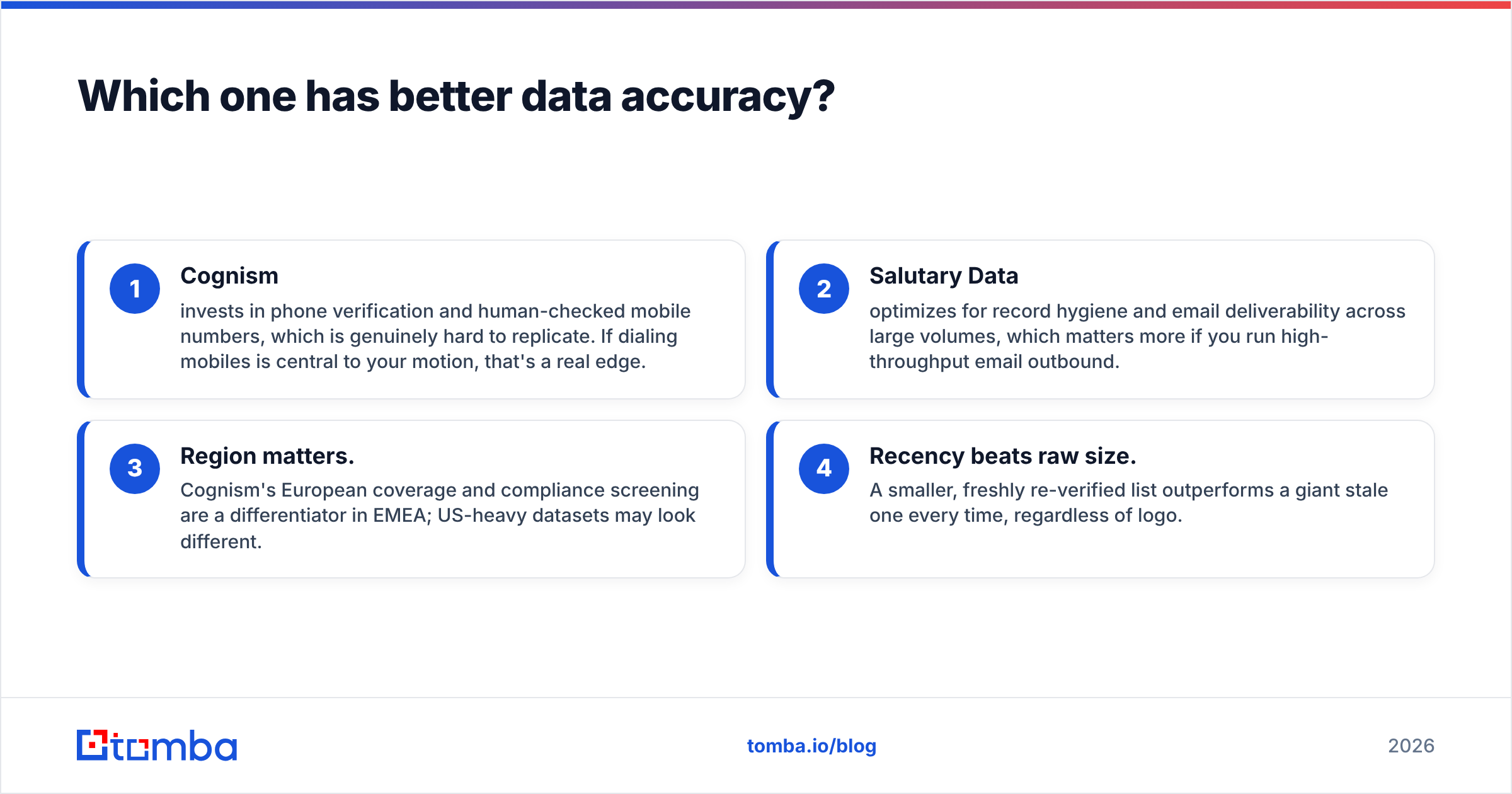
- Cognism invests in phone verification and human-checked mobile numbers, which is genuinely hard to replicate. If dialing mobiles is central to your motion, that's a real edge.
- Salutary Data optimizes for record hygiene and email deliverability across large volumes, which matters more if you run high-throughput email outbound.
- Region matters. Cognism's European coverage and compliance screening are a differentiator in EMEA; US-heavy datasets may look different.
- Recency beats raw size. A smaller, freshly re-verified list outperforms a giant stale one every time, regardless of logo.
The only accuracy test that counts is a paid pilot on 500–1,000 of your real target accounts, measuring bounce rate, connect rate, and how many records were simply missing. Read independent user reviews on G2 before you pilot, then let your own bounce data settle the argument.
What do Cognism and Salutary Data cost?#
Both are priced for committed spend, not for dabbling.
- Cognism is quote-based, seat-based, and annual. Expect a meaningful yearly commitment, and expect cost to scale with the number of reps who need access. Some plans meter how many records you can view or export.
- Salutary Data is license- or volume-based. You're effectively paying for access to a dataset, which can be more cost-efficient per record at scale but shifts the workflow burden onto you.
The hidden cost in both cases is the same: you often pay for the whole platform or the whole dataset even when a given week only needs a handful of verified emails. That mismatch — big commitment, spiky usage — is exactly what pushes a lot of smaller teams toward usage-based tooling.

When is a leaner email-finder the smarter buy?#
Short answer: when your bottleneck is "I need accurate contact emails for these specific people," not "I need a whole intelligence suite."
Plenty of teams over-buy. They sign a platform contract to solve a targeted problem — finding and verifying work emails — and end up paying for intent dashboards and seats they never touch. If that sounds familiar, a focused, pay-as-you-go stack is cheaper and faster to stand up.
That's the gap Tomba fills. Instead of an annual platform license, you get transparent, usage-based access to core prospecting primitives:
- Email finder — find professional emails by name, company, or domain search.
- Email verifier — validate deliverability before you send, including catch-all verification.
- Bulk + API — run lists at scale or wire it into your own workflow via the Tomba API.
- Enrichment — fill in the gaps on records you already own from your B2B database.
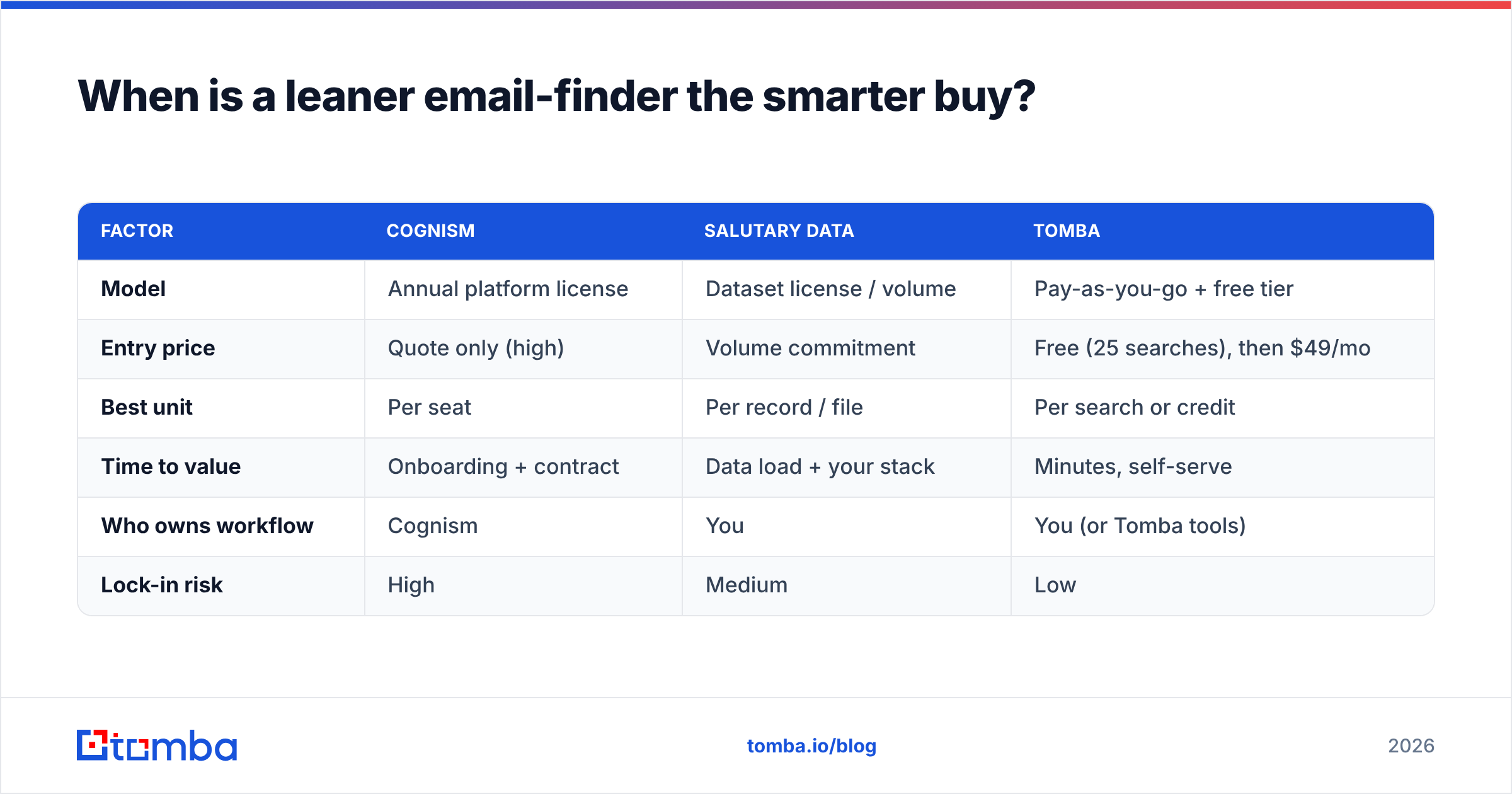
Here's how the three buying models line up.
| Factor | Cognism | Salutary Data | Tomba |
|---|---|---|---|
| Model | Annual platform license | Dataset license / volume | Pay-as-you-go + free tier |
| Entry price | Quote only (high) | Volume commitment | Free (25 searches), then $49/mo |
| Best unit | Per seat | Per record / file | Per search or credit |
| Time to value | Onboarding + contract | Data load + your stack | Minutes, self-serve |
| Who owns workflow | Cognism | You | You (or Tomba tools) |
| Lock-in risk | High | Medium | Low |
Tomba's published pricing runs Free (25 searches/mo), Starter at $49/mo, Growth at $99/mo, and Pro at $249/mo, with Enterprise custom. The point isn't that Tomba replaces a full intelligence platform — it's that most teams don't need a full platform to hit their number. They need clean, verified emails on demand.
Which should you choose?#
Pick by your operating model, not by feature-count bragging rights.
Choose Cognism if: you want one turnkey platform, phone-verified mobiles are core to your outreach, you sell into EMEA and value built-in compliance screening, and you have the budget for an annual, per-seat contract. You're paying for convenience and verified phone data — and for the right team, that's money well spent.
Choose Salutary Data if: you already run a mature outbound stack, you'd rather license clean records and control cost per contact, and you have the data-ops muscle to plug a raw dataset into your own sequencer and CRM. You're paying for volume and portability.
Choose a usage-based email finder if: your real need is accurate, verified contact emails without a platform commitment — or you want to keep a cheap, flexible layer alongside whatever bigger tool you run. Start on a free tier, measure bounce rates on your own list, and only scale spend when the data proves itself.
The most common mistake isn't picking the "wrong" vendor. It's buying a subscription-shaped tool for a usage-shaped problem, then watching seats and credits go unused. Match the model to the motion first; the logo matters far less.
Frequently asked questions#
Is Cognism better than Salutary Data? Not universally. Cognism is better if you want an all-in-one platform with verified mobile numbers and intent data. Salutary Data is better if you want raw, hygiene-focused records at volume to run through your own stack. They optimize for different buyers.
Which is cheaper, Cognism or Salutary Data? It depends on scale and usage. Cognism's per-seat annual licensing can get expensive as headcount grows. Salutary Data's volume-based licensing can be more cost-efficient per record but assumes you supply the workflow. Neither is a good fit for low, spiky usage.
Do I need either one just to find work emails? No. If your core need is finding and verifying professional emails, a usage-based tool like Tomba covers that at a fraction of the commitment, with a free tier to test accuracy on your own targets first.
Can I combine a data provider with an email finder? Yes, and many teams do. Use a broad dataset or platform for firmographics and intent, then layer a verifier and email finder on top to keep deliverability high and fill in missing contacts.
The bottom line#
Cognism and Salutary Data are both credible — they just answer different questions. Cognism answers "give me a complete, compliant prospecting workflow with great phone data." Salutary Data answers "give me clean records at volume that I control." Decide which question is actually yours before you sign anything.
And if the honest answer is "I mostly just need accurate emails, verified, without an annual contract," start smaller. Spin up the Tomba Email Finder on the free tier, run it against your real target list, and let the bounce rate make the call. You can always add a heavier platform later — but you can't get back budget you spent on seats nobody logged into.
Related guides#
// get started
Find, verify and enrich your first contacts today
Start on the free plan with 25 searches a month, then scale when your team is ready.
Free plan · No credit card required · GDPR & CCPA
// about the author