Cognism vs Span Global Services: Which B2B Data Wins in 2026?
Cognism sells compliant, real-time B2B contact intelligence; Span Global Services sells prebuilt email lists. Here's an honest breakdown of accuracy, pricing, compliance, and which fits your outbound motion in 2026.
Choosing a B2B data vendor is really a bet on where your next 10,000 leads come from. Get it right and your reps spend their day talking to real buyers. Get it wrong and they burn hours on bounced emails, wrong numbers, and stale titles. Cognism and Span Global Services sit on two very different sides of that bet, so comparing them isn't apples-to-apples — it's more like comparing a live utility feed to a warehouse full of pre-packed boxes.
This guide breaks down what each vendor actually sells, how they price it, where the data comes from, and which one fits your motion. No vendor spin — just the trade-offs you'd want a peer to tell you before you sign.
TL;DR: Cognism vs Span Global Services#
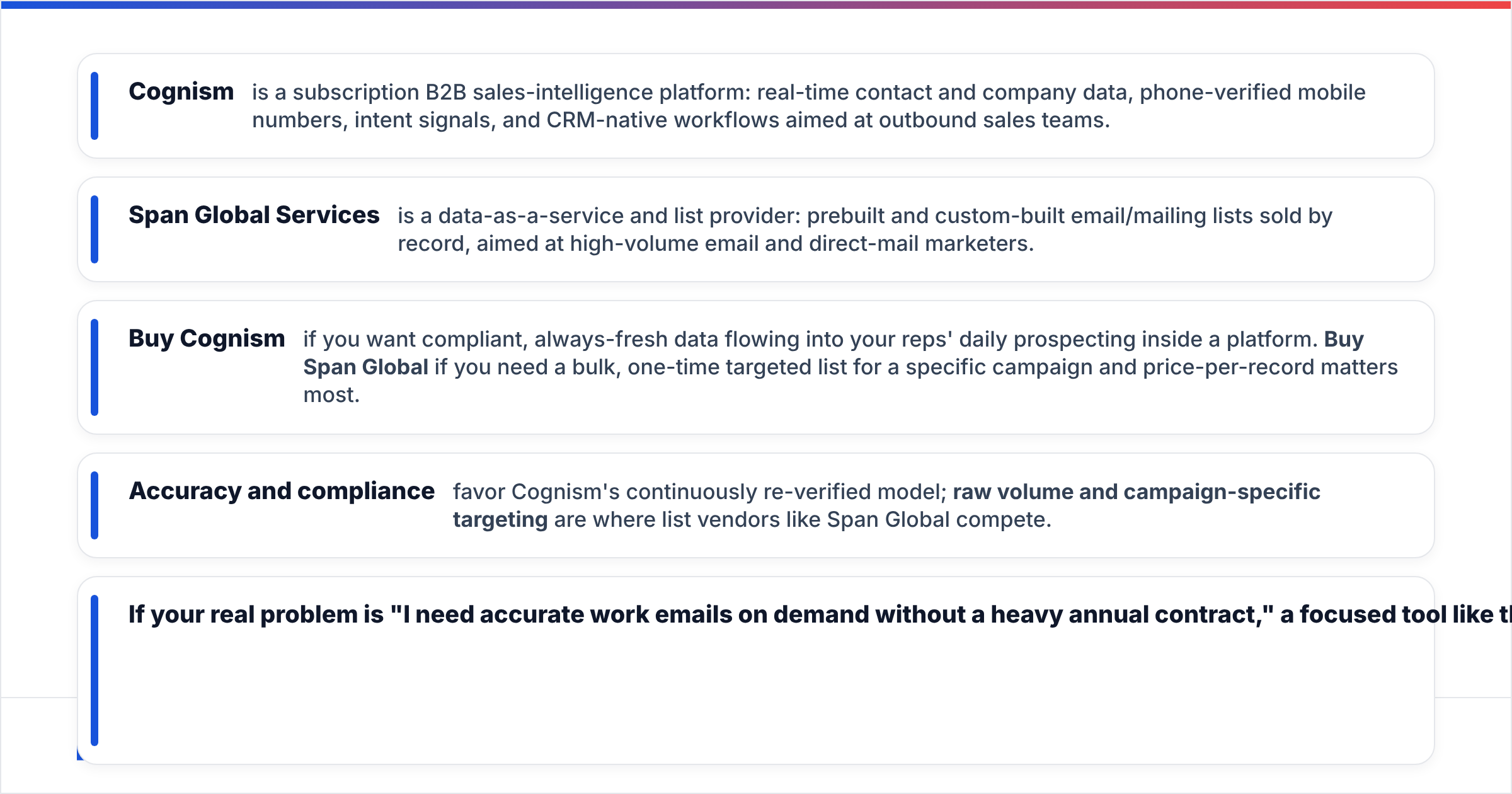
- Cognism is a subscription B2B sales-intelligence platform: real-time contact and company data, phone-verified mobile numbers, intent signals, and CRM-native workflows aimed at outbound sales teams.
- Span Global Services is a data-as-a-service and list provider: prebuilt and custom-built email/mailing lists sold by record, aimed at high-volume email and direct-mail marketers.
- Buy Cognism if you want compliant, always-fresh data flowing into your reps' daily prospecting inside a platform. Buy Span Global if you need a bulk, one-time targeted list for a specific campaign and price-per-record matters most.
- Accuracy and compliance favor Cognism's continuously re-verified model; raw volume and campaign-specific targeting are where list vendors like Span Global compete.
- If your real problem is "I need accurate work emails on demand without a heavy annual contract," a focused tool like the Tomba Email Finder may beat both on cost-per-verified-contact.

What is Cognism?#
Cognism is a premium sales-intelligence platform built around compliant, globally-sourced B2B data. Its pitch is that reps shouldn't just get a phone number — they should get a number a human has verified will ring the right person. That "phone-verified" mobile dataset (marketed as Diamond Data) is its signature feature, alongside company firmographics, technographics, and buyer-intent signals licensed through Bombora.
The core value is workflow, not just records. Cognism lives inside your stack — a browser extension over LinkedIn, native syncs to Salesforce and HubSpot, and enrichment that keeps existing CRM records from rotting. You pay an annual subscription, usually with unrestricted-view licensing so reps aren't rationing credits mid-sprint. You can read their own framing on the Cognism website, but independent reviews on G2 are the more honest signal on data quality by region.
Cognism's strongest markets are EMEA and North America, and its compliance posture (GDPR-aligned, notified DNC checking in some regions) is a deliberate selling point for teams that worry about how their data was sourced.
What is Span Global Services?#
Span Global Services is a B2B data and demand-generation provider whose backbone is list building. You tell them the audience — say, IT directors at US manufacturers with 200+ employees — and they deliver a targeted file of contacts you can load into an email or direct-mail campaign. They also offer data appending, cleansing, and managed email/telemarketing campaigns as services on top of the raw data.
The mental model is different from Cognism. Instead of a seat-based subscription and a live platform, you're largely buying records — prebuilt industry/technology lists or a custom-built file scoped to your brief. That makes Span Global attractive for marketers running big, one-off pushes where the goal is reach at a predictable per-contact cost, and where a self-serve prospecting UI isn't the point.
The trade-off inherent to any list model is freshness. A file is accurate the day it's compiled; job changes, role moves, and departures start eroding it immediately. Reputable providers re-verify and offer replacement guarantees for hard bounces, and Span Global's cleansing services exist partly to address this — but it's the structural weakness of buying data as a static asset rather than a live feed. You can review their service catalog on the Span Global Services site.
Cognism vs Span Global Services: side-by-side comparison#
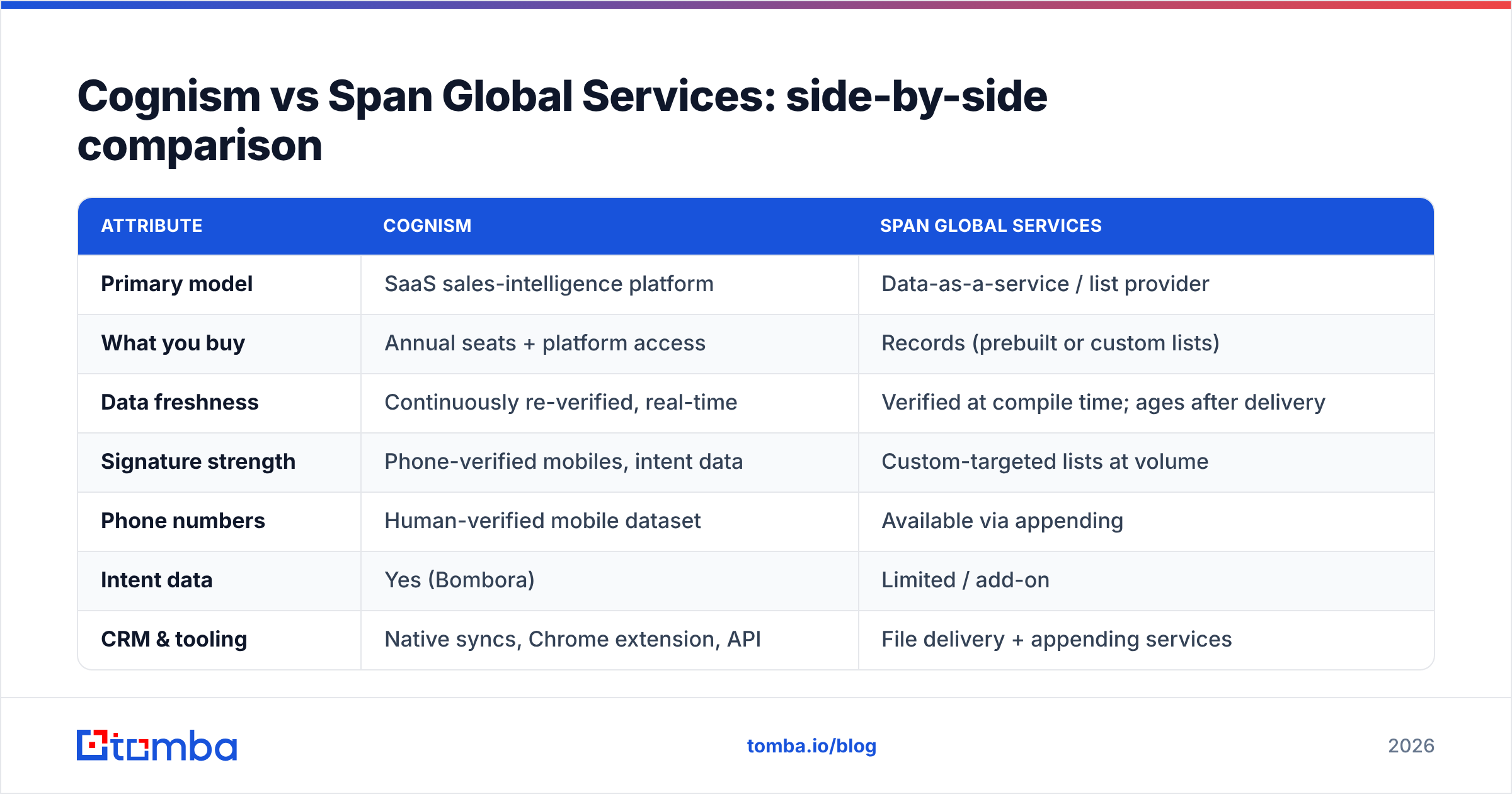
Here's the core of it in one view. Treat exact pricing as directional — Span Global quotes per project and Cognism quotes per seat/region, so neither publishes a flat public rate card.
| Attribute | Cognism | Span Global Services |
|---|---|---|
| Primary model | SaaS sales-intelligence platform | Data-as-a-service / list provider |
| What you buy | Annual seats + platform access | Records (prebuilt or custom lists) |
| Data freshness | Continuously re-verified, real-time | Verified at compile time; ages after delivery |
| Signature strength | Phone-verified mobiles, intent data | Custom-targeted lists at volume |
| Phone numbers | Human-verified mobile dataset | Available via appending |
| Intent data | Yes (Bombora) | Limited / add-on |
| CRM & tooling | Native syncs, Chrome extension, API | File delivery + appending services |
| Compliance focus | GDPR-aligned, DNC checking | Opt-in sourcing, cleansing services |
| Best for | Outbound sales teams, daily prospecting | Bulk marketing & direct-mail campaigns |
| Pricing shape | Higher annual commitment | Per-record / per-project |
Is Cognism better than Span Global Services?#
Better at what is the only question that matters. Cognism wins decisively when your problem is ongoing, rep-driven outbound where data freshness and workflow determine productivity. If a team of SDRs prospects every day, a live platform that re-verifies mobiles and pushes clean records into the CRM will out-earn a static file within a quarter — the compounding cost of bad data (bounces, wrong numbers, damaged sender reputation) is brutal at volume.
Span Global competes when the job is a defined campaign with a defined audience. If marketing needs 50,000 contacts in a niche vertical for a Q3 nurture and direct-mail push, buying a scoped list can be faster and cheaper than provisioning platform seats nobody will use afterward. You're paying for reach, not for a daily tool.
Three practical differences decide most evaluations:
- Freshness model — Cognism's continuous re-verification vs a list that's a snapshot in time. This is the single biggest driver of real-world email deliverability.
- Cost structure — Predictable annual subscription vs variable per-record spend. Finance teams often prefer one; campaign owners often prefer the other.
- Workflow depth — A platform reps live in vs a file you import. If adoption and daily use matter, the platform usually wins.

What about accuracy and bounce rates?#
Accuracy is where the list-vs-platform gap shows up most. No vendor — Cognism, Span Global, or anyone else — ships 100% accurate B2B data, because the underlying reality changes constantly. Roughly a quarter to a third of B2B contact data degrades every year as people change jobs. The differentiator is how quickly a provider notices and corrects.
A live platform re-checks records close to the moment you use them, so the email you export today was likely validated recently. A prebuilt list is only as fresh as its last compile date, which is why the smart move with any purchased file is to re-verify before you send rather than trust the delivery date. This is a five-minute step that protects your domain reputation, and it's cheap insurance regardless of which vendor you chose.
That's also where a dedicated verification layer earns its keep. Running any list — from either vendor — through an email verifier before a campaign catches the records that decayed between compile and send, and flags risky catch-all domains that inflate your apparent list size without being safe to email. If you're buying static lists at volume, treat verification as mandatory, not optional.
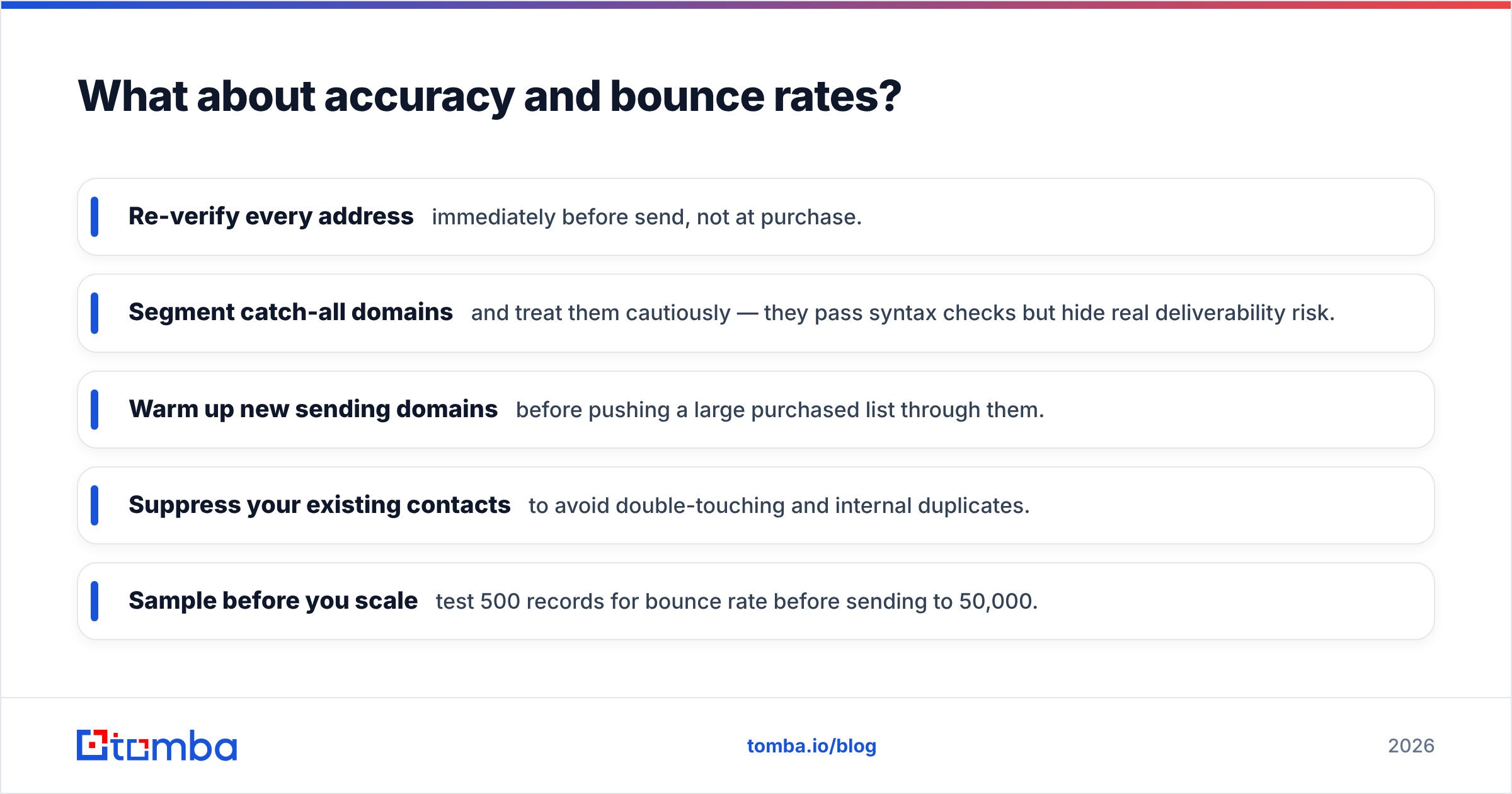
A quick pre-send checklist that applies to data from either provider:
- Re-verify every address immediately before send, not at purchase.
- Segment catch-all domains and treat them cautiously — they pass syntax checks but hide real deliverability risk.
- Warm up new sending domains before pushing a large purchased list through them.
- Suppress your existing contacts to avoid double-touching and internal duplicates.
- Sample before you scale — test 500 records for bounce rate before sending to 50,000.
How does pricing compare?#
Neither vendor is a self-serve, price-on-the-page product, so budget expectations matter. Cognism is a higher-commitment annual subscription — you're buying a platform and seats, and the entry point reflects that. The upside is unrestricted access for the reps who use it daily; the downside is you're paying whether or not the whole team logs in.
Span Global is project-priced — cost scales with how many records you want and how custom the targeting is. That's efficient for a one-time push and inefficient if you find yourself buying fresh lists every month, because you're repeatedly paying for data that a subscription would have kept current for you.
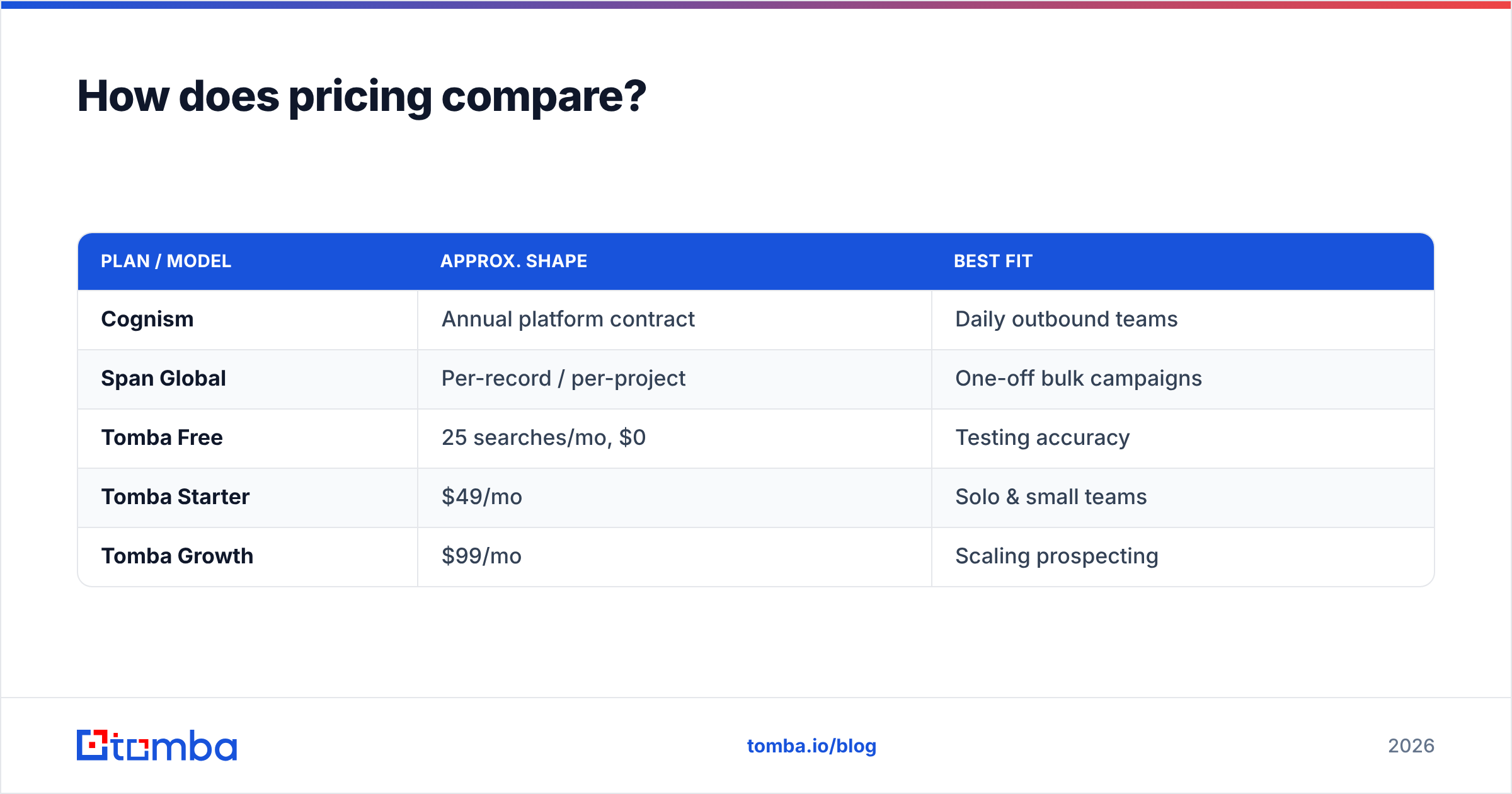
For a lot of small and mid-sized teams, the honest answer is that both are more than they need. If your actual requirement is "find and verify accurate business emails as I prospect, without an enterprise contract," a usage-based tool is the better economic fit. That's the gap Tomba targets: transparent Tomba pricing starts with a free tier of 25 searches per month, then Starter at $49/mo, Growth at $99/mo, and Pro at $249/mo — no annual lock-in required to get real work done, and a domain search that finds every reachable address at a company on demand instead of buying the whole list up front.
| Plan / model | Approx. shape | Best fit |
|---|---|---|
| Cognism | Annual platform contract | Daily outbound teams |
| Span Global | Per-record / per-project | One-off bulk campaigns |
| Tomba Free | 25 searches/mo, $0 | Testing accuracy |
| Tomba Starter | $49/mo | Solo & small teams |
| Tomba Growth | $99/mo | Scaling prospecting |
Which one should you choose?#
Match the tool to the motion, not to the brand.
Choose Cognism if you run a real outbound sales org, you need phone-verified mobiles and intent signals, compliance is a board-level concern, and you want data flowing into Salesforce or HubSpot every day. The annual cost is justified when reps live in the platform and freshness directly drives pipeline.
Choose Span Global Services if you're a marketer with a specific, high-volume campaign, you need custom-targeted reach in a niche segment, and you'd rather buy a scoped file than provision a year of platform seats. Just budget for re-verification and manage the freshness risk deliberately.
Choose a focused finder like Tomba if your core need is accurate, on-demand email discovery and verification without an enterprise contract — and you'd rather pay for what you use. Many teams pair approaches: a platform or list for breadth, and a precise finder to fill gaps and verify everything before it hits the send button.
The vendors that hurt you are the ones you pick by logo instead of by workflow. Cognism and Span Global are both legitimate — they just answer different questions. Decide which question you're actually asking first.
The bottom line#
Cognism sells living intelligence; Span Global Services sells targeted lists. If your outbound depends on freshness and daily rep workflow, Cognism's model earns its premium. If you need bulk reach for a defined campaign and can manage decay, Span Global is a reasonable buy. And if you mostly need verified emails without the overhead of either, start smaller.
Want to see how accurate on-demand data feels before committing to any annual contract? Try the Tomba Email Finder free — 25 searches a month, real verified business emails, and a built-in verifier so nothing hits your list unchecked. It's the fastest way to benchmark what "accurate" should actually mean before you sign with anyone.
Related guides#
// get started
Find, verify and enrich your first contacts today
Start on the free plan with 25 searches a month, then scale when your team is ready.
Free plan · No credit card required · GDPR & CCPA
// about the author