Cognism vs Spherescout (2026): B2B Data Platform Comparison
Cognism and Spherescout both promise clean B2B contact data, but they win on different fronts. Here is an honest, side-by-side breakdown of coverage, compliance, pricing, and who each tool actually fits.
Choosing between Cognism and Spherescout usually comes down to one question your budget owner will ask: are you paying for verified data at scale, or for a leaner tool that gets a specific job done without the enterprise contract? Both platforms sell B2B contact data, but they are built for different buyers. This comparison breaks down where each one wins so you do not sign a year-long deal for the wrong reasons.
TL;DR — Cognism vs Spherescout at a glance#
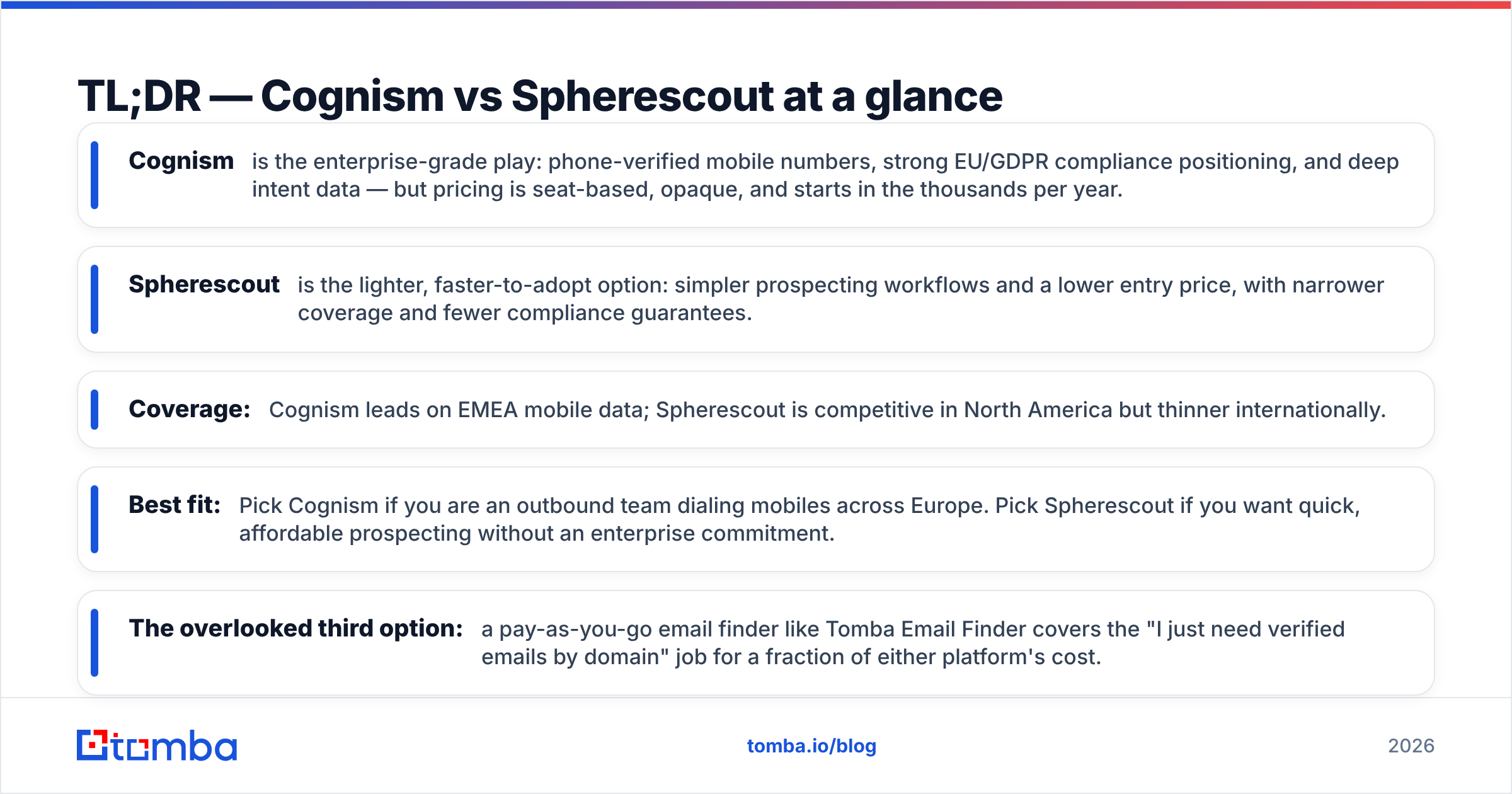
- Cognism is the enterprise-grade play: phone-verified mobile numbers, strong EU/GDPR compliance positioning, and deep intent data — but pricing is seat-based, opaque, and starts in the thousands per year.
- Spherescout is the lighter, faster-to-adopt option: simpler prospecting workflows and a lower entry price, with narrower coverage and fewer compliance guarantees.
- Coverage: Cognism leads on EMEA mobile data; Spherescout is competitive in North America but thinner internationally.
- Best fit: Pick Cognism if you are an outbound team dialing mobiles across Europe. Pick Spherescout if you want quick, affordable prospecting without an enterprise commitment.
- The overlooked third option: a pay-as-you-go email finder like Tomba Email Finder covers the "I just need verified emails by domain" job for a fraction of either platform's cost.
What is Cognism and who is it for?#
Cognism is a sales intelligence platform aimed at mid-market and enterprise revenue teams. Think of it as a phone book that has been fact-checked by a legal department: its headline feature, "Diamond Data," is a set of phone numbers that Cognism claims to human-verify, and its compliance story (GDPR, CCPA, notified DNC lists across Europe) is the reason large teams choose it over cheaper databases.
Its strengths are concrete. Cognism's mobile coverage in EMEA is among the best on the market, its Chrome extension pulls contacts directly from LinkedIn and company sites, and it layers on intent data from Bombora so reps can prioritize accounts showing buying signals. If your GTM motion is high-volume outbound calling into regulated European markets, this is the category most teams shortlist first. You can read its own positioning on cognism.com and cross-check user sentiment on G2.
The trade-offs are equally concrete: pricing is quote-only and seat-based, annual contracts are the norm, and smaller teams routinely report that the platform is more capability than they can use. You are buying a Cadillac whether or not you need the heated seats.

What is Spherescout and how does it differ?#
Spherescout positions itself as a leaner B2B prospecting and data tool — the kind of product a growing sales team adopts when Cognism's price tag does not fit the budget yet. Instead of leading with enterprise compliance and verified mobiles, Spherescout leads with speed of adoption: sign up, build a list, export contacts, start outreach.
That framing shapes everything. Spherescout tends to be stronger in North American coverage than deep international mobile data, its workflows are simpler (fewer knobs, faster onboarding), and its pricing is more transparent and accessible to smaller teams. The flip side is that you get fewer of the compliance guarantees and intent-data layers that justify Cognism's cost. For a Series A startup running a focused North American motion, that is often an acceptable trade.
The honest summary: Spherescout competes on price and simplicity, not on breadth or verification depth. Whether that is a strength or a weakness depends entirely on what your team actually needs — which is the whole point of comparing them properly.
Cognism vs Spherescout: full comparison table#
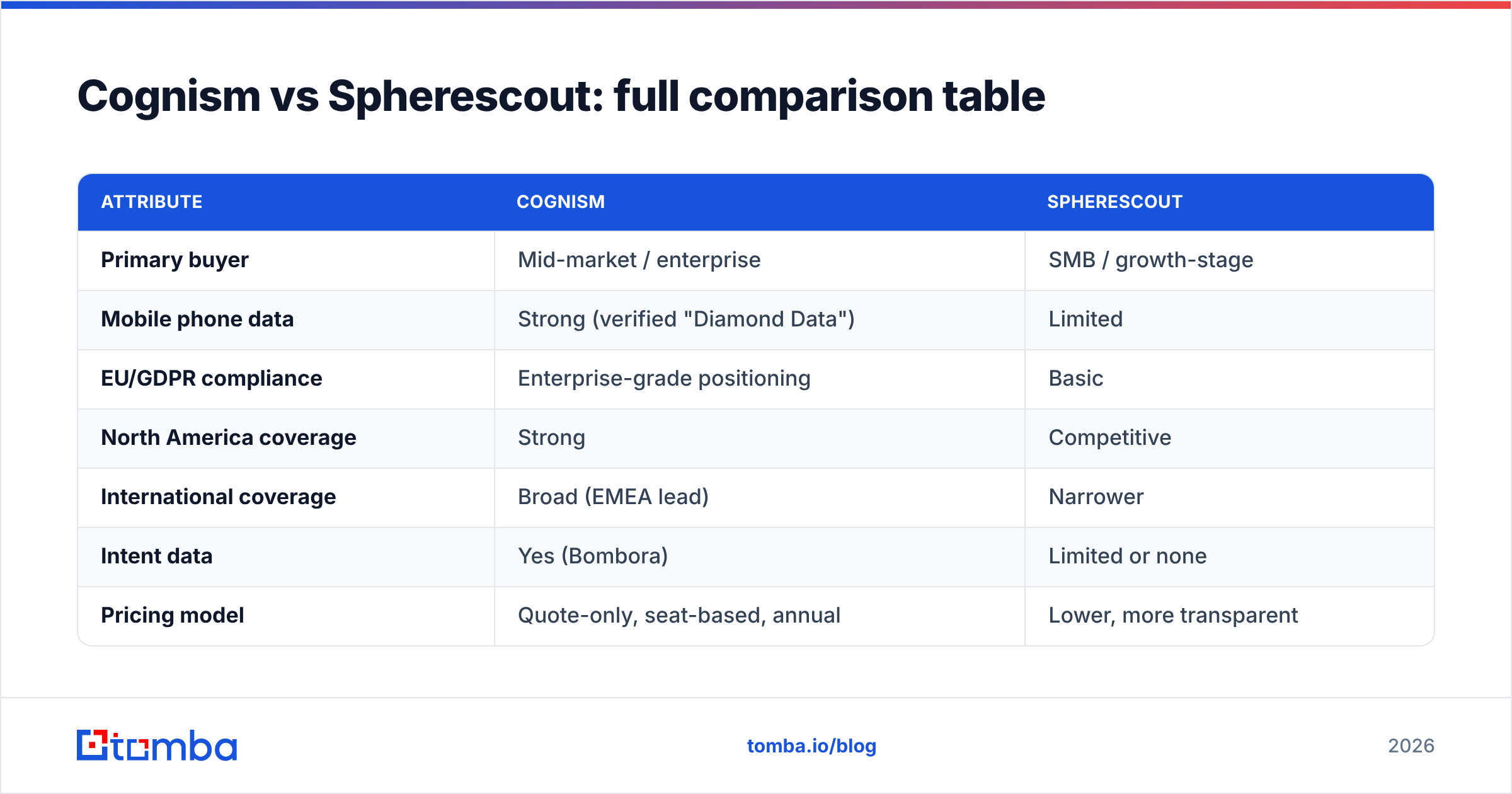
| Attribute | Cognism | Spherescout |
|---|---|---|
| Primary buyer | Mid-market / enterprise | SMB / growth-stage |
| Mobile phone data | Strong (verified "Diamond Data") | Limited |
| EU/GDPR compliance | Enterprise-grade positioning | Basic |
| North America coverage | Strong | Competitive |
| International coverage | Broad (EMEA lead) | Narrower |
| Intent data | Yes (Bombora) | Limited or none |
| Pricing model | Quote-only, seat-based, annual | Lower, more transparent |
| Entry price | Thousands/year | Accessible |
| Onboarding speed | Slower (enterprise rollout) | Fast |
| Best for | High-volume EMEA outbound | Lean NA prospecting |
Use this as a filter, not a verdict. If two or more rows in the "Cognism" column are non-negotiable for your team — verified mobiles, EU compliance, intent — the price gap is usually justified. If none of them are, you are likely overpaying, and either Spherescout or a focused email tool will serve you better.

Which has better data accuracy?#
Accuracy is where these tools earn or lose their price, and it is also where marketing claims get slippery. Every vendor advertises a high accuracy percentage; almost none of them define it the same way. Here is how to read the two.
Cognism stakes its reputation on phone verification. Its "Diamond Data" mobiles are human-checked, which is why its accuracy claims for phone numbers hold up better than most in independent testing and user reviews. For email data, Cognism is solid but not dramatically ahead of the field — the verification rigor is concentrated on phones.
Spherescout relies more on aggregated and algorithmically validated data. That keeps costs down but means accuracy varies more by region and seniority of the contact. In North America for common roles, it performs well. For senior EMEA contacts or niche industries, expect more bounce.
The practical test is the same for both: run a paid trial against a list you already know the answers to. Export 100 contacts you can independently verify, then measure the real bounce and connect rates. A vendor's stated "98% accuracy" means nothing next to your own bounce log. If you want a neutral primer on how contact-data providers source and refresh records, Tomba documents its own approach on the data sources page, and any provider worth paying for should be equally transparent.
/blog/generated/memes/2026-07-07/cognism-vs-spherescout-meme-1.png
How do Cognism and Spherescout compare on pricing?#
Pricing is the cleanest dividing line between these two platforms, and it is where most buyers make their decision.
Cognism does not publish prices. Expect a quote-only, seat-based annual contract that typically lands in the thousands to tens of thousands of dollars per year, depending on seats, data volume, and add-ons like intent. There is no meaningful free tier and no month-to-month escape hatch. You commit, you onboard, you use it. For a well-funded team dialing at scale, the cost per booked meeting can absolutely pencil out. For a three-person team, it rarely does.
Spherescout is more accessible, with lower and more transparent pricing designed to let smaller teams start without a procurement process. You give up depth and compliance guarantees, but you keep your budget flexible.
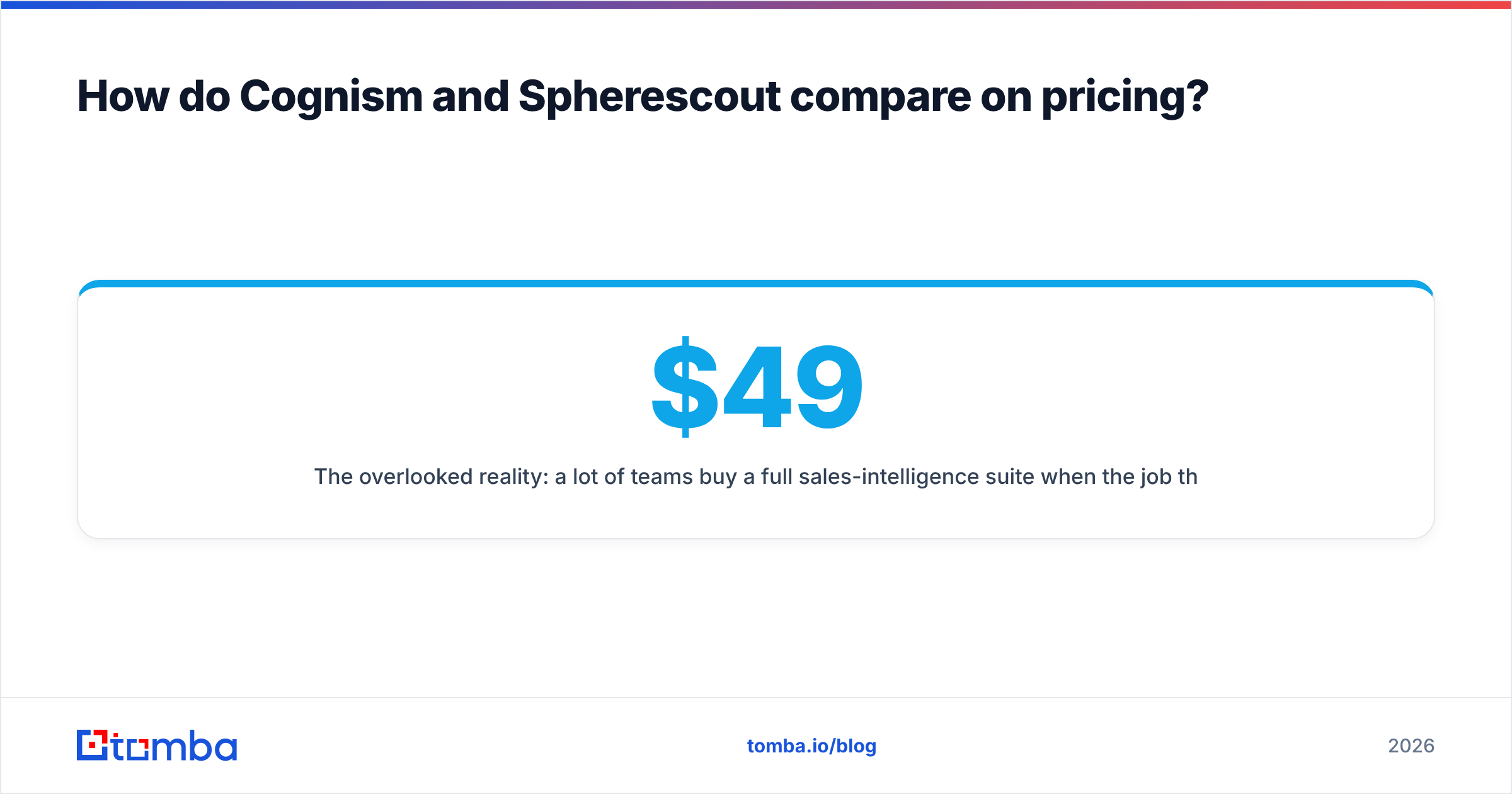
The overlooked reality: a lot of teams buy a full sales-intelligence suite when the job they actually need done is "find and verify professional emails by company." That is a much cheaper job. Tomba's pricing illustrates the gap — a Free tier with 25 searches/month, Starter at $49/mo, Growth at $99/mo, and Pro at $249/mo — pay-as-you-scale instead of a five-figure annual seat contract. If you do not need verified mobiles or intent data, paying enterprise rates for email discovery is the most common overspend in outbound.
Which tool fits your team? A decision framework#
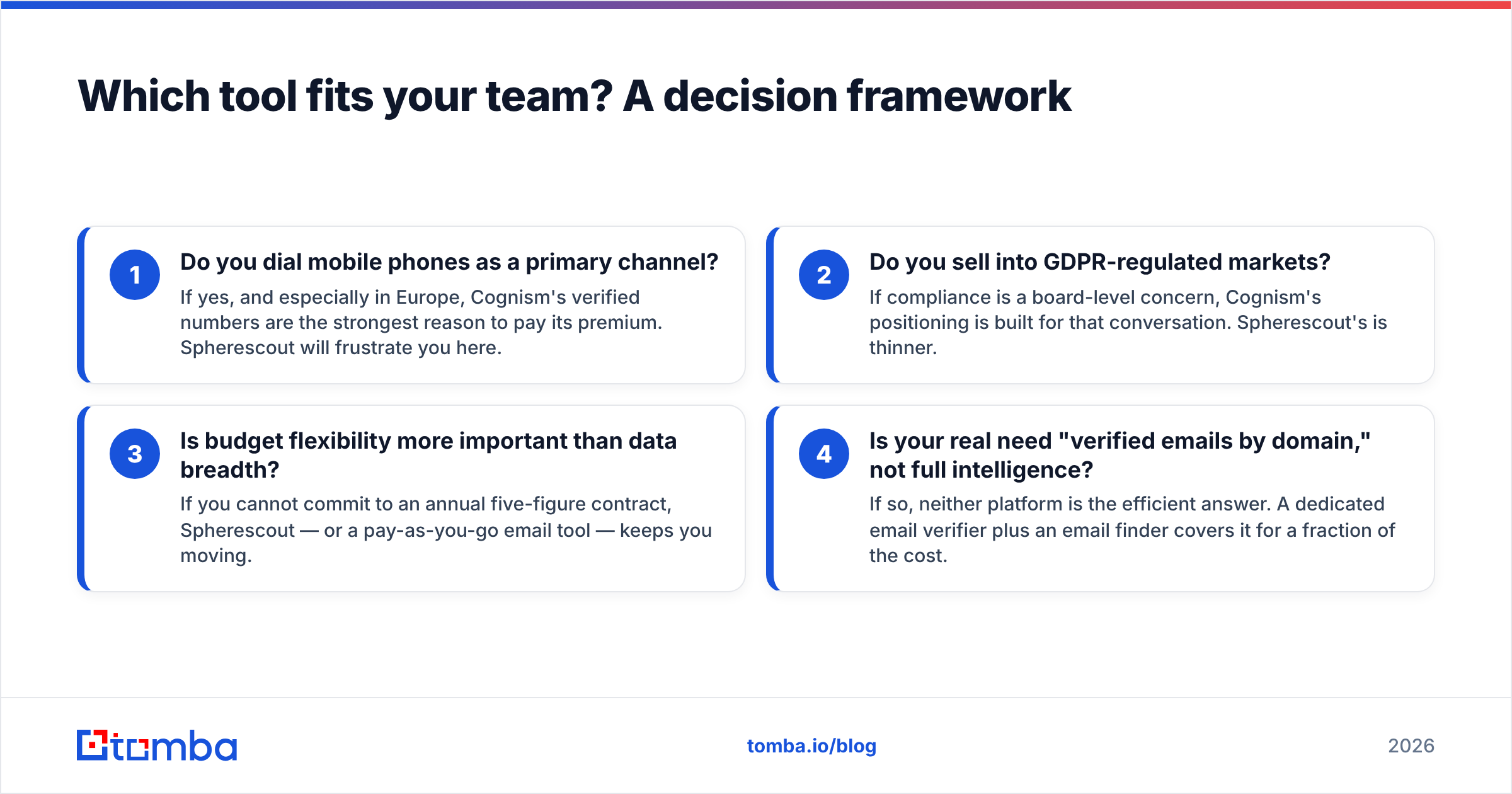
Skip the feature checklist and answer these four questions honestly.
- Do you dial mobile phones as a primary channel? If yes, and especially in Europe, Cognism's verified numbers are the strongest reason to pay its premium. Spherescout will frustrate you here.
- Do you sell into GDPR-regulated markets? If compliance is a board-level concern, Cognism's positioning is built for that conversation. Spherescout's is thinner.
- Is budget flexibility more important than data breadth? If you cannot commit to an annual five-figure contract, Spherescout — or a pay-as-you-go email tool — keeps you moving.
- Is your real need "verified emails by domain," not full intelligence? If so, neither platform is the efficient answer. A dedicated email verifier plus an email finder covers it for a fraction of the cost.
Most teams that struggle with this decision have quietly answered "no" to questions 1 and 2 — which means they are shopping in the wrong tier entirely.
Where does a dedicated email finder fit in?#
Both Cognism and Spherescout are suites: they bundle contact discovery, enrichment, sometimes dialing, and reporting into one platform. That bundling is valuable when you use most of it and wasteful when you do not.
If your outbound motion is email-first and you mostly need accurate professional addresses, a focused tool is faster and cheaper. You can run a domain search to pull every known email pattern at a target company, verify addresses before you send to protect your sender reputation, and enrich records through an API — without paying for intent data your reps never open. Analysts like Gartner track this whole category if you want the wider market map before committing.
This is not an argument against Cognism or Spherescout. It is an argument for matching the tool to the job. Buy the suite when you use the suite; buy the point tool when you have a point problem.
The verdict: Cognism vs Spherescout#
Choose Cognism if you are a mid-market or enterprise outbound team that dials mobiles, sells into Europe, and needs a compliance story your legal team will sign off on. The price is real, but so is the value for that specific profile.
Choose Spherescout if you are a smaller or growth-stage team that wants clean prospecting without an enterprise contract, primarily in North America, and can trade some data depth for budget flexibility and fast onboarding.
Choose neither — and pick a dedicated email finder if what you actually need is verified professional emails by domain, name, or company, billed as you grow rather than locked into annual seats. That is the quiet majority of outbound teams, and it is exactly the job Tomba Email Finder is built for: find emails by domain or name, verify them before you send, and connect the results to your CRM through Tomba's integrations. Start on the free tier, test it against a list you can verify yourself, and only scale spend when the data proves itself. That is a smarter first move than signing any five-figure contract on the strength of a demo.
Related guides#
Ready to find emails that actually work?
Join 150,000+ professionals who stopped guessing and started sending. Free credits on signup — no credit card required.
Get the Tomba newsletter
Practical outbound tactics and product updates — once every two weeks.
About the author