Cognism vs Tomba: Data Accuracy, Pricing, and Which to Pick
Cognism sells enterprise sales intelligence; Tomba sells a pay-as-you-grow email finder. Here's an honest, side-by-side look at accuracy, pricing, and compliance so you pick the right one.
Choosing between Cognism and Tomba usually isn't a "which tool is better" question. It's a "which problem am I actually solving" question. One is a full enterprise sales-intelligence suite with a sales team and annual contracts. The other is a self-serve email finder you can start using in the next five minutes for $49/month. This comparison keeps both honest and helps you match the tool to your budget, team size, and workflow.
TL;DR: Cognism vs Tomba at a glance#
- Cognism is a premium B2B sales-intelligence platform built for mid-market and enterprise revenue teams. Strong EU/UK phone-verified data, intent signals, and compliance tooling — but annual contracts, sales-led onboarding, and pricing that typically lands in the five figures.
- Tomba is a self-serve email finder and verification stack with a public price list, a free tier (25 searches/mo), and paid plans from $49/month. Built for founders, agencies, and lean outbound teams that want emails fast without a contract.
- Accuracy: Cognism leans on phone verification ("Diamond Data") for cell numbers; Tomba leans on domain-pattern matching plus SMTP verification for email deliverability. Different strengths, different jobs.
- Buy Cognism if you need verified mobile numbers, intent data, and CRM-wide enrichment at scale and have the budget. Buy Tomba if you need accurate work emails on demand, transparent pricing, and an API without a sales call.

What is Cognism?#
Cognism is a sales-intelligence platform. Think of it less as a single tool and more as a data warehouse with a subscription attached: a large contact and company database, phone-verified mobile numbers, buyer-intent signals (via a Bombora partnership), technographics, and native CRM integrations for Salesforce and HubSpot.
Its headline differentiator is Diamond Verified phone data — cell numbers that a human or process has actually confirmed, which matters a lot for cold-calling teams tired of dialing dead lines. Cognism also markets heavily on GDPR and CCPA compliance, including notified-email coverage in Europe, which makes it attractive to teams doing outbound into the EU and UK.
The tradeoff is the buying motion. Cognism is sold annually, through a sales rep, with pricing gated behind a demo. You generally commit to a seat count and a credit/data package up front. That's normal for enterprise software, but it's a different world from a self-serve credit card checkout.
What is Tomba?#
Tomba is an email finder and verification platform. You give it a name and a company domain — or just a domain — and it returns professional email addresses, along with a confidence score and the source it was found on. Around that core sit a domain search for pulling every email on a company, an email verifier for scrubbing lists before you send, a catch-all verifier, a phone finder, and a data enrichment layer.
The philosophy is the opposite of enterprise-suite: transparent, published pricing; a genuine free tier; a fast email finder API; and integrations with Google Sheets, Excel, a Chrome extension, and Zapier so it drops into a workflow you already have. You don't talk to a rep unless you want Enterprise. You sign up, and you're finding emails.
Tomba won't send your cold-call cadence or surface intent data. That's not its job. Its job is to get you accurate, deliverable contact emails cheaply and at volume.
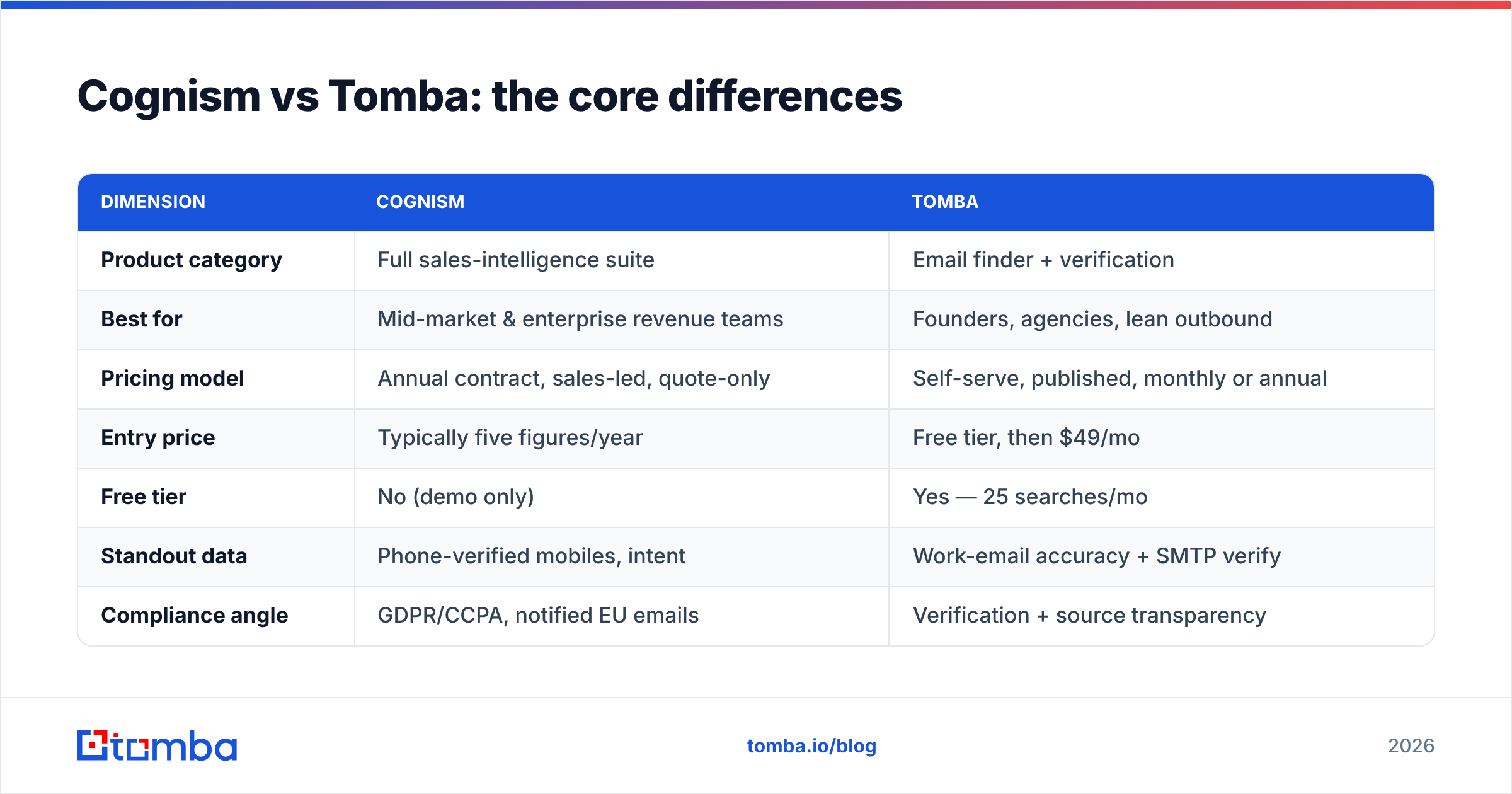
Cognism vs Tomba: the core differences#
The cleanest way to see the gap is to line up what each one is optimized for.
| Dimension | Cognism | Tomba |
|---|---|---|
| Product category | Full sales-intelligence suite | Email finder + verification |
| Best for | Mid-market & enterprise revenue teams | Founders, agencies, lean outbound |
| Pricing model | Annual contract, sales-led, quote-only | Self-serve, published, monthly or annual |
| Entry price | Typically five figures/year | Free tier, then $49/mo |
| Free tier | No (demo only) | Yes — 25 searches/mo |
| Standout data | Phone-verified mobiles, intent | Work-email accuracy + SMTP verify |
| Compliance angle | GDPR/CCPA, notified EU emails | Verification + source transparency |
| Onboarding | Demo + rep + implementation | Instant signup |
| API access | Available (enterprise) | Available on paid plans |
| Time to first result | Days (sales cycle) | Minutes |
Read that table as a fork in the road, not a scoreboard. If you need phone numbers, intent, and enterprise governance, the top row of features justifies Cognism's price. If you need emails and nothing else is holding you back, paying enterprise rates for capabilities you won't touch is just waste.
Is Cognism's data more accurate than Tomba's?#
It depends entirely on which data type you mean — and this is where most head-to-head comparisons get lazy.
For mobile phone numbers, Cognism has a real edge. Its Diamond-verified numbers are checked specifically to cut down on wrong or disconnected dials, and for a phone-heavy SDR team that's worth paying for. Tomba offers a phone finder and phone validator, but phone is not its center of gravity.
For work email addresses, the comparison tightens considerably. Tomba's model finds an email through domain-pattern analysis and public sources, then runs SMTP-level verification to confirm the mailbox exists before handing it to you. That verification step is what protects your sender reputation and keeps bounce rates down — the thing that actually determines whether your campaign lands in the inbox. You can read more about how email deliverability depends on clean lists rather than raw volume.

No email-finding tool — Cognism or Tomba — is 100% accurate, and any vendor claiming otherwise is selling. The honest framing is: for verified cell numbers and intent, Cognism leads; for deliverable work emails at a fraction of the cost, Tomba is competitive and far cheaper per contact. If email accuracy is your top concern, always verify before you send regardless of source, and treat confidence scores as guidance, not gospel.
How does pricing compare?#
This is the sharpest contrast between the two, and often the deciding factor.
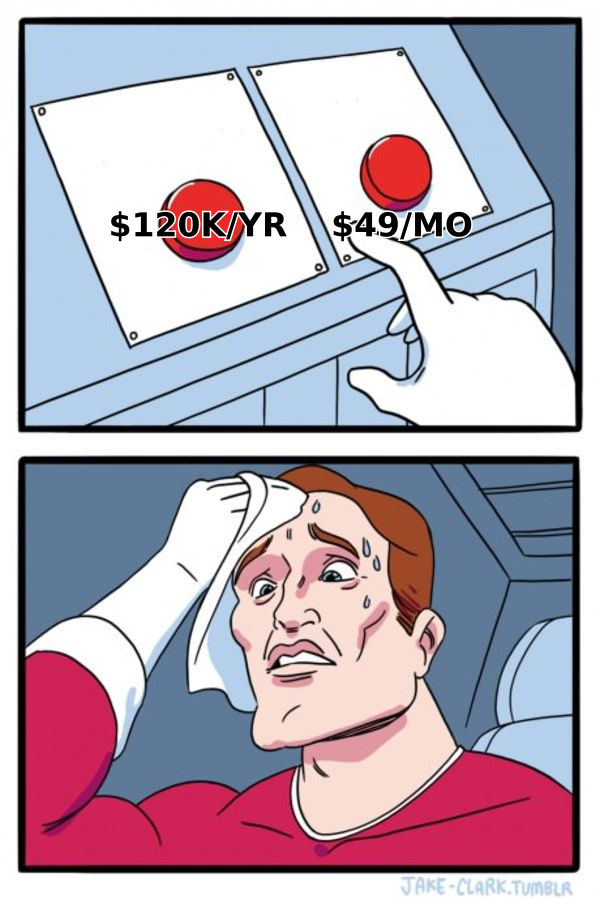
Cognism does not publish prices. Deals are quoted per team, usually annual, and industry reports and review sites consistently place entry packages in the low-to-mid five figures per year once you add seats and a meaningful data allowance. You're buying a platform, and you're committing before you use it.
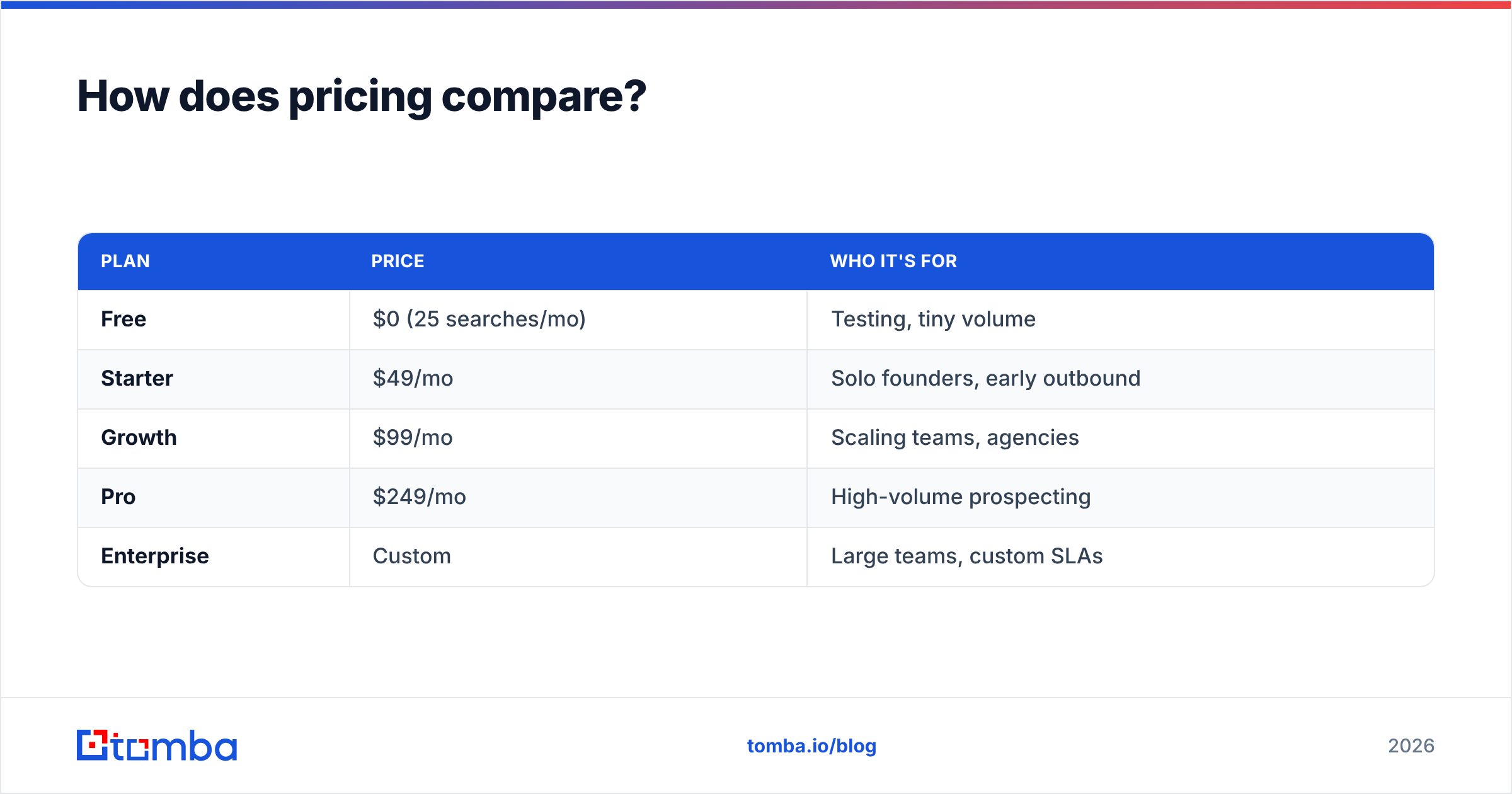
Tomba publishes everything. Here's the full ladder:
| Plan | Price | Who it's for |
|---|---|---|
| Free | $0 (25 searches/mo) | Testing, tiny volume |
| Starter | $49/mo | Solo founders, early outbound |
| Growth | $99/mo | Scaling teams, agencies |
| Pro | $249/mo | High-volume prospecting |
| Enterprise | Custom | Large teams, custom SLAs |
You can see full Tomba pricing without a demo. The practical difference: with Tomba you can test the actual product on the free tier, upgrade to $49/month, and cancel any time. With Cognism you commit for a year before you've fully validated fit. For a small team, that risk asymmetry matters more than any feature checkbox.
When should you choose Cognism?#
Pick Cognism when the following are true:
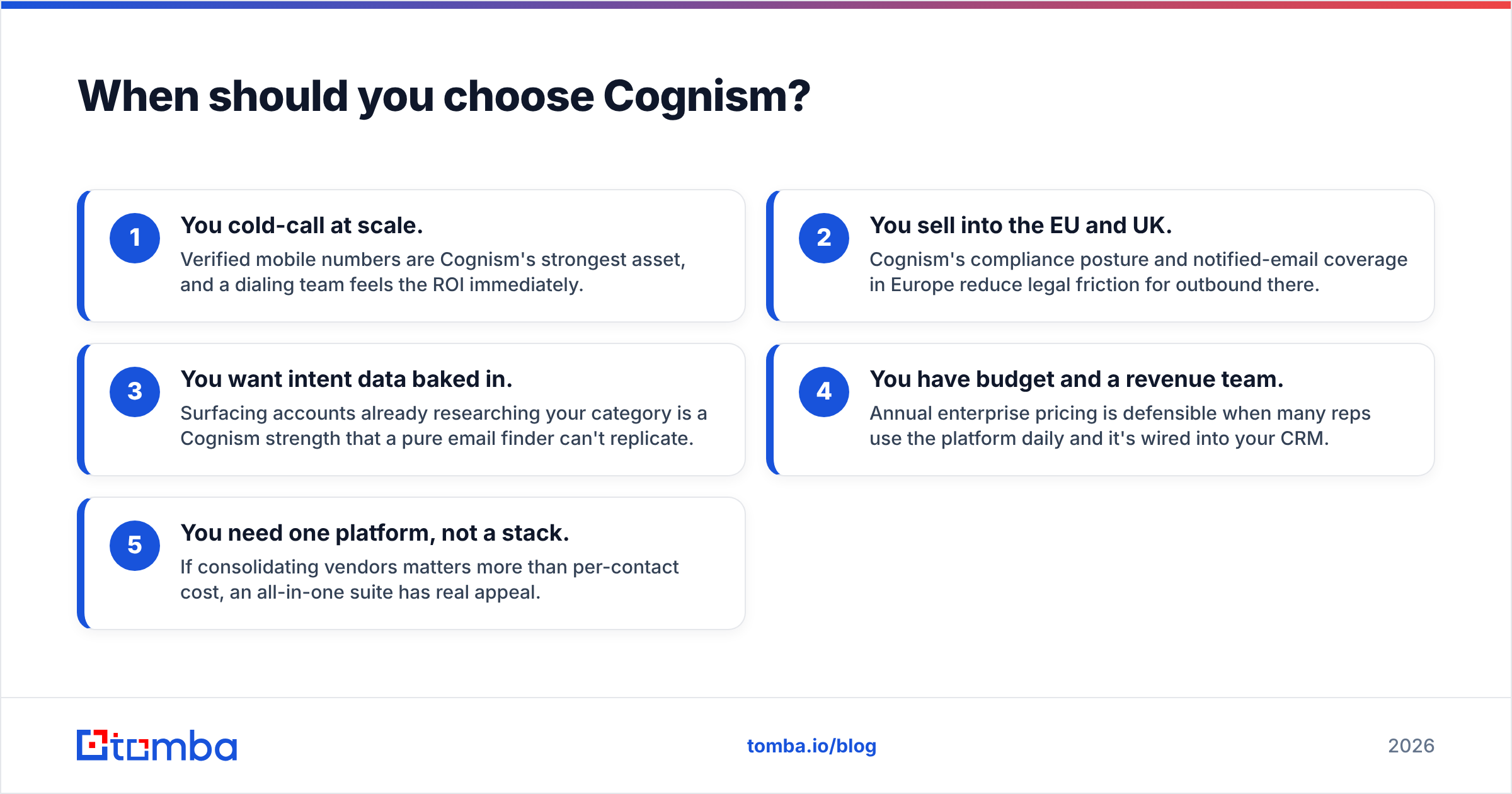
- You cold-call at scale. Verified mobile numbers are Cognism's strongest asset, and a dialing team feels the ROI immediately.
- You sell into the EU and UK. Cognism's compliance posture and notified-email coverage in Europe reduce legal friction for outbound there.
- You want intent data baked in. Surfacing accounts already researching your category is a Cognism strength that a pure email finder can't replicate.
- You have budget and a revenue team. Annual enterprise pricing is defensible when many reps use the platform daily and it's wired into your CRM.
- You need one platform, not a stack. If consolidating vendors matters more than per-contact cost, an all-in-one suite has real appeal.
If those describe you, Cognism is a strong, legitimate choice — and this comparison isn't trying to talk you out of it. You can review its own positioning on cognism.com and cross-check user sentiment on G2.
When should you choose Tomba?#
Pick Tomba when these are true:
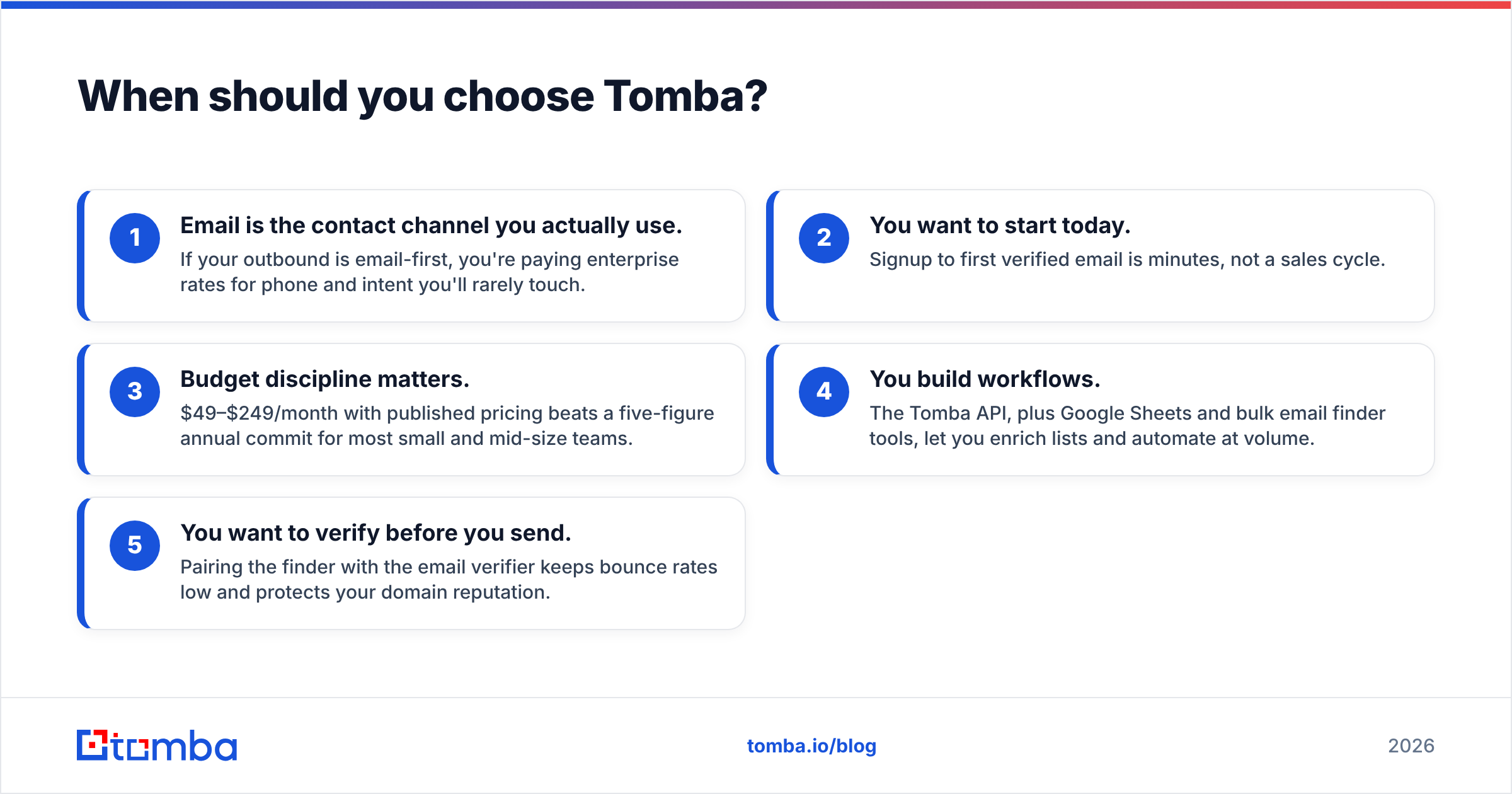
- Email is the contact channel you actually use. If your outbound is email-first, you're paying enterprise rates for phone and intent you'll rarely touch.
- You want to start today. Signup to first verified email is minutes, not a sales cycle.
- Budget discipline matters. $49–$249/month with published pricing beats a five-figure annual commit for most small and mid-size teams.
- You build workflows. The Tomba API, plus Google Sheets and bulk email finder tools, let you enrich lists and automate at volume.
- You want to verify before you send. Pairing the finder with the email verifier keeps bounce rates low and protects your domain reputation.
Agencies running outreach for many clients, founders validating a market, and RevOps teams enriching CRM records on a budget all tend to land on Tomba for the same reason: accurate emails, no contract, and pricing that scales with actual usage.
Can you use both together?#
Yes, and plenty of teams do. There's no rule that says you pick one vendor forever. A common pattern: use Cognism for account-level intelligence, phone numbers, and intent on your priority target list, and use Tomba as the cost-efficient workhorse for high-volume email discovery and verification across the broader universe of prospects.
Because Tomba is self-serve with an API and a free tier, layering it on top of an existing Cognism contract costs almost nothing to test. If Tomba covers 80% of your email-finding at a fraction of the credit cost, you can shift volume away from your expensive enterprise credits and stretch them further. That's not disloyalty to either tool — it's just good cost engineering.

Cognism vs Tomba: the verdict#
There's no universal winner, because they're built for different buyers.
Choose Cognism if you're a funded revenue team that lives on the phone, sells into Europe, wants intent data, and can justify an annual enterprise contract. Its verified mobile data and compliance tooling earn their keep at that level.
Choose Tomba if your outbound is email-first and you value transparent, low pricing, instant self-serve access, and a clean API over an all-in-one suite you'd only half-use. For the vast majority of small teams, agencies, and founders, that's the better fit — and the risk of trying it is roughly zero.
The honest test: write down the three data points you'll actually use every week. If two of them are phone and intent, Cognism. If they're work email, verification, and enrichment, Tomba will do the job for a tiny fraction of the cost.
Start finding emails today#
If your real bottleneck is accurate, deliverable work emails — not a six-figure data platform — start with the Tomba Email Finder. The free tier gives you 25 searches a month with no card and no sales call, so you can test accuracy on your own prospect list before spending a dollar. When you're ready to scale, plans start at $49/month, the API drops straight into your workflow, and every email can be run through verification before you hit send. Try it, measure the deliverability, and let the results — not a contract — decide.
Related guides#
// get started
Find, verify and enrich your first contacts today
Start on the free plan with 25 searches a month, then scale when your team is ready.
Free plan · No credit card required · GDPR & CCPA
// about the author