Cognism vs VC-Backed Data Tools: 2026 Comparison & Verdict
Cognism vs VC-backed data platforms: an honest 2026 breakdown of accuracy, pricing, compliance, and lock-in — plus where a leaner tool beats the funded giants.
Choosing a B2B data provider in 2026 usually comes down to one quiet question nobody puts on the pricing page: how much of your budget is paying for the data, and how much is paying for the venture-capital growth engine behind it? That is the real story in Cognism vs VC-backed data tools.
Cognism is one of the most funded names in sales intelligence, and it competes against a whole cohort of similarly VC-backed platforms — ZoomInfo, Apollo, Lusha, Seamless.AI. This guide compares Cognism to that funded cohort on the things that actually move your pipeline, then shows where a leaner, usage-priced tool wins outright.
TL;DR#
- Cognism is strong on phone-verified mobile numbers and EU/GDPR compliance, but it sells on annual contracts with per-seat pricing and no transparent public tiers.
- The broader VC-backed cohort (ZoomInfo, Apollo, Lusha, Seamless.AI) trades on database size and funding-fueled feature sprawl — you often pay for breadth you never touch.
- Accuracy is the tiebreaker, and it varies more by region and role than any vendor logo suggests. Always trial on your own ICP before signing.
- Lock-in is the hidden cost. Annual seats, credit expiry, and export caps mean the sticker price is rarely the real price.
- If you want verified email data without the annual commitment, a usage-priced email finder like Tomba starts at $49/mo and bills for what you use.

What does "Cognism vs VC-backed" actually mean?#
It means comparing two philosophies, not just two logos.
Cognism raised large venture rounds and, like its funded peers, built a business model that has to justify that capital: land big annual contracts, expand seats, and keep net revenue retention high. That shapes everything downstream — the sales motion (demo-gated, no self-serve), the pricing (opaque, negotiated), and the roadmap (feature breadth to defend enterprise deals).
The "VC-backed" side of this comparison isn't one competitor. It's the pattern shared by the funded giants:
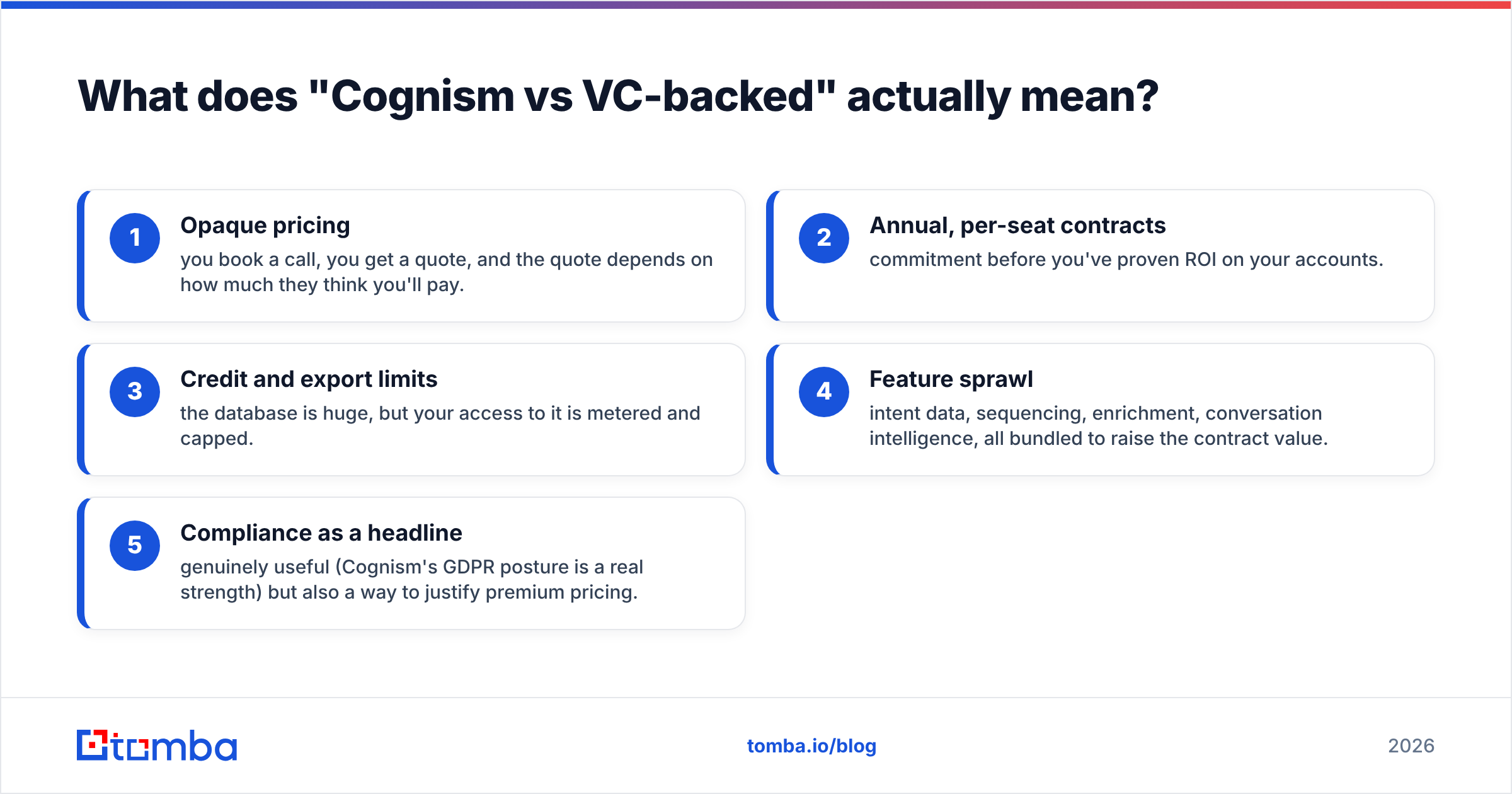
- Opaque pricing — you book a call, you get a quote, and the quote depends on how much they think you'll pay.
- Annual, per-seat contracts — commitment before you've proven ROI on your accounts.
- Credit and export limits — the database is huge, but your access to it is metered and capped.
- Feature sprawl — intent data, sequencing, enrichment, conversation intelligence, all bundled to raise the contract value.
- Compliance as a headline — genuinely useful (Cognism's GDPR posture is a real strength) but also a way to justify premium pricing.
None of that makes these tools bad. ZoomInfo and Cognism earn strong marks on G2 for a reason. The point is that a chunk of your invoice funds the growth machine, not just the records you export.
Is Cognism better than other VC-backed data tools?#
For specific jobs, yes. Cognism's differentiators are real:
- Diamond Data phone verification — human-verified mobile numbers, which matters a lot for outbound calling teams in EMEA.
- GDPR and DNC coverage — Cognism checks numbers against Do-Not-Call lists across multiple regions, reducing legal risk for European outreach.
- International coverage — noticeably deeper EU and APAC data than several US-centric rivals.
Where it's not clearly ahead: US email coverage (Apollo and ZoomInfo are competitive), self-serve accessibility (Apollo wins), and price transparency (nobody in the funded cohort is transparent, but Cognism is among the more guarded).
So "better" depends on your motion. Calling EU prospects? Cognism is a serious contender. Running high-volume email outbound in North America on a startup budget? The math gets harder to justify.
How do Cognism and the VC-backed cohort compare on price and terms?#
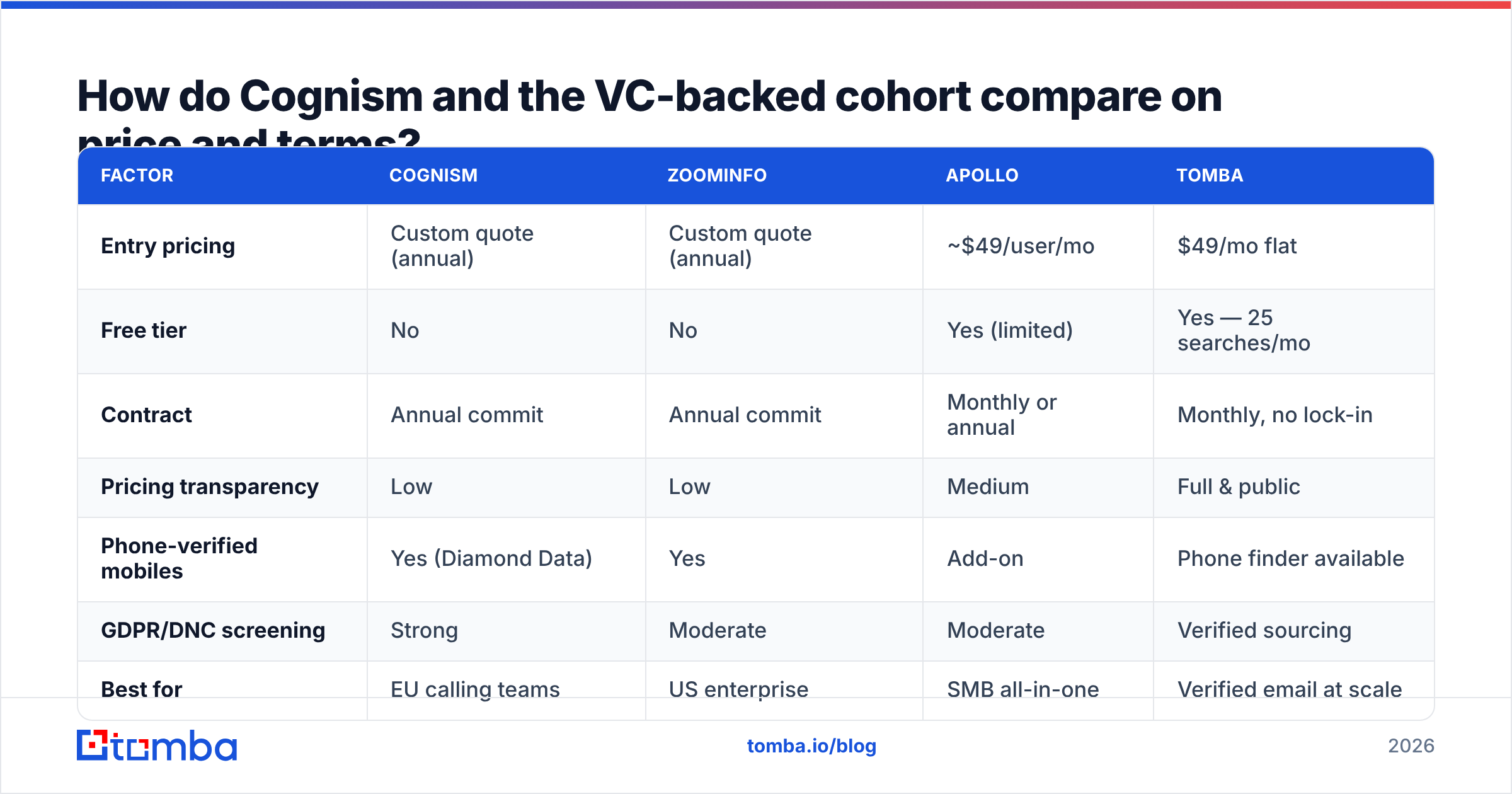
Here's the honest comparison. Public figures for the funded platforms are approximate because pricing is negotiated; the Tomba column is the published, self-serve rate.
| Factor | Cognism | ZoomInfo | Apollo | Tomba |
|---|---|---|---|---|
| Entry pricing | Custom quote (annual) | Custom quote (annual) | ~$49/user/mo | $49/mo flat |
| Free tier | No | No | Yes (limited) | Yes — 25 searches/mo |
| Contract | Annual commit | Annual commit | Monthly or annual | Monthly, no lock-in |
| Pricing transparency | Low | Low | Medium | Full & public |
| Phone-verified mobiles | Yes (Diamond Data) | Yes | Add-on | Phone finder available |
| GDPR/DNC screening | Strong | Moderate | Moderate | Verified sourcing |
| Best for | EU calling teams | US enterprise | SMB all-in-one | Verified email at scale |
Two things jump out. First, only the leaner and mid-market options publish a number you can act on today — see Tomba pricing for the full breakdown. Second, the funded giants gate their entry point behind a sales call, which usually means a higher floor than the logos advertise.
How accurate is the data, really?#
Accuracy is where marketing claims and reality diverge most — and it's why you should never sign on a vendor's own benchmark.
Every provider quotes a headline accuracy figure north of 95%. Those numbers are measured on the vendor's best-covered segments. Your results depend on three variables the sales deck won't mention:
- Region — EU mobile accuracy (Cognism's strength) and US email accuracy are different problems solved by different data pipelines.
- Seniority — VP-and-above contacts churn faster and are harder to keep current than individual-contributor records.
- Catch-all domains — a huge share of "unverifiable" business emails sit behind catch-all servers, and providers handle them very differently. Screen them with a dedicated catch-all verifier before you trust a bounce-free claim.

The practical takeaway: run the same 200-contact ICP list through every tool you're evaluating during the trial, then verify the outputs independently. A provider that returns fewer records but verifies them cleanly often beats a bigger database that pads coverage with stale or guessed addresses. If you want to see where a vendor's records originate, transparent providers publish their data sources — the funded cohort rarely does at that granularity.
Where do the VC-backed giants genuinely win?#
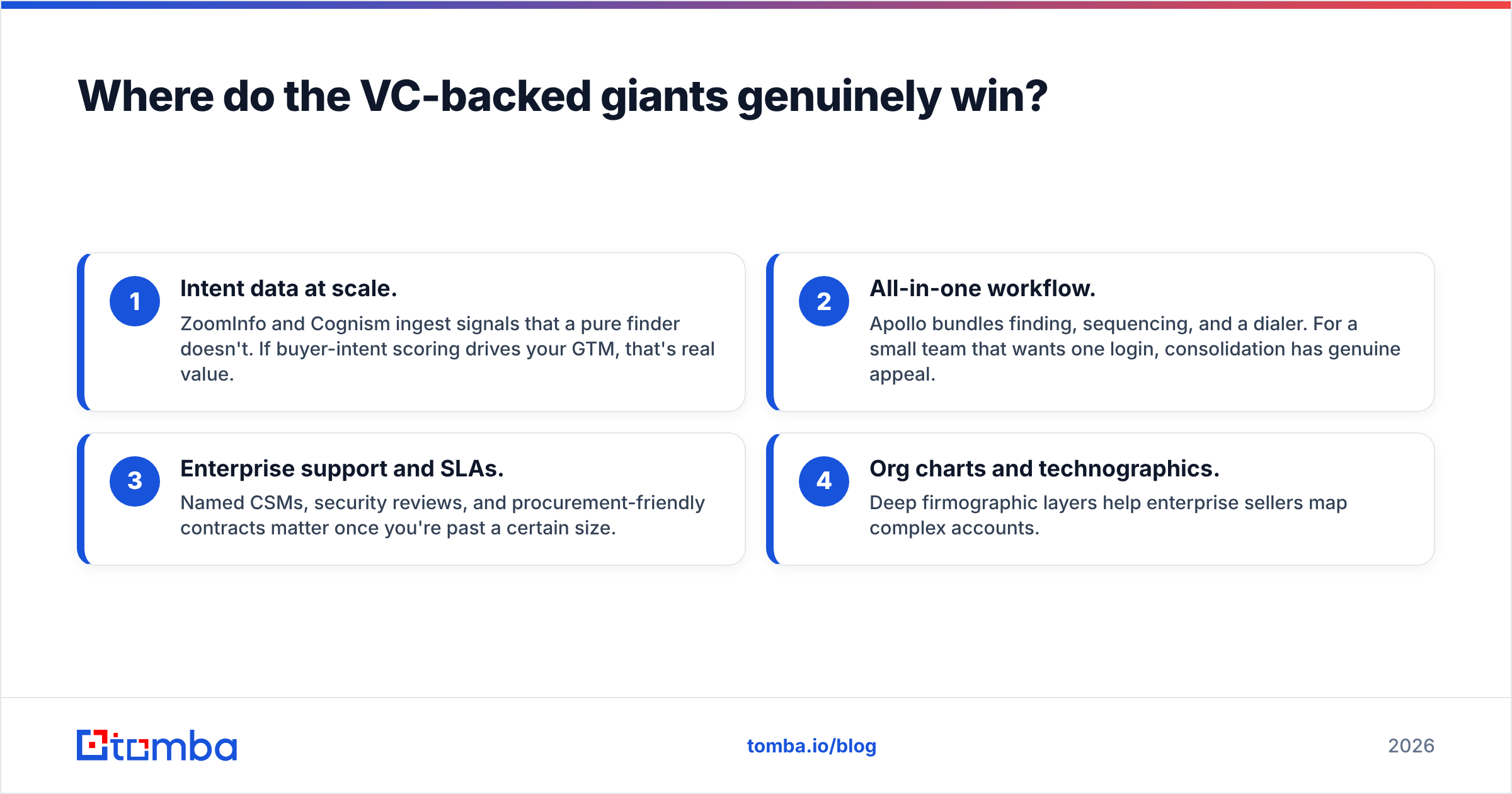
Give the funded platforms their due — there are jobs they do better than a lean tool:
- Intent data at scale. ZoomInfo and Cognism ingest signals that a pure finder doesn't. If buyer-intent scoring drives your GTM, that's real value.
- All-in-one workflow. Apollo bundles finding, sequencing, and a dialer. For a small team that wants one login, consolidation has genuine appeal.
- Enterprise support and SLAs. Named CSMs, security reviews, and procurement-friendly contracts matter once you're past a certain size.
- Org charts and technographics. Deep firmographic layers help enterprise sellers map complex accounts.
If those capabilities map to how you actually sell, the premium can be worth it. The mistake is paying enterprise prices for enterprise features you'll never switch on.
Where does a lean, usage-priced tool beat them?#
The counter-case is straightforward: most teams need accurate, verified contact data and don't need the rest of the suite.
- No annual lock-in. You commit monthly and scale up or down with real demand instead of a forecast you made in Q1.
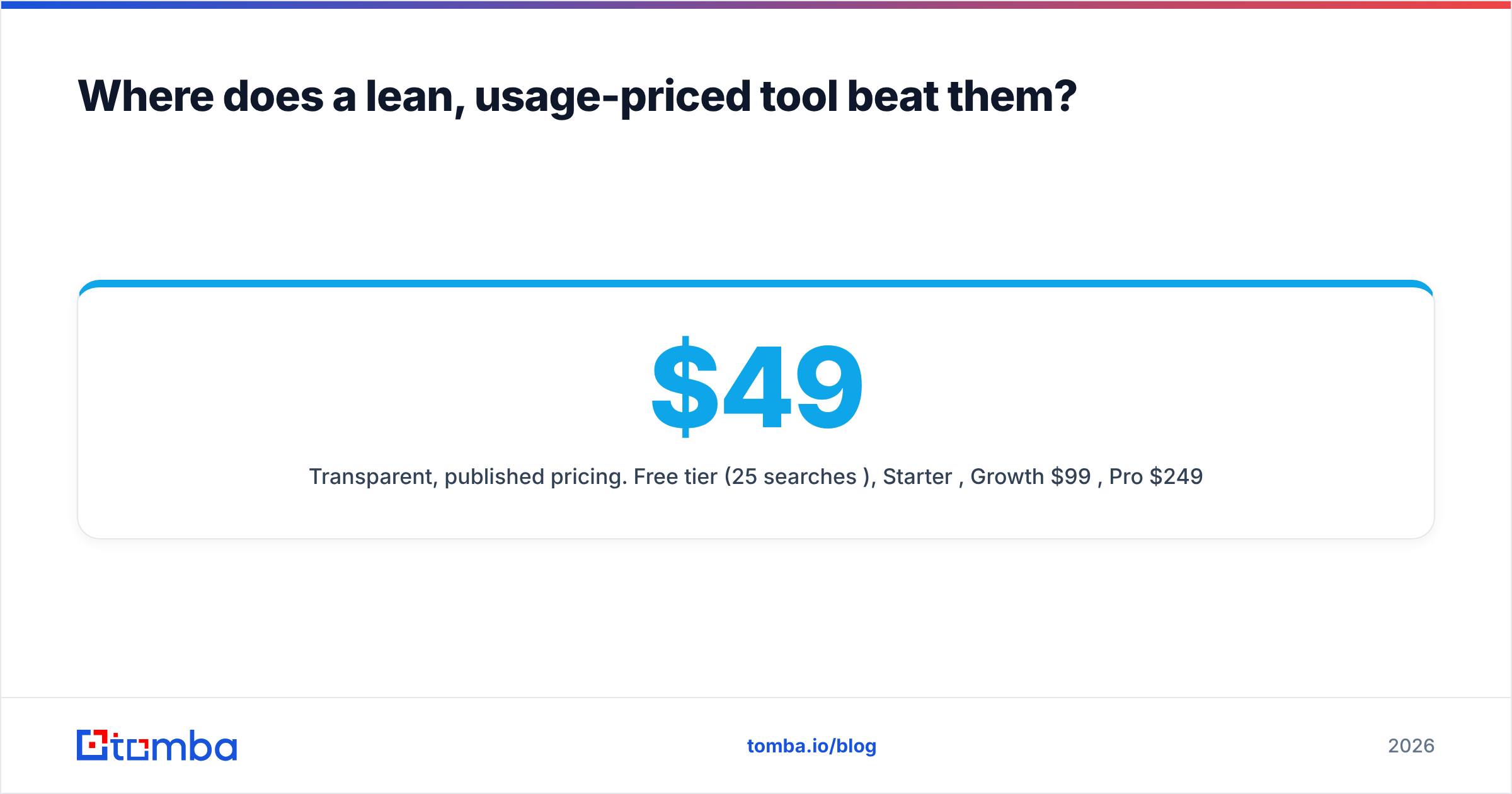
- Transparent, published pricing. Free tier (25 searches/mo), Starter $49/mo, Growth $99/mo, Pro $249/mo. No demo required to see the number.
- Pay for records, not seats. Usage-based billing means a two-person team and a ten-person team aren't punished by per-seat math.
- Composable, not bundled. Pull exactly the pieces you need — domain search, enrichment, verification — via the Tomba API and skip the features you'd never open.
- Verification built in. Every found email can be checked with the email verifier so you're protecting sender reputation, not just filling a CRM.
For prospecting-led teams, RevOps folks stitching data into their own stack, and startups that refuse to sign an annual contract before proving ROI, this is usually the better trade. It's also why buyers researching a Clearbit alternative or RocketReach alternative increasingly land on usage-priced tools.
Cognism vs VC-backed tools: which should you choose?#
Decide by motion, not by brand recognition:
- Choose Cognism if you run EU/EMEA outbound calling, need GDPR-safe phone data, and have the budget for an annual enterprise contract.
- Choose ZoomInfo if you're a US enterprise that lives on intent data and org charts and has procurement muscle to negotiate.
- Choose Apollo if you want a cheap-ish all-in-one for a small team and can tolerate variable data quality.
- Choose a lean usage-priced finder if you want verified email (and phone) data, transparent pricing, and zero lock-in — and you'd rather compose your own stack than buy a bundle.
Analyst frameworks from Gartner and peer reviews on G2 are useful for the enterprise shortlist, but they can't tell you how a tool performs on your ICP. Only a hands-on trial does that. Cross-check any vendor claim against Cognism's own site and then test it against your real list.
The bottom line#
The funded giants aren't overpriced because they're bad — they're priced to fund growth, and a slice of every invoice pays for that. If you need intent data, org charts, and enterprise SLAs, that trade can be worth it. If you mainly need accurate, verified contact data without an annual commitment, you're overpaying for a growth engine you didn't ask to fund.
Start where the cost is transparent and the risk is low. Tomba's email finder gives you verified professional emails by name, company, or domain, on a free tier and month-to-month plans from $49 — no demo call, no annual lock-in, and every result verifiable before it hits your sequence. Run your ICP through it alongside Cognism, compare the verified deliverable rate, and let your own numbers pick the winner.
Related guides#
// get started
Find, verify and enrich your first contacts today
Start on the free plan with 25 searches a month, then scale when your team is ready.
Free plan · No credit card required · GDPR & CCPA
// about the author