Cognism vs Xverum (2026): B2B Data Platforms Compared
Cognism and Xverum both sell B2B data, but they solve different problems. Here's an honest breakdown of accuracy, coverage, compliance, delivery, and pricing to help you pick the right platform in 2026.
Choosing between Cognism and Xverum comes down to one question: do you need a ready-to-use sales intelligence platform, or a raw data pipeline you can pipe into your own systems? They both sell B2B data, but they are built for different buyers, and picking the wrong one wastes budget fast.
This is a neutral, feature-by-feature breakdown so you can match the tool to how your team actually works.
TL;DR: Cognism vs Xverum at a glance#
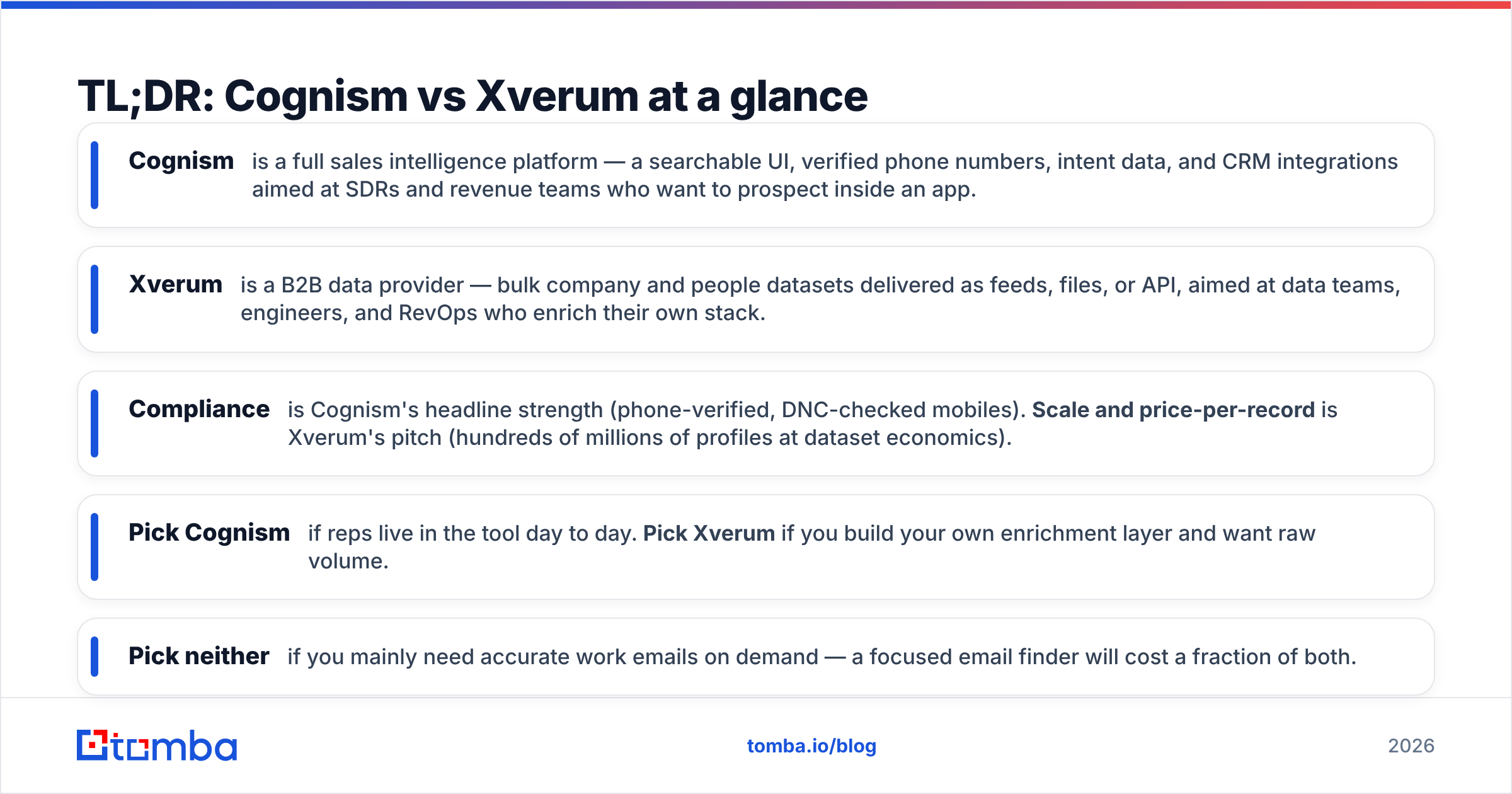
- Cognism is a full sales intelligence platform — a searchable UI, verified phone numbers, intent data, and CRM integrations aimed at SDRs and revenue teams who want to prospect inside an app.
- Xverum is a B2B data provider — bulk company and people datasets delivered as feeds, files, or API, aimed at data teams, engineers, and RevOps who enrich their own stack.
- Compliance is Cognism's headline strength (phone-verified, DNC-checked mobiles). Scale and price-per-record is Xverum's pitch (hundreds of millions of profiles at dataset economics).
- Pick Cognism if reps live in the tool day to day. Pick Xverum if you build your own enrichment layer and want raw volume.
- Pick neither if you mainly need accurate work emails on demand — a focused email finder will cost a fraction of both.
What is Cognism?#
Cognism is a sales intelligence platform. Think of it like a fully-stocked showroom: you walk in, search by filters, and walk out with a contact list ready to call or email. Its core selling points are verified mobile phone numbers (marketed as "Diamond Data"), a global contact database, buyer intent signals from Bombora, and native integrations with CRMs and sales engagement tools.
The company leans hard on compliance. Cognism checks phone numbers against Do-Not-Call registries across regions and positions itself as GDPR- and CCPA-conscious, which is why it's popular with European sales teams where data-privacy exposure is a real risk. You can read their positioning on the Cognism homepage.
Cognism is built for the person doing outreach — an SDR, an account executive, a marketer building a campaign list. The value is speed inside a polished interface, not raw data ownership.

What is Xverum?#
Xverum is a B2B data provider, not a prospecting app. The analogy: it's a wholesale supplier, not a retail store. You don't log in to click through leads one at a time — you receive large, structured datasets of company and people profiles, delivered as bulk files, scheduled feeds, or via API, and you load them into your own warehouse, CRM, or model.
Xverum's pitch is scale and freshness at dataset economics: hundreds of millions of profiles, refreshed on a schedule, priced closer to a data license than a per-seat SaaS subscription. Its buyers are data engineers, RevOps teams building enrichment pipelines, and companies training or feeding models that need volume. See their Xverum data offering for the raw specs.
The trade-off is obvious: there's no shiny UI to hand an SDR, and no built-in dialer or intent overlay. You get the data; what you do with it is your problem to solve.

Cognism vs Xverum: side-by-side comparison#
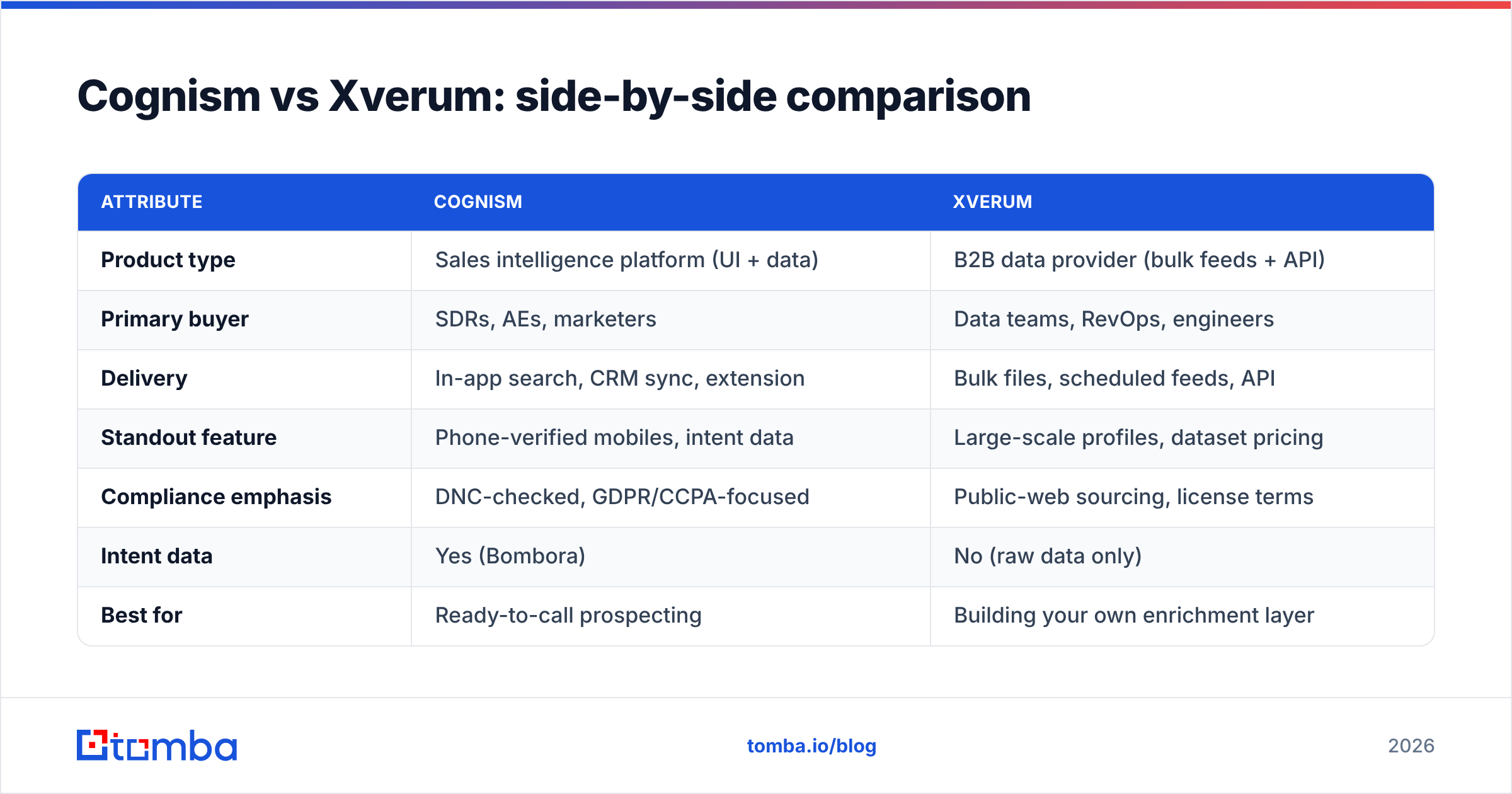
| Attribute | Cognism | Xverum |
|---|---|---|
| Product type | Sales intelligence platform (UI + data) | B2B data provider (bulk feeds + API) |
| Primary buyer | SDRs, AEs, marketers | Data teams, RevOps, engineers |
| Delivery | In-app search, CRM sync, extension | Bulk files, scheduled feeds, API |
| Standout feature | Phone-verified mobiles, intent data | Large-scale profiles, dataset pricing |
| Compliance emphasis | DNC-checked, GDPR/CCPA-focused | Public-web sourcing, license terms |
| Intent data | Yes (Bombora) | No (raw data only) |
| Best for | Ready-to-call prospecting | Building your own enrichment layer |
| Pricing model | Per-seat SaaS, annual, quote-based | Data license / volume-based |

Which has better data accuracy and coverage?#
The honest answer: they measure accuracy differently because they sell different things.
Cognism's accuracy story centers on phone verification. Its team human-verifies a subset of mobile numbers, which is why its connect rates get cited in reviews. For a rep who needs to actually dial and reach a decision-maker, that verification is the whole point. But Cognism's total database is smaller than the biggest bulk providers, and coverage skews toward the regions and roles it prioritizes.
Xverum's accuracy story is about scale and refresh cadence. It sources from public web data at high volume and re-crawls on a schedule, so the strength is breadth — you get more records, more firmographic fields, and more raw profiles to work with. The weakness is that raw web-sourced data always needs a verification step before you email or call it, because a record being present isn't the same as it being reachable today.
That verification gap is the single most important thing to understand in this comparison. A large dataset with no validation layer will quietly tank your deliverability if you blast it. This is why many teams run any bulk source — Xverum included — through a dedicated email verifier before it touches a sending domain.

How do Cognism and Xverum handle compliance?#
Compliance is where the two diverge most sharply.
Cognism built its brand partly on compliance. It checks phone numbers against Do-Not-Call lists, markets GDPR and CCPA alignment, and gives European teams a defensible story for their outreach. If your legal team scrutinizes where lead data comes from — common in EU B2B — this matters a lot.
Xverum positions its data as sourced from publicly available web information under its own license terms. That's a legitimate model, but the compliance burden shifts more onto you: you're responsible for how you use the data, honoring opt-outs, and meeting the regulations in your target regions. For a mature data team with legal support, that's manageable. For a small sales org without a compliance function, it's a risk to weigh.
Neither approach is "right" — they match different risk appetites. A regulated enterprise in Europe leans Cognism. A US-based growth team building an internal enrichment stack may be comfortable with Xverum plus their own guardrails. If you want a primer before you decide, review the fundamentals of email deliverability and how sender reputation is affected by list quality.
What does Cognism vs Xverum cost?#
Pricing is the least transparent part of both, so treat these as directional.
Cognism uses per-seat, annual, quote-based pricing. There's no public self-serve price and no meaningful free tier — you talk to sales, and cost scales with seats, data volume, and add-ons like intent. Expect enterprise-level annual commitments. That's fine if reps use it daily; it's expensive if you only need occasional data pulls.
Xverum prices like a data license: volume-based, tied to the size and refresh frequency of the datasets you take rather than the number of people logging in. For high-volume enrichment this is often cheaper per record than a seat-based tool, but there's typically a minimum commitment that makes it overkill for small, ad-hoc needs.
Here's the practical decision framework:
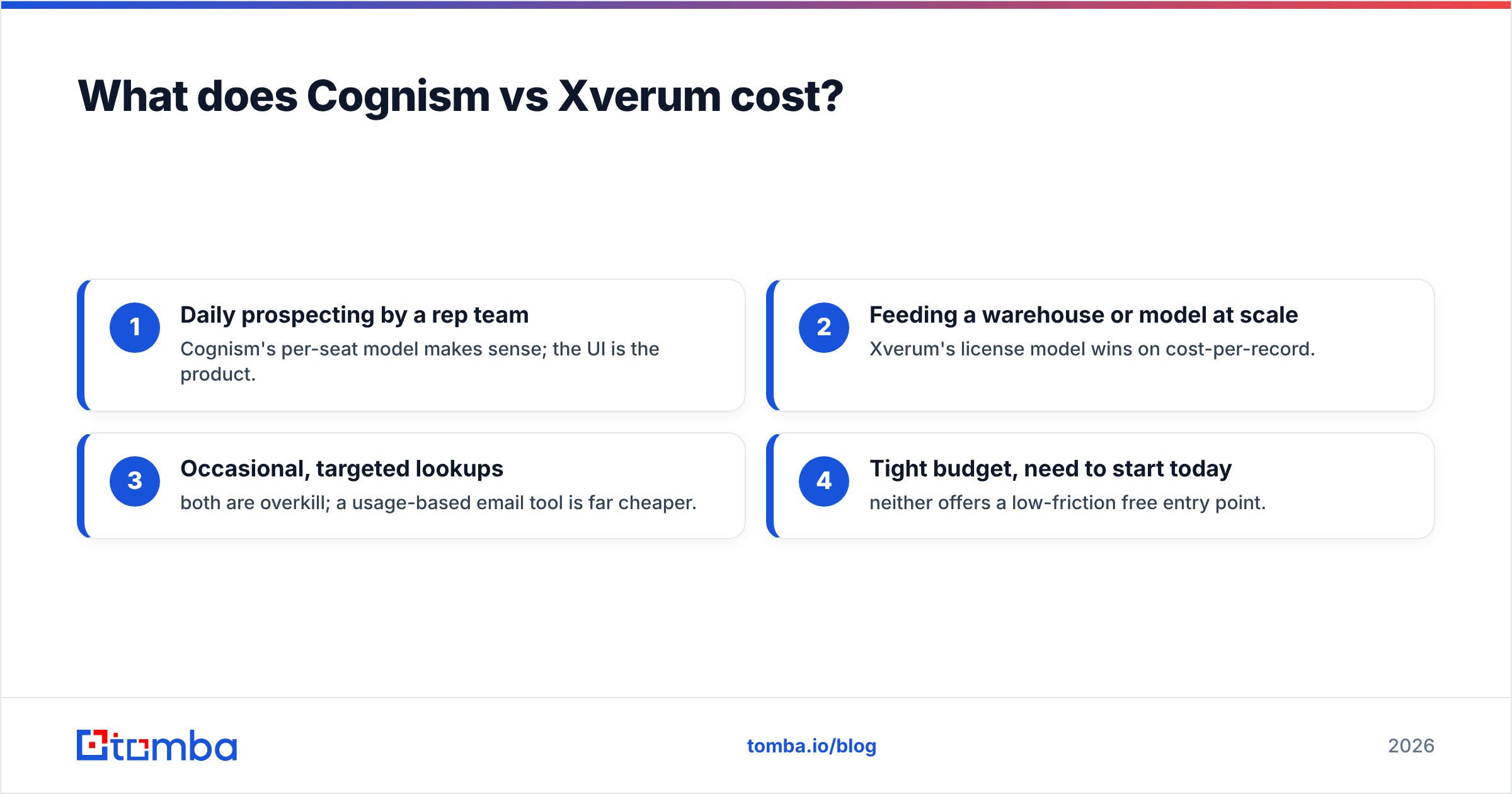
- Daily prospecting by a rep team — Cognism's per-seat model makes sense; the UI is the product.
- Feeding a warehouse or model at scale — Xverum's license model wins on cost-per-record.
- Occasional, targeted lookups — both are overkill; a usage-based email tool is far cheaper.
- Tight budget, need to start today — neither offers a low-friction free entry point.
That fourth point is where a lot of teams get stuck. If your real need is "get me accurate work emails for these specific companies without a five-figure annual contract," a focused tool with transparent Tomba pricing — a free tier at 25 searches/mo, Starter at $49/mo, Growth at $99/mo — solves it without the enterprise sales cycle.
When should you choose a focused email finder instead?#
Both Cognism and Xverum are heavyweight solutions, and heavyweight isn't always what you need.
You should look at a dedicated email finder when your core job is finding and verifying work email addresses — not building a full intent-driven prospecting motion (Cognism) and not ingesting hundreds of millions of raw records (Xverum). A lot of teams buy a huge platform to solve a problem that's really "I have a list of companies and names, get me the emails."
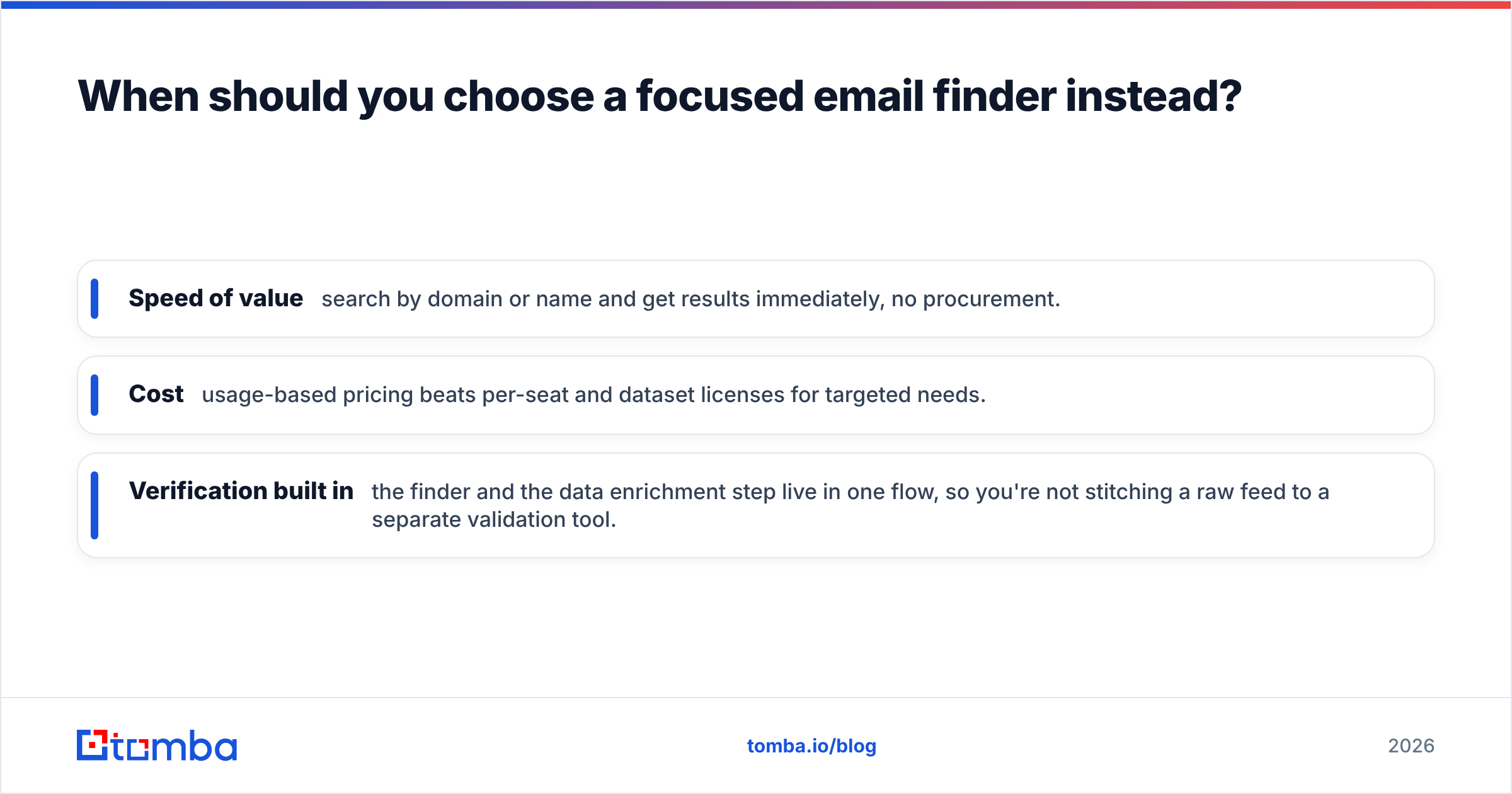
For that job, a purpose-built tool wins on three fronts:
- Speed of value — search by domain or name and get results immediately, no procurement.
- Cost — usage-based pricing beats per-seat and dataset licenses for targeted needs.
- Verification built in — the finder and the data enrichment step live in one flow, so you're not stitching a raw feed to a separate validation tool.
You can also mix approaches. Some teams use Xverum-style bulk data as a raw base, then run it through a focused B2B database and verification layer to clean it before outreach. Others skip the big platforms entirely and build lists on demand.
Independent reviews are worth reading before you commit to either heavyweight — check current user feedback on G2 to see how accuracy and support hold up in practice, since vendor claims and real-world results often differ by region and use case.
Cognism vs Xverum: the verdict#
There's no universal winner — there's a right fit.
Choose Cognism if you have a rep team that prospects inside a tool every day, you sell into compliance-sensitive markets (especially Europe), and you value verified mobile numbers and intent data enough to pay per seat.
Choose Xverum if you have a data or RevOps team that owns its own enrichment pipeline, you need raw volume at dataset economics, and you're equipped to handle verification and compliance yourself.
Choose a focused email finder if your actual need is accurate, verified work emails on demand — without a long procurement cycle or an annual enterprise contract you'll underuse.
If that last description fits, start with the Tomba Email Finder. Find professional email addresses by domain, name, or company, verify them in the same flow, and scale usage as you grow — with a free tier to test accuracy before you spend a dollar. It won't replace a full intent platform or a bulk data license, but for the job most teams actually have, it's the fastest path from a name to a reply.
Related guides#
// get started
Find, verify and enrich your first contacts today
Start on the free plan with 25 searches a month, then scale when your team is ready.
Free plan · No credit card required · GDPR & CCPA
// about the author