Cold Acquisition in 2026: The No-Fluff Playbook That Works
Cold acquisition isn't dead in 2026 — it just punishes lazy targeting and dirty data. Here's the channel mix, cost math, and step-by-step playbook that still books meetings.
TL;DR
- Cold acquisition is the practice of turning people who have never heard of you into customers through proactive outreach — email, phone, LinkedIn, and paid touch — instead of waiting for inbound demand.
- It still works in 2026, but the margin for sloppiness is gone: spam filters, saturated inboxes, and buyer skepticism punish broad "spray and pray" blasts.
- The three levers that decide your results are targeting (who), data quality (can you actually reach them), and relevance (why they should care).
- A tight, verified list of 200 right-fit prospects beats a scraped list of 20,000 every time — deliverability and reply rates both collapse on dirty data.
- Tools like a reliable email finder and email verifier are no longer optional; they are the difference between landing in the inbox and burning your domain.
What is cold acquisition?#
Cold acquisition is customer acquisition that starts from zero relationship. You reach out to a prospect who has not raised a hand, has not visited your pricing page, and does not know your brand — and you try to earn a conversation.
Think of it like introducing yourself at a large conference. Warm acquisition is chatting with someone who already follows your work; cold acquisition is walking up to a stranger and giving them a reason to keep listening in the first ten seconds. The mechanics are different, and so is the skill required.
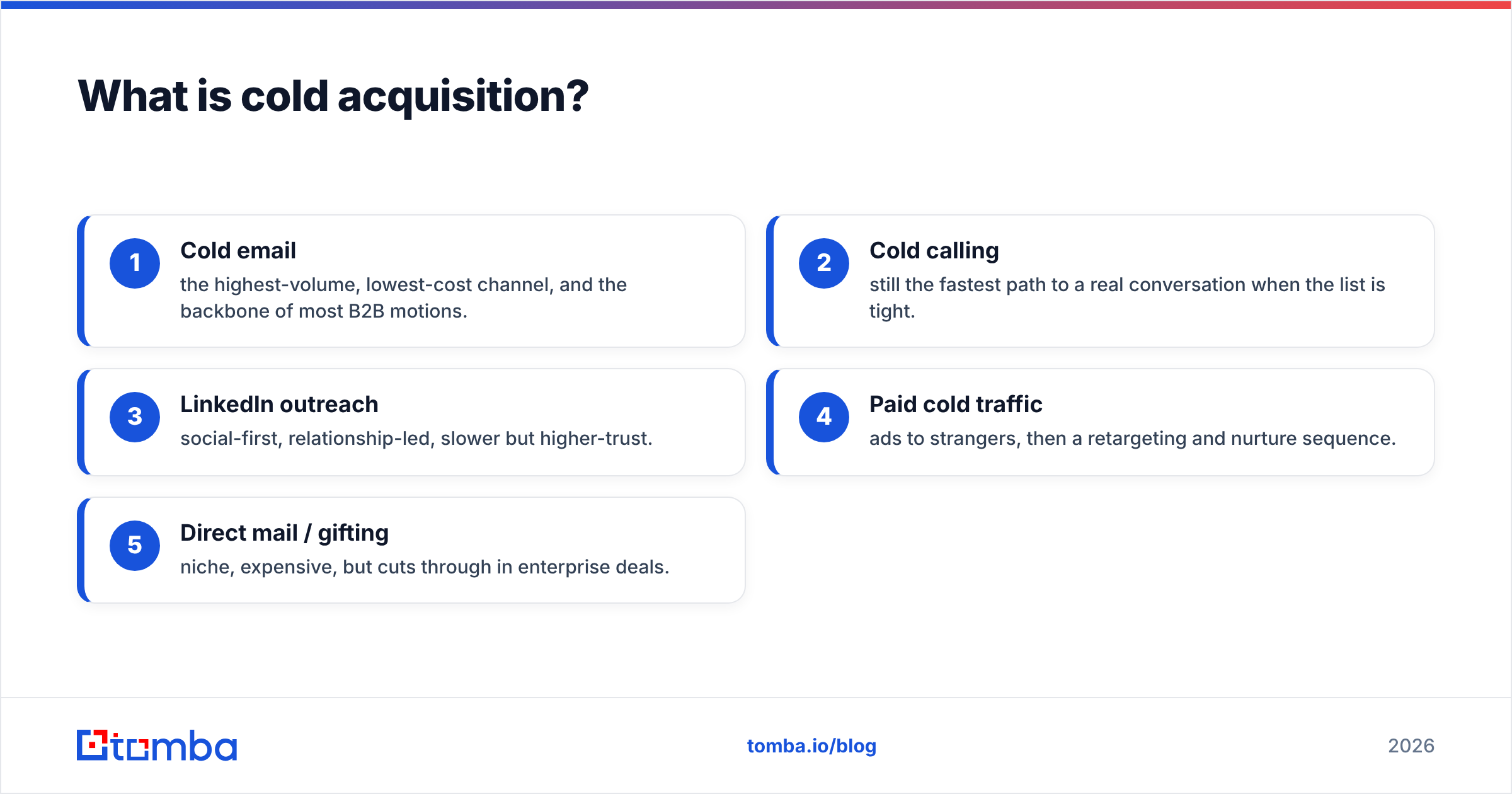
Technically, cold acquisition spans any outbound channel where the first touch is unsolicited:
- Cold email — the highest-volume, lowest-cost channel, and the backbone of most B2B motions.
- Cold calling — still the fastest path to a real conversation when the list is tight.
- LinkedIn outreach — social-first, relationship-led, slower but higher-trust.
- Paid cold traffic — ads to strangers, then a retargeting and nurture sequence.
- Direct mail / gifting — niche, expensive, but cuts through in enterprise deals.
The channel matters less than the fundamentals underneath it. Every one of these fails the same way: bad targeting and bad data.

Is cold acquisition still worth it in 2026?#
Yes — but only if you treat it as a precision instrument, not a volume game.
The reason people declare cold outreach "dead" every year is that the lazy version genuinely stopped working. Mailbox providers like Google and Microsoft tightened bulk-sender rules, requiring authentication (SPF, DKIM, DMARC) and low complaint rates. You can read Google's own sender guidelines to see how strict the thresholds now are. Blast 10,000 unverified addresses and you will trip spam traps, spike bounces, and torch your domain reputation within a week.
But the buyers are still there. According to research aggregated on G2, the majority of B2B buyers still accept meetings sourced through outbound when the message is relevant to a problem they actually have. Demand did not disappear; tolerance for irrelevance did.
So the honest 2026 answer is: cold acquisition is worth it if you can consistently do three things —
- Reach a narrow, well-defined segment.
- Contact them on verified, accurate data.
- Lead with a message about their problem, not your product.
Miss any one and your economics fall apart.
How does cold acquisition compare to warm and inbound?#
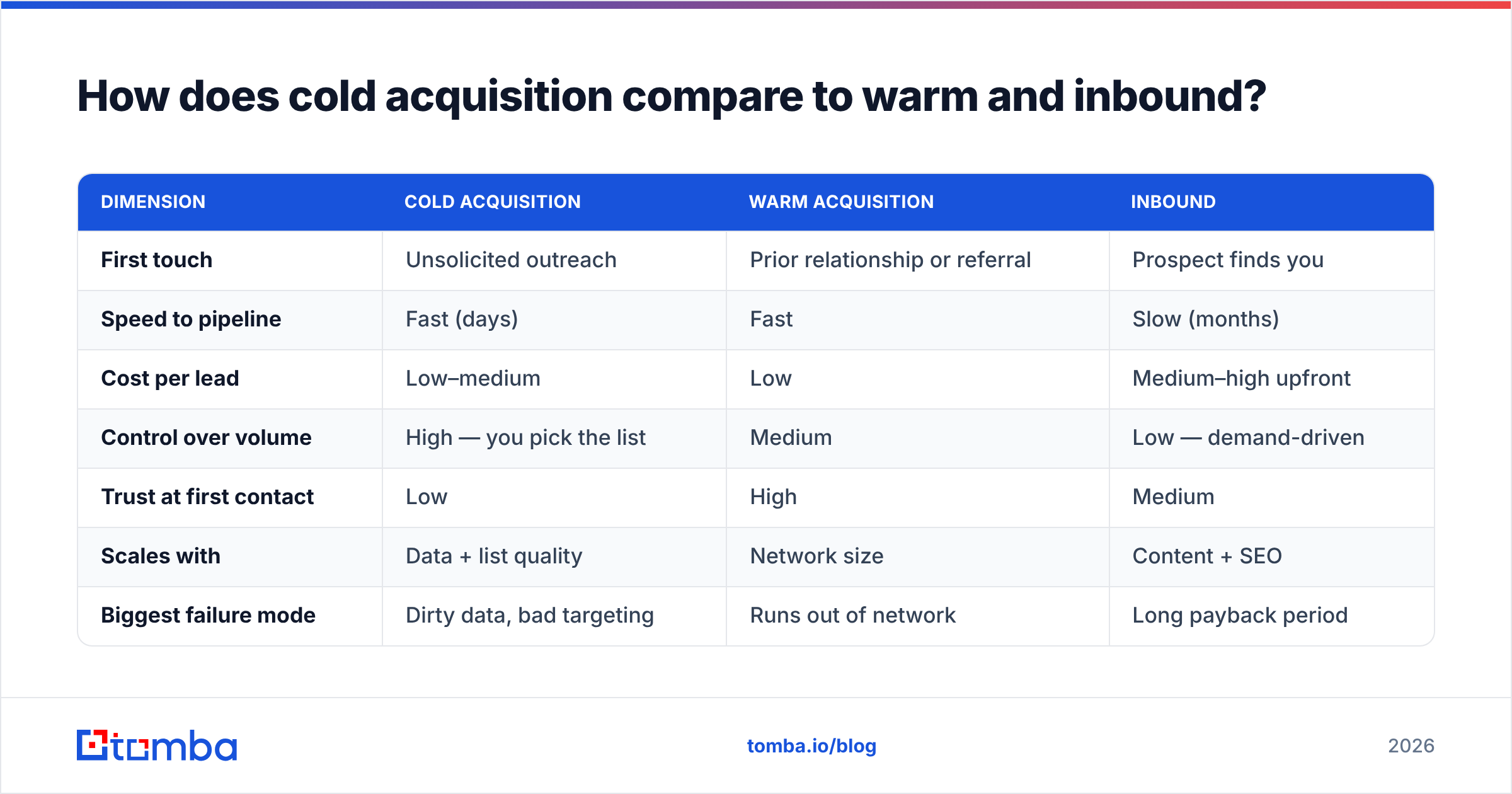
Different acquisition motions solve different problems. Cold outreach gives you control and speed; inbound gives you trust and scale over time. Most teams need a blend, weighted by their stage and budget.
| Dimension | Cold Acquisition | Warm Acquisition | Inbound |
|---|---|---|---|
| First touch | Unsolicited outreach | Prior relationship or referral | Prospect finds you |
| Speed to pipeline | Fast (days) | Fast | Slow (months) |
| Cost per lead | Low–medium | Low | Medium–high upfront |
| Control over volume | High — you pick the list | Medium | Low — demand-driven |
| Trust at first contact | Low | High | Medium |
| Scales with | Data + list quality | Network size | Content + SEO |
| Biggest failure mode | Dirty data, bad targeting | Runs out of network | Long payback period |
The takeaway: cold acquisition is the only channel where you can decide on Monday to talk to 300 specific decision-makers and have replies by Friday. That control is exactly why it survives — no other motion lets an early-stage team manufacture pipeline on demand.
What does cold acquisition actually cost?#
Cold acquisition is cheap on paper and expensive when done badly. The visible cost is tooling; the hidden cost is a burned domain and a demoralized team chasing bounced sends.
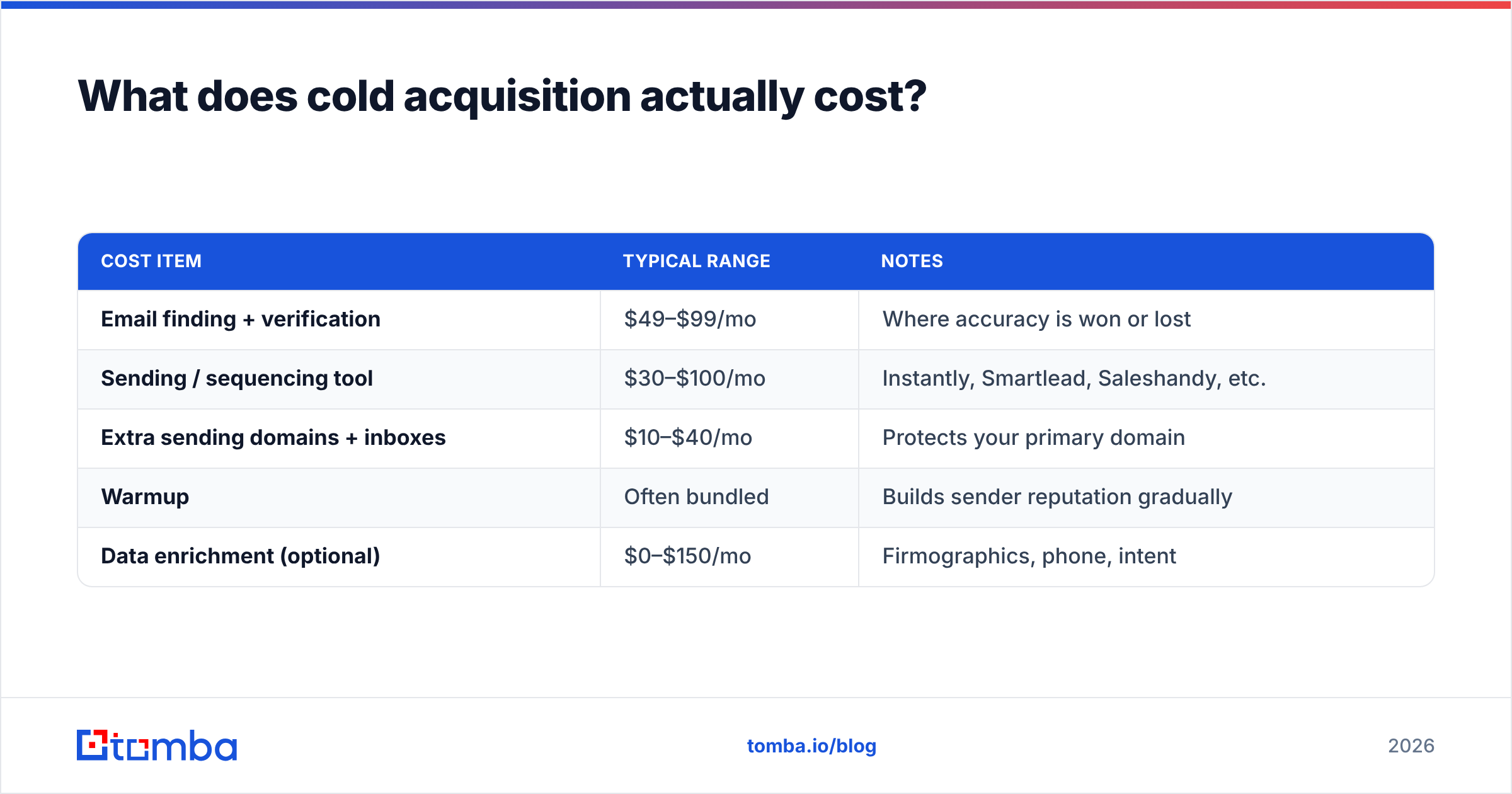
Here is a realistic monthly stack for a small outbound team running one to two sending domains:
| Cost item | Typical range | Notes |
|---|---|---|
| Email finding + verification | $49–$99/mo | Where accuracy is won or lost |
| Sending / sequencing tool | $30–$100/mo | Instantly, Smartlead, Saleshandy, etc. |
| Extra sending domains + inboxes | $10–$40/mo | Protects your primary domain |
| Warmup | Often bundled | Builds sender reputation gradually |
| Data enrichment (optional) | $0–$150/mo | Firmographics, phone, intent |
For context, Tomba's own pricing starts with a free tier of 25 searches per month, then Starter at $49/mo, Growth at $99/mo, and Pro at $249/mo — so the data layer for a serious cold program lands in the $49–$99 range for most teams.
The real cost math is reply-rate driven. If verified data lifts your reply rate from 1% to 4%, you need a quarter of the volume to book the same meetings — which means fewer sends, lower spam risk, and a longer-lived domain. Cheap dirty data is the most expensive thing you can buy.
What makes cold acquisition actually work?#
Targeting, data, and relevance — in that order. Everything else is production detail.
1. Narrow your ICP until it feels uncomfortable#
Most cold campaigns fail because the list is too broad. "SaaS companies" is not a segment. "Series-A B2B SaaS companies in fintech, 20–80 employees, hiring their first RevOps person" is. The narrower the segment, the sharper your message can be — and sharpness is what earns replies.
2. Get contact data you can trust#
This is the step teams skip and the one that quietly kills campaigns. A guessed email pattern (first.last@company.com) is right often enough to feel safe and wrong often enough to spike your bounce rate above the 2–3% threshold that triggers spam filtering.
The fix is a two-step data process:
- Find the address using a domain search or name-based lookup rather than guessing.
- Verify every address before it enters a sequence, and route catch-all domains through a dedicated catch-all verifier so ambiguous addresses do not silently bounce.
Clean data is not a nice-to-have. It is the load-bearing wall of the entire motion.

3. Lead with their problem#
The winning cold message is short, specific, and about the recipient. Open with an observation about their world — a role they just posted, a market they operate in, a tool they use — and connect it to a problem you solve. Save the product pitch for after they reply.
4. Sequence, don't blast#
A single email is a coin flip. A four-to-six touch sequence across email and one other channel (a call or a LinkedIn note) is what produces predictable reply rates. Space touches over two to three weeks and change the angle each time instead of repeating "just bumping this."
What's the step-by-step cold acquisition playbook?#
Here is the sequence that consistently books meetings without wrecking your domain:
- Define the segment. Write your ICP down to firmographic and role-level detail. If you can't name the exact job titles, you are not ready to send.
- Build the list. Pull companies that match, then find the right contacts. Use a bulk email finder to do this at scale rather than one profile at a time.
- Verify everything. Run the full list through verification. Remove hard bounces and risky addresses before they ever touch your sending tool.
- Warm the infrastructure. Set up dedicated sending domains, authenticate them, and warm the inboxes for two to three weeks before volume sending.
- Write the sequence. Four to six touches, one problem per email, a clear and low-friction call to action ("Worth a quick chat?" beats "Book a 30-minute demo").
- Send in small daily batches. Keep per-inbox volume conservative — a few dozen sends per inbox per day, not hundreds.
- Measure the right metric. Track positive reply rate and meetings booked, not opens. Open tracking is increasingly unreliable and can hurt deliverability.
- Prune and iterate. Kill segments and messages that underperform. Double down on the ICP slices that reply.
Follow this and cold acquisition becomes a system you can forecast, not a lottery you keep replaying.
What are the most common cold acquisition mistakes?#
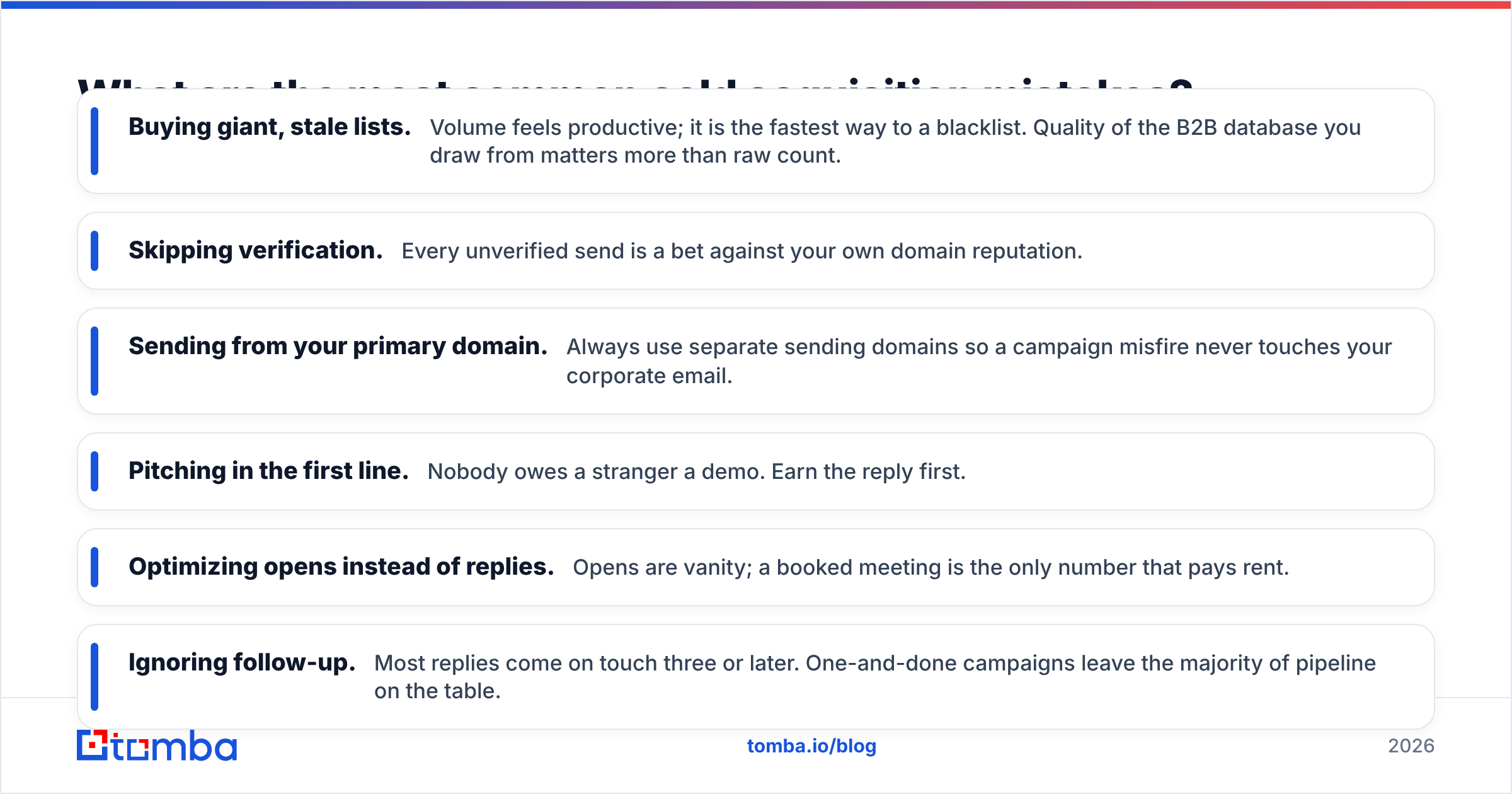
- Buying giant, stale lists. Volume feels productive; it is the fastest way to a blacklist. Quality of the B2B database you draw from matters more than raw count.
- Skipping verification. Every unverified send is a bet against your own domain reputation.
- Sending from your primary domain. Always use separate sending domains so a campaign misfire never touches your corporate email.
- Pitching in the first line. Nobody owes a stranger a demo. Earn the reply first.
- Optimizing opens instead of replies. Opens are vanity; a booked meeting is the only number that pays rent.
- Ignoring follow-up. Most replies come on touch three or later. One-and-done campaigns leave the majority of pipeline on the table.
Avoiding these six covers most of the gap between teams that say "cold outreach doesn't work" and teams quietly booking meetings from it every week.
How do you keep cold acquisition compliant and deliverable?#
Deliverability and compliance are the same discipline viewed from two angles: respect the recipient and the infrastructure will reward you.
Practically, that means authenticate your domains, honor opt-outs immediately, keep your complaint rate near zero, and never mail an address you haven't verified. If your bounce rate creeps up, stop and clean the list before sending another batch. A dedicated email verifier run before every campaign is the single highest-ROI habit in the entire motion — it protects the asset (your domain) that everything else depends on.
Regulations like GDPR and CAN-SPAM also shape what "cold" can look like by region. The safe posture is legitimate business interest, honest identification, an easy unsubscribe, and outreach that a reasonable recipient would find relevant rather than spammy. Neutral, professional, opt-out-friendly outreach clears both the legal and the deliverability bar at once.
The bottom line#
Cold acquisition in 2026 rewards precision and punishes laziness. The teams winning at it aren't sending more — they're sending smarter, to tighter segments, on cleaner data, with messages built around the buyer's problem. Get the targeting and the data right and the channel is as alive as it ever was.
The data layer is where most of that battle is won. Tomba's email finder helps you build accurate, verified prospect lists by domain, name, or company — so your sends reach real inboxes instead of spam folders or hard bounces. Start on the free tier, verify before you send, and let clean data do the heavy lifting for your next cold acquisition campaign.
Related guides#
Ready to find emails that actually work?
Join 150,000+ professionals who stopped guessing and started sending. Free credits on signup — no credit card required.
Get the Tomba newsletter
Practical outbound tactics and product updates — once every two weeks.
About the author