Cold Canvassing in 2026: What Still Works and What Doesn't
Cold canvassing isn't dead, but the rules have changed. Here's where door-knocking still wins, where it burns time, and how to pair it with modern data.
TL;DR
- Cold canvassing — showing up in person or door-to-door to pitch prospects with no prior contact — still works in specific markets (local services, field sales, real estate), but it's brutally inefficient for most B2B tech and SaaS.
- The win rate depends almost entirely on targeting. Random door-knocking wastes reps; a pre-qualified route can beat cold calling on close rate.
- Modern teams treat canvassing as one channel in a multi-touch sequence, not a standalone strategy — pair the in-person touch with verified contact data and follow-up email.
- The biggest cost isn't rejection; it's time per contact. One rep can knock ~30 doors a day or email 300 verified prospects.
- Use canvassing where physical presence changes the outcome. Use data-driven outreach everywhere else — and blend the two when the deal size justifies it.
What is cold canvassing?#
Cold canvassing is direct, unsolicited outreach to prospects you've had no prior relationship with — traditionally in person. Think of it like fishing by wading into the river and casting where you can see fish, versus dropping a net across the whole stream. You cover less water, but every cast is deliberate and you can read the situation in real time.
The term comes from field sales and political campaigning: reps walk a territory, knock doors, or visit businesses on a street-by-street basis. Today "cold canvassing" also stretches to cover any first-touch cold outreach done at volume — door-to-door, foot traffic in office parks, and sometimes cold calling or cold email lumped under the same umbrella. In this guide we focus on the in-person and hybrid definition, because that's where the real trade-offs live.
Here's the honest framing: canvassing is high-cost, high-signal. You spend far more time per prospect than you would with a digital channel, but you get body language, immediate objections, and a human connection no email can match. Whether that trade is worth it depends entirely on what you sell and to whom.
Does cold canvassing still work in 2026?#
Yes — but only in a narrower band of use cases than a decade ago. The channels that killed generic canvassing (email, LinkedIn, targeted ads) also made the surviving canvassing use cases sharper.
Cold canvassing still performs when three conditions hold:
- Physical presence changes the outcome. Home services (solar, roofing, pest control, security), local retail partnerships, and commercial real estate all benefit from being seen on-site.
- The buyer is hard to reach digitally. Owner-operators of local businesses, trades, and franchises often ignore email but will talk to someone standing in their shop.
- Territory density is high. If you can knock 30 relevant doors in a square mile, the time-per-contact math works. Spread those 30 across a metro area and it collapses.
Where it fails: B2B SaaS, enterprise software, and any sale where the decision-maker sits behind a badge reader and a gatekeeper. You'll burn a day to reach one receptionist. Those markets moved to sales prospecting built on data — find the right person, verify the contact, and reach them where they already work.
Industry data backs the shift. According to HubSpot's sales research, reps consistently rank referrals and warm digital channels above cold in-person outreach for efficiency — but field-heavy verticals still report canvassing as a top-three source of pipeline. The takeaway isn't "canvassing is dead." It's "canvassing is specialized."
Cold canvassing vs cold calling vs cold email#
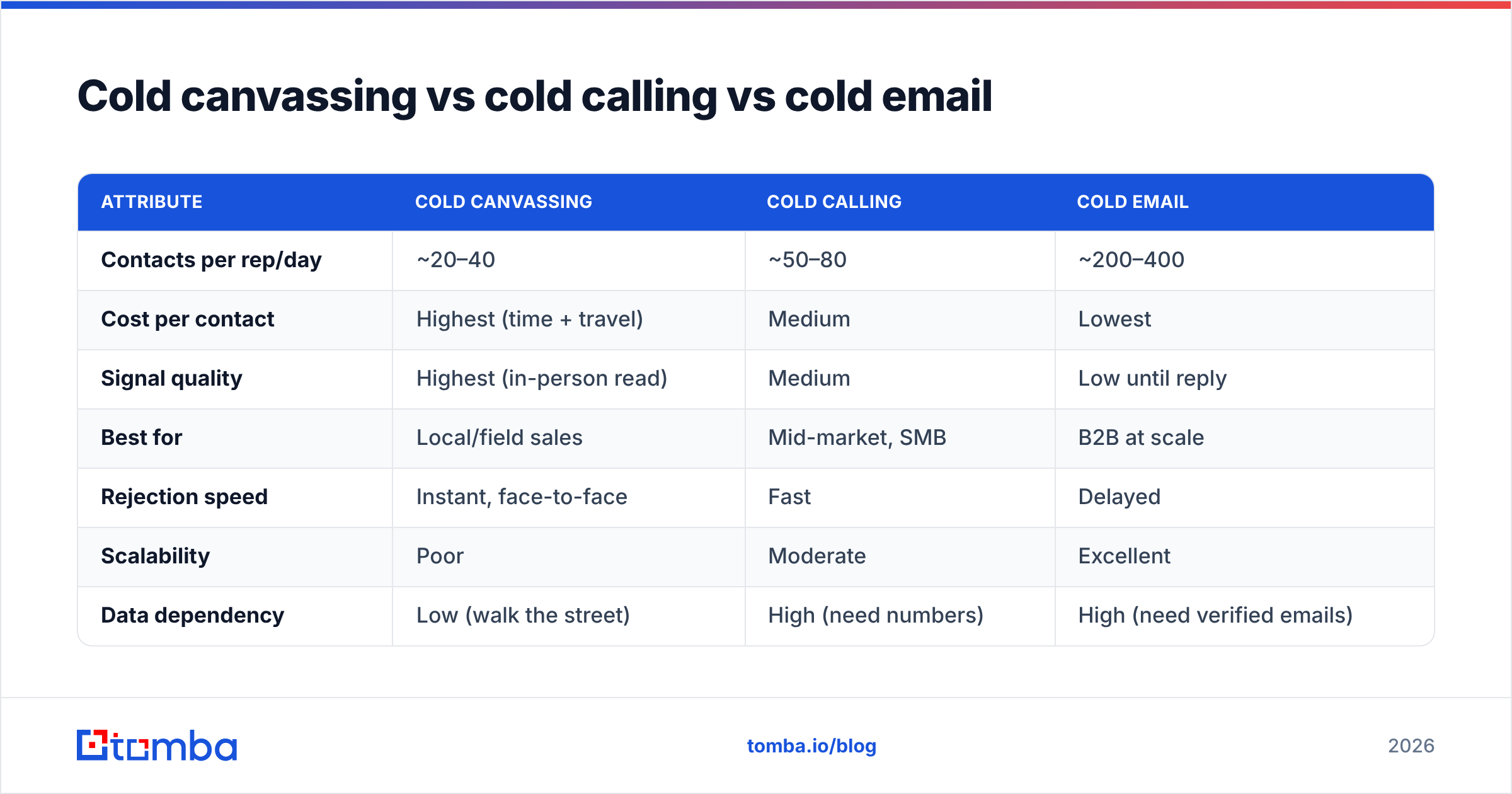
The three "cold" channels are often confused. They solve the same problem — starting a conversation with a stranger — at wildly different costs and scales. Here's how they stack up.
| Attribute | Cold Canvassing | Cold Calling | Cold Email |
|---|---|---|---|
| Contacts per rep/day | ~20–40 | ~50–80 | ~200–400 |
| Cost per contact | Highest (time + travel) | Medium | Lowest |
| Signal quality | Highest (in-person read) | Medium | Low until reply |
| Best for | Local/field sales | Mid-market, SMB | B2B at scale |
| Rejection speed | Instant, face-to-face | Fast | Delayed |
| Scalability | Poor | Moderate | Excellent |
| Data dependency | Low (walk the street) | High (need numbers) | High (need verified emails) |
The pattern is clear: canvassing trades scale for signal. You learn more per conversation but have far fewer of them. Cold email inverts that — massive reach, thin signal until someone replies. Smart teams don't pick one; they sequence them. Canvass the accounts worth a visit, call the mid-tier, and email the long tail with verified email addresses so your reach channel doesn't bounce.
One critical note: cold email only scales if your list is clean. A canvasser who knocks a wrong door loses five minutes. A cold emailer with a dirty list loses their sender reputation, and that damage compounds across every future campaign.
How do you run a cold canvassing campaign that works?#
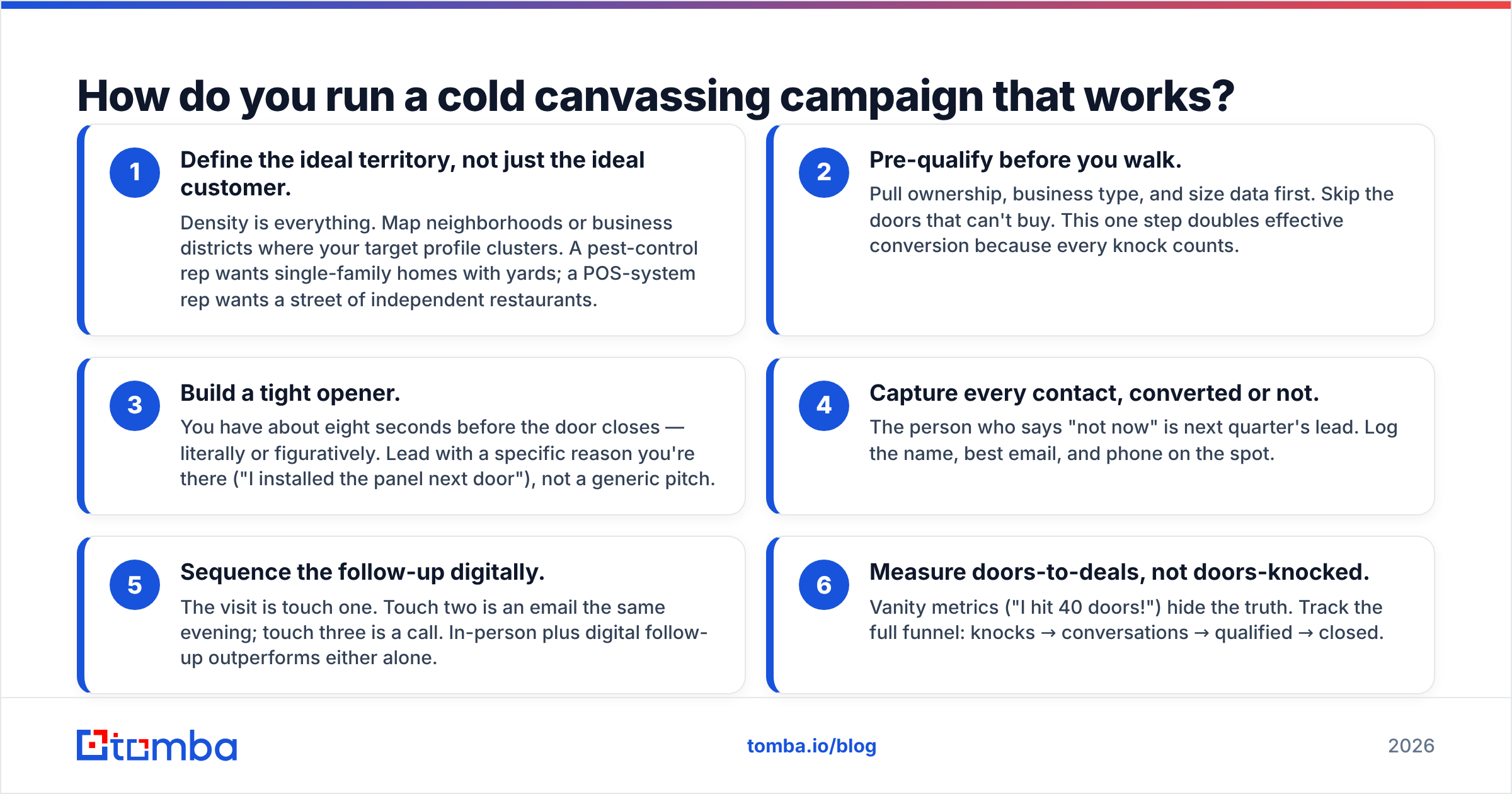
A structured canvass beats a random one every time. The reps who hate canvassing are usually the ones handed a map and told to "go get 'em." Here's the framework that turns door-knocking from a grind into a system.
- Define the ideal territory, not just the ideal customer. Density is everything. Map neighborhoods or business districts where your target profile clusters. A pest-control rep wants single-family homes with yards; a POS-system rep wants a street of independent restaurants.
- Pre-qualify before you walk. Pull ownership, business type, and size data first. Skip the doors that can't buy. This one step doubles effective conversion because every knock counts.
- Build a tight opener. You have about eight seconds before the door closes — literally or figuratively. Lead with a specific reason you're there ("I installed the panel next door"), not a generic pitch.
- Capture every contact, converted or not. The person who says "not now" is next quarter's lead. Log the name, best email, and phone on the spot.
- Sequence the follow-up digitally. The visit is touch one. Touch two is an email the same evening; touch three is a call. In-person plus digital follow-up outperforms either alone.
- Measure doors-to-deals, not doors-knocked. Vanity metrics ("I hit 40 doors!") hide the truth. Track the full funnel: knocks → conversations → qualified → closed.
The hidden multiplier in that list is step 4. Field reps are notorious for losing contact data — a name scrawled on a clipboard never makes it into the CRM. Feeding canvass contacts into a system where you can enrich leads with verified email and phone turns a one-shot visit into a repeatable sequence.
What are the real costs and limits of cold canvassing?#
The number that kills most canvassing programs isn't the rejection rate — it's the fully loaded cost per contact. Let's make it concrete.
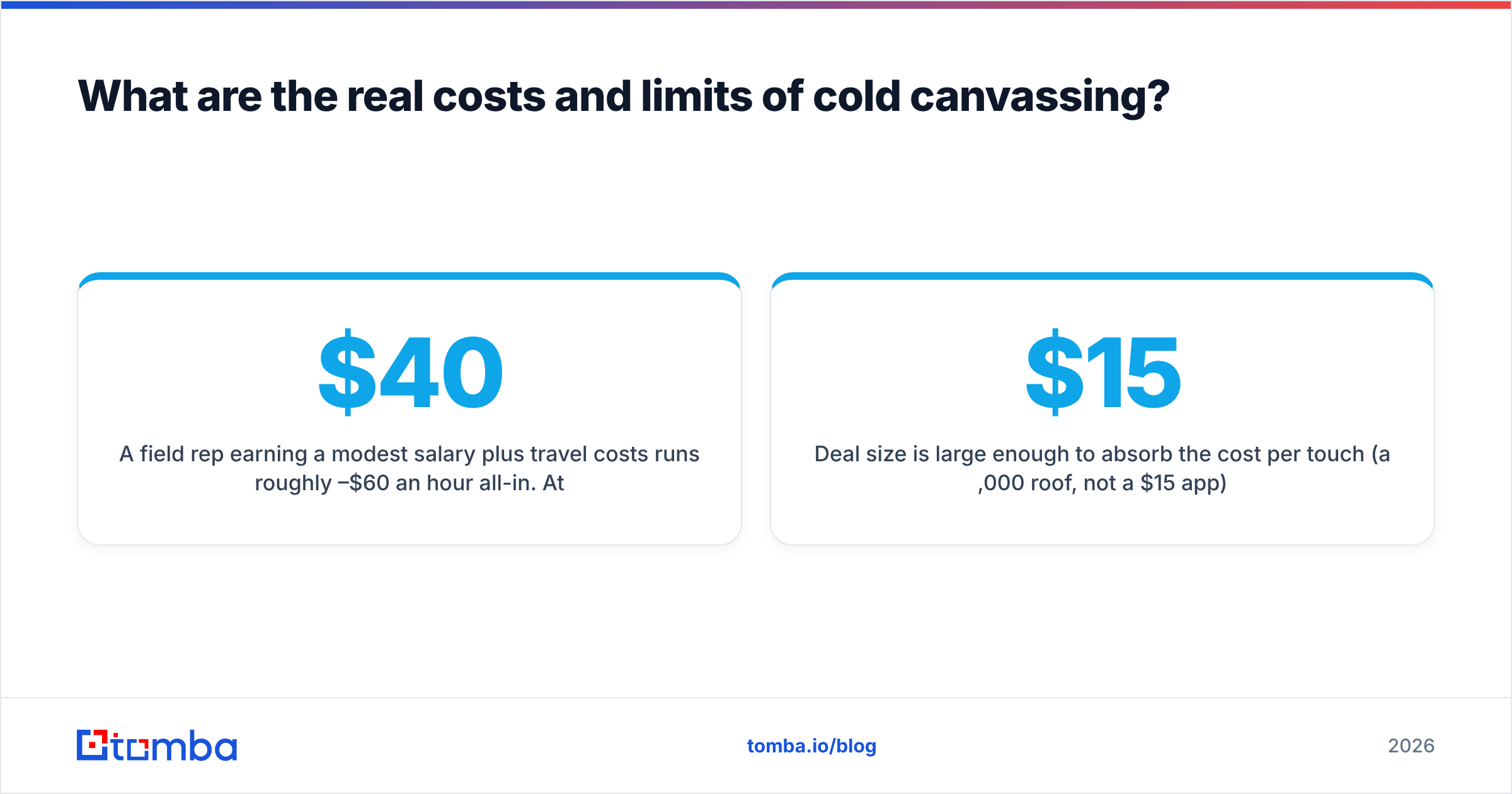
A field rep earning a modest salary plus travel costs runs roughly $40–$60 an hour all-in. At 30 doors a day with maybe six real conversations, you're paying $50–$80 per meaningful conversation before anyone buys anything. Compare that to a cold email campaign where the marginal cost per verified contact is cents.
That math isn't an argument against canvassing — it's an argument for using it surgically. The economics only work when:
- Deal size is large enough to absorb the cost per touch (a $15,000 roof, not a $15/month app).
- Close rates are high because the in-person read genuinely moves deals.
- Territory is dense so travel time stays low.
The other limits are structural. Canvassing doesn't scale linearly — you can't 10x it by hiring, because good territory is finite and reps cannibalize each other. It's weather-dependent, geography-locked, and hard to A/B test the way you can iterate an email subject line. And in many commercial buildings and gated communities, you simply can't get in.
None of this means abandon the channel. It means cap your canvassing at the accounts where physical presence earns its keep, and route everything else to data-driven outreach. The teams that get this wrong pour their whole prospecting budget into a channel that structurally can't grow.
How does modern data make canvassing smarter?#
The old knock-every-door model is obsolete because data lets you skip the doors that will never buy. Think of it as the difference between metal-detecting a random beach versus one where a survey already told you where the coins are. Same tool, radically different yield.
Here's how a modern field-plus-data workflow looks:
- Pre-visit: Pull a list of qualifying businesses in your territory — by type, size, and location — before you leave the office. Identify the owner or decision-maker so you ask for them by name.
- On-site: Have the decision-maker's role and company context ready. Walking in knowing the owner's name and that they run three locations changes the entire conversation.
- Post-visit: Immediately verify and log a business email and direct phone number so your follow-up actually lands. A visit with no reachable contact is a dead end.
- Ongoing: Enrich the record over time and re-engage on a cadence. The prospect who wasn't ready in Q1 gets a relevant touch in Q3.
This is where tools like a B2B database and a domain-based company email search turn canvassing from a solo grind into a team system. You canvass fewer, better doors — and every door you knock feeds a CRM record you can nurture for months. The in-person touch becomes the opener of a long relationship rather than a one-shot gamble.
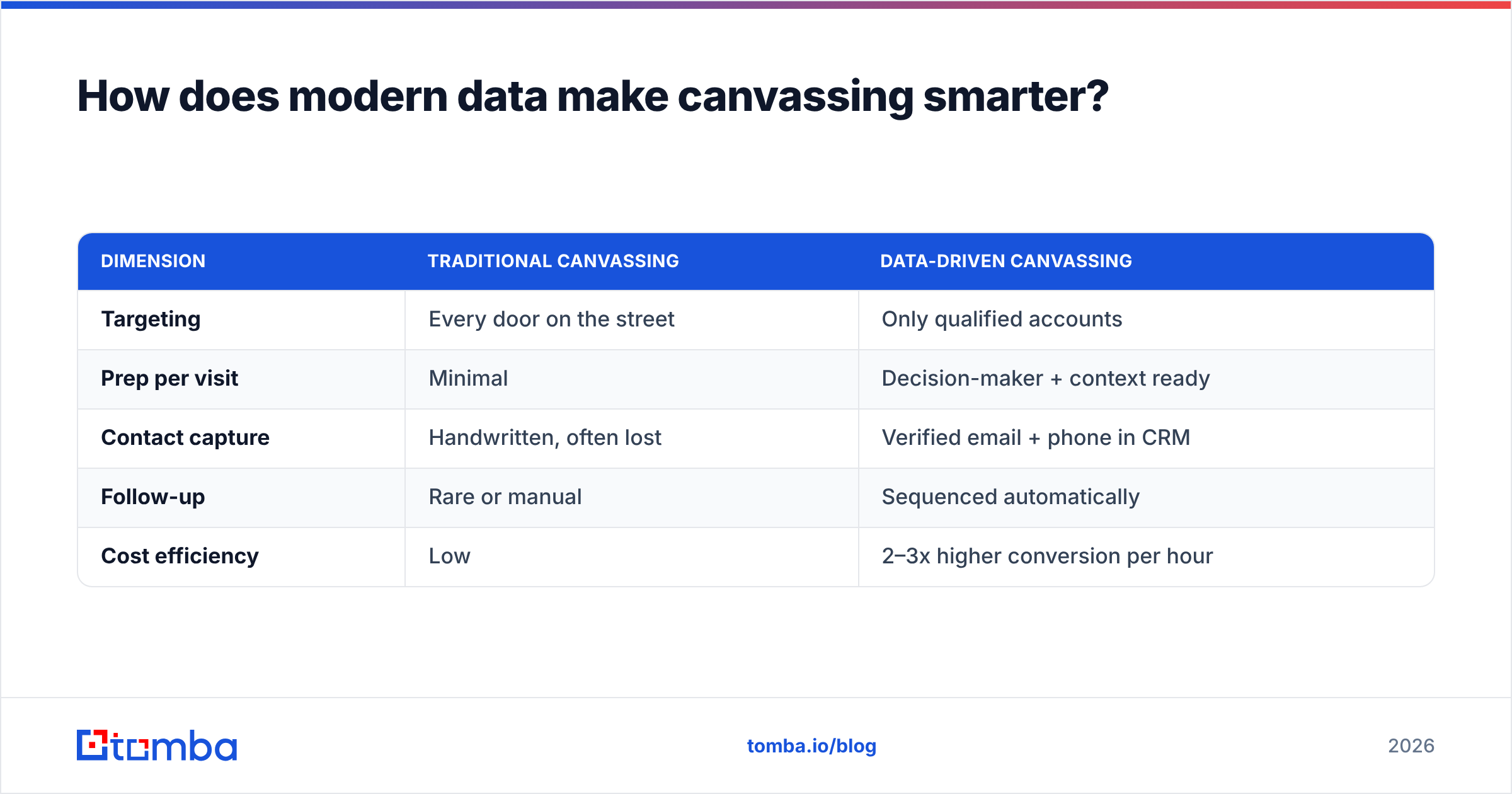
Compare the old and new models directly:
| Dimension | Traditional canvassing | Data-driven canvassing |
|---|---|---|
| Targeting | Every door on the street | Only qualified accounts |
| Prep per visit | Minimal | Decision-maker + context ready |
| Contact capture | Handwritten, often lost | Verified email + phone in CRM |
| Follow-up | Rare or manual | Sequenced automatically |
| Cost efficiency | Low | 2–3x higher conversion per hour |
The reps who resist this shift aren't wrong that in-person selling has magic. They're wrong that it has to be unstructured to keep that magic.
When should you skip canvassing entirely?#
Skip cold canvassing when the buyer lives behind a screen, the territory is sparse, or the deal size can't justify the cost per touch. That covers most B2B software, remote-first companies, and any market where your ideal customer is a title (VP of Engineering) rather than a storefront.
In those cases, the higher-leverage play is data-first outreach: identify the accounts, find the decision-makers, verify their contact details, and run a disciplined multi-channel sequence. You lose the in-person read, but you gain 10x the reach and a channel you can actually measure and improve. For a deeper look at the trade-offs across tools, see Apollo alternatives and how modern prospecting stacks are built.
The best sales orgs run a portfolio. They canvass the handful of high-value, geographically concentrated accounts where showing up matters, and they run everything else through email and phone at scale. Treating canvassing as your only strategy is as much a mistake as ignoring it entirely — it's a scalpel, not a shovel.
Frequently asked questions#
Is cold canvassing the same as cold calling? No. Cold calling is done by phone; cold canvassing is done in person (or, loosely, any first-touch outreach at volume). Canvassing gives you a face-to-face read; calling gives you more contacts per day. Most field teams use both.
What industries still use cold canvassing successfully? Home services (solar, roofing, pest control, security), local retail and restaurant tech, commercial real estate, and franchise sales. The common thread: a physical location, a reachable owner, and a deal large enough to justify a visit.
How many doors should a canvasser knock per day? Realistically 20–40 in a dense territory, yielding maybe 5–8 genuine conversations. If your numbers are far below that, your territory is too sparse — tighten it with better data before adding reps.
Can I combine canvassing with cold email? Yes, and you should. Use the in-person visit as touch one, then follow up the same day with a verified email and a call. In-person plus digital follow-up consistently beats either channel alone. Just make sure your list is clean so the email half doesn't hurt your email deliverability.
The bottom line: canvass smart, then scale with data#
Cold canvassing in 2026 isn't a relic and it isn't a silver bullet. It's a specialized channel that earns its keep in dense, high-value, physically grounded markets — and quietly bleeds money everywhere else. The teams that win treat every knock as the start of a data-backed relationship, not a one-shot pitch, and they route everything canvassing can't reach into scalable digital outreach.
If your bottleneck is finding and reaching the right decision-makers — whether to knock on their door or land in their inbox — start with clean, verified contact data. Tomba's Email Finder turns a company name or domain into verified professional emails so your follow-up actually connects, and your reps spend their time on the doors and accounts that count. Pair the human touch of canvassing with the reach of data, and check the Tomba pricing plans — starting free with 25 searches a month — to see which fits your team.
Related guides#
Ready to find emails that actually work?
Join 150,000+ professionals who stopped guessing and started sending. Free credits on signup — no credit card required.
Get the Tomba newsletter
Practical outbound tactics and product updates — once every two weeks.
About the author