Cold Canvassing Prospecting Method: The 2026 Field Guide
Is knocking on doors dead in 2026? Here's when the cold canvassing prospecting method still wins, how it stacks up against digital outreach, and how to run it without wasting reps' time.
TL;DR
- Cold canvassing is the prospecting method of contacting prospects with no prior relationship — historically door-to-door, now a blend of physical visits, walk-ins, and cold digital touches.
- It still works in 2026 for local, territory-based, and high-trust B2B sales (field services, construction, medical device, regional SaaS resellers) where a face beats an inbox.
- It fails when reps knock blind. The modern version pairs boots-on-the-ground with data: verified contacts, company firmographics, and a tight territory list before anyone leaves the office.
- Pure canvassing is expensive per contact. Layer it with cold email and calls so each in-person visit is earned, not random.
- The biggest lever is targeting. Build the list with real company and contact data first, then canvass only accounts worth the drive.
What is the cold canvassing prospecting method?#
Cold canvassing is the practice of reaching out to prospects who have shown no prior interest and have no relationship with you. Think of it like fishing a stretch of river you've never cast in: you don't know which spot holds fish, so you cover ground systematically until you get bites. Classic canvassing meant walking a business district door to door. Today it spans in-person walk-ins, cold calls, and unsolicited digital outreach — but the defining trait is the same: no warm intro, no inbound signal, first contact is on you.
The method sits at the top of the funnel next to cold calling and cold email. Where it differs is presence. A canvasser is physically or directly in front of the prospect, which raises both the cost per contact and, done right, the conversion rate per contact.
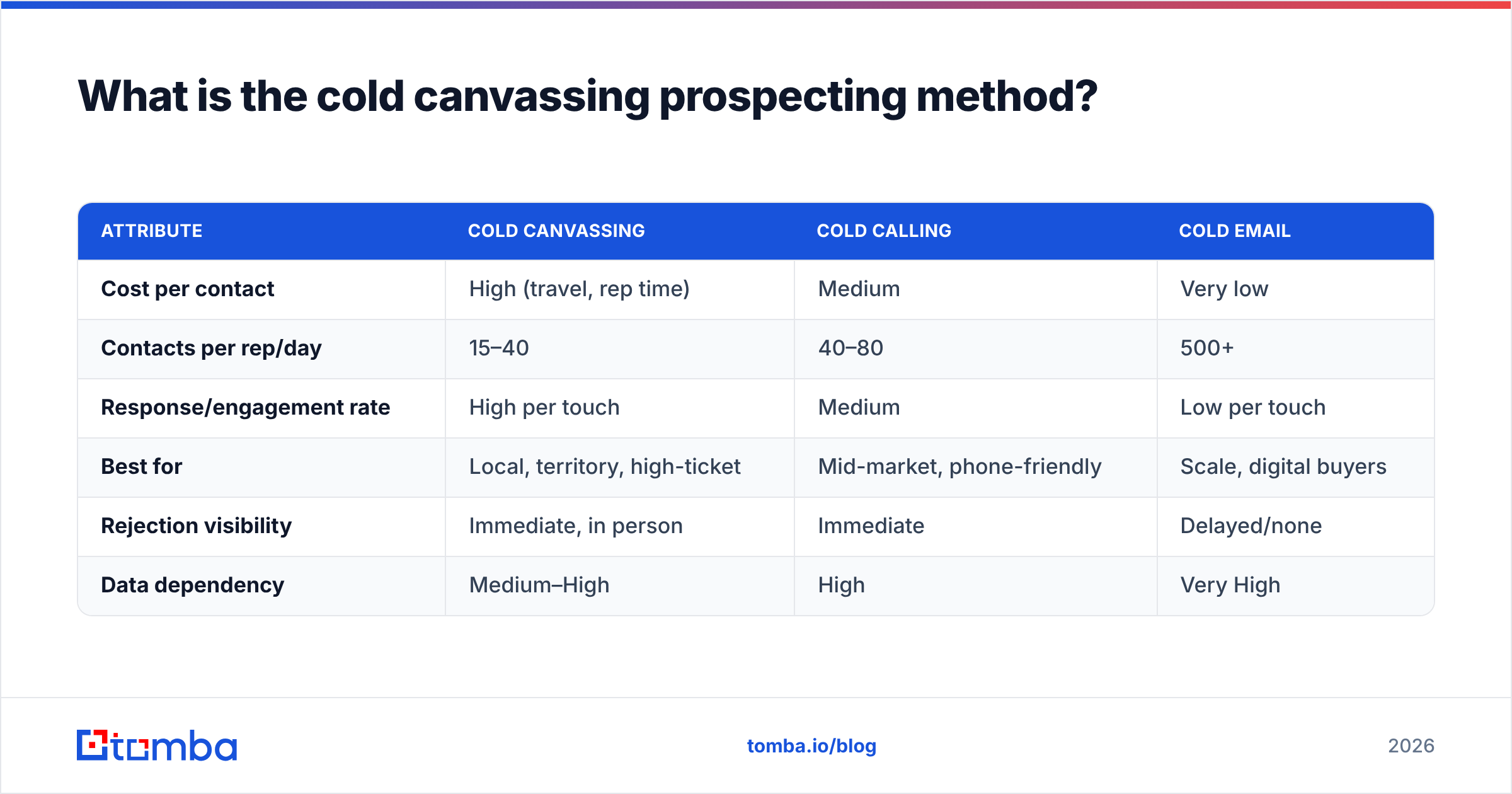
Here's how the three cold approaches compare on the attributes that decide whether canvassing earns a place in your motion:
| Attribute | Cold Canvassing | Cold Calling | Cold Email |
|---|---|---|---|
| Cost per contact | High (travel, rep time) | Medium | Very low |
| Contacts per rep/day | 15–40 | 40–80 | 500+ |
| Response/engagement rate | High per touch | Medium | Low per touch |
| Best for | Local, territory, high-ticket | Mid-market, phone-friendly | Scale, digital buyers |
| Rejection visibility | Immediate, in person | Immediate | Delayed/none |
| Data dependency | Medium–High | High | Very High |
Notice the pattern: canvassing trades volume for depth. You touch fewer people, but each touch carries more weight because you showed up. That trade only pays off if the people you show up to are the right ones — which is where most canvassing programs quietly bleed money.
Does cold canvassing still work in 2026?#
Yes — but only in specific lanes, and only when it's data-led. Buyers in 2026 are saturated with digital outreach. Inboxes are noisy, spam filters are aggressive, and connect rates on cold calls keep sliding. A well-timed in-person visit cuts through precisely because it's rare. The scarcity of physical presence is now an advantage, not a handicap.
Canvassing earns its keep when three conditions hold:
- Geography matters. You sell into local businesses, defined territories, trade shows, office parks, or event floors where prospects cluster physically.
- Deal size justifies the drive. High-ticket or high-LTV deals absorb the cost of a rep's time on the road.
- Trust is the bottleneck. In categories where buyers need to see a face — construction, equipment, healthcare, financial services — presence shortens the trust curve.
Outside those lanes, canvassing is a poor use of rep hours. If your buyer is a remote-first software team, no one is sitting at a desk waiting for a knock, and you're better off with digital sales prospecting at scale.
The mistake teams make is treating "canvassing" and "digital" as an either/or. They're a stack. According to HubSpot's sales research, multi-touch sequences across channels consistently outperform single-channel outreach. The modern canvassing method uses digital to qualify and warm, then reserves the expensive in-person touch for accounts that clear the bar.
How do you run a modern cold canvassing method?#
Run it in four stages: target, prepare, execute, and follow up. The old model skipped straight to "execute" — grab a stack of flyers and start knocking. That's why it earned a bad reputation. The version that works front-loads the data work.
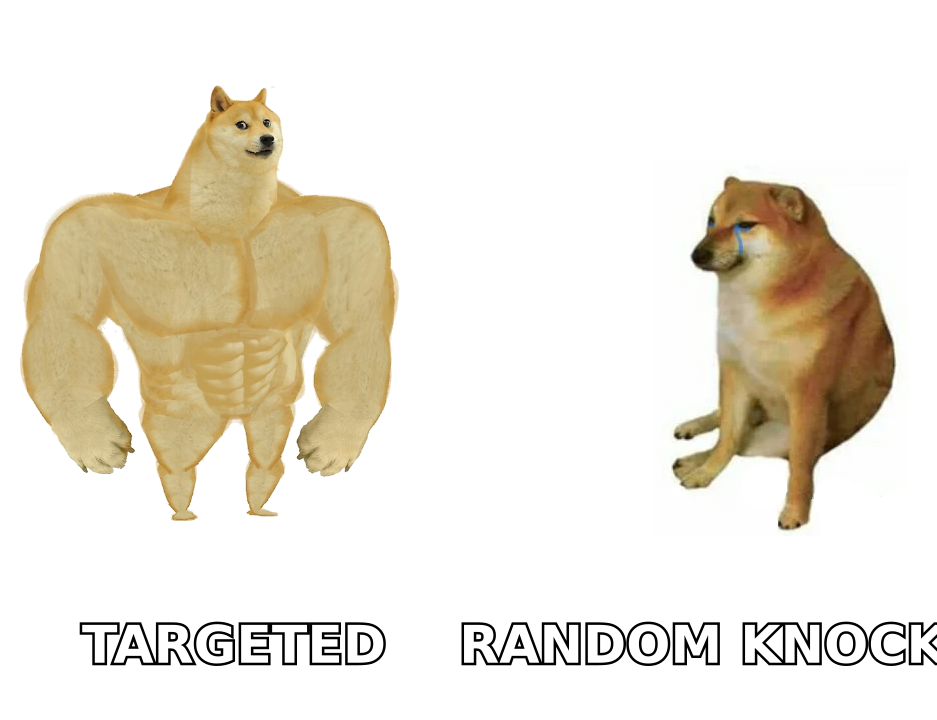
1. Target the territory with data, not a map. Before anyone leaves, build a real list. Pull the companies in your target geography and segment by fit: industry, headcount, revenue signals, and buying triggers. A canvasser walking into 30 random storefronts will beat a canvasser who visited 12 pre-qualified accounts on almost no metric that matters. Use a B2B database to scope the territory and a domain search to pull the right contacts at each company so you know who to ask for at the front desk.
2. Prepare the contact intelligence. Walking in and asking "who handles purchasing?" wastes the visit. Know the decision-maker's name, role, and email before you arrive. Enrich each account so the rep has a named target, a verified email for follow-up, and a phone number for the pre-visit call. This is where data enrichment turns a cold knock into a semi-warm meeting.
3. Execute with a reason to be there. The best canvassing visits aren't truly cold — they're the physical leg of a sequence. Send a short cold email or make a call first, then reference it at the door: "I emailed Tuesday about cutting your fleet fuel spend — I was in the area." That single line reframes the interaction from intrusion to follow-through.
4. Capture and follow up immediately. Log every visit the same day: who you spoke to, their real email, next step. The follow-up email within 24 hours is what converts the in-person moment into a pipeline entry. Verify the address first so your follow-up actually lands — a bounced follow-up erases the whole visit.
What tools does the cold canvassing method need in 2026?#
The field bag changed. A clipboard and business cards used to be the whole kit. Now the highest-performing canvassing teams carry a data layer that turns each visit into a trackable, followable touch. The tooling breaks into four jobs:
- Territory and account data — Know which companies to visit and why. This is your B2B database and firmographic filters that define the route.
- Contact discovery — Find the named decision-maker and their verified contact details before the visit, using an email finder and phone finder.
- Verification — Confirm emails are deliverable so post-visit follow-up doesn't bounce. Run addresses through an email verifier before you send.
- CRM and sequencing — Log visits and trigger multi-channel follow-up. Push data straight into your stack via a HubSpot integration or Pipedrive integration.
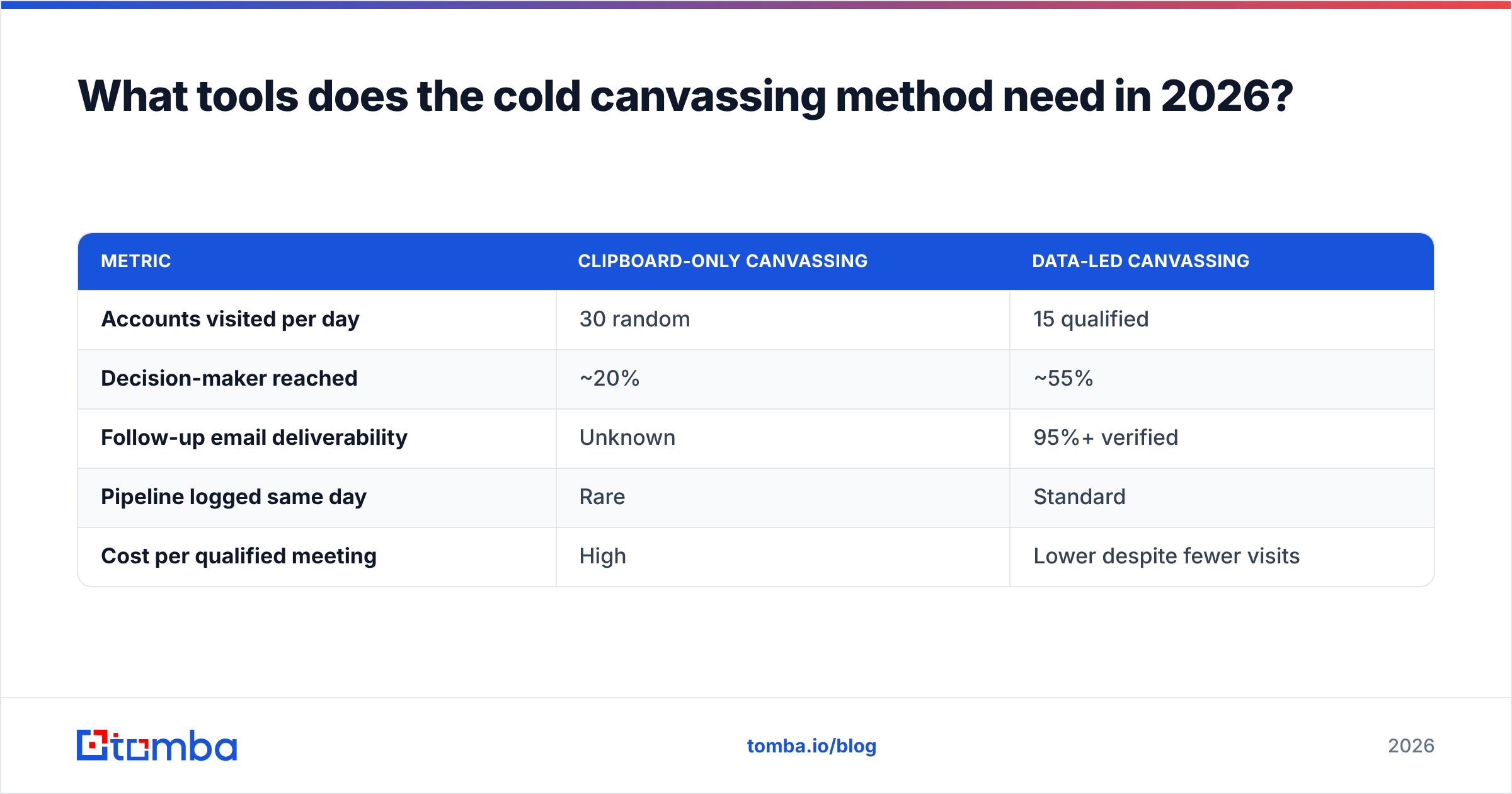
Here's how a data-led canvassing stack compares to the old clipboard method on the metrics a sales manager actually reviews:
| Metric | Clipboard-only canvassing | Data-led canvassing |
|---|---|---|
| Accounts visited per day | 30 random | 15 qualified |
| Decision-maker reached | ~20% | ~55% |
| Follow-up email deliverability | Unknown | 95%+ verified |
| Pipeline logged same day | Rare | Standard |
| Cost per qualified meeting | High | Lower despite fewer visits |
Fewer visits, more meetings. That's the whole argument for putting data in front of the door-knock. The rep spends drive time on accounts that can actually buy instead of burning the tank on tire-kickers.
How does cold canvassing compare to digital-only prospecting?#
Cold canvassing wins on trust and memorability; digital wins on scale and cost. Neither is universally better — they solve different problems, and the strongest 2026 programs run both.
If you sell a $200/month tool to remote startups, canvassing makes no sense; you'd never find the buyers physically, and the economics collapse. Lean fully digital: build lists, verify them, and run cold email plus LinkedIn. If you sell $50k equipment to regional manufacturers, a rep at the plant beats a hundred emails to a shared inbox that no one opens.
Most B2B teams live in the middle, and that's where the hybrid shines. Use digital outreach to cast wide and surface interest, then deploy canvassing on the accounts that engage, go quiet, or sit in a dense territory worth a route. Your email verifier keeps the digital leg clean, and your territory data decides which of those contacts earn an in-person visit.
One caution rooted in the numbers: canvassing does not scale linearly. Adding a rep adds one more body covering one more route. Digital scales with data volume. So treat canvassing as your precision instrument and digital as your volume engine. Vendor comparison sites like G2 list dozens of tools for the digital layer — the point is to feed both layers from one clean data source rather than maintaining two disconnected motions.
What are the biggest mistakes in cold canvassing?#
The failures are predictable, which means they're preventable:
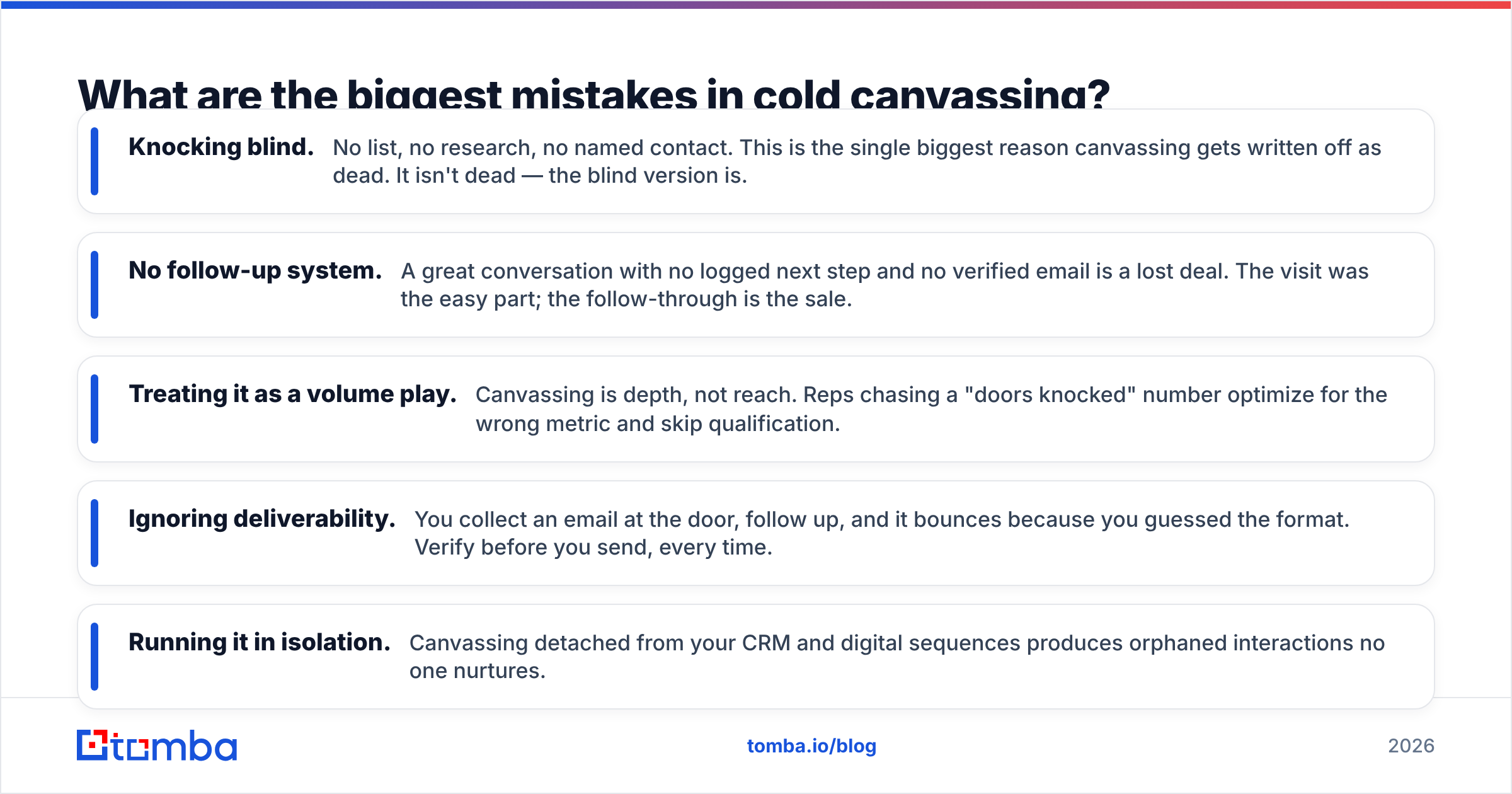
- Knocking blind. No list, no research, no named contact. This is the single biggest reason canvassing gets written off as dead. It isn't dead — the blind version is.
- No follow-up system. A great conversation with no logged next step and no verified email is a lost deal. The visit was the easy part; the follow-through is the sale.
- Treating it as a volume play. Canvassing is depth, not reach. Reps chasing a "doors knocked" number optimize for the wrong metric and skip qualification.
- Ignoring deliverability. You collect an email at the door, follow up, and it bounces because you guessed the format. Verify before you send, every time.
- Running it in isolation. Canvassing detached from your CRM and digital sequences produces orphaned interactions no one nurtures.
Fix the first mistake and the rest get easier, because targeting quality raises everything downstream. That's why data — not hustle — is the modern canvasser's edge. Peers in this space, including reputable data vendors like BookYourData, have built entire businesses on the same premise: outreach is only as good as the list behind it.
How do you measure canvassing success?#
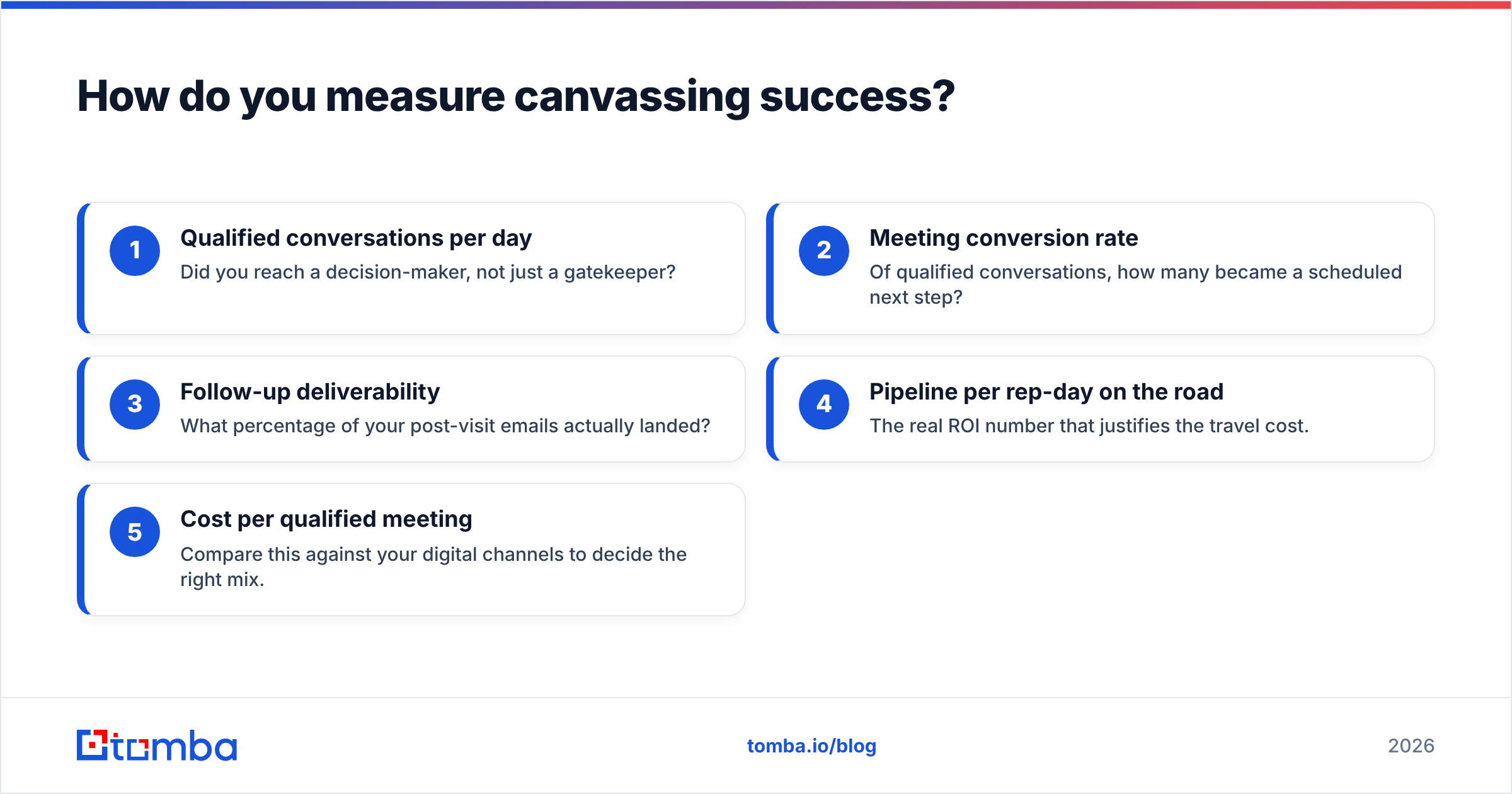
Track meetings booked and pipeline created per rep-day, not doors knocked. Activity metrics feel productive but reward motion over outcome. The metrics that matter:
- Qualified conversations per day — Did you reach a decision-maker, not just a gatekeeper?
- Meeting conversion rate — Of qualified conversations, how many became a scheduled next step?
- Follow-up deliverability — What percentage of your post-visit emails actually landed?
- Pipeline per rep-day on the road — The real ROI number that justifies the travel cost.
- Cost per qualified meeting — Compare this against your digital channels to decide the right mix.
If cost per qualified meeting from canvassing beats your digital channels for a given segment, canvass more there. If it's worse, shrink the routes and shift budget. Let the numbers, not tradition, set the mix each quarter.
The bottom line#
Cold canvassing isn't a relic and it isn't a silver bullet — it's a precision channel that rewards preparation and punishes guesswork. In 2026 the winning version looks nothing like the clipboard era: it starts with a targeted list, arms every rep with a named decision-maker and a verified email, and treats each in-person visit as the sharpest touch in a multi-channel sequence.
The one thing that separates a canvassing program that prints pipeline from one that burns gas money is the data behind the door. Before your reps hit the street, build the list right: use the Tomba Email Finder to pull verified decision-maker contacts for every account in your territory, so every knock is aimed and every follow-up lands. Check Tomba pricing to start on the free tier and scale as your territory grows.
Related guides#
Ready to find emails that actually work?
Join 150,000+ professionals who stopped guessing and started sending. Free credits on signup — no credit card required.
Get the Tomba newsletter
Practical outbound tactics and product updates — once every two weeks.
About the author