Cold Outbound in 2026: The Complete Playbook for Real Replies
Cold outbound still works in 2026 — but only if your data is clean, your targeting is tight, and your channels are sequenced. Here's the full playbook.
Cold outbound is not dead — but the version that worked in 2019 absolutely is. Blasting 5,000 unverified addresses with a "quick question" subject line now gets you filtered before a human ever sees it. In 2026, cold outbound is a precision discipline: clean data, tight targeting, and coordinated channels. Do it right and it's still the most predictable pipeline source you own. Do it wrong and you burn your domain, your list, and your reputation in a week.
This guide breaks down exactly what still works, what silently kills your reply rate, and the multichannel sequence to run.
TL;DR#
- Cold outbound in 2026 = data quality × targeting × sequencing. Weakness in any one factor collapses the whole thing.
- Deliverability is the new gatekeeper. Google and Microsoft now enforce authentication and spam-rate thresholds; a dirty list gets you throttled fast.
- Multichannel beats email-only. Email + LinkedIn + phone lifts reply rates over any single channel run alone.
- Personalization at the segment level scales; per-line "I saw your post" does not. Relevance beats effort.
- Verify before you send. Bounce rate above 3% is the single fastest way to torch your sender reputation.
What is cold outbound in 2026?#
Cold outbound is proactively contacting prospects who have not raised their hand — no demo request, no download, no prior relationship. Think of it like knocking on doors in a neighborhood you researched, versus waiting for someone to ring your bell (inbound). The difference in 2026 is that the doors now have smart locks: mailbox providers, spam filters, and buyers who have seen the same three templates a hundred times.
The mechanics changed because the gatekeepers changed. Since Google and Yahoo tightened bulk-sender requirements, unauthenticated mail and high complaint rates get you throttled or junked automatically. Meanwhile buyers are drowning — the average B2B decision-maker gets dozens of cold messages a week. Your job is not to send more. It's to be the one message that is obviously relevant and obviously easy to reply to.
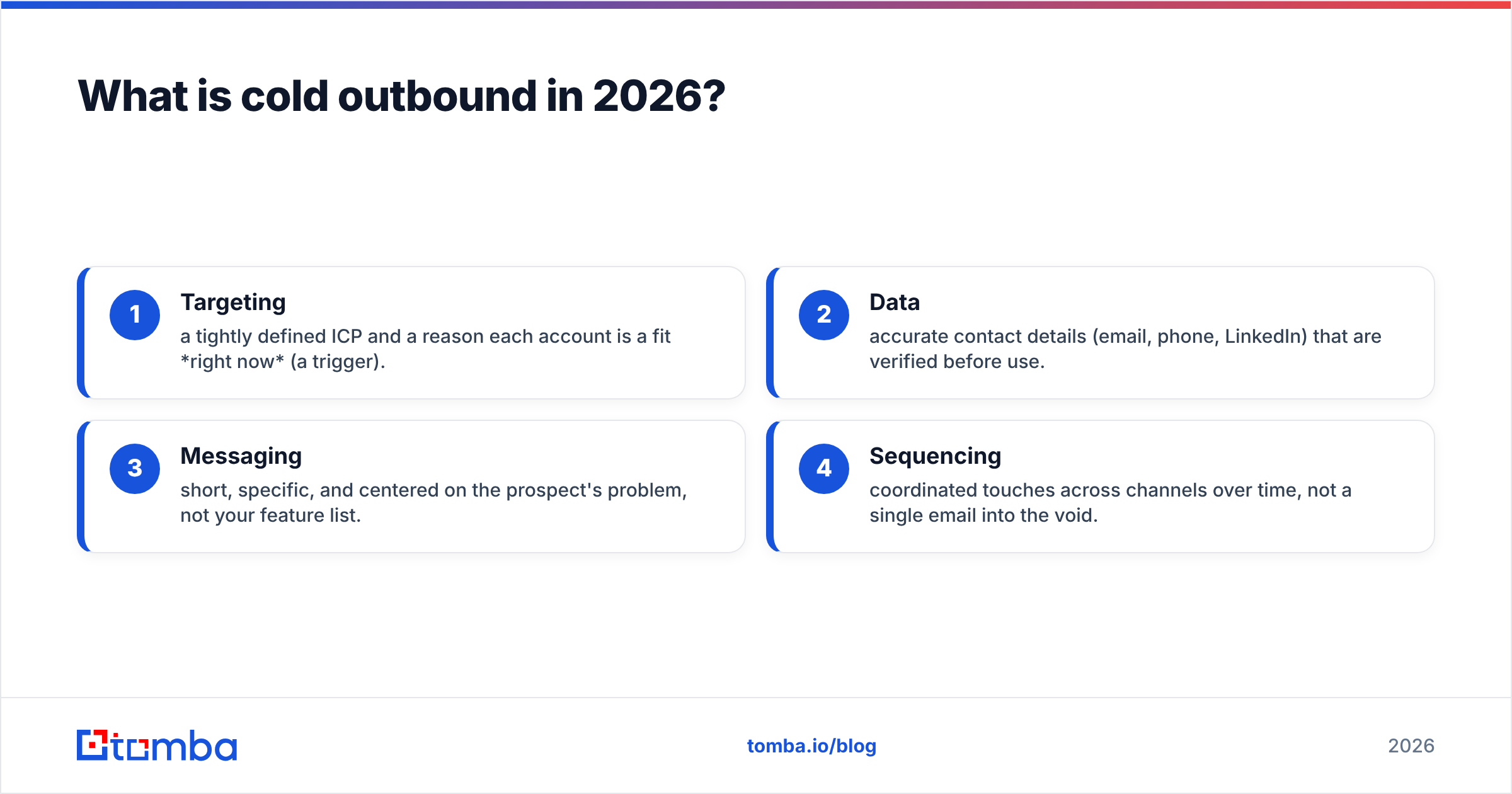
Cold outbound today rests on four pillars:
- Targeting — a tightly defined ICP and a reason each account is a fit right now (a trigger).
- Data — accurate contact details (email, phone, LinkedIn) that are verified before use.
- Messaging — short, specific, and centered on the prospect's problem, not your feature list.
- Sequencing — coordinated touches across channels over time, not a single email into the void.
Why do most cold outbound campaigns fail?#
Most campaigns fail before the first email sends, because the list is bad. If 15% of your addresses bounce, mailbox providers read that as a spammer signature and start routing even your valid mail to junk. Everything downstream — the clever subject line, the tight copy — is wasted effort sitting in a folder nobody opens.
The second most common killer is targeting that's too broad. "Everyone with 'VP' in their title at a company over 50 people" is not an ICP; it's a phone book. Broad lists force generic copy, and generic copy gets ignored. Narrow your segment until you can write one email that genuinely lands for every person on the list.
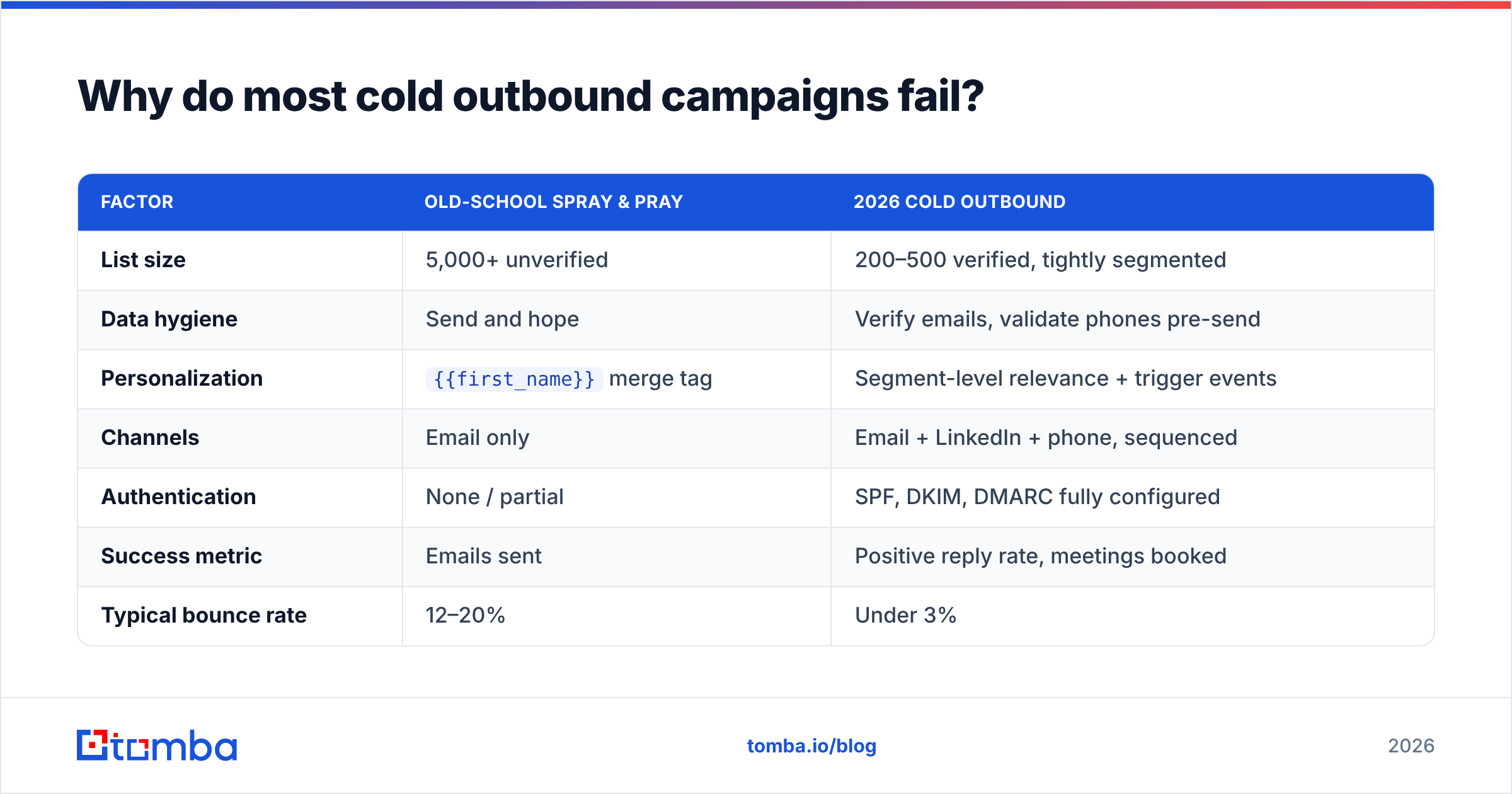
Here's how the two eras compare:
| Factor | Old-school spray & pray | 2026 cold outbound |
|---|---|---|
| List size | 5,000+ unverified | 200–500 verified, tightly segmented |
| Data hygiene | Send and hope | Verify emails, validate phones pre-send |
| Personalization | {{first_name}} merge tag |
Segment-level relevance + trigger events |
| Channels | Email only | Email + LinkedIn + phone, sequenced |
| Authentication | None / partial | SPF, DKIM, DMARC fully configured |
| Success metric | Emails sent | Positive reply rate, meetings booked |
| Typical bounce rate | 12–20% | Under 3% |
The pattern is clear: fewer, better-targeted, well-authenticated touches beat volume every time. If you're still optimizing for "emails sent," you're measuring the wrong era.
What makes cold outbound data accurate?#
Accuracy comes from verification, not collection. Anyone can scrape a list; the question is whether those addresses still route to a real inbox. People change jobs constantly, companies migrate domains, and role-based catch-all addresses swallow mail without bouncing — so a raw scrape decays the moment you export it.
A defensible data process looks like this:
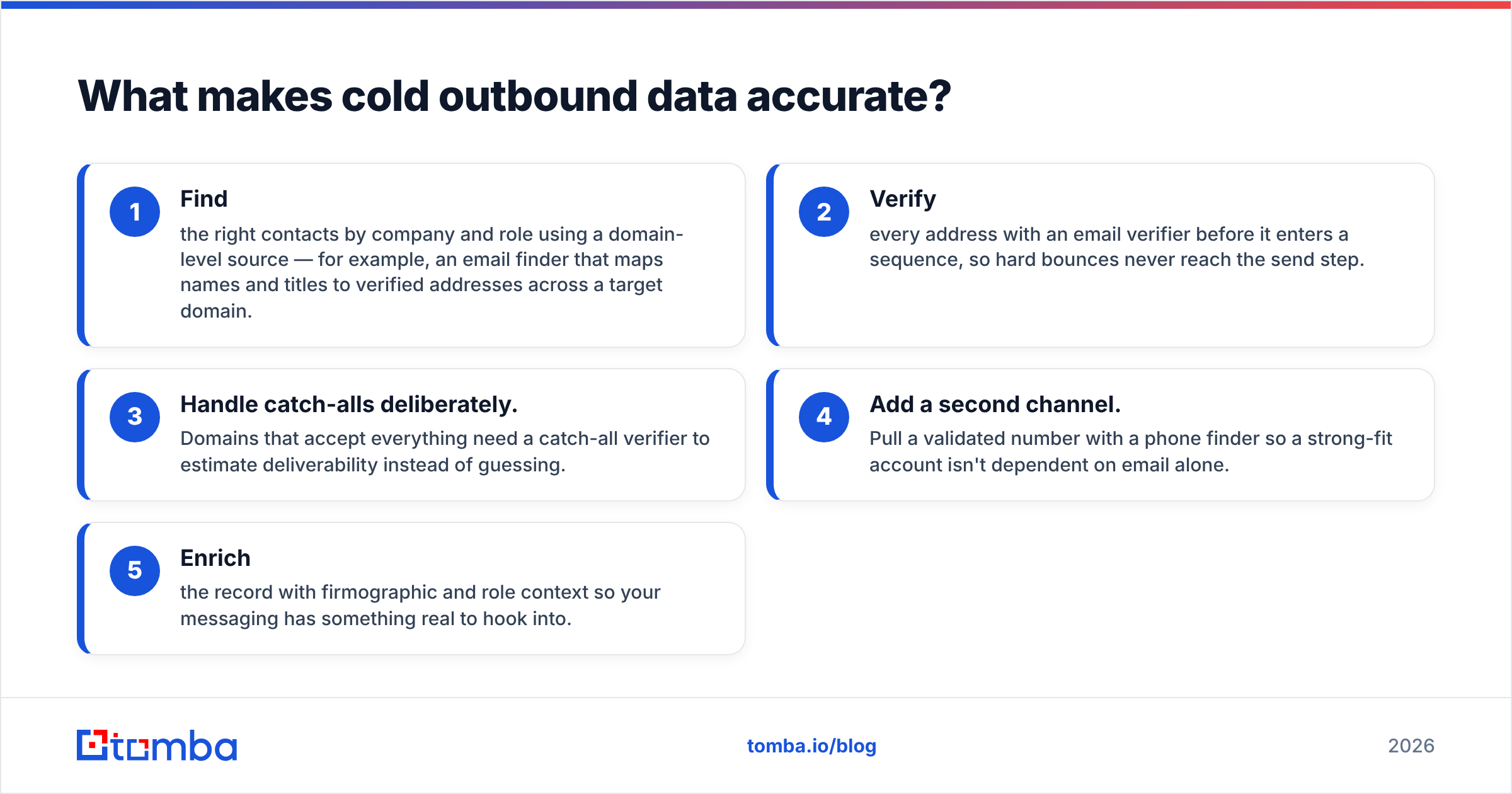
- Find the right contacts by company and role using a domain-level source — for example, an email finder that maps names and titles to verified addresses across a target domain.
- Verify every address with an email verifier before it enters a sequence, so hard bounces never reach the send step.
- Handle catch-alls deliberately. Domains that accept everything need a catch-all verifier to estimate deliverability instead of guessing.
- Add a second channel. Pull a validated number with a phone finder so a strong-fit account isn't dependent on email alone.
- Enrich the record with firmographic and role context so your messaging has something real to hook into.
The goal is a bounce rate under 3% and enough context per contact to write a relevant first line. Independent review sites like G2 are a good sanity check on any data vendor's accuracy claims before you commit budget — treat self-reported numbers skeptically.
Which channels should a cold outbound sequence use?#
Use all three that your buyer actually uses: email, LinkedIn, and phone. Relying on email alone in 2026 means competing in the most crowded, most filtered channel there is. Layering channels multiplies the odds a prospect sees you and gives each touch a different context — an email references your LinkedIn view, a call references your email.
A proven multichannel cadence over roughly two weeks:
- Day 1 — Email. Short, specific, one clear ask. Reference the trigger that made this account relevant.
- Day 2 — LinkedIn. View the profile and send a low-pressure connection request (no pitch). This warms the name before your next email.
- Day 4 — Email. A one-line bump adding a single new piece of value — a relevant stat, a customer result, a resource.
- Day 6 — Phone. Call. Even a voicemail referencing your email lifts email reply rates on later touches. Strong LinkedIn outreach plus a call is the highest-response combination for most B2B segments.
- Day 9 — Email. A different angle: a new use case or a question about their current process.
- Day 13 — Break-up email. Brief, no guilt, easy to reply "not now." These consistently pull replies from people who meant to respond and forgot.
Keep every touch short, keep the ask singular, and make sure the channels reference each other so the sequence feels like one coordinated person — not five disconnected bots. Sales-methodology resources from vendors like HubSpot and Salesforce reinforce the same principle: cadence and relevance beat raw volume.
How do you write cold outbound copy that gets replies?#
Lead with their problem, not your product. The fastest way to lose a cold reader is to open with who you are and what you sell. Open instead with a specific, relevant observation about their world, then connect it to an outcome they care about. The whole email should be readable in under ten seconds on a phone.
A reliable structure:
- Opening line (relevance): a trigger or segment-specific observation. "Noticed you're hiring three SDRs this quarter" beats "Hope you're doing well."
- Problem/value (one sentence): the specific pain your segment feels and the outcome you drive.
- Proof (optional, one line): a concrete result — "cut ramp time 40% for two similar teams."
- Ask (singular, low-friction): "Worth a 15-minute look next week?" Not "let me know your availability, happy to walk through our full platform, here's a calendar link and a deck."
Things that quietly kill reply rates: multiple asks, long paragraphs, links in the first email (they can trigger filters and read as salesy), and fake personalization that's obviously templated. If you can't write one genuinely relevant email for the whole segment, your segment is too broad — go back and tighten it.
What tools do you need for cold outbound?#
You need four capabilities: data, verification, sending infrastructure, and CRM tracking. You don't need fifteen tools — you need one reliable source for each layer and clean handoffs between them. Overbuying tools is a common way teams spend more and send worse.
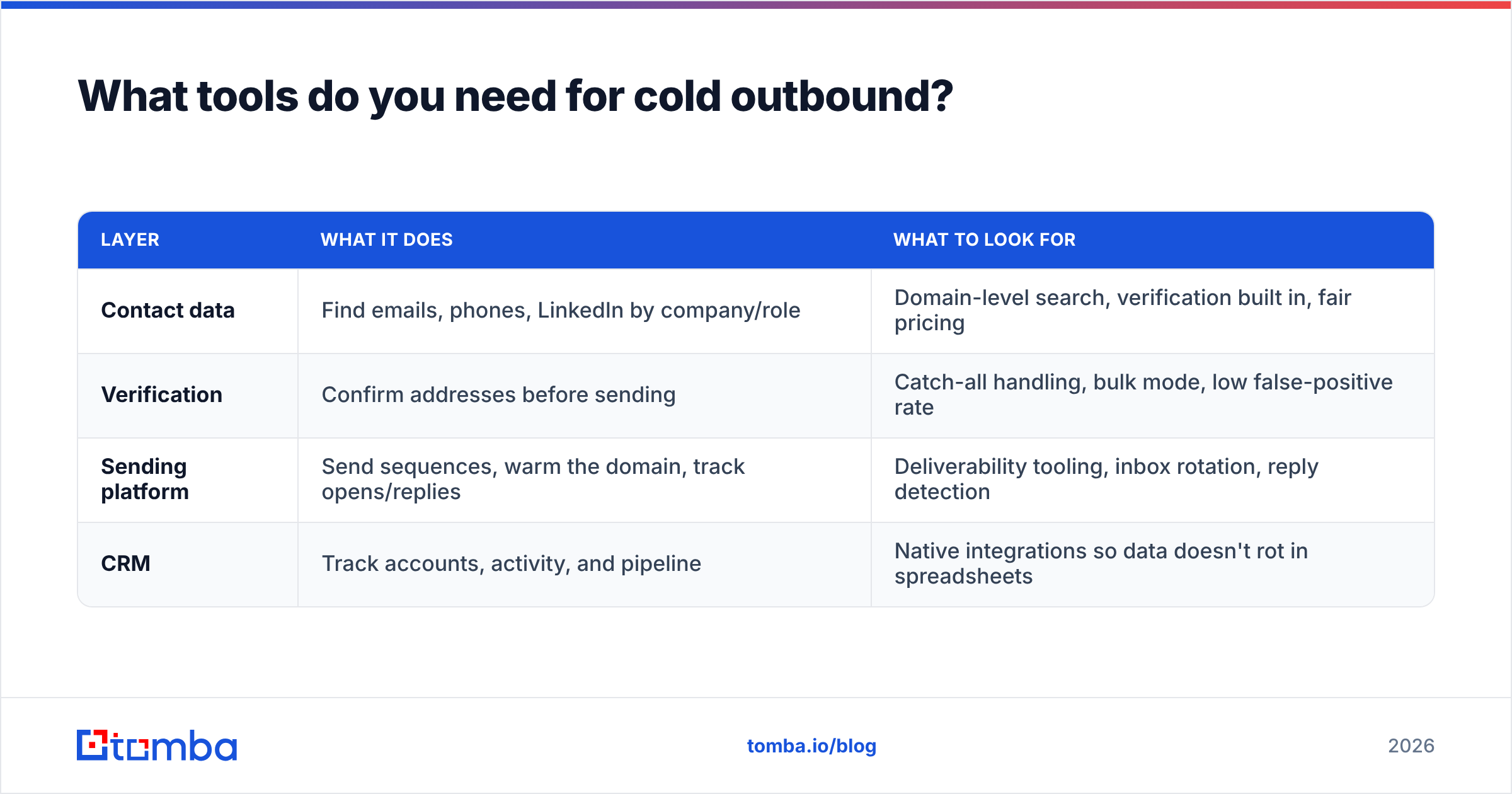
| Layer | What it does | What to look for |
|---|---|---|
| Contact data | Find emails, phones, LinkedIn by company/role | Domain-level search, verification built in, fair pricing |
| Verification | Confirm addresses before sending | Catch-all handling, bulk mode, low false-positive rate |
| Sending platform | Send sequences, warm the domain, track opens/replies | Deliverability tooling, inbox rotation, reply detection |
| CRM | Track accounts, activity, and pipeline | Native integrations so data doesn't rot in spreadsheets |
For the data and verification layers, tools that combine both in one workflow save real time and reduce list decay between steps. Tomba covers find, verify, catch-all, phone, and enrichment in a single stack, with a free tier of 25 searches per month and paid plans starting at $49/mo — see full Tomba pricing for the tier that matches your send volume. Whatever you choose, make sure it plugs into your CRM so verified contacts flow straight into your sequences instead of dying in a CSV.
How do you protect deliverability while running cold outbound?#
Authenticate your domain, warm it up, and keep bounce and complaint rates low. In 2026 deliverability is not a "nice to have" — it's the gate. Even perfect copy gets junked if the mailbox provider doesn't trust your sender identity. Treat your domain reputation like a credit score: slow to build, fast to wreck.
The non-negotiables:
- Set up SPF, DKIM, and DMARC. These are the authentication records mailbox providers now require from bulk senders. Missing them is an automatic strike.
- Warm the sending domain before volume — ramp gradually over weeks so your send pattern looks human, not like a switch flipped from 0 to 500.
- Use a separate sending domain (not your primary company domain) so an outbound misstep never damages your transactional and internal mail.
- Verify every list pre-send to hold bounce rate under 3%. This is the single highest-leverage deliverability action you control.
- Monitor complaints and replies. Rising spam complaints or falling reply rates are early warnings — pause and diagnose before providers start throttling you.
Deliverability and data quality are the same fight from two angles: a clean, verified list keeps bounces down, which keeps your reputation intact, which keeps your good emails landing. Skip verification and every other optimization is built on sand.
Is cold outbound still worth it in 2026?#
Yes — when it's done as a precision system rather than a volume game. The teams complaining that "outbound is dead" are almost always running the 2019 playbook: big unverified lists, email-only, generic copy, no authentication. The teams booking consistent meetings are running tight segments, verified multichannel data, coordinated sequences, and disciplined deliverability. Same channel, opposite results.
Cold outbound remains the most controllable pipeline source you have. You decide who to target, when, and with what message — you're not waiting on ad algorithms or SEO cycles. That control is exactly why it still works, and why the fundamentals in this guide matter more than any single tactic or template.
Start with the layer that makes everything else work: your data. Find and verify the right contacts before you write a single line of copy. Tomba's Email Finder maps verified professional emails by domain, name, or company — and with a free tier plus data enrichment and phone lookup in the same stack, you can build a clean, multichannel list that actually lands in the inbox. Get the data right first, and the rest of the playbook finally has something solid to stand on.
Related guides#
Ready to find emails that actually work?
Join 150,000+ professionals who stopped guessing and started sending. Free credits on signup — no credit card required.
Get the Tomba newsletter
Practical outbound tactics and product updates — once every two weeks.
About the author