7 Best Collectivei Alternatives in 2026 for Revenue Teams
Collective[i] promises AI forecasting and network intelligence, but it's not the only option. Here are 7 Collectivei alternatives compared on price, data quality, and real-world fit.
Collective[i] sits in an unusual corner of the sales stack: part AI forecasting engine, part network-based intelligence layer, part automated CRM hygiene tool. It's a compelling pitch for large revenue teams — but it's also opaque on pricing, heavy to implement, and overkill for plenty of the teams that end up evaluating it. If you're here, you've probably already sensed that.
This guide compares seven credible Collectivei alternatives, what each one is genuinely good at, and where the money actually goes. No vendor is perfect, and this isn't Collective[i]'s own comparison page — so expect trade-offs, not a coronation.
TL;DR: The Short Version#
- Collective[i] is strong on autonomous forecasting and its business graph, but implementation is enterprise-grade and pricing is quote-only — a poor fit for lean or mid-market teams.
- Clari and Gong are the two heavyweight alternatives: Clari owns the forecasting/RevOps workflow, Gong owns conversation intelligence.
- Aviso and BoostUp are the closest "AI forecasting" swaps at a lower entry point than the enterprise incumbents.
- People.ai and Salesforce Einstein win when you're already deep in Salesforce and want native activity capture and scoring.
- Every one of these tools is only as accurate as the pipeline data feeding it. Fixing contact and account data with a tool like Tomba's data enrichment often lifts forecast quality more than swapping the forecasting engine.
What Is Collective[i] and Why Look for Alternatives?#
Collective[i] is an AI-driven revenue platform built around three ideas: automatically capturing sales activity, cleaning and enriching CRM records, and generating forecasts from a large "business graph" of buyer and seller interactions. The theory is that a network trained across many companies predicts deals better than any single company's history.
That's a real advantage in the right hands. But teams shop for Collectivei alternatives for a few recurring reasons:
- Opaque pricing. There's no public price. Everything is a custom enterprise quote, which makes budgeting and quick pilots hard.
- Implementation weight. Network intelligence and autonomous forecasting need clean data, integrations, and change management. Small teams stall.
- Data-network trade-offs. Some organizations are uncomfortable with the shared-network model for competitive or compliance reasons.
- Feature overlap. If you mostly want conversation intelligence or straightforward pipeline inspection, you're paying for capabilities you won't use.
If any of those hit home, the tools below cover the same jobs with different center of gravity.
![Diagram: What Is Collective[i] and Why Look for Alternatives](https://blog-cdn.tomba.io/content/images/2026/07/canva/collectivei-alternatives/collectivei-alternatives-what-is-collective-i-and-why-look-for-alternatives.png)
How Should You Evaluate a Collectivei Alternative?#
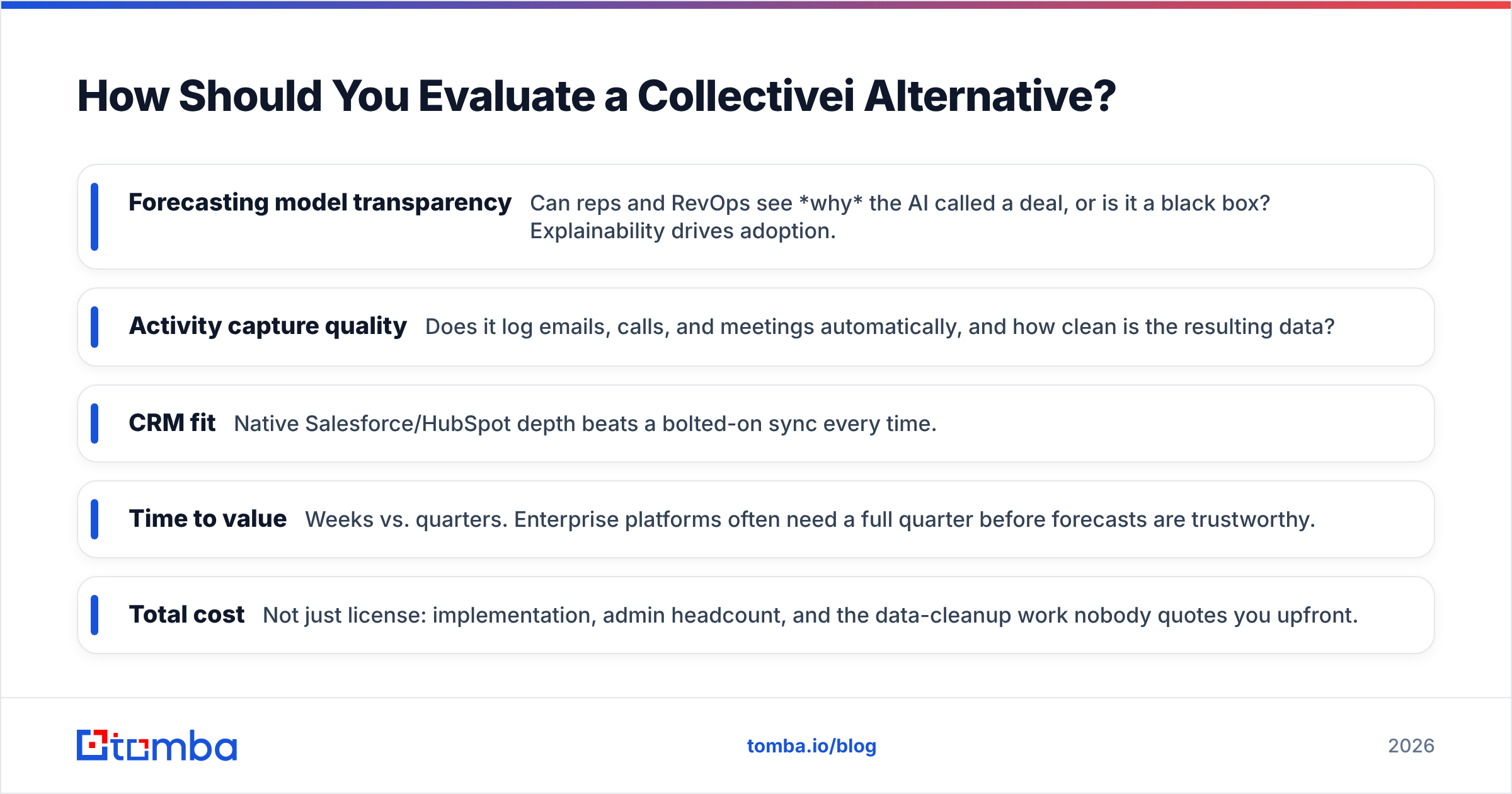
Before the list, anchor on the criteria that actually predict whether a tool sticks. Use these five as a scorecard:
- Forecasting model transparency — Can reps and RevOps see why the AI called a deal, or is it a black box? Explainability drives adoption.
- Activity capture quality — Does it log emails, calls, and meetings automatically, and how clean is the resulting data?
- CRM fit — Native Salesforce/HubSpot depth beats a bolted-on sync every time.
- Time to value — Weeks vs. quarters. Enterprise platforms often need a full quarter before forecasts are trustworthy.
- Total cost — Not just license: implementation, admin headcount, and the data-cleanup work nobody quotes you upfront.
Keep that last point in mind. A forecasting engine trained on stale contacts and duplicate accounts produces confident, wrong numbers. That's why data quality — the unglamorous layer under all of this — matters as much as the model.
The 7 Best Collectivei Alternatives in 2026#
1. Clari — Best for RevOps-Led Forecasting#
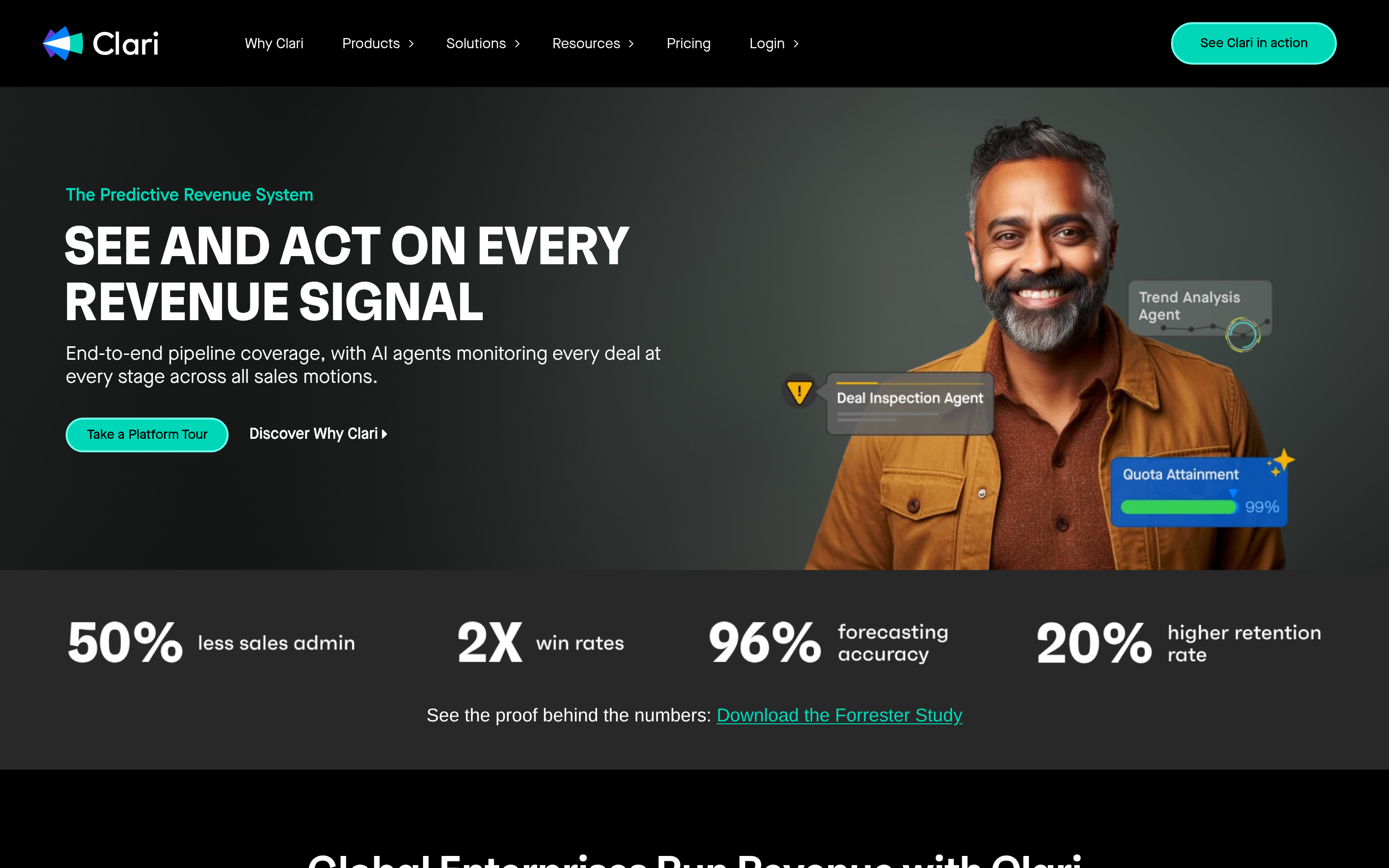
Clari is the default answer when a Collective[i] evaluation is really a forecasting-and-pipeline evaluation. It pulls activity into a structured forecasting workflow, gives RevOps a defensible number to run the business on, and surfaces pipeline risk early. Where Collective[i] leans on its network graph, Clari leans on rigorous, role-based forecast roll-ups your team can actually inspect and defend in a board meeting.
Trade-off: it's priced and scoped for the enterprise, so expect a real implementation and a quote-based contract of its own.
2. Gong — Best for Conversation Intelligence#
Gong records, transcribes, and analyzes sales conversations, then layers deal and forecast intelligence on top. If the gap you feel with your current stack is "we don't know what's actually being said in deals," Gong is the stronger pick. Its forecasting has matured, but conversation intelligence remains the core reason teams buy it.
Trade-off: call recording is powerful but culturally heavy — rep buy-in and regional consent rules need managing.
3. Aviso — Best AI Forecasting at a Lower Entry Point#
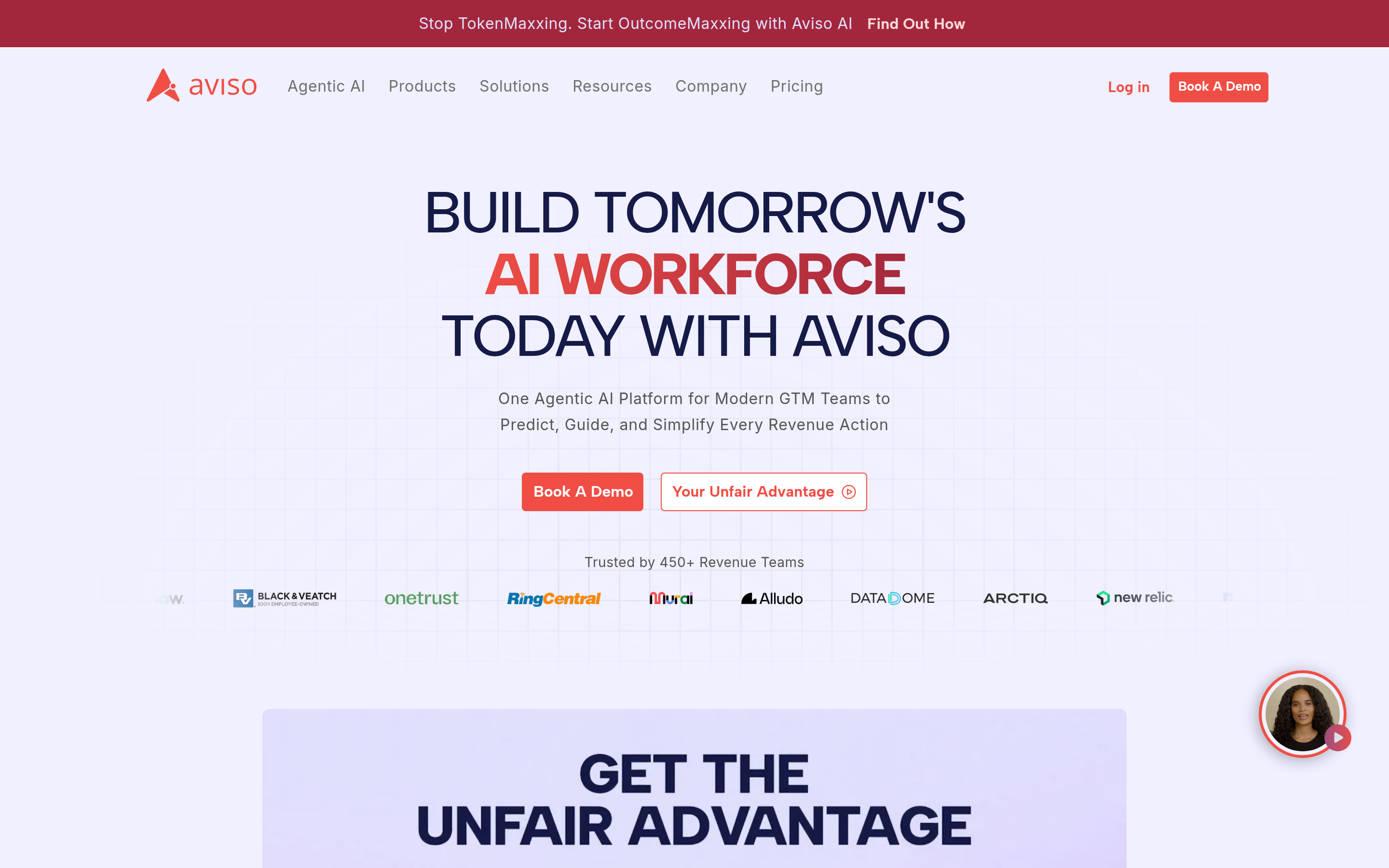
Aviso is arguably the closest philosophical match to Collective[i]: AI-first forecasting with predictive deal scoring and a conversational assistant. Teams that want the "let the model call the number" experience without the largest-vendor price tag often shortlist Aviso against Collective[i] directly.
Trade-off: smaller ecosystem and fewer third-party integrations than Clari or Salesforce-native options.
4. BoostUp — Best for Mid-Market Revenue Intelligence#
BoostUp bundles forecasting, deal inspection, and conversation intelligence into one platform aimed squarely at mid-market revenue teams. It's frequently the "we want most of what the enterprise tools do, sooner" choice, with faster time to value than the heaviest incumbents.
Trade-off: less brand gravity than Clari/Gong, so do your own reference checks.
5. People.ai — Best for Salesforce Activity Capture#
People.ai specializes in automatically capturing activity and mapping it to contacts and accounts, then feeding that into scoring and forecasting. If your pain is "our CRM is a graveyard of half-logged activity," People.ai attacks that root cause well.
Trade-off: it shines inside a Salesforce-centric org; value drops if your CRM footprint is fragmented.
6. Salesforce Einstein — Best Native Option#
If you already live in Salesforce, Einstein's forecasting and opportunity scoring may cover enough of Collective[i]'s job without adding a vendor. Native data access, no extra sync layer, and one bill are real advantages.
Trade-off: Einstein is capable but rarely best-in-class at any single job; power users often still add a specialist tool.
7. Revenue.io — Best for Real-Time Rep Guidance#
Revenue.io blends conversation intelligence, dialer, and real-time guidance for reps. It's less about the RevOps forecast and more about improving the live selling motion, which makes it a complement-or-alternative depending on where your gap sits.
Trade-off: guidance and dialer strengths mean forecasting depth is secondary versus Clari or Aviso.
Collectivei Alternatives Compared: Pricing and Fit#
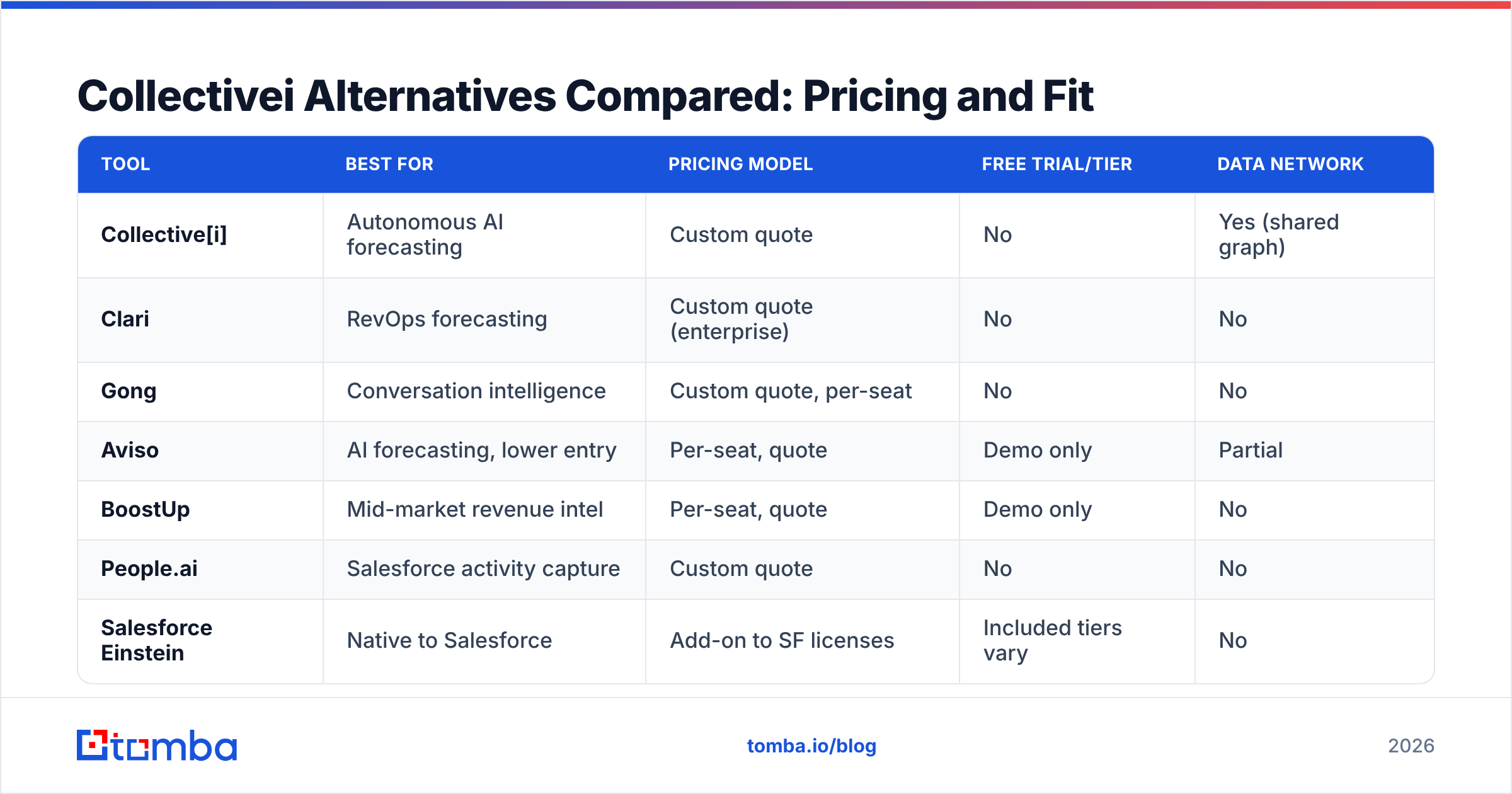
Pricing across this category is mostly quote-based, which is exactly why buyers get frustrated. Here's an honest, normalized view. "Entry" reflects the smallest realistic annual commitment reported by users on review sites — treat all enterprise figures as directional, not gospel.
| Tool | Best for | Pricing model | Free trial/tier | Data network |
|---|---|---|---|---|
| Collective[i] | Autonomous AI forecasting | Custom quote | No | Yes (shared graph) |
| Clari | RevOps forecasting | Custom quote (enterprise) | No | No |
| Gong | Conversation intelligence | Custom quote, per-seat | No | No |
| Aviso | AI forecasting, lower entry | Per-seat, quote | Demo only | Partial |
| BoostUp | Mid-market revenue intel | Per-seat, quote | Demo only | No |
| People.ai | Salesforce activity capture | Custom quote | No | No |
| Salesforce Einstein | Native to Salesforce | Add-on to SF licenses | Included tiers vary | No |
A pattern jumps out: almost nobody publishes real prices, and free tiers are rare-to-nonexistent. That's the norm for enterprise revenue intelligence. If transparent, self-serve pricing matters to you, weigh that heavily — it usually signals how the whole buying (and renewal) relationship will feel.
For a sanity check on how each vendor is actually rated by buyers, cross-reference G2's revenue intelligence category before you shortlist. Marketing pages and peer reviews rarely tell the same story.

What Do These Tools All Depend On? Clean Pipeline Data#
Here's the uncomfortable truth every forecasting vendor soft-pedals: the model is downstream of your data. A best-in-class AI forecast built on duplicate accounts, missing contacts, and dead email addresses will be precise and wrong — which is the most dangerous combination in a QBR.
Think of it like a GPS. A brilliant routing algorithm still sends you into a lake if the underlying map is out of date. Revenue intelligence is the same: the algorithm is only as good as the map of contacts, accounts, and activity beneath it.
That's the layer buyers consistently underestimate. Before (or alongside) any Collectivei alternative, teams get outsized returns from tightening the data foundation:
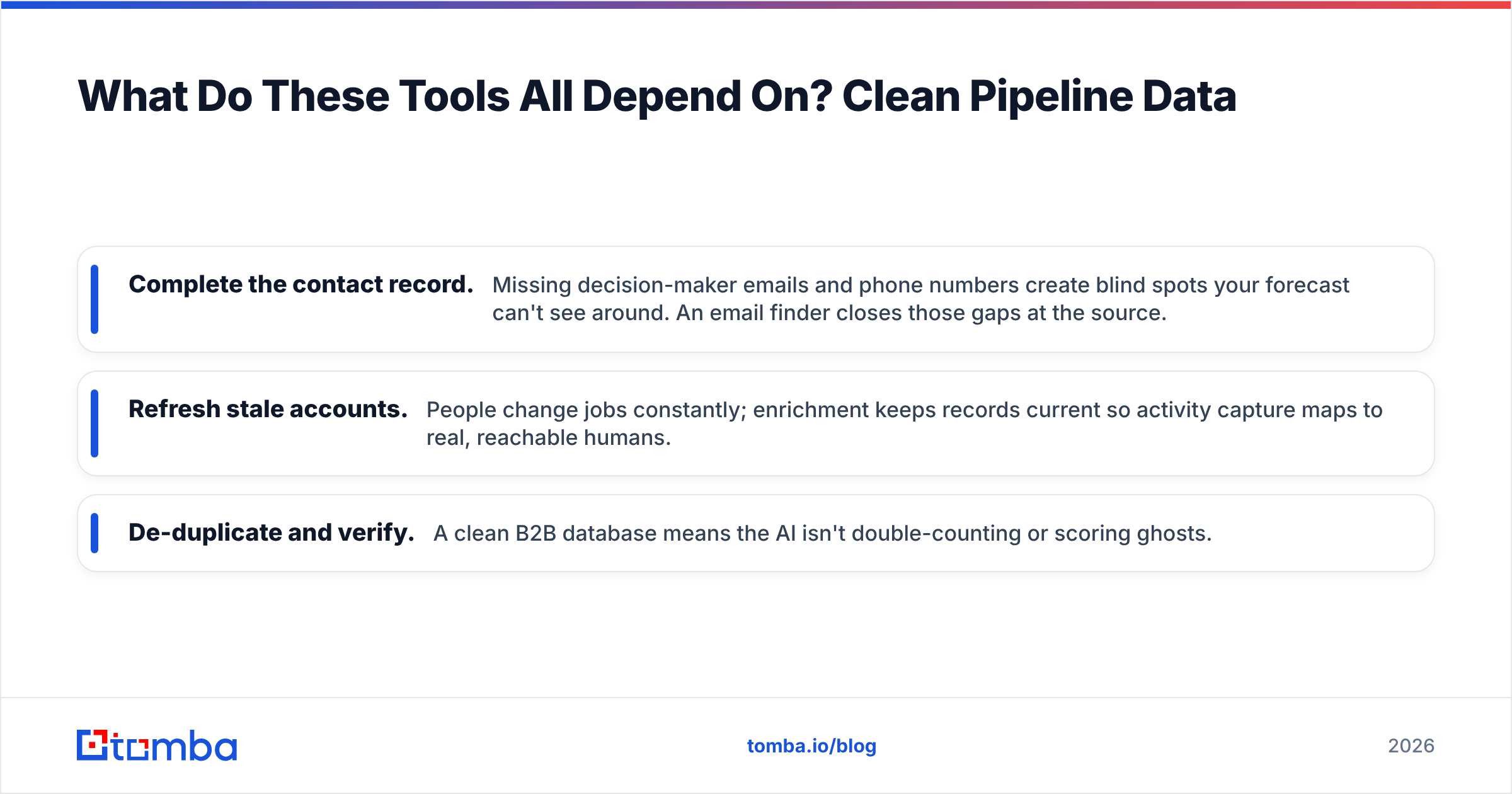
- Complete the contact record. Missing decision-maker emails and phone numbers create blind spots your forecast can't see around. An email finder closes those gaps at the source.
- Refresh stale accounts. People change jobs constantly; enrichment keeps records current so activity capture maps to real, reachable humans.
- De-duplicate and verify. A clean B2B database means the AI isn't double-counting or scoring ghosts.
None of this replaces a forecasting platform. It makes whichever platform you choose meaningfully more accurate — often for a fraction of the cost of the platform itself.
Which Collectivei Alternative Is Right for You?#
Match the tool to your actual gap, not the flashiest demo:
- You need a defensible forecast for the board → Clari.
- You don't know what's happening inside live deals → Gong.
- You want Collective[i]-style AI forecasting for less → Aviso or BoostUp.
- Your CRM activity data is a mess → People.ai.
- You're all-in on Salesforce and hate adding vendors → Einstein.
- You want to coach reps in real time → Revenue.io.
- Your forecast is wrong because your data is wrong → fix the data layer first, then pick from the list above.
Most teams that think they need a network-intelligence platform actually need two smaller things: a forecasting tool that RevOps trusts, and dramatically cleaner input data. Solve those and the "should we buy Collective[i]?" question often answers itself.
The Bottom Line#
Collective[i] is a serious platform, but "serious" and "right for you" aren't the same thing. If you want transparency, faster time to value, or a lower entry point, Clari, Gong, Aviso, BoostUp, People.ai, Einstein, and Revenue.io each cover a specific slice of what it does — usually better in one dimension and worse in another. Shortlist by your gap, not by feature-count.
And whichever engine you choose, feed it clean data. Start by filling the contact gaps your forecast can't see: use the Tomba Email Finder to find and verify the decision-maker emails behind every account in your pipeline, then check Tomba pricing — it starts free with 25 searches a month and scales to $49/mo, a rounding error next to any enterprise forecasting contract. Better data in, better forecasts out.
Related guides#
Ready to find emails that actually work?
Join 150,000+ professionals who stopped guessing and started sending. Free credits on signup — no credit card required.
Get the Tomba newsletter
Practical outbound tactics and product updates — once every two weeks.
About the author