Commercial Real Estate Prospecting Software: The 2026 Buyer's Guide
Most commercial real estate prospecting software sells you dashboards, not deals. Here's how to judge the tools by data accuracy, coverage, and real cost — and where a lean stack beats a bloated platform.
Commercial real estate moves on relationships, but relationships start with a correct phone number and a working email. That is the unglamorous truth behind every "AI-powered" pitch you will read this year. Before you sign an annual contract, it helps to know what commercial real estate prospecting software actually does well, where it quietly fails, and how to avoid paying enterprise money for a bounce-heavy contact list.
TL;DR#
- Commercial real estate prospecting software helps you find property owners, decision-makers, and their verified contact details, then organize outreach — but the value lives in data accuracy, not the dashboard.
- The big CRE platforms (CoStar, Reonomy, Crexi) are strong on property and ownership data and weak, or expensive, on verified direct contact info.
- A leaner stack — a property/ownership source plus a dedicated email finder and verifier — often books more meetings per dollar than a single all-in-one suite.
- Judge every tool on four things: coverage of your market, contact accuracy, integration with your CRM, and true cost per usable contact.
- Free trials lie. Test with 50 real prospects in your farm area before committing to any annual plan.
What is commercial real estate prospecting software?#
Commercial real estate prospecting software is any tool that helps brokers, investors, and lenders identify target properties and owners, then reach the right decision-maker. Think of it like a metal detector on a beach: the platform sweeps a huge amount of public and licensed data and beeps when it finds something worth digging for. The dig — the call, the email, the follow-up — is still your job.
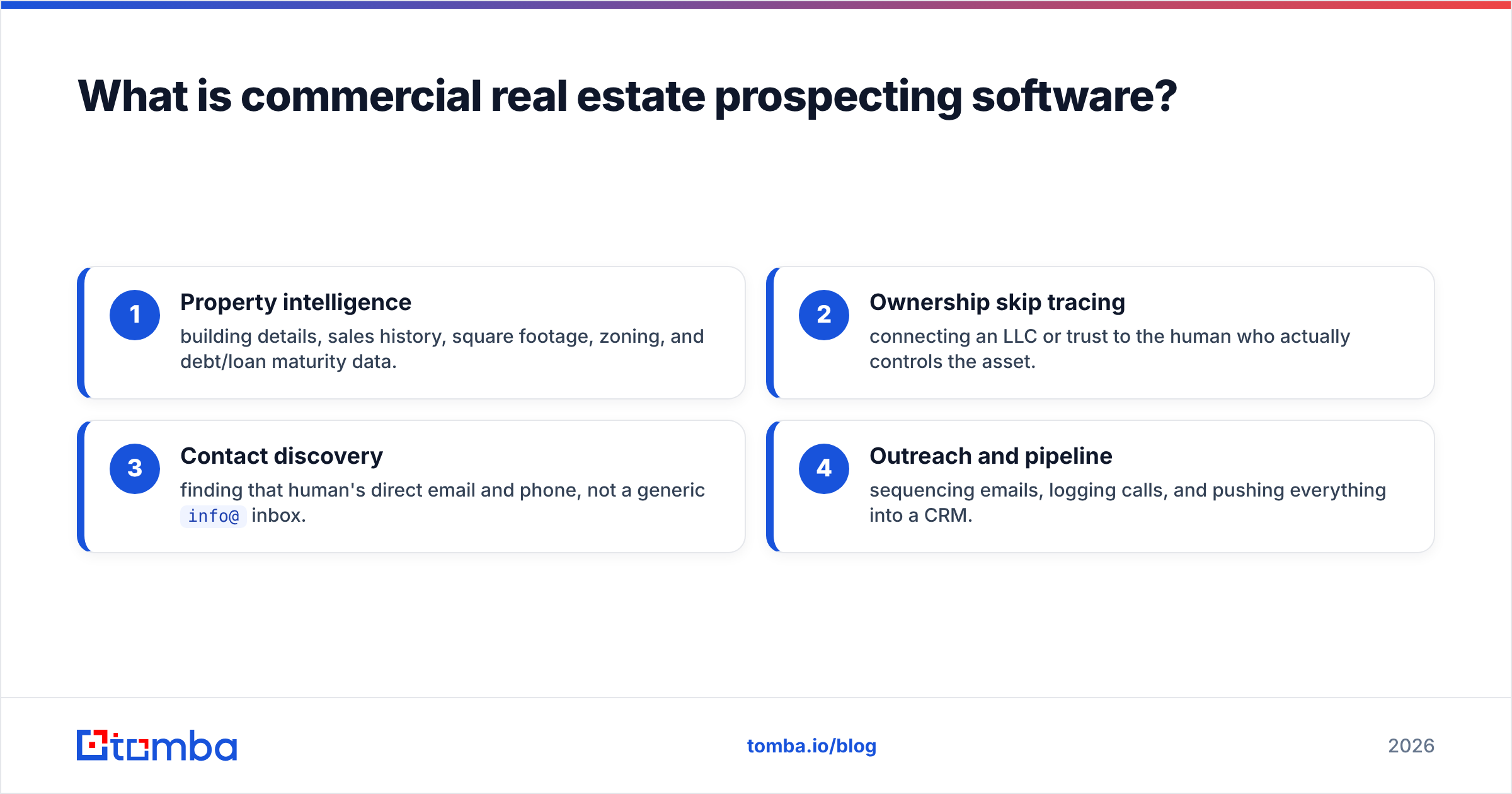
In practice, these tools cluster into four jobs:
- Property intelligence — building details, sales history, square footage, zoning, and debt/loan maturity data.
- Ownership skip tracing — connecting an LLC or trust to the human who actually controls the asset.
- Contact discovery — finding that human's direct email and phone, not a generic
info@inbox. - Outreach and pipeline — sequencing emails, logging calls, and pushing everything into a CRM.
Most vendors are excellent at one or two of these and mediocre at the rest. The mistake buyers make is assuming a platform that nails property data also nails contact data. It rarely does — ownership is often hidden behind shell entities, and even when you unmask the principal, the direct email may be stale. That is why a dedicated email verifier belongs in almost every CRE stack, regardless of which primary platform you choose.
Why does data accuracy matter more than features?#
Because a beautiful sequence sent to a dead inbox is worse than no sequence at all — it burns your sender reputation. If 20% of your list bounces, mailbox providers start routing your good emails to spam too. One bad contact database can quietly cripple an entire outbound program.
Here is the chain reaction most brokers never trace back to its source:
- Bad email → hard bounce → your domain's sender reputation drops.
- Lower reputation → more of your valid emails land in spam.
- More spam placement → fewer replies → the tool looks broken when the data was the real culprit.
According to industry deliverability guidance from providers like HubSpot, keeping your bounce rate under roughly 2% is the line between a healthy sender and a throttled one. Most raw CRE contact exports will not clear that bar without a verification pass. That is not a knock on the platforms; property and ownership data ages differently than personal contact data. Owners sell, executives change firms, and the LLC on the deed was formed by an attorney who has not touched the file in years.
The takeaway: treat every contact a CRE platform hands you as a lead, not a fact. Run it through verification, then dial.
What are the main types of commercial real estate prospecting software?#
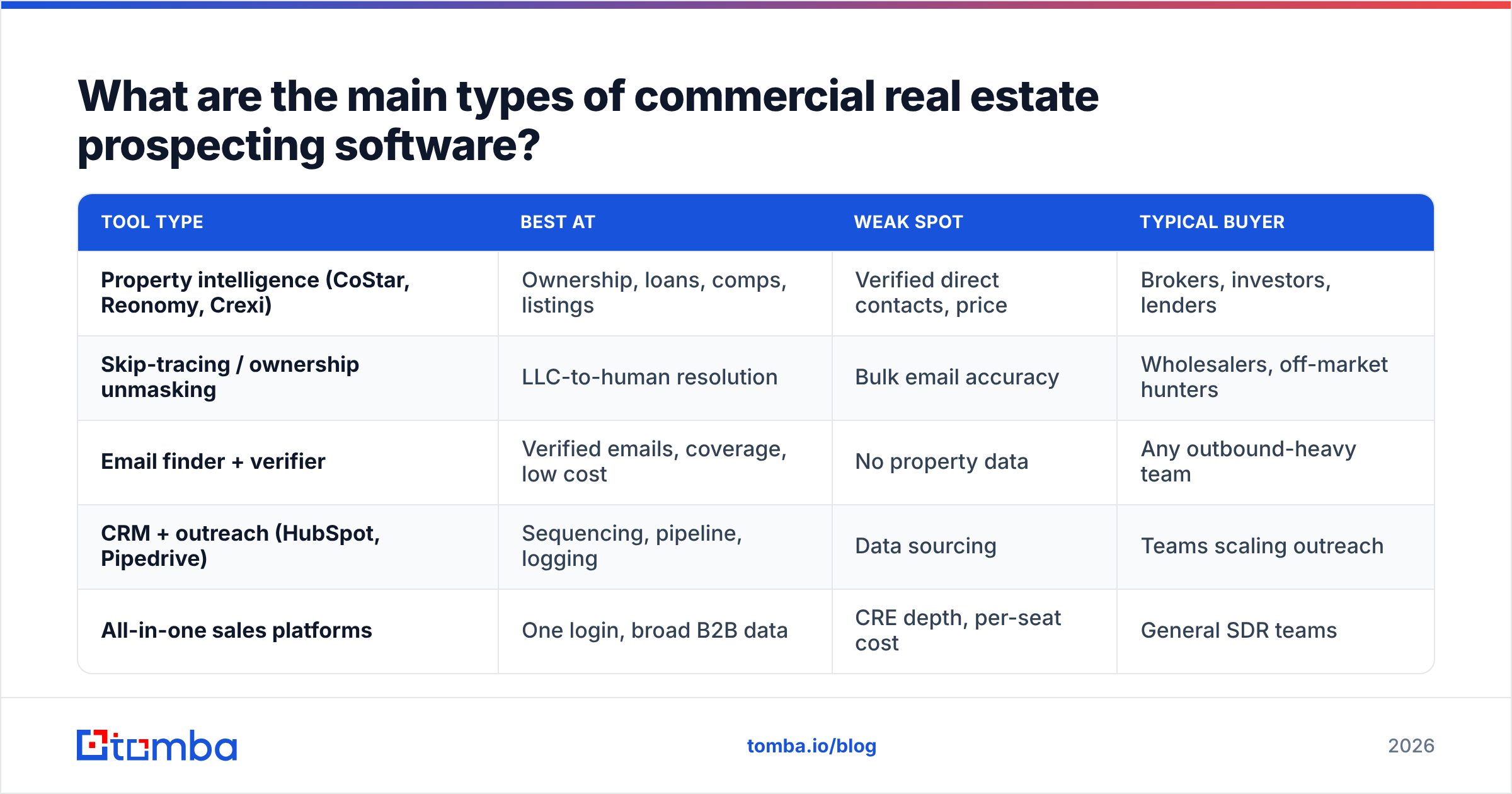
Use this as a map before you spend a dollar. The right stack usually combines two or three categories, not one platform that claims to do everything.
| Tool type | Best at | Weak spot | Typical buyer |
|---|---|---|---|
| Property intelligence (CoStar, Reonomy, Crexi) | Ownership, loans, comps, listings | Verified direct contacts, price | Brokers, investors, lenders |
| Skip-tracing / ownership unmasking | LLC-to-human resolution | Bulk email accuracy | Wholesalers, off-market hunters |
| Email finder + verifier | Verified emails, coverage, low cost | No property data | Any outbound-heavy team |
| CRM + outreach (HubSpot, Pipedrive) | Sequencing, pipeline, logging | Data sourcing | Teams scaling outreach |
| All-in-one sales platforms | One login, broad B2B data | CRE depth, per-seat cost | General SDR teams |
Notice that no single row wins on every axis. A property intelligence suite gives you the who owns what; an email finder gives you the how to reach them; a CRM keeps the deal alive. Buying only the first and expecting the other two is how brokers end up with a $12,000 subscription and a spreadsheet of info@ addresses.
How do the leading platforms compare on price and contact data?#
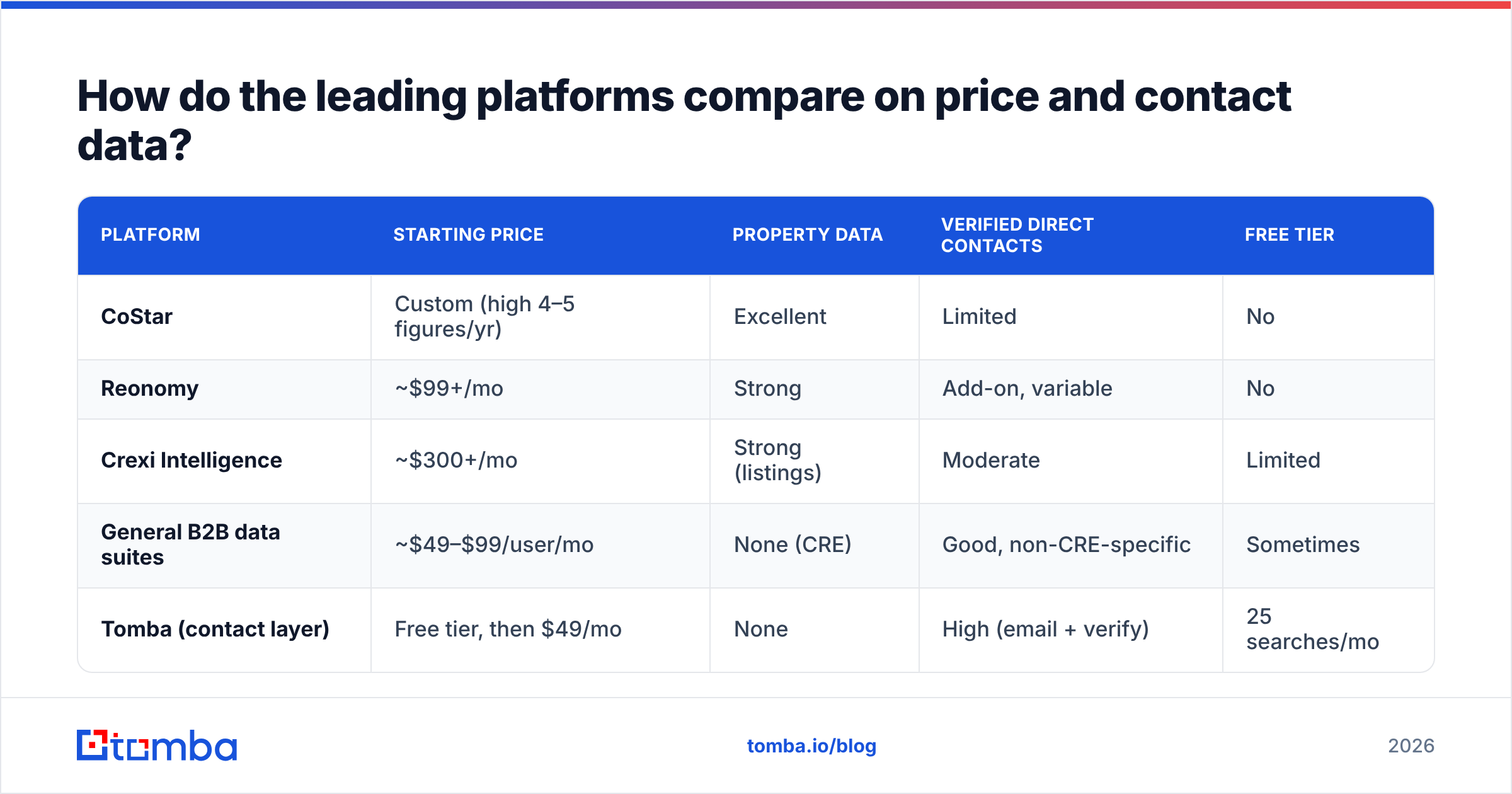
Prices below are indicative starting points published by the vendors and widely reported on review sites like G2 and Capterra; CRE suites in particular negotiate heavily and often quote custom annual contracts. Treat this as a shape, not a quote sheet.
| Platform | Starting price | Property data | Verified direct contacts | Free tier |
|---|---|---|---|---|
| CoStar | Custom (high 4–5 figures/yr) | Excellent | Limited | No |
| Reonomy | ~$99+/mo | Strong | Add-on, variable | No |
| Crexi Intelligence | ~$300+/mo | Strong (listings) | Moderate | Limited |
| General B2B data suites | ~$49–$99/user/mo | None (CRE) | Good, non-CRE-specific | Sometimes |
| Tomba (contact layer) | Free tier, then $49/mo | None | High (email + verify) | 25 searches/mo |
The pattern is consistent: the deeper a tool goes on property and ownership, the more it charges and the less it guarantees on verified personal contact data. That gap is exactly where a focused contact layer earns its keep. Pairing a property source you already trust with Tomba's domain search and verification — starting on a free tier and scaling through transparent Tomba pricing — often costs a fraction of upgrading your CRE suite's contact add-on, and the emails actually land.

Is an all-in-one platform better than a lean stack?#
A lean stack usually wins for teams under 20 people; an all-in-one starts to justify itself only at enterprise scale with dedicated ops. The reason is control. When your data, verification, and outreach are separate best-in-class tools, you can swap any one of them the moment it underperforms. When they are bundled, a weak contact database is welded to an otherwise fine CRM, and you cannot fix it without ripping out the whole thing.
Consider the two approaches side by side:
- All-in-one suite — One login, one invoice, one support line. But you inherit that vendor's data quality on every axis, pay per seat whether or not each rep uses every module, and get locked into an annual contract that is hard to unwind mid-year.
- Lean stack — Property source + email finder + verifier + CRM. More moving parts to connect, but each piece is chosen on merit, most bill monthly, and you can A/B test data providers head-to-head with a free tier before committing budget.
The connective tissue that makes a lean stack painless is integration. If your email finder pushes verified contacts straight into HubSpot or Pipedrive, the "more tools" objection mostly evaporates. Tomba's HubSpot integration and broader integrations library exist precisely so the contact layer disappears into the CRM you already run.
What features actually move the needle for CRE prospecting?#
Ignore the AI marketing copy for a minute. In day-to-day brokerage prospecting, these are the features that correlate with booked meetings:
- Verified email at the point of discovery. Finding an address is worthless if you cannot trust it. A tool that verifies inline — checking MX records, catch-all status, and deliverability — saves you a separate cleanup step. Catch-all domains are common in property management firms, so a real catch-all verifier matters more in CRE than in most industries.
- Bulk processing. Farming a submarket means working hundreds of owners at once. A bulk email finder that accepts a list of domains or names and returns verified contacts is the difference between an afternoon and a week.
- Direct-dial phone data. Commercial deals still close on the phone. A phone finder that surfaces mobile numbers, not just switchboards, keeps your call blocks productive.
- CRM sync. If a rep has to copy-paste, they won't. Native sync to your pipeline tool is non-negotiable at scale.
- Transparent credit costs. You should be able to calculate cost-per-verified-contact before you buy, not discover it in month three.
Everything else — sentiment scoring, "intent signals," AI-written first lines — is a nice-to-have that only pays off after the first five are solid. Fix the data foundation first.
How much should commercial real estate prospecting software cost?#
Budget by outcome, not by sticker price. The number that matters is cost per usable (verified, reachable) contact, and it hides in the fine print of every plan.
Here is a simple way to compare any two tools honestly:
- Take the plan's monthly price and its included credits or searches.
- Estimate the tool's real accuracy from a 50-contact test (not the vendor's claim).
- Divide price by (credits × accuracy) to get cost per usable contact.
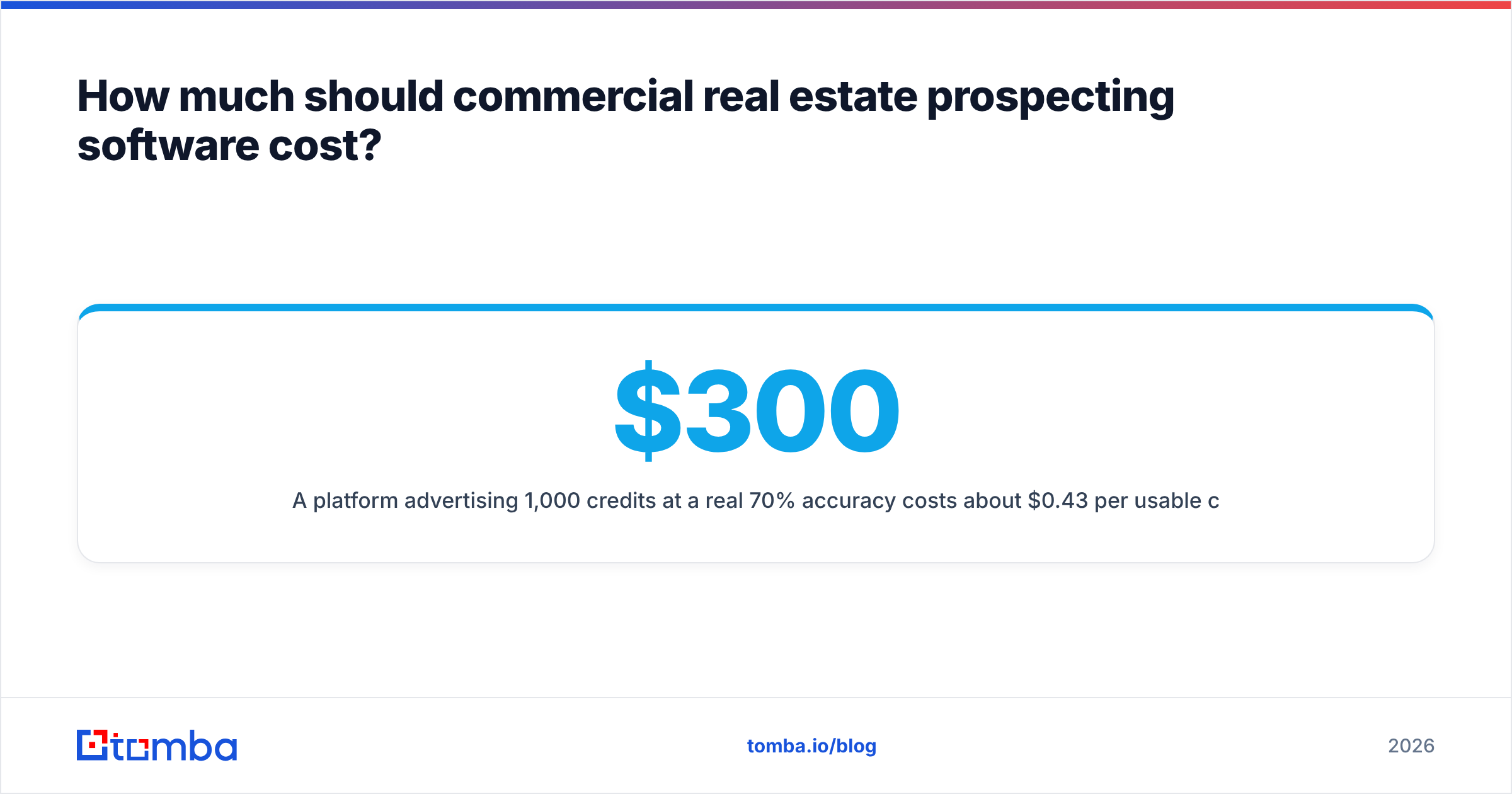
A $300/month platform advertising 1,000 credits at a real 70% accuracy costs about $0.43 per usable contact. A $49/month plan with a higher verified-accuracy rate and a free tier to test on can undercut it dramatically — and you can prove it before paying, using the 25 free monthly searches to run your own bake-off. That is the entire argument for testing on your own farm area instead of trusting a case study.
For teams pulling data programmatically, an email finder API changes the math again: you enrich owners on demand inside your own workflow instead of paying per seat for a UI most of your team never opens.
How do you build a CRE prospecting workflow that actually books meetings?#
Assemble it in layers, and test each layer before adding the next:
- Source properties and owners. Use your CRE intelligence platform (or public records) to build a target list of buildings and the LLCs behind them.
- Resolve owners to humans. Skip trace the entity to a principal — a person with a name and a company domain.
- Find and verify contacts. Run those names and domains through an email finder and validate every result. Discard anything that fails verification instead of "spraying and praying."
- Enrich for context. Add title, company size, and phone via data enrichment so your outreach is specific, not generic.
- Sequence and sync. Push verified contacts into your CRM and run a short, personalized sequence — property-specific first line, clear reason for the call, one ask.
- Measure and prune. Track reply rate by data source. Cut the sources that bounce; double down on the ones that book.
The teams that win at CRE outbound are not the ones with the most expensive software. They are the ones who treat contact data as perishable, verify relentlessly, and keep their sender reputation clean enough that their emails actually arrive.
The bottom line#
The best commercial real estate prospecting software for you is whatever combination hits your market with the highest verified contact accuracy at the lowest true cost — and that is almost never a single all-in-one suite. Pair the property intelligence source you trust with a dedicated contact layer, verify everything, and measure cost per usable contact rather than per seat.
If your bottleneck is reaching the owners you have already identified, start where the leverage is highest. Use the Tomba Email Finder to turn names and domains into verified, deliverable contacts — test it free on 25 searches this week against your current list, and let the bounce rate decide. Clean data has always been the real product. Everything else is a dashboard.
Related guides#
Ready to find emails that actually work?
Join 150,000+ professionals who stopped guessing and started sending. Free credits on signup — no credit card required.
Get the Tomba newsletter
Practical outbound tactics and product updates — once every two weeks.
About the author